




Abstract
Purpose:
The purpose of this study was to analyze the effects of different intervals between stitch throws on tendon graft fixation with the Krackow stitch.
Methods:
Forty-four porcine flexor profundus tendons were randomly divided into four groups of 11 specimens each. The Krackow stitch with various stitch intervals (2.5, 5.0, 7.5, and 10.0 mm) were evaluated, and named the K-2.5, K-5.0, K-7.5, and K-10.0 groups, respectively. A braided nonabsorbable suture was used to complete each suture-tendon construct. All specimens were pretensioned to 100 N for three cycles, cyclically loaded from 50 to 200 N for 200 cycles, and then finally loaded to failure. Elongation after cyclic loading, ultimate load to failure, and the mode of failure were recorded.
Results:
There were significant differences in elongation after cyclic loading among the K-2.5 (31% ± 5%), K-5.0 (32% ± 4%), K-7.5 (34% ± 5%), and K-10.0 (41% ± 8%) groups (p = 0.004); the post hoc analysis showed significantly smaller values in the K-2.5 and K-5.0 groups than in the K-10.0 group (p = 0.002 and 0.003, respectively). The stitch interval was correlated with elongation after cyclic loading (r = 0.52, p < 0.001). Ultimate loads to failure and cross-sectional area were not significantly different across the four groups.
Conclusion:
The Krackow stitch with stitch intervals of 2.5 and 5.0 mm had significantly smaller elongation after cyclic loading than with an interval of 10.0 mm in this porcine biomechanical study. The stitch interval was moderately correlated with elongation after cyclic loading.
Introduction
A reliable soft-tissue fixation suture technique is essential in ligament reconstruction surgeries. A suture-tendon construct that can endure the necessary mechanical loading allows for early rehabilitation before the completion of biologic healing in the graft tunnel. 1 –5 Although numerous suture techniques have been proposed for tendon grafts fixation, 2,4 –13 the Krackow suture, proposed in 1986, remains particularly common. 8
A number of studies have suggested that the Krackow suture could provide superior tendon graft fixation strength compared with other suture techniques. 2,14,15 Deramo et al. 2 compared the soft-tissue fixation strength of the Krackow stitch and SpeedWhip stitch (a nonlocking premanufactured stitch), the results of which indicated that the Krackow stitch was significantly more secure since it had less elongation after cyclic loading and similar load to failure. Sakaguchi et al. 15 biomechanically tested the tendon graft fixation strength among the Krackow stitch, baseball stitch, and whipstitch, and showed that the Krackow stitch was again superior. Hahn et al. 14 compared the biomechanical properties in tendon graft fixation between the Krackow stitch and whipstitch. Their results advocated the Krackow stitch for tendon graft fixation since it had less gap formation and better preservation of the tendon architecture.
Although the Krackow stitch usually consists of three or more locking loops placed along each side of the tendon, several studies have discussed the effects of suture throws on the soft-tissue graft fixation. 4,14 –16 McKeon et al. 4 biomechanically evaluated several configurations of the Krackow stitch, and found that different numbers of suture loops (two, four, or six pairs of loops) did not affect elongation after cyclic loading or peak load to failure. Sakaguchi et al. 15 evaluated the effects of suture throws on the Krackow stitch; results suggested that there was no difference in cyclic elongation and maximum failure load between a Krackow stitch with 6 throws and one with 10 throws. Hong et al. 16 assessed the effects of the number of suture throws used in the Krackow stitch on the biomechanical properties of the suture-tendon constructs. Their results revealed that there was no difference in elongation after cyclic loading and ultimate load to failure among the constructs with 3, 5, and 7 pairs of throws; however, the elongation after pretensioned in Krackow 7-throw group was significantly higher than that of the 3-throw and 5-throw groups. 16 Similarly, Hahn et al. 14 compared the biomechanical properties in tendon graft fixation with the Krackow stitch in different numbers of suture throws (2, 4, 6, 8, and 10 throws), the results of which indicated that higher gap formation was observed in Krackow-suture constructs with more than 6 throws.
Despite the effects of suture-throw number in the Krackow stitch on tendon graft fixation having been widely discussed, the effects of the interval size between suture throws have seldom been mentioned. Jassem et al. 17 biomechanically evaluated the effects of different suture pitches in tendon graft fixation, namely, 1-cm suture pitch and 0.5-cm suture pitch. The 1-cm suture pitch group was composed of three pairs of throws with 1-cm intervals between suture throws, while the 0.5-cm suture pitch group comprised five pairs of throws with 0.5-cm intervals between throws. 17 Their results revealed that both the 1-cm and 0.5-cm suture pitch groups had similar suture slippage at failure and maximum force to failure. 17 Although the working length was standardized in this study, both the suture throws and the intervals between throws were different between the two groups 17 ; in other words, the effects of different interval lengths were not evaluated independently.
In response, the purpose of this study was to analyze the effects of different intervals between stitch throws on tendon graft fixation with the Krackow stitch. We hypothesized that longer stitch interval in the Krackow stitch would lead to longer elongation after cyclic loading.
Materials and methods
The current study was granted an exemption from the institutional review board at the National Cheng Kung University Hospital, Tainan, Taiwan. Porcine flexor profundus tendons acquired from fresh adult male porcine (mean age, 2 years) hindleg trotters were used. A total of 44 tendons of equal length (18 cm) were excised. The trotters, stored at −20°C, were thawed to room temperature, after which the entire flexor profundus tendon was dissected. Upon inspection, it was agreed that none showed any degenerative or pathologic changes. The attached soft tissue was removed and a transverse section 5–6 mm in thickness was acquired from the distal end of each tendon. With the use of a calibration scale, an 8.9-megapixel digital camera (EOS 60D; Canon, Tokyo, Japan) and image analysis software (SigmaScan Pro 5.0; Systat Software Inc, San Jose, CA, USA), the cross-sectional area of each tendon section was calculated.
Krackow stitch configurations in three pairs of suture throws with different stitch intervals (2.5, 5.0, 7.5, and 10.0 mm) were evaluated, namely, K-2.5, K-50, K-7.5, and K-10.0 groups (Figure 1). The Krackow stitch began at 1 cm from the distal end of the tendon. The porcine tendons were randomly divided into four groups of 11 specimens each, with each group randomly assigned to receive one of the four kinds of Krackow stitch configuration. 0.9% saline solution was sprayed on the tendons to keep them moist during preparation and testing. A No. 2 ULTRABRAID® suture (Smith & Nephew, MA, USA) was used for all samples.

Illustrations of the Krackow stitches with stitch intervals of 2.5, 5.0, 7.5, and 10.0 mm, from left to right.
Biomechanical testing
Each suture-tendon construct was mounted on a universal material-testing system (AG-X; Shimadzu, Tokyo, Japan). A sinusoid clamp was used to fix the proximal end of the tendons, allowing an equal length (approximately 9 cm) of free tendon (Figure 2). The ends of the sutures were knotted together and looped over a post on the adapter of the material-testing machine.

The biomechanical testing setup. The specimen was fixed in a sinusoid clamp; the ends of the sutures were knotted tightly and looped over a post on the load cell in the materials-testing machine.
After each tendon was pretensioned to 100 N at a rate of 100 mm min−1 for three cycles, preloading to 50 N for 1 min was applied. Next, each suture-tendon construct was cyclically loaded between 50 and 200 N at a rate of 200 mm min−1 for 200 cycles. The aforementioned parameters were set based on previous studies. 2, 5,11,14,16,18 –21 A violet line and two violet marks, respectively, made on the tendon at a point 5 cm from the distal end of the tendon and on both suture limbs where they extend from the tendon, served as indicators for measuring the elongation of each suture-tendon construct. Elongation after cyclic loading for each sample was acquired by calculating the difference in distance between the violet line on the tendon and the violet marks on each suture after pretensioning and cyclic loading. A video digitizing system (HDR-XR 269 digital video camera; Sony, Tokyo, Japan) employed for image recording was coupled with image analysis software (SigmaScan Pro 5.0) for measuring the distance between the markers. After cyclic loading, each suture-tendon construct was loaded to failure at a rate of 20 mm min−1, the ultimate failure load of which was determined when the maximum tensile force suddenly dropped or discontinued in the load-displacement curve. During biomechanical testing, the displacements and loadings were recorded at a sampling rate of 1 kHz, with failure mode noted at the end of testing.
Statistical analysis
The sample size was calculated based on elongations after cyclic loading in a pilot study, in which there were a total of 12 specimens randomly assigned to four groups (K-2.5, K-5.0, K-7.5, and K-10.0 groups). An α equal to 0.05 and a power (1 − β) of 0.80 were given for this a priori power analysis model, the calculated effect size of which was 0.54. A total sample size of 44 specimens was then determined with the use of G*Power, version 3.1.3 (available at http://www.gpower.hhu.de; Heinrich Heine-University of Dusseldorf, Dusseldorf, Germany).
Statistical comparisons were conducted with SPSS for Windows, version 16.0 (SPSS Inc, Chicago, IL, USA). Descriptive statistics, including means and standard deviations, were obtained for the four groups. The Kruskal–Wallis test was used to compare the cross-sectional areas, elongations after cyclic loading, and failure loads among the four groups; in addition, post hoc analysis with the Mann–Whitney U test was conducted with a Bonferroni correction, resulting in the significance level being set at p < 0.0125. The Spearman correlation coefficient was utilized to evaluate the correlation between the stitch interval and elongation after cyclic loading since one variable was continuous and the other was ordinal. Statistical significance was set as p ≦ 0.05.
Results
The cross-sectional areas were not significantly different among the K-2.5 (42 ± 5 mm2), K-5.0 (42 ± 5 mm2), K-7.5 (42 ± 4 mm2), and K-10.0 (43 ± 4 mm2) groups (p = 0.919). However, there were significant differences in elongation after cyclic loading among the K-2.5 (31% ± 5%), K-5.0 (32% ± 4%), K-7.5 (34% ± 5%), and K-10.0 (41% ± 8%) groups (p = 0.004). The post hoc analysis showed that elongation after cyclic loading in the K-2.5 and K-5.0 groups was significantly less than the K-10.0 group (p = 0.002 and 0.003, respectively); otherwise, there were no differences between the K-2.5 and K-5.0 groups (p = 0.652), the K-2.5 and K-7.5 groups (p = 0.133), the K-5.0 and K-7.5 groups (p = 0.217), or the K-7.5 and K-10.0 groups (p = 0.028; Figure 3). Accordingly, stitch interval was positively correlated with elongation after cyclic loading with statistical significance (r = 0.52, p < 0.001). In addition, the ultimate loads to failure were not significantly different among the K-2.5 (354 ± 22 N), K-5.0 (353 ± 37 N), K-7.5 (371 ± 18 N), and K-10.0 (367 ± 28 N) groups. All specimens in each group failed at the knot of the suture. (Table 1).

Elongation after cyclic loading for the Krackow stitches with stitch intervals of 2.5, 5.0, 7.5, and 10.0 mm.
Biomechanical properties of the Krackow stitch with different suture intervals.
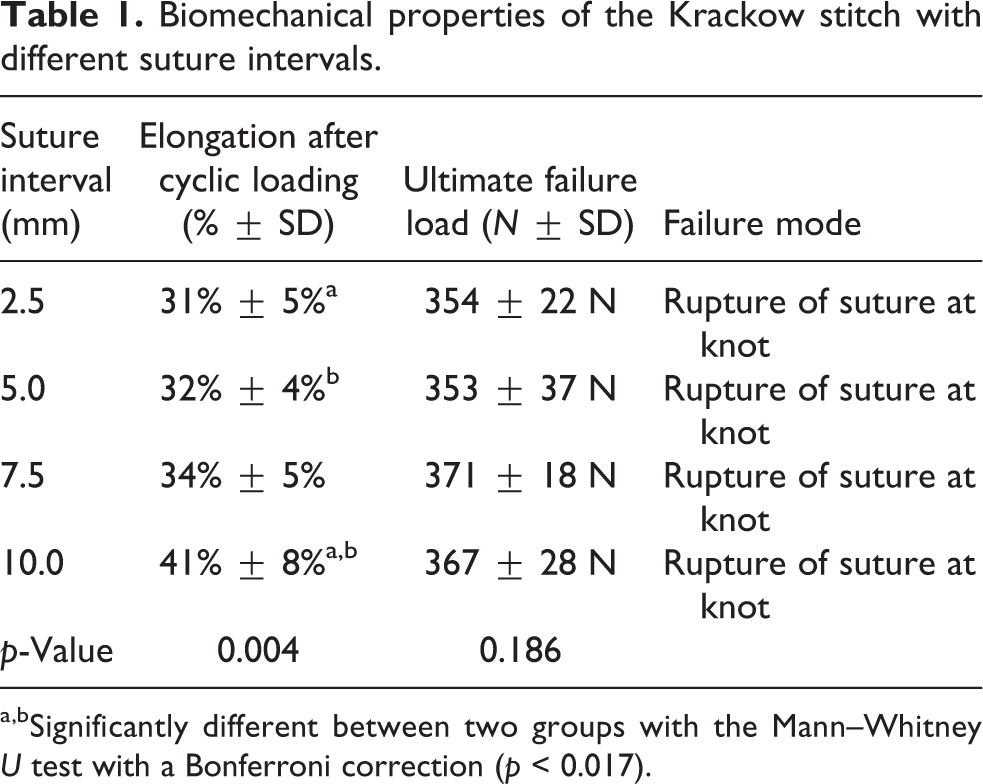
a,bSignificantly different between two groups with the Mann–Whitney U test with a Bonferroni correction (p < 0.017).
Discussions
The Krackow stitch, commonly used for tendon graft fixation in ligament reconstruction surgeries, has long been advocated because of its superior biomechanical properties compared with other fixation techniques, such as the baseball stitch, whipstitch, and SpeedWhip stitch. 2,14,15 Although several studies have evaluated the effects of different suture throws on the tendon graft fixation strength of the Krackow stitch, 4,14 –16 the impact of stitch interval has rarely been discussed. 17 In response, we evaluated the biomechanical properties of the Krackow suture with different lengths of stitch interval in a porcine in vitro biomechanical study. Our results revealed that the Krackow stitch with smaller stitch intervals (2.5 and 5.0 mm) had less elongation after cyclic loading than the Krackow stitch with a 10.0-mm stitch interval. In addition, we also found a positive correlation between the stitch interval distance and elongation after cyclic loading.
Minimizing elongation of the suture-tendon construct is important because elongation of the graft may lead to graft loosening, resulting in clinical failure. 2 The cyclic loading test in this biomechanical evaluation simulated postoperative rehabilitation; as such, smaller elongation after cyclic loading represented better fixation. In the present study, our results indicated that the Krackow stitch with an interval of 2.5 mm had the smallest elongation after cyclic loading, which was significantly less than that with a 10.0-mm interval. The Spearman correlation test also suggested that the stitch interval and elongation after cyclic loading were moderately correlated. Moreover, we believe that the smaller amount of in-tendon suture material of the K-2.5 group contributed to less suture slippage, resulting in smaller suture-tendon elongation.
It should be noted that not only the intervals between stitch throws but also the working length of Krackow configurations in four groups were different in the present study. Our results revealed that the elongation after cyclic loading in the group with greater working length (K-10.0 group) was significantly larger than the groups with smaller working lengths (K-2.5 and K-5.0 groups). Actually, the previous study 17 has compared the effects of varying Krackow suture pitch (1-cm construct versus 0.5-cm construct) within a standardized working length (2 cm), and showed no difference between two groups either in the ultimate yield strength or elongation of graft. 17 As a result, it is possible that the difference in working length may play a role in elongation after cyclic loading in the present study.
Previous studies have tried to determine the optimal suture pattern for the Krackow stitch, several of which have indicated that adding more suture throws in the Krackow stitch could potentially hold adverse effects on the tendon graft fixation. 4,14,16 Hong et al. 16 suggested that performing three pairs of throws in the Krackow stitch is sufficient since the elongation after cyclic loading and maximum load to failure were not different from other groups; further, elongation after pretensioning increased in the Krackow stitch with seven pairs of suture throws. 16 Similarly, Hahn et al. 14 reported that adding more throws in the Krackow stitch was not necessary since they found that the gaps formed after cyclic loading increased with the loop number. In the present study, we evaluated the Krackow stitch with three pairs of suture throws only. Combined with the findings of previous studies, we suggest choosing 2.5 mm as the interval between throws when performing the Krackow suture in three pairs of throws. The clinical implication is that surgeons should perform the Krackow suture with a small stitch interval and fewer suture throws.
Although data from different studies could not be compared directly, the experimental results in our study are consistent with those in of previous studies. 2,14,16 In the present study, we found 32% ± 4% elongation after cyclic loading and 353 ± 37 N failure load in the Krackow stitch with a 5-mm interval. Hong et al. 16 reported that the Krackow stitch with three suture throws had an elongation of 26.5% ± 3.9% and failure load of 318 ± 33 N. The failure loads of 376 ± 40 N and 323 ± 12 N in the respective studies by Deramo et al. 2 and Hahn et al. 14 were also similar to the findings in our study.
Limitations
This study had several limitations. First, porcine flexor profundus tendons were evaluated in this study, not human tendons. Although some structural differences between porcine and human tendons exist, a previous study 22 found porcine flexor tendons to be reasonable surrogates for human semitendinosus tendons. Second, only a cyclic loading test in a single axial direction was applied in evaluating the tensile properties; therefore, all physiologic loading conditions were not captured. Third, it is possible that the individual surgeon’s technique might affect elongation of the suture-tendon construct. Finally, the biomechanical testing in the present study was performed on relatively healthy tendons; however, the clinical application from this study could be limited if the tendon grafts used in the reconstruction surgeries have pathological changes.
Conclusions
The Krackow stitch with stitch intervals of 2.5 and 5.0 mm had significantly smaller elongation after cyclic loading than with an interval of 10.0 mm in this porcine biomechanical study. The stitch interval was moderately correlated with elongation after cyclic loading.
Footnotes
Acknowledgements
The authors would like to thank Shing-Yun Chang (Department of Orthopaedic Surgery, National Cheng Kung University Hospital, College of Medicine, National Cheng Kung University, Tainan, Taiwan), and Medical Device R&D Core Laboratory, National Cheng Kung University Hospital, Tainan, Taiwan for assistance with this project.
Declaration of conflicting interests
The author(s) declared no potential conflicts of interest with respect to the research, authorship, and/or publication of this article.
Funding
The author(s) received no financial support for the research, authorship, and/or publication of this article.