




Abstract
Purpose:
Primary bone tumors of the fibula are rare. There are only a few studies reporting the incidence, histologic, and anatomic distribution of primary fibula tumors. This study aimed to comprehensively report the incidence, presenting symptoms, and histologic tumor types with the anatomic and histologic distribution of primary bone tumors of the fibula.
Methods:
Between January 1983 and December 2017, 6457 primary bone tumors and tumor-like lesions were diagnosed and treated in our musculoskeletal oncology surgery clinic. Of these, 264 (4.08%) were primary bone tumors and tumor-like lesions of the fibula. We retrospectively reviewed patients’ records, histopathology records, and radiologic images regarding age, gender, anatomic localization, histopathologic diagnosis, and treatment methods.
Results:
There were 209 (79.2%) benign and 55 (20.8%) malignant lesions. The most common benign and malignant tumors were osteochondroma (51 of 209; 24.4%) and chondrosarcoma (16 of 55; 29.1%). The proximal fibula was the most common location for both benign and malignant tumors (141 of 209; 67.5% and 45 of 55; 81.8%, respectively), followed by the distal fibula (52 of 209; 24.9% and 8 of 55; 14.5%, respectively) and the diaphysis (17 of 209; 8.14% and 2 of 55; 3.64%, respectively).
Conclusion:
The incidence of primary bone tumors is higher than that reported in previous studies. Benign lesions constitute the majority of cases. One-fifth of all cases are malignant. The most common anatomic site involving the primary fibula tumors is the proximal fibula.
Level of evidence:
III.
Introduction
It was estimated that 3260 people will be diagnosed and 1550 people will die of primary malignant bone and joint tumors in the United States in 2017. 1 Primary malignant bone tumors account for 0.2% of all malignancies. 1 Primary benign bone tumors occur more often than primary malignant bone tumors. 2 –4 The incidence of primary benign tumors is underestimated due to their usual asymptomatic nature.
Primary bone tumors of the fibula are rare. Only 2.5% of primary bone tumors are located in the fibula. 5 Although one-half to three-fourth of the fibula tumors are benign, significant morbidity and mortality are caused by malignant tumors. 5,6 Osteochondroma, osteosarcoma, Ewing’s sarcoma, and giant cell tumor were reported as the most common tumors at this location. 7 The proximal one-third is more frequently involved than the mid and distal one-third. 5,8
Previously, few epidemiologic studies on primary bone tumors of the fibula were reported, including information on age, sex, anatomical site distribution, and histologic type. 3 –6,9
This study aimed to report the incidence, anatomic distribution, and histopathologic type of primary bone tumors, and tumor-like lesions of the fibula which were evaluated and diagnosed in a musculoskeletal oncology surgery clinic.
Material and methods
After Institutional review board approval, our hospital pathology, patients, and radiology records were examined. A total of 9498 musculoskeletal tumor cases diagnosed and treated in our hospital between January 1983 and December 2017 were included. After excluding 3041 soft tissue tumors and metastases, 6457 primary bone tumors and tumor-like lesions were included. Of these, 283 were primary bone tumors and tumor-like lesions of the fibula. After exclusion of cases lacking in histopathologic reports or radiologic images, a total of 264 primary bone tumor and tumor-like lesions of the fibula were included in this study.
Patients’ age, gender, tumor localization, histopathologic diagnosis, staging according to Enneking classification, 10 and treatment methods were recorded. The primary complaints of patients were noted. A comprehensive assessment was performed including the radiograph, magnetic resonance, computed tomography, and scintigraphy images.
Tumor localization was classified as proximal third, diaphysis (middle third), and distal third of the fibula. The World Health Organization classification of bone tumors 11 was used in the classification of primary bone tumors and tumor-like lesions of the fibula. All analyses were descriptive. Patient characteristics were summarized as means, standard deviations, lowest values, highest values, medians, or proportions.
Results
According to our data, of the 9498 cases of musculoskeletal tumor diagnosed, 6457 met the inclusion/exclusion criteria. The mean age of the patients was 25.54 ± 16.72 (median age 18, range 3–78) years. The mean age of the males was 23.64 ± 16.04 (median age 17, range 3–75) years, and the mean age of the females was 27.08 ± 17.09 (median age 16, range 3–78) years. Of the 264 patients with primary bone tumors of the fibula, 118 were males (44.7%) and 146 were females (55.3%). Overall, primary bone tumors and tumor-like lesions of the fibula constituted 4.08% (264/6457) of all primary bone tumors. Of these, 209 (79.2%) were benign lesions (99 (37.5%) tumor-like lesions and 110 (41.7%) benign tumors) while 55 (20.8%) were malignant (Table 1). Although, females constituted 124 of 209 patients (59.13%) with benign lesions, in contrast, males constituted 33 of 55 (60%) patients with malignant lesions. There were 114 (43.2%) and 150 (56.8%) patients with right and left side involvements, respectively.
Distribution of benign and malignant lesions according to histologic tumor types.

The vast majority (148 of 264; 56.7%) of the primary bone tumors and tumor-like lesions of the fibula were observed in patients under the age of 21 years. In this age group, 120 of 209 benign lesions (57.4%) and 28 of 55 malignant lesions (50.9%) were observed. Furthermore, 47 of 55 (85.5%) malignant tumors were observed in patients aged between 12 years and 51 years. Malignant lesions were relatively less frequent in the 0–12 (5.4%) and the 51–78 (9.1%) years age groups (Table 2).
Distribution of benign and malign lesions according to age groups.

Benign lesions were predominant in our series, with 209 patients. The mean age was 24.89 ± 16.58 (median 17, range 3–77) years, and the majority 124 (59.4%) were females. The primary benign bone tumors of the fibula occur in 141 patients (67.5%) at the proximal fibula, its most commonly involved site. The distal fibula was involved in 52 patients (24.9%) and diaphysis involvement was observed in 17 patients (8.2%).
The most frequently diagnosed primary benign bone tumor of the fibula was osteochondroma, found in 51 patients (24.4%), followed by enchondroma in 37 patients (17.7%), and aneurysmal bone cyst in 36 patients (17.3%). Malignant lesions, 55 of 264 (20.8%), were found less than benign lesions. Of the 55 patients with malignant lesions, 32 (58.2%) were males and the mean age of the patients was 28.07 ± 17.02 (median 19, range 3–78) years. The proximal fibula was also the most commonly involved site for malignant tumors involving 45 patients (81.8%), followed by the distal fibula with 8 patients (14.5%). Diaphysis involvement was observed in two patients (3.7%). The most common primary malignant bone tumor of the fibula was chondrosarcoma, with 16 patients (29.1%), followed by 15 (27.3%) with Ewing sarcoma, and 15 (27.3%) with osteosarcoma.
According to the Enneking classification system, the lesions were most commonly diagnosed at stage 1, which consisted of 60.9% of all benign lesions. Enneking stage IIA lesions were predominant (19 of 55 cases; 34.5%) among the primary malignant bone tumors of the fibula (Table 3). Regardless of the Enneking stage, the most commonly applied surgical method was resection (77 cases; 29.2%) followed by curettage and bone grafting (50 cases; 18.9%). Amputation, wide resection, and radical resection were the favored surgical methods for lesions greater than Enneking stage IB (Table 4).
Distribution of all tumors according to Enneking classification system.

Treatment methods according to Enneking classification of all benign and malignant tumors.
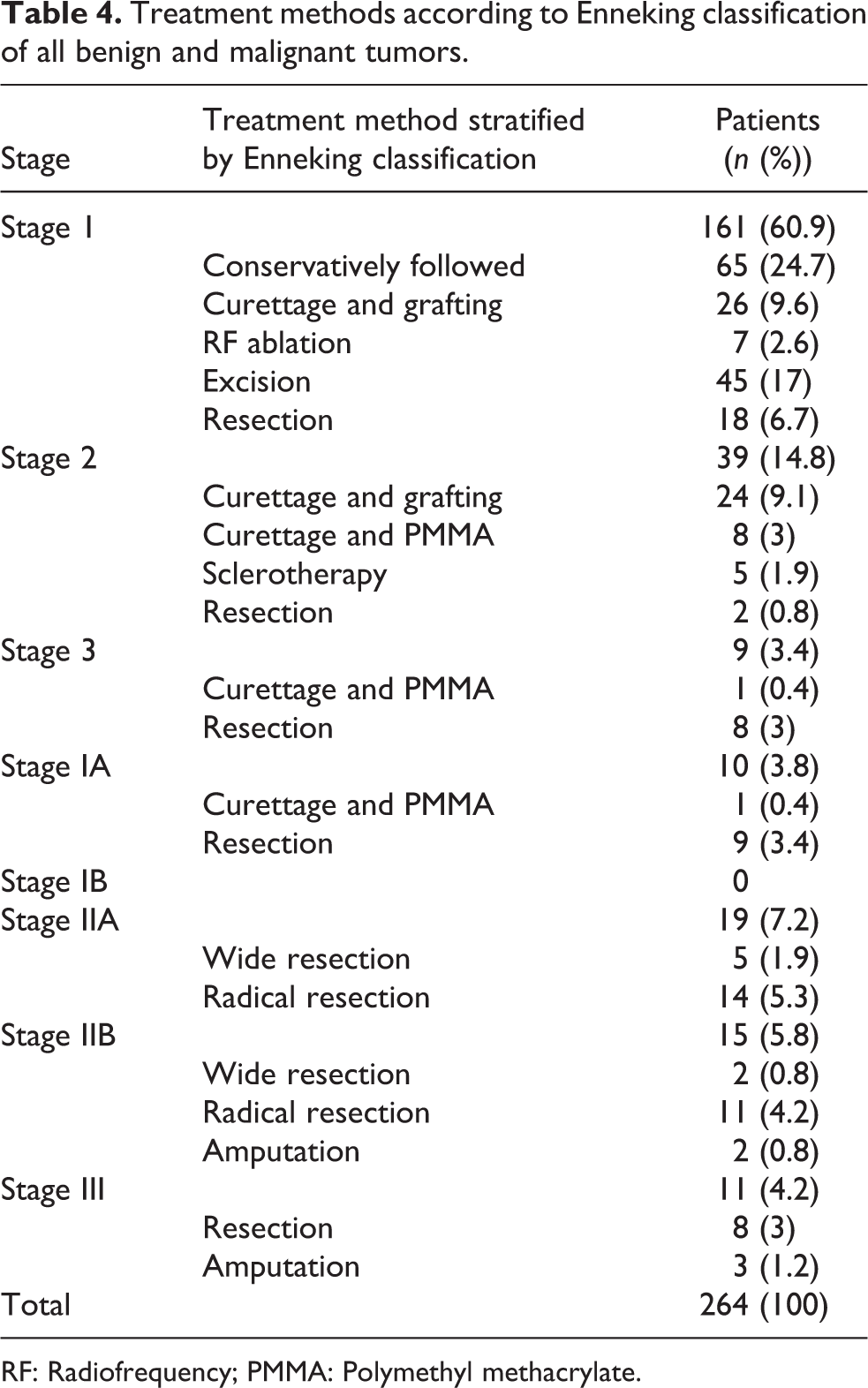
RF: Radiofrequency; PMMA: Polymethyl methacrylate.
Discussion
The most important finding of our study was that primary fibula tumors constituted 4.08% (264/6457) of all primary bone tumors. This is higher than the previous reports of the prevalence being between 2.5% and 3.6%. 4 –6,12 Moreover, malignant fibula tumors were found in 20.8% of all primary fibula tumors. The most common benign primary bone tumors of the fibula were osteochondroma, enchondroma, and aneurysmal bone cyst. The most common malignant primary bone tumors of the fibula were chondrosarcoma, Ewing sarcoma, and osteosarcoma. There are some differences between our results and those of previous reports. 4 –6,9
Primary bone tumors and tumor-like lesions of the fibula are rare; and benign lesions are more common than malignant lesions. 2 –4 The incidence of primary benign bone tumors is underestimated because commonly they are asymptomatic. 12 The relatively higher incidence of primary bone tumors of the fibula in our study as compared to previous reports may be associated with the underestimation. Various studies have been reported on the incidence of primary bone tumors of the fibula. 4 –6,9 Nevertheless, to the best of authors’ knowledge, limited data have been reported about primary bone tumors of the fibula.
Most of the previous epidemiologic data focused on the number and distribution of the histologic tumor types. 4,5,9 However, our study reported on the incidence, histological, and anatomical distribution of primary bone tumors.
Previously, male predominance was reported in primary fibula tumors. 4 In our study, female predominance was detected overall and in benign primary fibula tumors. However, male predominance was detected in malignant primary fibula tumors.
The clinical presentation of primary fibula tumors may vary. 5 Patients may complain of pain, swelling, pathological fractures, deformity, or peroneal nerve symptoms. In our study, the most common symptoms were pain and swelling. In five patients referred to our clinic with pathological fracture, the pathological diagnoses were aneurysmal bone cyst, chondrosarcoma, and simple bone cyst in two, one, and two patients, respectively.
The proximal fibula was more commonly involved than the distal fibula and diaphysis. 4 Similarly, in our study, we found that the primary bone tumors of the fibula most commonly involved the proximal fibula. Furthermore, 67.5% of the benign lesions and 81.8% of the malignant lesions involved the proximal fibula. The most common primary benign tumors of the proximal fibula were enchondroma, osteochondroma, and aneurysmal bone cyst in that order. With malignant tumors, the most common were Ewing sarcoma, chondrosarcoma, and osteosarcoma.
In the distal fibula, 24.9% of the benign lesions and 14.5% of the malignant lesions were involved. Unlike the proximal fibula distribution, the most common primary benign tumors of the distal fibula were osteochondroma, aneurysmal bone cyst, and non-ossifying fibroma, in that order. In the distal fibula, the most common malignant tumors were osteosarcoma, chondrosarcoma, and fibrosarcoma.
The least common location was the diaphysis, and 8.14% of the benign and 3.64% of the malignant lesions occur in this location. Fibrous dysplasia, osteoid osteoma, and non-ossifying fibroma were the most common benign tumors of the diaphysis. One patient each with osteosarcoma and chondrosarcoma involved diaphysis of the fibula.
The vast majority of the primary bone tumors of the fibula were found in patients under the age of 21 years and 85.5% malignant tumors were observed in patients between 12 years and 51 years. More than half of these malignant tumors were observed in patients under the age of 21 years. Also, more than half of the benign tumors were observed in patients under the age of 21 years.
Previously, some analyses on fibula tumors were performed. 4,5 The most common benign and malignant primary fibula tumors were osteochondroma and osteosarcoma, respectively. However, in our study, the most common benign and malignant tumors were osteochondroma and chondrosarcoma, respectively. The diversity in the incidences may be related to the limited number of patients in our study and the different regional incidences of the reported bone tumors.
In our study, Enneking stage 1 lesions constituted 77.04% of benign lesions, although Enneking stage IIA lesions were the most common constituting 34.6% of malignant bone tumors of the foot. The vast majority (81.8%) of the malignant lesions in our study were diagnosed at Enneking stage IIA or higher.
The present study is not the largest series but may be the most comprehensive epidemiologic series about primary fibula tumors. Lack of clinical and functional results is a weakness. Because fibula tumors are rare, the number of patients studied is relatively small.
In conclusion, primary fibula tumors are rare. Benign lesions constitute the majority of cases. One-fifth of all cases are malignant. Benign lesions are usually asymptomatic; hence, the actual numbers may be higher. Tumors often manifest primarily with pain and swelling. The vast majority of the benign and malignant fibula tumors are seen in pediatric and young adult age group. In the present study, the most common benign lesion was osteochondroma and the most common malignant lesion was chondrosarcoma.
Footnotes
Declaration of conflicting interests
The author(s) declared no potential conflicts of interest with respect to the research, authorship, and/or publication of this article.
Funding
The author(s) received no financial support for the research, authorship, and/or publication of this article.