




Abstract
Purpose:
Bone allografts supplied by University Malaya Medical Centre Bone Bank are sterilized by gamma radiation at 25 kGy in dry ice (DI) to minimize radiation effects. Use of cheaper and easily available cooling materials, gel ice (GI) and ice pack (IP), was explored. Composites of DI and GI were also studied for the use in routine transportations and radiation process.
Methods:
(a) Five dummy bones were packed with DI, GI, or IP in a polystyrene box. The bone temperatures were monitored while the boxes were placed at room temperature over 96 h. Durations for each cooling material maintaining freezing temperatures below −40°C, −20°C, and 0°C were obtained from the bone temperature over time profiles. (b) Composites of DI (20, 15, 10, 5, and 0 kg) and GI were used to pack five dummy bones in a polystyrene box. The durations maintaining varying levels of freezing temperature were compared.
Results:
DI (20 kg) maintained temperature below −40°C for 76.4 h as compared to 6.3 h in GI (20 bags) and 4.0 h in IP (15 packs). Composites of 15DI (15 kg DI and 9 GI bags) and 10DI (10 kg DI and 17 GI bags) maintained the temperature below −40°C for 61 and 35.5 h, respectively.
Conclusion:
Composites of DI and GI can be used to maintain bones in deep frozen state during irradiation, thus avoiding radiation effects on biomechanical properties. Sterile frozen bone allograft with preserved functional properties is required in clinical applications.
Keywords
Introduction
Frozen bone allografts supplied by Bone Bank of University Malaya Medical Centre (UMMC Bone Bank) for transplantation in orthopedic surgeries mainly in arthroplasty and oncology are sterilized following strict donor screening and aseptic handling. The bones are sterilized by gamma irradiation at Malaysian Nuclear Agency, about 40 km from the bank.
Radiation is recommended by Asia Pacific Association of Surgical Tissue Banking (APASTB) and American Association of Tissue Banks (AATB) standards as terminal sterilization to minimize risk of transmitting diseases. 1,2 Tissue banks are required to establish and validate packaging and freezing protocols to demonstrate the maintenance of the freezing temperature of the tissues at the required storage temperature for the entire transportation and also throughout irradiation process. 1 Dry ice (DI) is the most common cooling material used for packaging. 3 –5
Bones at UMMC Bone Bank are stored in −80°C deep freezers. During transportation and irradiation process, bones are maintained below −40°C by packing the bones in 20 kg DI in a polystyrene box. Maintaining frozen temperature is required throughout sterilization process to minimize detrimental effects of radiation on biomechanical properties due to free radical formation through indirect effects of radiation. 4,6 –9 Hamer et al. 10 found that femur rings irradiated at −78°C on DI were less brittle due to less collagen damage as compared to bones irradiated at room temperature. Eagle et al. 11 kept tissues at a low temperature of −79°C in 15 kg DI in polystyrene-insulated transport boxes during the transport to and from the gamma facility. Rooney et al. 5 used 2.5 kg DI to maintain −55°C for at least 48 h, while Russell et al. 12 and Gut et al. 9 used DI to maintain deep freezing temperature of −70°C and −50°C throughout irradiation process, respectively. Many others used DI to pack frozen bones during sterilization, 13 –18 unfortunately the amount of DI used and the freezing temperature during irradiation process were not mentioned.
Bryce et al. 3 reported that different amounts of DI were required for different sizes of polyform boxes (Esky) that they used to dispatch different numbers of bone at temperature below −20°C over the entire requisite time to allow distribution to customers. In addition, thermally insulated packaging can maintain product temperatures within acceptable ranges thus slow down the deterioration of the product in the distribution environment until it reaches the consumer. 19
Although DI is the common cooling material for maintaining bones in frozen state throughout irradiation process or during long-distance and overseas dispatch, 4,20,21 it is a conundrum and an uphill task especially when the cost of DI keeps increasing and there were times when supply of DI was limited or not available in some parts of Malaysia. Therefore, cheaper and easily available cooling materials were sought as an alternative to DI.
A comparative study was conducted on two cooling materials namely, gel ice (GI) and ice pack (IP) against DI to pack femoral heads in a polystyrene box. This study also compared temperature profiles of various composites of DI and GI at a given density and thickness of the packaging box with the aim to identify the cooling composites that could keep the frozen bones below −40°C throughout transportation and radiation sterilization process.
Materials and methods
The experiment used a “dummy” material instead of real bones, therefore ethical approval was not required.
Comparative study of cooling materials
Three types of cooling material were purchased from the local suppliers (Figure 1). DI slabs in rectangular shape (20 (L) × 12 (W) × 2.5 (H) cm) were purchased on the same day of the experiment from Linde (M) Co. Ltd. about 6 km from the Bone Bank. GI bags (Thermafreeze, Theodore, Alabama, USA) (19.9 (L) × 13.6 (W) cm in dry form) were soaked in distill water for 15 min and kept frozen at −80°C for at least 2 to 3 days prior to use. The thickness of GI bag was 13.42 ± 2.17. IP (Coleman, China) (20 (L) × 13.5 (W) × 4.9 9 (H) cm) were also kept frozen before use. Golf balls individually wrapped with four layers of rubber glove and sealed with masking tape until the average weight was close to the average weight of the femoral head were used as “dummy.” These “dummy” bones were individually packed in triple-layered plastic bags and kept frozen in −80°C deep freezer for more than 3 days prior to experiment simulating the real stored bones. A polystyrene box with external dimensions of 49.5 (L) × 36.5 (W) × 33.5 (H) cm and wall thickness of 3 mm was used. Internal wall of the box was covered with a bubble plastic wrap (Figure 2(a)) which could act as an insulator. 22 Two layers of cooling material were placed at the bottom while one layer on the surrounding walls (Figure 2(b)). A row of five packs of dummy bones were placed in the middle of the box and probe of a calibrated thermocouple thermometer (EBI 310, EBRO Logger, Germany) was inserted between the bones (Figure 2(c)). More cooling materials were arranged to cover the bones and also fill up empty space (Figure 2(d)). The bubble plastic wrap was placed on top before putting the lid (Figure 2(e)) and sealed with a masking tape to ensure airtightness but allowing the probe cable to pass through the lid and connect to data logger outside the box. The data logger of the thermocouple thermometer was secured by tapping it on the box (Figure 2(f)). The boxes were weighed using a scale (Seca 762, Germany), and box density was calculated as weight/volume.

Three types of cooling materials used in the experiment: (a) DI, (b) GI, (c) IP. DI: dry ice; GI: gel ice; IP: ice pack.
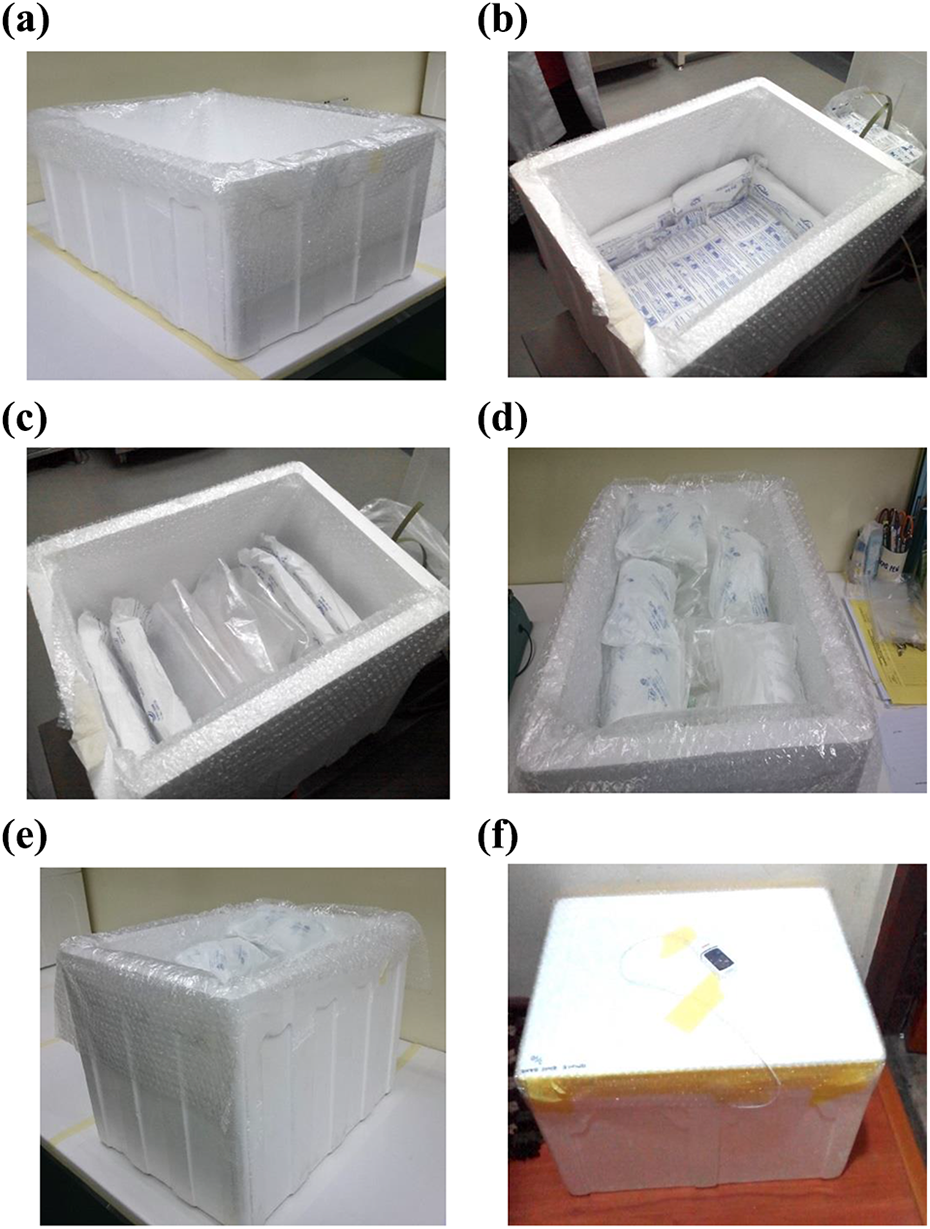
Packing bones with cooling materials in the polystyrene box: (a) internal wall of the box was covered with a bubble plastic wrap; (b) two layers of the cooling material were placed at the bottom of the box and one layer surrounding the walls; (c) a row of five packs of dummy bones were placed in the middle of the box; (d) layers of the cooling material on top to cover the bones and empty space; (e) the top was covered with a bubble plastic wrap before putting on the lid; and (f) the temperature was recorded by a thermocouple thermometer secured by tapping on the box to monitor over 96 h while kept in a room without air conditioner.
The boxes were placed in a non-air-conditioned room to stimulate the environment in the radiation facility. The surrounding temperature was closely monitored over 96 h at interval times of 15 min. The boxes were weighed after the storage time. Data from the data logger were retrieved using Winlog Basic (version 2.66) software in the form of PDF. The experiment was repeated and temperature over time profiles of the three cooling materials were plotted and compared. From the temperature profiles, durations for the temperature to rise to the selected freezing temperatures (−40°C, −20°C, and 0°C) were obtained.
Temperature monitoring
Thermocouple thermometer (EBI 310, EBRO Logger, Germany) comprising a data logger and two probes were used to monitor the temperature of the bones and the surrounding (Figure 3). The device was factory calibrated with the conformity certificate that complied to the CE guidelines 2001/108 EG and that also complied to the guidelines in accordance with EN 12830. The data logger has a resolution of 0.1°C, accuracy of ± 2.0°C and measured in the range of −200°C to +250°C. The flexible probe was inserted in between the bone packages inside the box to record the bone temperature. The data logger with an in-built probe for the surrounding temperature was setup to record the ambient temperatures at every 15-min intervals.
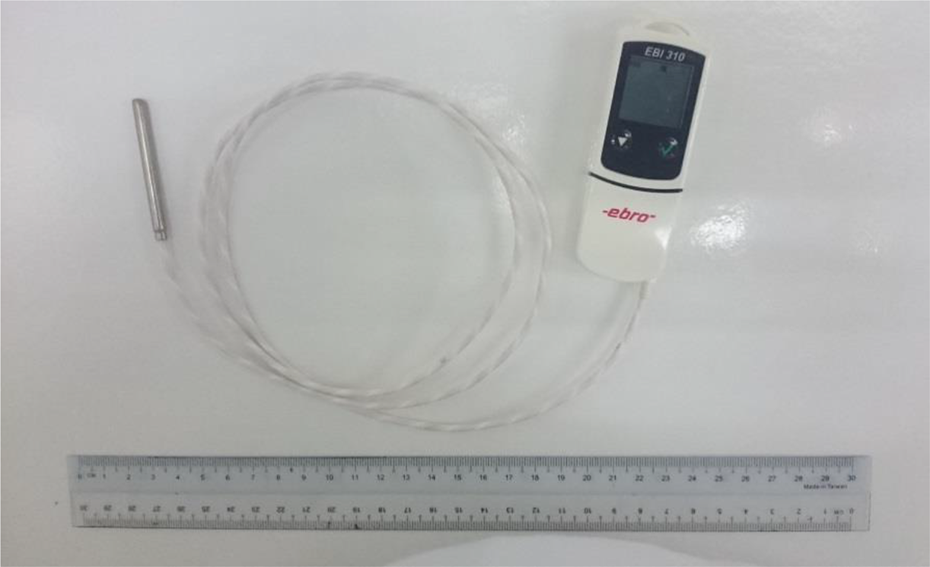
Thermocouple thermometer comprised a probe to monitor temperature of bone and a data logger (monitor) with an inbuilt probe to monitor the surrounding temperature.
Composites of DI and GI
Inner wall of a polystyrene box was covered with bubble plastic wraps before placing the slabs of DI at the bottom and on the surrounding walls. Five dummy bones were arranged in the middle as in Figure 4 and the probe of thermocouple thermometer attached to one of the bone packages was inserted in the center of the polystyrene box in between the bone packages. GI bags were used to fill up the space and finally covered the bones with DI before placing the bubble plastic wrap on top. The box was closed and sealed. Data logger was taped on the box.

(a) The probe for thermocouple thermometer was attached to the frozen dummy bone, (b) placed the probe in between the bone packages in the center of the polystyrene box, and (c) filled up the space with GI and covered the top with DI. GI: gel ice; DI: dry ice.
Five composites of DI and GI as shown in the work flow (Figure 5) comprised of the following combinations: Work flow for experiment on composites of DI and GI as cooling material. DI: dry ice; GI: gel ice. 20DI—only DI of 20 kg was used 15DI + GI—15 kg DI with bags of GI 10DI + GI—10 kg DI with bags of GI 5DI + GI—5 kg DI with bags of GI 0DI—only GI bags were used
The initial weight of the sealed box was kept almost similar, not exceeding 20 kg, to ensure the boxes had almost the same density and configuration, thus having similar radiation dose distribution and absorption. 7 The experiment was repeated three times.
Statistical analysis
Descriptive statistics (mean and SD) were computed for all composites as variables (20DI, 15DI + GI, 10DI + GI, 5DI + GI, and 0DI). Level of significance among the three cooling materials (DI, GI, and IP) and the composites of DI + GI maintaining specific freezing temperatures were tested using one-way analysis of variance (ANOVA) with Tukey’s post hoc test was used to determine the possible differences among the groups. The power of the study on five composites was more than 90% with 5% level of significance and a two-sided test conducted for three replicates in each group. The data were tabulated and analyzed using IBM’s SPSS Statistical Software for Windows (IBM SPSS, version 22, Chicago, Illinois, USA). Any p values less than 0.05 were considered to be statistically significant.
Results
Dummy bones
A preliminary experiment was conducted to compare dummy and femoral head. Five samples for each material were packed with 20 kg DI in a polystyrene box and the temperature was monitored until reaching 0°C. The temperature of femoral head could be maintained below −40°C for 80.00 ± 5.66 h while golf balls could be maintained for 86.88 ± 10.1 h. The duration for golf balls maintained below −20°C was 110.75 ± 17.3 h which was comparable to femoral heads, 108.13 ± 15.4 h. Golf ball with almost similar size of human femoral head was used as the “dummy” bone in the experiments. After several wrappings, the mean weight of the dummy was 79.46 ± 25.04 g, which was comparable to the mean weight of the femoral head 75.92 ± 19.27 g. The use of the dummy bones could avoid the use of the real femoral heads and they were easier to handle and reuse.
Comparative study of cooling materials
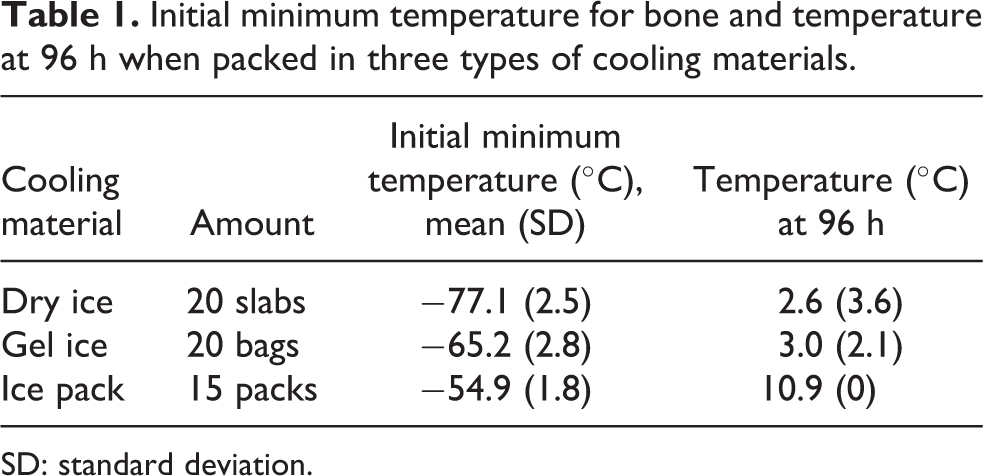
The amount of cooling materials used to pack five dummy bones varied due to different sizes and shapes of the cooling materials. A slab of DI has an average weight of 1 kg per slab; however, the weight might be reduced when there was a delay in collecting and using after purchase. A bag of GI initially contained a dry powder which swollen after soaking in distill water, turned into irregular size after frozen and tend to get smaller when refrozen. An IP is a rigid plastic casing containing liquid inside. The polystyrene box was filled up as much as possible with these respective cooling materials but not exceeding 20 kg, the maximum weight allowed for a box to be irradiated using research loop at the irradiation plant. The results indicated that all the cooling materials used in the study could initially reach the deep freezing condition: 20 kg DI gave the lowest temperature (−77.1°C) while 20 bags of GI and 15 packs of IP reduced the bone temperature to −65.2°C and −57.8°C, respectively (Table 1). At 96 h of storage, the bones were no longer frozen in all the boxes. The temperature profiles from the repeated experiments were found consistent.
Initial minimum temperature for bone and temperature at 96 h when packed in three types of cooling materials.
SD: standard deviation.
Profiles of bone temperature throughout the experiments are shown in Figure 6 (a) to (c). Total weight of the DI slabs and the IP packs per box used in the experiments were consistent except a small variation for the GI bags used because the weight of the GI bags was influenced by the amount of the absorbed water. The surrounding or room temperature was almost constant throughout the experimental periods with the lowest temperature of 26.2 ± 0.4°C was recorded in the morning and the highest of 26.7 ± 0.4°C in the afternoon.

Profiles of bone temperature packed in (a) DI, (b) GI, and (c) IP. DI: dry ice; GI: gel ice; IP: ice pack.
Durations for the temperature rising to the varying levels of freezing temperatures of −40°C (deep freezing), −20°C (freezing), and 0°C (mild freezing) were obtained from the temperature profiles and as summarized in Table 2.
Duration for bone temperature rising to varying levels of freezing temperatures while packed in dry ice, gel ice, and ice pack.

SD: standard deviation.
Composites of DI and GI
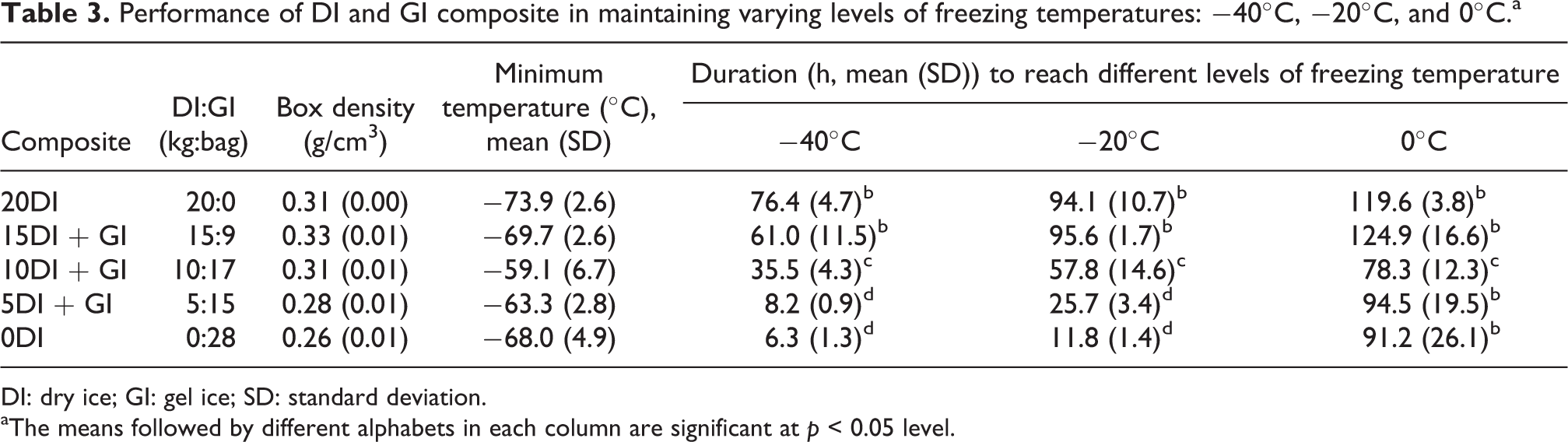
Composites of DI and GI in varying compositions resulted in different performance of freezing condition of the bones. Profiles of bone temperature over time for the five composites are plotted for comparison as shown in Figure 7. The temperature dropped initially to the lowest temperature with the magnitude depending on the amount of the DI used. The temperature increased sharply for 10DI + GI, 5DI + GI, and 0DI but gradually for 15DI + GI and 20DI. Durations taken to rise to three levels of freezing temperatures that is, −40°C, −20°C, and 0°C were obtained from the profiles and as summarized in Table 3, reflected the ability to maintain the specific freezing temperature, which seemed to decrease by decreasing the amount of DI in the composites. The longest deep freezing condition (below −40°C) was maintained by 20DI (20 kg DI alone) for 76.4 h while the 0DI (28 bags of GI alone) could only be maintained for 6.3 h.

Profiles of bone temperature in five varying composites of DI and GI from triplicate experiments: 20DI, 15DI + GI, 10DI + GI, 5DI + GI, and 0DI. DI: dry ice; GI: gel ice.
Performance of DI and GI composite in maintaining varying levels of freezing temperatures: −40°C, −20°C, and 0°C.a
DI: dry ice; GI: gel ice; SD: standard deviation.
aThe means followed by different alphabets in each column are significant at p < 0.05 level.
Discussion
A dummy to replace femoral head, a product made of biological material was considered. Previous study reported the use of wooden stick as a dummy to long bones based on similarity in density. 7 We searched for easily available material that has almost similar density, shape, and weight of femoral heads. Golf ball is made of rubber and plastic. Golf ball is slightly smaller but by adding more rubber gloves, plastic wrap, rubber bands, a golf ball could match the weight of femoral head. Density has influence on thermal mass of material. 23
Terminal sterilization of frozen bone allografts by gamma irradiation as practiced by the UMMC Bone Bank since its establishment in 1998 is effective and there were no complaints from the surgeons on the bone sterility based on the retrospective study conducted from 1998 to 2012. 24
The initial minimum temperature must be deep freezing which reflects the ability of the cooling material to maintain deep freezing condition below −40°C during the long-distance transportation and irradiation process. The ability of the cooling material to maintain the freezing temperature below −20°C is required for short-distance transportation of bone allografts that will be immediately used for transplantation upon reaching the hospitals. Duration taken to reach 0°C reflects the ability of the cooling material to maintain the mild freezing temperature below 0°C that is useful for in-house dispatch of bone allografts and for transporting bones immediately after procurement to the bone bank.
The findings confirmed that 20 kg dry ice is still the best cooling material for maintaining bones in deep frozen state below −40°C for a long period of 76.4 h in tropical indoor of Malaysia (26–28°C). The duration covers the transport of the bones from the Bone Bank to the irradiation facility, sterilization process, and the transport of the irradiated bones back to the Bone Bank. By using 20 kg DI, the lowest initial temperature recorded was −77.1°C almost similar to the report by Eagle et al., 11 where low temperature of −79°C was obtained by 15 kg DI in a polystyrene.
GI (28 bags) maintained the deep freezing condition for only 5 to 6 h, not sufficient for covering the duration of radiation process; however, it can be considered for short- and long-distance dispatch. IP (15 packs), which is less flexible for handling could keep deep freezing state for just 3 h thus acceptable for in-house dispatch only. However, these GI and IP can be a good alternative for transporting bones below −20°C for the period of 10 and 8 h, respectively, such as in transporting the newly procured bones to the Bone Bank. Unlike DI, GI, and IP are reusable and readily available in the bank, therefore no hassles in purchasing and collecting it from the manufacturer prior to irradiation.
Rooney et al. 5 demonstrated that at 37°C, the XPL10 carton with 9.5 kg of dry ice maintained femoral head and tendon tissue temperature below −55°C for at least 48 h and tissue temperature did not rise above −40°C until at least 70 h. They also indicated that tissue temperature was maintained for longer periods at a storage temperature lower than 37°C. Therefore, the mean rate of DI loss did not vary significantly due to the surrounding temperatures. In addition, a similar rate of DI loss was observed using both loosely packed DI and DI placed inside perforated bags. 5 This study found that the DI still packed in the plastic bag had losing rate slower than when the plastic bag was removed. In addition, the plastic bag could minimize freezing injury during handling dry ice.
The composites of 15DI (15 kg DI with 9 GI bags) and 10DI (10 kg DI with 17 GI bags) could reduce the amount of the DI used and seemed be able to maintain the bone temperature below −40°C for 61 and 35.5 h, respectively. Therefore, these composites can be adopted for routine radiation process and also for long-distance dispatch. Based on our radiation service records from 2013 to 2015, time taken for radiation sterilization process was around 24 h including 4 h for packaging and transporting the bones to the irradiator and another 2 h to bring back to the Bone Bank for storage. 24 In the seven batches of 2015, the bones packed in 20 kg DI were still frozen at −64.33 ± 6.90°C after completing the radiation process confirming that the bones were irradiated in deep freezing state. The temperature profiles of varying composites developed in the study are useful in predicting the temperature during irradiation process and at any time during transportation. The profiles provide an assurance that the deep freezing condition is maintained as long as no changes occur in the density and configuration of the polystyrene box.
The findings showed that by increasing the amount of DI from 5, 10, 15 to 20 kg, the duration maintained below −40°C increased from 8.2, 35.5, 61.0 up to 76.4 h, respectively. Similarly, Bryce et al. 3 reported that increasing amount of DI prolonged the storage time below −20°C.
In terms of costing, using the current price of DI at Malaysian Ringgit 6.15 per kg (slab), the cost could be reduced from RM 123.00 for 20 kg dry ice to Malaysian Ringgit 92.25 when 15DI + GI composite is used and further reduced to Malaysian Ringgit 61.50 for 10DI + GI composite for sterilization process. The use of DI will be definitely costly as the price of DI keeps surging. Use of GI (0DI) for long-distance transportation is acceptable for those places where DI is not available, however DI must be added prior to radiation process to ensure the bones are irradiated while in deep frozen state below −40°C.
Conclusion
DI alone is still the best cooling material however the composites of DI and GI can be as an alternative to maintain bone temperature below −40°C thus can reduce the cost of packaging for routine sterilization and for long-distance transportation especially when the price of DI keeps increasing. The temperature profiles of the composites developed by this study will act as a reference assuring that the functional and biomechanical properties of bone allografts are not affected by radiation. Sterile bones of high quality are required for transplantation especially where the bone strength is concerned.
Footnotes
Acknowledgements
The project was led by SR. The experimental design was done by SR, NY, SM, NWM and AM. The study was commenced by SR, NY, SM, SMS and NNH. Data analyses were carried out by SR, NY and SM. Fund received was managed by SM and SR. Finally, all authors contributed for the preparation of manuscript.
Declaration of conflicting interests
The author(s) declared no potential conflicts of interest with respect to the research, authorship, and/or publication of this article.
Funding
The author(s) disclosed receipt of the following financial support for the research, authorship, and/or publication of this article: The study was fully supported by UM Research Grant, Research Officer Grant Scheme (BR005-2015) and also Yayasan Ortopedik (Orthopaedic Foundation).