




Abstract
Purpose:
The purpose of the study was to compare the yield and compressed volume of femoral head allograft prepared by either hand morselization or a bone mill.
Methods:
Twenty human femoral head allografts were donated from a bone bank and morselized by two different methods. The heads were divided in half and split into two sample groups. One group underwent hand morselization with large bone nibblers, while the other was prepared using a bone mill. The volume of graft produced was measured. Ten-gram aliquots of each sample then underwent 30 impactions in a contained cavity, with the volume of graft compression measured.
Results:
Bone milling yielded approximately 31% more usable graft than hand morselization (81% to 50%; p = 0.0001). There was no difference between the compressed volume of graft prepared by either method (p = 0.14).
Conclusion:
This study demonstrates the efficacy of preparation of allograft with a bone mill and assists the clinician in determining the yield of graft by the weight of femoral head, thereby potentially minimizing excessive ordering and wastage.
Introduction
Femoral head allograft is an increasingly scarce resource in Australia and should not be wasted. 1,2 The process of donor analysis, graft procurement, and processing is extensive and costly but is vital in ensuring contaminate-free allograft and minimizing the risk of infection. 1 –4 However, it often results in the exclusion of many potential donors, creating a supply limitation. 1
Hip and knee revision arthroplasty regularly requires femoral head allograft to help restore bone stock and reconstruct defects. 5 –9 However, the estimate of bone required is often inaccurate preoperatively, which can lead to insufficient or excessive amounts being ordered, with possible wastage. Femoral head allograft is purchased by the number of heads and not by head weight or size. 1 Thus, the quality of graft obtained is often inconsistent (due to variations in head size and density) and removed from the surgeon’s control. 1
Differing methods of preparation introduce manageable variables. Hand morselization with large bone nibblers 10 is the traditional method for preparation but can be tedious and time-consuming, with potential for inadvertent graft wastage. Bone milling is an alternative method for allograft preparation 1 and may be more efficient. Preferences in composition (cancellous or cortico-cancellous) or graft chip size also affect mechanical properties.
The purpose of this study is to evaluate the amount of graft produced (and thus wastage) when preparing femoral head allograft by hand morselization versus bone milling. Furthermore, the compressed volume of the hand morselized and bone milled allograft was analyzed to potentiate any possible difference in graft properties when prepared differently.
The Trauma and Orthopaedic Research Unit at the Canberra Hospital gave institutional review board approval to run the study. The femoral heads were previously donated to the bone bank with full consent but due to loss of the Therapeutic Goods Administration license for the on-site bone bank, the heads were deemed not viable for human implantation and designated for research.
Methods
Preparation of morselized grafts
This study was conducted as a prospective comparative trial. Twenty fresh frozen femoral heads were obtained from our institution’s bone bank. The heads were procured at the time of primary hip arthroplasty for osteoarthritis and stored at –80°C. Consent was obtained from the patient for the purpose of donation and bone bank procedures and protocols were all followed. They were processed with the intent for implantation; however, the bone bank lost its Therapeutic Goods Administration license, and the heads were donated for research. The median age of the donors was 65 (51–85), with 14 females and 6 males.
The femoral heads were individually thawed in 1 L of room temperature water for 30 min while placed in a watertight ziplock bag. Their weights were then recorded on a scale accurate to 0.01 g. Subsequently, the heads were divided in a coronal plane into two halves (originating at the fovea and bisecting the femoral neck). Each half was placed in an opaque bag, given a de-identifying code and weighed by an independent observer, before being placed in separate groups.
In group A, the half heads were denuded of cartilage with a handheld saw, and the mixed cortico-cancellous bone was then passed through a Noviomagus Bone Mill (Spierings, Nijmegen, the Netherlands). The standard milling drum was used, yielding a graft chip length of approximately 8–10 mm. The allograft was placed back into the opaque bag and weighed by the independent observer.
In group B, the other half of the divided femoral heads was denuded of cartilage by a saw and morselized by hand utilizing a large bone nibbler. One in every five pieces of hand morselized graft was measured with calipers. The average graft diameter was 9.3 mm (8.0–10.1). The allograft was placed back into the opaque bag and weighed by the independent observer.
The direct yield from each half femoral head was compared with its pre-prepared weight.
Impaction procedure
Impaction was performed through a construct that consisted of a PVC pipe (1.5 m × 15 mm) centralized on a solid wooden frame over an inverted 10 mL syringe (Figure 1). The PVC pipe acted as a guide for a mass (455 g) which was dropped from a height of 1 m to simulate a consistent classical impaction maneuver. The end of the syringe was left uncovered to allow for expulsion of bone marrow and other liquid elements of the graft.
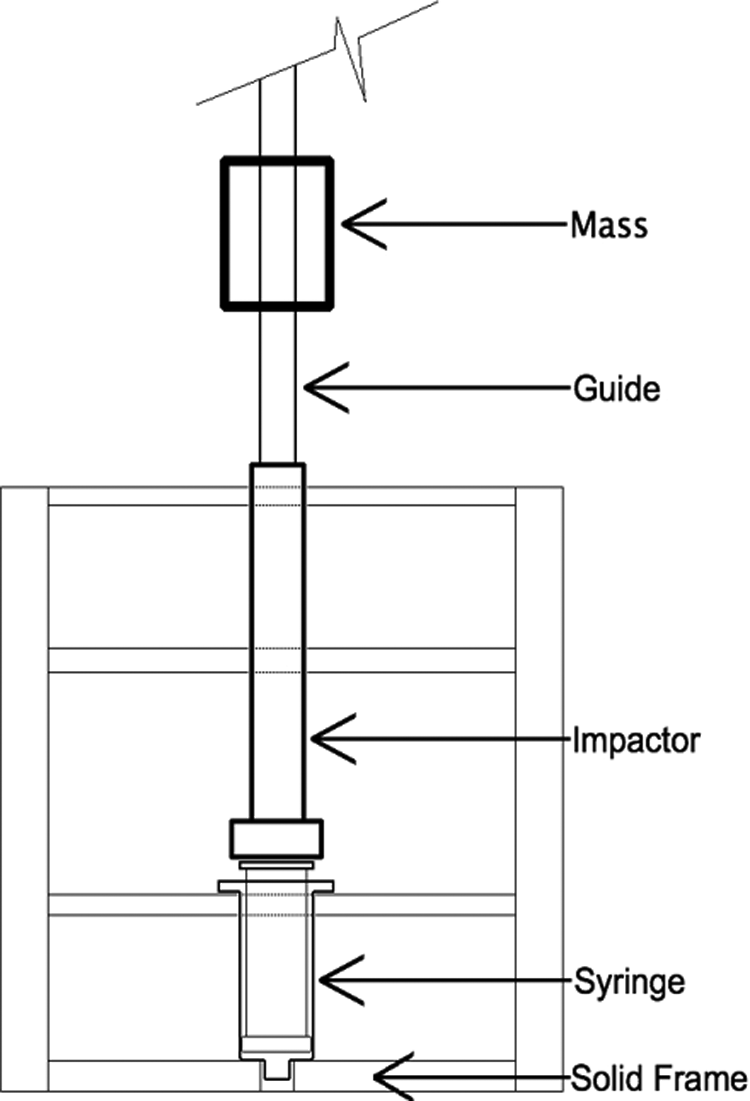
Apparatus used for impaction of graft aliquots.
Measured 10-g aliquots of morselized graft were placed into syringes and impacted 30 times to achieve maximum stiffness. 11 –13 The volume of graft in each syringe was measured by four independent observers. Due to the viscoelastic mechanical properties of morselized graft, 14 impactions occurred at 10-s intervals and the volume measurement was recorded 1 min post the final impaction.
Statistical analysis
The yield of graft (final prepared weight/weight of unprepared half heads) was calculated for each head in both groups, with the mean compared through a paired sample t-test. The level of interobserver agreement for volume measurements after bone compression was interrogated using an intraclass correlation coefficient (ICC1, 4) with one-way random effect for average measures. The means of the bone mill group and hand morselization group allograft were then compared with a paired sample t-test. All data were analyzed using SPSS version 20 (IBM, Chicago, IL, USA). The significance level was set at p < 0.05.
Results
Bone milling as a method of preparation yielded more bone per femoral head (81% (75–87%)) when compared to hand morselization (50% (43–57%); p = 0.0001; Figures 2 to 4).

Weight of each femoral head half post sectioning into halves and the weight produced through bone milling, compared with original femoral head weight.
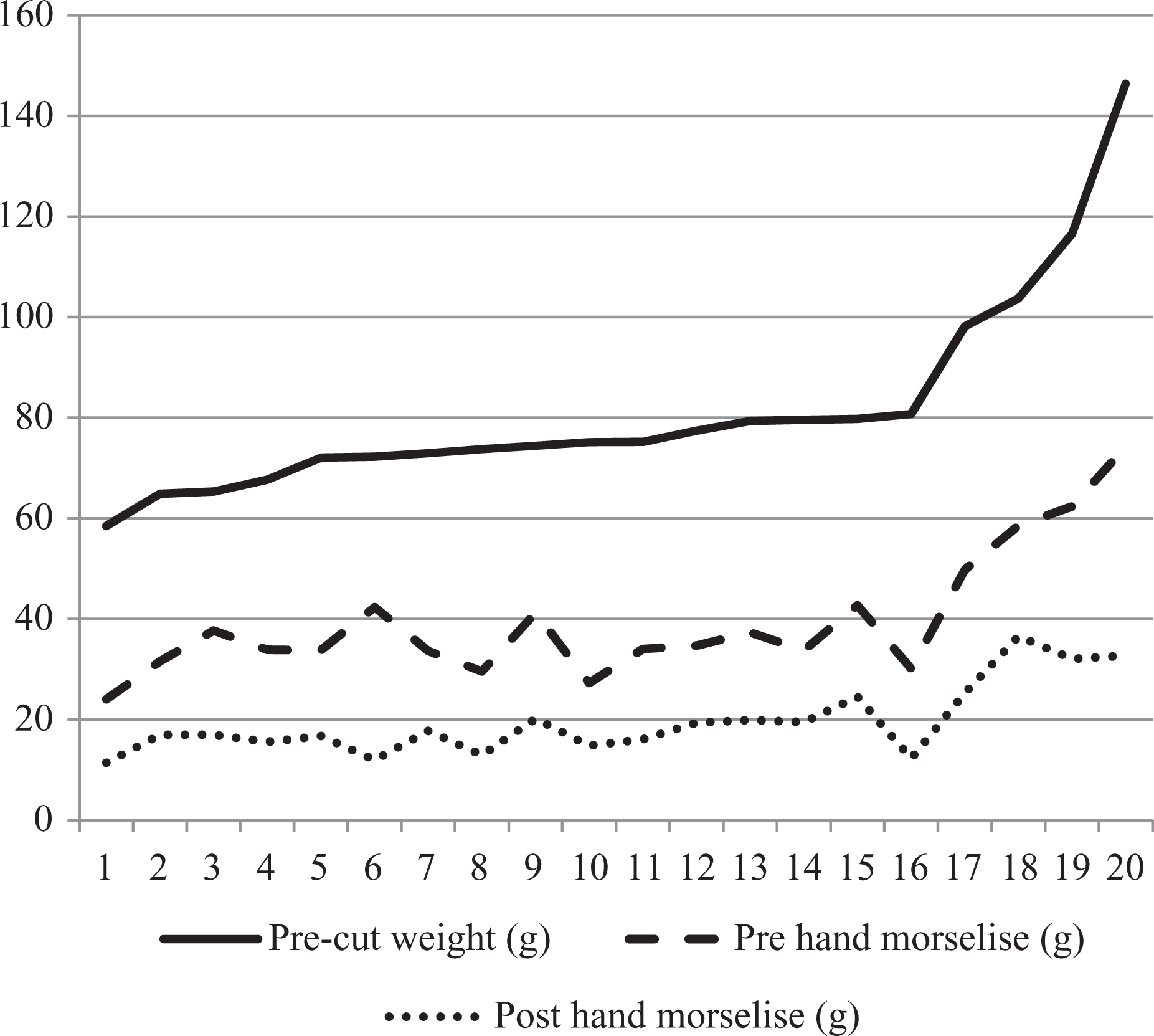
Weight of each femoral head half post sectioning into halves and the weight produced through hand morselization, compared with original femoral head weight.
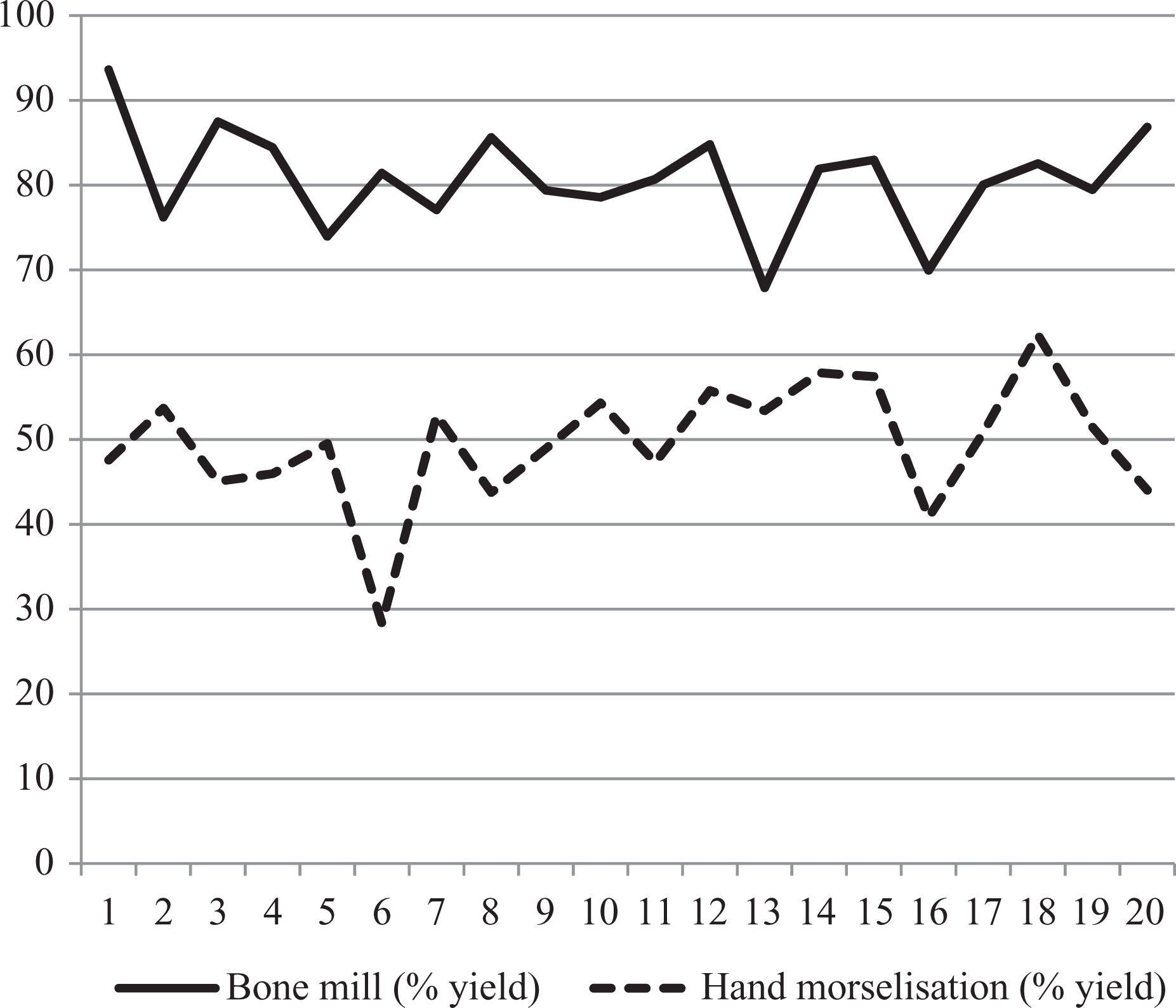
Percentage yield of graft from each sample for bone milling versus hand morselization.
There was a very strong intra-observer agreement when measuring the volume of impacted graft (intraclass correlation of 0.99). There was no significant difference between postimpaction volume of the bone mill group (5.80 cm3 (5.40–6.20 cm3)) and the hand morselization group (6.02 cm3 (5.37–6.67 cm3); p = 0.14).
Discussion
Bone graft is a necessity in orthopaedic surgery, allowing for the reconstitution of bony defects in trauma (due to fracture comminution or underlying osteoporotic bone) or revision arthroplasty (as a result of osteolysis). 4 Although autograft is ideal, it is associated with a significant risk of donor-site morbidity, thus allograft is often utilized. 15,16
The most commonly utilized allograft is the femoral head, obtained from patients undergoing elective total hip arthroplasty. The cost of donor screening, harvesting, storage, and delivery is high, particularly in smaller institutions. Final product cost per full femoral head has been quoted as between US$978 and US$1549 internationally, while at our institute, each head was valued at US$1694. 4,17 Prior analyses indicate that between 34 and 63 femoral head allografts must be implanted annually to offset the financial burden of operating a bone bank. 17 Institutions utilizing smaller numbers or those without a bone bank must purchase commercially available graft at a significant cost to the institution.
Multiple studies have demonstrated that current harvests are unlikely to cope with future demands for allograft. 2,18,19 Rigorous but necessary medical screening of donors excludes almost half. 2 The use of autologous bone in primary hip arthroplasty also diminishes the amount available for allogeneic transplant. Harvested bone may still be eliminated by mandatory staggered testing for viral markers or bacterial infection. Concurrently, demand for allograft is increasing, with a rise in revision arthroplasty rates and the use of techniques such as impaction grafting (which may consume up to five femoral heads). 2,20 This mismatch of need and supply, combined with high costs, entails that all wastage should be eradicated.
Procured femoral heads consist of articular cartilage and both cortical and cancellous bone. Articular cartilage must be discarded as its presence compromises the impaction process and resultant stiffness. 8,13 The remaining bone can then be morselized into either cancellous or cortico-cancellous chips. Classically, cancellous graft is espoused as preferable for defect reconstitution, as its porous structure allows for rapid revascularization. 21 Early concerns regarding lack of mechanical strength have been contradicted by more recent evidence indicating comparable stiffness to cortico-cancellous graft. 13
Historical hesitancy towards the inclusion of cortical elements in bone graft centers on its structural properties being more compact and less porous than cancellous bone, with its rate of revascularization and incorporation has been questioned. 8 However, Kligman has demonstrated better early and midterm clinical and radiological outcomes (such as cup migration and the presence of radiolucent lines) in both femoral and acetabular impaction grafting when utilizing purely cortical morselized allograft as compared to cancellous allograft. 6,22 Although further evaluation is required, these results, combined with potentially superior mechanical properties, indicate that mixed cortico-cancellous graft is a viable alternative to purely cancellous bone.
Chip size also affects implantation outcomes. Larger particles exhibit lower recoil and subsidence of the impacted graft bed. 14 Mechanical testing has also demonstrated higher stiffness and shear resistance and greater prostheses stability. 10,11,23 These results have been reproduced in long-term clinical series, where acetabular grafting with large particles has demonstrated superior survival rates compared to grafting with small slurry bone grafts (such as that obtained with acetabular reaming). 24 –28
The aim of the current study was to compare the yield of graft obtained through differing preparation methods as well as assess the compressibility of both preparation methods. One limitation was the relatively small size of the comparative groups. Additionally, impaction was performed into small volume tubes, and the results may not necessarily indicate outcomes when impaction is performed into larger cavities such as the femoral canal. Morselized chips through a bone nibbler tended to be larger in size than those produced by the bone mill, introducing a small potential confounder in terms of compressibility. However, the results demonstrate significantly greater yield through milling when compared to hand morselization, by an average of 31%.
There was no difference in postimpaction volume between both groups. These results have significant implications for the surgeon when determining the type and amount of graft required, especially in the context of supply limitation. Bone milling is a more efficient process and may allow surgeons to fill a defect with a lower number of femoral heads. It is recommended that the milling drum be set to achieve larger particle size, which has demonstrated superior mechanical properties during grafting.
Conclusion
As demonstrated in this study and the prior literature, procured femoral heads range in size, shape, and weight. 1 This study allows the quantification of average weight and volume of graft obtained per femoral head through each preparation technique, and facilitates surgical planning. Typically, femoral head allograft is ordered by the number of heads, with three to four routinely obtained for revision operations. 2 However, variations in head geometry can result in excess or inadequate volumes required for procedures. Once a head is thawed, it must be used or discarded. It is noted that most revision procedures need approximately 200 g of bone for impaction grafting. 1 Thus, it is recommended that institutional bone banks record the weight of donated bone and that surgeons carefully assess preoperative imaging to closely determine graft requirements, allowing ordering by weight to match the need and diminishing the burden on this already scarce resource. From the results of this study, the following formula can be utilized to estimate the amount of graft available post preparation: Femoral head weight (g) × 0.81 (via bone mill) or × 0.50 (via hand morselization). Further research is needed on long-term results regarding mechanical properties and incorporation of cortico-cancellous graft into host bone.
Footnotes
Declaration of conflicting interests
The author(s) declared no potential conflicts of interest with respect to the research, authorship, and/or publication of this article.
Funding
The author(s) received no financial support for the research, authorship, and/or publication of this article.