




Abstract
Objectives:
Our study aims to develop and evaluate the practicality, clinical merit, and usefulness of a hand clerking sheet for use in a clinical orthopedic surgical unit. We hypothesize that the cause and extent of damage to anatomical structures will be more accurately documented in concordance with intraoperative findings when evaluated with the clerking sheet.
Materials and method:
All patients admitted to a tertiary care institute for hand-related injuries requiring acute surgical intervention within a 1-year period were evaluated. Assessments made preoperatively without the clerking sheet were evaluated retrospectively. Data concerning cause and extent of damage to anatomical structures were recorded using the hand clerking sheet for all newly admitted cases. The number of injuries documented prior to surgery and intraoperatively was compared.
Results:
Patients who were assessed without the use of a clerking sheet had their injuries diagnosed with 61% accuracy (96/157), while patients who were assessed with the use of a clerking sheet were diagnosed with 91% accuracy (146/160). Overall, injuries evaluated with the clerking sheet were more accurate than without the aid of the clerking sheet 91% versus 61% (p < 0.05).
Conclusion:
The high level of concurrence supports the view that patients admitted for hand-related injuries that were assessed with the aid of a hand clerking sheet or hand chart were diagnosed more accurately.
Background
Hand injuries prove to be a bane for most junior house and medical officers due to its complexity and subtleness in presentation. 1 Previous studies with similar aims have used intraoperative findings as the final arbitrator of the accuracy of the final clinical diagnosis. 2 –4 Even the most experienced clinicians are unable to assess patients with 100% diagnostic accuracy. 2 Hand injuries that are missed may be associated with significant morbidity and resultant medico-legal implications.
Our study aims to develop and evaluate the practicality, clinical merit, and usefulness of a hand clerking sheet for use in a clinical orthopedic surgical unit. We hypothesize that the cause and extent of damage to anatomical structures will be more accurately documented in concordance with intraoperative findings when evaluated with the clerking sheet.
Materials and methods
All patients admitted to a tertiary care institute for hand-related injuries requiring acute surgical intervention within a 1-year period were evaluated. In view of serious implications associated with overlooking injuries, assessments made preoperatively without the clerking sheet were evaluated retrospectively.
Data concerning cause and extent of damage to anatomical structures were recorded using the hand clerking sheet (Appendix 1) for all newly admitted cases. The number of injuries documented prior to surgery and intraoperatively was compared to evaluate for accuracy.
All initial assessments and documentation on clerking sheets for both groups were done by junior doctors, postgraduate first and second years. The patients were subsequently reviewed by a registrar, senior specialist trainee on duty, before being listed for surgery. Subsequent reviews by registrars were documented separately without usage of the clerking sheet.
Data was analyzed using IBM SPSS Statistics for Windows (v19.0; IBM Corp, Armonk, New York, USA) software for evaluation of significance.
All procedures performed in studies involving human participants were in accordance with the ethical standards of the institutional and/or national research committee and with the 1964 Helsinki declaration and its later amendments or comparable ethical standards.
Results
In the arm without the clerking sheet, 157 injuries were found at operation, with doctors diagnosing 96 correctly (61%). That means 61 injuries were missed preoperatively. Of the 50 patients that were assessed, only 26 had all injuries accurately diagnosed preoperatively (52%) (Figure 2).

Mean number of injuries in both arms and documented with the clerking sheet.

Proportion of injuries diagnosed preoperatively without the clerking sheet.
Of the patients evaluated with the clerking sheet, 160 injuries were found at operation with 146 diagnosed correctly (91%). Fourteen injuries were missed preoperatively. Of the 50 patients that were assessed, 40 of them had all injuries accurately diagnosed preoperatively (80%) (Figure 3).
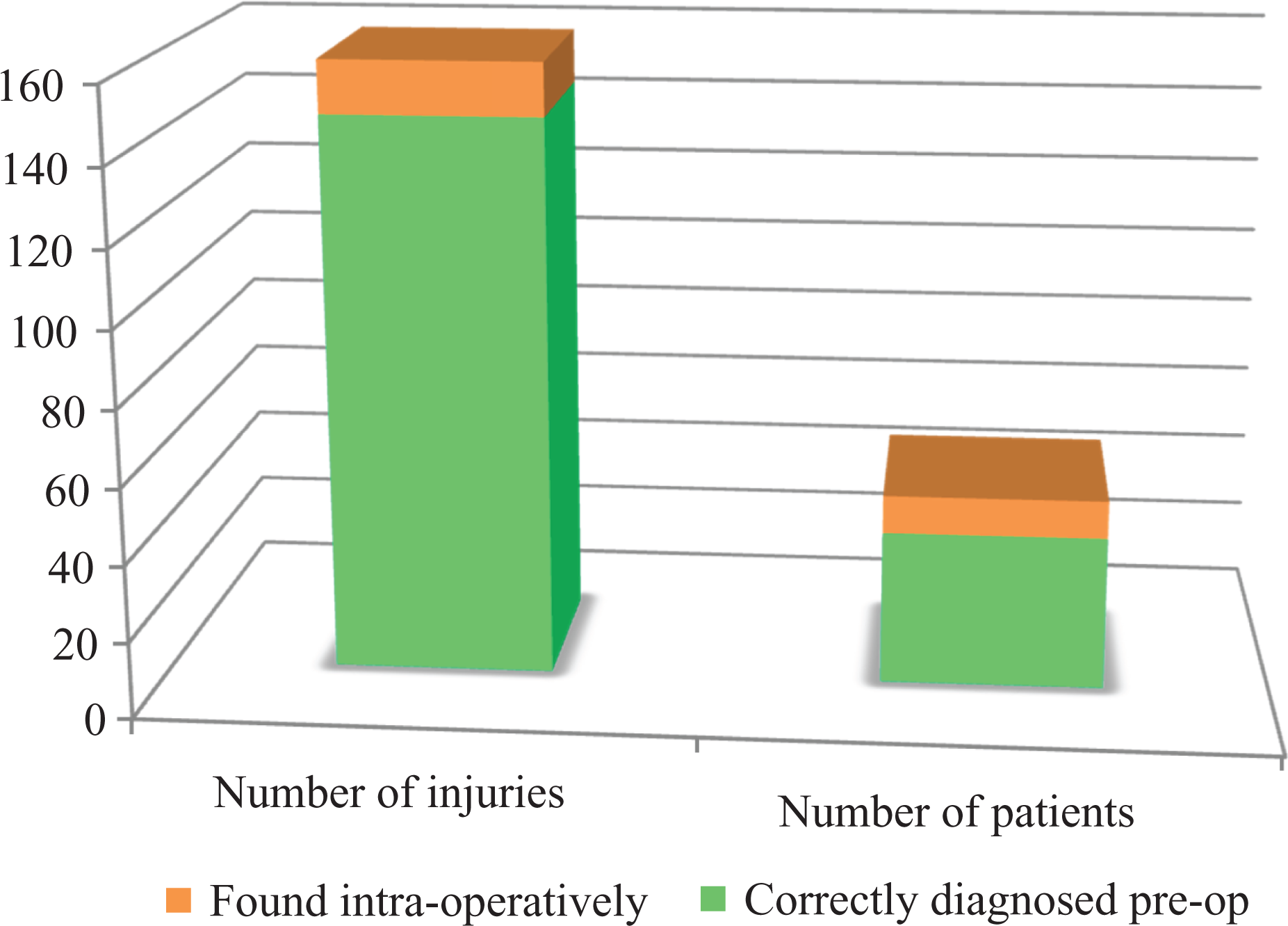
Proportion of injuries diagnosed preoperatively with the clerking sheet.
The mean number of injuries per patient in both arms was 3.20 with the clerking sheet and 3.14 without the clerking sheet (p < 0.01).
Using the t-test, the mean number of injuries documented with the clerking sheet was 2.92 compared to 1.92 without the clerking sheet (p < 0.01) (Figure 1).
Overall, injuries evaluated with the clerking sheet were more accurate than without the aid of the clerking sheet 91% versus 61% (p < 0.05) (Table 1).
Injuries documented and missed with and without the hand clerking sheet.

Discussion
The high level of concurrence between preoperative and intraoperative findings when the clerking sheet is used signifies the utility of having a designated clerking aid for assessment and diagnosis of hand injuries. The accuracy and clarity of information passed on to senior surgeons would allow for ease of planning of surgeries and mitigate medicolegal implications of missed injuries.
In this study, only patients admitted to a tertiary care institute were included. This implies that the patients in the study had more serious injuries, as patients with minor injuries would have been reviewed and treated by an emergency department physician. Also, non-admitted patients that were subsequently reviewed and found to have more serious injuries in an outpatient specialist clinic were not included. Subsequent studies may focus on the assessment of hand injuries in the emergency department and outpatient clinic setting for minor injuries.
The usage of a retrospective-matched control method is a limitation of the study. For the junior doctors using the clerking sheets, it may be perceived as a form of audit and result in more meticulous assessment and documentation.
The diagnostic rate without usage of a hand clerking sheet (61%) is comparable with previous studies where hand injuries were assessed by emergency physicians (54–68%). 3,4 Patients reviewed with a clerking sheet had 91% of their injuries diagnosed, comparable with the diagnostic accuracy (68–94%) in previous studies when reviewed by a specialist hand surgeon 3,4 This signifies that patients were unlikely to be over diagnosed and received a standard of care similar to being reviewed by a specialist hand surgeon.
Junior doctors were also briefed on the study protocols and results of the study were used purely for study purposes and not for institutional auditing. As our institutions protocols are refined further, future studies may be done with additional controls put in place and a larger cohort size to deliver a more robust evaluation of the impact of our intervention on outcomes.
Utility of study
The hand clerking sheet allows for more accurate and uniform description of hand-related injuries as an aid to junior staff. There is an increased clarity in the information disseminated from junior to senior staff, and this allows for easier preoperative planning for the surgeon.
Implants and personnel required for complex procedures can then be readied preemptively in the event that they are required for the surgical procedure.
It allows for an increased speed and efficiency in assessment. In the setting of a busy acute care facility, it could potentially reduce the waiting time for patients waiting in the emergency department.
Perhaps, the most significant value of the hand clerking sheet would be its ability to provide a framework for all staff to assess hand-related injuries, such that the examination is thorough and extensive.
With the rising cost of health care and the medicolegal implication associated with missing injuries, it is imperative that hospitals and staff are equipped with the knowledge and appropriate resources, so as to ensure a detailed and thorough assessment for each and every patient.
The hand clerking sheet is a tool that is simple and readily implemented. It provides not just clinical utility, but has a role in the realm of clinical research as it allows for clinical data to be recorded in a uniform manner, such that it may be analyzed and perused for future ideas.
Footnotes
Author’s note
Informed consent was obtained from all individual participants included in the study.
Declaration of conflicting interests
The author(s) declared no potential conflicts of interest with respect to the research, authorship, and/or publication of this article.
Funding
The author(s) received no financial support for the research, authorship, and/or publication of this article.