



Abstract
Background:
Physicians with history of unprofessional behaviour during their medical training are shown to be 3 times more likely to have board disciplinary action later in their career. One realm in which unprofessional behaviour takes place is the phenomenon of unverifiable publications or “ghost publications.” To that end, this study aims to assess the rate of ghost publications among a recent cohort of Canadian Plastic Surgery residency applicants to determine if this phenomenon is geographic in nature.
Methods:
The current study was a retrospective, cross-sectional observational study; a review of all residency applications submitted to a single Canadian Plastic Surgery residency program from 2015 to 2018 was performed and all their listed publications were verified for accuracy. The review was conducted by a third party librarian and a research coordinator blinded to the authors identifying information. “Ghost publication” was defined as any publication listed as “published,” “accepted,” or “in-press” that did not exist in the literature.
Results:
A total of 196 applications of 186 applicants were submitted over the span of 4 years. A total of 362 publications listed as peer-reviewed articles, belonging to 114 applications were extracted and reviewed. Among the 362 publications listed as peer-reviewed articles, 2 could not be found in the literature (0.55%). Additionally, 42 citations were found with 48 minor differences than what was cited.
Conclusions:
The rate of ghost publications among recent applicants to a Plastic Surgery residency program is low (less than 1%). Future studies should investigate methods to further improve and instill the value of professionalism in our future plastic surgery trainees.
Introduction
Professionalism is the foundation of society’s trust in physicians. Defined as a core competency by the Royal College of Physicians and Surgeons of Canada and the American Association of Medical Colleges, medical professionalism has also been recognized internationally by numerous regulatory bodies as a basic tenet of ethical practice and an integral component of the delivery of medical care. 1 The principles and responsibilities of professionalism demand that those of us with the privilege of serving as physicians do so with a dedication to the interests of the patient, an obligation to the welfare of the public, and a commitment to set and maintain standards of integrity. 2,3
One manifestation of unprofessional behaviour is the falsification of publications. A phenomenon known as “ghost publication” has been reported to appear in residency program applications, namely the inclusion of fraudulent publications by medical student applicants to presumably enhance their competitiveness by boosting their research experience. 4 Previous studies have investigated this in several specialties, including internal medicine, paediatrics, psychiatry, radiology, general surgery, orthopaedic surgery, and otolaryngology, with the percentage of “ghost publications” ranging from 1% to 38%. 5 -10 Within the specialty of Plastic and Reconstructive Surgery only 3 prior studies have investigated the rates of ghost publications, all from American residency training programs. While Larson et al, found that the rate of fraudulent publications among Plastic Surgery applicants to be 2%, 4 Chung et al and Rodriguez-Unda et al found an alarmingly high rate of 14% and 11%, respectively. 11,12
While the previous findings were all in the setting of American residency programs, publication misrepresentation among Plastic Surgery residency applicants has not been evaluated in Canada. Given that Plastic Surgery residencies are among the most competitive medical specialties, the primary goal of this study was to determine the prevalence of “ghost publications” among applicants to a single Canadian Plastic Surgery residency program and compare it to previous studies.
Methods
Institutional review board approval was obtained from McGill University (A03-E23-19A) and the University of British Columbia Children’s and Women’s Research Ethics Board (H18-03756) prior to study commencement. All residency applicants’ curriculum vitae (CVs) submitted to McGill University’s Plastic Surgery residency program from 2015 to 2018 inclusive were obtained. All identifying information were coded and removed to protect the applicants’ identities before the citation search was performed. This information was kept with the first author (H.E.) who was not involved with the citation search and statistical analysis. None of the other authors had access to any identifying information of the study subjects. The citation verification and analysis were performed at the University of British Columbia by a research coordinator and a librarian.
Publications included in this study were limited to peer-reviewed articles listed in the applicants’ CVs. Only publications that were listed as “published,” “accepted,” or “in-press” were included. Exclusion criteria included published and non-published abstracts, conference proceedings, book chapters, non peer–reviewed publications, and essays. Finally, peer-reviewed studies that were listed as “submitted” or “on-going” were also excluded. Data extracted included the publication title and author list, the journal name, applicants’ gender and age, and their affiliated undergraduate medical school. The applicants’ undergraduate degree as well as their highest academic degree were also extracted. Descriptive and summary statistics of the applicants’ demographics were calculated.
Following data extraction from the applicants’ CVs, the selected citations were searched by a medical librarian (C.P.). MEDLINE, Web of Science, and Google Scholar databases were all searched to identify the accuracy of the listed publications. Citations that were not verified in the primary search underwent a more comprehensive secondary search that included discipline-specific journals and databases, as well as a hand search of primary sources.
Our definition of ghost publication was adapted from Larson et al. 4 Citations were classified as “verified accurate,” “verified with minor changes,” or “ghost citations.” “Verified accurate” citations were defined as those verified by the librarian to be identical to the citation listed by the applicant. “Verified with minor changes” were citations that were found by the librarian that had minor variations from what was listed by the applicant such as a change in title or author list. Finally, a “ghost publication” was defined as any citation listed by the applicants as “published,” “accepted,” or “in-press” that did not exist in the literature.
Results
A total of 196 CVs of 186 applicants (8 applicants applied twice and 1 applicant applied 3 times) were submitted to the residency program over the span of 4 years. Out of the 186 applicants included in this study, 97 (52.2%) were male while 89 (47.8%) were female. The vast majority of applicants received their medical degree from a Canadian medical school (n = 168, 90.3%), while only 4 (2.2%) graduated from a United States medical school. Most applicants had no post-graduate degrees (n = 140, 75.3%), followed by one graduate degree (n = 40, 22.0%). The most common undergraduate degree was a Bachelor of Science (n = 119, 64.0%). A full list of the applicants’ affiliated medical schools by country and graduate degree is in Table 1.
Applicants’ Demographics.
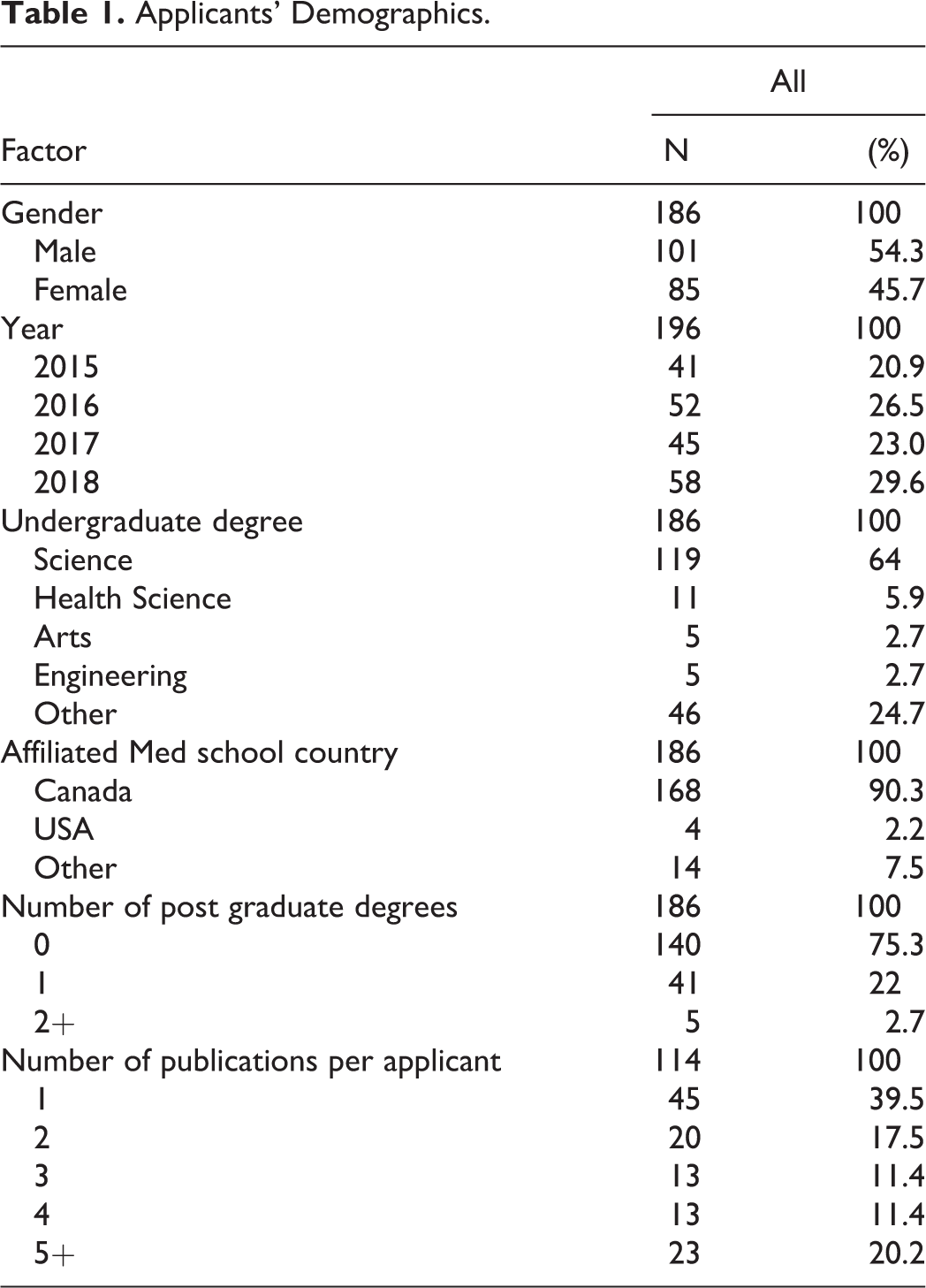
A total of 437 self-reported publications were extracted from the applicants’ CVs. Sixty-four (14.6%) were excluded from the analysis since they were non peer–reviewed articles such as abstracts, conference proceedings, and nonscientific publications. An additional 10 duplicate publications were removed from repeated applications which rendered a total of 363 peer-reviewed self-listed publications. Most applications had at least 1 self-reported publication (n = 125, 64%), while 71 application had no self-reported publication (n = 71, 36%). Out of the applications that included at least one self-reported peer-reviewed publications, 45 (36%) had 1 publication and 20 (16%) had 2 publications. The highest number of self-reported publications by one applicant was 30 publications.
Out of the 363 non duplicate self-reported publications, 318 (87.6%) were “verified accurate.” Forty-two (11.6%) publications were verified with 48 minor changes (found differently than cited). These belonged to 32 applicants. Out of the 48 minor variations, 15 (31.3%) had a missing author, 4 (8.3%) had an additional author, 15 (31.3%) had a change in author order list, 9 (18.8%) had an incorrect title, and 5 (10.4%) had an incorrect journal name. Only one publication was non-verifiable because the applicant did not include the author list but rather mentioned that they are the “first author.” Finally, only 2 publications (0.55%) by 2 different applicants were not found and deemed to be “ghost publications” (Figure 1).
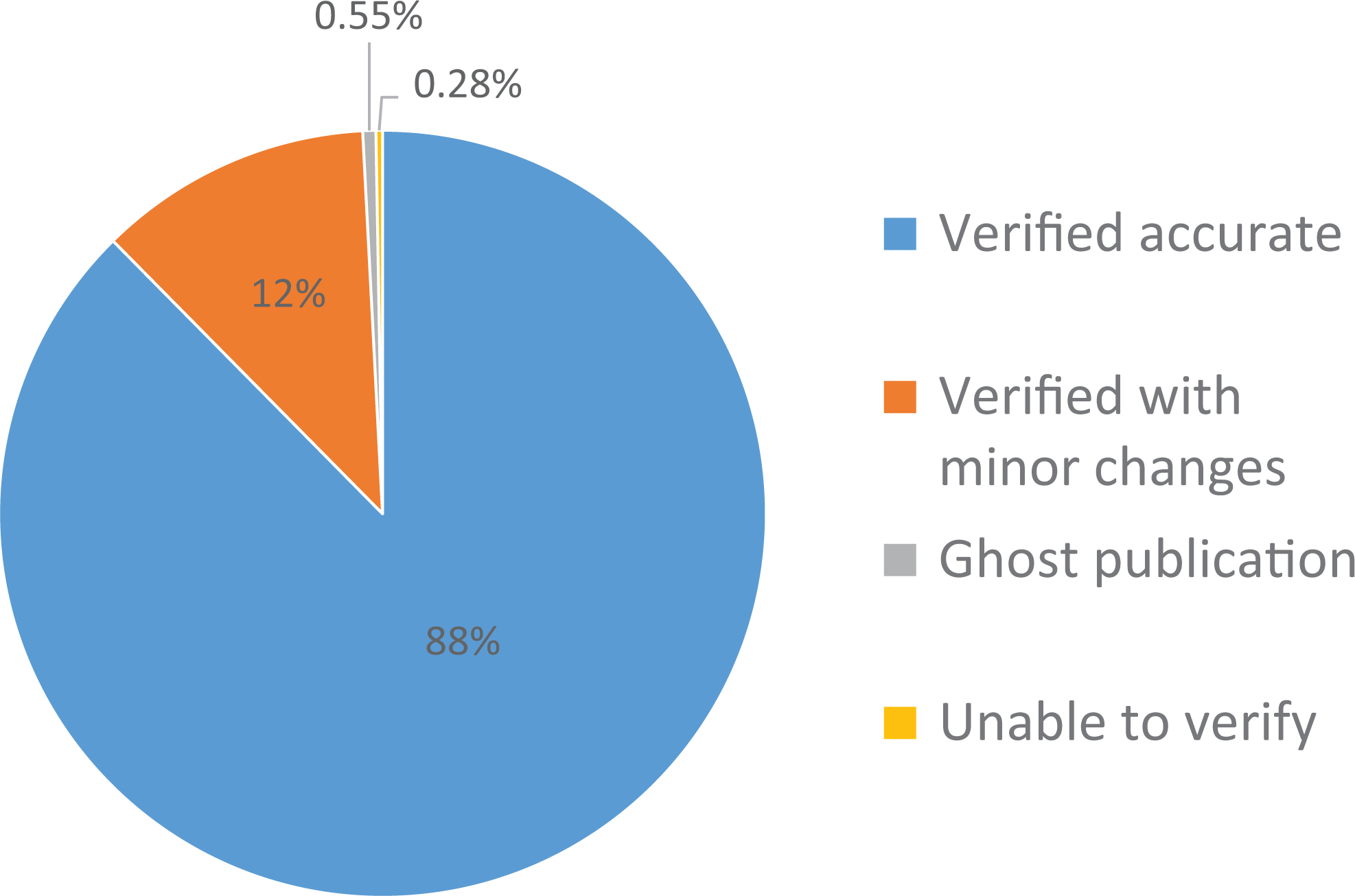
Distribution of ghost publications among total number of citations.
Discussion
The study herein is the first to present data on the rate of fraudulent or ghost publications in a pool of applicants applying to a Plastic Surgery program in Canada. The data demonstrates a ghost publication rate of 0.55%, the lowest of all studies on this subject in Plastic Surgery.
The medical profession prides itself on its moral foundation. While physicians strive to uphold the highest standards of professionalism, there have been notable instances of unprofessionalism in the medical field. 13 In fact, previous literature has demonstrated an association between unprofessionalism among physicians and earlier professional misconduct during medical training. 14,15 Applicants to plastic surgery residency programs use several strategies to strengthen their applications such as preforming well on elective rotations, participating in research projects and other extracurricular activities, and many others. However, our study shows that falsifying publications on their CV is not a common strategy used.
Three previous studies have demonstrated that the rate of ghost publications in applicants applying to Plastic Surgery programs in the United States (US) varied widely from 2% to 14%. 4,11,12 There are several possible reasons that could account for the wide variability in rates of ghost publications between our study and the previous literature. The first might be how ghost publication is defined. For example, Rodriguez-Unda et al, defined ghost publication as any publication where the author was not named in the authorship list or the publication was not found in the literature, 11 while Larson et al, defined it solely based on whether the publication existed or not. 4 Both studies included text books chapters and other non peer–reviewed publications. The authors of the present study deemed a publication to represent a ghost publication only if it did not exist in the literature. On average, it takes between 4 and 5 years from initiation to publish a study, therefore, we acknowledge that authorship changes occur after submission/tentative acceptance and therefore did not include that as part of the definition of ghost publications. 16 Moreover, we exclusively studied ghost publications in peer-reviewed manuscripts due to the fact that other types of publications such as conference proceeding and non peer–reviewed articles have less strict authorship criteria and are more likely to not be indexed in scientific databases. Textbook chapters were also excluded because their lag time (between acceptance and actual publication) could be very long, in the order of years. A sub analysis of the previously published papers demonstrates that a notable amount of the ghost publications seen in their studies were not peer-reviewed journal articles but rather text book chapters and non peer–reviewed publications. Therefore, out stricter inclusion criteria implemented probably contributed to the lower rate of ghost publications compared to previous studies.
Another reason that may have contributed to our results differing from previous literature is that 2 of the previous studies on ghost publications in Plastic Surgery were conducted before 2012. There has been a huge emphasis on implicit and explicit teaching of professionalism in medical curriculums in the last several years, 17,18 which might have diminished professional misconduct among medical students. While Rodriguez-Unda et al, was published in 2020 and still showed quite a high rate of ghost publications, this could be explained by their liberal inclusion criteria which included text books and non peer–reviewed articles. Finally, this study is the first to assess the rate of ghost publications in applicants applying to a Canadian Plastic Surgery residency, as opposed to the other studies which assessed US Plastic Surgery residency programs. Both the US and Canadian medical education highly value professionalism; however, previous studies have shown that Plastic Surgery residency programs in both countries assess applicants using slightly different criteria. Specifically, there is more emphasis on objective measures such as standardized board exam scores and research publications in the US, while Canadian Plastic Surgery programs highly value subjective measures such as performance on clinical electives. 19,20 We speculate that the higher emphasis on objective measures of success such as research publications might put more pressure on applicants to US programs to falsify publications. Future studies should investigate methods of increasing professionalism and instilling its importance in future plastic surgery trainees. Furthermore, we encourage future investigators to assess the rate of ghost publication in prospective cohorts.
The main limitation to this study is that it is restricted to applicants to a single Canadian Plastic Surgery residency program. However, unlike the US, there are only 13 Plastic Surgery residency programs across Canada, therefore a large number of applicants apply to the majority of programs. In fact, there were a total of 267 applications to Canadian Plastic Surgery residency programs from 2015 to 2018 which means the current study’s sample size comprised 73.4% of the total number of applicants. Another limitation is the lack of statistical analysis to demonstrate any potential associations between ghost publications and other covariates. However, due to the very low rate of ghost publications (2/363), it was not possible to elicit any meaningful statistical associations.
Conclusion
The rate of ghost publications in a recent cohort of applicants to a Canadian Plastic Surgery residency program is 0.55%, which is notably lower than previous studies. While the low rate of publication infidelity in Canada might suggest that recent medical curriculum reforms which emphasize the importance of professionalism are promising, the presence of any ghost publications indicates that there is room for improvement in professionalism and integrity development. Moreover, the authors suggest the need for increased awareness at the residency and fellowship level to continue to uphold the highest levels of professional and ethical virtues. Continued efforts to educate residency applicants on the importance of honest and accurate reporting of scientific publications is likely warranted. Finally, the relatively low rate of ghost publications found in this study is a testament to the high moral integrity of the majority of applicants.
Footnotes
Declaration of Conflicting Interests
The author(s) declared no potential conflicts of interest with respect to the research, authorship, and/or publication of this article.
Funding
The author(s) received no financial support for the research, authorship, and/or publication of this article.
