




Abstract
Endometriosis, a chronic condition affecting women worldwide, remains a complex and enigmatic disease. Despite its appearance and debilitating symptoms, the lack of sufficient information about endometriosis often leads to misconceptions and stigmatization of women. This literature review aims to shed light on the phenomenon of stigma surrounding endometriosis and its profound impact on the mental health of affected women. The search for relevant literature was conducted in the databases PubMed, ScienceDirect, and Scopus. Inclusion criteria for the studies were as follows: patients with endometriosis, exploration of the phenomenon of stigma in this sample, qualitative or quantitative design, publication after 2000, and written in English. Out of the total of 478 articles identified from the three databases, 6 articles met the inclusion criteria for this literature review. The review’s findings indicate that women with endometriosis encounter stigma from an early age, extending from their school years into adulthood. Employers and family members often question the severity of their pain, while menstrual pain is unjustly normalized as something women should endure. The impact of this stigma and criticism on the mental health of these women is profound, leading to feelings of despair, social exclusion, and even suicidal thoughts. In conclusion, this literature review underscores the pressing need for increased awareness and efforts to address the stigma surrounding endometriosis.
Introduction
Endometriosis is a chronic and progressive condition that exerts a considerable impact on various aspects of a woman’s life, encompassing personal, intimate, and professional spheres. 1 The prevalence of endometriosis is 10%–15% of all women of reproductive age and symptoms include, but are not limited to, chronic pelvic pain, dysmenorrhea, alterations in menstrual cycles. 2 Moreover, endometriosis is commonly associated with infertility, impacting sexual functioning, self-confidence, and the couple’s relationship. 3 These factors can significantly contribute to the likelihood of experiencing anxiety and depressive symptoms among affected women.
In addition to these challenges, women afflicted by endometriosis frequently experience lower health-related quality of life compared to those without the condition. Relevant meta-analyses have revealed a higher prevalence of depressive symptoms in women with endometriosis, and other studies have indicated a greater incidence of anxiety in this population which was thought to be a result of the intensity of the pain.4,5 In a cross-sectional study with 79 women, 44.3% presented depressive symptoms and 25.3% presented anxiety, while 31.7% reported stress symptoms. 6 Nonetheless, a recent body of research argued that not all women with endometriosis necessarily experience higher distress levels compared to healthy women, despite the undeniable challenges posed by the condition.7,8
While it may often get overlooked in research, stigma could be an underlying factor that contributes to diminished psychosocial health among women living with endometriosis. Based on Goffman, 9 stigma is a “profoundly discrediting” and socially undesirable trait. Individuals with such deeply discrediting attributes often face stigmatization, being labeled as weak, dangerous, or bad. Building upon Goffman’s research on stigma, numerous studies have reaffirmed that women perceive menstruation as a concealed and embarrassing period of contamination, associating it with shame and negativity, resulting in social stigma.10–12 In this context, menstruating women can be referred to as “discreditable individuals,” as per Goffman. 9 These women experience differences and symptoms that are not immediately evident to those with whom they interact such as family, friends, and health providers. This is due to the absence of a definitive measurement that can assess their symptoms, and menstruation pain often gets normalized by individuals. 13 Moreover, endometriosis-related stigma might act as a hindrance to early diagnosis. Research estimates suggest that the average diagnostic delay spans from 4 to 11 years from the onset of symptoms to the confirmation of endometriosis, leading to increased symptom severity, worsened physical and psychosocial consequences, and delayed access to effective treatment and care. 14
Through a comprehensive review of existing research, this study seeks to shed light on the various aspects of stigmatization experienced by women with endometriosis and the impact on their mental health. By synthesizing findings from qualitative and quantitative studies, the review aims to identify patterns of stigmatization encountered throughout different stages of life. Ultimately, the literature review intends to increase awareness and understanding of the stigmatization faced by women with endometriosis. By highlighting the significance of this issue, the review aspires to advocate for more compassionate and supportive environments, empowering healthcare providers, policymakers, and the general public to play an active role in combatting the stigma associated with this challenging condition.
Methods
To search for articles related to stigma among endometriosis patients, the following databases were used: PubMed, ScienceDirect, and Scopus. The search for relevant literature was conducted in June 2023 using the keywords “endometriosis” and “stigma.” Articles were deemed eligible if they: (1) included endometriosis patients, (2) explored stigma within this sample, (3) were either qualitative or quantitative studies, (4) had been published after 2000, and (5) they were written in English. Reviews and letters to the editor were excluded. The steps of article selection for this literature review are presented in detail in the flowchart (Figure 1).
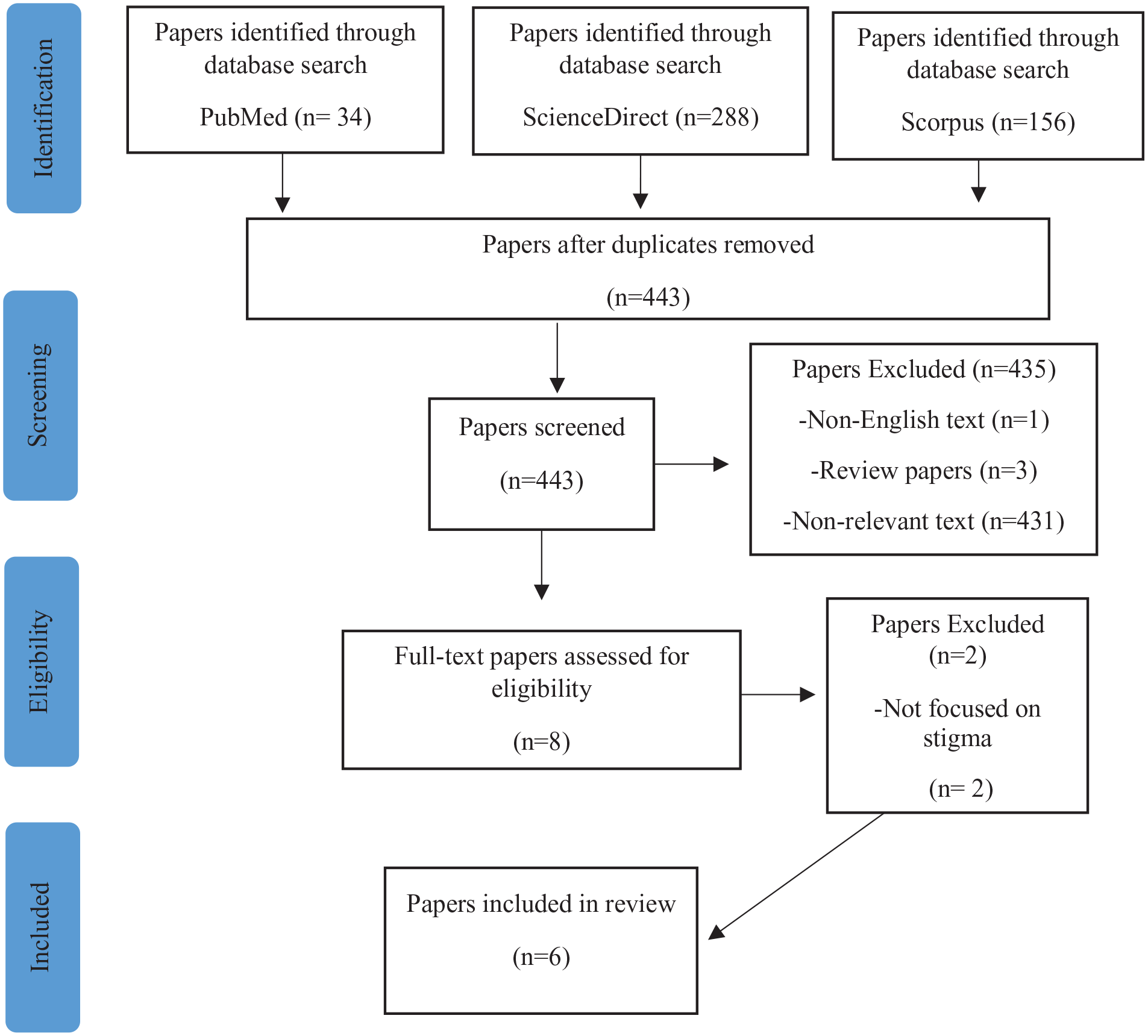
Flowchart of literature review.
Results
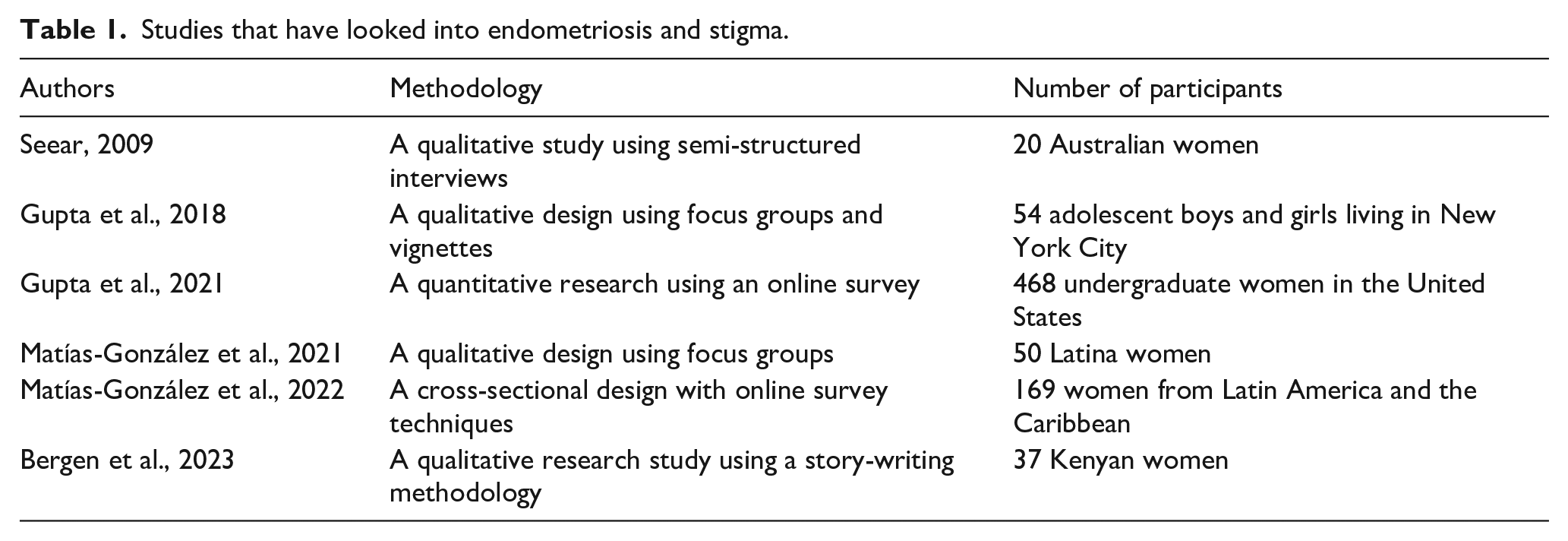
From the database search for relevant literature, 478 articles were identified across the three databases. After removing duplicates and applying inclusion criteria, six articles were included in the literature review. Out of the six included articles, four used qualitative methodologies and two were quantitative studies (Table 1).
Studies that have looked into endometriosis and stigma.
Self-esteem and social isolation
Exploring the impact of stigma on self-esteem and quality of life, Matías-González et al. 15 conducted a cross-sectional study among 169 women with endometriosis from 14 Latin-American and Caribbean countries. Endometriosis-related stigma was measured using the Stigma Scale for Endometriosis (SSE) which measures both internalized and enacted stigma. Further, an adapted version of the Stigma Stress Scale (CogApp) was employed to measure the stress levels specifically induced by endometriosis stigma as higher scores in this scale reflect higher stress due to endometriosis-related stigma. Finally, the evaluation of self-esteem was made through the Rosenberg Self-Esteem Scale. All the measures were adapted and translated to Spanish. Analyses of the data revealed high levels of endometriosis stigma which was suggested to be associated to worse endometriosis symptoms and poor quality of life. Further, it was found that there is a significant relationship between self-esteem, stigma related to endometriosis, and the impact of incapacitating pain on the quality of life of individuals with endometriosis in Latin America and the Caribbean. The study highlights that the negative perceptions and stereotypes associated with endometriosis contribute to the negative impact of incapacitating pain on the overall well-being, quality of life, and self-esteem of women with endometriosis. Understanding and addressing this endometriosis-related stigma may be crucial in improving the overall well-being and mental health of individuals living with this condition in the region.
Menstrual stigma was also found to prevent help-seeking and increase the feeling of isolation. Social exclusion and fear of being rejected by their romantic partners due to their long-term endometriosis symptoms was commonly voiced by women. 16 As a result of the social exclusion experienced by friends and romantic partners, feelings of hopelessness and even suicidality were voiced. 16 Additionally, there was unanimity among adolescent girls and boys that menstruation carries a significant stigma. 17 Menstruation was commonly through to be linked with weakness and was regarded as a taboo subject. Comparisons between the stigma surrounding mental health issues, such as depression, and the stigma surrounding endometriosis were also made. Participants noted that both conditions are less understood, less believed, and taken less seriously compared to other health problems. This pervasive stigma was thought to hinder open discussions about menstruation in general and also affect conversations about symptoms related to endometriosis. Notably, participants remarked that this issue is particularly prominent in a school environment, as the lack of menstrual health education was associated with the girls’ reluctance to discuss such matters openly.
Concealment and diagnostic delay
Stigmatization of endometriosis has also been suggested as one of the reasons women do not receive prompt diagnosis. In a qualitative study conducted in Australia, women described menstruation and endometriosis symptoms as attributes that needed to be concealed. 18 To avoid stigmatization related to menstruation and endometriosis, women developed a strategic management of information about their menstrual cycle, which was also referred to as “menstrual etiquette.” Women reported that heavy bleeding and pelvic pain during workdays had to be managed, otherwise they would get in “trouble.” Aside from embarrassment, women felt that they get judged by their colleagues, with some of them accusing them of malingering and assuming they try to avoid their work responsibilities. There were also instances where women were encouraged to conceal their endometriosis to avoid being exposed to stigmatization, while family, friends, and partners tended to normalize pain. What the study highlights is that the diagnostic delay is not solely a result of women’s inability to differentiate between “normal” and “abnormal” menstruation. Instead, even when women recognize irregularities and abnormal symptoms in their menstrual cycles, stigmatization can hinder their willingness to disclose these issues. Specifically, women reported facing disbelief from employers, partners, and family members who perceive menstruation as a normal and non-pathological process. This disbelief often includes ostracism, criticism, and attempts to downplay menstrual pain or redefine menstrual irregularities as normal.
Disbelief and the notion that menstrual pain is normal were also discussed by Latina women in a qualitative study. Matías-González et al. 19 found that menstrual pain is often perceived as normal by families, health care professionals, and society. This notion was perceived as having been influenced by the stigmatized status of menstruation itself, leading to a lack of understanding and communication taboo surrounding the topic. As a result, Latina women living with endometriosis reported choosing to hide their symptoms and suffer in silence due to the fear of being stigmatized or not being understood. The study also revealed that there is a tendency among relatives, partners, and health professionals to believe that women should be able to manage pain during menstruation and sexual intercourse. This belief was viewed as having contributed to a sense of inability to disclose the true extent of suffering experienced by these women, as they felt pressure to endure the pain silently as if it were an expected part of being a woman.
Life disruptions
Gupta et al. 20 explored life disruptions and anticipated stigma among college students in the United States. The study found that 88% of the participants experienced disruptions related to symptoms consistent with endometriosis. These disruptions were categorized into three main areas. Social disruptions had the highest frequency of reported disruptions, with 82.7% of participants experiencing challenges in their social life due to endometriosis symptoms. Social disruptions could encompass difficulties in maintaining relationships, engaging in social activities, or participating in social events. About 58.8% of the participants reported experiencing disruptions in their academic pursuits due to endometriosis symptoms. These disruptions could include difficulties in attending classes regularly, focusing on studies, or meeting academic requirements. Approximately 34.4% of the participants faced disruptions in their work or professional life because of endometriosis symptoms. Work disruptions could involve absenteeism, decreased work productivity, or limitations in fulfilling job responsibilities. Disruptions were related to higher levels of anticipated stigma, but the study highlighted that participants belonging to specific demographic groups (immigrants, sexual and gender minority women, and Black and Latina) experienced higher levels of anticipated stigma in comparison to U.S.-born, straight/heterosexual, and White participants. These findings emphasize the importance of considering intersectionality in future research on endometriosis. Intersectionality recognizes that individuals belong to multiple social categories, and these intersections can compound and influence their experiences of stigma and discrimination.
In a qualitative study, schools were identified as the primary source of stigmatization. 16 Based on women’s experiences, school faculties and teachers failed to offer sufficient practical and emotional support for their symptoms. Moreover, teachers inadvertently worsen girls’ difficulties by using stigmatizing labels like “attention-seeking,” which dissuades adolescents from seeking help for their troubling menstrual symptoms. However, stigmatization would continue in their adult life and would expand in their workplace. Feelings of shame, criticism, and negative reactions from colleagues and employers were some of the common experiences that led women to quit their jobs or change their career paths.
Discussion
The findings of this review reveal that women with endometriosis often face stigmatization due to the debilitating symptoms they experience, which significantly impacts their quality of life. An important insight from this study is that stigmatization can begin at an early age and permeate various aspects of a woman’s life, including educational environments and professional settings. Experiences of stigmatization in school, work, family, and social contexts were reported by participants.16,18–20 The current literature review highlights a concerning lack of knowledge among the general public about endometriosis and its profound effects on a woman’s life. This knowledge gap contributes to unfair labeling of affected women in schools,16,20 leading to unwarranted criticism directed toward them.18,19 Additionally, it exerts pressure on women to seek “safer” professional environments by quitting their jobs or pursuing alternative career paths.
Stigma is pervasive, even within family environments, where women fear rejection by romantic partners, and menstrual pain is normalized as something women must endure.16,19 Although the diagnostic delay in endometriosis is confirmed, 14 endometriosis-related stigma, combined with the taboo around discussing menstruation, could further prevent open sharing of symptoms and delay diagnosis, hindering timely clinical interventions. This review also reveals that the broader community, close families, and social environments lack knowledge and perpetuate criticism, severely affecting women’s health and well-being. The experienced stigma exacerbates feelings of isolation and fear of rejection, significantly lowering the quality of life. This literature review demonstrates that the negative impact of stigma reaches distressing levels, as it also correlates with decreased self-esteem and even suicidal ideations among affected women. Prior studies have suggested that the intensity of endometriosis symptomatology could be associated with a higher prevalence of depression and anxiety among affected women.4,5 Nonetheless, stigma could be an additional factor exacerbating women’s mental health. These findings underscore the urgent need for policy changes and robust support systems to address the pressing issues faced by women with endometriosis.
The current review has some limitations that need to be mentioned. The main limitation, yet a significant finding of this review, is the small number of published studies concerning this particular topic. However, this is because the stigma surrounding women with endometriosis is an area that has been under-researched and requires more scientific attention. Additionally, another important limitation is that in the majority of studies included in the literature review, the sample size, that is, the number of participants who completed the study, was very small, making it impossible to generalize the findings of each study. Therefore, the findings of this review should be interpreted with caution. Finally, another limitation is that the review included studies that are only published in English, which means that, although only one study in another language emerged, there might be studies concerning this specific topic published in other languages and not included.
Recommendations for future directions
One promising avenue for future research is to delve into underexplored aspects of endometriosis stigma. This could include investigating the experiences of marginalized populations, such as LGBTQ+ individuals, ethnic and racial minorities, or individuals with varying socioeconomic backgrounds, to gain a more comprehensive understanding of how stigma affects different groups. Further, individual case studies can provide valuable qualitative insights into the lived experiences of individuals with endometriosis. These narratives can offer a rich source of data for understanding the multifaceted nature of stigma and its impact on individuals’ lives. Researchers may also consider conducting empirical studies that directly measure stigma as an exposure variable. This could involve developing and validating scales or instruments to assess stigma in the context of endometriosis. Such studies would enable a deeper exploration of the factors contributing to stigma and its consequences. Finally, interdisciplinary research involving healthcare professionals, social scientists, and psychologists could assist with better understanding the causes and consequences of stigma.
Creating effective policies to address endometriosis-related stigma is crucial for improving the well-being and quality of life for individuals living with this condition. Public awareness campaigns to educate the general populace, healthcare providers, and policymakers about endometriosis, its prevalence, symptoms, and the physical and emotional toll it takes on those affected should be funded and developed. To ensure that young people are educated about reproductive health conditions, including endometriosis, and to reduce stigma from an early age, information should be incorporated in school curricula. Additionally, mandatory training programs for healthcare providers, aiming to improve their understanding of endometriosis, its symptoms, and best practices for diagnosis and treatment should be implemented. During these programs, healthcare professionals should be encouraged to adopt a compassionate and empathetic approach when dealing with patients, acknowledging the pain and emotional distress associated with endometriosis. Regarding workplace challenges, anti-discrimination policies should be enforced in the workplace to protect employees with endometriosis from discrimination and to ensure reasonable accommodations for their health needs. Individuals with endometriosis should be protected by laws against discrimination in employment, and advocacy groups and regulatory agencies to support individuals and enforce legal remedies should be established.
Conclusion
The current review highlights the prevalence of endometriosis-related stigma among both adolescent and adult females, significantly impacting various aspects of their lives. Negative reactions and criticism of their symptoms often lead to disruptions in their daily lives and poorer mental health. While acknowledging the well-documented evidence on the lived experiences and societal impacts of endometriosis, there is a growing consensus on the necessity of directing research efforts toward investigating the fundamental causes and pathophysiology of endometriosis. Understanding the etiology of this condition is crucial for the development of improved treatments and preventive measures, which, in turn, could alleviate the burden of stigmatization. As we strive for a comprehensive understanding of endometriosis, a balanced research approach encompassing both lived experiences and pathophysiological mechanisms is warranted. Further, raising awareness of endometriosis symptoms should begin in schools and extend to the patients’ families and romantic partners. Additionally, policies and provisions in employment and support systems need development to better support women with endometriosis. It is crucial to create a society where women with endometriosis feel fully supported, without the burdening notion that their condition excludes them from leading fulfilling lives alongside everyone else.
Footnotes
Data availability statement
Data sharing not applicable to this article as no datasets were generated or analyzed during the current study.
Declaration of conflicting interests
The author(s) declared no potential conflicts of interest with respect to the research, authorship, and/or publication of this article.
Funding
The author(s) received no financial support for the research, authorship, and/or publication of this article.
