



Abstract
Development of a biocompatible functional dental occlusion requires maxillo mandibular relation records. Clinical errors in these physical records are mostly caused by protracted clinical setting times. If dimensionally accurate and stable, recently introduced fast and superfast vinlpolysiloxane-based recording materials could reduce these inaccuracies, however such studies have yet not been attempted. This in-vitro study determined the post-polymerization dimensional accuracy of novel fast/superfast vinyl polysiloxane (VPS)-based jaw relation recording materials (JRRM). Four VPS-based JRRMs (Primo, Mark 3, Jetbite, and Defend) with three polymerization variants [regular, fast, and superfast] were investigated for dimensional accuracy. 180 samples allotted to four controls [PR, MR, JR, DR] and eight experimental [fast set (PF, MF, JF, DF); superfast (PSF, MSF, JSF, DSF)] were observed under a stereomicroscope using three different measurement coordinates between the X and Y axes, as specified by american dental association specification number 19. A one-way ANOVA (Kruskal-Wallis) rank test determined median scores, followed by a post hoc (Dunn) test. All probability “p” values were judged to be significant at 0.05. The one-way ANOVA showed significant differences between studied groups, with all regular setting JRRMs except Mark 3 showing the least overall linear changes, followed by super-fast set and fast set. Gp MR showed the highest [Mdn(IQR); 25.19(0.02)], while Gp DSF showed the least [25.00(0.02)] against original die measurements. All fast-set and superfast-set JRRMs showed expansion in terms of physical change. Mark 3 (regular, fast, and superfast) showed clinically unacceptable dimensional changes after 1 h of VPS-based JRRM setting. Defend Superfast was the most accurate material, including regular. Clinically, different variants fulfill dimensional accuracy and stability at various time intervals, therefore different variants may be indicated for specific purposes in fabrication of occlusion for a dental prosthesis.
Introduction
Establishing a working occlusion that is in dynamic balance with each component of the stomatognathic system is one of the primary goals of various prosthodontic treatment options. Both removable and fixed prosthodontic treatment options vary in their abilities to influence the temporomandibular joint and masticatory muscles through occlusion. 1 Occlusion for various fixed prosthodontics varies according to the type (implant-supported or fixed partial denture) of prosthodontic option and at times may include other essential measures to correct existing occlusion (occlusal splints).2,3 Within each type, the prosthodontic treatment option (implant overdenture vs fully bone-anchored, spring-fixed partial denture vs fixed movable bridge) chosen will require individual occlusal characteristics that may largely depend on the presence or absence of the opposing and adjacent jaws/teeth.4,5 Fixed prosthodontic occlusion has a direct influence on the masticatory muscle function since interferences during the act of occluding teeth cause muscle hyperactivity and alteration of contractions. In removable prosthodontics, such interferences, while having less pronounced effects on the muscle, affect the prosthesis’s stability and its function. 6 Irrespective of the prosthesis type, these occlusal errors are incorporated while recording the relations between the maxillary and mandibular jaws. The relation between the two arches is recorded in an ideal, dimensionally stable material that should continue to maintain accuracy over a desired period of time, depending upon the purpose and the timing of developing artificial occlusion. This feature is required to compensate for the laboratory transfer time and, more significantly, verify the accuracy once the artificial occlusion is developed, which itself has multiple stages depending upon the prosthesis option. Since transfer inaccuracies were first brought to clinicians’ notice, 7 various researchers have identified them to be primarily due to poor material quality, 8 followed by the clinical method used, 9 patient-related characteristics, and incorrect clinical manipulation. 10 Clinical variance (expansion or contraction) and maximum tolerance for these mounting errors are 0.11 mm laterally and 0.07 mm anteroposteriorly, which act as guidelines for manufacturers, researchers, and clinicians. 11 Jaw relation records (JRR) are of various types depending upon their function, with a centric and eccentric relation (protrusive, right, and left lateral) record usually sufficing for most prosthodontic occlusion. Additionally, clinicians use a check record of the same patient to verify the correctness of a particular JRR. Limitations on tooth displacement resistance, high post-setting rigidity, minimal dimensional changes, high flow for correct occlusal details, clinical workability, inertness on tissues, verifiability, and disinfection ease are some of the distinctive features that the jaw relation recording materials (JRRM) should possess.12–14 The first such record was prepared in a blend of natural waxes as early as 1756. 15 Since then, different materials like dental waxes,16–24 gypsum-based (dental and impression plaster),16,25 acrylic resins,12,26,27 zinc oxide-eugenol combination-based impression pastes,15,28,29 and elastomers (polyether-based17,18,30,31 and vinyl-terminated polysiloxanes8,16–24,32,33) have been extensively investigated.
The vinyl-terminated polydimethylsiloxanes (VPS; polyvinyl methylsiloxane) are versatile polymers with diverse applications in medicine due to their physiological inertness, hemocompatibility, low toxicity, thermal stability, antiadhesive properties, solubility, film-forming ability, and resistance to degradation.34–36 Siloxane (SiO2), found in various organisms, has been proposed as a replacement for medico-pharmaceutical resources in the past five decades. 35 Biomaterial compatibility requires factors such as lack of inflammatory, allergic, or noxious reactions; obliteration of formed essentials; changes in enzymes or proteins; immunological reactions; carcinogenic effects; and tissue deterioration.35,37,38 Polysiloxanes have unique properties due to their hybrid nature, consisting of a polar inorganic supporting skeleton and non-polar functional organic quartets.35,38 They have five principal structures ranging from simple linear to complex forms (branched, cyclic, crosslinked) that can easily transform into a 3-D network.8,33,36,38 Depending on the number of functional monomers, they can be mono-, di-, tri-, and tetra-functional.35–38 Their superior dimensional accuracy when used as JRRs has been reported in both clinical16,28 and in vitro studies.8,17–22,29,30,32,33 While a dominant number of in vitro studies reported better dimensional accuracy of VPS over other elastomers like polyether,17–22,29,30 a few studies found polyether stability to be less compromised13,15,39,40 when used as JRRM. Few studies, however, also found that while polyether showed lesser early dimensional changes, the VPS-based materials showed fewer changes over different time intervals (48 and 72 h). Other studies found polyether-based JRRMs to be less accurate than VPS-based.29,41 Sharma et al. 29 reported accuracy of VPS over a period of 7 days, while Lozano et al. 41 noted negligible changes in injectable silicones (Futar D) after 22 days. Recently, with the evolution of digital dentistry, there has been a lot of interest generated in VPS-based JRRM. Modifications have resulted in not only improving the short- and long-term linear dimensional accuracy of conventional (standard or regular) VPS-based JRRM but also significant advances in terms of manipulating and dispensing the material in the desired areas of interest. Scannable, transparent, and fast-setting VPS-based JRR have been launched with high claims of accuracy over long time periods. Despite intraoral scanning of natural dentition eliminating the errors that are associated with physical impressions, the use of physical VPS-based JRRMs is considered a standard procedure in recording jaw relations. This is mainly due to the less accuracy of quantifying occlusal contact area using digital scans (3D intraoral scans).42,43 VPS-based JRRM that can be scanned has mainly slight differences in the percentages of basic elemental constituents, with higher percentages of silicon, carbon, and oxygen.8,32,33 The addition of titanium dioxide renders the property of scannability, which enhances the reflectivity of the JRRM. Yazigi et al.’s, 44 study compared conventional and scannable registration materials for maxillary-mandibular relationships and dimensional stability, finding significant differences in vertical discrepancies after storage times. Conventional JRRMs have also seen advancements in terms of making them clear or transparent in appearance after setting, while other advances fast and superfast have targeted the clinical variables associated with the difficulties encountered by clinicians in making records, especially for patients who have poor neuromuscular control and coordination.
Making a precise JRR in a prosthodontic patient is difficult and relies on the patient’s ability to hold the mandible in a specific position until the material sets. The material requires having high flow at the time of recording occlusal anatomy while taking less time to become hard at the same time. Minor movements during setting drag the partially set elastomer, increasing the chances of incorporating voids while at the same time distorting the whole complex. While patients with poor neuromuscular control have little or no control over holding the mandible in one place, patients with excellent neuromuscular control have a different complex issue. Mastication is an autoloading orofacial cyclic movement controlled by a cardinal (central) pattern generator (CPG) within the brainstem that can be influenced by descending and recurrent feedback from somatosensory receptors. 45 Intentional movements, like opening or protruding a jaw, are propelled by the primary motor cortex and the cortical masticatory area. Irrespective of the status of neuromuscular control or coordination, any material between the teeth is perceived as food, which results in the patient closing the mandible in either maximum intercuspation or habitual intercuspation, while the JRR is supposed to be made at centric relation. Dental plaster JRR, having a consistency almost similar to water, decreases this tendency of the patient, thus allowing ease in making JRR at a centric relation.8,32 With all these factors significantly affecting the outcome for the accuracy of JRR, the VPS-based JRRM should be set as quickly as possible to minimize the effects of involuntary or voluntary mandibular movements. With the introduction of superfast-setting and fast-setting JRRM by many manufacturers, it therefore becomes imperative to check their accuracy, especially when the percentage or actual chemical constituents have been changed. This study was therefore aimed at investigating the linear dimensional accuracy of regular and quick (fast and superfast) setting JRRM. The objectives of the study are to determine whether they are as accurate as regular JRRMs in terms of linear accuracy and, in case they differ from the original dimensions, whether this change is in the form of expansion or contraction. The study will only examine the accuracy at 1-h intervals because establishing the accuracy is crucial before checking the long-term accuracy. We think that regular and quick-setting JRRMs will differ, but the null hypothesis says they won’t.
Materials and methods
Ethics: This in vitro laboratory study followed the protocol of the concerned institute and the university, which mandates ethical approval irrespective of the study type. Written approval was procured from Scientific research committee, College of dentistry, Jazan University (vide reference number CODJU-2331F). Materials being investigated for outcome are biocompatible with humans as indicated by their local and international approvals.
Study design: A multiple-group comparative pretest-posttest experimental research design was used that consisted of two control types (original die, regular setting) and two experimental [fast setting (F) and superfast (SF) setting] JRRMs of four different brands by different manufacturers.
Operational definitions: In context with the present research, the jaw relation record defines the static relationship between opposing natural or artificial teeth or arches, as in the case of a complete denture prosthesis. 46 The JRR has three parts that identify its specific functions, chiefly stabilizing, fixing, and guiding parts. Each record is bound to capture three specific lines of different widths but the same length, representing the ability of the material to capture the details.
Biomaterials Specifications: The experimental and the ancillary materials used during the course of preparing specimens and testing them are presented in Table 1, which also specifies the properties and manipulation variables associated with each material. To standardize and minimize the confounding effect of manipulation, all experimental materials chosen were dispensed and manipulated automatically using a manufacturer-specified automix dispenser having plastic automix tips. Based on the setting time [regular set, fast set, superfast set], four different brands of VPS-based JRRMs [Primo, Mark 3, Jet Bite, and Defend] were investigated.
List of materials, manufacturers and their specifications.

JRRM: jaw relation registration/recording material; ml: milliliters; MT: mixing time; WT: working time; ST: setting time; H: hardness; DR: detail reproduction; DS: dimensional stability; D: days; Hg: mercury; C: centigrade; F: fahrenheit; °: degrees; mm: millimeter; s: seconds; μm: micrometer; Compositions: Base cartridge: Methylhydrogensiloxane (water repellent); other siloxane prepolymer [dimethylsiloxane copolymer (1–10%)]; hybrid silicone [Polysiloxane (<5%)]; filler silica (30%–50%); Pigment (10%–20%); Food dyes/aroma (0.1%–0.5%); Catalyst: Di vinyl polydi-methlsiloxane (vinyl terminated polydimethylsiloxane–ViPDMS); initiator-organoplatinic complex (0.01%–0.05%); Universal Precautions: eye irritant; use only vinyl gloves.
Specimen Standardization and Mold Designing (Figure 1): An austenitic stainless-steel die based on the requirements and guidelines by American Dental Association specification number 19 for non-aqueous elastomeric impression materials was produced mechanically using digital design and milling. 47 The die specifications are similar to those used in previous,13,17,20,29–31,39–41 and recent8,32,33 studies. According to the specifications, the die should be cylindrical-shaped and have at least three separable or detachable components that fit within each other. These three components [a cylinder-ruled block, mold former, and riser] are the ruled block, which has two vertical lines that intersect with three horizontal lines engraved. The horizontal lines are differentiated based on the width [small (24 μm), medium (55 μm), and large (85 μm)]. The surface details and the dimensions for each component are presented in a schematic sketch represented as Figure 2. The die components, when assembled, provide a specimen with a uniform thickness of 3 mm, on which the intersecting lines are engraved. The distance between the coordinates linearly provides the dimensional accuracy, while measuring the depth of each line provides the information of dimensional changes. The third component riser ensures easy removal of the specimen from the block without distorting the inscribed and recorded lines.
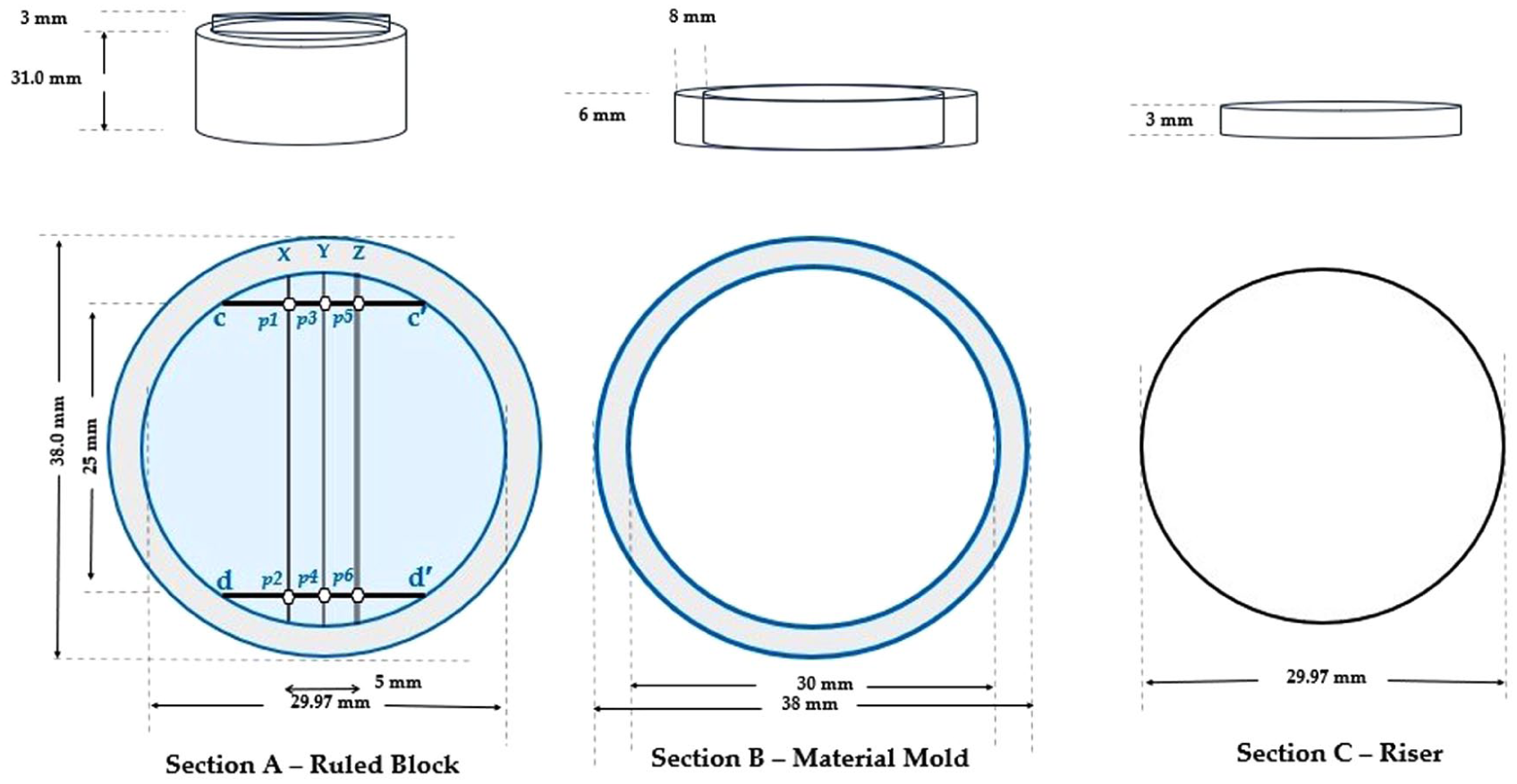
American Dental Association (specification number 19) recommended die characteristics for measuring dimensional accuracy and stability for non-aqueous elastomers.

Flowchart showing study design, variables and study groups.
Specimen preparation
Material Manipulation: Each specific material was loaded on their respective manufacturer-provided, gun-shaped dispenser and locked. To ensure that both pastes came out together in the same amount, initial material was extruded, and the nozzle was wiped. Each cartridge is a uniform double barrel having a base and catalyst pastes. An automix tip was then locked into the nozzles, and the plunger of the gun was pressed, which pushes the two respective plungers on the back side of the cartridge, moving them together at one time. While the material is being pushed into the automix tips, the spiral-shaped sections of the tip over a length of 6 inches keep extruding a uniformly mixed material at the tip. The material after mixing was directed directly on the top of the die after cleaning the die with a swab. To simulate the clinical conditions, the dispenser was sterilized [steam autoclave, prevacuum, 132°C, 3 min exposure] after every cartridge finished. Between each specimen-making, the dispenser was disinfected [isopropyl alcohol 15%] as per the manufacturer’s recommendations.
Preparing and Grouping Specimens (Figure 2): Individual dual-barrel cartridges of all related materials were mixed using a dispenser, with the auto-mix tip then directed on the surface of the ruled block. Once the block was filled throughout its entire surface, a glass slab laminated with a polyethylene sheet was placed over top to compress the material and minimize air bubbles while removing any excess at the same time. A mastication simulated load of 500 g was pressed on the slab, which also ensured opposing the material closure resistance that varies between 0.5 and 13.8 N.4,9,28 While setting, the mold was placed in a controlled water bath maintained at oral temperature. Once the setting time of each individual material was reached (Table 1), the mold was removed and the excess was cut, followed by finishing of fine edges. Before storing, the specimens in each subgroup were disinfected using 0.5% glutaraldehyde for a time period of 10 min. 48 This protocol is followed to simulate clinical conditions and is used for all elastomeric impression materials. Washing of each specimen was carried out under water for 15 s, followed by air drying at room temperature and then storage in 100% relative humidity for the test time of 1 h. A total of 15 specimens were allotted to each group according to the material type [regular, fast, and superfast]. Sixty samples represented the regular (R) [primo (PR), mark 3 (MR), jet bite (JR), defend (DR)]49–52 group, which served as respective controls for each experimental subgroup. Likewise, sixty samples were allotted to two experimental groups fast set (F) [primo (PF), mark 3 (MF), jet bluebite (JF), defend (DF)] and superfast (SF) [primo (PSF), mark 3 (MSF), jet bluebite (JSF), defend (DSF)] (Figure 2).
Measurement: Each specimen for each material type had a uniform 3 mm thickness and 30 mm diameter, with two vertical (CC′; DD′) and three horizontal lines (X, Y, Z) present on the surface. To ensure consistency in measuring, the intersection between the vertical and horizontal lines was identified and labeled as (p1, p2, p3, p4, p5, p6), with measurements being made between two successive points (p1 and p2, p3 and p4, p5 and p6). Measurements for all samples were standardized by placing the sample on the standard flat stage plate that is a part of the stereomicroscope. The measurements were taken on a stereomicroscope (Amscope, Irvine, CA, USA) that is equipped with a Universal Serial Bus charged-coupled device camera. All specimens were measured under an adjustable illumination (low, average, high) for the ring and backlight, while the line and spotlight had no adjustments. All specimens were observed and measured by a single operator who was first calibrated in standardizing the points of the coordinates to be recorded. For each point, the junction between the horizontal and vertical lines was taken as the point of coordinates. The operator examined each specimen through the diopter eyepiece of the stereomicroscope while adjusting the image for fineness of details using the focus knob at 10× magnification. 32 For each sample, three linear dimensions between lines CD and C′D′ represented at three different point coordinates, thus generating three measurements for each sample on individual analysis. The average of these three measurements was recorded as the final value of the specimen for that particular group. The original dimensions of these coordinates for the die, which also served as a control to determine the accuracy against the original length, were recorded as three repeated measures, with the average of three being taken as final.
Statistical analysis: A Microsoft Excel sheet (MS Excel, version 20H2) was used for inputting all the individual values for each specimen in each group under respective control and experimental categories. The data was first refined and then coded for running inferential analysis with the assistance of SPSS (Statistical Package for the Social Sciences, Version 25, IBM Corp., Armonk, NY, USA). For inferential statistical analysis, the individual values of each specimen in each subgroup were run for a normality test through Shapiro–Wilk analysis. The test results recommended using nonparametric tests with median, interquartile range, and mean rank scores as measures of central tendency. The median values obtained for each subgroup were then compared using a one-way ANOVA rank test (Kruskal-Wallis), followed by determination of within groups using a post hoc (Dunn) test after correction of the probability value using the formula [correct alpha = alpha/number of group pairs]. For differences between the subgroups, the probability value was set as equal to or less than 0.05 (p ≤ 0.05). For within-group differences, the probability value was 0.05/66 (p ≤ 0.00075).
Calculating changed dimensions between median values of each group against the original die values and the median values for each subgroup that served as control were expressed in terms of millimeters, which was converted into percentage changes using the mathematical formula D (%) = [(X – Y)/X ×100], where X was the mean length of either the die or the control group, while Y represented the median length of the experimental sample.8,33 Depending upon whether the difference was positive or negative, a symbolic expression of either the expansion or contraction was designated to the overall group, thus denoting the clinical significance of test results.
Results
Analysis of setting times: the setting time of regular setting JRRMs ranged from 60 to 180 s (Mark 3). For fast-setting JRRMs, the setting time ranged between 40 (Jet blubite) and 60 s. For super-fast-setting JRRMs, the setting time varied from 30 to 45 s (Mark 3). Defend regular set provided the highest working time of 120 s, while JetBlue Superfast had the least working time of 20 s.
Linear accuracy measures between experimental and control groups: The median values along with their quartile ranges and mean rank scores obtained among all groups are presented in Table 1. When compared to the original dimensions of the die, results show that all materials had an increase in length, indicating expansion of all respective materials, except Gp DSF, which showed no changes. Regular setting JRRMs showed fewer changes except for mark 3, which showed the highest changes among all other subgroups [Mdn (IQR); 25.19, (0.02)]. Overall, the fast setting shows higher changes, followed by superfast and regular being the least. There were statistically significant differences (p ≤ 0.05) between the subgroups that were analyzed, according to the one-way ANOVA Kruskal-Wallis rank test results (Table 2). Gp DSF [MRS [9]] ranked higher than all other subgroups, including the regular setting that acted as a control.
Comparative differences in the median values and interquartile range of vinyl polysiloxane-based jaw relation recording materials (JRRM) based on the setting times (regular; fast and super fast).

JRRM: jaw relation recording material; N: number; IQR: interquartile range; MRS: mean rank scores; p = probability value; H = difference between two or more groups of an independent variable on a continuous dependent variable.
Setting times: Defend Regular set = 60 s; Jet Bite Regular set = 60 s; Mark 3 Regular set = 180 s; Primo Regular set = 90 s; Defend Fast set = 60 s; Jet Blue Bite Fast set = 40 s; Mark 3 Fast set = 60 s; Primo Fast set = 60 s; Defend Superfast = 30 s; Jet Blue Bite Superfast = 30 s; Mark 3 Superfast = 45 s; Primo Superfast = 30 s.; (regular setting jet bite/fast and superfast setting is jet blue bite).
Interpretation of Groups: commercial brands = primo (P); mark 3 (M); jet bite (J); defend (D); regular setting = R; fast setting = F and superfast setting = SF.
statistically significant at probability 'p' value of less than or equal to 0.05.
Linear accuracy measures within different subgroups: a total of 66 pairs were compared in the post hoc (dunn) test, with corrected alpha being 0.00075 (p ≤ 0.00075). the test calculates the mean rank differences, the results of which are presented in Table 3. The versatility of the test allows a particular subgroup to be compared against all other subgroups, thus presenting additional value to test results. Except Jet blue bite (fast and superfast), none of the materials showed any significant differences from their respective regular set type. This indicates that except jet blue bite, all other types are similar in dimensional accuracy as that of their regular set type. Defend super-fast was the only subgroup that differed from defend fast, thus indicating that except defend super-fast, there were no differences between fast and super-fast types of each brands. Clinically, this implicates that the linear accuracy of fast and super-fast set types of 4 brands does not differ significantly. When observations are made over a brand, the results show that there are no differences between brand primo and defend, jet fast, mark 3 regular, fast and super-fast differ significantly from primo and defend brands (all types). Overall, less differences exist between regular set types of each brand while more significant differences exist in superfast type followed by fast type JRRM (Table 3).
Post hoc (Dunn) test results for multiple group comparison of various vinyl polysiloxane-based jaw relation recording materials (JRRM; fast and super-fast); showing differences and their respective significances when compared against their respective controls (regular).

JRRM: jaw relation recording material; MRD: mean rank difference; p: probability value.
Interpretation of Groups: commercial brands = primo (P); mark 3 (M); jet bite/ jet blue bite (J); defend (D); regular setting = R; fast setting = F and superfast setting = SF; (regular setting jet bite/fast and superfast setting is jet blue bite).
Statistical Interpretation: Test employed – One way ANOVA on ranks (Kruskal Wallis H test); Post Hoc test – multiple comparison (Dunn test) after Bonferroni’s correction (p value/n). All significant values denoted as * are significant at the p value of ≤0.00075. (Corrected α = α/m = 0.05/66 = 0.0007576; where α is the p value and m is the number of total subgroups).
Linear accuracy measures when compared to original die: Table 4 presents comparative test results of comparative differences in median linear dimension values of each subgroup when compared to the original dimensions on the die. The comparison allows one to determine whether the dimensional changes are clinically acceptable or not. All regular set brands showed no significant differences from the original die except mark 3. Except primo fast set, all other fast setting brands showed significant differences from the original dimensions of the die, indicating primo fast set has better dimensional accuracy among all investigated brands that are fast setting. Among different brands of super-fast set types, the defend super-fast set type was the only brand which did not show any significant differences from the original die. When clinically applied, primo regular, defend regular, primo fast set and defend super-fast set are the only brands that are as accurate as original die.
Post hoc (Dunn) test results for multiple group comparison of various vinyl polysiloxane-based jaw relation recording materials (JRRM; fast and super-fast); showing differences and their respective significances when compared against original die measures.

JRRM: jaw relation recording material; OD: original die; MRD: mean rank difference; p: probability value.
Interpretation of Groups: commercial brands = primo (P); mark 3 (M); jet bite/ jet blue bite (J); defend (D); regular setting = R; fast setting = F and superfast setting = SF; (regular setting jet bite/fast and superfast setting is jet blue bite).
Statistical Interpretation: Test employed – One way ANOVA on ranks (Kruskal Wallis H test); Post Hoc test – multiple comparison (Dunn test) after Bonferroni’s correction (p value/n). All significant values denoted as * are significant at the p value of ≤0.00064. (Corrected α = α/m = 0.05/78 = 0.000641; where α is the p value and m is the number of total subgroups).
Physical and clinical expression of dimensional changes: Table 5 presents the net changes in linear dimensions in terms of millimeters, percentage and net expression (equal, expansion or contraction), of each subgroup when compared against their own respective control (regular group) and against the original dimensions on the die. When compared against the die, defend super-fast was the only material which showed no change (0%) from die, while all other materials showed a change ranging from least 0.16% (jet bite regular) to highest 0.76% (mark 3 regular). When evaluated on the clinical threshold scale limit of 0.11 mm, 7 it can be said that none of the types of mark 3, and jet blue bite fast show values that are higher than the clinical threshold. When each material was compared against their respective controls (regular sub group), primo fast set was the only group which did not reflect any change from primo regular (0%), while the other least change was observed in defend fast and the highest in jet bluebite fast. Compared to regular, mark 3 fast and super-fast and defend superfast set observed contraction (decrease) from the values observed in their respective regular set controls, while all others observed increase (expansion).
Dimensional variations (millimeters; percentage) between the control groups (original die; regular respective brands) and experimental groups (fast and superfast setting) vinylpolysiloxane-based jaw relation recording materials.
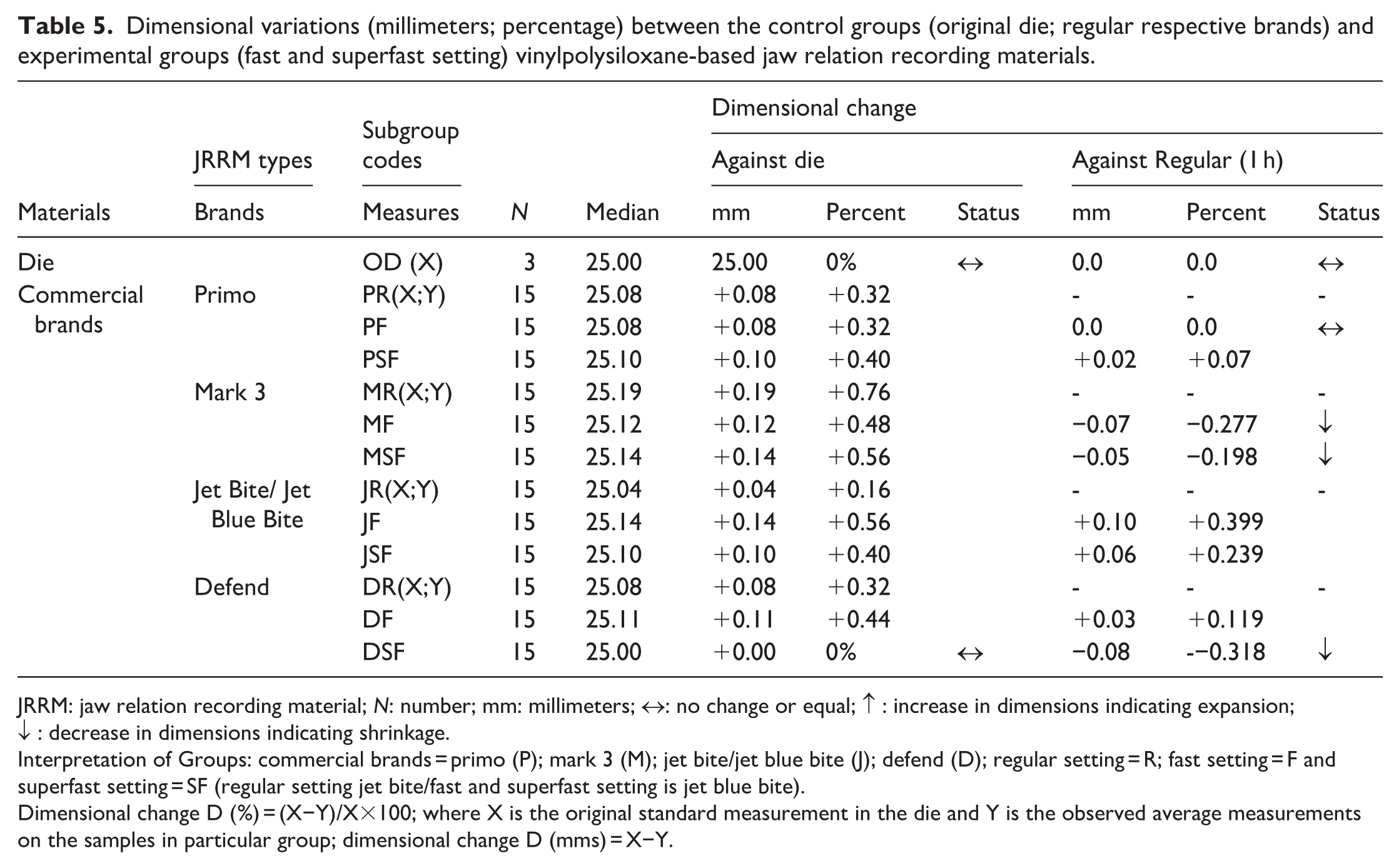
JRRM: jaw relation recording material; N: number; mm: millimeters; ↔: no change or equal; ↑ : increase in dimensions indicating expansion; ↓ : decrease in dimensions indicating shrinkage.
Interpretation of Groups: commercial brands = primo (P); mark 3 (M); jet bite/jet blue bite (J); defend (D); regular setting = R; fast setting = F and superfast setting = SF (regular setting jet bite/fast and superfast setting is jet blue bite).
Dimensional change D (%) = (X−Y)/X×100; where X is the original standard measurement in the die and Y is the observed average measurements on the samples in particular group; dimensional change D (mms) = X−Y.
Discussion
This vitro study intended to determine the dimensional accuracy of four different commercial brands of VPS-based JRRMs, which have been marketed on the basis of providing consumers a luring advantage of setting quickly, which is generally desired by clinicians. the major findings in this study when summarized include that at 1 h, all investigated materials showed dimensional changes in the form of expansion when compared to original die with the exception of defend superfast, the regular set (60–180 s) showed less changes than fast (40–60 s) and superfast set (30–45 s), fast setting showed higher changes than superfast set, no significant difference existed between fast or superfast when compared with regular except jet bluebite (fast and superfast), Mark 3 regular was significantly different from the original die, all brands of Mark 3 and jet blue bite fast showed changes that are clinically unacceptable (±0.11 mm). Based on the findings of our study, the null hypothesis is thus rejected while partially accepting the primary hypothesis.
The basis of the need for this study lies in the fact that ignorance about the knowledge 53 and use of VPS-based JRRM over less dimensionally stable materials like waxes and impression pastes in either removable or fixed prosthodontics is evident in recent studies. 54 Cost-saving academic administrations need to provide training to dental students that is based on recent evidence to enhance their competitive abilities. At the same time, it also becomes mandatory for manufacturers to restrict their claims that lure dental practitioners to certain clinical advantages over actual benefits in terms of material properties. Although a JRR undergoes a three-dimensional change during setting, vertical changes are less likely to induce occlusal errors clinically since these are overcome by orienting the maxillary cast of the patient to the hinge axis of the mandible at the temporomandibular joint. 55 Simultaneously, linear or horizontal discrepancies are mainly caused by inherent material compositions, and because of the cuspal engagement of interdigitating teeth, even minor changes can result in improper occlusal fit of the working cast, which leads to incorporation of error in the restoration. 8
The results of our study may be considered to be in general agreement with previous studies that have demonstrated superior dimensional accuracy of VPS-based JRRMs over registration waxes,13,17,20,31,39–41 resin-based,12,26 impression paste,13,15,20,29,31 and polyether-based.17,29,30,39,40 This assumption is based on the fact that all these studies have used the same ADA-specified die, except for Dua et al. 30 (die with a single line) and Dwivedi et al., 17 who used typodont models. Our linear discrepancy values for all VPS-based JRRMs in this study also fall within the same range as that reported at 1 h in these studies. Contrarily, our results on VPS-based JRRM may not fall in line with those who reported polyether to be more accurate than VPS.13,15 Tejo et al. 15 reported a change of only 0.12% after 1 h, which is higher than the defined superfast in this study. His study also used different mathematical formulas to determine the percent changes. Contradicting the results of this and all other studies, Narde and Venugopalan found that bite wax (Aluwax) and additional silicone (AvueBite) did not differ significantly from each other. His study, however, used an E4 scanner that clinically took measurements from the oral cavity. 56
The VPS-based JRRMs have a composition that is similar to the addition-silicone elastomeric impression materials. They are also available as a two-paste formula that mainly contains a base and a catalyst formulation. With both pastes existing as a viscous paste, the hand manipulation is bound to introduce mixing errors, which are not observed in automix techniques. The base formulation in VPS-based JRRM contains a low molecular weight copolymer (polymethyl hydrogen siloxane) having a terminal silane group.57,58 On the contrary, the catalyst formulation also contains moderately low molecular weight polymer (vinyl-terminated polydimethyl siloxane) but with a vinyl terminal group, in combination with a chloroplatinic acid that acts as a metal complex catalyst. 59 Base paste contains other components like silica filler with appropriately required hydrophilicity, 60 with fillers blended among three silicone polymer types. A cross-linking agent and an inhibitor along with pigments are incorporated in the base paste, while the catalyst paste may contain an additional plasticizer. 59
There are three possible ways that the setting times can be reduced, making the VPS material set very fast. One is to increase the content of the catalyst, while the second, more appropriate and more efficient method, is to replace portions of crystalline silica with other hydrophilic fillers like diatomaceous earth.60,61 The nature of this filler affects the overall properties, especially viscosity, strength, and percent strain of the set material. Partial replacement of crystalline silica with fumed silica has been reported to produce ideal manipulation and setting times for addition silicone VPS-based impression materials. 61 Both base and catalyst pastes may contain fillers of different types depending upon the desired property. A silanated filler can increase the filler-polymer bond strength besides acting simultaneously as a cross-linking agent. 59 Filler content irrespective of the type alters the pH of the material, with more filler content decreasing the pH. 61 In turn, the setting time alters accordingly, therefore having a negative correlation with pH. The second mechanism of speeding up the setting process is adding an accelerator; however, such a process facilitates the reactions that produce by-products (hydrogen), which alters the quality of the JRR. Regular setting materials have an increased setting time (60–180 s), which is achieved by the addition of reactive retarders (tetracyclic vinyl) with a preference to undergo polymerization before siloxane copolymer. 62 In turn, these reactive retarders, while undergoing polymerization, do not form any chain. This blocking of the chain is temporary just to prevent siloxane polymer from undergoing polymerization, which in turn increases the setting time. The siloxane polymer cannot undergo polymerization unless the whole retarder molecule is absolutely consumed. Clinically, however, desired working and setting times can be easily achieved by storing the material in cold conditions.
Studies have shown that the working time that includes the setting time can be prolonged by 60–90 s if the elastomer is stored at 2°C. 63 The third possible mechanism in accelerating the setting process is producing an early phase setting reaction that is exothermic in nature. The heat produced during this initial stage speeds up the setting reaction and influences the rate of transforming shrinkage. 64 Our study results on regular set JRRMs show that, except for Mark 3, all other regular setting materials had fewer dimensional changes than both fast and fast-set materials. Because manufacturers do not disclose compositional changes for marketing reasons, the differences in setting times are likely due to substituting some reactive crystalline silica parts. Those with less accuracy may have used more accelerators, which decreases setting times but affects accuracy. Analysis of each component among the four different commercial interocclusal records used in our study explains their relative behavior in setting time and the effect of such changes on primary properties. The key difference in composition between the fast and superfast variants of Primo is the incorporation of a faster platinum catalyst in the superfast variant with higher reactive groups while decreasing the organic filler [carbon, oxygen, and silicon] content with fewer alterations in inorganic fillers [aluminum, sodium, magnesium, titanium, and calcium], thus allowing the material to retain rigidity, dimensional stability, and thixotropic properties. 49 For Mark 3, the differences between the fast and superfast variants are affected primarily by the acceleration of the set in superfast, using lower organic filler loads and increasing the content of initiator chloroplatinic acid (platinum complex, specifically Karstedt’s catalyst or Speier’s catalyst), which activates the cross-reaction early upon mixing.15,26,50 Such initiator tweaks also result in higher Shore A, while ensuring rigidity and dimensional stability. 26 Contrarily, the fast and superfast variants of JetBlue Bite differ primarily due to reduced organic fillers in the superfast variant, allowing little or no rebound flow while at the same time increasing rigidity without losing the flexibility of the final set. 51 Defend Superfast had the highest accuracy at 1 h when compared to all other materials and their respective variants, including Defend Fast. The superfast variant of Defend differs from fast in that it uses optimized fillers (fumed silica) and plasticizers. 52 The optimization is done in the form of finer silica particle size, which allows more uniform distribution in the superfast variant. Lower and finer particle sizes ensure earlier and better flow, thereby reducing viscosity and heat buildup resistance during curing, which inturn also minimizes voids. 26 The superfast also has less plasticizer (siloxane oligomers), which enhances early elasticity without sacrificing final rigidity. All these features enhance a balanced cross-linking via a higher platinum catalyst, which additionally decreases brittleness. Overall the differences in properties are as a result of differences in the fillers, with Primo using silica/quartz, Mark 3 using silicate glass/silica, Jetbite/Bluebite having amorphous silica, and defend having fumed silica as their respective fillers. Exact formulations are proprietary and not publicly detailed in product SDS or literature, but generic VPS compositions apply across brands with minor variations like pigment or thixotropy additives.
Our findings are further substantiated by recent studies that compared dimensional accuracy between scannable and transparent VPS-based JRRMs.8,32 Sayed et al. 32 reported that after 1 h of setting, transparent recording materials were dimensionally more accurate than scannable. Alamri et al. 33 also reported that registration materials used for CADCAM were less accurate than transparent, with one of the CADCAM materials showing significant changes in linear accuracy after 7 days. They attributed the accuracy of transparent JRRMs to the high percentage of quartz silica, which is between 30% and 50%. Higher percentages of naturally translucent quartz silica are necessary to render the material translucent. To render a JRRM scannable, higher reflectivity is desired for optical scanning, 65 which is achieved by the addition and higher content of TiO2. In addition, non-reinforcing fillers like oxides of aluminum, magnesium, and zinc or salts of calcium (calcium carbonate) are incorporated to enhance processing and extrudability (viscosity) of the final product. 66 The salt also neutralizes the hydrogen gas produced during matrix formation. Since quartz silica used in transparent JRRMs is naturally transparent, therefore eliminating other components improves the accuracy of the set mass.8,32 Studies investigating the dimensional accuracy or dimensional stability of fast and superfast variants are lacking. However, in a recent study of different VPS-based interocclusal recording materials as function of setting times, the author found defend superfast to be dimensionally accurate at 1 h while also observing jet bluebite fast as less accurate at 1 h. However the author concluded that defend superfast was less accurate at 168 h while jetbluebite fast had lesser dimensional changes at 24 and 72 h. However, it is important to note that the study compared these materials against the values of the control group which was Occlufast rock, considered to be a standard VPS-bite registration material. 67 All VPS-based JRRMs investigated in this study exhibited dimensional expansion at 1 h post-polymerization when compared to the original die, with the exception of Defend Superfast, which showed little or no dimensional change. Regular-set variants generally displayed the least changes, followed by superfast and fast sets, with Mark 3 Regular exhibiting the highest expansion (3.04%). The observed distinctions stem chiefly from differences in types of fillers used as described earlier.
Comparative analyses with more current research provide credence to these findings; nonetheless, there are inconsistencies due to differences in research methodology. The results that we obtained are consistent with those that Alqarawi et al. 8 and Sayed et al. 32 reported, which stated that VPS was superior at 1 h. On the other hand, Tejo et al. 15 reported polyether demonstrating a higher level of accuracy (0.12%). This can be related to the fact that their non-automix mixing introduced differences. The initial setting expansion [1 h] in the fast and superfast variants are due to rapid polymerization that traps initial H-radical expansion before the shrinkage has been compensated, which in turn has been attributed to changes in accelerator or retarder composition percentages (e.g. tetracyclic vinyl), reducing net change, while brand-specific fillers (TiO2 in scannable JRRMs) further degrade accuracy by enhancing reflectivity over stability.
A unique finding observed in our study was the increase in dimensions among fast and superfast setting JRRMs when compared against the die dimensions, indicating that expansion of the material rather than shrinkage has taken place. While the VPS matrix sets initially, it undergoes expansion till setting starts, at which time shrinkage starts taking place, overcoming the initial changes of expansion.7,8,16,32 These physical changes are primarily due to the formation of H-radicals, which is also accompanied by more consumption of VPS monomer. Monomers with high molecular weight tend to react slowly, which is why the shrinkage is delayed, but once shrinkage sets in, the expansion observed earlier is compensated. Since fast and superfast set quickly, the necessary shrinkage to compensate for the earlier expansion is lost. However, at the same time, regular set JRRMs with increased setting times were also observed to expand when compared to the original die. Such an effect is caused by the addition of reactive retarders, which delay the chain formation, thus not allowing the shrinkage to occur as a result of monomer conversion. Expansion and contraction of elastomer varies and may increase if the edentulous spans are very long. In such cases, the rigidity of the elastomer is a significant property that minimizes errors. Clinical factors like contact of the JRR with soft tissues like gingiva may cause error in mounting, as gingival resilience can lead to tissue displacement or rebound during record removal, distorting occlusal relationships and resulting in articulator mounting inaccuracies up to 0.2–0.5 mm. 68
Strength and limitations: Both fast set and superfast setting JRRMs haven’t ever been investigated for linear accuracy, making this study a novel attempt. In vitro design that does not represent actual clinical scenarios involved, long span records, single axis measurements are the limitations of the present study.
Conclusion
With the backup of the study results, it may be concluded that all VPS-based JRRMs investigated, irrespective of the variant [regular, fast, and superfast], show linear changes in the form of expansion when compared to original dimensions. All regular setting JRRMs except Mark 3 showed clinically acceptable changes. Among variants based on setting times [fast and superfast], both Mark 3 and Jet Blue Bite Superfast showed clinically unacceptable dimensional changes. Among all variants, Defend Superfast showed the greatest post-polymerization dimensional accuracy at 1 h, thereby making them an ideal jaw relation recording material, if the fast setting of JRRM is desired. Primo Regular and Fast and Defend Regular also met clinical thresholds of minimum dimensional change (<0.11 mm) at 1 h, indicating their feasibility for making accurate JRR. Jet blue bite fast variant and all variants of Mark 3, failed to meet the clinical threshold and may not be considered to be accurate JRRMs, irrespective of the clinical conditions encountered. While all these measurements were made immediately after setting for 1 h, all VPS JRRMs are recommended to be used to 22 days; therefore, further studies evaluating the influence of time intervals on dimensional accuracy are recommended. The study also recommends that long-span JRR, which may extend clinically to 5 cm or more, should be investigated.
Footnotes

Ethical considerations
The study was approved by Scientific research committee, College of dentistry, Jazan University vide research proposal number CODJU-2331F.
Author contributions
All authors have contributed substantially according to the ICMJE guidelines and have read and agreed to the published version of the manuscript. All authors agree to be accountable for all aspects of this work.
Funding
The authors received no financial support for the research, authorship, and/or publication of this article.
Declaration of conflicting interests
The authors declared no potential conflicts of interest with respect to the research, authorship, and/or publication of this article.
Data availability statement
All relevant data has been presented within the article; however, the raw data files are available with the corresponding author which can be availed upon reasonable request.*