




Abstract
In a variety of applications, such as sensing, vibration control, wind turbine blades, automobile panels, submersible vehicles, and structural health monitoring, smart structures which are made up of laminated composite plates sandwiched between two piezoelectric layers are used. The issue of fractional derivatives for delaminated and multilayered piezoelectric composite plate supported on a viscoelastic foundation’s free vibration response has been tackled in this work. A system of differential quadrature and a perturbation method are used to derive and solve the governing equations. Four form functions, the Lagrange interpolation polynomial, the Cardinal Sine function, the Delta Lagrange, and the Regularized Shannon kernel are used in this study to provide new DQM approaches. A numerical system is suggested and tested under a range of support circumstances to determine its accuracy and efficiency, which relies on prior enabling more accurate predictions critical for the design and deployment of intelligent structural systems.
Keywords
Introduction
A variety of applications, including sensing, vibration control, wind turbine blades, automobile panels, undersea vehicles, aerospace, and structural health monitoring, use smart hybrid structures, which consist of laminated composite plates sandwiched between two piezoelectric layers. As a result, numerous researchers looked into how a laminated piezoelectric composite plate behaved dynamically. Chen and Lü 1 investigated laminated plate free vibration analysis using three-dimensional elasticity theory. Khdeir 2 looked into laminated plate buckling and free vibration. Matsunaga 3 and Wu and Chen 4 used the power series expansion approach to investigate the buckling and vibration of a laminated composite plate. Hachemi 5 used the finite element technique (FEM) version p to examine the dynamic behavior of laminated composite sandwich plates with changing stiffness. Using FEM, Kumar and Kumar 6 examined the free vibration of laminated composite plates. Wang et al. 7 used first order shear deformation theory to study the buckling and free vibration of graphene reinforced composite laminated plates. Additionally, the cylindrical bending vibration of a laminated plate made of uniform layers of piezoelectric composite with varying widths and thicknesses was examined by Vel et al. 8 Zhang et al. 9 used the differential quadrature method (DQM) to examine the oscillatory behavior of a laminated piezoelectric composite plate. Using DQM and the theories of elasticity and piezoelectricity, Ragb et al. 10 investigated the oscillatory behavior of piezoelectric composite plates. A piezoelectric composite plate’s oscillatory behavior was precisely measured by Heyliger and Brooks. 11 A piezoelectric laminated composite plate’s static and oscillatory properties were examined by Feri et al. 12 Piezoelectric laminated materials were examined by Kumari et al. 13 More researchers14–17 used functionally graded materials in their researches. Feri et al. 18 explored an analytical method for solving three dimensional bending behavior of a functionally graded (FG) material layer covered by piezoelectric layers and subjected to uniform transverse pressure and an electric field. Feri et al. 19 used state space method and Fourier expansion to investigate thermo viscoelastic response of a sandwich FG plate covered by two piezoelectric layers and it subjected to an electro-thermal load. Ragb and Matbuly 20 studied nonlinear oscillatory behavior of plate resting on Winkler Pasternak foundation using DQM. Zenkour and Alghanmi 21 solved a problem of FG plate supported by Winkler–Pasternak foundations attached with an actuator using the Navier method. Sui et al. 22 discussed dynamic behavior of thick plates resting on an elastic foundation, based on the Mindlin plate theory, using FEM. Ye et al. 23 used FEM to study bending and dynamic analysis of laminated cylindrical panel supported on Pasternak foundation. Chanda et al. 24 studied static and dynamic analysis of laminated piezoelectric composite plate supported on Pasternak foundation. Yas et al. 25 discussed free vibration of FG piezoelectric plates supporting on Pasternak foundation using state space method in the direction of thickness and DQM in the radial direction.
Viscoelastic foundations play a central role in improving the performance and resilience of various engineering structures. Olunloyo et al. 26 proposed an exact solution for vibration problem of a hollow beam conveying fluid on a viscoelastic foundation. Goodarzi et al. 27 discussed vibration of a FG nanoplate supported by visco-Pasternak foundation using modified strain gradient and modified couple stress theories. Rahmani et al. 28 discussed vibration of a laminated composite plate supporting on viscoelastic foundation using DQM.
Delamination is a split between neighboring layers, known as delamination, can be caused by a number of things, including as mechanical stress, heat loading, or environmental deterioration.29–32 It also spreads along the interface between neighboring layers. One crucial aspect of preserving structural integrity is identifying and fixing delamination. Li and Halim 33 used the Green function method to investigate the vibration of a delaminated beam. Using FEM, Bhardwaj et al. 34 investigated the vibration and static analysis of a delaminated composite plate. Using FEM, Verenkar et al. 35 investigated the free vibration of a multi-layered delaminated composite plate. Dileep Kumar et al. 36 investigated the dynamic behavior of a delaminated plate using FEM and first order shear deformation theory. FEM was utilized by Keshava Kumar et al. 37 to examine the free vibration of a delaminated composite plate. Moorthy and Marappan 38 used an experimental modality to assess delamination in composite laminates. FEM was utilized by Hirwani et al. 39 to investigate the dynamic analysis of a curved panel made of delaminated composite. FEM was utilized by Ju et al. 40 to investigate the dynamic analysis of a delaminated composite. Although many researchers studied nano beams and composite plates on elastic foundations,41–45 the effect of fractional derivatives have not been investigated.
The Lagrange polynomial interpolation, the Cardinal Sine function, the Delta Lagrange, and the Regularized Shannon kernel are the four shape functions that are used in this paper’s new DQM technique. With few nodal sites, these methods yield precise results.46–49 Piezoelectricity theory and three-dimensional theory of elasticity is used to create the governing equations supported with fractional derivatives in x-direction. For every differential quadrature approach, MATLAB codes are created. To compare the results with exact and numerical solutions, a comparison analysis is presented. Thus, it is possible to demonstrate the convergence, precision, and effectiveness of the methods that have been provided. Additionally, a parametric research is presented to examine how the frequencies and mode shapes are affected by the length to thickness ratio, damper modulus parameter, delamination length, delamination position, and supporting cases.
Formulation of the problem
Consider a laminated plate consisting of composite and piezoelectric layers which are bounded together. Each layer has a depth of

Laminated plate with a delamination.
Based on the principles of three-dimensional elasticity theory and piezoelectricity theory, the governing equations can be written as9,50:


In these equations, (x, y, z) represent the reference coordinate system. In addition (u, v, w) refer to the displacements in x, y, z directions respectively, t represents time,
The formulations which define the constitutive properties for a cross-ply laminate of an orthotropic material can be expressed as9,50:


where


In these relations,
Assuming harmonic behavior in the free vibration of the plate, the field quantities can be written as:

Here
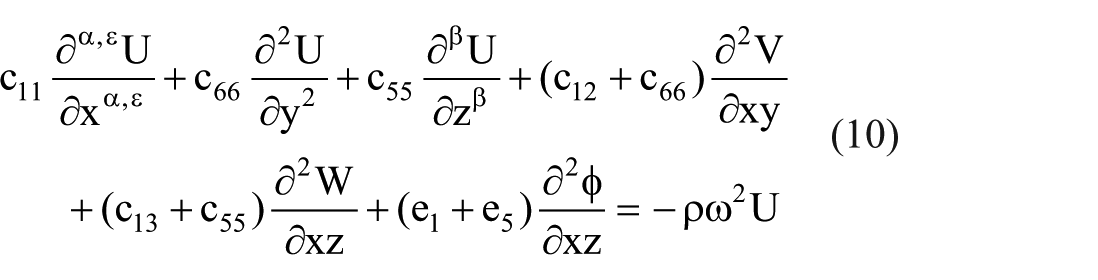
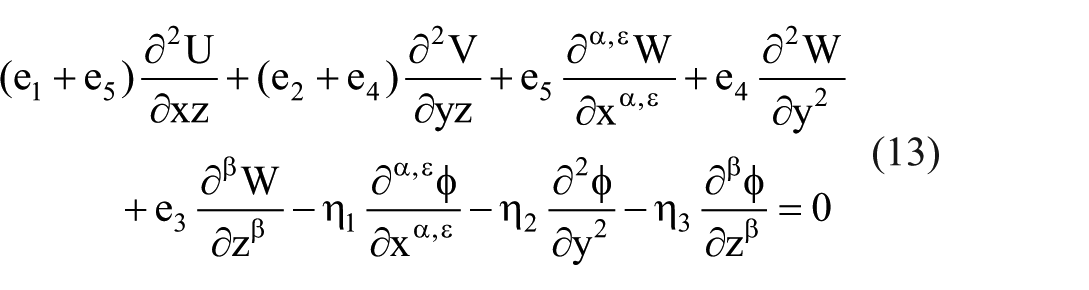
Hence, we apply the equation (9) into the equations (1) to (6), one can write the governing equations as:


The boundary conditions can be written as 9 :
For a simply supported end:


For a clamped supported end:

For a free supported end:


For upper and lower surfaces of the plate, boundary condition can be written as:
For closed circuit (grounded):

For open circuit:

At the interface locations, the continuity conditions can be expressed as:

Here, p = (1, L−1), L denotes to the number of layers.
Method of solution
Polynomial DQM (classical DQM)
In this approach, the Lagrange interpolation polynomial is used as the shape function. The nodal points can be uniformly or non-uniformly distributed. To get the non-uniform distribution of the points, one may use the Chebyshev Gauss Lobatto discretization as follows 51 :

This technique can approximate the field quantities as follows51–55:

For the 1st derivative, the weighting coefficients can be expressed as51–56:

Here,

For the nth derivative, the weighting coefficients may be represented as 55 :

Sinc DQM
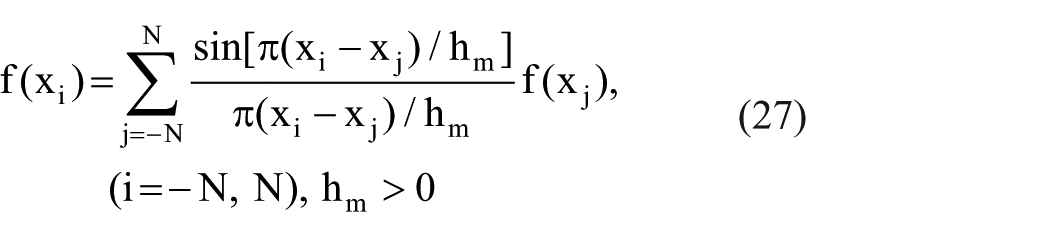
The Sinc DQM uses the Cardinal Sine function as a shape function. The points are uniformly distributed as uniform points with number N. The field quantities and their derivatives are transformed to weighted linear sums of the nodal values fi,(i = −N : N), as follows10,55:
Weighting coefficients for the 1st and the 2nd derivatives are represented as follows10,55:

Here,
Discrete singular convolution DQM
The singular convolution can be written as follows10,55:

Where,
This technique depends on many kernels used as shape functions. The points are uniformly distributed as uniform points with number N. This technique uses narrow bandwidth (2M + 1) to can control the accuracy of the results. There are two common kernels known as Delta Lagrange Kernel (DLK) and Regularized Shannon kernel (RSK).
Delta Lagrange Kernel (DLK)
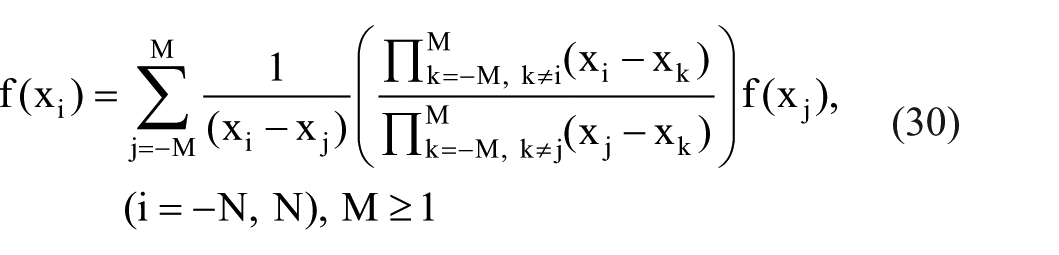
Delta Lagrange Kernel (DLK) may be used as a shape function. So, the field quantities can be written as:
The weighting coefficients of the 1st and the 2nd derivatives can be defined as10,55:

where

Regularized Shannon kernel (RSK)
Regularized Shannon kernel (RSK) is used as a shape function as:
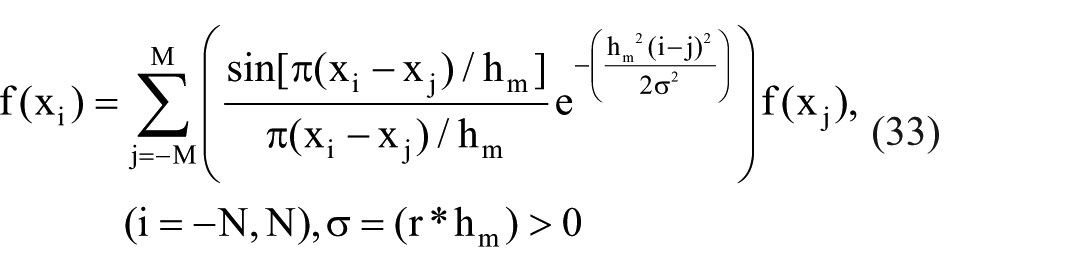
The 1st and the 2nd derivatives have weighting coefficients as follows10,53,56
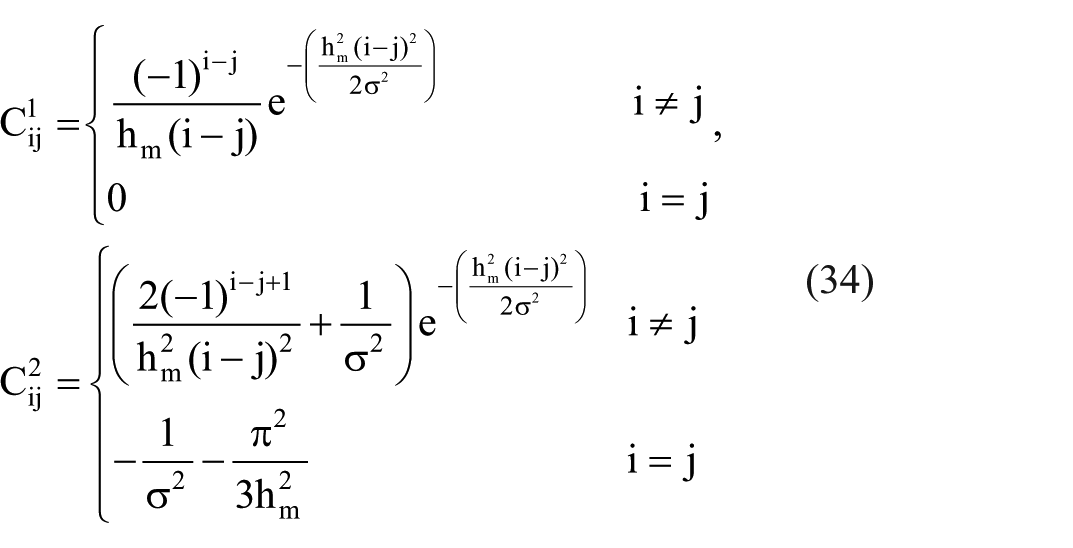
where,
Fractional derivatives
Fractional derivative is an important subject in many engineering applications. There are different definitions of fractional derivative, such as Riemann–Liouville, Caputo, and Weyl.
Caputo’s fractional derivative
By assuming (n−1) < α < n, the fractional derivative of f(x) of order α based can be written as 46 :
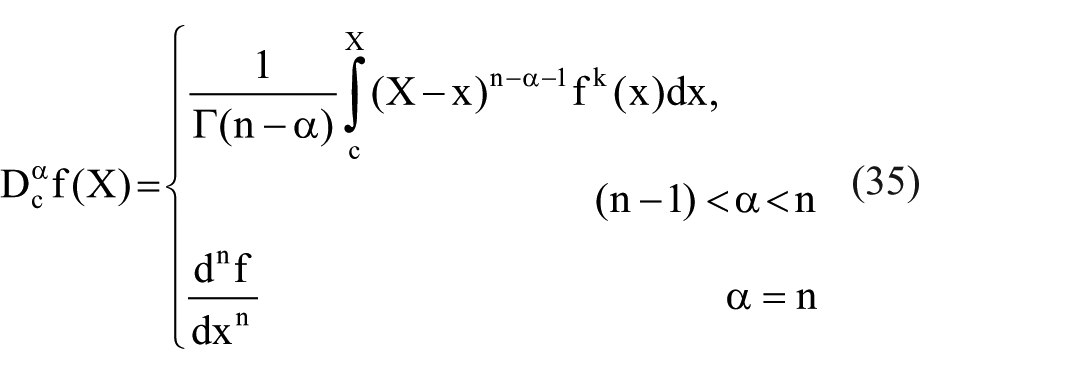
where c is the lower limit of integration.
Caputo’s fractional derivative can be applied with classical PDQM, Sinc DQM, DLK DQM and RSK DQM by using equation (35) and equation (22) to determine the weighting coefficients
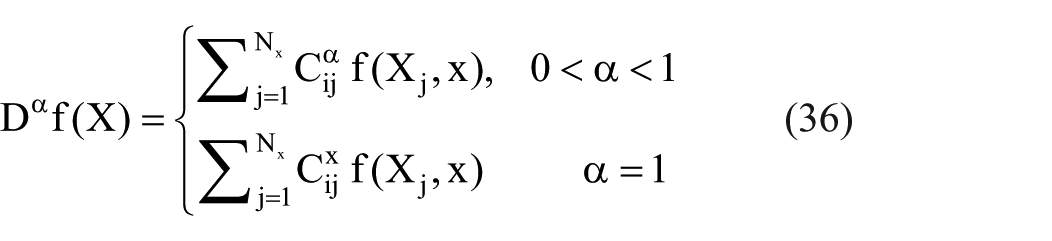
where
Generalized Caputo’s fractional derivative
Fractional differential operators due to their non-local characteristics, which can take various forms, most effectively describe the system influenced by memory. Therefore, the researchers extend the fractional operators to hold the hidden aspects of the real nonlocal phenomena. The definition of the generalized Caputo fractional derivative of a certain order and operator is presented by44,45:

Henceforth, the solution of equation (37) can be written as:

By substituting the generalized Caputo’s fractional derivative in equation (37) into equation (22) of differential quadrature method based on four shape functions to calculate the weighting coefficients

So, the weighting coefficient

Discretization of the problem
In this section, we substitute DQM equations with four shape functions as appearing in equations (22) to (40) on equations (10) to (21). Consequently, the problem is transformed to the following non-linear algebraic system:


The nonlinear algebraic system may be written as follow:

where, [I] is the unit matrix.
Also, this system can be considered as follow:

Then, the overall nonlinear algebraic system for all layers with continuity conditions can be put in the form:

Where, L denotes to the number of layers.
Boundary conditions may also be explained as follow
For the simply supported end:



For the free supported end:


For the top and the bottom surfaces, the boundary condition may be written as:
For closed circuit (grounded):

For open circuit:

The continuity conditions at the interface locations can be demonstrated as follow:

Where p = (1, L−1), L is the number of layers.
Numerical results and discussions
A parametric study is introduced to discuss the influence of a/h ratio, delamination length, delamination position, damper modulus parameter, and boundary conditions on the obtained fundamental frequency.
For practical purpose, the field quantities are put in dimensionless terms as 10 :
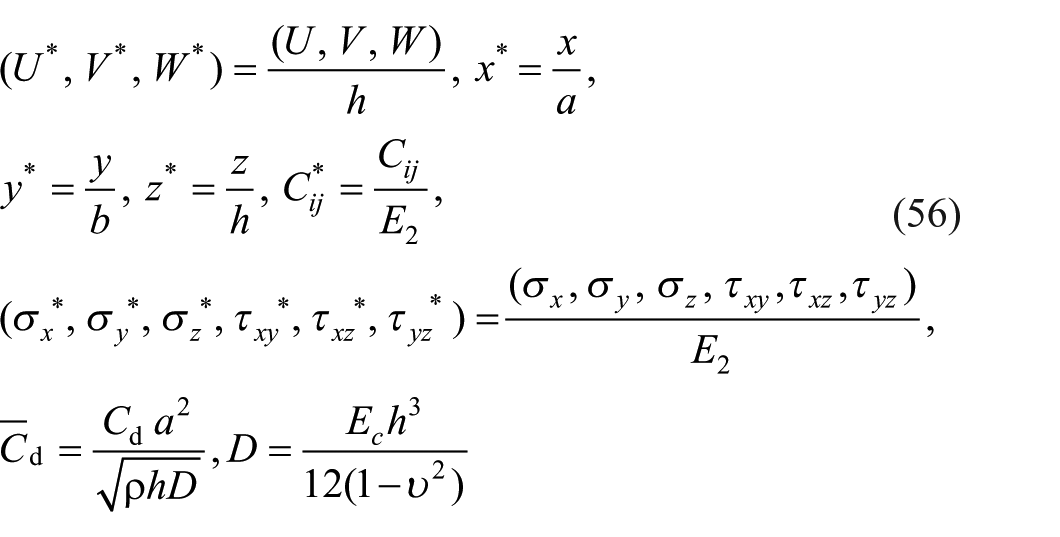
where,
The dimensionless frequencies

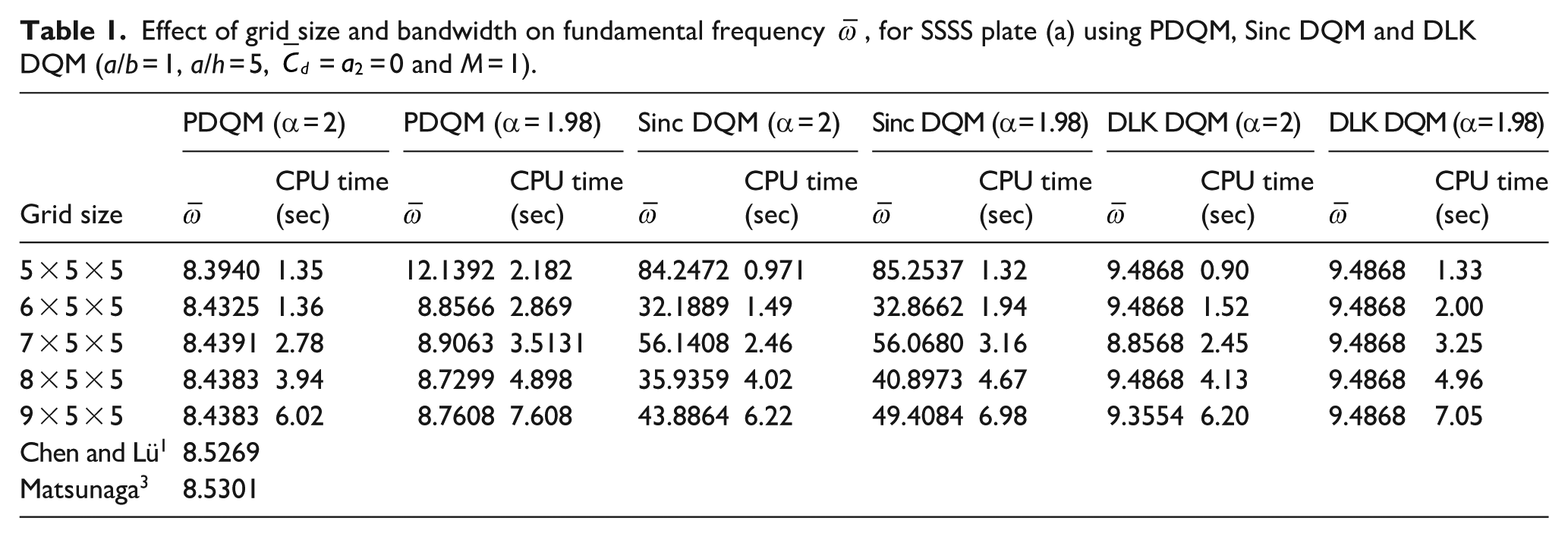
Numerical quadrature schemes are designed, for each technique of DQM techniques, to solve free vibration problems involving delaminated piezoelectric composite plates that rest on a viscoelastic foundation. A comparative study is presented to compare the obtained results with these schemes against the published exact and numerical solutions to check the validity of these schemes.
Plate (a) is composed of two composite layers with orientation angles

Configurations of laminated plates (a) which is rested on viscoelastic foundation.
Effect of grid size and bandwidth on fundamental frequency
Effect of bandwidth, and regularization parameter

It is noted from previous tables that, RSK DQM give the best accurate and efficient results compared to the other techniques, So RSK DQM method is employed for deducing the parametric studies. Tables 3 and 4 show the obtained fundamental frequency parameter
Comparison of the fundamental frequency

The fundamental frequency of SSSS plate (a): [0/90] with central delamination crack at the interface of the two layers. a/b = 1, a/h = 5, N = 7 × 6 × 5 using RSKDQM. E1 = 40E2, E3 = E2, G12 = G13 = 0.6E2, G23 = 0.5E2, v12 = v13 = v23 = 0.25, a/b = 1 (a1 = a3).

Furthermore, a parametric study is introduced in Figures 3 and 4 to show the influence of a/h ratio, the normalized damper modulus parameter

Variation of obtained fundamental frequency parameter

Variation of obtained fundamental frequency parameter
Conclusion
The free vibration of a delaminated fractional piezoelectric composite plate resting on a viscoelastic foundation with SSSS boundary conditions is effectively investigated using a numerical scheme based on DQM. The three-dimensional theory of piezoelectricity and elasticity is used to formulate the governing equations. Furthermore, parametric analysis is used to examine how the resulting fundamental frequency is affected by the a/h ratio, delamination length, delamination position, foundation parameters, and damper modulus parameter. PDQM, RSK DQM, Sinc DQM and DLK DQM techniques are introduced. RSK DQM method at M = 1, and
The fundamental frequency
The fundamental frequency
The fundamental frequency
Footnotes

Funding
The authors disclosed receipt of the following financial support for the research, authorship, and/or publication of this article: This work was supported and funded by the Deanship of Scientific Research at Imam Mohammad Ibn Saud Islamic University (IMSIU) (grant number IMSIU-DDRSP2602).
Declaration of conflicting interests
The authors declared no potential conflicts of interest with respect to the research, authorship, and/or publication of this article.
Data availability statement
The data presented in this study are available in the article.