




Abstract
Physiological parameters of the oral cavity have a profound impact on any restorative solutions designed for edentulous patients including denture adhesives. This study aims to mathematically quantify the influence of three such variables, namely: the temperature, pH, and the swelling of such adhesives under the influence of saliva on its mechanical behavior. The mathematical quantification is further aimed to implement a material model for such adhesives which considers the impact of such physiological factors. The denture adhesive is experimentally investigated by means of rheological steady state frequency sweep tests to obtain the relaxation spectrum of the material. The relaxation behavior is measured for a wide range of oral cavity temperatures and pH. Also, the adhesive is hydrated and upon swelling to different levels again tested to understand the impact of swelling on the mechanical behavior. The experimentally measured continuous relaxation spectrum is modeled as a viscoelastic material using a discrete set of points based on the Prony series discretization technique. The relaxation spectrums for various temperatures are compared and the possibility of a time-temperature superposition is explored for the model. Similarly, the measured values of Storage and loss modulus are investigated to understand the role of pH and swelling. The results in this study clearly indicated a horizontal shift in the relaxation behavior with increase in temperature. And hence, the time-temperature shift factor was calculated for the adhesive. The relaxation spectrum also showed a strong correlation with swelling of the adhesive and the pH. The influence of these two parameters were captured into the model based on the relaxation time parameter in the Prony series approach. Based on this study the impact of these parameters could be appreciated on the performance and mechanical behavior of denture adhesives and implemented into a Prony series based viscoelastic material model which can be used with numerical simulations.
Keywords
Introduction
Dentists widely use denture adhesives to improve the performance of removable partial dentures (RPDs). 1 Per the United States Food and Drug Administration, denture adhesives are primarily classified as pastes or powders that help dentures remain in place. These adhesives have been shown to improve the retention behavior of RPDs on the soft tissue of the oral mucosa, thereby reducing slippage and displacement along the dental arch. This in turn results in a reduction in discomfort and perceivable pain for the denture wearers.2 –5 Adhesives can also fill the gaps caused by shrinking bone and give temporary relief from loosening dentures. Furthermore, greater stability and increased incisal bite force have also been highlighted with their application.6,7 Numerical simulations using the finite element method (FEM) allow for performance assessment under dynamic bite and chewing forces, as well as the consideration of a multitude of other factors impacting denture and adhesive function within the oral cavity. These models therefore facilitate the improvement of denture adhesives and three-dimensional designs of RPDs. One of the critical factors determining the accuracy of such FE simulations is the underlying mechanical properties of the denture adhesive and the corresponding material model used to simulate them. Material models ranging from linear elastic to hyper elastic have been proposed in literature for such adhesives.8,9 However, in general these adhesives exhibit a viscoelastic response to applied mechanical load, especially at increased temperatures and higher stress levels. 10 Such time-dependent and rate-dependent material responses or viscoelasticity is observed in many such polymeric materials, including various pastes and adhesives. 11 Boltzmann’s formulation for viscoelastic response provides the relationship between the stress and strain and assumes that a more recent strain contributes more to the stress at the current time. 12 Viscoelastic materials can be characterized using the relaxation modulus and this represents the basic constitutive relation between stress tensor and strain tensor for a such polymeric material. In the case of modeling polymers like adhesives, we can consider an almost incompressible volumetric part and assume it to be elastic while considering the isochoric part to be viscous in nature. Experimentally, the continuous relaxation spectrum for polymeric materials can be obtained using rheological dynamic mechanical analysis (DMA) studies. The viscoelastic behavior can be approximated using combinations of mechanical elements like springs and damping material.
The physiological parameters prevalent in the oral cavity also play a significant role in the performance of any dental restorative solutions, including denture adhesives. They are comprised of a wide range of physical, biological, and chemical parameters that are diverse and extremely difficult to quantify. Additionally, many of these parameters are interdependent and some of them are strongly influenced by the saliva and salivary flow within the oral cavity. Furthermore, understanding their influence on denture adhesives is crucial for reducing the irritation and discomfort of denture wearers. Biological factors include complex variables such as the age of the denture wearer, amount of primary or secondary caries, the health of the oral cavity, residual ridge resorption, the degree of crown damage, edentulous regions, and changes in jaw shape, among others. Physical factors such as temperature and pressure also play a significant role in the oral cavity. 13 The oral cavity is continuously influenced by the saliva and its pH determines the state of the oral cavity to a large extent. 14 Saliva is made of 99% water and helps keep the mouth moist, supports swallowing, and breaks down food for digestion.15,16 Adhesives in the oral cavity are subjected to changes in hydration due to the constant interaction with saliva and their varying flow rates. Adhesives swell to different ratios based on the amount of time under the influence of saliva and in turn their mechanical response to forces also changes. Notably, adhesives have demonstrated better performance after attaining a specific range of swelling, which helps fill the gaps in the denture soft tissue contact spaces as well. However, characterizing the influence of such physiological factors on the mechanical behavior of denture adhesives is extremely challenging to quantify mechanically.17,18
Therefore, this work aims to develop a Prony series-based material model for denture adhesives to be utilized for finite element numerical simulations. Further, the work focuses on quantifying the influence of three specific physiological factors, namely the temperature in the oral cavity, the pH of the medium (saliva), and the adhesive swelling under the influence of saliva. These factors are then incorporated into the Prony series based viscoelastic material model of the denture adhesive.
Methods
Rheological measurements
The mechanical characterization of the denture adhesive in this study is performed based on rheological DMA in accordance with the work of Gill et al. 19 The continuous relaxation spectrum in terms of the storage modulus, G′, and loss modulus, G″, of the adhesive is experimentally evaluated considering the influence of three variables: temperature, pH, and adhesive swelling under the influence of saliva. The G′ and G″ values are measured through a steady state shear test using a plate-plate geometry for a frequency sweep over three decades of measurement from 0.01 to 10 Hz, with the results plotted for 10 measurement points per every decade. The effect of temperature variation was evaluated from 17°C to 52°C, with the individual relaxation profiles recorded in 5°C steps. Similarly, the adhesive was immersed in artificial saliva solution for pre-determined lengths of times to allow it to attain a specific amount of swelling. Then the adhesive was carefully transferred onto the rheometer to perform the steady state shear test using the same frequency sweep from 0.01 to 10 Hz. Additionally, the pH of the specimen was altered via immersion in acidic, alkaline, and neutral media to study the influence of pH on the specimen and its mechanical behavior.
Prony series approximation
The continuous relaxation spectrum can be approximated using a discrete number of points to be implemented in numerical schemes. In this study the experimental results for the adhesive are utilized to model a viscoelastic material based on the Prony series approximation technique with Np terms. The resulting relaxation spectrum is fit using a Prony series approximation fit curve with N = 1, 2, 3, . . .. This process is repeated until the relative change in the accuracy of the curve fit with Np = N terms is less than 0.01% better compared to the previous fit with Np = N − 1. The accuracy of the curve fit was decided based on R2 and reduced R2 values for the individual curve fit obtained. Based on this, the number of Prony series terms, Np, was decided for the study. Each of the relaxation spectra obtained for the adhesive specimen by varying the temperature, pH, and swell test conditions were fit using the Prony series approximation with the selected number of Prony terms. The resulting relative amplitudes, gi, for the corresponding relaxation times, τi, obtained are tabulated.
Time temperature superposition
The relaxation spectra of the adhesive experimentally obtained at varying temperatures were visually compared. If they showed a similar profile and only a characteristic shift in the curves, they can be combined using the time temperature superposition (TTS) principle. The TTS can be achieved either by the Williams-Landel-Ferry (WLF) approach or the Arrhenius approach. In order to determine which modeling approach was most appropriate, the scatter of ln (τ) versus

Using these calculated shift factors, the relaxation spectra of the adhesive obtained for each individual temperature can be shifted accordingly to obtain the relaxation characteristic of the adhesive over a broader range of time or frequency. Thus, the temperature variable can be subsumed into the Prony series model in terms of the relaxation time variable itself.
Variation with pH and volume swelling
Similar to estimating the influence of temperature on the behavior of the adhesive, the pH and swelling ratio were also considered in this study. The adhesive specimen was hydrated to the desired swelling ratio by immersing the specimen in artificial saliva solution, as noted earlier. The swelling ratio was increased in steps of 20%, up to the point when the adhesive attained saturation. The saturation state is defined as the time after which the increase in adhesive swelling was found to be infinitesimal even over a long period of time. The calculation of swelling times to attain this state was based on calculation of change in weight of the adhesive specimen after immersion in saliva with increasing time. The adhesive specimens were then subjected to rheological DMA with the same range of frequency sweep that was used for evaluating temperature (0.01–10 Hz). The resulting relaxation spectra were plotted, and the corresponding storage and loss modulus values were recorded. Based on these curves, the variation of the moduli with the swelling ratio was plotted initially for a specific temperature of 32°C. For this specific example, the discrete approximation was once again evaluated based on the Prony series technique, just like the approach followed for temperature previously noted. This was replicated for all the swelling measurements to obtain the corresponding Prony series parameters. In this manner the relaxation behavior of the adhesive under the influence of swelling due to saliva was mathematically quantified.
Following the same approach, the adhesive was tested after equilibrating at different pH values ranging from strongly acidic (pH = 2) to alkaline (pH = 10). These adhesive specimens were similarly subjected to shear tests with a frequency sweep of 0.01 to 10 Hz. The effect of pH on the adhesive behavior is also expressed in terms of the Prony parameters gi and τi, which were evaluated based on the corresponding rheological shear tests. Finally, the influence of the swelling ratio on the adhesive specimen in combination with temperature and pH is further discussed and compared.
Results
In this section, we detail the observed variations of the storage and loss moduli with respect to the three chosen oral cavity parameters (temperature, pH, swelling). The variation of the moduli from changes in temperature for the selected frequency range of 0.01 to 10 Hz is illustrated in Figure 1. The figure presents the results for temperatures in the range of 17°C to 52°C. The experimentally determined continuous relaxation spectra were subjected to curve fitting based on the formulation of Prony series approximation for N = 3 terms. The resulting Prony series fit parameters (i.e. the amplitudes, gi, and the corresponding relaxation times, τi, for the continuous relaxation spectrum at 32°C) are recorded in Table 1.

Relaxation spectra obtained by rheological frequency sweep test: (a) variation of storage modulus and (b) variation of loss modulus.
Prony series parameters evaluated for the discretization of the continuous relaxation spectrum obtained at the measurement temperature of 32°C.

Based on these results, the variation of the shear moduli with temperature for specific bite loading frequencies of 0.5, 1, 2, 5, and 10 Hz are further illustrated in Figure 2. The storage modulus showed an overall decreasing tendency in response to increasing temperature from 17°C to 52°C for the adhesive specimen at pH 7 and a swelling ratio of 100%. The adhesive exhibited a consistently decreasing tendency for G′ values until approximately 37°C–42°C; this trend in G′ values was also seen for the other test conditions with regards to pH and swelling. At this point the storage modulus showed a small spike; as seen in this test case around 42°C–47°C in Figure 2.

Variation in dynamic shear moduli with respect to temperature for an adhesive specimen maintained at a constant swelling of 100% and at pH 7.
The loss modulus also decreased, although with a relatively smaller slope for the same increase in temperature from 17°C to 42°C; beyond this point its value remained nearly constant at higher temperatures. In some cases, the loss modulus also showed a relatively smaller increase around 37°C–42°C mark. Both G′ and G″ values decreased with further increases in temperature after this initial spike. Similar patterns of distortion in the measurements were observed for most of the test cases. Another interesting observation from Figure 2 was the similarity in the shape of the curves for different temperatures. They clearly indicate that there was a horizontal shift between them as the temperature increased from 17°C to 52°C for the adhesive formulation tested at a swelling ratio of 100% and maintained at pH 7. This trend was repetitive and consistently observed for different swelling and pH values, albeit with different degrees of horizontal shift. Therefore, TTS was hypothesized to be possible and applied to the adhesive behavior to assimilate the effect of temperature. The horizontal shift factors were calculated based on the Arrhenius approach.
To calculate the Arrhenius shift factor, the activation energy for the adhesive formulation,

Calculation of TTS shift factor using the Arrhenius approach for the (a) first relaxation time, (b) second relaxation time, and (c) third relaxation time for a three parameter Prony series approximation.

The shift factor was calculated based on the above result using equation (1). The calculated shift factor for the individual temperature measurements in the range 17°C to 42°C is presented in Table 2. Using these shift factors, the denture adhesive was modeled for time temperature superposition in order to include the influence of temperature in the viscoelastic material model. Implementation using the commercial FEA package ANSYS for performing numerical simulation was based on the Tool Narayanaswamy shift function, which is a simplification of the Arrhenius shift function. 20
Horizontal shift factors calculated for each measured temperature based on the Arrhenius approach.

Like the analysis for temperature, the rheological results were also evaluated with respect to the swelling ratio of the adhesive and the pH of the medium. The plot of shear moduli versus the swelling ratio of the adhesive is presented in Figure 4 for three representative frequencies in the primary biting range: 1, 2, and 5 Hz. These frequencies were selected based on the temperature data seen in Figure 3. The loss modulus of the specimen showed a strong negative correlation to adhesive swelling. After 220% swelling, further increases in swelling had an infinitesimal effect on the loss modulus. The storage modulus on the other hand showed a weaker correlation to the increase in swelling ratio. Initially, until a swelling ratio of 100% was attained, the storage modulus curve did not show any categorical tendency. However, after this threshold was reached the storage modulus also showed a decrease, albeit with a much lower slope (Figure 4).

Variation in the dynamic shear moduli with respect to swelling of the adhesive.
The relaxation spectra obtained from DMA were also compared to observe the impact of the pH of the medium on the adhesive’s mechanical behavior. The comparison of the storage and loss modulus values for the same representative frequencies of 1, 2, and 5 Hz is presented in Figure 5. As the pH shifted from acidic to alkaline, the storage modulus was observed to increase moderately. Although interestingly the loss modulus showed an opposite decreasing tendency with change in pH from acidic to alkaline. Compared to the impact of temperature and swelling, the influence of pH was marginal but still not insignificant.
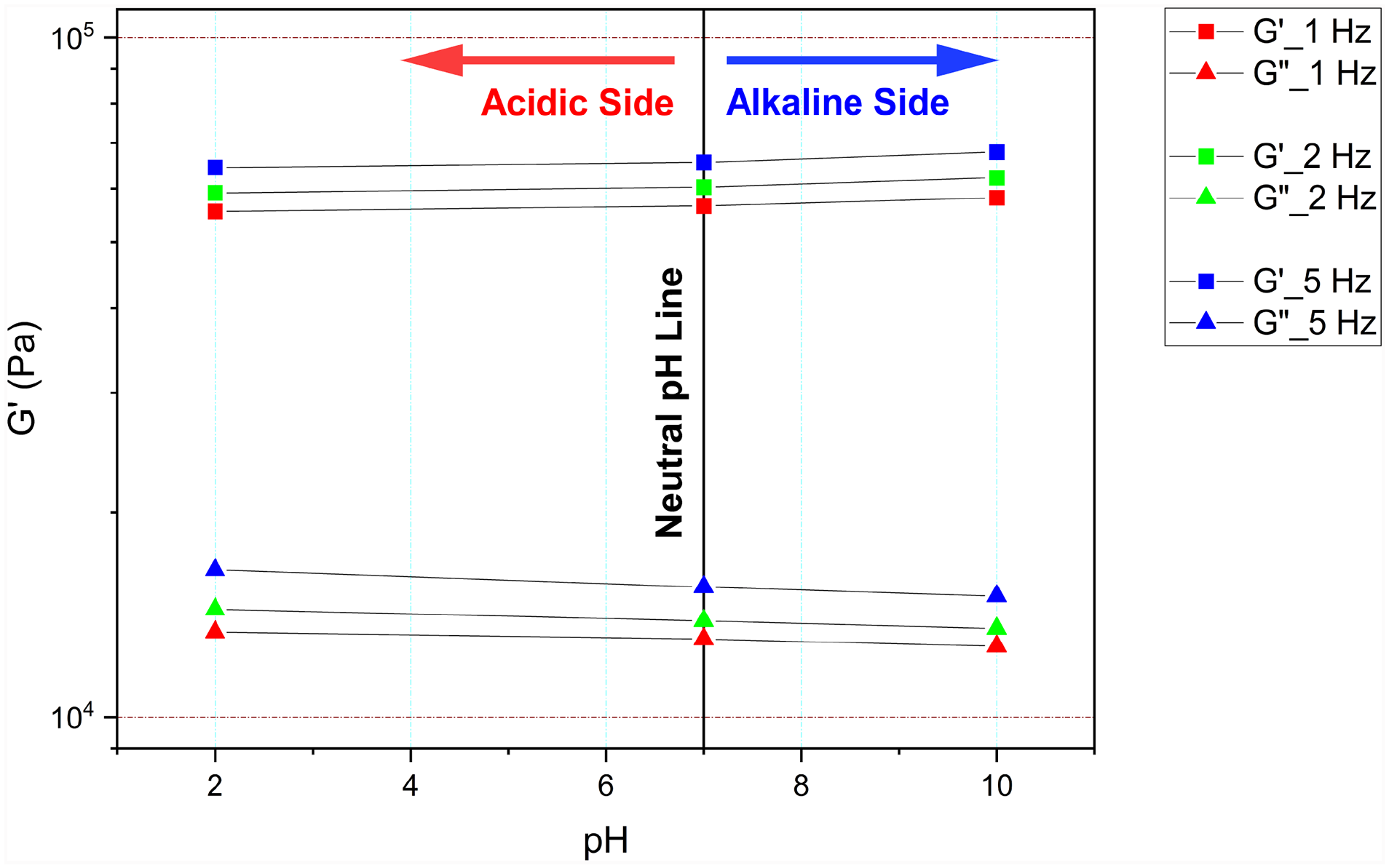
Variation in the dynamic shear moduli with respect to the pH of the medium.
Discussion
The relaxation spectrum can be used to predict the behavior of polymeric materials in any other standard mechanical test.
21
The Maxwell model provides a suitable approach to mechanically represent the relaxation behavior of the adhesive and allows for improvement in the approximation by controlling the number of branches considered. This physical behavior is represented by a generalized Maxwell model with “N” branches and the relaxation modulus is calculated as shown in equation (3). Here,

One suitable approach for mathematical quantification is using Prony series discretization of the continuous relaxation spectrum. The Prony series is based on the number of Prony terms, Np, along with the corresponding relative moduli, gi, and the relaxation times,

Comparison of the curve fit of the relaxation spectrum with increasing number of Prony series parameters from Np = 1 to Np = 4.
As noted, our model uses three physiological variables and the relative change in the Prony parameters with regards to these variables is necessary to appreciate the complexity of the material and the challenge of modeling it. The relaxation spectra do not exhibit a change in shape as a function of time, but only appear to shift horizontally when the temperature is changed.
23
This is clearly noted in the shear relaxation spectrum for different temperatures presented in Figure 2. The horizontal shifting of the curves was also observed for all settings of pH and swelling. Therefore, at higher temperatures relaxation behavior can be visualized as equivalent to a relaxation with a reduced relaxation time. Conversely, at lower temperatures the relaxation time is hypothesized to correspondingly increase. The WLF equation is one of the methods used to calculate the shift factor at and above the glass transition temperature, θg. Previous θg data indicate that conventionally heat processed denture bases reach the glass transition at around 110°C based on differential scanning calorimetry (DSC).
24
In the present study we evaluate temperatures from 17°C to 52°C, which was selected based on the possible range of temperatures in the oral cavity. These temperatures are considerably lower than the glass transition temperature of the adhesive considered. Also, the rheological DMA experiments were primarily carried out at the temperatures experienced within the oral cavity.
25
The material was not tested for negative temperatures or at very high temperatures, as studying the master curve of the adhesive was not an objective of our work. For the tested range of temperatures and based on the shape of the storage and loss modulus curves, we speculate that we are predominantly in the rubbery plateau region or the terminal region of the material. Based on the exhaustive research performed in these fields in the past century, we could discard the possibility of α−transitions as we are not near the glassy region of the relaxation spectrum. Based on our experimental range of testing we speculate that the transition observed in our data could be best described by Arrhenius behavior. Also, based on the scatter plot of ln (τ) versus

From the representative data shown in Figure 4, the initial observation was made that there exists a strong correlation between the swelling of the adhesive under the influence of saliva and salivary flow and the storage and loss modulus values. A similar trend was observed across the range of pH and temperatures tested, which further supported this initial observation. This was significant as the swelling of the adhesive under the influence of saliva is very difficult to predict, as it is a dynamic interaction continuously altered by several factors such as salivary flow rate. From Figure 4 we also observe that there is a significant decrease in the loss modulus as the adhesive swells in the presence of saliva and potentially becomes less viscous. In other words, the resistance to deformation is lowered and therefore, the adhesive layer is prone to shear at lower loads. As the swelling increases the material shows a tendency to relax faster. That is to say, the effect of swelling can be compared to that of increasing temperature and consequently yielding lower relaxation times. 26 In our experiments it was noted that the adhesive reaches a saturation level of swelling at around 220% when immersed in artificial saliva, and that the time needed to attain this saturation level varied with the pH of the medium. Regardless, in all cases the desired saturation level was attained within the timeframe of 120–180 min. After this, the increase in swelling ratio was infinitesimal with respect to additional time. As such, it can be reasonably stated that the adhesive achieves its saturation point in situ relatively quickly after being applied by the denture wearer and that its properties at this level of swelling are relevant for the majority of its operating time within the oral cavity.
In principle the time-temperature superposition approach regarding the change in the relaxation time can also be used for pH.27,28 The time-pH superposition or time-concentration superposition are viable approaches to include the influence of pH directly into the material model. However, in this study the influence of pH was not modeled using the time-pH superposition approach, as a coupling of both time-temperature and time-pH superposition is very complicated to implement.29,30 Furthermore, the variables of temperature, swelling, and pH were also thought to influence one another, which makes such an approach even more challenging. Lastly, the final objective of the study to implement the viscoelastic material model in a standard FEA package like ANSYS presents its own limitations. The TTS was utilized to capture the influence of temperature, but the influence of swelling and pH were considered by evaluating the corresponding relaxation times based on the individual shear relaxation spectra obtained for the two variables. As such, the approach to capture the impact of swelling percent into the viscoelastic material model in this study was based on the change in the relaxation times, τi, and the corresponding amplitudes, gi, for a given time, t, and temperature, θ. Including this effect into the representative expression for the shear relaxation modulus for the denture adhesive takes on the form shown in equation (5). In this expression we define

Conclusion
Accordingly, the influence of temperature, swelling under the influence of saliva, and pH of the medium can be incorporated into the viscoelastic material model of the denture adhesive based on the above equation. By using the discrete approximations of the continuous relaxation spectra in combination with the horizontal shift factors and the relaxation times at different pH and swelling ratios, the adhesive specimen was modeled as a Prony series based viscoelastic material with its mechanical behavior under different pH, swelling, and temperature accounted for in the model. The implementation in numerical finite element analysis was achieved based on the Tool Narayanaswamy shift function approach, which is a simplification of the Arrhenius shift function. 20
Footnotes
Declaration of conflicting interests
The author(s) declared no potential conflicts of interest with respect to the research, authorship, and/or publication of this article.
Funding
The author(s) received no financial support for the research, authorship, and/or publication of this article.
