




Abstract
The nanoparticles are frequently used in biomedical science for the treatment of diseases like cancer and these nanoparticles are injected in blood which is transported in the cardiovascular system on the principle of peristalsis. This study elaborates the effects of Lorentz force and joule heating on the peristaltic flow of copper and iron oxide suspended blood based nanofluid in a complex wavy non-uniform curved channel. The Brinkman model is utilized for the temperature dependent viscosity and thermal conductivity. The problem is formulated using the fundamental laws in terms of coupled partial differential equations which are simplified using the creeping flow phenomenon. The graphical results for velocity, temperature, streamlines, and axial pressure are simulated numerically. The concluded observations deduce that the solid volume fraction of nanoparticles reduces the velocity and enhance the pressure gradient and accumulation of trapping bolus in the upper half of the curved channel is noticed for temperature dependent viscosity.
Keywords
Introduction
Biological fluids are the fluids in human body that relief in the transport of proteins and nutrients or expel waste products from the cells. Blood, semen, saliva, urine, and mucus are commonly known as biological fluids. Peristaltic movement is a natural phenomenon for the transport of biological fluids from lower pressure region to higher pressure region due to propagation of Sinusoidal wave on the walls. Many theoretical studies are reported for observing the peristaltically moving biological materials. Srivastava et al. 1 developed a peristaltic model for the peristaltic transport of psychological fluid in a non-uniform tube. The flow rates in the present study are compared with observed flow rates vas deferens of rhesus monkeys, the small intestine and the ductus efferences of the male reproductive tract. A theoretical study is carried out by Tripathi et al. 2 to discuss the peristaltic flow of viscoelastic fluid in a channel with applications for the chyme movement in small intestine. Srivastava and Srivastava 3 used Power law fluid model to discuss the peristaltic transport of biological material through vas deferens and small intestine under long wavelength and low Reynolds approximations. Gastric transport of biofluid using viscoelastic fluid model is discussed by Tripathi and Anwar Bég. 4 A biological model proposed by Eytan et al. 5 to discuss the peristaltic transport of embryo in uterine cavity. Abdelsalam et al. 6 discussed the self-population of swimming sperms in the fallopian tube under biological assumptions. The outcome of present study is helpful to human cervical canal of female. Johnson-Segalman fluid model is used by Ashraf et al. 7 to report the peristaltic-ciliary flow in human fallopian tube.
During the last few years, a lot of work has been reported to discuss the mechanism of different biological liquids which presence importance in biosciences, health engineering, and bio-technological processes. The importance of magnetic induction is preserved in different eras of engineering and health treatment. The bioliquids application with interference of magnetic force is observed by various authors.8–10
An interesting feature of magnetic hydrodynamic on the peristaltic flow is deal with Hall current. The occurrence of Hall current is when the electron-atom collusion frequency is low under the influence of strong magnetic field. The Hall current has marked effects on the current density and magnetic force term. Hall current has many applications in magnetic field sensing equipments, Hall sensors and probes, proximity testers, and MRI. Effects of Hall current on the flow of viscous fluid in non-uniform regime is investigate by Javid et al. 11 Important outcomes of this study can help in the design of robot capsule which can flow though small vessels during surgery without any hurdle. In another attempt, Javid et al. 12 interpreted the onset of Hall current on the flow of viscoelastic fluid in a complex wavy non-uniform channel with large number of application in bioengineering. Krishna and Chamkha 13 analyzed the effects of Hall current and ionic slip on elastico-viscous fluid in rotating frame. Li et al. 14 used the shooting method to discuss the effects of Hall current on the peristaltic flow and heat transfer features of Jeffery fluid in curved channel with different wave frames.
Various investigations are contributed by scientists on the thermal flow of nanofluids in recent days. Based on improved assessment of nanofluids properties, dynamic applications of such materials are noticed in thermal processes, industrial mechanisms, extrusion framework, energy generation, and other more. The nanomaterials report fine thermal determination and improved consequences. Some multidisciplinary applications are noticed for nanofluids flow in heating of various devices, cooling mechanisms, heat transmission systems, etc. The low case energy resources are also suggested on basis of nanofluid intersections. Different mechanism of treatment for diseases have also been introduced where nanomaterials play significant role. Choi 15 led the novel idea of such materials with experimental approach. Buongiorno 16 endorsed the Brownian aspect and thermophoresis object of nanofluid model. Khan et al. 17 predicted the nanomaterials thermal capacitance referred to the disk flow where contribution of slip phenomenon was effective. A theoretical study is carried out by Nadeem et al. 18 to analyze the peristaltic flow of hybrid nanofluid with SWCNTs and MWCNTs in a rectangular wavy duct. A numerical simulation is performed by Abbasi and Farooq 19 to investigate the flow of water based hybrid nanofluid in a non-uniform channel. It is concluded that magnitude of heat transfer coefficient is large in non-uniform channel as compared to uniform channel. Javid et al. 20 theoretically investigate the flow characteristics for the peristaltic flow of Powell Eyring hybrid nanofluid in a curved domain with ciliated walls. A comparison for different flow features is reported for both curved and straight channel as a productive application in drug delivery systems. Tripathi et al. 21 numerically investigated the electro osmotic flow of coupled stress hybrid nanofluid through a micro channel. It is noted that thermal characteristics are strongly effected by joule heating parameter. Simultaneous effects of slip and Lorentz forces are addressed by Ali et al. 22 in the peristaltic transport of Jeffery hybrid nanomaterial through asymmetric planner channel. In the above-mentioned literature, the viscosity of the nanofluids is taken to be constant but when the temperature rises due to the viscous dissipation, the physical properties may change significantly. It is necessary to take the variation in viscosity of hybrid nanofluid to predict the flow behavior at high temperature. Therefore, it is very interesting to the researchers to study the peristaltic flows and heat transfer with variable properties. Ali et al. 23 exhibited the viscous particles flow space dependent viscosity induced by peristaltic waves. Ashwinkumar et al. 24 highlighted the thermal influence of cross hybrid nanofluid confined by diverse surface. Ramana Reddy et al. 25 numerically simulate the consequence of Carreau nanofluid properties with variable viscosity. Sucharitha et al. 26 investigated the simultaneous effects of Joule heating and wall flexibility for nanofluid flow. The cross-diffusion effects of nanofluid in duct was reported by Sucharitha et al. 27
In human cardiovascular system veins and arteries are curved in nature and the blood is transported on the mechanism of peristalsis. Owning the applications of magnetic nanoparticles in biomedical science in this study peristaltic motion of blood-based copper and iron oxide hybrid nanofluid is investigated. The mathematical model is established using fundamental conservation laws and simplified using biological assumptions. The resulting equations are numerically simulated to analyze the impact of physical parameters on different features of the blood motion.
Flow configuration and fundamental equations
The problem for hybrid nanofluid due to curved surface channel with sinusoidal wave is under consideration. The speed of peristaltic waves is expressed with


Geometry of the problem.
In which
The fundamental conservation laws of mass, momentum, and energy used in the analysis are

Where

The relations which endorsed the properties of hybrid nanofluid are given as. 33

In above table
Governing equations in curvilinear-coordinate system
The rheological equations to describe the unsteady hybrid nanofluid flow in the curvilinear system are28–33:


The relations reported above of unsteady in fixed frame and can be transformed to time independent in wave frame. Both the frame of reference can be related by using the following linear transformations28–33:

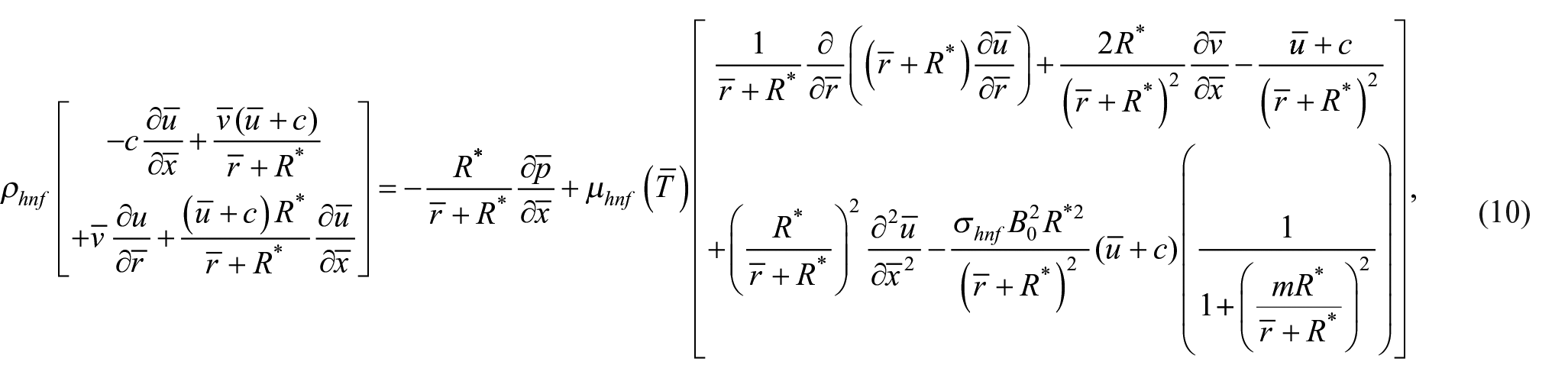
In wave frame of reference equations (3)–(6) takes the form



Dimensionless formulation and resulting equations
The above equations (8)–(11) can be normalized by defining the dimensionless variables28–32:

After using the above dimensionless variables and stream function related by

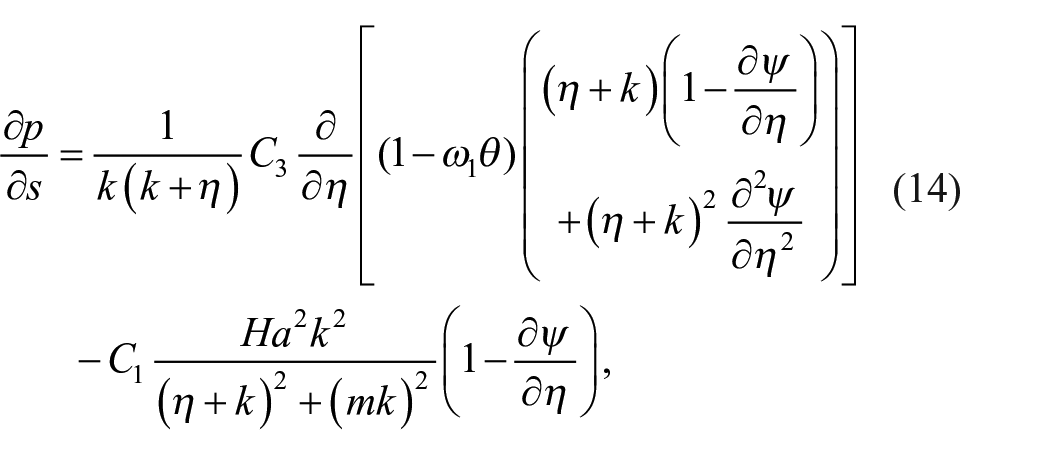

with axial component


The dimensionless flow constraints is28–30:

In laboratory frame, mean flow rate

Mathematical expressions of the walls in dimensionless form are

in which


The thermo-physical values of nanoparticles and base fluid is presented in table 2.
Numerical values of thermo-physical properties. 33

Solution methodology
Eliminating the pressure from the equations (13)–(14) by cross differentiation, the resulting equation along with equation (15) subject to boundary conditions (16) are numerically solved using Mathematica built in function ND Solve for the particular values of involved parameters.
Results and discussion
The fundamental onset of flow parameters governs to formulated model is tested graphically. The investigation deals with different cases like for constant viscosity

(a-b) Variation of axial velocity

(a-b) Variation of axial velocity

(a-b) Variation of axial velocity
In Figure 5 the temperature distribution
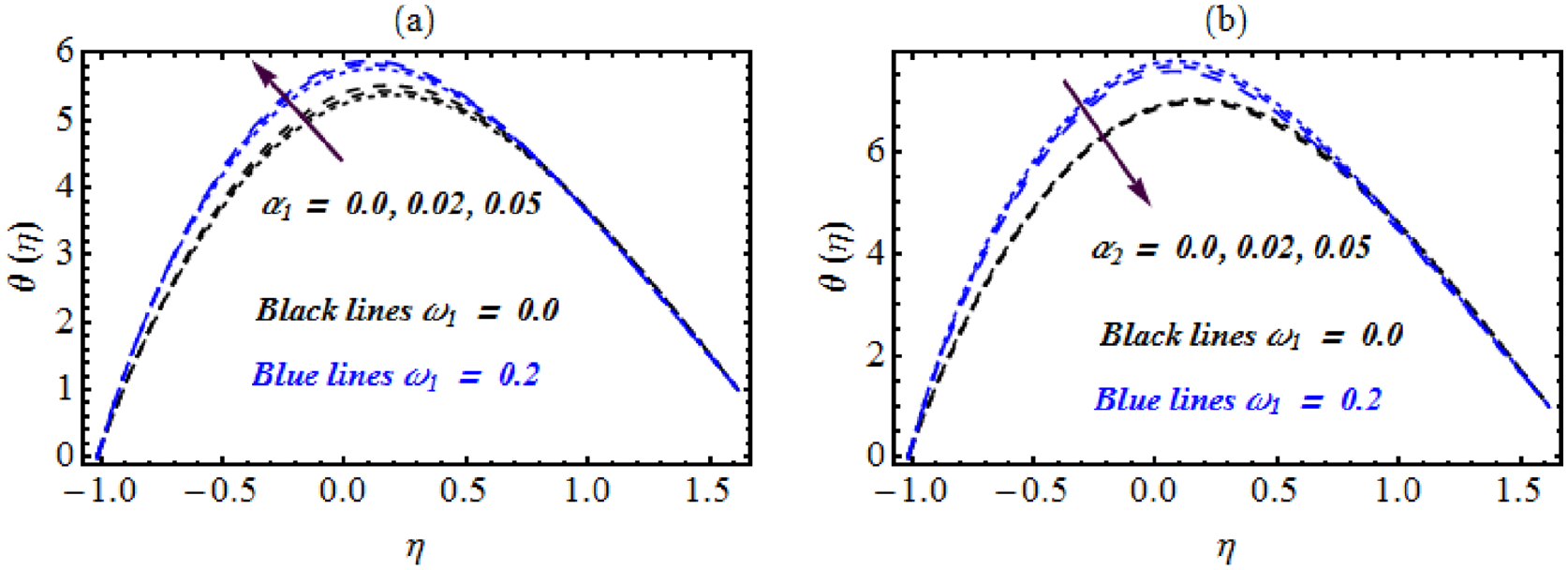
(a-b) Variation of temperature distribution

(a-b) Variation of temperature distribution

(a-b) Variation of temperature distribution
Streamlines for different values of Hartman number

(a-d) Variation of streamlines against Hartman number

(a-d) Variation of streamlines against Hall parameter

(a-d) Variation of streamlines against curvature parameter
Figures 11 and 12 present the pressure gradient variation against the volume fraction of

(a-b) Variation of pressure gradient against solid volume fractions of nanoparticles

(a-b) Variation of pressure gradient against Hartman number
The effects of Hartman number, Hall parameter and curvature parameter on both skin friction and heat transfer coefficient are presented in Tables 3 and 4 for two working nanofluids. That is,
Variation of skin friction against several parameters with

Change in heat transfer coefficient with

Main findings
From the above graphical and tabulated results the main outcomes of the present study are summarized as follow
➢ Velocity is decreasing function of solid volume fractions of
➢ Hartman number decreases the velocity in upper half while Hall parameter enhanced the velocity along the axial direction in upper regime of channel.
➢ The symmetry in the velocity profile is noted for the increasing values of curvature parameter.
➢ A smaller velocity change is associated to the temperature dependent viscosity.
➢ The temperature is increasing function Hall parameter while decreasing function of Hall parameter.
➢ The temperature is large for variable viscosity when compared to constant viscosity.
➢ Accumulation of trapping bolus in the upper half of the curved channel is noticed for temperature dependent viscosity.
➢ For
➢ Solid volume fraction of both
➢ The pressure gradient declines by prompting the variable viscosity.
➢ The heat transfer coefficient is decreasing function of Hartman number and curvature parameter.
➢ For temperature dependent viscosity the heat transfer coefficient enhanced as compared to constant viscosity.
Refs.34–38 are added for the future work, which altered the existed model to the peristaltic flow model.
Footnotes
Author’s Note
Muhammad Ijaz Khan is also affiliated to Department of Mechanical Engineering, Lebanese American University, Beirut, Lebanon.
Declaration of conflicting interests
The author(s) declared no potential conflicts of interest with respect to the research, authorship, and/or publication of this article.
Funding
The author(s) disclosed receipt of the following financial support for the research, authorship, and/or publication of this article: The authors would like to thank the Deanship of Scientific Research at Umm Al-Qura University for supporting this work by Grant Code: 22UQU4331317DSR80.
