




Abstract
Gold-based metal nanoparticles serve a key role in diagnosing and treating important illnesses such as cancer and infectious diseases. In consideration of this, the current work develops a mathematical model for viscoelastic nanofluid flow in the peristaltic microchannel. Nanofluid is considered as blood-based fluid suspended with gold nanoparticles. In the investigated geometry, various parametric effects such as Joule heating, magnetohydrodynamics, electroosmosis, and thermal radiation have been imposed. The governing equations of the model are analytically solved by using the lubrication theory where the wavelength of the channel is considered large and viscous force is considered more dominant as compared to the inertia force relating the applications in biological transport phenomena. The graphical findings for relevant parameters of interest are given. In the current analysis, the ranges of the parameters have been considered as:
Introduction
Nowadays nanofluids are well-known conventional fluids and being are used for enhancement of various thermal properties particularly thermal conductivity of the base fluids. Varieties of base fluids, including water, methanol, oil, and ethylene glycol are utilized to prepare the nanofluids and hybrid nanofluids. The numerous types of nanofluids and their distinctions are adequately explained by the types of nanoparticles and their shapes. The dispersed nanoparticles in base fluids have higher thermal conductivities, hence nanofluids give better thermal performance than traditional fluids. Chemical processes, cooling of electronic equipment, heat exchanger, machine cooling, heat transfer efficiency, improving diesel generator efficiency, solar water heating, and engine cooling are just a few of the industrial and engineering applications of nanofluids. 1 In view of these applications, many investigators have started working on nanofluid flows in various geometries. Homotopy analysis approach was employed for squeezing water-gold (along with various nanoparticle shapes such as lamina, tetrahedron, hexahedron, sphere, and column) based nanofluid flow between horizontal channels. 2 Further, fourth and fifth order Runge-Kutta-Fehlberg technique was considered to analyze the gold nanoparticles effects on Sisko fluid (considering Sisko fluid as blood) flow over a stretching surface. 3 The mobility of nanofluid in an inclined diverging or converging channel is analyzed using the perturbation method. 4 The Matlab bvp4c simulation was used for the hybrid (copper and alumina treated as hybrid nanoparticles) nanoliquids flow along a widening/shrinking cylinder. 5 The ANSYS Fluent 19.3 simulations for the Poiseuille flow of alumina nanofluid in parallel plates. 6 The numerically approach was carried for the nanofluid flow in a pillow plate to discuss the applications for heat exchanger. 7 The flow of nanofluid in a rotating system with the single and multi-carbon nanotubes is studied by using the HAM BVPh 2.0 program. 8 Green’s function-based approach was used to squeeze nanofluid flow in parallel plates. 9 The boundary layer flow of blood-gold nanofluid across a paraboloid of revolution using the Runge–Kutta method and the MATLAB bvp4c methodology. 10 The nanofluid flow in a 3D tilted prismatic solar enclosure was studied using the ANSYS FLUENT program (version 19.1). 11 The micropolar gold blood nanofluid flow in a permeable channel was studied using HAM. 12 The Casson nanofluid flow is analytical solved to get the closed-form solution of the model. 13
In the gastrointestinal tract (GI), peristalsis is the movement of a food bolus across the entire length of the tract. The movement begins in the pharynx and concludes in the anus (windpipe). Peristalsis can be found in both smooth and skeletal muscles. In the field of physiology, it is well-known because it is a critical component of many biological systems, including spermatozoa transport, small blood vessel vasomotion, ovum movement, and urine flow from the kidney to the bladder. 14 Nanofluids have the potential to benefit a wide range of gastrointestinal illnesses, including inflammatory bowel disease, drug administration, and the management of chronic intestinal inflammation. In light of these considerations, researchers have recently begun investigating nanofluid flows in the direction of biological applications in a variety of flow scenarios, including channel, endoscope, curved shape, and so on, in order to better understand how they work. The computational solutions demonstrated the heat and mass transfer characteristics on the motion of cilia for Newtonian, Pseudo-plastic, and Dilatant fluids in an inclined peristaltic channel using Mathematica software. 15 The nature of third grade nanofluid flow in peristaltic vertical annulus was addressed by taking the gold nanoparticles in base fluid blood into account. 16 Further several studied have been reported by using various technique to comprehend the thermal characteristic of the nanoparticle in the Newtonian and non-Newtonian fluid.17–21 The peristaltic flow of nanofluids in a vertically asymmetric channel (Ag-water and Cu-water nanofluids) is discussed and observed that the Cu has much better efficiency rather than Ag. 22 The flow of nanofluid driven by peristalsis were discovered in an asymmetric channel. 23 The heat transfer rate in a multiphase flow induced by metachronal propulsion is discussed through porous media. 24
Biological fluids can be found in living things when they are exposed to a strong magnetic field. Scientists have paid a great deal of attention to the behavior of physiological fluids with magnetohydrodynamics mechanisms over the course of the last few decades. Many applications in bioengineering and medical sciences, such as magnetic resonance imaging (MRI), cancer treatment, drug transport, reducing bleeding during surgeries, and the invention of magnetic devices for cell separation and wound healing, 25 have made significant contributions to this field. On the basis of these findings, the current researchers have investigated the effect of MHD on nanofluid flows in biological geometries in the laboratory. The computational solutions for the of Eyring–Powell nanofluid flow under convective conditions are presented with applications of MHD and peristalsis mechanisms. 26 The HPM was utilized to explore the motion of nanofluids generated by the peristalsis mechanism in their experiments. 27 In the context of magneto-hydrodynamics, the magnetic nano particles are considered in the viscoelastic fluid 28 and observed that the gold particle enhanced the thermal conductivity of the fluid. 29 By employing the Runge-Kutta-Fehlberg approach, the flow of blood nanofluid in three distinct geometries is observed. 30 Jeffrey nanofluid MHD peristaltic flow via peristaltic compliant barriers was studied theoretically, 31 who presented their findings. The MHD peristalsis of Jeffrey nanofluid flow through a conduit was investigated32,33 while the MHD peristalsis motion of Carreau nanofluid with copper and silver nanoparticles is discussed. 34 Further investigations on heat transfer analysis and nanofluid can be found in the given Refs.35–40 and several therein. The electro-osmotic flow (EOF) of various fluids is investigated in diverse microchannels, such as circular, elliptic, rectangular and slit microchannels. Nowadays the attention of researchers on electro-osmotic flow has shifted to the EOF heat transfer characteristics. In chemical and biological industries, the biofluids transport noticed in microfluidic devices, and shows the nonlinear rheological behavior. In view of these, many investigations have been done in various situations, such as EOF in diverging channels, 41 EOF in parallel plates,42,43 and EOF in converging channels. 44
Aforementioned works discuss the fluid flows in various directions such as nanofluids, peristalsis, electroosmosis and magnetic field, but no study is seen in the direction of blood-gold-based nanofluid flow through peristalsis with electrohydrodynamics, magnetohydrodynamics, Joule heating and radiation. Therefore, the current research focuses on the electroosmotic blood-based nanofluids with gold nanoparticles suspension in presence of nanoparticles. Here, blood is modeled as non-Newtonian viscoelastic fluids model that is, Jeffrey fluid model to investigate the rheological importance of blood. The effects of Joule heating, electric field, thermal radiation, and magnetic fields have also been discussed. The mathematical formulation was carried out using the lubrication strategy to examine the creeping nature of the blood flow. Exact solutions are obtained and graphically explained the influence of emerging parameters. The findings of the present model may be applicable in targeting the drugs in circulatory systems and developments of the bio microfluidics pumps for health care.
Problem description
The flow of a viscoelastic nanofluid (blood as the base fluid with suspended gold nanoparticles) through a microchannel is studied under various factors such as MHD, radiation, Joule heating, and electroosmosis. Electric field and peristalsis in the positive X-axis direction are responsible for the flow. At both the walls (lower

Schematic representation of the peristaltic transport.
The following are the wall shapes that relate to flow configurations 38 :


where
An incompressible Jeffrey fluid has the constitutive equations as follows 28 :


where

It is possible to write the two-dimensional governing equations for the viscoelastic nanofluid with electroosmosis, radiation, Joule heating and magnetic field as follows 38 :


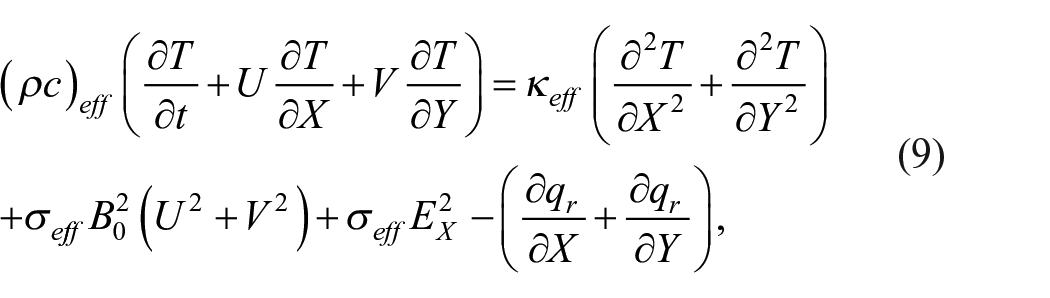
where U represents the axial velocity, V is transverse velocity,
In equation (9), the radiation
The following are the thermophysical properties 45 :


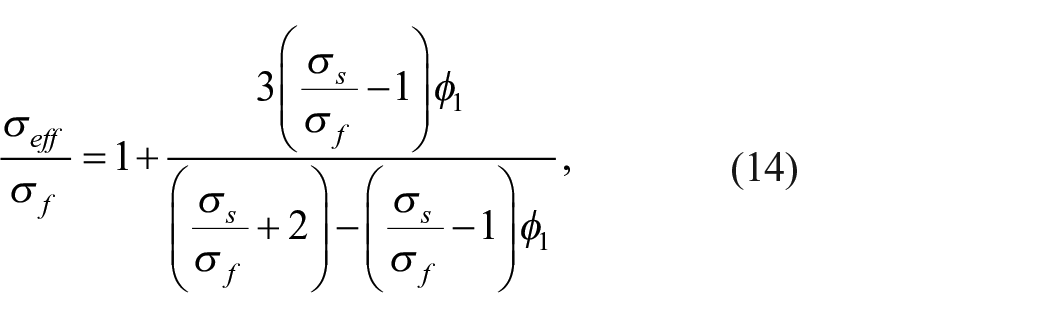
where
Potential distribution
The Poisson equation is represented by

where
As per Boltzmann distribution, the electric charge density is given by

where
Under Debye–Hückel linearization, the equations (15) (16) will take the form as:

Scaling and transformations of mathematical model
The transformations among both wave and fixed frames are as follows:

and the scaling parameters are defined as follows:

where


in conjunction with the associated boundary conditions
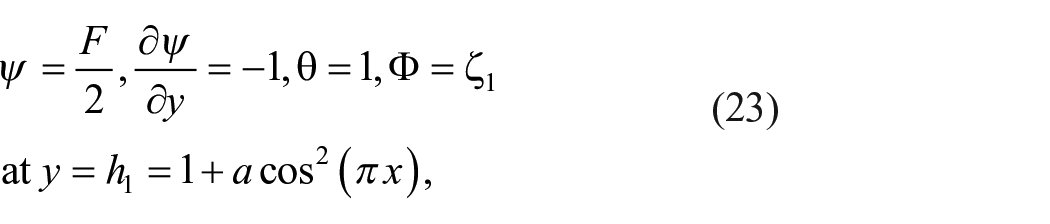

The flow rate is described this way in both the fixed and moving frames of reference:

here
The dimensionless shear stress


Solution of the problem
Equations (20)–(22) are solved under the boundary conditions (23)−(24), and the solutions for various physical quantities are as follows:


in which
Discussion of the findings
This section displays graphical representations of numerous fluid flow variables, including as velocity

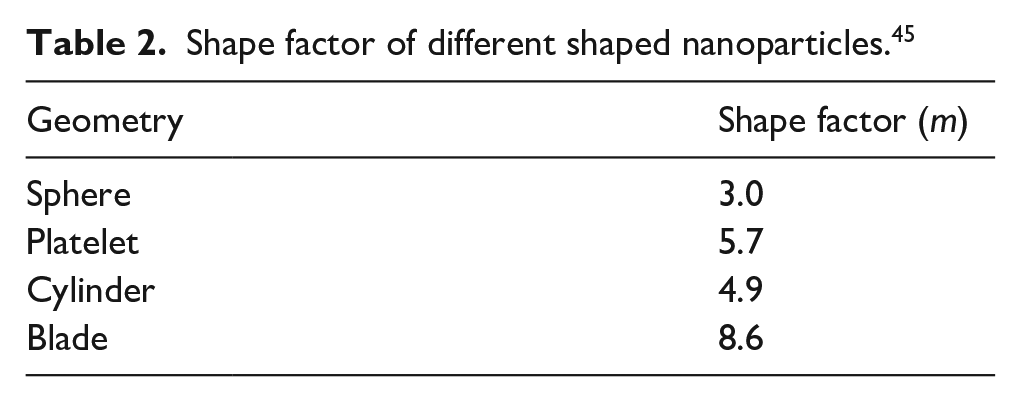
Shape factor of different shaped nanoparticles. 45
The comparison of velocity profile with the existing literature. 49

Figure 2 represents the velocity profiles for various fluid parameters such as electroosmosis parameter

Influence of (a) electroosmosis parameter
Figure 3 is plotted to see the variations of nanoparticle temperature with respect to Brinkman number, Joule heating parameter, Hartmann number and Radiation parameter. It is clear from these plots that; all the graphs are parabolic in nature. The nanoparticle temperature reduces with rising values of Brinkman number (see Figure 3(a)). It is also mentioned that the highest temperature is noticed for the stronger Brinkman number and the lowest temperature is recorded in the case of absence of Brinkman number. It is clear from Figure 3(b) that, with increase of the Joule heating parameter, the temperature increases and noticed that the lower temperatures have been recorded in the absence of the Joule heating parameter. A stronger magnetic field yields the decrement in nanoparticle temperature (see Figure 3(c)). It is depicted from Figure 3(d) that; the nanoparticle temperature decrement is noticed with rising values of radiation parameter. Figure 3(e) shows that when the viscoelastic fluid parameter is increased, the temperature rises; moreover, larger temperatures are engaged in the viscoelastic nanofluid model in comparison to the viscous nanofluid model. The Figure 3(f) is sketched to see the temperature profile for various shapes of nanoparticles (sphere (
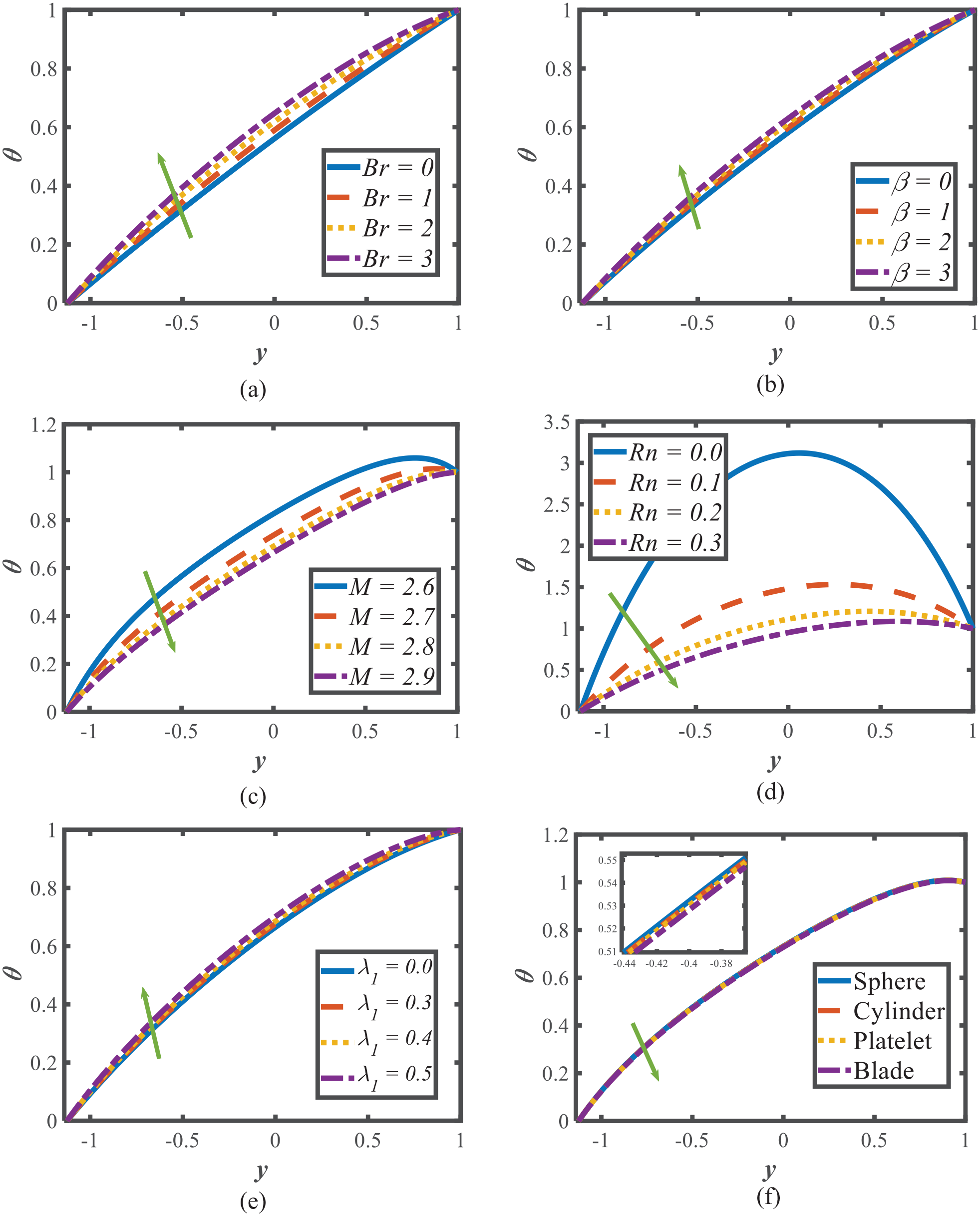
Influence of (a) Brinkman number
To see the behavior of shear stress distribution (at the wall
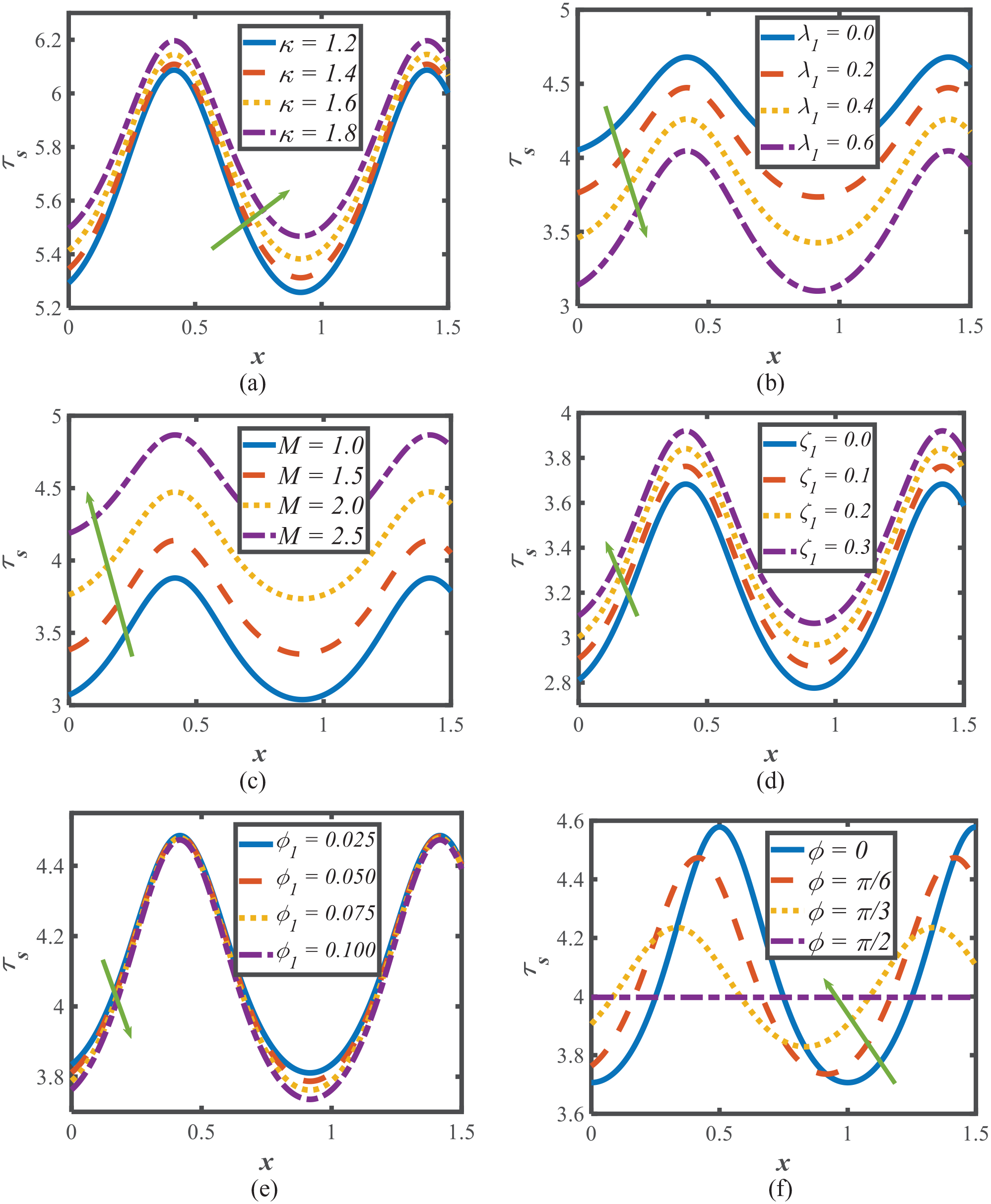
Influence of (a) electroosmosis parameter
Figure 5 is plotted to observe the mechanism of heat transfer coefficient at the wall
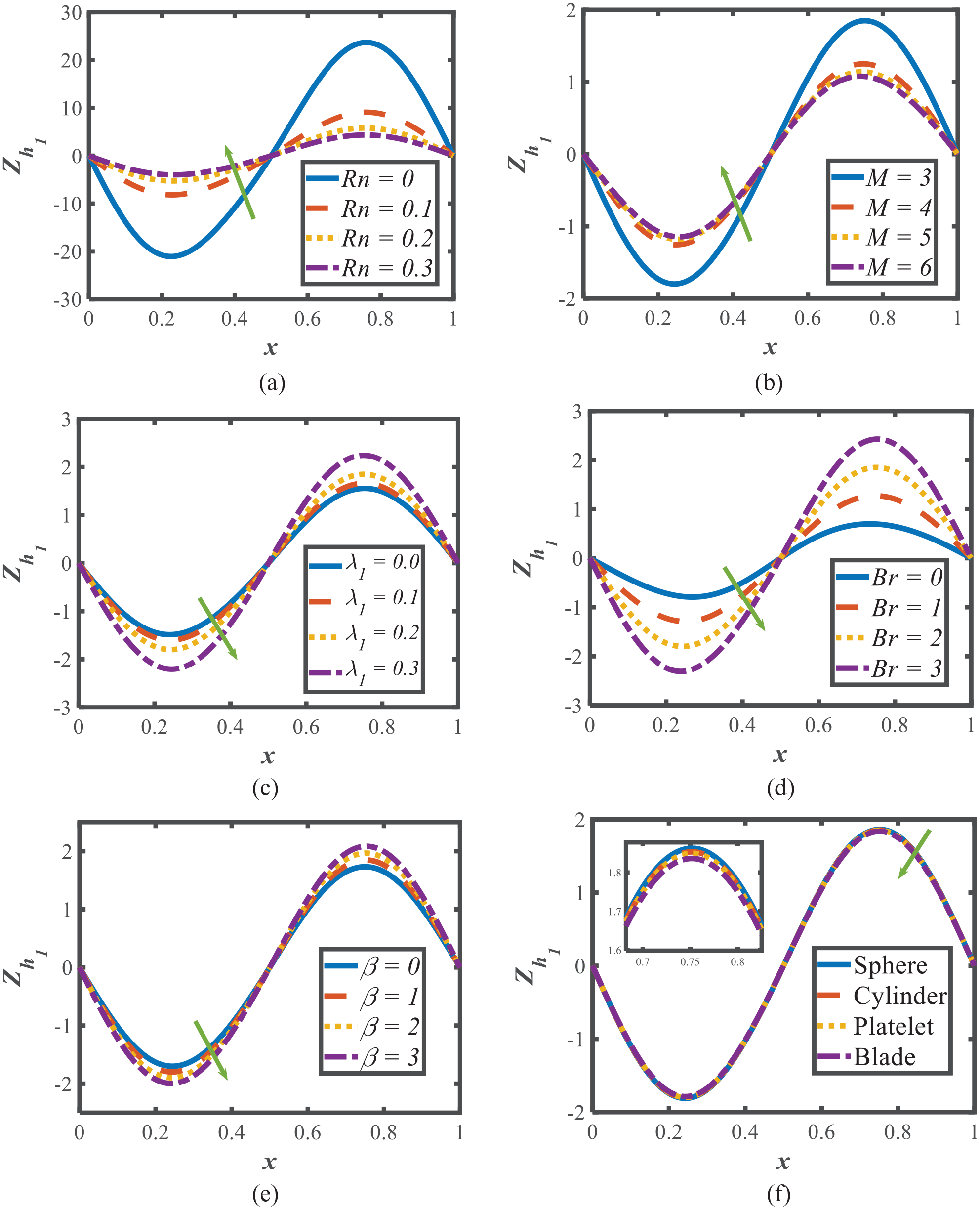
Influence of (a) radiation parameter

Streamline profiles for various Hartmann numbers such as (a) 2, (b) 2.1, (c) 2.2, and (d) 2.3.

Streamline profiles for various Helmholtz-Smoluchowski velocity such as (a) 3.1, (b) 3.3, (c) 3.5, and (d) 3.7.
Conclusions
The proposed model takes into account the gold-blood-based nanofluid flow in an asymmetric peristaltic geometry. All of the different impacts, such as Joule heating, EMHD, and radiation, have been taken into consideration. The governing equations that resulted have been solved analytically for the electric potential, stream function, velocity, and temperature of nanoparticles, among other things. There have been graphical representations for a variety of flow quantities provided. The investigation is carried out in relation to the platelet nanoparticles that are engaged in the nanofluid model. The following are the key findings of the current investigation, summarized as follows:
❖ Stronger magnetic field leads the reduction in the velocity and trapping bolus.
❖ The shear stress distribution increases with higher Hartmann number.
❖ Electroosmosis parameter reduces the velocity and enhances the shear stress.
❖ Stronger viscoelastic fluid parameter increases the velocity and decreases the shear stress.
❖ Higher values of Brinkman number and Joule heating parameter leads an increment in nanoparticle temperature.
Footnotes
Declaration of conflicting interests
The author(s) declared no potential conflicts of interest with respect to the research, authorship, and/or publication of this article.
Funding
The author(s) disclosed receipt of the following financial support for the research, authorship, and/or publication of this article: Princess Nourah bint Abdulrahman University Researchers Supporting Project number (PNURSP2022R41), Princess Nourah bint Abdulrahman University, Riyadh, Saudi Arabia.
