




Abstract
The previous research showed the anti-biofouling improvement of the polyamide six (PA6) fiber when grafted by 2-hydroxyethyl methacrylate (HEMA) individually, and in combination with acrylic acid (AA) known as dual monomers system. The effects of several operative parameters, including vessel reaction temperature and time, ultra violet (UV) pre-irradiation time, and also HEMA-AA mole ratios (for dual system) on the surface grafting of a PA6 fiber by HEMA and also, dual HEMA-AA system were studied. The studied grafting parameters were grafting degree (D), grafting efficiency (E), formed homo and or co-polymer (Y), reaction extent (K), and reaction ratio (R). A pre-UV irradiation technique (PUVA) used for irradiation of the fibers. The results showed efficient polymerization and grafting reactions for the selected operative parameters. The increasing reaction temperature reduced the grafting of the HEMA and AA on the fiber surface. Instead, it accelerated the homo and or co-polymerization of the HEMA and AA monomers. The reaction time had the lowest effect on the homo and co-polymer formation of the used monomers in the studied dual HEMA-AA system. The increasing pre-UV irradiation time was beneficial for the grafting of the studied monomers on the PA6 fiber. The reason referred to increasing the number and concentration of the active sites on the fiber surface.
Introduction
The marine biofouling is the unfavorable deposition and extension of marine organisms on the immerged surfaces in seawater. The unpleasant aggregation of living organisms (biofouling) leads to a series of serious problems for the submerged fish cages in seawater, that is, restriction of seawater circulation in cage net and consequently, lack of enough solved oxygen in the water which results fish death.1,2 Among several used materials for manufacturing the fish cage nets, nylon (polyamide, PA) fibers frequently use due to their excellent physical properties, including abrasion resistance and durability. 3 To increase the biofouling resistance of a fiber surface, it is customary to graft chemically an adequate material on the fiber surface. The grafting chemicals give either superior hydrophilicity or hydrophobicity to its surface and increase the anti-biofouling nature of the surface modified fiber. The grafting of a monomer on the fiber surface may improve with the aid of UV pre-irradiation.4–6
However, there are few studies on the anti-biofouling effect of different grafting chemicals on the PA fibers. Shalaby et al. 7 examined the bonding of glycidyl methacrylate on PA6 fibers with the aid of diallyl dimethyl ammonium chloride using a redox initiator. They measured the grafting rate and proposed a mechanism for the grafting process. In another attempt, 8 they reported the surface treatment of PA6 fibers with the linkage of 2-hydroxyethyl methacrylate by redox initiator for medical purposes. Zarrini et al. 9 provided nylon-polyaniline nanocomposite by bonding aniline on the electro spun PA6 nanofibers to eliminate the anion dye, methyl orange. They realized that the dye adsorption was dependent on the dopant pH, and the highest yield observed for dopant pH of 1. The immobilization of the recombinant Invertase (INVB) from Zymomonas mobilis on activated PA6 micro beads with glutaraldehyde and polyethyleneimine (PEI) perused by Vallejo-Becerra et al. 10 The improved micro beads were more thermally stable than un-modified samples. The self-cleaning and antibacterial specifications observed for treated PA6 fabric with a corona discharge and subsequent coating with TiO2 nanoparticles using pad-dry-cure approach. 11 The improvement in hydrophilicity of the PA6 fabric attained by coating the fiber surface with a mixture of carboxy methyl cellulose and acrylic acid with the aid of UV irradiation by Ibrahim et al. 12 To produce a stationary phase with strong cation interchange, Jiang and Marcus 13 linked the 2-acrylamido-2- methyl propane sulfonic acid (AMPS) on PA6 fiber surface using microwave irradiation. They also made stationary phase with weak cation interchange. 14 Liu et al. 15 grafted the zwitterionic agent of sulfobetaine methacrylate on the polyamide thin-film composite membranes with the ATRP technique to assess the anti-biofouling effect of the surface. The nylon six fabric surfaces were activated by chemical bonding of meth acrylic acid (MAA) and also 2-hydroxyethyl methacrylate (HEMA) using dielectric barrier discharge plasma. 16 Abdel-Megeed et al. 17 assayed the electro spinning of PA6 with direct insertion of chitosan. In the next stage, they treated the surface of PA six/chitosan nanofibers with glycidyl tri methyl ammonium chloride to generate an excellent antibacterial nanofibers resistant against Pseudomonas cichorii and Dickeya dadantii bacteria.
Other researchers18–21 used certain techniques, including electron beam, gamma, and plasma radiation to link several grafting chemicals on the PA6 fiber surfaces.
HEMA (Scheme 1) synthesized by a single-step reaction from meth acrylic acid and or methyl methacrylate. 22 The availability of hydroxyl group on HEMA chemical structure allows substitution reactions with the polymers, that is, polyamides. Because it is soluble in water, it frequently uses in hydrogels and also dental and biomedical applications. Acrylic acid (AA), as a colorless and simplest unsaturated carboxylic acid, is soluble in water (Scheme 1). It has several applications in materials and biology science. 23 Because of having a double bond in structure, the above-mentioned monomers have enough capability for homo and copolymerization through a radical mechanism.

The 2-hydroxyethyl methacrylate (HEMA) and acrylic acid (AA) chemical structures.
Authors already studied the grafting of HEMA on the PA6 fiber surface using a UV irradiation technique named pre-UV irradiation (PUVI). 24 They also studied the grafting of a HEMA-AA dual system on the same fiber with the above-mentioned irradiation technique. 25 The chemical linkages between the above-mentioned grafting agents and the surface of the PA6 fiber confirmed by using several characteristic techniques, including ATR-FTIR, DSC, XRD, SEM, and contact angle. Furthermore, the anti-biofouling properties of the grafted PA6 fibers evaluated. The results showed the grafting of the HEMA, and dual HEMA-AA system thoroughly changed the surface properties of the PA6 fiber when compared with the rest studied monomers individually, or in combination as dual monomers system. It was due to the formed hydrogel layer on the surface of the fiber. The results of the biological tests also showed that HEMA, and also dual HEMA-AA system were suitable grafting monomers for improving the surface anti-biofouling properties of the PA6 fiber.24,25 In the current study, the effects of several operative parameters, including reaction temperature, reaction time, ultra violet (UV) pre-irradiation time, and also HEMA-AA mole ratios (for dual monomers system) on the surface grafting of a nylon six (PA6) fiber were studied using HEMA and dual HEMA-AA system as grafting agents. The studied grafting parameters were grafting degree (D), grafting efficiency (E), formed homo and co-polymer (Y), reaction extent (K), and reaction ratio (R). The PUVA technique was used for the UV irradiation of the fibers.
Experimental
Materials
Polyamide fiber (PA6) with 210 Denier and 34 filaments received from Aliaf public joint stock co., Tehran, Iran. The benzophenone (photo initiator, BP, 99%), 2-hydroxyethyl methacrylate monomer (HEMA, 97%), acrylic acid (AA, 99%), p-toluene sulfonic acid (homo-polymerization inhibitor agent, PTSA, 90%), dichloromethane (solvent, 99%), and methanol and dimethyl formamide (solvents for Soxhlet extraction, 99%) supplied by MERCK, Germany. The PA6 fibers pre-treated and washed with sodium carbonate (MERCK, Germany) and a nonionic detergent (IRAMID-CD, Padideh shimi jam co., Tehran, Iran) before further using.
Processing method
The grafting of the HEMA and dual HEMA-AA system on the PA6 fiber performed as described earlier.24,25 The reaction temperatures, reaction times, UV pre-irradiation times, and HEMA-AA mole ratio selected between 60°C and 90°C, 0.5 and 4 h, 5 and 30 min, and 1–2 and 3.6–1, respectively. The total HEMA and HEMA-AA (for dual system) concentrations kept at 0.75 mol/L. The molecules of the monomers in the reaction vessel (HEMA, and HEMA-AA in dual system) have two options, grafting on the PA6 fiber surface, and or to form homo and or co-polymer, that is, poly HEMA, and poly HEMA, poly AA, and HEMA-AA copolymer for the dual system. With considering the above point, the grafting degree (D) and the sum amount of the formed HEMA and AA homo-polymers, and HEMA-AA copolymer during the grafting reaction (Y) calculated as mentioned in earlier reports24,25 as below:


The grafting efficiency (E), reaction extent (K), and grafting ratio (R) calculated using the following equations26–28:


Where

The grafting degree of polymer (D), formed homo-polymer (Y) (a), grafting efficiency (E), reaction extent (K), and reaction ratio (R) (b) versus the reaction time for the grafted PA6 fiber with HEMA. The UV pre-irradiation time, the HEMA concentration, and the reaction temperature kept at 20 min, 0.294 mol/L, and 700C, respectively. The PTSA and BP weight percent’s were 0.45% and 5%, respectively.
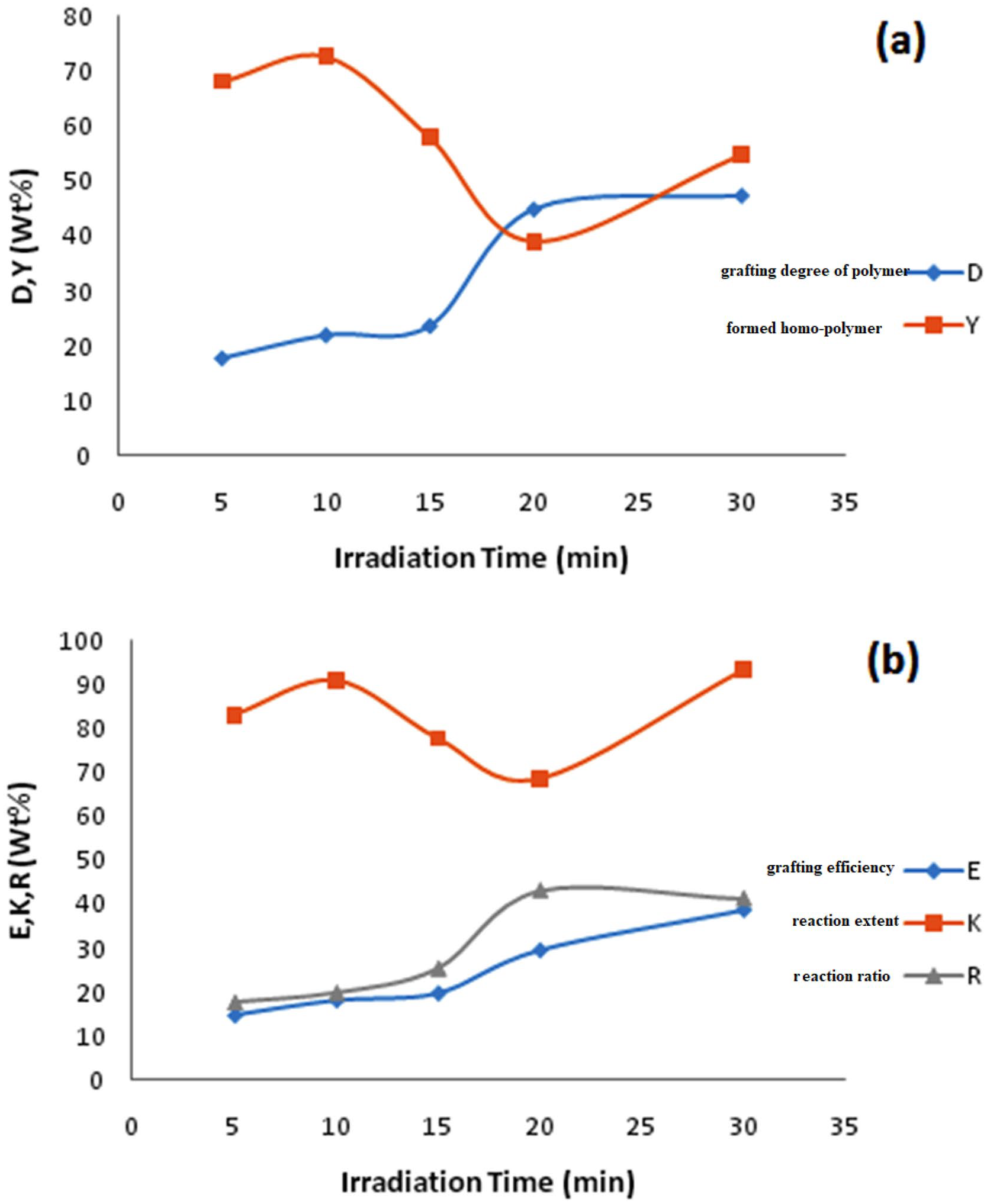
The grafting degree of polymer (D), formed homo-polymer (Y) (a), grafting efficiency (E), reaction extent (K), and reaction ratio (R) (b) versus the UV pre-irradiation time for the grafted PA6 fiber with HEMA. The reaction time, the HEMA concentration, and the reaction temperature kept at 3 h, 0.294 mol/L, and 700C, respectively. The PTSA and BP weight percentages were 0.45% and 5%, respectively.
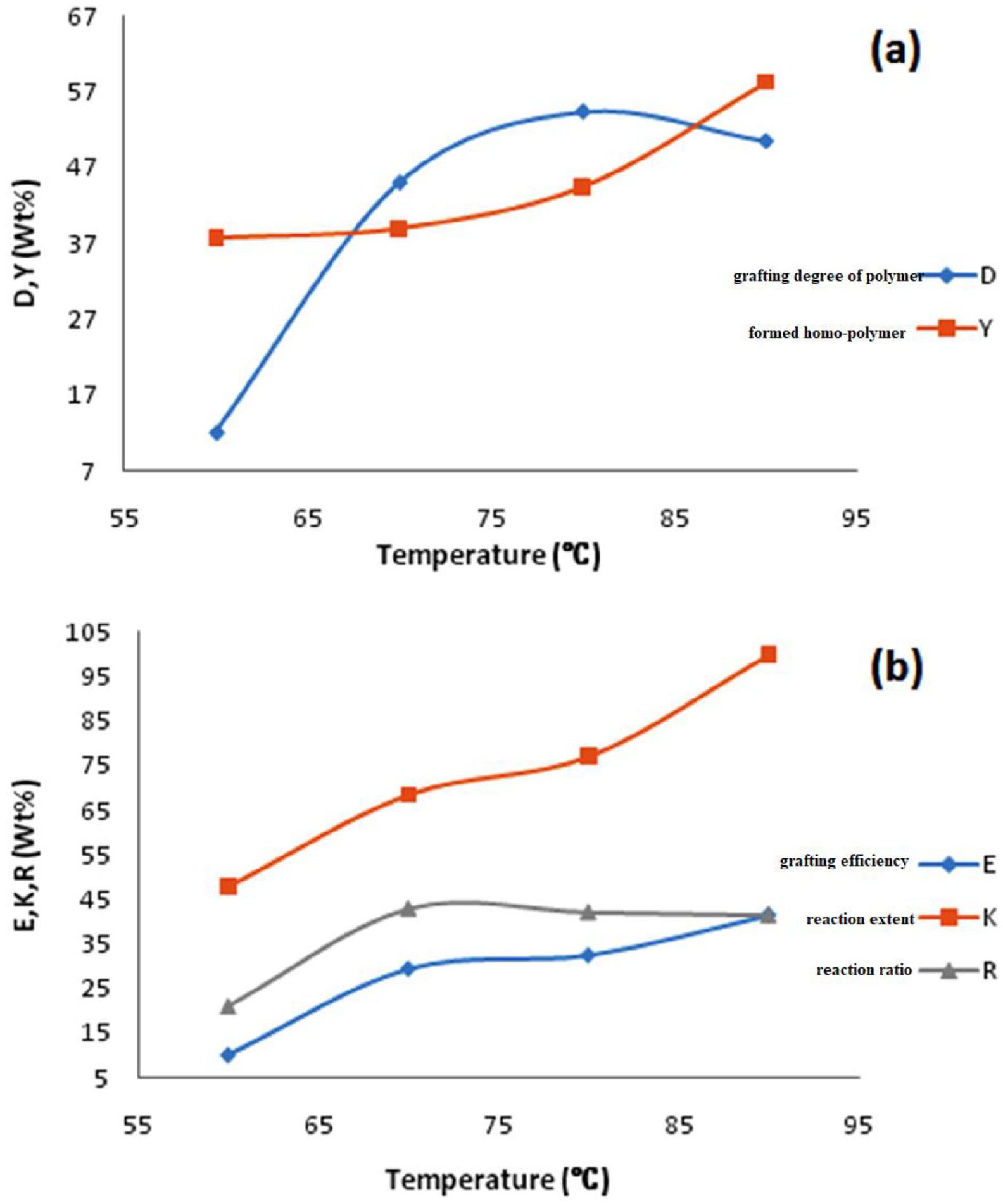
The grafting degree of polymer (D), formed homo-polymer (Y) (a), grafting efficiency (E), reaction extent (K), and reaction ratio (R) (b) versus the reaction vessel temperature for the grafted PA6 fiber with the HEMA. The reaction time, the HEMA concentration, and the UV pre-irradiation time kept at 3 h, 0.294 mol/L, and 20 min, respectively. The PTSA and BP weight percentages were 0.45% and 5%, respectively.
The grafting degree of polymer (D), formed homo and co-polymer (Y), grafting efficiency (E), reaction extent (K), and grafting ratio (R) versus the reaction time for the grafted PA6 fiber with dual HEMA-AA system. The PTSA and BP weight percentages, reaction temperature, UV pre-irradiation time, and HEMA-AA weight ratio kept at 0.45% and 5%, 700C, 20 min, and 1–3.6, respectively. The total monomers concentration was 0.75 mol/L. The median value of five repeated experiments was reported.
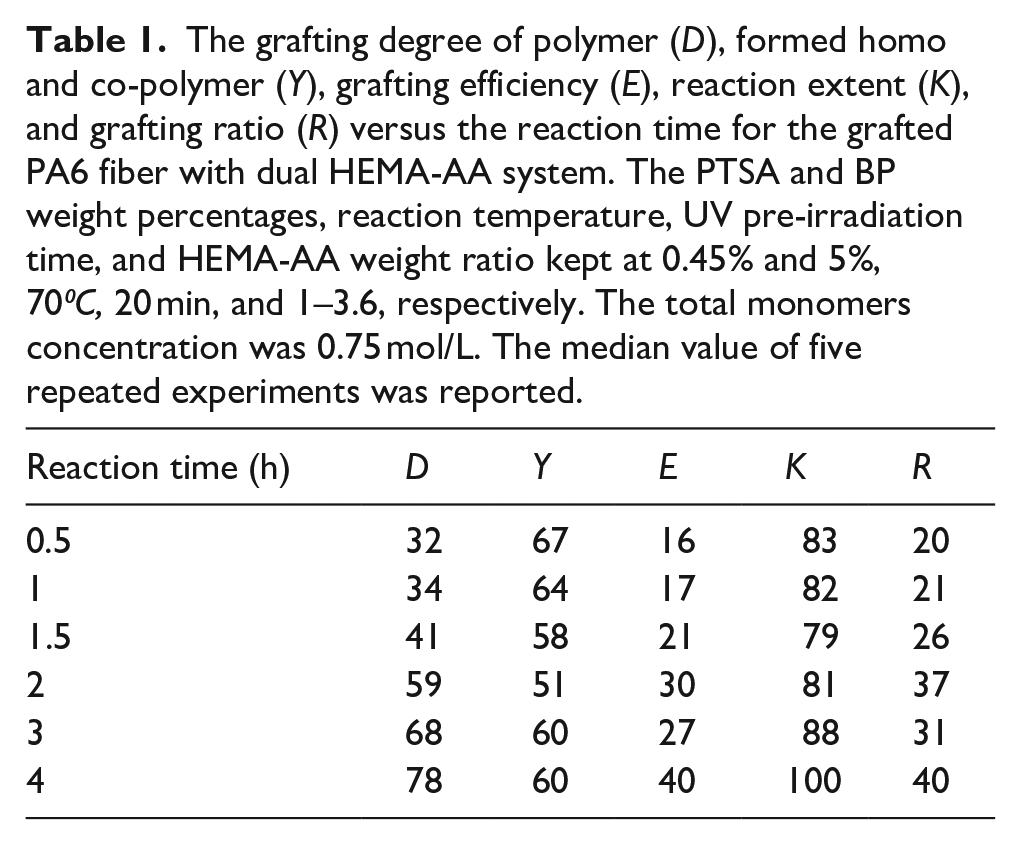
The grafting degree of polymer (D), formed homo-polymer (Y), grafting efficiency (E), reaction extent (K), and grafting ratio (R) versus the UV pre-irradiation time for the grafted PA6 fiber with dual HEMA-AA system. The PTSA and BP weight percentages, reaction temperature, reaction time, and HEMA-AA weight ratio kept at 0.45% and 5%, 700C, 2 h, and 1–3.6, respectively. The total monomers concentration was 0.75 mol/L. The median value of five repeated experiments was reported.
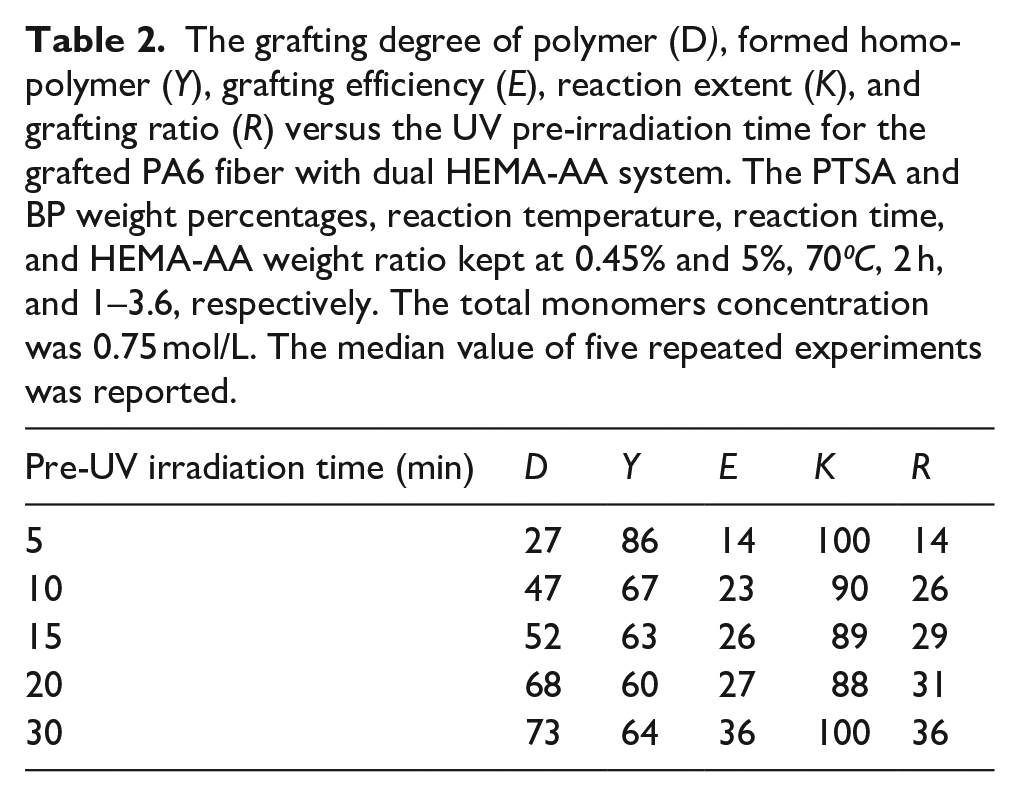
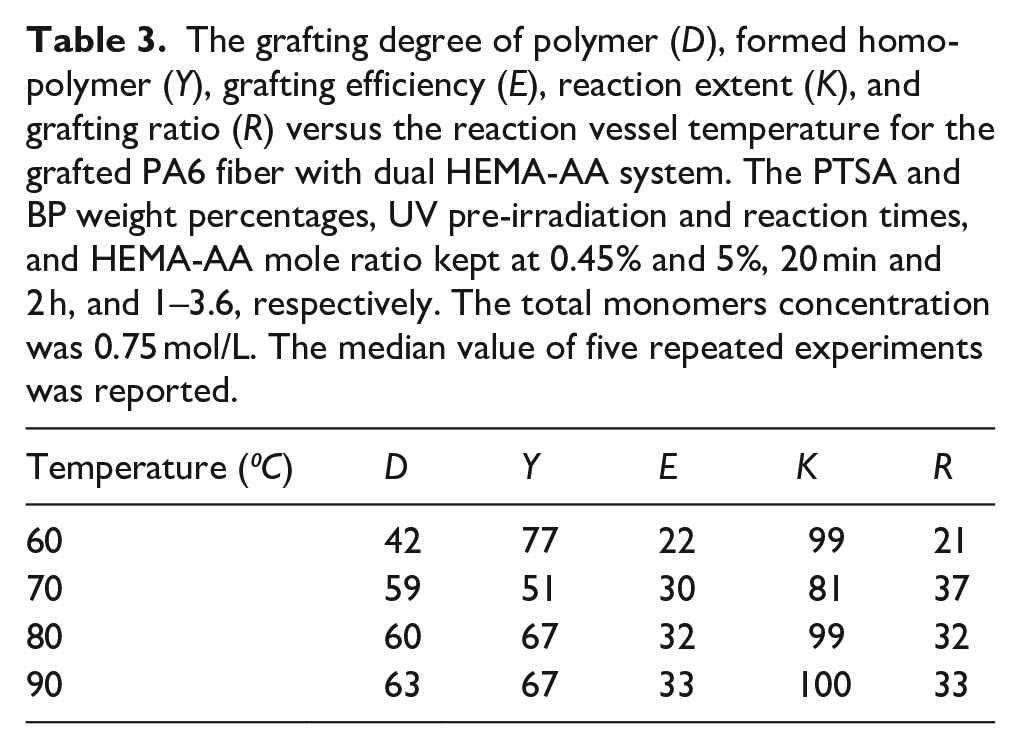
The grafting degree of polymer (D), formed homo-polymer (Y), grafting efficiency (E), reaction extent (K), and grafting ratio (R) versus the reaction vessel temperature for the grafted PA6 fiber with dual HEMA-AA system. The PTSA and BP weight percentages, UV pre-irradiation and reaction times, and HEMA-AA mole ratio kept at 0.45% and 5%, 20 min and 2 h, and 1–3.6, respectively. The total monomers concentration was 0.75 mol/L. The median value of five repeated experiments was reported.
The grafting degree of polymer (D), formed homo-polymer (Y), grafting efficiency (E), reaction extent (K), and grafting ratio (R) versus the HEMA-AA mole ratio in dual HEMA-AA system for the grafted PA6 fiber for the same system. The PTSA and BP weight percentages, reaction temperature, UV pre-irradiation, and reaction times kept at 0.45% and 5%, 700C, 20 min, and 2 h, respectively. The total monomers concentration was 0.75 mol/L. The median value of five repeated experiments was reported.

Results and discussion
The grafting by UV irradiation technique is an efficient method for the development of new functional materials. 23 It has several advantages, that is, carry out the reaction at room temperature and grafting in the gaseous and or liquid phase of the monomer. Among of already studied two UV irradiation techniques,24,25 the PUVI technique showed more efficient results, and it selected as an appropriate UV irradiation technique in this study.
The effect of the reaction time on the grafting parameters
Figure 1 and Table 1 show the D, Y, E, K, R values (%) versus grafting reaction time for the grafted PA6 fiber with HEMA, and dual HEMA-AA system, respectively. The UV pre-irradiation time, the HEMA concentration, and grafting reaction temperature were 20 min, 0.294 mol/L, and 70°C, respectively.
For dual system, the HEMA-AA weight ratio kept as 1–3.6. In all experiments, the PTSA and BP weight percent’s were 0.45, and 5 wt%, respectively. Figure 1 shows the formed HEMA homo-polymer (Y) reduced from 55% to 39% when reaction time increased from 0.5 to 3 h. Further increasing of the reaction time up to 4 h was beneficial for the above-mentioned parameter, and increased the formed HEMA homo-polymer to the value of 56%. In the reaction vessel, two simultaneous reactions (phenomenon) are in competition with each other, grafting of the HEMA molecules on the PA6 surface, and homo-polymerization of the HEMA molecules. In the initial stages, the former was the predominant phenomenon, while by extending the reaction time, the latter phenomenon accelerated. The reason refers to the steric hindrance of the already grafted HEMA molecules on the PA6 surface. They reduced the rate of grafting process for higher reaction times, and accelerated the HEMA homo-polymerization. However, increasing the reaction time had a positive effect on the rest studied parameters with different rates. The D, E, K, and R values ranged from 24% to 49%, 20% to 40%, 74% to 96%, and 27% to 42% when reaction time increased from 0.5 to 4 h, respectively. Depending on the conditions in the reaction vessel, the HEMA monomers had three options, stay as monomer, homo-polymerize with each other, and the grafting on the PA6 surface. The continuous increasing of the reaction extent parameter (K) up to 96% represented that only 4% of the initial HEMA remained un-reacted after 4 h. Also the 42% reaction ratio parameter (R) after 4 h reaction showed that only 42% of the reacted HEMA molecules grafted on the PA6 surface, while the rest HEMA molecules (58%) homo-polymerized with each other. It was concluded the HEMA monomers had more tendency to homo-polymerize with each other rather than grafting on the PA6 fiber. However, the tendency was more evident in lower reaction times (compare the R values in Figure 1). Our founds conformed with the other reports.6,8,29 Figure 1 also demonstrates the grafting efficiency (E) became double when the reaction time increased from 0.5 to 4 h.
Table 1 shows the dual HEMA-AA system reached 100% reaction extent (K) after 4 h reaction. For above-mentioned dual system, the K reached 83% after 0.5 h and stayed at this level up to 2 h. After that the K values increased to the values of 88% and 100% for reaction times of 3 and 4 h, respectively. Meanwhile, increasing reaction time had not significant effect on the homo and co-polymer formation of the studied monomers, HEMA and AA with the exception of 2 h reaction time. The Y values stayed within a range of 58%–67%. The R’s showed 20%–40% of the reacted AA, and HEMA grafted on the PA6 surface for the studied reaction times. The D and E values ranged between 32% and 78% and 16% and 40%, respectively. The latter values showed the lower tendency of HEMA and AA for grafting on PA6 fiber surface compared with homo and co-polymerization of the studied monomers with each other.
The effect of the UV pre-irradiation time on the grafting parameters
The UV pre-irradiation performed in this study, usually increases the active sites of a polymer surface. 6 The capacity of a surface for adsorption of other molecules depends on the concentration and the numbers of active sites on the surface. Figure 2 represents the studied operative parameters, D, Y, E, K, and R versus UV pre-irradiation time for the HEMA grafted PA6 fibers. As observed, increasing UV pre-irradiation time was beneficial for the D, E, and R. The values ranged between 18% and 48%, 15% and 39%, and 18% and 41%, respectively, when UV pre-irradiation time increased from 5 to 30 min. It expected because the UV pre-irradiation amended the PA6 surface by increasing the active surface sites. However, for Y and K, no regular trends were observed. The homo-polymer % of HEMA (Y) reached a maximum value of 73% for 10 min UV pre-irradiation and subsequently reduced to lower values and finally fixed at 55% for 30 min UV pre-irradiation time. For reaction extent % (K), the minimum and maximum values were 68% and 93% for 20 and 30 min UV pre-irradiation times, respectively.
Table 2 shows for dual HEMA-AA system, the Y value reached 86% immediately after 5 min UV pre-irradiation and subsequently, it reduced to the values of 67%, 63%, 60%, and 64% for UV pre-irradiation times of 10, 15, 20, and 30 min. It seemed, increasing the UV pre-irradiation time was influential to activate the active sites on the PA6 surface because with increasing the UV pre-irradiation time, the amount of HEMA and AA homo and or co-polymers reduced and consequently, the grafting of the above-mentioned monomers on the PA6 surface increased. This fact was also evidenced by considering the increase of E, D, and R values from 14% to 36%, 27% to 73%, and 14% to 36% when the UV pre-irradiation time increased from 5 to 30 min, respectively. The high K values in Table 2 demonstrate the high reaction extent for all studied UV pre-irradiation times, that is, 100% for both, 5 and 30 min UV pre-irradiation times.
Understanding the adsorption-desorption phenomena and effective parameters on these processes was crucial to explain the adsorption mechanism of the HEMA and AA molecules on the PA6 surface. The adsorption and desorption of a molecule on and or from a solid surface are two competitive reactions. They depend on several parameters, that is, Gibb’s free energy, the interaction between adjacent molecules, namely, HEMA and AA, aqueous boundary layer diffusion, chemical structure similarity of the adsorbed molecule and the solid surface, solid surface energy, and steric hindrance after reaction progress. 30
The effect of the vessel reaction temperature on the grafting parameters
The increasing of the E and Y values with reaction temperature (Figure 3) was a good evidence to show the positive effect of the mentioned parameter on the grafting and also homo-polymerization of the HEMA. The values for E and Y were 10%–42% and 38%–58%, respectively, when the reaction temperature increased from 60°C to 90°C. The reason refers to increasing the mobility of the available species, that is, macromolecule (PA6) and monomer (HEMA) in the reaction vessel. Improving molecular mobility increases the collision between similar and or dissimilar molecules. The consequence may be a chemical reaction if they have enough activation energy. However, the Y values (the HEMA homo-polymerization) were extremely higher than the E values (the grafted HEMA on the PA6 surface). It concluded, the increasing of the reaction temperature was more influential on the HEMA homo-polymerization. It was due to the higher mobility of the light HEMA molecules compared with heavy PA6 macromolecules. Our founds conformed with other report. 31 Surprisingly, For HEMA-AA dual system, Y and E (Table 3) showed opposite trends. The Y values reduced from 77% to 67%, and the E values increased from 22% to 33% when the vessel reaction temperature increased from 60°C to 90°C.
Authors believe, although increasing the temperature increased the mobility of the HEMA and AA molecules, but simultaneously it increased the PA6 surface active sites. The production of the new active sites accelerated the grafting reactions. The increasing K values from 48% to 100% for the HEMA (Figure 3), and also 81%–100% for the HEMA-AA dual system (Table 3) represents the increasing of the reaction temperature have a positive effect on the reactivity of the HEMA and AA, including homo-polymerization, co-polymerization, and the grafting on the PA6 surface. The R (reaction ratio) values showed no regular trend with variation of the vessel reaction temperature.
The effect of the HEMA-AA ratio on the grafting parameters
Table 4 represents the D, Y, E, K, and R values (%) for a dual HEMA-AA/PA6 system with different HEMA-AA ratios.
The reaction time, vessel reaction temperature, and the UV pre-irradiation time kept at 3 h, 70°C, and 20 min, respectively.
The PTSA and BP weight percent’s were 0.45% and 5%, respectively. The total monomer concentration was 0.75 mol/L. The results showed the increase of the HEMA ratio in the dual HEMA-AA system was beneficial for the related formed homo and co-polymer parameters (Y and R). However, the grafting related parameters (D and E) deteriorated with the increase of the HEMA ratio in the dual HEMA-AA system. As an illustration, the D and E values (except HEMA-AA, 3.6-1) reduced from 30% to 19%, and 59% to 31%, respectively, when the HEMA % in the dual HEMA-AA system increased from 22% to 67%. The Y values increased from 51% to 69%, and the R values reduced from 37% to 21% for the above-mentioned HEMA ratios in the dual HEMA-AA system. The reason refers to better interaction between the HEMA molecules compared with the AA molecules for homo-polymerization. 32 Also, the relatively high values of K (81%–94%) was good evidence for homo-polymerization, co-polymerization, and grafting reactions for the dual HEMA-AA system.
Conclusion
From this study, it was concluded that for the studied values of the operative parameters, the polymerization and grafting reactions performed effectively. The increase of reaction time and temperature improved the tendency of the HEMA molecules to form homo-polymer compared with grafting on the PA6 fiber surface. The variation in the reaction time had the lowest effect on the homo and co-polymer formation of the used monomers in the dual HEMA-AA system. The increase of the UV pre-irradiation time was beneficial for the grafting of the studied monomers on the PA6 surface because it increased the number and concentration of the active sites on the fiber surface.
Footnotes
Acknowledgements
The authors sincerely thank the staff of polymer chemistry laboratory, Faculty of Science, Ferdowsi University of Mashhad for cooperation. University approval references, 3/38652 and 3/38655.
Author Contributions
Dr. Saeed Ostad Movahed (Associate professor) wrote the main manuscript text and Ms.’s N.S. Saleh, and F. Attarbashi, as his graduate students, performed the experiments and prepared the figures. University approval references, 3/38652 and 3/38655
Data availability
The datasets generated during and/or analyzed during the current study are available from the corresponding author on reasonable request.
Declaration of conflicting interests
The author(s) declared no potential conflicts of interest with respect to the research, authorship, and/or publication of this article.
Funding
The author(s) received no financial support for the research, authorship, and/or publication of this article.
