




Abstract
The use of smart and advanced composite materials instead of conventional metals is foreseen in material sciences due to the development of novel manufacturing techniques. In this regard, a novel type of composite materials “functionally graded materials (FGM)” has attained great attention owing to their intrinsic mechanical characteristics. FGM have been the focus for researchers for analytical formulation, static structural (large deformation, material nonlinearity) analysis as well as for dynamic analysis on simple beams and on structure having non-uniform tapered rectangular profile considering different boundary conditions. No focus is made to thin structure having non-uniform circular cross-sections. This study aims to deal with analyzing the “dynamic behavior of thin circular non-uniform truncated conical section” which is mostly used for manufacturing of fishing rod. This works primarily compares the static, modal, and harmonic analysis under the application of loads of 50 N acting on fishing rod made up of conventional steel, composite (carbon fiber) steel, and functionally graded material (FGM) with the help of ANSYS®. Firstly, static analysis performed to analyze the structural behavior under the application of static loadings. After that modal analysis performed and first five modes selected for Steel; from 0 to 600 Hz, for Carbon Fiber; from 0 to 850 Hz and for FGM; from 0 to 900 Hz for harmonic analysis. Maximum defection at resonance for steel is 7.94 mm, for composite is 74.4 mm, and for FGM is just 0.032 mm. The comparison of these results clearly depicts that FGM is having excellent vibration suppression performance as compared to other two materials under consideration. This confirms that thin structure (non-uniform circular profile) made of FGM can be used efficiently for the intended applications in future.
Keywords
Introduction
Comparative modal analysis of Cantilever beam made up of bio composite material (nettle/polyester and chicken feather/epoxy) is carried out to study the dynamics of the beam. The natural frequencies of cantilever beam made up of nettle/polyester cantilever were higher than chicken feather/epoxy. 1 Dynamic characteristics of FG beam with material variations along axial or transverse direction through the thickness based on the power law resulted in changes in the stiffness of beam along spatial. Which in turns results in change of mode shapes and frequencies. If material properties change along thickness direction, this does not affect the beam stiffness along spatial and consequently no change in mode shape is observed. Fundamental frequencies or mode shapes does not affect by slenderness ratio. When ratio of E less than one, natural frequencies increase with power exponent and these natural frequencies decreases with an increase in power exponent. 2
Free vibration analysis of FGM beam reveals that fundamental frequency as well as mode shape (for lower length to thickness ratio) greatly affected by transverse shear. This affects is more pronounced at higher mode of vibration. 3 Functionally graded beam structures are analyzed by development of a new beam element to study the thermoelastic response of such structures. First-order shear deformation theory is utilized for development of new beam element, which take it into account the variation of thermal and elastic properties in direction of thickness. The presence of coupled inertial and stiffness parameters caused significant variation in natural frequencies of FGM beams. Its behavior is somewhere between parent and constituent material. 4 FEA has identified that natural frequencies of FG beams greatly depends on the foundation modulus and this has been studied under various configuration of boundary conditions including clamped-free (CF), Clamped-Clamped (CC), Simply supported (SS), and Clamped and Simply supported (CS). 5 FEA utilized for analyzing the thick and thin shell structures under different loading such as thermal and mechanical. It is observed that the responses of the FGM shells are in between the responses of the homogeneous shells (homogeneous shells of pure ceramic (Al2O3) and pure metal (steel) shells). 6
Evaluation of effective modulus for functionally graded beam (Al/SiC and Ni/Al2O3), is validated based on third order zigzag theory and modified rule of mixtures (MROM) using experimental and static free vibration analysis. 7 Static and dynamic behaviors of functionally graded beams (FGB) having rotary inertia and shear deformation carried out based on new unified approach. Rayleigh beam and Euler–Bernoulli are two special cases analytically derived from Timoshenko beam theory. This result in development of a single fourth-order partial differential equation. The solution of this equation has direct relationship with the physical quantities under consideration. The resulting equation are applicable for layer layered Timoshenko beams. 8
A new beam theory is developed based on governing equation of motion using Hamilton’s principals and ordinary differential equation is developed, which can be solved analytically. It is based on the assumption that lateral normal stress of the beam is zero. 9 Functionally graded cantilever beam subjected to end force is analyzed using large and small deformation theories. The deflection and rotations of FG beams are analyzed by considering the effect of non-linearity parameters and young’s modulus (depth dependent). The composition of constituents caused the variation of bending stiffness in such a way that larger load can be applied as compared to the homogenous beams. The composition can be varied such that bending stress developed at internally as compared to the outer fiber of the beams. 10
A new model for Euler-Bernoulli beams is developed with the help of spline finite point method (SFPM) by observing the free transverse vibration of axially functionally graded (FG) by varying cross-sectional and material properties along the longitudinal directions. 11 The displacement field of the beam is assumed to be varied having cubic B-spline interpolation functions. The proposed method shows the distinguished features of high modeling efficiency, low computational cost, and convenience for boundary condition treatment. Differential Transformation method (DTM) utilized for studying the free bending vibration of rotating axially functionally graded (FG) Euler–Bernoulli tapered beams (ETB) along with variation of different boundary conditions are studied. For low order differential quadrature element method is implemented. 12 This is applicable to the modeling of any beam whose MOI and X-sectional area is changing along the axial direction. This method is verified by studying the natural frequencies by considering the effect of material non-homogeneity, taper ratio, rotating speed parameter, hub radius, and tip mass.
Free vibration of axially functionally graded beams having non-uniform cross-section has been studied. 13 A novel and simple approach (Fredholm integral equation developed which has a non-trivial solution) developed to solve natural frequencies of beams having variable flexural rigidity and mass density using free vibration analysis approach. However, this resulted into fast convergence and have high accuracy. The transverse vibration of four types (two metals and two Ceramics) of Timoshenko beams (non-uniform axially functionally graded with cross-sectional and material properties varying in the beam length direction) based on the Chebyshev collocation method has been investigated. 14 Depending on the values of taper ratios (increasing height and width taper ratios) boundary conditions, the natural frequencies of AFGM beams may decrease or increase. The natural frequencies are dependent mainly on height taper ratio than the width taper ratio except for the fundamental frequencies of clamped-free beams. The natural frequencies of AFGM beams always reduce as the slenderness ratio increases.
The present study focused on comparison of modal and subsequently harmonic analysis of “non-uniform thin circular profile FGM Structures” from vibration perspective to evaluate the usefulness of FGM for reduction of vibration. This area needs attention to evaluate, analyze, and compare the structural behavior of thin structure. The analysis reveals that FGM is best choice among other two materials as great vibration elimination occurred due to its inherent damping property.
Finite element analysis
Finite element analysis typically consist of 3 × phase. First phase is pre-processing, in which CAD Model is prepared. The next step in prep-processing is creation of Finite Element Model. The second phase of FEA is the computation and third are the post processing. A typical flow chart is shown in Figure 1.

Finite element analysis procedure.
In this paper, fishing rod was designed on Solid works 2019 as per dimension shown in Figure 2.
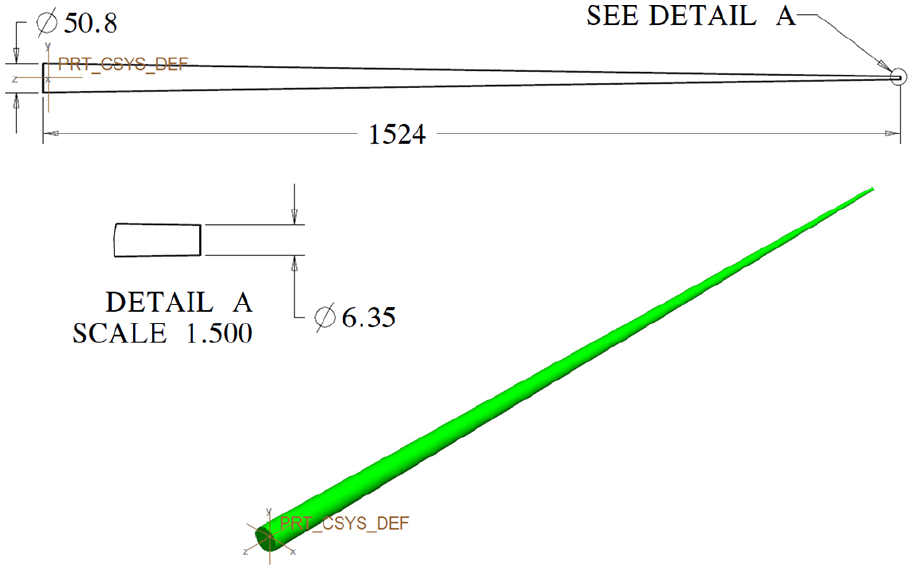
Geometric details of the fishing rod (units are in mm).
FEM meshed model
The element used by ANSYS is the SOLID186 element is a higher order 3-Dimensions with 20 node elements (see Figure 3). This component has a quadratic displacement conduct. Every node in this element has three degrees of freedom. These grades of freedom are transitioning in the nodal x, y, and z directions. Other options of this element are tetrahedral, pyramid, and prism.
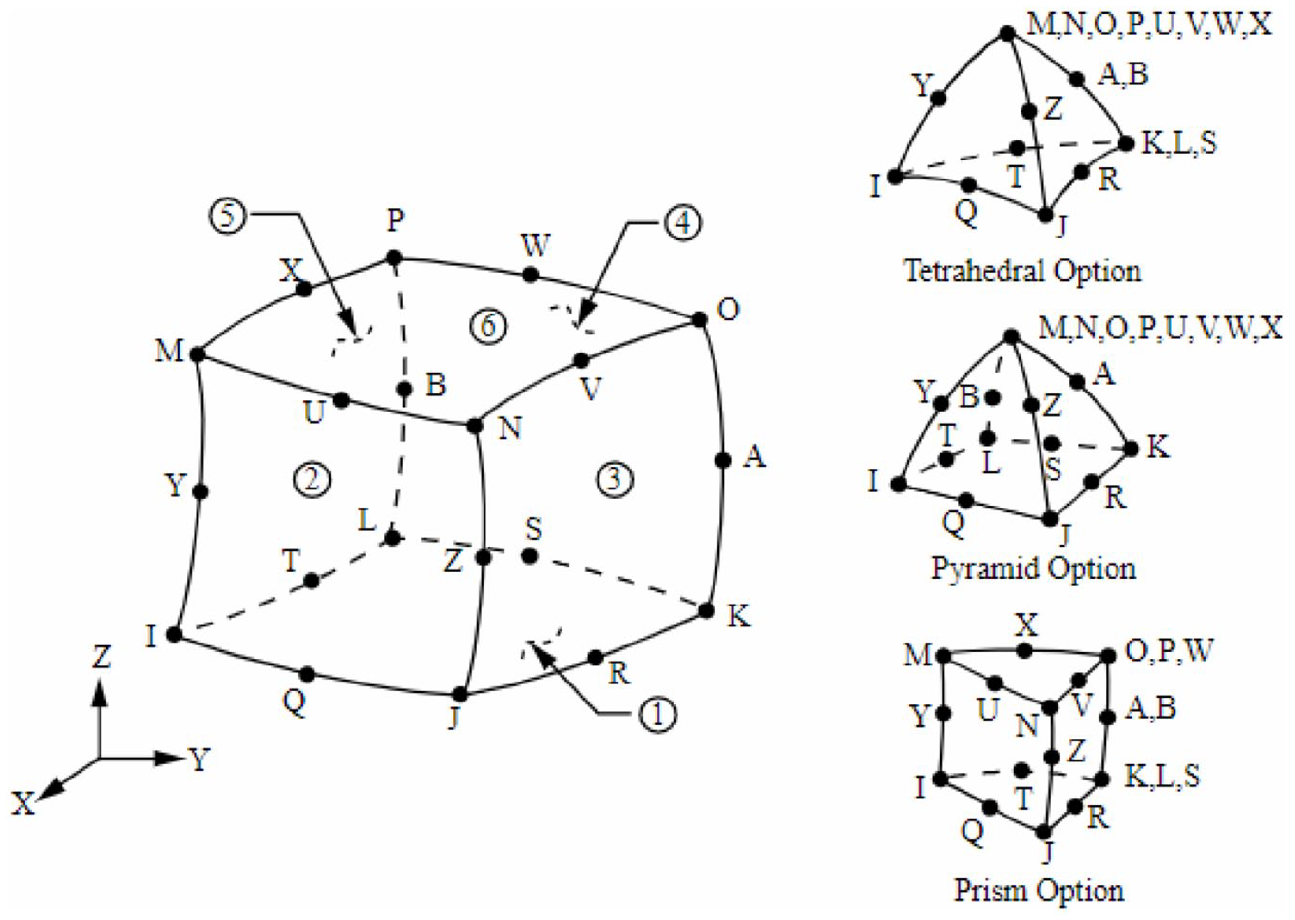
Three dimensions element (SOLID186) used in this work.
The number of nodes and elements generated on the fishing rod model are 12,347 and 2226, respectively. The properties for materials are enlisted in Table 1.
Material Properties of Axially Graded Fish Rod Beam.

Material properties for FGM’s
Theoretical Formulation FGMs are defined as a combination of two constituent materials, of which one side ceramic rich and another side metal rich. In this study, axially functionally graded metals beam is shown in Figure 4. Fish rod is divided into 16 × volume fractions. Volume #1 is referred to first part (left side) of fishing rod and Volume # 16 is the last part (right side) of the fishing rod.

FEM meshed model of fishing rod.
The material properties denoted by “S” of FGMs defined by “product of material properties and volume fractions of the constituent materials” and overall sum of all elements (i = 1–k) is unity, which can be formulated and shown as below.

Where
where N is a positive real number


All these values are having suffix as “c” and “m” to represents the “ceramic rich” and “metal rich” respectively. “z” refers to change in height as follows; middle to top (+ve side) and middle to bottom side (−ve). It is on the middle in thickness direction. “h” refers to the actual height of the beam. “N” is equal to the number Volume Division. That is, N = 16.
In our case with reference to Figure 5 above; values chosen are as follows.

Axially functionally graded fish rod (isometric and side view).
Using above equations (1)–(3), the resulting material properties of FG materials are tabulated in Table 2.
The properties of materials.

Displacement boundary condition
The bottom of the fishing rod is used to hold the rod. Therefore, the bottom handle (left side) was provided with fixed support as shown in Figure 6. The other end is free.

Fixed boundary condition at the bottom of fish rod.
Loading boundary condition
A force of 50 N is the self weight (5 kg, load of Rod) acting on the Rod while 42.426 N is Vertical Component of Lifting Load (i.e. 8.5 × Cos 60° = 42.423 N). When Self Weight and Lifting load applied simultaneously, Rod deflected at the free end and deflection causes the approximate inclination to 30°, which makes overall implication of acting this load at 90° at the tip of fishing rod (see Figure 7). Large deflection option turns on in the analysis setting to analyze the behavior.

Vertical and angular force applied on the tip of fish rod.
Static structural analysis of fishing rod
Static structural analysis was performed on a fishing rod to determine the values of stress and deformation under the application of applied forces and supports. The assumption is for steady loading and response conditions.
Modal analysis
Modal analysis of fishing rod performed to determine the natural behavior of the system. This helps to understands the dynamics of the system under consideration. Similar FEM model as of static structural analysis is utilized. All the displacement conditions are same. All loads (external loads) are removed to get natural behavior. Damping is considered in the analysis. A value of 0.02 is considered as constant structural damping. Based on these settings, mode shapes and natural frequencies obtained.
Harmonic analysis
Harmonic analysis is performed to measure stresses caused by harmonic loading. In our case, modal analysis is used as a baseline to proceed further. The values of natural frequencies acquired from the modal analysis were regarded as input values of the frequency range to perform harmonic analysis. Constant structural damping of 0.02 is also considered for this analysis. Applied loadings at the tip are vertical load and another load acting at right angle to the tip of the fishing rod. To predict the frequency response of fishing rod, the frequency was varied from 0 to 600 Hz for Steel, 0–850 Hz for Carbon fiber, and 0–900 Hz for FGM.
Results and discussions
In this section, the results of static, harmonic, and modal analysis are discussed.
Deflection and stress contour plot of fishing rod
Figure 8 shows the results of Von Mises stresses. The maximum “Von Mises” stresses developed in fishing rod are 46.44 MPa. The resulting deformation (maximum, in the direction of applied loading) in y-direction is 4.8 mm, shown in Figure 9 below.

Von Mises stress contour plot (with zooming of maximum stress point) for conventional steel.

Y-direction deformation contour plot for conventional steel.
Maximum Von Mises stresses developed in Carbon fiber steel are 58.23 MPa. These stresses are relatively high as compared to the conventional steel. Von-Misses Stress contour plot of composite (carbon fiber) steel is shown in Figure 10 and deflection contour plot of composite (carbon fiber) is in Figure 11.
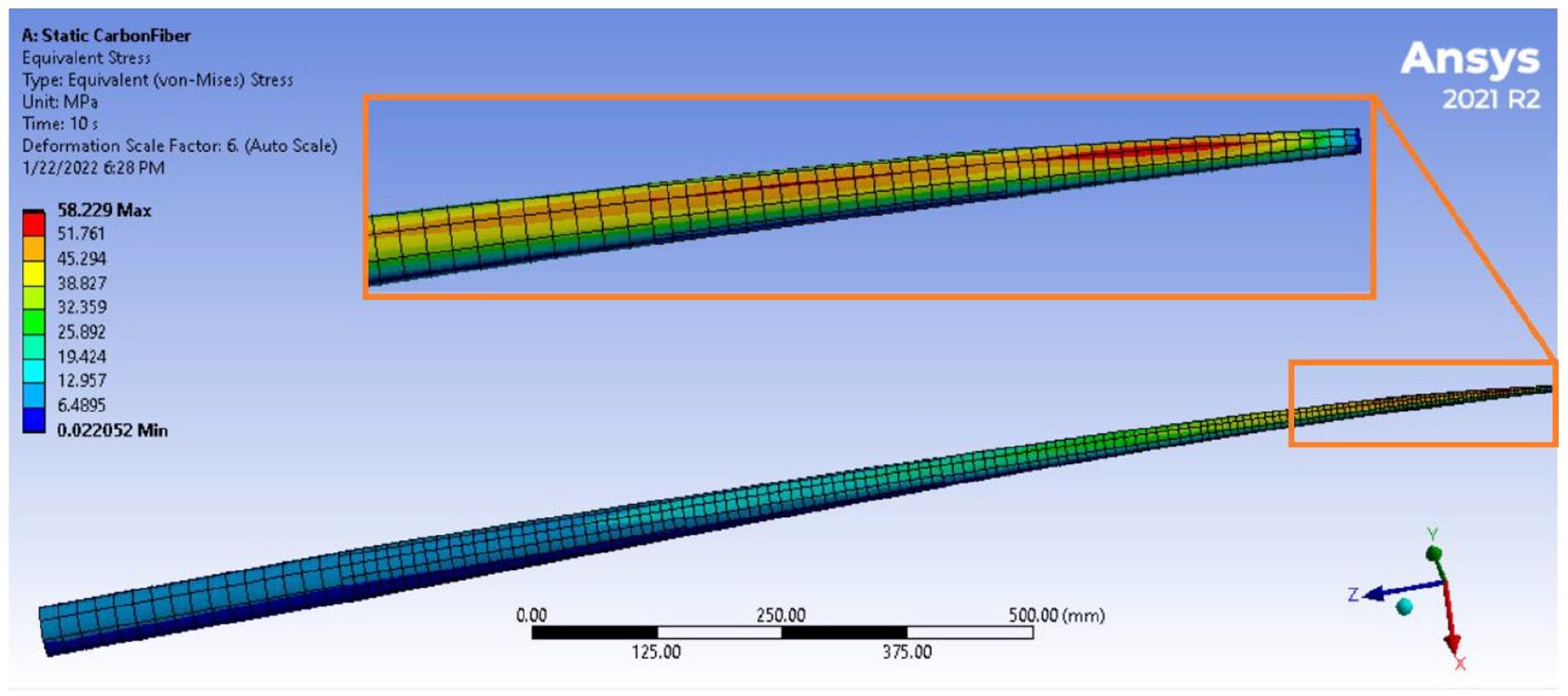
Von Mises stress contour plot for carbon fiber steel.

Y-direction deformation contour plot for carbon fiber steel.
The deflection for composite (carbon fiber) steel comes out to be −12.6 mm, which is 3 × times higher than conventional steel. Similar Von Mises Stress values of 58.23 MPa (see Figure 12) can be observed for FGM as well. However, if we analyze the deflection, this is much lower than composite (carbon fiber) steel. And deflection (see Figure 13) is 25% lower than conventional steel, which comes out to be −3.1 mm. This reason (in addition to damping inherent properties) makes FGM a suitable choice for fishing rod.
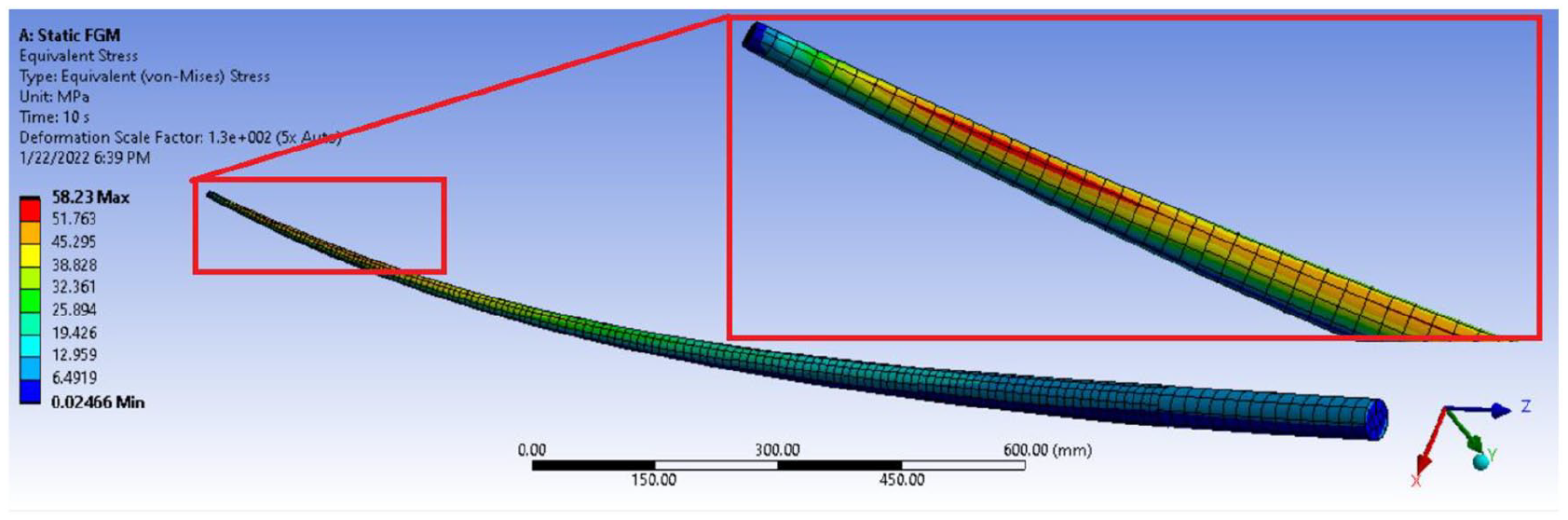
Von Mises stress contour plot (with zooming of maximum stress point) for FGM.
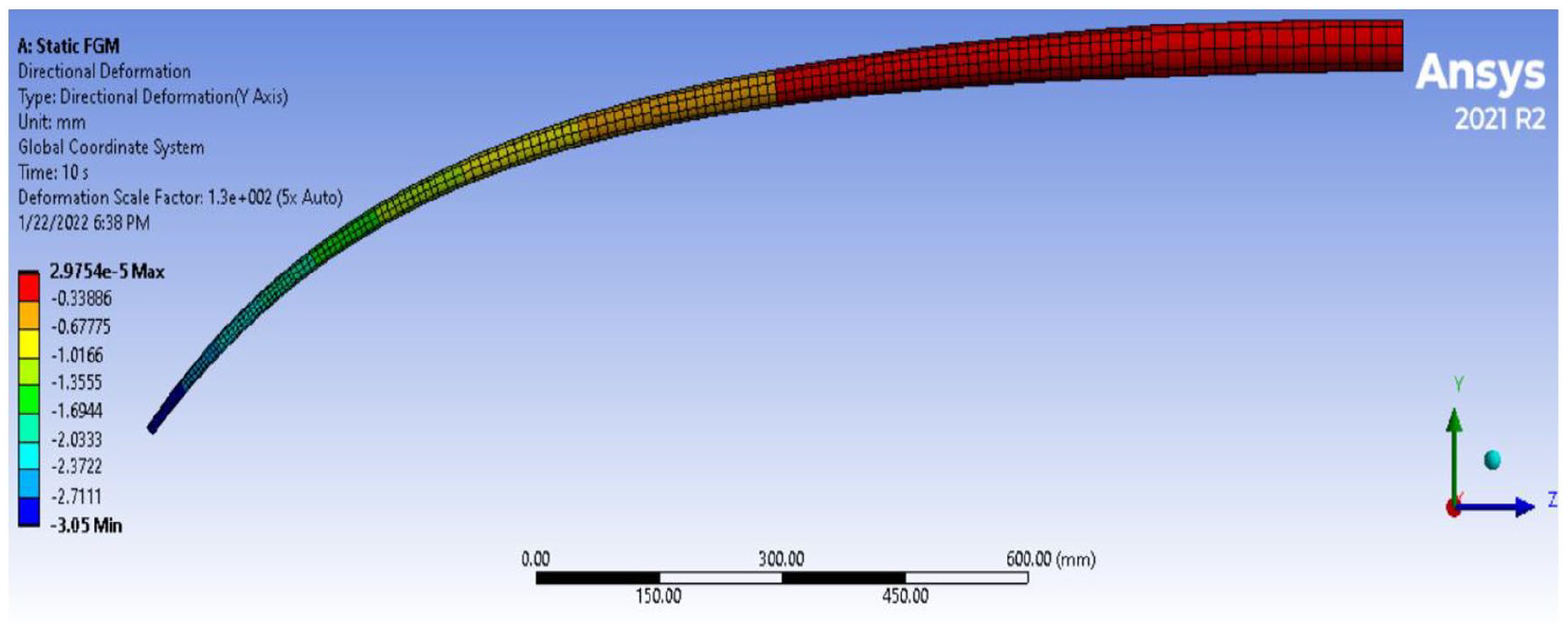
Y-direction deformation plot for FGM.
The addition of carbon into the steel (carbon-fiber steel) reasonably changed the values of all-important factors, particularly the stress value compared with the conventional steel is significantly higher. The FGM exhibited the same trend except for the stress. It is clear that the highest value of deformation obtained is for carbon fiber steel (composite). On the contrary, the minimum value of deformation is for functionally graded material.
Although the steel is stiffer and will withstand more but in the designing of fishing rod, it is not preferentially used. The same is the case with composite carbon steel, but functionally graded composite (carbon fiber reinforced) material demonstrated excellent behavior. Due to composition alteration, rigidity, and stiffness of the FGCMs are very high as compared to the steel and composite (carbon fiber) steel. In addition to it, FGM have inherent excellent damping properties, which resulted in the higher service life of FGM as compared to the other materials (steel, carbon fiber steel).
Natural frequencies and mode shapes
When an element experiences dynamic loading, it is quite crucial to analyze the mode shapes and natural frequencies. The obtained results after performing the modal analysis on the fishing rod (made up of conventional steel, functionally graded composite material, and composite carbon steel) were compared. The natural frequency corresponding to five-mode shapes was calculated for every material type to analyze the impact of all three types of material on the vibration behavior. Table 3 shows the respective values of natural frequencies. The results showed that the natural frequency of FGCM was more than the natural frequency of the other two materials because of the special atom arrangement in the FGCM. From the results of the natural frequency response, inconsistent frequencies were acquired for every utilized material since resonance or modes are intrinsic properties of the structural or the mechanical element. Because resonance depends on the physical and chemical characteristics of the material and boundary conditions, hence alterations in the material characteristics impacts the structure mode shapes. Figures 14 to 18 are contour plots of modal shape.
First 5 × transverse mode frequency for steel, carbon fiber composite & FGM.

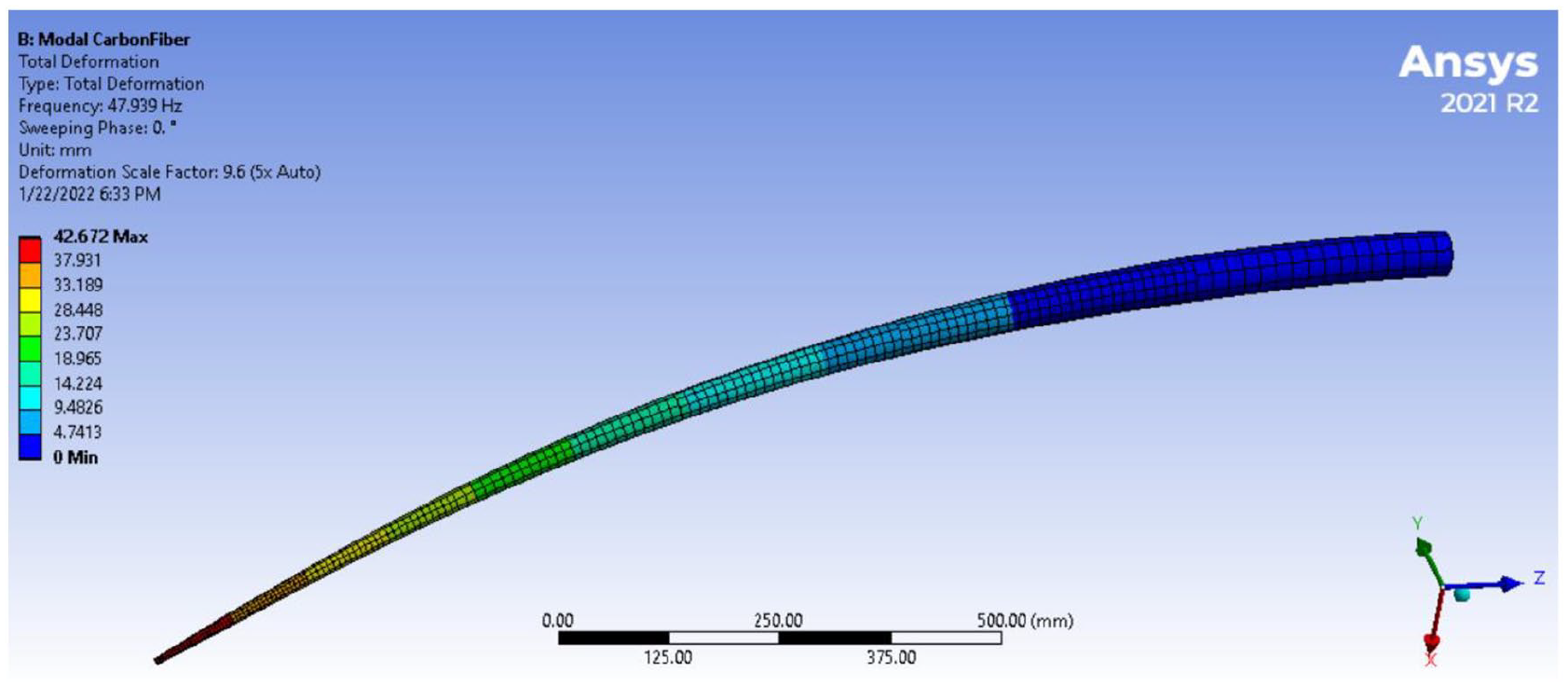
Contour plot of Mode # 1.

Contour plot of Mode # 2.

Contour plot of Mode # 3.

Contour plot of Mode # 4.

Contour plot of Mode # 5.
All of these are similar for each material type studied here. Bending was the first vibration mode, and the fishing rod bent in the direction of the applied load in the y-direction.
Concerning to the mathematical expression of the natural frequency, it corresponds to stiffness and mass of the material. The frequency response increases as the stiffness of the material increases, whereas natural frequency demonstrates an inverse relation with the mass properties. Although there is a considerable difference between the values of all materials, higher frequencies are observed at high modes. The first five frequencies for the conventional steel are 32.4, 93.2, 199.7, 354, and 555.9 Hz. For composite (carbon fiber) steel and FGM first 5 × frequencies are 47.9, 137.9, 295.6, 523.8, 822.8, 45.4, 130.6, 280, 496.1, and 779.2 Hz respectively. The fishing rod can break under resonance conditions, and this can further negatively affect the corresponding supporting components.
Frequency response analysis of fishing rod
The fishing rod was exited at several natural frequencies and external loads. Applying the load and boundary conditions yielded a plot between amplitude and frequency for three materials, as shown in Figure 19. The resonance point can be obtained, and the overall functioning and performance of the fishing rod can be comprehended from the function of the frequency response. To predict the frequency response function of deflection of the fishing rod made of different materials, the frequency considered for Steel from 0 to 600 Hz, for Carbon Fiber from 0 to 850 Hz, and for FGM from 0 to 900 Hz.

Relationship between amplitude and frequency for conventional steel, FGCM, and composite carbon steel.
As can be seen in Figure 19, a high resonance of 7.94 mm was noticed for the steel in fourth mode at the frequency of 354 Hz. Whereas a very high resonance of 74.4 mm observed in the second mode at frequency of 137.9 Hz for composite (carbon fiber) steel.
Despite these, FGM is observed to be only 0.032 mm, which clearly depicts its excellent vibration suppression performance as compared to other two materials under consideration for this study. The vibrational performance of FGCM much better than the conventional steel and composite steel because of the higher modulus elasticity for the functionally grading of material. This confirms that thin structure (non-uniform circular profile) made of FGM can be used efficiently for the intended applications.
Conclusion
The present research aims to compare the modal response of non-uniform thin circular profile structure (made up of) conventional steel, composite (carbon fiber) steel, and functionally graded material. Functionally graded materials FGM’s have been emerged as a novel type of composite and known as advanced engineering materials since they are capable of withstanding, coarse environmental circumstances, showing no deviation in the characteristics of matrix material as well as low failures rate. In this study non-uniform axially graded thin structure (having circular cross-section) are analyzed using static structural, modal analysis, and harmonic analysis. The fishing rod was excited harmonically (from 0 to 900 Hz) under application of load for three materials. The comparison of the results (Figure 19) shows that maximum amplitude for FGM is only 0.032 mm. as compared to steel having amplitude of 7.94 mm. FGM is 250 × times better than steel in vibration response. Composite (carbon fiber) steel is not suitable at all, as it is having very deflection of 74.4 mm in second mode at 137.9 Hz. This clearly depicts FGM excellent vibration suppression performance as compared to other two materials under consideration for this study. The analysis presented in this work can further be extended to analyze the complex structure involving thin structure having non-uniform circular profile.
Footnotes
Acknowledgements
The author is very thankful to all the associated personnel in any reference that contributed in/for the purpose of this research.
Data availability statement
The data will be available for review from the corresponding author on request.
Declaration of conflicting interests
The author declared no potential conflicts of interest with respect to the research, authorship, and/or publication of this article.
Funding
The author received no financial support for the research, authorship, and/or publication of this article.
