




Abstract
Phosphate-buffered saline (PBS) adsorption on model films composed of gelatin and nanofibrillated celluloses (NFCs) with different aldehyde and carboxyl contents was studied by means of the quartz crystal microbalance with dissipation (QCM-D) technique in this study. The results showed that frequency shift (Δf) due to PBS adsorption increased with increasing gelatin content to 50% in NFC-containing films. The dissipation shift and adsorption rate of PBS followed the same trend. Model films with NFC-1 having 1.22 mmol/g aldehyde and 0.6 mmol/g carboxyl groups adsorbed more PBS than those consisting of NFC-2 with 0.25 mmol/g aldehyde and 1.15 mmol/g carboxyl groups except for film composed of 50% gelatin. However, adsorption rate of PBS was found to be slower for NFC-1 containing film because the acetal and amidol bonds formed by functional groups in the network of cellulose and gelatin needed more time to let PBS migrate into the films.
Introduction
Nanofibrillated cellulose (NFC) has high aspect ratio, biodegradability, and high chemical reactivity. The Young’s modulus of NFC with a diameter of 5–100 nm and several micrometers in length is up to 135 GPa.1–3 NFC has been used for different purposes, such as in nanoscaled papers,4–6 as a papermaking additive,7,8 reinforcement of nanocomposites,9–14 and rheology modifiers in foods, paints, cosmetics, and pharmaceutical products, and many others.3,15
The NFC is produced by disintegration of fiber walls via intense mechanical shearing forces. The pretreatment of fibers with chemicals and/or enzymes before the disintegration process provides a larger inner surface area and allows breaking of hydrogen bonds in the fibrillary structure of the fiber wall using less mechanical energy.3,15,16 TEMPO (2,2,6,6-tetramethylpiperidine-1-oxyl) oxidation attracts researchers because it needs very little mechanical shearing force.16–18 This oxidation reaction converts hydroxyl groups at the C6 position of the glucose unit to carboxyl groups, giving an anionically charged structure. During this oxidation, a small number of aldehyde groups also form. 18 Cimecioglu and Thomadies showed that the content of aldehyde groups in polysaccharides can be increased under specific conditions of TEMPO oxidation at a temperature below 15°C and pH 9.5. 19
Gelatin is a biodegradable and biocompatible protein, produced by acid or alkaline hydrolysis of collagen present in animal skin and bone. It has been used in the food industry to provide viscosity, elasticity, and stability, as well as in the pharmaceutical industry for encapsulation of nanoparticles 20 and for building scaffold in biomaterial applications such as tissue engineering and wound dressing, among others.21–25 The composites consisting of gelatin and different kinds of celluloses, such as bacterial cellulose, 26 carboxyl methylcellulose,27,28 and cellulose nanocrystal,29–31 have been studied for different purposes. For these kinds of applications, cross-linkers such as glutaraldehyde, D,L-glyceraldehyde, carbodiimide/N-hydroxysuccinimide, and enzymatic cross-linkers are needed to provide the required strength properties. 20 Instead of adding a cross-linker, a self-cross-linking network due to the aldehyde groups on the NFC makes the film durable when it contacts liquids. On the other hand, this can change the liquid adsorption properties of composites during applications, especially where they are exposed to different kinds of liquids.
There is not enough knowledge in the available literature related to how the aldehyde groups of the NFC–biopolymer matrix affects liquid adsorption. In this work, the adsorption of phosphate-buffered saline (PBS), a model liquid for wound exudate due to the similarity with the liquid in the human body regarding osmolality and ion concentration, on the model films prepared with gelatin and NFCs having different amounts of aldehyde and carboxyl groups was studied by means of the quartz crystal microbalance with dissipation (QCM-D) technique. It was aimed at understanding how the functional groups of NFC and the gelatin/NFC ratio affect liquid adsorption regarding wound dressing materials consisting of similar ingredients.
Experimental details
Materials
The bleached Mg bisulfite pulp from Biocel Paskov a.s. (Czechia) was used for NFC production. Gelatin, produced from bovine skin by alkaline treatment, was kindly provided by Gelco Gelatinas do Brasil Ltda. (Sao Paulo, Brazil). It contains 84.4% protein, 5.7% carbohydrate, and 0.059% sodium salt according to supplier. It was dissolved in deionized water at 45°C for 45 minutes before use. PBS was used to simulate simple wound exudate in adsorption experiments. It was prepared by dissolving 8 g of NaCl, 0.2 g of KCl, 1.42 g of NaHPO4, and 0.24 g of KH2PO4 in a liter of deionized water. Its pH was adjusted to 7.4 using HCl solution. All chemicals were analytic grade and purchased from Sigma-Aldrich (Taufkirchen/Germany).
Methods
NFC preparation
Bleached pulp was pretreated with TEMPO oxidation according to methods taken from previous studies.18,19 NFC-1 was produced as follows: NaBr (0.125 g/g fiber) and TEMPO (0.0125 g/g fiber) were dissolved in deionized water and added to the fiber suspension (10 g/L) at 5 ± 1°C, placed in an ice bath and pH was adjusted to 9.5 with 0.1 M NaOH. The pH of NaOCl (5 mmol/g) was also set to 9.5 and added to the fiber suspension. The oxidation reaction continued for 1 h at 5 ± 1°C. Then, temperature and pH were increased to 24°C and 10.0, respectively. This last step of oxidation was continued for 30 min. After washing the fibers with deionized water, the fiber suspension (0.5% w/w) was disintegrated with a high-pressure homogenizer (APV-1000, APV Hemisan, Bornova-İzmir) at 150 bar/750 bar. The homogenization procedure was repeated 10 times. In production of NFC-2, the fibers were treated with NaBr (0.125 g/g fiber), TEMPO (0.0125 g/g fiber), and NaOCl (5 mmol/g fiber) at pH 10.0 and 24°C for 1 h. Fibers were washed with deionized water filtered through a coarse filter paper on a Buchner funnel. The oxidized fibers were exposed to the homogenization effect three times at 100 bar/500 bar. The NFC/gelatin films were built on an SiO2 crystal surface with a spin coater. Before film preparation, crystals were cleaned with piranha solution for 1 min and rinsed with deionized water. After drying with N2 gas, they were dipped in a solution of 0.1% polyvinylamine (in 0.01 M NaCl) for 5 min, rinsed with deionized water, and dried with N2 gas. The pH of NFC and gelatin solutions (0.15% w/w) were adjusted to 5.5. They were mixed at 250 rpm for 30 min. Once the NFC/gelatin suspension were dropped on the crystal surface, spinning was started and continued for 1 min. The spinning velocity for NFC-1/gelatin was 3500 rpm, and for NFC-2/gelatin it was 4500 rpm due to the higher viscosity. The model films were heated in an oven at 90°C for 2 h and stored in a desiccator.
QCM-D studies
Adsorption properties of PBS applied to NFC/gelatin films were studied using QCM-D experiments. The QCM-D instrument monitors both frequency and dissipation factors during interaction between a surface and material. The resonant frequency of the crystal decreases as the adsorbed mass, Δm, increases. If the adsorbed mass is evenly distributed, rigidly attached and small compared to the mass of the crystal, Δm is calculated by the Sauerbrey equation from change in frequency (Δf) due to the adsorption 32

where n is an overtone number and C is a constant that describes the sensitivity of the device to changes in mass: 0.177 mg Hz−1m−2 for the AT-cut, 5 MHz crystals used in this study.
When the driving power to the crystal is switched off there is a decay in the oscillation due to frictional losses in the crystal in the adsorbed layer and in the surrounding solution. The energy dissipation is characterized by dissipation factor D 33

where E′ is the energy dissipated during one oscillation and E is the total energy stored in the quartz oscillator.
After mounting the model film in a QCM cell, deionized water (pH 5.5, adjusted with 0.05 M HCl solution) was added to the measurement chamber to ensure a stable baseline for the frequency and energy dissipation. The adsorption experiments were then started by exchanging buffer with PBS solution at pH 7.4. The Qsoft software from Q-Sense was utilized to record the changes in Δf and ΔD during the adsorption process. The third overtone was used for evaluation data, basically due to its stability. All QCM experiments were conducted at a constant temperature of 24.0°C.
Aldehyde and carboxyl content
The aldehyde content was determined by NaOH titration after pretreating the NFC with hydroxyl amine hydrochloride, according Sirvio et al. 34 The carboxyl content of the NFC was determined by using the conductometric titration method. 18
Isoelectric point (IEP) of NFC and gelatin
A particle charge detector (PCD2; MÜTEK GmbH, Seevetal, Ramelsloh/Germany) was used to determine the streaming potential of solutions at different pH. Before measurement, concentrations of gelatin and the NFCs were adjusted to 1% (w/w) and 0.1% (w/w), respectively.
X-ray diffraction (XRD) analysis
XRD measurements were performed using a Bruker D8 Advance X-ray powder diffractometer device, Bruker D8 Advance X-ray powder diffractometer (Billerica-Massachusetts/United States) using a Cu Kα radiation source (λ = 0.154 nm). The scanning rate and scan speed were 3° ⩽ 2θ ⩽ 90° and 2°/min, respectively. Crystalline indices of NFC were determined according to peak intensities of the characteristic crystalline and amorphous regions of the XRD patterns. The crystalline index was calculated according to the formula

The main crystalline peak (I002) and amorphous peak (Iam) were used as NFCs between 2θ = 21.5°–22.9° for I002 and 2θ = 16.9°–18.2° for Iam.
Results and discussion
IEPs of gelatin and NFCs
The NFC/gelatin films were produced at pH 5.5, at which gelatin had cationic charge while NFCs had anionic charges (see Figure 1). The lysine and arginine groups of gelatin are protonated at acidic pH lower than IEP (pH 6.2). Beyond the IEP, higher than pH 6.2, these groups lose their protons and glutamic and aspartic acid became negatively charged. 20 As seen in the figure, when the NFCs were mixed with gelatin, electrostatic attraction was the driving mechanism as well as hydrogen, acetal, and amidol bonds. When the PBS was injected into the model film, the pH increased to 7.4 and electrostatic repulsion became dominant between these two components. The electrolytes in the PBS adsorbed ionic groups on both NFCs and gelatin. It can be concluded that electrolyte adsorption and electrostatic repulsion promoted swelling of the films.
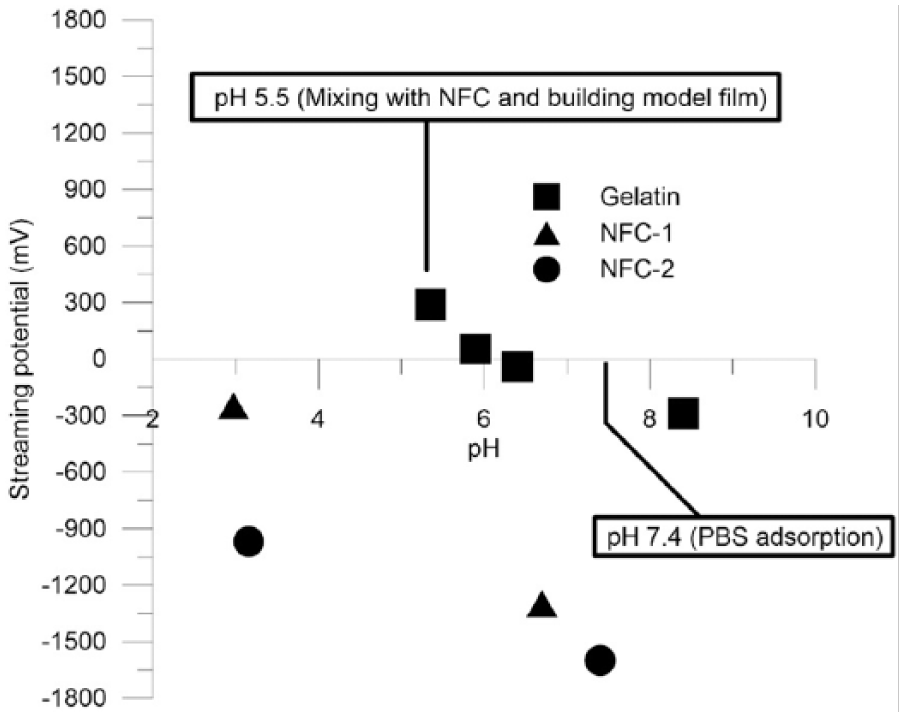
Izoelectric point of gelatin and NFCs.
PBS adsorption study
As known, selective oxidation carried out with TEMPO converts the hydroxyl groups at the C6 position of glucose to carboxyl and aldehyde groups. 18 The aldehyde and carboxyl content of NFC-1, produced by a combined method consisting of oxidation with two steps at pH 9.5 and 5°C and then at pH 10 and room temperature were 1.22 mmol/g and 0.6 mmol/g, respectively. NFC-2 is produced by a single-step oxidation and had 0.25 mmol/g aldehyde group and 1.15 mmol/g carboxyl group. The crystalline indices of NFC-1 and NFC-2 were 38.8% and 82.8%, respectively. This can be due to the structural and chemical deformation in the crystalline regions of fibrils during the oxidation reaction.
Figures 2 and 3 show the changes in Δf and ΔD due to the PBS adsorption on NFC-1/gelatin and NFC-2/gelatin films at pH 7.4, respectively. Figure 4 shows Δf and ΔD values after 15 min of PBS adsorption. As seen in this figure, Δf and ΔD reached maximums when the gelatin content increased to 50%, and decreased at higher gelatin contents. Although the Δf and ΔD values were higher for films containing NFC-1 with higher aldehyde content, at 50% gelatin content the reverse effect was surprisingly observed, attributed to structural change of the film. It can be concluded that the model film consisting of more NFC could have more pores and higher surface area than films containing more gelatin due to the higher stiffness of NFC compared with gelatin. Additionally, complexation between NFC and gelatin can result in aggregated and more porous structures, depending on gelatin content. To clarify this phenomena, additional research should be done regarding surface image analysis addition to macroscopic studies such as aerogel or film. Another finding is that films composed of 100% gelatin adsorbed less PBS than films consisting of 100% NFC-1 and NFC-2 due to the higher hydrophilicity of NFCs.
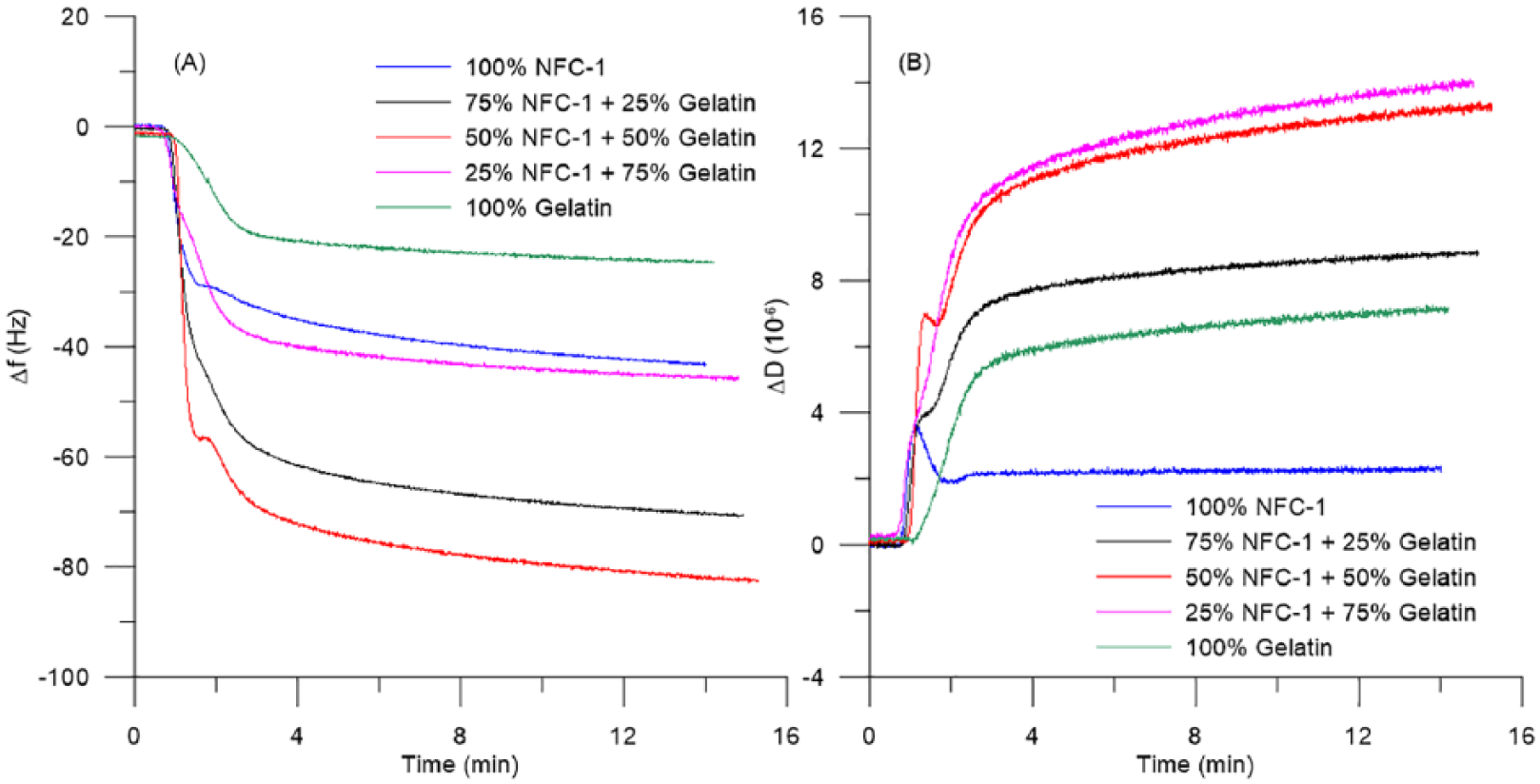
The changes in frequency (a) and dissipation (b) values as a function of time during PBS adsorption to NFC-1/gelatin films at pH 7.4.
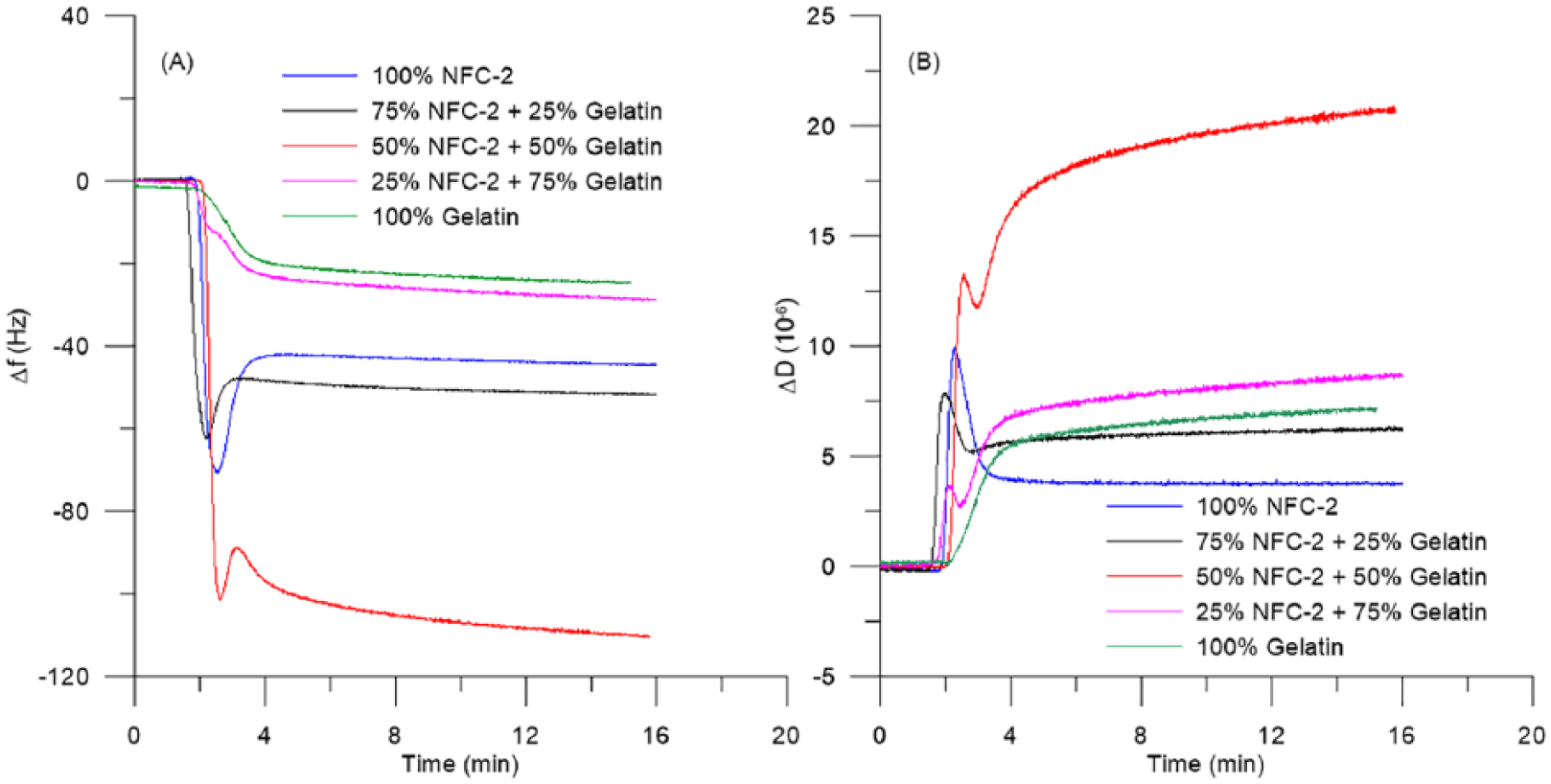
The changes in frequency (a) and dissipation (b) values as a function of time during PBS adsorption to NFC-2/gelatin films at pH 7.4.
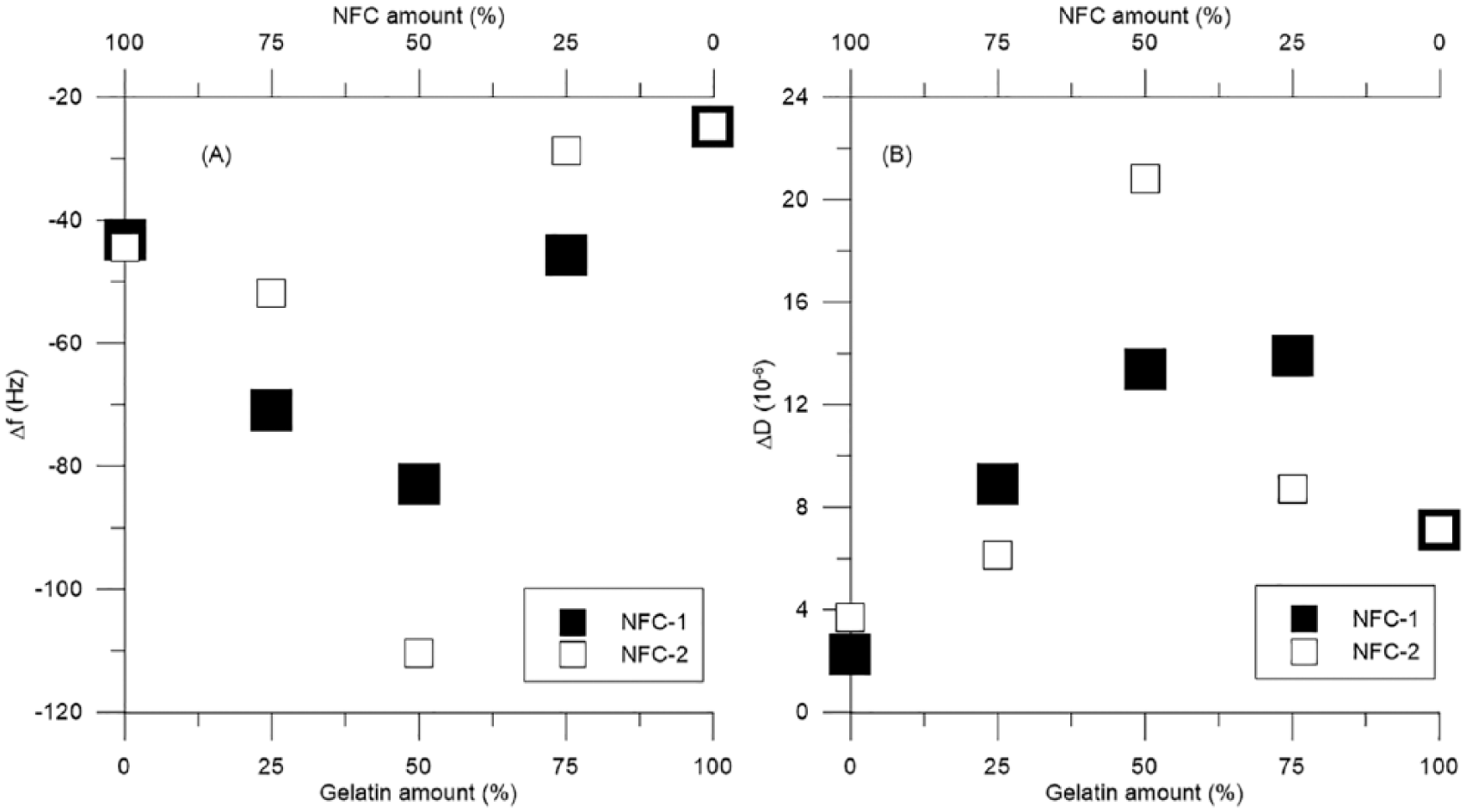
Δf (a) and ΔD (b) values after 15 min of PBS adsorption.
To clarify PBS adsorption through the NFC/gelatin film, it is important to evaluate the interaction between NFC and gelatin. Khakalo et al. 35 found, using surface plasmon resonance, that the adsorbed amount of gelatin on the NFC model film was 2.27 mg/m2 at pH 5.8. If the average specific surface area is assumed to be 250 m2/g, 36 the gelatin adsorption on NFC can be calculated as 0.55 g/g. This gives an approximation that a mixture consisting of 64% NFC and 36% gelatin gives almost 100% coupling between these materials. From this point of view, it can be concluded that mixtures consisting of 50% NFC/50% gelatin and 25% NFC/75% gelatin had excess gelatin molecules and started to fill the gaps between NFCs. However, this coupling ratio can change depending on NFC and gelatin properties. As mentioned before, the Δf due to the PBS adsorption increased with increasing gelatin content to 50% and thus the coupling ratio was probably close to 50%. Chen et al. found that film composed of TEMPO modified nanocrystal cellulose (NCC) and gelatin adsorbed more water vapor with increases in NCC content. 26 After 30% NCC content, adsorption decreased. This was attributed to aggregation between NCC and gelatin. 30 Islam et al. also showed that the water-binding capacity of NCC/gelatin film decreased with increasing NCC due to the reacting end groups of gelatin by NCC. 37 The interaction of the carbonyl group of cellulose and amine group was reported by Taokaew et al. according to Fourier-transform infrared spectroscopy (FTIR) results. 38 Even if the NCCs were not the same as the NFCs, it is clear that composition and structural properties of nanocellulose/gelatin matrices affect adsorption properties.
Adsorption rate of PBS
The adsorbed mass on the crystal sensor can be calculated by the Sauerbrey equation (equation (1)) using change in Δf. The adsorption rate of PBS, mg/m2s, through films was determined by the initial slope of the Sauerbrey mass vs. adsorption time, adding a linear trend line to the data, as shown in Figure 5. The adsorption rate of PBS to the film consisting of NFC-1 with the higher aldehyde content was lower compared with the NFC-2 film (Figure 6). The cross-linked and compact structure of the film due to acetal and amidol bonding between aldehyde groups and hydroxyl and/or amine groups 39 decreased the adsorption rate. It is clearly seen that when the gelatin content increased to 50% the adsorption rate increased for both NFC-1 and NFC-2 films. After this point, more gelatin probably changed the film structure and lowered the adsorption rate. The complexation mechanism between cationic gelatin and anionic NFC at pH 5.5 is also a factor for the film properties and consequently changes the adsorption rate.
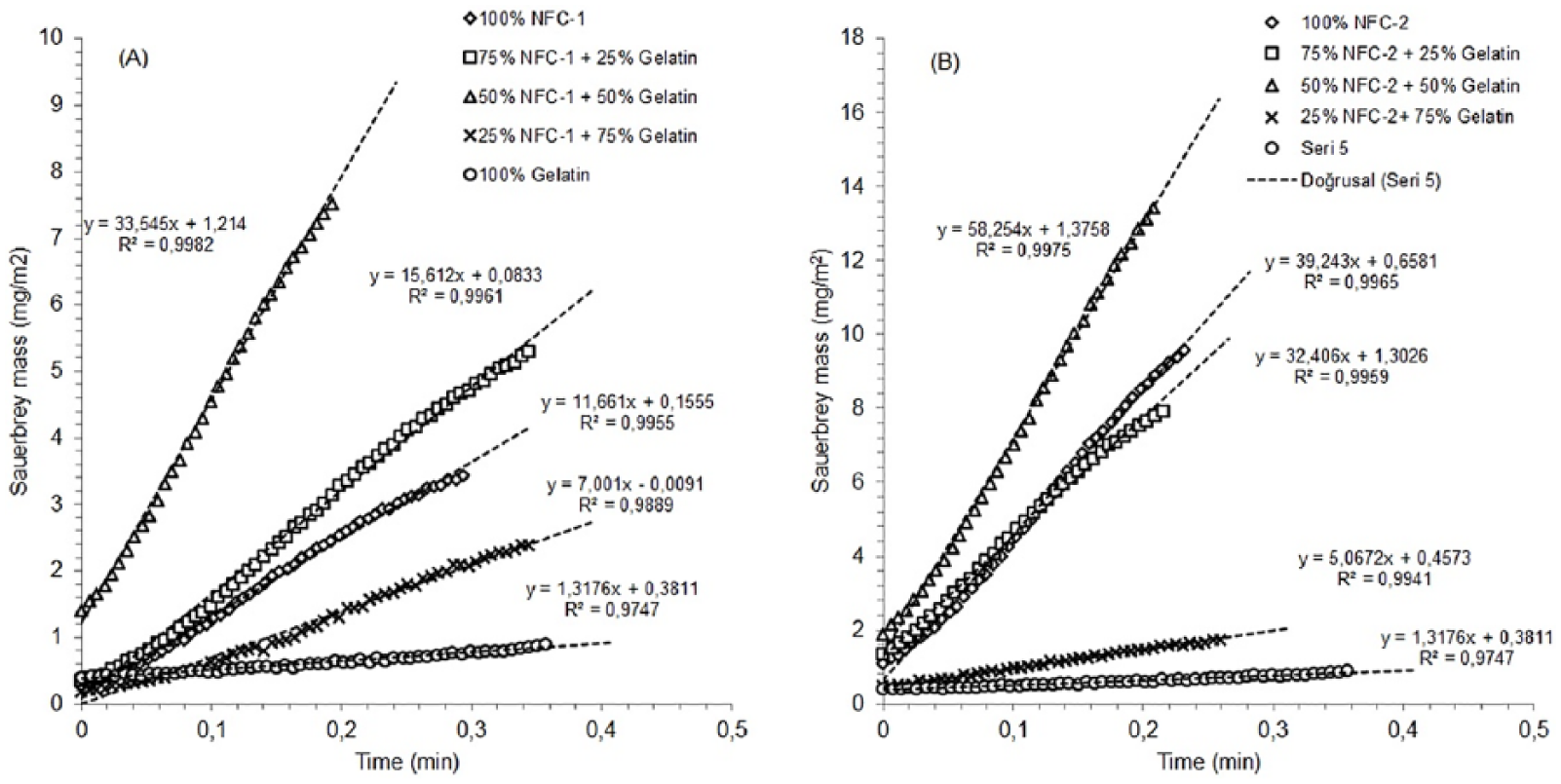
The curves of the Sauerbrey mass vs. time at various NFC/gelatin compositions.
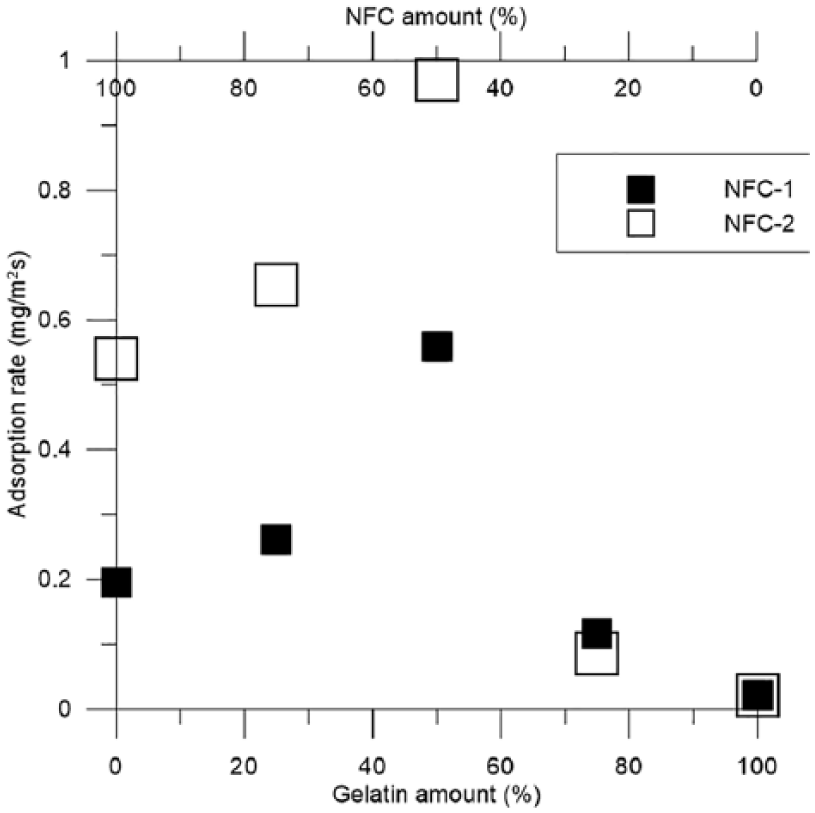
Adsorption rate of PBS to the model film consisting of NFC-1/gelatin and NFC-2/gelatin films.
Conclusions
The adsorption of PBS to the model film consisting of gelatin and NFCs with different aldehyde and carboxyl groups was studied with the QCM-D technique. Results showed that adsorption behavior changes based on aldehyde and carboxyl amounts of NFC as well as gelatin/NFC percentage in the film. The Δf and ΔD reached maximum values when the gelatin content increased to 50%. At higher gelatin contents these values decreased. The adsorption rate of PBS, the initial slope of the Sauerbrey mass vs. time, was found to be slower for film composed of NFC-1/gelatin with more aldehyde and fewer carboxyl groups. The cross-linking cellulose and gelatin network with acetal and amidol bonds not only reduced PBS adsorption to functional groups but also prevented PBS migration through the film. It was also found that the adsorption rate increased with increased gelatin content up to 50%. This was attributed to possible structural and chemical changes of the films.
Footnotes
Declaration of conflicting interest
The authors declare no potential conflicts of interest with respect to the research, authorship, and/or publication of this article.
Funding
The authors disclosed receipt of the following financial support for the research, authorship, and/or publication of this article: All authors acknowledge kind financial support from the Setaş Chemical Inc. Research & Development Centre.