




Abstract
Introduction:
In order to develop a good hip protector to prevent in the elderly hip fracture as a result of a fall, we studied the buffer characteristics of sponges and air cushions.
Methods:
The buffer rate of material was defined, and the absorption ability of the material to instantaneous impact was evaluated. An experimental device was developed and used to measure the buffer rates of sponges and leak-allowed air cushions with orifice(s).
Results:
According to the experimental results, the buffer rate largely depended on the hardness of the sponge materials, and on the total area of the orifice(s) for the leak-allowed air cushions. Compared with the sponge with correct hardness and thickness, the buffer characteristic of the air cushion seems slightly inferior.
Conclusions:
Nevertheless, the air cushion’s overall performance, including the better buffer rate, ultra-lightness, flexibility, and low cost, makes it a potentially useful material for hip protectors and other sport protectors.
Introduction
For an aging society, health care of the elderly has been a significant issue. Especially, taking care of a paralyzed elderly person has become a heavy burden on his/her family as well as on society. According to survey, falls have become the third reason for paralysis in the elderly. Thus, it is necessary to protect the elderly from hip fracture during falls.
There have been quite a few studies on the current hip protectors for the elderly. Kannus et al. have tested the efficiency of hip protectors with human subjects by randomized experiments. 1 Van Schoor et al. have studied the characteristics of hard and soft hip protectors 2 with biomechanics methods. Laing et al. have studied the effect of soft shell hip protectors on the hip by measuring the pressure distribution during sideways falls. 3 Diniz Melo et al. have developed a type of polymer composite hip protector, 4 and Tanaka et al. have studied the buffer characteristics of the leak-allowed air cushion used as hip protector. 5 In China, Song et al. have carried out a series of experiments to evaluate the buffer characteristics of different kinds of sponges used as hip protectors. 6 And Wang et al. 7 and Xu 8 have also obtained applicable results. These studies are very helpful for detailed discussion on the protection against hip fracture in elderly people as well as on the protection effect. However, there are still some limitations in the studies. For example, some methods are potentially dangerous. Besides, only the effect of the hip protector was measured, and there are not enough studies available on the buffer characteristics of materials. In fact, the buffer rate of the material is the key point for a hip protector.
This study aimed at the development of a hip protector for the elderly. By developing an experimental device, the buffer rates of different kinds of sponges and leak-allowed air cushions were determined, and satisfactory results were obtained.
Experimental system
When an elderly person falls, the instant impact to his/her hip is approximately 3700 N, 9 but with osteoporosis his/her hip can only withstand about 2100 N. In this work, an experimental device was designed to simulate a human’s fall and produce a similar impact. The measuring system used in this study is shown in Figure 1. The system mainly consists of an experimental device, a piezoelectric sensor, a charge amplifier, and an oscilloscope. The experimental device is composed of fixed and movable parts. The fixed part includes a baseplate, a top plate, two fixed linear bushes, and two slides, while the movable part includes a plate and two linear bushes. The movable mass unit weighs 1.437 kg and is freely movable along slides in the range of 0–420 mm, so the mass unit can produce up to about 3700 N instant impact during free fall. In addition, The piezoelectric sensor was fixed on a sensor support installed on the baseplate.
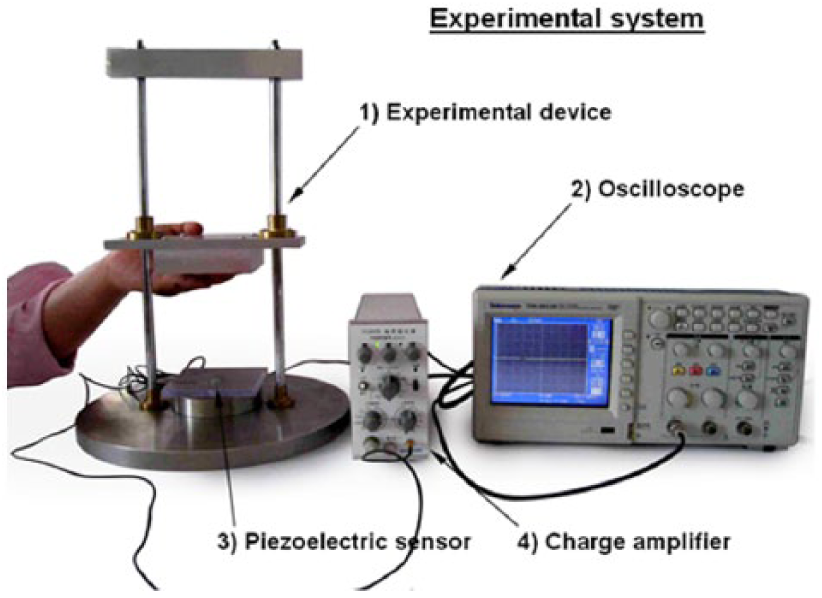
Picture of the measuring system.
Experimental method and materials
Experimental method
In order to compare the impact properties of different buffer materials, the parameter buffer rate is defined as follows.

where: F1 is the impact detected by the sensor without buffer material; F2 is the impact with buffer material.
In the test, free fall height of the movable mass unit (1.437 kg) was set to 50 mm, 100 mm, 150 mm, 200 mm, 250 mm, 300 mm, and 340 mm, respectively, so the instant impacts at different heights were about 1423 N, 2012 N, 2464 N, 2845 N, 3181 N, 3485 N, and 3700 N, respectively.
The buffer material used in this experiment includes several kinds of sponges on the market with different hardnesses and densities, leak-allowed air cushions, and two kinds of knee pads. Each sponge is made of uniform shape with an area of 100mm × 100mm, and a thickness of 10 mm. The leak-allowed air cushion also has an area of 100mm × 100mm, which includes eight air bubbles (size: φ 29mm × H 10mm), as shown in Figure 2. Moreover, each experiment was repeated five times and then the average buffer rate was calculated.
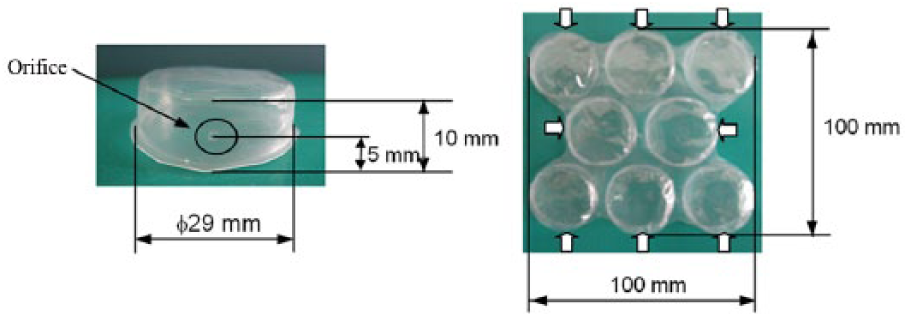
Leak-allowed air cushion material.
Materials for the experiment
The basic performance of the sponges and the sponge knee pads is shown in Table 1.
Basic performance of the materials.

The leak-allowed air cushion can shunt impact load by venting air from the air bubble through the orifice(s) to dissipate the energy, so its buffer performance was thoroughly investigated in this study. The air bubble was made of polyethylene film with a sidewall thickness of 0.084 mm and a top wall thickness of 0.060 mm. The weight of a single air bubble was 0.15 g, giving a bulk density of 0.023 g/cm3. The orifice of the air bubble was located at the sidewall so that the air inside the bubble can easily flow out, as shown in Figure 2(a). The overall look of a single leak-allowed air cushion is shown in Figure 2(b), in which the arrows show the positions of the orifices. The total weight of a single leak-allowed air cushion was around 12 g. For air cushions with double and multiple orifices, the orifices were uniformly distributed around the air bubble circumference and on the sidewall.
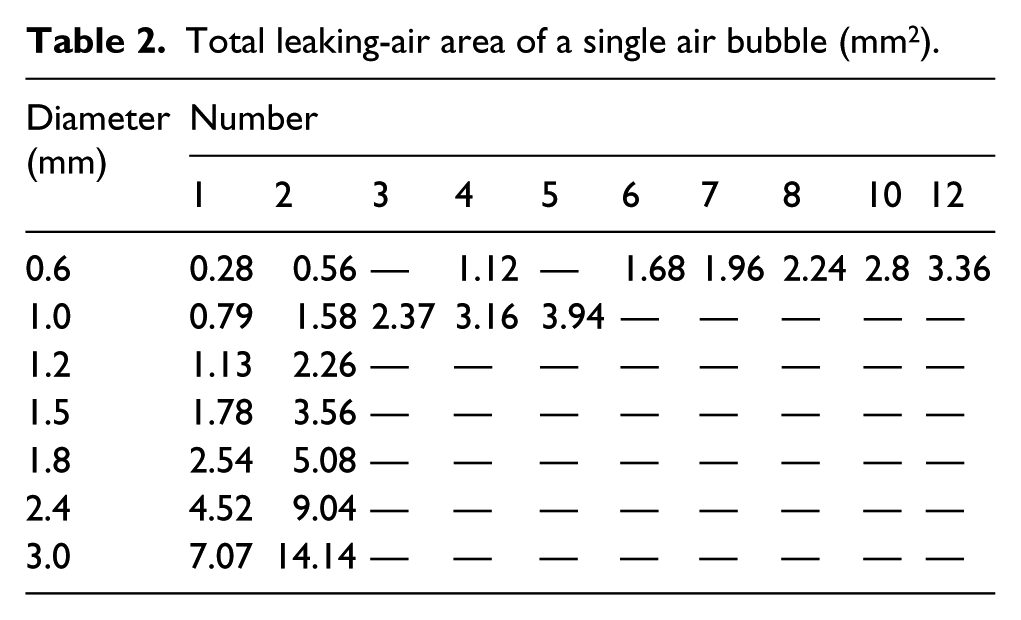
It is considered that the size and number of the orifices would probably affect the buffer characteristics of the cushion. In this study, the diameter was set to 0.6 mm, 1.0 mm, 1.2 mm, 1.5 mm, 1.8 mm, 2.4 mm, and 3.0 mm, respectively, for the single and double orifices, while the diameter was only fixed at 0.6 mm and 1.0 mm for the case of more than two orifices, as shown in Table 2. The leak-allowed area of a single air bubble with different diameters and numbers is also shown in Table 2.
Total leaking-air area of a single air bubble (mm2).
Experimental results and analysis
Buffer rate of the sponges
The buffer rates of the different kinds of sponges with a thickness of 10 mm are shown in Figure 3. It is known that the buffer rates of the sponges are different according to different hardness and viscoelasticity. Even in one kind of sponge, its buffer rate can change with respect to the impact force.
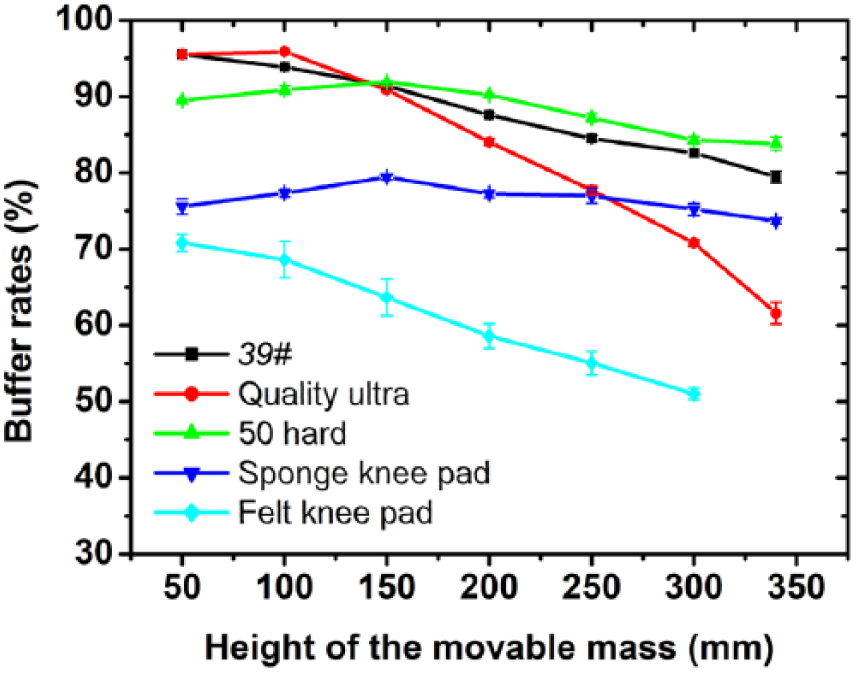
Buffer rates of the sponge materials with a thickness of 10 mm.
When the movable mass unit falls freely from the height of 340 mm, the instant impact caused is 3700 N. Under this situation, the buffer rate of the sponge 50 hard was the highest (over 83%) among all the experiment materials. This might be due to the fact that when the instant impact was increased, the sponge 50 hard tended to deform appropriately, thus it absorbed energy better. It can also be seen from Figure 3 that the buffer rate was closely related to the physical properties of the material. Moreover, the sponge knee pad had a value of 73.69%, the felt knee pad had the worst absorption (the plate broke at the impact of 3700 N, thus no data was available). From the results, we can see that the two knee pads on the market are not the best choice.
Buffer rates of the leak-allowed air cushion
The buffer rates of the leak-allowed air cushions with a single orifice on the air bubble are shown in Figure 4. It can be seen from Figure 4 that the buffer rates of the leak-allowed air cushion were different with respect to different orifice diameters. As the impact force increased, the buffer rates of all the leak-allowed air cushions decreased. It can also be seen that when the movable mass unit was at the height of 340 mm, the buffer rate for the 1.5 mm diameter orifice was the highest. The underlying reason might be that less energy was absorbed with respect to the smaller orifice and less exhaust air. However, the leak-allowed air cushion with too large diameter orifices may instantly vent air from the bubble under the instant impact, causing the buffer rate to decrease, which suggests that the air in the bubble should not be vented too quickly. Therefore, there should be a best leaking-air area for the leak-allowed air cushion.
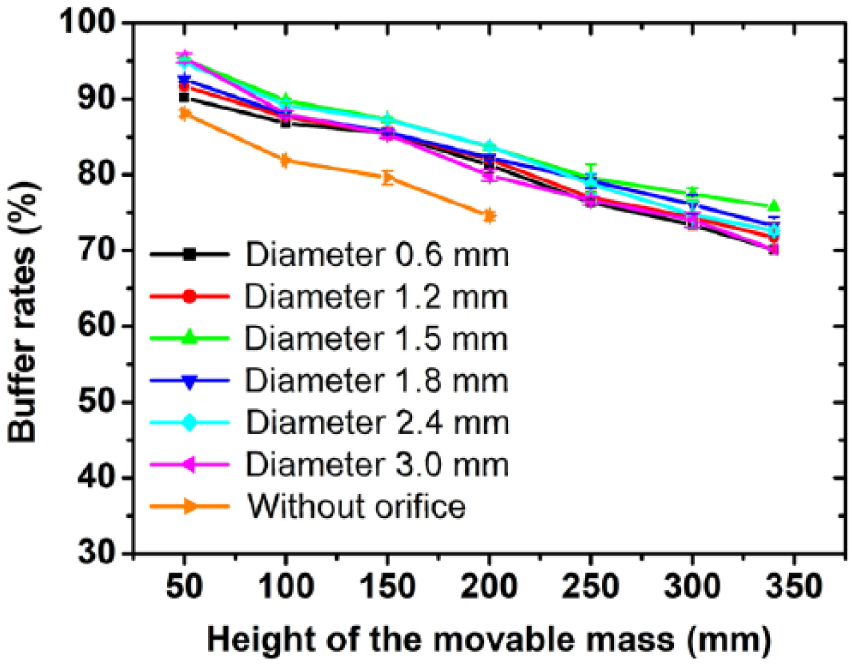
Buffer rates of the leak-allowed air cushion with a single orifice.
The closed-air cushion without orifice had the lowest buffer rate (Figure 4). Specifically, the air bubble may be broken if the impact force reaches a certain degree, such as height of 250 mm, 300 mm, and 340 mm. This is because the closed-air cushion can only consume a small amount of energy by its deformation, and most of the energy would be directly transmitted to the pressure sensor. By contrast, the leak-allowed air cushion can consume energy by ejecting the airflow through the orifice during the impact load, so its buffer rate is much higher than the closed-air cushion.
The buffer rates of the leak-allowed air cushion with double orifices are shown in Figure 5. It was shown that the buffer rates of the leak-allowed air cushion were not only related to the diameter, but also concerned with the number of the orifices, as shown in Figures 4 and 5. For example, the buffer rate of a single orifice with 1.5 mm diameter equaled 75.75% (Figure 4), which was the highest among all single orifices under the impact force of 3700 N, while the buffer rate of double orifices with 1.2 mm diameter equaled 73.25% (Figure 5), which is the highest. Therefore, total area of the orifices may be the key factor in the buffer rate.
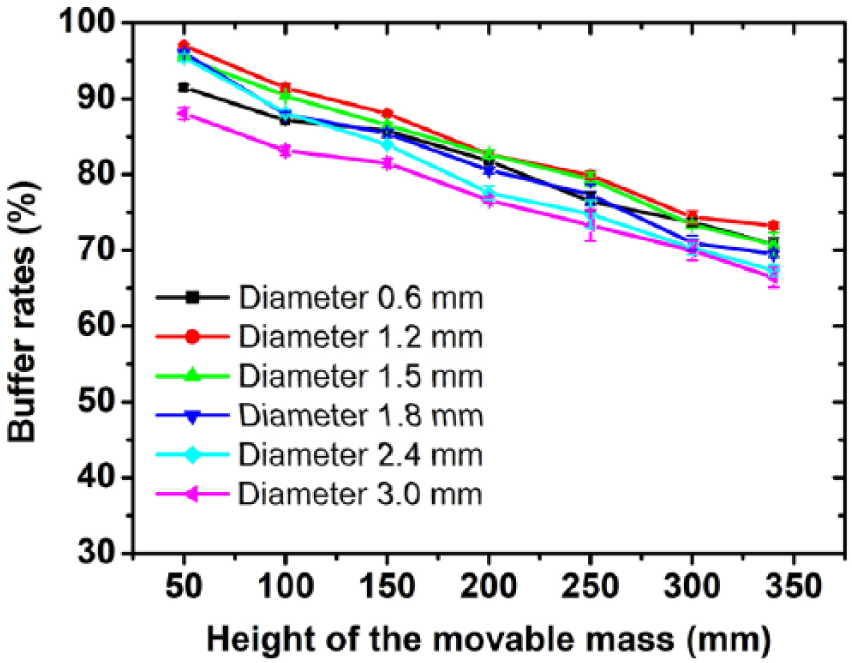
Buffer rates of the leak-allowed air cushions with double orifices.
The buffer rates of the leak-allowed air cushion with multiple orifices with a diameter of 0.6 mm and 1 mm, respectively, are shown in Figure 6 (under the instant impact of 3700 N). It was shown that when the diameter was 0.6 mm, the leak-allowed air cushion with seven orifices achieved the best result, with the leaking-air area of 1.96 mm2. However, when the diameter was 1.0 mm, the leak-allowed air cushion with three orifices achieved the best result, with the leaking-air area of 2.37 mm2. Considering that the area of a single orifice with 1.5 mm diameter was 1.78 mm2, and one of the double orifices with 1.2 mm diameter was 2.26 mm2, we estimated that the leak-allowed air cushion would achieve a higher buffer rate with a leaking-air area of around 2 mm2 and an impact force of 3700 N.
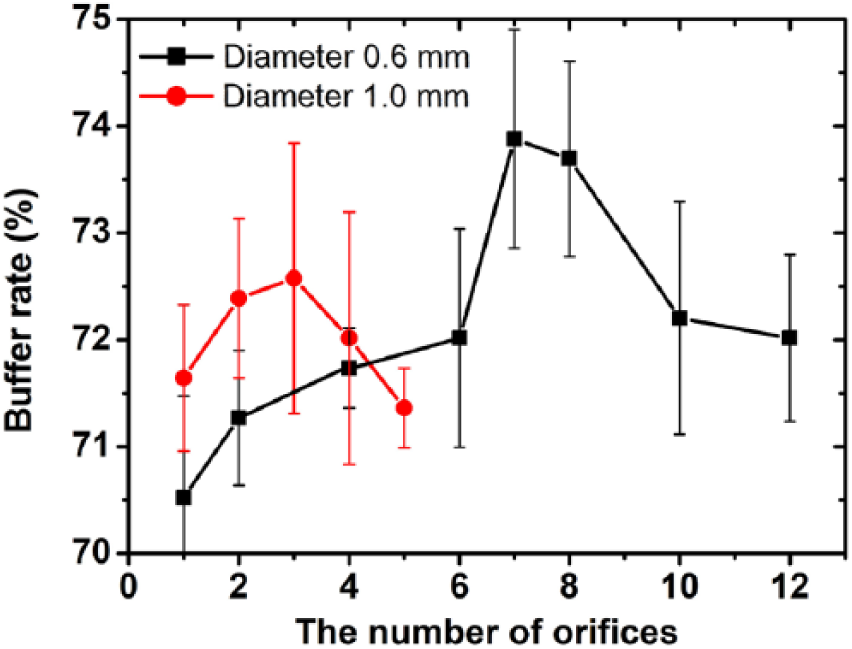
Buffer rates of the leak-allowed air cushions with multiply orifices.
Although the leak-allowed air cushion with a single orifice of 1.5 mm diameter achieved the highest buffer rate among all kinds of the leak-allowed air cushions in this study, it was still 10% lower than the 50 hard sponge with a thickness of 10 mm. Nevertheless, since the leak-allowed air cushion can effectively absorb the energy of the impact force and has good properties such as ultra-lightness, flexibility, and better applicability, it is one of the appropriate materials for hip protectors.
Conclusions
Based our study, we could draw the following conclusions:
The developed experimental device in this study simulates the instant impact during an elderly person’s fall, and it is an effective tool to study the buffer performance of materials.
The buffer rates of material with different hardnesses are not identical under the same instant impact. The soft material efficiently absorbs energy at the relatively small instant impact, but with the increase of the impact, its absorption ability obviously declines and the buffer rate decreases. On the other hand, the hard material is effective with respect to the relatively large instant impact, indicating good impact resistance.
The leak-allowed air cushion may be a potentially useful material for use in hip protectors and other sport protectors due to its better buffer characteristics, ultra-lightness, flexibility, and low cost. However, its buffer rate is slightly lower than some sponge materials. Therefore, we expect to do more studies on the buffer rates of the leak-allowed air cushion at different thicknesses, different textures, and with different combinations to achieve the optimal effect. And, we expect to develop a series of hip protectors with good performance to improve the protective effect, and to protect the elderly people from hip fracture during falls, through the application of the research results.
Footnotes
Declaration of Conflicting Interest
The author(s) declared no potential conflicts of interest with respect to the research, authorship, and/or publication of this article.
Funding
The author(s) disclosed receipt of the following financial support for the research, authorship, and/or publication of this article: This work was partly supported by the project of Natural Science Foundation of Heilongjiang Province (grant number C2015025), and by the Heilongjiang Provincial Department of Education Science and Technology Research Project (grant number HDJCCX-2016209).