



Abstract
Background:
This study examines the relationship between early-life rural residence and executive function (EF) in mid- and late-life and investigates the roles of educational attainment and childhood financial level.
Design and Methods:
Cross-sectional and longitudinal analyses were conducted using data from the Cognitive Project in Waves 2 and 3 of the Midlife in the United States (MIDUS) study. Structural equation modeling was employed to examine the relationships among these variables.
Results:
Educational attainment mediated the rural-EF relationship, and childhood financial status moderated the mediation model. The relationship between rurality and EF decline was fully mediated by education and differentially impacted by childhood financial status.
Conclusions:
Educational attainment is a key pathway between childhood rurality and adult EF. While rural individuals are at a disadvantage in educational attainment and score lower on measures of EF in adulthood, childhood financial level appears to be most impactful for individuals who grew up in urban environments.
Introduction
Individuals from rural backgrounds face disproportionately higher risks for a range of health challenges, including an elevated likelihood of developing Alzheimer’s disease and related dementias (ADRD) compared to their urban counterparts.1,2 These disparities are shaped by systemic differences in healthcare access, availability of health-promoting resources, socioeconomic conditions, and educational opportunities. Executive function (EF)—which encompasses cognitive processes such as working memory, reasoning, inhibition, and cognitive flexibility—is particularly relevant, as impairments in EF are among the earliest cognitive changes observed in ADRD. 3 Emerging evidence suggests that rural-urban disparities in EF may originate in early life and persist into older adulthood.4–6 Given the significant influence of early life conditions on adult EF and the known association between impaired EF and ADRDs, understanding the early life conditions that impact adult EF and its decline is imperative. Rural and Urban Residence in Relation to EF.
A growing body of research has documented geographic disparities in cognitive functioning between rural and urban populations, with early life residence emerging as a critical factor. Specifically, individuals raised in rural environments are at heightened risk for cognitive decline in later life compared to those raised in urban settings. 1 Several studies have shown that rural childhood residence is associated with lower EF in older adulthood, even after controlling for key confounders such as adolescent IQ, genetic risk factors, educational attainment, and socioeconomic status across the lifespan.2,7 Notably, one study found that growing up on a farm conferred an even stronger negative association with later-life cognitive performance than general rural living, suggesting that specific aspects of rural environments may be especially detrimental. 7
The mechanisms underlying these rural–urban disparities in EF remain incompletely understood. Some research suggests rural living in early life may expose individuals to a greater number of known modifiable risk factors such as reduced access to healthcare, higher poverty rates, and limited cognitive stimulation 7,8; however, these factors do not fully account for the geographical difference in cognitive outcomes. Broader contextual mechanisms such as social network density, cultural attitudes toward formal education, economic diversification, and the availability of cognitively enriching occupations may also contribute. Moreover, while rural disadvantage may manifest differently from urban poverty, both represent structural inequities that can restrict educational and cognitive development through distinct pathways: rural disadvantage via geographic isolation and resource scarcity, and urban poverty via concentrated deprivation and environmental stressors. Recognizing rurality as a complex, multidirectional social determinant of health may provide a richer framework for understanding its long-term cognitive implications.
Recent research has focused on identifying modifiable risk factors for EF decline in older adults, 9 yet even when controlling for these factors, an association between early life rural residence and later life cognitive decline persists, 7 suggesting additional, unmeasured factors may be contributing to the relationship. Identifying the specific characteristics of rural environments that contribute to lifelong disparities in EF is critical for informing targeted interventions and shaping policies to support cognitive health across diverse geographic populations.
Rural/urban residence and educational attainment
Education may be a critical factor shaping geographic disparities in EF. Significant disparities in educational attainment persist between rural and urban populations in the United States. Individuals raised in rural areas are less likely to pursue and complete postsecondary education than their urban counterparts.10–12 These disparities are shaped by structural limitations in rural education systems, including underfunded schools, teacher turnover/shortages, fewer advanced courses, and limited access to college preparatory resources.13–15 Geographic isolation and limited access to nearby higher education institutions also appear to contribute to lower college enrollment and completion rates among rural youth. 16
Beyond structural constraints, socioeconomic and cultural factors further hinder educational attainment in rural areas. Higher rates of poverty, limited household resources, and competing family or work responsibilities often reduce opportunities for academic advancement.16,17 Additionally, community norms in some rural areas may prioritize local employment and familial obligations over postsecondary education, particularly when higher education is viewed as a pathway to outmigration.16,18 Together, these factors create compounding disadvantages that shape educational outcomes over the life course and may ultimately influence long-term cognitive and economic well-being.
Educational attainment is a critical determinant of adult cognitive outcomes, particularly EF.19,20 Higher levels of education are associated with better performance on tasks involving attention, planning, inhibition, and cognitive flexibility—core components of EF. 20 Education is thought to build cognitive reserve, allowing individuals to better compensate for age-related neural changes and maintain cognitive performance into older adulthood. 21 Thus, disparities in educational opportunities, such as those faced by individuals raised in rural settings, may be the primary pathways leading to long-term differences in EF and increased vulnerability to cognitive decline with aging.
The role of childhood income
The role of familial socioeconomic status in childhood plays a clear role in educational attainment; however, the relationship with rurality and adult EF is less clear. While it may seem likely that low family income would exacerbate disparities for rural individuals who already face structural and psychosocial barriers to education, some research contradicts this expectation. For example, Peterson et al. found that rural residence in childhood is associated with worse EF and episodic memory across the lifespan, regardless of socioeconomic status. 22 Similarly, another study found that higher income provides the greatest benefits in academic skills for urban youth, while rural youth see minimal benefits related to family income. 23 Thus, limited school options and opportunities may partially level the playing field for rural residents, regardless of their economic backgrounds, while these disparities are starker in urban areas where school quality may substantially vary based on socioeconomic status. Further research is needed to clarify these relationships.
Hypotheses
Based on prior research, we first hypothesize that growing up in a rural area will be associated with poorer performance on measures of EF in mid- and late life. Second, we hypothesize that the effect of rurality on EF will be mediated by educational attainment, such that more rural individuals may have lower access to higher education, which may account for the effect of rurality on EF. Finally, we hypothesize that the relationships between rurality, EF, and educational attainment may depend on one’s family income during childhood. We propose to examine these relationships across multiple time points to evaluate the effects on adult EF more broadly, as well as the effects on EF decline over time.
Design and methods
Participants
Data from the longitudinal survey Midlife in the United States (MIDUS) was used for this study. 24 Figure 1 presents the inclusion and exclusion criteria. Individuals who participated in the Cognitive Project at Wave 2 (MIDUS 2, 2004–2006) with available rurality information were eligible for the cross-sectional analysis. 25 Considering the measurement accuracy, participants who had their Brief Test of Adult Cognition by Telephone (BTACT) tasks flagged problematic and/or their accuracy for Stop & Go Switch Task (SGST) being no more than 75% were excluded from the analysis (see detail for the tasks in Measures section).26,27 Those who reported “Moved around” for the area where they were raised were also excluded, leading to a total sample size of N = 3383 at Wave 2. Over two-third of these individuals continued participating in the Cognitive Project at Wave 3 (MIDUS 3, 2013–2017). 28 After applying the same inclusion and exclusion criteria mentioned above, a total of N = 2035 participants had valid executive functioning data at Wave 3. The full protocol for MIDUS data collection can be found elsewhere.24,29

Participants inclusion and exclusion flow chart.
Measures
Demographics
Age and sex at birth collected from MIDUS 2 Project 1 were included in the analyses as covariates. The age variable that was re-calculated and updated as of 08/05/2019 was adopted in the analysis. Sex assigned at birth was categorized into 1 = “Male” (reference group) and 2 = “Female”.
Education level
Participants’ levels of education were collected from MIDUS 2, Project 1. Participants were asked to select their highest level of education completed from 12 levels ranging from 1 = “No school/some grade school (1–6)” to 12 = “PH.D., ED.D., MD, DDS, LLB, LLD, JD, or other professional degree”. Considering education was measured ordinally with a sufficiently wide range, it was treated as a continuous variable in our analysis, with one unit increase representing a progression of one education level. 25
Childhood financial level
Participants’ childhood financial level was extracted from data at Wave 1 (MIDUS 1, 1995–1996), given that it would not change over time. Participants were asked to report their childhood family financial situation compared to the average family at the time using a seven-point Likert-type scale, with 1 = “A lot better off” – 7 = “A lot worse off”. A higher score indicated a worse childhood financial level in relation to the average family.
Rurality
Data on rurality was also collected at Wave 1, where participants reported the type of area they were raised in for most of their childhood using the following categories: 1 = “Rural”, 2 = “Small town”, 3 = “Medium-sized town”, 4 = “Suburbs”, 5 = “City”, and 6 = “Moved around”. The “Moved around” category was excluded due to the challenge of assigning it a specific level. The remaining responses were reverse coded to create a numeric measure, with higher values indicating a greater level of rurality. 30
Executive function
EF was assessed in the Cognitive Project at Waves 2 and 3 using the Brief Test of Adult Cognition by Telephone (BTACT) and the Stop & Go Switch Task (SGST).25,28 BTACT measures the cognitive function in terms of accuracy across domains critical to cognitive aging through six subtests, which are immediate word list recall, digits backward span, category fluency, number series, backward counting, and delayed work list recall. 26 SGST measures both accuracy and latency by assessing essential control functions including task-switching and inhibitory control. 27 Detailed tasks were discussed elsewhere.25,28 An exploratory and confirmatory factor analysis conducted by et al. developed the factor EF, loading on digits backward span, category fluency, number series, backward counting, and SGST. 27 A composite score was calculated by averaging the standardized z-scores for the five respective tests. Higher composite scores indicated better executive functions. Note that to ensure measurement accuracy, data from participants with problematic BTACT subtests were excluded, and following the recommendation of the task creator, a criterion of 75% accuracy for SGST was applied. 27
Statistical analysis
We conducted the analyses using R version 4.3.2. 31 Mediation and moderation analyses were conducted using structural equation modeling with the R package “lavaan.” 32 Descriptive statistics were used to summarize sample characteristics, and a paired t-test was conducted to evaluate differences in EF between the two time points. Next, we assessed the mediation effect of education level on the relationship between rurality and EF at Wave 2 with demographic variables adjusted. The indirect effect was evaluated using the bootstrapping method with 5000 iterations to ensure robust statistical inference. The moderating effect of childhood financial level was examined on both the relationship between rurality and education and the relationship between rurality and EF. Complete cases were used for analyses at Wave 2 assuming data were missing completely at random (about 0.3%).
For the longitudinal analysis, given that about one-third of participants dropped out by Wave 3, we performed an attrition analysis using t-test and chi-square test to examine the differences between participants who remained in the cognitive project and those who dropped out. Mediation and moderation models were then conducted for EF at Wave 3 hypothesizing that rurality affects late-life EF through its influence on education and midlife EF. In addition to the moderating effects examined at Wave 2, we further tested whether childhood financial level moderated the association between EF at Wave 2 and EF at Wave 3. The longitudinal models were estimated based on all eligible participants (N = 3383) with Full Information Maximum Likelihood (FIML) employed to account for missing data due to attrition. 33 As a sensitivity analysis, the models were re-estimated using only participants with complete cases at Wave 3 (N = 2035). All hypothesized models are presented in the Appendix (Figure A1). The sample size was deemed adequate to provide sufficient statistical power in accordance with established guidelines for SEM and mediation analyses.34,35
Results
Sample characteristics
Sample characteristics at Wave 2 are summarized in Table 1. The average age of eligible participants was approximately 55.6 (SD = 12.1) years, with 53.2% identifying as female. Their average highest level of education completed was 7.4, corresponding to some college but no bachelor’s degree. The mean financial level during childhood was 4.0, indicating an overall average family financial status. About half of the participants were raised in a rural area (24.8%) or a small town (25.5%). The overall rurality level averaged 3.2, corresponding to a medium-sized town.
Sample characteristics at Wave 2.
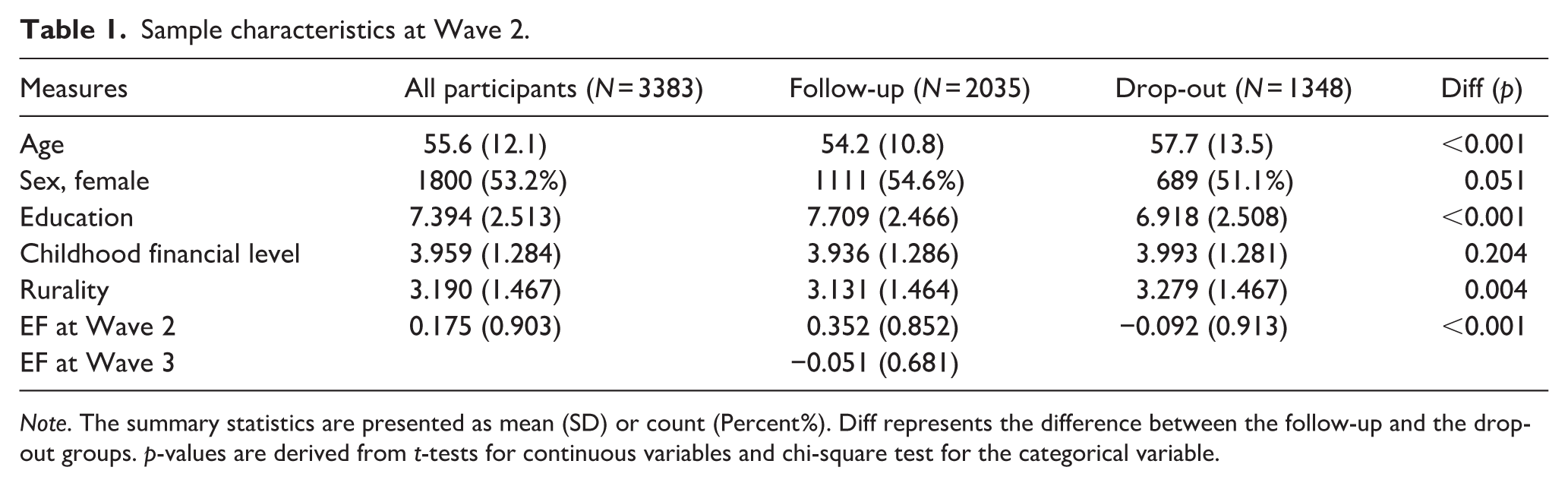
Note. The summary statistics are presented as mean (SD) or count (Percent%). Diff represents the difference between the follow-up and the drop-out groups. p-values are derived from t-tests for continuous variables and chi-square test for the categorical variable.
At Wave 2, the mean standardized EF score of eligible participants was 0.175 (SD = 0.903), indicating performance 0.175 standard deviations above the overall mean. Among participants who completed the follow-up at Wave 3, the mean standardized EF scores were 0.352 (SD = 0.852) at Wave 2 and −0.051 (SD = 0.681) at Wave 3, with the difference being statistically significant based on a paired t-test (t = 33.251, df = 2034, p < 0.001). The average follow-up period was 9.4 (SD = 1.1) years. These findings indicate a substantial decline in executive function over approximately 9 years, as well as a potential attrition bias given participants who remained in the study tended to have higher baseline executive function. This was confirmed by the attrition analyses, which revealed significant differences between follow-up and drop-out groups in age, education, rurality, and baseline EF. Specifically, participants who remained in the study were generally younger, more educated, grew up in a less rural area, and demonstrated higher executive function at baseline.
Results at Wave 2
Figure 2A and B and Appendix Table A1 present the results of the mediation and moderation models at Wave 2. The mediation model (model 1) was saturated. The direct effects indicated that greater rurality was significantly associated with lower levels of education (B = −0.251, SE = 0.030, p < 0.001) and reduced EF (B = −0.039, SE = 0.009, p < 0.001). In contrast, higher education was positively associated with better EF (B = 0.126, SE = 0.005, p < 0.001). A significant indirect effect of rurality on EF through education was also observed, with education level mediating 45.7% of the total effect (B = −0.032, Boot SE = 0.004, Boot CI = −0.039 to −0.024).

Final mediation and moderated mediation models. Note. Panels (A and B) illustrate the final cross-sectional mediation and moderated mediation models at Wave 2; Panels (C and D) present the longitudinal models estimated with all participants using FIML; Panels (E and F) present the longitudinal models based on participants with EF scores at Wave 3.
The moderated mediation model (model 2) presented a good fit (see Table A4). The direct effect of rurality on education was significantly moderated by childhood financial level (B = 0.052, SE = 0.023, p = 0.022). Participants who grew up in families that were financially worse off than the average at the time tended to have lower educational levels; however, the negative impact of increasing rurality on education weakened as childhood financial status declined (see Figures 3A and B). This interaction also led to a significant moderated mediation effect (Index = 0.006, Boot SE = 0.003, Boot CI = 0.001–0.012), such that the negative impact of living in a rural area on executive function via educational opportunities was stronger for individuals who grew up financially better off (see Figure 4).

Associations moderated by childhood financial level.
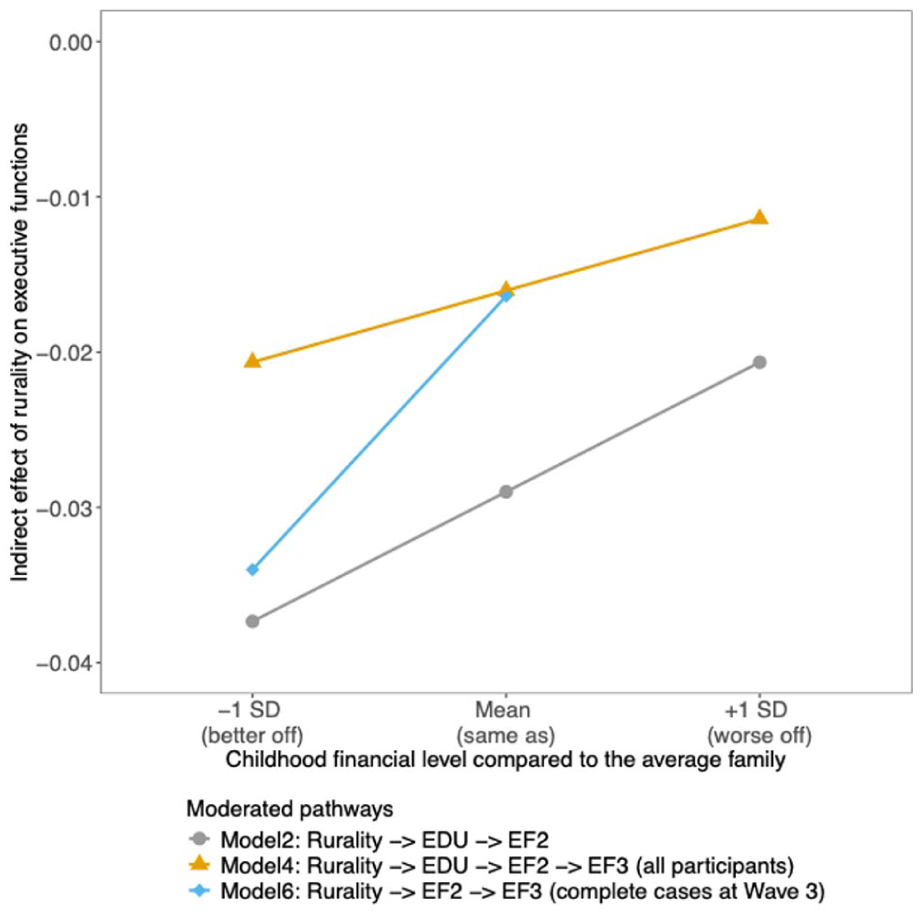
Indirect effects of rurality on executive function moderated by childhood financial level.
Results at Wave 3
Figure 2C–F and Appendix Tables A2 and A3 present the results of the mediation and moderation models at Wave 3. All models demonstrated reasonably good fit (see Table A4). Including all participants, the sequential mediation analysis revealed a significant indirect effect from rurality to late-life EF at Wave 3 (EF3) through education and midlife EF at Wave 2 (EF2; total indirect B = −0.039, SE = 0.005, p < 0.001). Consistent with the cross-sectional analyses, the rural-urban educational disparities were larger among socioeconomically advantaged individuals, resulting in a moderated mediation effect from rurality to late-life EF through education and midlife EF (Index = 0.004, Boot SE = 0.002, Boot CI = 0.000–0.007; see Figure 4). Among participants who remained at Wave 3, the sequential mediation effect of rurality on late-life EF remained significant (total indirect B = −0.033, SE = 0.007, p < 0.001). However, childhood financial level did not moderate the rurality-education association but significantly moderated the direct effect of rurality on midlife EF (B = 0.025, SE = 0.008, p = 0.003). Participants with greater childhood financial advantages experienced greater declines in EF if they lived in more rural (vs urban) areas during childhood (see Figures 3C–D and 4).
Discussion
This longitudinal study examined the impact of early-life rurality on adult EF, identifying education as a key mediator and childhood financial status as a conditional moderator. On Average, individuals raised in more rural environments exhibited significantly lower educational attainment, which was associated with reduced EF in adulthood and sequential decline in EF over time. Notably, education mediated approximately 45.7% of the total effect of rurality on EF at Wave 2 (cross-sectionally), as well as mediating the effect of rurality on decline in EF over 10 years. These findings are consistent with prior research linking educational attainment to cognitive reserve and EF in later life,36–38 and underscore the pivotal role of educational access in shaping cognitive status and decline in mid and late-life. By integrating early environmental context, educational attainment, and cognitive trajectories across nearly a decade of follow-up, this study provides novel evidence for how structural rural disadvantages become biologically and cognitively embedded over time.
The moderation analysis revealed that individuals with rural upbringings were less likely to obtain higher levels of education regardless of childhood financial status, whereas financial status significantly impacted educational attainment for individuals from more urban upbringings. Notably, rural participants in the highest financial bracket had comparable education levels to more urban participants from the lowest financial bracket. This suggests that for individuals from rural backgrounds, the additional impact of childhood financial resources may be less pronounced, potentially due to uniformly limited access to educational resources in rural settings. The significant moderated mediation may indicate that individuals from financially disadvantaged backgrounds are particularly susceptible to long-term cognitive consequences via reduced educational attainment, but that this effect is much clearer for urban-residing individuals. For rural individuals, higher financial status did not significantly improve EF outcomes in adulthood. These findings align with existing literature emphasizing the compounded effects of socioeconomic and geographic disadvantages on educational and cognitive outcomes,39–41 but shed light on new and unique considerations for individuals based on their geographic upbringing. More broadly, rural disadvantage in the U.S. reflects a distinct but parallel form of structural inequity when compared with urban poverty. Specifically, geographic isolation, limited school funding, and workforce shortages may constrain opportunity in ways that differ from, and yet are equally detrimental as urban resource deprivation.
At Wave 3, over an average follow-up period of 9.4 years, the indirect effect of rurality on changes in EF through education persisted, even after accounting for baseline cognitive ability. This enduring association highlights the long-term influence of early-life structural factors on cognitive trajectories into later adulthood. Interestingly, the moderating effect of childhood financial status observed at Wave 2 was not evident at Wave 3. This attenuation may reflect several possibilities. First, as participants aged, cohort or period effects could have reduced variability in educational exposure, particularly among older cohorts who experienced more uniformly constrained educational opportunities. Second, attrition and reduced sample size at Wave 3 may have limited statistical power to detect nuanced moderating effects. Finally, it is possible that the influence of early financial context diminishes over time as other life-course factors, such as occupational attainment and adult socioeconomic stability, become stronger determinants of cognitive aging. While the observed decline in EF between Waves 2 and 3 is consistent with normative age-related cognitive changes, 6 our findings emphasize that early structural disadvantages, such as limited educational opportunities in rural areas, can exacerbate these declines. Education emerges as a critical resilience factor, potentially mitigating the adverse effects of rurality on cognitive aging, a concept supported by the cognitive reserve hypothesis.21,38 These results further highlight the importance of policy-level interventions aimed at strengthening rural educational infrastructure. Investments in school quality, broadband access, teacher retention, and college preparatory resources in rural communities may have enduring downstream effects on cognitive health and aging trajectories.
Limitations
Several limitations warrant consideration. First, the MIDUS sample is relatively racially homogenous and much of the sample was recruited from areas in the Midwest U.S. Thus, the findings may not be generalizable to other rural or more diverse cohorts and geographic regions. Second, EF was assessed using standardized composite scores, which may not capture domain-specific cognitive processes and represents a more limited subset of executive abilities. Further, broader EF domains such as planning, set-shifting, reasoning, etc. were not directly assessed, which may constrain the interpretability of the composite score. This consideration is important as prior studies have found that different components of EF and memory differentially decline with age. 42 Third, reliance on retrospective self-reports for childhood financial status and rurality may introduce recall bias. That is, participants’ current socioeconomic status, cognitive state, or emotional experiences may color their recollections, leading to either overestimation or underestimation of their early-life circumstances. Next, we used FIML to address missing data, which assumes missing at random. While our attrition analyses revealed that the dropout was related to the observed variables in our analyses, we cannot rule out the possibility that data were missing not at random, for example, due to severe cognitive or health declines that precluded participation. In such cases, the strength of associations and disparities may be underestimated, as the most vulnerable individuals would be systematically excluded. In addition, while the sample size in this study was considered adequate according to established recommendations for SEM and mediation analyses, we did not conduct a formal power analysis. Therefore, we cannot fully exclude the possibility of insufficient power for detecting subtle or complex effects. Finally, the potential for reverse causation should be considered, such that lower executive function could influence how accurately participants recall or interpret their childhood experiences, potentially complicating interpretation of these associations.
Conclusions and future directions
These results contribute to a growing body of literature advocating for life course perspectives in cognitive health research. They suggest that interventions aimed at enhancing educational access in rural and underserved urban areas may yield long-term cognitive benefits and help reduce disparities in cognitive aging. From a policy and practical standpoint, targeted investments in rural and low-SES urban education may yield broad intergenerational benefits. Policymakers and community leaders should prioritize initiatives that reduce geographic and economic inequities in school funding, support teacher recruitment and retention, and expand community learning hubs that provide cognitive and social engagement opportunities. Future research should explore the mechanisms linking rurality and education to cognitive outcomes, such as school quality, access to enrichment opportunities, and ongoing structural disadvantages in adulthood. Comparative studies examining rural-urban disparities across countries or socioeconomic systems may also clarify which educational or policy frameworks most effectively mitigate geographic disadvantage. Additionally, expanding this work to more diverse populations and contexts will enhance generalizability and inform regionally tailored interventions.
Footnotes
Appendix
Fit indices for the final models.

| Chi-square test | |||||||
|---|---|---|---|---|---|---|---|
| Models | Statistic | df | p-value | CFI | TLI | RSMEA | SRMR |
| Model 1 (Saturated) | |||||||
| Model 2 | 1.974 | 2 | 0.373 | 1.000 | 1.000 | 0.000 | 0.001 |
| Model 3 | 17.416 | 2 | <0.001 | 0.996 | 0.974 | 0.048 | 0.010 |
| Model 4 | 19.712 | 6 | 0.003 | 0.996 | 0.988 | 0.026 | 0.008 |
| Model 5 | 17.416 | 2 | <0.001 | 0.994 | 0.966 | 0.062 | 0.011 |
| Model 6 | 18.652 | 5 | 0.002 | 0.995 | 0.982 | 0.037 | 0.009 |

Ethical considerations
All MIDUS data collection was reviewed and approved by the Education and Social/Behavioral Sciences and Health Sciences IRBs (Protocol Number: 2016-1051) at the University of Wisconsin-Madison. Only de-identified analysis of secondary data was completed for the current study.
Author contributions
Dr. Sheffler led conceptualization, methodological planning, manuscript drafting, and supervision and administration of the project. Ms. Bautista and Smith assisted in the conceptualization and writing of the manuscript. Ms. Karter assisted in reviewing and editing the manuscript, and Dr. Meng led the methodology, managing and cleaning the data, completing formal analyses, creating tables and figures, and writing the manuscript.
Funding
The authors received no financial support for the research, authorship, and/or publication of this article.
Declaration of conflicting interests
The authors declared no potential conflicts of interest with respect to the research, authorship, and/or publication of this article.
Data availability statement
All MIDUS data is freely available through the ICPSR National Archive of Computerized Data on Aging.