



Abstract
Background:
Physical fitness is a key protective factor against cardiovascular diseases, metabolic disturbances, and cancer, partly due to its influence on antioxidant capacity. However, the relationship between aerobic fitness and specific redox markers remains inadequately explored in young Saudi men.
This study investigates the correlation between maximal oxygen uptake (VO2max) and key antioxidant parameters in healthy Saudi males.
Design and methods:
In this cross-sectional study, a group of 88 healthy Saudi men aged 18–25 years with a normal BMI (18.50–24.99) and moderate physical activity levels was recruited. VO2max was assessed using cardiopulmonary exercise testing on a Bruce treadmill protocol. The resting redox status was evaluated by plasma total antioxidant capacity (TAC), superoxide dismutase (SOD) catalase, and thiobarbituric acid reactive Species (TBARS) using ELISA technique.
Results:
The mean VO2max of the participants was 41.8 ± 7.1 ml/kg/min, with over 50% classified as having “poor” or “very poor” fitness categories. A significant positive correlation was identified between VO2max and TAC (r = 0.251, p = 0.018). However, no significant associations were detected between VO2max and SOD, catalase, or TBARS.
Conclusions:
These findings indicate that aerobic fitness is positively associated with resting total antioxidant capacity, potentially offering greater protection against oxidative stress-related chronic diseases. The absence of significant correlations between VO2max, individual antioxidant enzymes and lipid peroxidation markers may be attributed to the relatively low VO2max levels in this cohort. Further research is warranted to explore this relationship across a broader range of fitness levels and additional oxidative stress biomarkers.
Keywords
Introduction
VO2max is the gold standard clinical measure of cardiovascular fitness. It is defined as the maximal oxygen consumption at maximum exercise. 1 A high VO2max is widely recognized as a protective factor against diverse medical ailments, including cardiovascular diseases, metabolic disturbances, and cancer. 2 One of the significant determinants of VO2max is the physical activity level. Highly active individuals often exhibit high VO2max. Furthermore, an individual can improve their VO2max through exercise training, as it induces multiple physiological adaptations that enhance the body’s capacity to deliver and consume oxygen, thereby increasing VO2. 3
On the other hand, the consumption of oxygen during exercise can converge in the derivation of abundant reactive radicals and aggravate the body’s oxidative stress. The greater the intensity of physical training, the higher the oxygen turnover is in the body. Consequently, endurance athletes are expected to exhibit elevated levels of free radicals and reactive oxygen species (ROS). 4
However, our body is equipped with multiple antioxidant protective mechanisms. Antioxidants can counteract, lower, or restore ROS-induced harm. Antioxidants reduce oxidation activity, even at comparatively modest concentrations, and offer protection to cellular elements against free radical harm by hindering or slowing the oxidative modification of biomolecules, including proteins, polysaccharides, lipids, and nucleic acids. Therefore, antioxidants are believed to support the integrity and health of various body systems. 5 Our body possesses multiple antioxidants. The endogenous antioxidants encompass key enzymatic defenses, including superoxide dismutase (SOD), catalase, glutathione peroxidase (GPx), and glutathione reductase (GRx), as well as non-enzymic counterparts like lipoic acid, glutathione, L-arginine, uric acid (UA), and bilirubin. 6
ROS excess concentration or a decrement of antioxidants leads to oxidative stress, where ROS overwhelms antioxidant capacity at a cellular level, leading to damage in critical cellular integrity, including proteins, lipids, and nucleic acids. Conversely, repeated physiological increases in ROS may induce adaptive upregulation of antioxidant capacity. 7
The ultimate impact of exercise on the body’s oxidative status remains uncertain. One proposed hypothesis suggests that exercise induces an increase in ROS production due to heightened metabolic activity. This excessive generation of ROS may consequently lead to oxidative stress. Others claim that the oxidative stress generated during acute bouts of exercise can trigger favorable adaptive responses responsible for the upregulation of various endogenous antioxidant elements. 8
Despite these perspectives, the existing literature on the interplay between physical fitness and oxidative status remains inconclusive. While some studies identified a favorable linkage between physical activity or VO2max and some antioxidant parameters, others reported no such association. 9 Even among studies that demonstrated a positive correlation, there is little agreement on which parameter is most directly correlated to physical fitness. This conflict is likely attributable to methodological heterogeneity in assessing fitness and oxidative status, as well as variability in study populations. Studies predominantly focus on older adults or individuals with underlying health conditions rather than healthy populations. 10
Therefore, this study intended to focus on a healthy population by evaluating the correlation between measured VO2max levels and key redox parameters in a cohort of healthy, non-athletic Saudi men of normal weight residing in the cities of Saudi Arabia’s Eastern Region. This study might be the first to explore one crucial aspect of physiological adaptations to physical fitness in the general young population of Saudi Arabia and the surrounding region.
Subjects and methods
This study employed a cross-sectional design conducted from March 2021 to March 2022 and included a cohort of 88 young Saudi men who were meticulously recruited. The inclusion criteria included being healthy, within the age range of 18–25, having a normal BMI (18.50–24.99), and having average physical activity. Those who did not meet these criteria, or have any chronic disease, or are taking medications that can limit their performance in the maximum exercise test, were excluded.
The participants were recruited from cities of Saudi Arabia’s eastern region. The study procedures were performed at King Fahad Hospital of the University, Al Khobar, Saudi Arabia. Ethical approval was granted by the university’s Institutional Review Board (IRB) and received the following number (IRB-PGS-2020-01-244, date 21/8/2021). The Fund was provided by the Deanship of Scientific Research (Project no. 2020-184-Med).
The sample size calculation for Pearson’s correlation was performed using the sample size calculator available on: https://homepage.univie.ac.at/robin.risl/samplesize.php?test=correlation and true value of r = 0.52 (double to value under null hypothesis), on 5% margin of error and 80% power of the test. The required sample size was found to be 85.
Each participant was interviewed and given all relevant information and instructions about the study procedures before attending an appointment at the university hospital’s cardiopulmonary exercise testing (CPET) lab. Physical activity was assessed using the Arabic version of the long form International Physical Activity Questionnaire (IPAQ-LF). 11
On the day of testing, participants provided written informed consent. Then, the following measurements were recorded: body weight in kilograms (kg) using an electronic weighing device (Seca, Hamburg, Germany), height in centimeters (cm) using a stadiometer (Seca, Hamburg, Germany), and body mass index (BMI) using Quetelet’s index (kg/m2) = weight (kg)/height (m)2.
Blood samples were extracted in the same setting via venipuncture, plasma was separated using a cold centrifuge, and the samples were stored at −80°C until analysis.
The CPET procedure began with measuring resting heart rate (HR) and systolic and diastolic blood pressure (BP) in a seated position. Three readings were obtained at 5-min intervals of rest. Three resting blood pressure (BP) readings were taken at 5-min intervals using a standard sphygmomanometer. The CPET was conducted using Quark CPET™ (COSMED® system, Italy) for all participants between 8:00 AM and 12:00 pm. The Quark CPET™ system and procedure were described in detail our previous work.12,13 The test followed Bruce incremental protocol, which was implemented in the Quark software. The Bruce protocol entails a graded treadmill exercise test during which the participants progressively increase their running speed and incline in intervals of 3 min until exhaustion.
The American College of Sports Medicine (ACSM) guidelines for test initiation and termination were followed. 14
Plasma levels of the antioxidant enzymes SOD and catalase, total antioxidant capacity (TAC), and the lipid peroxidation marker TBARS were measured using ELISA kits from Cayman Chemical Company (USA); which are Superoxide dismutase (SOD) assay: (Item Kit No. 706002), Catalase assay: (Item Kit No. 707002), total Antioxidant assay (TAC): (Item Kit No. 709001), and Thiobarbituric Acid Reactive Species (TBARS): (Item Kit No. 10009055). Intra- and inter-assay coefficients of variation were as follows: SOD (3.2%, 3.7%), catalase (3.8%, 9.9%), TAC (3%, 3.4%), and TBARS (8%, 12%).
Samples were analyzed in duplicate using the ETI-Max 3000 ELISA workstation (DiaSorin, Italy) as per manufacturer’s instructions. SOD is a metal-dependent enzyme that facilitates the conversion of the superoxide anion to molecular oxygen and H2O2. Catalase determines the peroxidative activity, where it uses aliphatic alcohols as specific substrates. Total antioxidant activity is the sum of the endogenous antioxidant enzymes activities, including (SOD), glutathione peroxidase (GPx), catalase, and macromolecules (albumin, ceruloplasmin, or food-derived compounds like α-tocopherol, β-carotene, ascorbic acid, reduced GSH, and bilirubin). The principle of measurement relies on the potential capability of antioxidants in the given sample to impede the oxidation of ATBS (2,2-Azino-di- 1 ) to ABTS•+ metmyoglobin.
The reporting of this study conforms to the STROBE statement, 16 and the completed STORBE checklist is provided as Supplementary File 1. 15
Statistical analysis
The data were systematically analyzed utilizing the Statistical Package of Social Sciences (SPSS) version 29. All data were found to be normally distributed and expressed as mean ± SD. Redox parameters were compared between the classes of VO2max using analysis of variance (ANOVA).
Pearson’s correlation analyses were performed to examine the potential correlations between VO2max and redox parameters. p-Value < 0.05 was considered as significant.
Results
This study included 88 young, healthy, non-athletic male participants from the Eastern cities of Saudi Arabia, all of whom met the eligibility criteria for assessing VO2max.
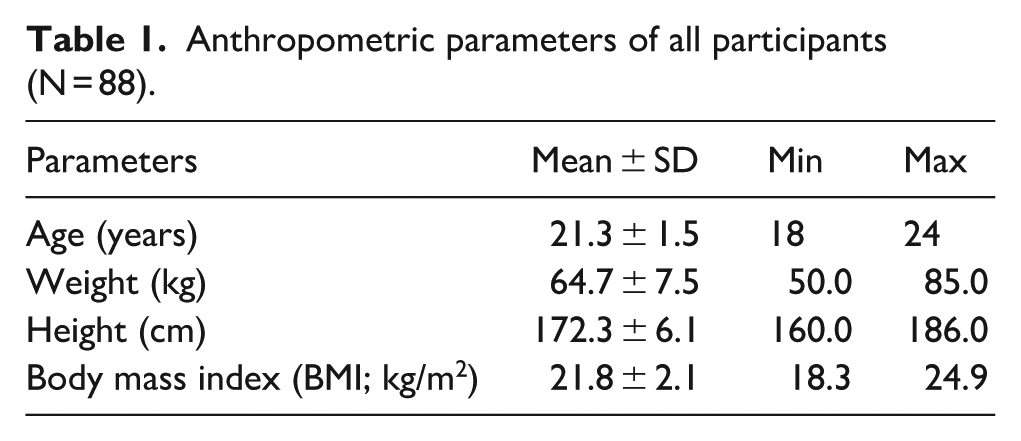
The participants’ anthropometric data, including age, weight, height, and body mass index (BMI), are shown in Table 1.
Anthropometric parameters of all participants (N = 88).
The mean VO2max of all participants is 41.8 ± 7.1 ml/kg/min. The participants were classified into six categories per ACSM guidelines: very poor (34.1 ± 2.8 ml/kg/min), poor (39.9 ± 1.1 ml/kg/min), fair (44.4 ± 1.1 ml/kg/min), good (48.0 ± 1.6 ml/kg/min), excellent (54.0 ± 1.2 ml/kg/min), and superior (58.1 ± 1.9 ml/kg/min), 13 and presented in Figure 1.

The classification of the participants according to VO2max level (ACSM’s classification). 14
The mean values of the redox parameters which include superoxide dismutase (SOD), catalase, and thiobarbituric acid reactive substances (TBARS) and total antioxidant capacity (TAC) for all participants are shown in Table 2.
The mean values of the redox parameters in all participants.

SD: standard deviation; SOD: Superoxide Dismutase; TAC: total antioxidant capacity; TBARS: Thiobarbituric acid reactive substances.
The redox parameters were compared among the six categories of VO2max using ANOVA. As Figure 2 shows, there were no significant differences in any of the redox parameters among these categories. Therefore, post-hoc tests were not performed.

Comparison of redox parameters among different categories of the measured VO2max using ANOVA: (a) comparison of the total antioxidant capacity (TAC), (b) comparison of superoxide dismutase (SOD), (c) comparison of catalase, and (d) comparison of Thiobarbituric Acid Reactive Species (TBARS). All ANOVA tests were insignificant.
Pearson correlation analysis was performed to investigate the association between different redox parameters, namely SOD, Catalase, TBARS, and TAC, and the measured VO2max in the current sample.
Table 3 presents the correlation coefficients (r) and p-values for each redox parameter with VO2max. The results indicated a significant positive correlation between TAC and VO2max (r = 0.251, p = 0.018). This positive correlation coefficient indicates a higher total antioxidant capacity with high values of VO2max. However, there were no other significant correlations between the individual redox parameters, including SOD (r = 0.073, p = 0.502), Catalase (r = 0.081, p = 0.451), or TBARS (r = 0.025, p = 0.816) levels with VO2max (Table 3).
Correlation of redox parameters with the measured VO2max of all participants.

SOD: Superoxide Dismutase; TAC: total antioxidant capacity; TBARS: Thiobarbituric Acid Reactive Substance; VO2max: maximal oxygen uptake.
Denote significance p < 0.05.
Discussion
Enhanced physical activity and improved physical fitness are proven to be a major protective factor against cardiovascular complications, metabolic disturbances, and other diseases including cancer. The underlying mechanisms of the favorable influence of good physical fitness in fighting diseases are not yet clarified. Multiple protective mechanisms have been proposed. These include optimized lipid profiles, enhanced endothelial function, reduced arterial blood pressure, and improved glucose metabolism. 16 However, a major pathophysiological mechanism for these diseases is a disturbed oxidative status with an accumulation of free radicals. 17
Therefore, we attempted to investigate the correlation between the physical fitness indicator of young Saudi men as represented by the standard fitness measure, VO2max, and the redox status or oxidative balance. The redox condition of the participating subjects was evaluated by measuring four parameters, namely superoxide dismutase (SOD), catalase, total antioxidant capacity (TAC), and thiobarbituric acid reactive substances (TBARS).
The current study found a mean VO2max of 41.8 ± 7.1 ml/kg/min in young Saudi men. This value indicates generally poor aerobic fitness in the cohort, possibly reflecting reduced physical activity and increased sedentary behavior. Furthermore, a significant proportion of the participants (more than 50%) were categorized as having poor or very poor VO2max, which might indicate insufficient engagement in regular endurance training or other lifestyle factors such as high sedentary behavior and suboptimal dietary habits or might reflect the involvement of genetic, constitutional, or environmental factors. Given the well-established benefits of higher VO2max, including reduced cardiovascular disease risk, improved metabolic health, and enhanced overall longevity, our findings underscore the critical role of interventions aimed at improving aerobic capacity in young adults.
The study of the relationship between VO2max and resting redox status and parameters reveals a significant positive correlation between resting TAC and VO2max, suggesting that individuals with higher aerobic fitness exhibit an enhanced total antioxidant capacity. This finding aligns with other studies in the literature despite the diversity in the adopted methodology. Although most studies reported a positive correlation between physical fitness or physical activity and total antioxidant capacity, this correlation was expressed in different populations. For instance, some studies focused on the effect of physical activity and physical fitness on ameliorating oxidative stress in the old population. In a previous attempt by Franzoni et al. who studied the correlation between physical fitness as represented by VO2max and physical activity from one side and lipid profile, flow-mediated dilation (FMD), and total antioxidant activity from the other side in multiple subgroups divided according to age and physical activity into young sedentary, old sedentary, young athletes, and old athletes and they found that VO2max is directly related to total antioxidant activity, FMD, and HDL. Interestingly, they found that exercise training in old athletes preserves their total antioxidant activity, HDL level, and FMD. 18
In another study that assessed the effect of physical fitness (VO2max) on oxidative stress in old subjects, 37 fit were compared to 35 unfit individuals, both men and women, with a mean age of about 65 years. The fit subjects showed significantly lower byproduct levels for lipid peroxidation and nucleic acid degradation. However, the total antioxidant power and the ratio of reduced and oxidized glutathione were similar in both. 19
Exercise is believed to induce a transient increase in oxidative stress by the generation of oxygen and nitrogen-reactive species, which stimulates the body’s adaptive mechanisms to enhance antioxidant capacity. Individuals with higher VO2max are likely to have undergone greater exposure to these adaptive processes through consistent physical activity, leading to enhanced TAC. 20 Therefore, this can clearly explain the positive correlation between VO2max and total antioxidant capacity and can further be supported by the previous longitudinal studies demonstrating the effect of exercise training on antioxidant power. For example, 8 weeks of training (three sessions per week) for young healthy individuals from the College of Physical Education, Belgrade, led to a significant enhancement of VO2max and upregulation of the antioxidant enzymes including SOD, glutathione peroxidase (GPx), glutathione reductase (GR), as well as a significant positive correlation was found between VO2max and the antioxidant enzymes SOD, GPx, and GR with r values (0.23, 0.37. 0.29) respectively. 21 Moreover, Margaritelis et al., 22 proposed that the generation of oxidative stress and the upregulation of antioxidant enzymes are directly proportional to the dose of exercise bouts and duration.
On the other hand, no significant correlations were observed between VO2max and the specific antioxidant enzymes SOD and catalase. These findings indicate that while the overall antioxidant capacity increases with aerobic fitness, individual antioxidant enzymes may not directly correlate with VO2max in the studied population. One possible explanation for this finding is that the participants in our study, despite having varying levels of VO2max, had low overall mean VO2max, and most of the values were skewed toward the poor and very poor categories. Therefore, the level of fitness of the included participants was sufficient to demonstrate a significant positive correlation between VO2max and the total antioxidant capacity but not with individual antioxidant enzymes. This conclusion may further support the idea that the population with lower physical fitness and VO2max will demonstrate lower antioxidant capacity. Another explanation for the lack of correlation between VO2max and SOD and catalase could be related to the assay sensitivity, biological variability, and an insufficient range of fitness levels in the cohort.
Similarly, no significant correlation was found between VO2max and TBARS, a marker of lipid peroxidation. It is possible that oxidative stress levels, as indicated by TBARS, do not vary significantly with aerobic fitness in this cohort. This may be due to the complex and dynamic nature of oxidative stress regulation, where multiple compensatory mechanisms or confounding variables, such as dietary antioxidant intakes, can modulate lipid peroxidation independently of VO2max.
Multiple earlier studies reported conflicting observations regarding VO2max and antioxidant enzymes or TBARS correlations. Rosado-Pérez and Mendoza-Núñez found a negative correlation between lipid peroxidation products (TBARS) and the VO2max of 52 participants (30 women and 22 men, with a mean age of 66 ± 4 years). However, no association was found between the VO2max and the antioxidant enzymes SOD, GPx, and TAC. 23
Santa-Rosa et al. selected a different type of population, which is healthy individuals with a family history of hypertension. They investigated the impact of an active lifestyle on the probability of developing hypertension in these young adults. They compared the levels of reactive oxygen species such as hydrogen peroxide and superoxide anion among four groups according to their physical activity and family history of hypertension (sedentary-no family history, sedentary with family history, active-no family history, and Active with family history). They found that an active lifestyle reduces all these risk factors and normalizes the level of ROS in active subjects with a family history of hypertension. Santa-Rosa et al. 24 reported no significant difference in lipid peroxidation byproducts such as TBARS or oxidized protein.
In a Malaysian study investigating the association between VO2max and oxidative status in 88 women with varying BMI (normal weight, overweight, and obese), there was no significant correlation between VO2max and oxidative biomarkers, including antioxidant enzymes and proteins. However, catalase levels were significantly elevated in obese participants compared to their normal-weight counterparts regardless of their fitness level, suggesting that obesity might obscure the effects of fitness on oxidative balance. 25 This last observation highlights the challenge of disentangling the effects of exercise-induced oxidative changes from confounding factors like body composition. Hence, our study aimed to mitigate the influence of confounding factors such as BMI and physical activity by controlling these two factors and recruiting only subjects with normal BMI and average physical activity.
In conclusion, this study’s findings contribute to the expanding body of evidence regarding the relationship between aerobic fitness and oxidative stress regulation. The observed positive, though weak, correlation between VO2max and TAC may suggest that enhancing aerobic fitness contributes to strengthening the body’s ability to combat oxidative stress through increased antioxidant capacity. However, the lack of significant associations between VO2max and SOD, catalase, and TBARS highlights the complexity of oxidative stress regulation and the potential influence of additional factors such as training duration, intensity, nutritional status, and genetic predisposition. Future research should consider a more detailed assessment of these factors, including dietary antioxidant intake, environmental and occupational sources of oxidants, and inflammatory markers, to offer a more thorough insight into the interaction between aerobic fitness and oxidative stress biomarkers.
Some limitations might affect the current study. The primary one is that it only involved young, healthy men, and different outcomes might have been observed if older participants had been included. Additionally, the study did not include female subjects. Both older individuals and females may exhibit distinct oxidation/antioxidation patterns, as well as different physical fitness profiles. Furthermore, the cross-sectional design limits causal inference, and single-time-point measurements may not capture dynamic oxidative responses.
Supplemental Material
sj-docx-1-phj-10.1177_22799036251407364 – Supplemental material for Association between VO2max and antioxidant capacity in healthy young Saudi men
Supplemental material, sj-docx-1-phj-10.1177_22799036251407364 for Association between VO2max and antioxidant capacity in healthy young Saudi men by Khaled Sayar, Abdullah Bamosa, Lubna Al-Asoom, Ayad Mohammed Salem and Qassim Muaidi in Journal of Public Health Research
Footnotes

Ethical considerations
The study was conducted in accordance with the Declaration of Helsinki, and approved by the Institutional Review Board of Imam Abdulrahman Bin Faisal and received the following number (IRB-PGS-2020-01-244, date 21/8/2021).
Consent to participate
Informed consent was obtained from all subjects involved in the study.
Author contributions
Conceptualization, KA, AB, LA, AS, and QM; methodology, KA and AB; validation, KA, AB, LA, AS, and QM; formal analysis, KA, AB, LA, AS; investigation, KA, AB, LA, AS, and QM; resources, KA, AB; data curation, KA, AB, LA, AS, and QM; writing—original draft preparation, KA, AB, LA.; writing—review and editing, KA, AB, LA, AS, and QM; supervision, AB, LA, AS, and QM; project administration, KA, AB, LA; funding acquisition, KA, and AB. All authors have read and agreed to the published version of the manuscript.
Funding
The authors disclosed receipt of the following financial support for the research, authorship, and/or publication of this article: This research was funded by the Deanship of Scientific Research of Imam Abdulrahman Bin Faisal University (Project no. 2020-184-Med).
Declaration of conflicting interests
The authors declared no potential conflicts of interest with respect to the research, authorship, and/or publication of this article.
Data availability statement
The data presented in this study are available on request from the corresponding author due to privacy concerns.
Supplemental material
Supplemental material for this article is available online.
References
Supplementary Material
Please find the following supplemental material available below.
For Open Access articles published under a Creative Commons License, all supplemental material carries the same license as the article it is associated with.
For non-Open Access articles published, all supplemental material carries a non-exclusive license, and permission requests for re-use of supplemental material or any part of supplemental material shall be sent directly to the copyright owner as specified in the copyright notice associated with the article.
