



Abstract
In Kenya, inadequate access to safe sanitation and the inconsistent use of available sanitation facilities present critical public health challenges, which necessitate sustainable interventions to improve sanitation infrastructure and hygiene practices. This study explored the influence of water supply reliability on the uptake of safe toilet (SATO) pans in Kitui and Kisumu Counties in Kenya. The research employed descriptive cross-sectional design, and used a mixed method approach. Data were collected from 382 participants (using a questionnaire) and 18 key informants through interviews. The participants were purposively sampled across both Counties. The results revealed a relationship between water supply reliability and SATO pan uptake. Kitui County residents, whose County experienced water scarcity, were 33.5% more likely to use SATO pans than those in Kisumu, whose County had more reliable water supply. The study thus underscores the role of SATO pan innovations as a context-appropriate sanitation solution, particularly due to their low-water-use design that suits areas with less water reliability. Moreover, the findings highlight the importance of creating awareness and promoting SATO pan innovations with careful consideration for water supply reliability as a key factor influencing adoption.
Introduction
Provision of water and sanitation are fundamental for promoting good hygiene behaviour, health, and well-being of humans. However, a significant proportion of populations and communities worldwide remain without access to safe drinking water, improved sanitation facilities and hygiene practices. 1 The World Health Organisation estimates that 6.3% of all deaths globally are caused by limited access to safe drinking water and improved sanitation facilities, and poor hygiene practices. 2 Moreover, the WHO/UNICEF Joint Monitoring Program for Water Supply, Sanitation and Hygiene (JMP) reported that 4.5 billion people do not have access to safely managed sanitation facilities globally. 2 Instead, the existing services are threatened by rapid urban population growth, rising inequalities, and climate change-associated events such as droughts that exacerbate sanitation challenges and undermine efforts to address service gaps. 3 Eventually, poor sanitation impacts negatively on public health, the mental, physical, and spiritual well-being of individuals and households. 4
The 2010 Kenya Constitution stipulates that every citizen has the right to access reasonable standards of sanitation. 5 However, in Kenya, the government is still working on the provision of safely managed sanitation and to deal with the issues of open defecation. This is, as approximately 8 million Kenyans practice open defecation, while 17 million lack access to basic sanitation. 6 Moreover, Kenya National Bureau of Statistics (2014) reported that the Community Led Total Sanitation (CLTS) real-time monitoring system indicated that only 19,000 (24%) of Kenya’s more than 70,000 villages have received open defecation-free certification. 4 These villages were in five Counties, namely Siaya, Busia, Isiolo, Migori, and Kitui. 2 Similarly, 4 in 10 urban residents (43%) and just 1 in 10 (12%) rural residents used improved sanitation facilities that were shared by two or more households. 4 About 66% of rural residents were also using improved toilets (sanitation facilities), most of which were pit latrines or open pits. 4 The situation prompted most county governments to comply with their constitutional mandate to provide safe sanitation facilities to their constituencies. One of the ways to doing that is the introduction of new innovations. One such innovation is the safe toilet (SATO) pan.
The SATO pan is a water-efficient sanitation innovation designed to improve hygiene by eliminating odours and disease-causing flies commonly associated with traditional pit latrines. Its key feature is a self-sealing trapdoor, which requires only a minimal amount of water for flushing, making it significantly more water-saving than conventional flush toilets. This low-water design enables the SATO pan to function effectively even in areas with unreliable water supply, using alternative sources such as harvested rainwater or minimal borehole water to meet safe sanitation standards.
The current study therefore aimed to explore the role of water supply reliability in the uptake of SATO pans in Kenya. The study also examined the role of awareness as a supplant variable, as well as the costs and design of SATO pans as the moderating variables. The choice of Kisumu and Kitui as the research areas, with contrasting reliabilities in water supplies is significant in achieving this objective. The role of water supply reliability as the independent variable and its relationship with the supplant and moderating variables is presented in the conceptual framework in Figure 1.

A conceptual framework of the study variables.
While this study conceptualises reliability of water supply as a critical aspect which could potentially influence the uptake of SATO pans, it also underscores the supplant role of awareness and sensitisation in promoting the sanitation facility uptake. For instance, the reliability of water supply as an independent variable influencing uptake is only relevant when the participants are aware of the existence and benefits of SATO pans. Concisely, water supply reliability could influence uptake of SATO pans due to the innovation’s design and benefits it offers to the end users. However, it is important to raise awareness of the end-users about its benefits, including less water usage and disease prevention among others.
Extant literature suggests that reliability of water supply influences the uptake of sanitation facilities in Kenya and beyond. 5 Many households, especially in semi-arid areas such as Kitui County depend on unreliable water sources (such as seasonal rivers, sand dams and roof harvested rainwater) for their supplies. 5 Such unreliable supplies may not be sufficient for cooking, cleaning and robust sanitation needs, such as flushing of toilets. Majority of the households (91.1%) cover distances longer than 500 m to the nearest water source. 5 More than half of the households spend more than 30 min queuing at the nearest water source, an indication of water problem in Kitui and environs, which is likely to impede the implementation of SATO pans. In Kitui, 86.2% of households rely on pit latrines, with nearly all using them for human waste disposal due to the region’s dry conditions and limited water availability. 5 In contrast, Kisumu County, which has relatively abundant water supply, shows lower uptake of low-water sanitation options, with sanitation outcomes influenced more by factors such as affordability and user preference than by water supply reliability.6,7 This suggests that drier regions like Kitui County tend to adopt sanitation solutions that require minimal water use, unlike water-sufficient areas where other barriers may limit uptake.
While availability of sanitation infrastructure is significant, adopting user-centred design to enhance the ease of use is similarly important. 8 Such factors as comfortable seating height, ease of use, and sufficient privacy influenced the overall user experience. Further, perceived benefits, such as improved cleanliness and reduced odour, positively influence the uptake of SATO pans. Trust in the innovation and its durability also played a crucial role in the decision to adopt SATO pans. Significantly, aligning the design of SATO pans with cultural norms and practices enhance their acceptability and uptake. 8 Rary et al. 9 identified challenges related to the maintenance and repair of SATO pans and the study recommended the integration of user-friendly maintenance mechanisms in the design, and affordability to ensure cost-effectiveness, long-term usability, and sustainability. By prioritising user feedback and involving them in the design process, sanitation facilities can be tailored to specific user requirements such as comfort, privacy and ease of use.9,10 Such user-centred approach ensures that SATO pans are designed with the end-users in mind, enhancing their acceptance and sustained utilisation. Concisely, it is important to consider the design process to enhance increased uptake.
Largely, community engagement and awareness creation plays a critical role in encouraging uptake of SATO pans. For instance, Cherunya et al. 11 highlight the significance of involving community members in decision-making processes and fostering a sense of ownership and responsibility in sanitation facility implementation. When communities are engaged, they become active participants in shaping sanitation initiatives, leading to greater acceptance and sustained utilisation of SATO pans. This involvement ensures that the design and implementation of sanitation solutions align with the specific needs and cultural context of the community, increasing the likelihood of adoption and long-term usage.
Further, awareness creation and training foster behaviour change interventions, which in turn promote sustained utilisation of SATO pans. 12 Schlegelmilch et al. 13 emphasise the importance of comprehensive user education programs that raise awareness, address cultural beliefs, and foster positive sanitation practices. By providing information on the benefits of safe sanitation and addressing misconceptions or cultural taboos, these programs can help individuals overcome barriers and adopt hygienic behaviours. Such interventions instil long-term behavioural changes, ensuring the continued use of SATO pans and improving overall sanitation practices within the community. Concisely, this study aimed to determine the role of water supply reliability in influencing the uptake of SATO pans, particularly by comparing adoption trends in Kitui and Kisumu Counties; two regions with contrasting water availability. It also considers the influence of awareness, income levels, and design preferences as additional factors affecting the uptake.
Materials and methods
The current study adopted a descriptive cross-sectional research design. Descriptive research entails a process of collecting data to answer questions based on the status of the subject in the study.13,14 Furthermore, descriptive research is concerned with describing the characteristics of the research outcomes. To achieve this, the researchers employed both the qualitative and quantitative research approaches. For the qualitative approach, key informant interviews (KIIs) were conducted with a total of 18 participants in the study areas (interview questions attached in Appendix 1). KIIs are essential for qualitative research as they offer in-depth insights from persons with specialised experience or knowledge of a phenomenon. KIIs were preferred as they were expected to facilitate collection of rich, detailed data through open-ended discussions, enabling the researcher to delve into complex issues. 13 Moreover, the flexibility of KIIs enabled the researchers to probe further on the participants based on the responses, resulting in deeper exploration of the issues. Eventually, the KIIs served as a means for validating the quantitative research findings, enhancing credibility by comparing the respondents’ perspectives with emerging themes.
Quantitative approach entailed structured questionnaire administered to 382 participants across the study areas. Quantitative approach thus provided measurable and objective data which enabled statistical analysis and generalisation of the study findings. 14 Triangulated with qualitative approach and review of literature, quantitative approach was expected to support evidenced-based decision making, providing data-driven insights that would be important for predictions, comparisons, and policy formulations.
Study areas
The study was conducted in Kisumu County (Figure 2) and Kitui County (Figure 3) in Kenya. The rationale for the choice of these two study areas was based on their contrasting environmental and water availability conditions, which offer a comprehensive understanding of sanitation challenges in either context. The peri-urban Kisumu, despite having abundant water supply, tend to experience low intake of SATO pans. On the other hand, Kitui County is semi-arid with limited water access, poor hygiene maintenance and dry sanitation issues. A comparative study of these two counties allows for an analysis of how different water supply reliability impact on sanitation practices and infrastructure needs, eventually informing sustainable and tailored sanitation solutions.

Kisumu County study area.

Kitui County study area.
Kisumu County lies between longitudes 33°20’E and 35° 20’E and latitude 0°20’ S and 0°50’ S. The County is bordered by Homa Bay County to the South, Nandi County to the North East, Kericho County to the East, Vihiga County to the North West, Siaya County to the West and surrounded by the second largest freshwater lake in the World; Lake Victoria. Kisumu County covers approximately 567 km2 on water and 2086 km2 in land area, representing 0.36% of the total land area of Kenya’s 580,367 km2. 15 Both Kisumu Central and Kisumu East, where data was collected, have reliable tap water supply, with Kisumu Water and Sanitation Company (KIWASCO) water distribution networks covering more than 80% of the research area. 15 The study focused on 134 households in Kisumu Central Sub-County and 117 households in Kisumu East Sub County.
Kitui County is about 160 km from Nairobi City in Eastern Kenya. The county is the sixth largest in Kenya by land mass, covering an area of approximately 30,496.4 km2. It shares borders with seven other counties, namely, Machakos and Makueni Counties to the west, Tana River County to the east and south-east, Taita Taveta County to the south, Embu County to the north-west, and Tharaka-Nithi and Meru Counties to the north. It is located between latitudes 0°10 South and 3°0 South and longitudes 37°50 East and 39°0 East. Most landmass in Kitui County is categorised as semi-arid with unreliable sources of water. Within the study areas, residents rely on seasonal rivers, boreholes, earthen water pans and harvested rainwater as their main sources of water supply. Residents walk for long distances in search of water during the dry months. The study focussed on 50 households in Katulani Sub-County, 57 households in Kitui Central Sub-County and 35 households in Kisasi Sub-County.
Sampling strategy and target population
A two-stage probability sampling strategy was used to select the target population in both Kisumu and Kitui Counties. The first stage involved selecting the sub-counties where the SATO pan project would be implemented. The second stage involved random sampling of households within the selected sub-counties. Purposive sampling was used to identify key informants, mainly from schools and local authorities within the study areas. Specifically, target key informants were local administration in the locations and sub-locations of the study, school heads, community opinion leaders, and religious leaders within the communities. A total of 18 key informants were interviewed in both Counties. Krejcie and Morgan’s Table 1 for Determining Sample Size for Research Activities,16,17 Educational and Psychological Measurements was used to generate a sample size of 382 out of the total population. The sample size was prorated to get the sample size for the Sub-Counties.
Target participants.

Source: KNBS (20).
Data collection
The primary data source for this study was key informant through interviews. For the quantitative approach, questionnaires were administered using the Open Data Kit (ODK) platform, which is a mobile data collection tool. The questionnaires were programmed using ODK and the tool was installed in all mobile devices that were used by the research assistants. Checks were put in place while programming the questionnaire (relevance and constraint) to ensure the completeness of data. Another level of verification was done by the ODK aggregate administrator who was a member of the field investigative team. Any erroneous entries were verified and corrected.
Data analysis
Quantitative data was analysed through inferential statistics (binary logistic regression to determine the relation between the occurrences) using Microsoft Excel. Thematic analysis of the qualitative data was conducted to support the quantitative findings. The results of the analysis were further presented in the form of textual expressions and direct quotations. The reporting of this study conforms to the ASSESS Tool 20210318 as developed by Ryan et al. 18 This tool provided a structured framework for documenting the intervention’s implementation, context, outcomes, and evaluation rigor, ensuring transparency and reproducibility of findings.
Ethical considerations
All participants were provided with written informed consent forms prior to the commencement of the interviews. They were assured that the data collected would be used solely for the purposes of this study and would not be disclosed to any third parties without their explicit consent. Additionally, the data collection instruments were carefully designed to avoid capturing any personally identifiable or sensitive information that could infringe on participants’ privacy. The researcher obtained the necessary ethical approvals and a research permit from the National Commission for Science, Technology and Innovation (License number NACOSTI/P/23/29392), under whose authority the current study was conducted.
Results and discussion
Quantitative data analysed in this section were collected from 382 participants, while the qualitative data were gathered from 18 key informants. Sub-section 3.1 contextualises key demographic information of the main research variables in sub-sections 3.2, 3.3 and 3.4 respectively.
Summary of key demographic information
Age distribution
Table 2 presents the age distribution of the study participants. Understanding the age profile of the respondents is important because age often influences sanitation practices, decision-making, and exposure to sanitation innovations. By capturing responses across multiple age brackets, the study ensured inclusivity and enhanced the representativeness of the findings. Such diversity provides a broader perspective on household sanitation behaviours and strengthens the reliability of the conclusions drawn.
Age distribution of the study participants.

The diversity in age distribution shows the relevance of sanitation practices across the diverse age groups. Moreover, the study shows that the population is within the economically active group at 36 %.11,18 The findings prompt the need for tailored sanitation campaigns that consider the specific needs and preferences of different age groups. For example, targeting younger age groups through digital platforms and older age groups through community meetings may be an effective strategy.
Gender distribution
Table 3 shows that the study had almost a balanced gender representation, with 53.9% of respondents identifying as male and 46.1% as female.
Gender distribution.

Promoting gender equity in sanitation programs is essential, as both men and women play crucial roles in household hygiene practices. 19 For this study, men were the majority of the heads of households, therefore they were considered as the key decision makers regarding the uptake of SATO pans.
Level of education
Table 4 presents the distribution of respondents by level of education. Level of education is an important demographic factor that shapes access to information, levels of awareness, and decision-making within households. By capturing respondents with varying levels of formal education, the study reflects a broad spectrum of educational experiences. Such a diversity enhances inclusivity of the results, and provides insights into how literacy and educational exposure may influence the uptake of SATO pans.
Level of education.

The varied educational backgrounds suggest the importance of designing sanitation education programs that cater for different literacy levels to promote the uptake of SATO pans and create awareness using platforms that are more accessible to all community members, such as social media platforms. This is crucial because Akpakli et al. 11 reported that households headed by people with higher levels of education were more likely to adopt improved sanitation facilities than those with lower levels of education. Additionally, the same researchers found out that households headed by individuals with higher educational levels were more likely to adopt improved sanitation facilities, largely due to greater access to information and sanitation promotion channels.
Level of income
Table 5 presents the distribution of income levels across the study areas. Income levels are important determinant of sanitation choices, as they directly influence the ability of households to adopt improved sanitation options. Examining income variation between Kisumu and Kitui Counties provided useful insights into the economic contexts that shape adoption decisions.
Level of income.

In Kitui County, about half of the respondents (49%) reported a monthly income of less than Kshs. 20,000, while fewer earned an income that was above this threshold. A near-similar trend was observed in Kisumu County, where 42% of respondents reported incomes that were below Kshs. 20,000. Notably, a significant proportion of respondents in both Counties, 34.1% in Kisumu and 30.6% in Kitui opted not to disclose their income. Such non-committal responses are not unusual in household surveys involving sensitive socioeconomic data, yet may reflect reluctance to share financial information due to privacy concerns, cultural norms, mistrust, or the irregular nature of incomes in informal and rural economies. 11 Moreover, for many households, income streams are inconsistent and derived from casual or informal employment, complicating the ability to report precise figures.
Household income levels directly affect spending power and, by extension, the ability to invest in improved sanitation facilities. While the income distribution varied between Kisumu and Kitui Counties, the general similarity in trends is attributable to the fact that the study largely focused on rural, informal and peri-urban settlements, where incomes are generally low. 11 The diversity of income levels highlights the importance of ensuring affordability in sanitation interventions. SATO pans, being relatively low-cost and water-efficient, present a viable solution for lower-income households, whereas respondents in higher income brackets were more likely to prefer flush toilets. These findings underscore the need for flexible sanitation strategies that accommodate varying household economic capacities.
County of residence, awareness, and uptake of SATO pans
Table 6 presents the logistic regression analysis of the relationship between a participant’s County of residence (Kisumu vs. Kitui) and awareness of SATO pans. During the analysis, Kisumu County was coded as 1 while Kitui County was coded as 0.
Logistic regression of the County of residence and awareness of SATO Pans.

The analysis suggests an overall statistically significant model (p = 0.0198), indicating that the county of residence is related to awareness of SATO pans. The regression coefficient for the County of residence (β = 0.289), indicate that the residents of Kitui County were more likely to be aware of SATO pans compared to the residents of Kisumu County. The odds ratio of 1.335 is an indication that Kitui County residents were 33.5% more likely to be aware of SATO pans than the Kisumu County residents. While the respondents in Kisumu County reported more reliable supply of water than those in Kitui County, the uptake of SATO pans remained relatively lower among the residents of Kisumu County, compared to the residents of Kitui County. This pattern suggests that awareness of SATO pans (rather than water availability alone) significantly influence their uptake.
Thematic analysis of the KIIs (Table 7) reinforces the findings on the relationship between awareness of the SATO pans and uptake.
Thematic analysis on awareness of SATO pans.

Overall, the findings indicate that the formal sensitisation and training on SATO pans had been limited as at the time of the study, with only two residents from Kitui County reporting exposure to structured training sessions. However, more respondents from Kitui County (n = 7) reported awareness of the benefits of SATO pans compared to Kisumu County (n = 4). The reported benefits primarily centred on improved hygiene and water efficiency, which are consistent with the intended design advantages of SATO pan innovations. The contrast in the findings denote how exposure to sensitization and structured training may have contributed to high levels of awareness among Kitui County residents compared to Kisumu County residents. The findings align with the earlier studies, suggesting that structured community sensitisation is critical for diffusion of sanitation innovations (Cherunya et al. 11 ; Schlegelmilch et al. 13 ).
Further, the participants identified multiple barriers to the uptake of SATO pans, key among them illiteracy, lack of awareness, and limited knowledge. The barriers were reported nearly equally across the two Counties, suggesting that knowledge gaps on SATO pans generally remain widespread. Nevertheless, respondents across the two Counties highlighted the supportive role of private organisations, NGOs and government agencies in creating awareness of SATO pans within the rural and peri-urban communities. These findings echo earlier evidence from sanitation interventions in Kenya, which revealed that participatory sanitation sensitisation and training significantly improved adoption and sustainable use of latrines (Cherunya et al. 11 ). Together, the emerging themes on awareness and sensitisation from the thematic analysis complement the regression analysis findings that awareness is a dominant determinant of SATO pan uptake in the two Counties.
Relationship between reliability of water supply and uptake of SATO pans
Table 8 presents the classification results of the logistic regression model assessing the relationship between reliability of water supply and the uptake of SATO pans.
Classification results for reliability of water supply vs. uptake of SATO pan.

The model yielded an AUC of 0.839, suggesting good predictive accuracy (AUC > 0.5). However, actual uptake remained low, with only 24 respondents (6.3%) reporting SATO pan coverage out of a total sample of 382.
Table 9 presents the logistic regression coefficients estimating the relationship between water supply reliability and SATO pan uptake.
Analysis of the relationship between water supply reliability and uptake of SATO pans.

The analysis results show a negative relationship between the reliability of water supply and uptake of SATO pans. The −0.760 coefficient (p = 0.001) yielded an odds ratio of 0.468, suggesting that the participants with reliable water supply were 53% less likely to adopt SATO pans compared to those with unreliable water supply. These findings may suggest that SATO pans are more likely to be preferred in contexts where unreliable water supply compel users to consider water-efficient sanitation options, consistent with Nyaga’s 5 earlier study.
Despite the statistically significant association, the overall uptake of SATO pans remained low across both Counties, with a reported coverage of 6.3%. The variability across the areas of study was notable; Kisumu County residents, with reliable water supply tended to prefer other sanitation options (such as flush toilets), while more of Kitui County residents with less reliable water supply opted for the SATO pans. Concisely, the results suggest that unreliability of water supply, rather than reliability of water supply, is a more decisive influencer in the uptake of SATO pans. The findings reinforce the broader literature that highlights the complex interplay between water supply reliability, community preferences, and sanitation adoption.4,8
Cost and uptake of SATO pans
From the qualitative analysis, purchase of SATO pans and associated installation costs emerged as notable theme. The participants highlighted different dimensions to the costs, including the cost of purchasing the SATO pans, installation, maintenance and related water usage costs.
Table 10 presents the associated cost components related to installation and maintenance of SATO pans as at the time of study.
SATO pan purchase and associated installation cost components.

Note: UNICEF-LIXIL Kenya report notes that the SATO pan itself is relatively cheap but overall toilet cost increases when adding slab and stall materials.
Table 11 presents the themes and sub-themes emerging from the KIIs regarding the perception on the costs of the uptake of SATO pans.
Summary of cost-related responses on SATO pans.

The thematic patterns indicate that the perception of purchase and installation cost remain a critical barrier to the uptake of SATO pans in both Kisumu and Kitui Counties. The respondents equated the purchase and installation of SATO pans to additional costs compared to that of conventional pit latrines. The respondents also considered the maintenance costs, largely related to renovation and desludging as additional financial burden. Fewer (n = 4) thought SATO pans added an additional water cost expenses to the household. Together, the findings suggest that the decisions to adopt SATO pans are not just shaped by the direct purchase prices, but also the installation and maintenance related costs.
Further thematic analysis revealed costs as a key challenge to SATO pan uptake in either Kisumu or Kitui Counties. Table 12 gives a highlight of these perceptions.
Cost-related Responses on SATO Pans in Kitui and Kisumu Counties.

The residents of Kitui County emphasised the burden of desludging and purchase costs against the low-income households. In Kisumu County, where water supply is reliable, and flush toilets were common, respondents still compared SATO pans unfavourably with alternative sanitation options, as they expressed concerns about installation expenses and availability of skilled labour for the installations.
These findings indicate that the perceptions on SATO pan installation costs are influenced by local socio-economic and infrastructural realities. For example, in Kitui County, the issue of cost is highlighted in relation to the purchase affordability and maintenance needs, reflecting the sensitivity to initial purchase and the recurring expenses. While in Kisumu County the initial purchase cost was not highlighted as a key hinderance, the installation charges and the high costs of skilled masons were considered prohibitive.
Hygiene, safety and design of SATO pans
The design of SATO pan, characterised by innovative trap door and small pit-hole is perceived to minimise odour and flies, and to enhance safety of the users.
Table 13 present results of the thematic analysis based on the design of SATO pans.
Thematic analysis of design-related issues of SATO pans.
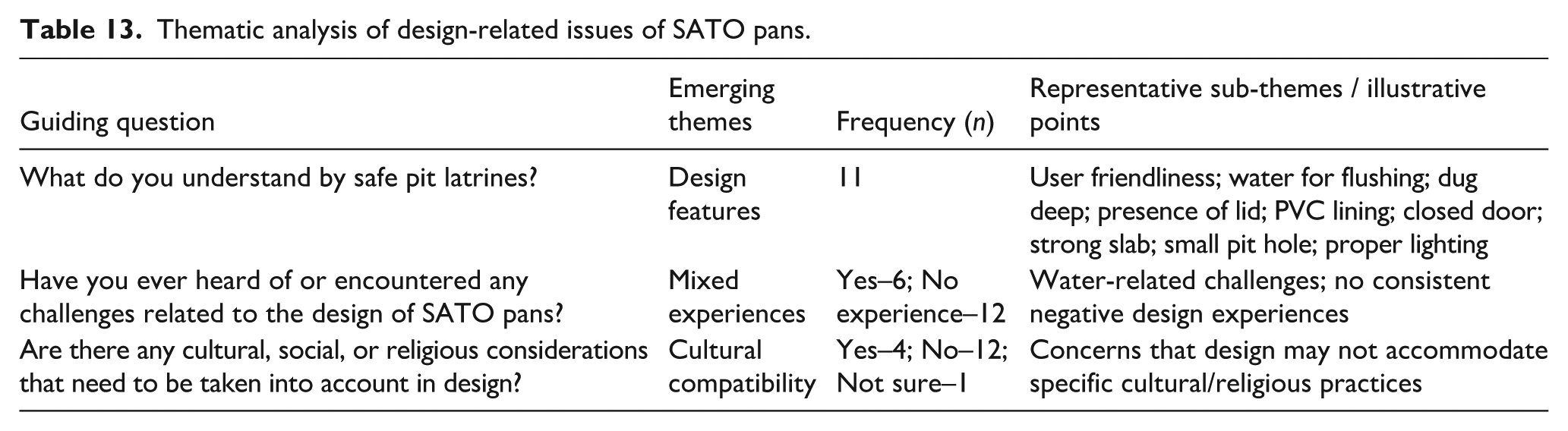
Importantly, there was high non-exposure to SATO pans among the respondents (n=12), limiting their ability to comment confidently on the design aspects. The limited experience may be attributed to the relatively low number of KII participants who had directly interacted with SATO pans. Although SATO pans are designed to be user-friendly and emphasise comfort, 8 earlier research has attributed their low uptake in some regions to design incompatibilities with socio-cultural norms. 8 In contrast, the current study did not generate sufficient evidence to support design-related barriers. This absence of evidence is likely explained by the limited exposure of KIIs to SATO pans in the study areas, which curtailed their abilities to provide first-hand assessments of design features. Furthermore, no respondents reported negative user experiences specifically attributable to design.
Comparison of the impacts of water supply reliability in Kisumu and Kitui counties
Comparatively, the current study findings suggest substantial differences in the influence of water supply reliability in the two Counties. Kisumu County had a more consistent water supply than Kitui County, but the uptake of SATO pans was lower in Kisumu County. From the quantitative analysis (Table 8), there is a negative relationship between water reliability and SATO pan uptake, with an odds ratio of 0.468. Such odds ratio suggests that residents in areas with a consistent water supply were 53% less likely to use SATO pans than those in areas with inconsistent water. Kitui County residents, who experienced relatively low water supply reliability, were 33.5% more likely to be aware of SATO pans than Kisumu County residents (Tables 8 and 9). This finding was reinforced by thematic analysis of KIIs, which revealed that Kitui County residents were more aware of the benefits of SATO pans than those in Kisumu County, particularly the benefits regarding water savings. In contrast, Kisumu County respondents, while aware of SATO pans through social media and training, frequently favoured flush toilets due to reliable water supply.
Further, purchase, installation, maintenance and other associated costs influenced uptake discrepancies. Income distribution statistics (Table 5) revealed that 48.7% of Kitui County residents and 42.4% of Kisumu County residents earned less than Kshs. 20,000, limiting their ability to finance better sanitation services. However, Kitui County respondents prioritised water-efficient sanitation options out of necessity, but Kisumu County respondents preferred conventional flush toilets due to their reliable water supplies. Concisely, the study reveals that water supply reliability has a relationship with tendencies to embrace SATO pans. Respondents in Kitui County, where water supply is scarce have embraced the SATO pan as a necessity. This was different with respondents in Kisumu County where there was reliable water supply and availability of various alternative sanitation options. This situation highlights the need for customised sanitation solutions in relation to available water supply infrastructure and the preference of communities to increase the uptake of their available sanitation solutions.
Conclusion and recommendation
Conclusion
This study examined the role of water supply reliability in influencing the uptake of SATO pans in Kenya, with a particular focus in Kisumu and Kitui Counties. Using both quantitative and qualitative data analysis, three key findings emerged from the study. First, awareness of SATO pans was a significant factor influencing their uptake. The logistic regression analysis suggested that the residents of Kitui County were 33.5% more likely to be aware of SATO pans than the residents of Kisumu County. This pattern was reinforced by a thematic analysis that highlighted limited structured sensitisation and training in either Counties, but stronger awareness in Kitui County than in Kisumu County.
Second, the reliability of water was negatively related with the uptake of SATO pans. The regression coefficient for water supply reliability at β = −0.760 (or odds ratio = 0.468) suggested that participants with reliable water supply were less likely to adopt SATO pans (at 53%) than those with unreliable water supply. In Kisumu County, where residents reported relatively more reliable water supply, the respondents preferred alternative sanitation options such as flush toilets, while in Kitui County, with unreliable water supply, respondents preferred SATO pans due to their water-efficient designs.
Third, design and cost aspects were not dominant determinants of the SATO pan uptake. Although the respondents, mostly in Kitui County considered purchase, installation and maintenance costs as burdensome, such perceptions did not emerge as statistically significant predictors in the quantitative regression model. Moreover, the design issues were less mentioned in thematic analysis results since majority of the respondents had limited direct interactions with the SATO pans.
Concisely, the study concludes that the uptake of SATO pans is largely shaped by the water supply reliability and awareness or sensitisation of the benefits of the SATO pans. Local water supply dynamics and awareness gaps are therefore the primary considerations in promoting the uptake of SATO pans in Kenya.
Recommendation
The current study findings underscore the significance of strengthening awareness and sensitisation efforts around SATO pans. In both Kitui and Kisumu Counties, the awareness gaps emerged as key barriers, though the challenge is more pronounced in Kisumu County where reliable water supply has led many residents to prioritise non-water saving flush toilets as opposed to the alternative water-saving SATO pans. Prioritising targeted awareness campaigns, through community demonstrations, social and mainstream media campaigns will ensure that households are more informed of the hygienic and water-saving benefits of SATO pans. Such awareness strategies must therefore highlight the water saving features of the SATO pans, and their suitability for residents with unreliable water supply. This can be achieved through strengthened partnerships with county governments and NGOs to upscale awareness creation and sensitisation.
Although cost did not emerge as a statistically significant factor in the uptake of SATO pans, the qualitative results suggested that it is a perceived barrier in either of the Counties. Consequently, affordability of the SATO pans should not be overlooked in attempts to promote their uptake. Considering subsidies and financing options can significantly ease the burden of purchase and related installation and maintenance costs, especially among the low-income households. With a reported prohibitive cost of purchase and installation, it may be important to build the local capacity for installation and maintenance. Training programs targeting plumbers, local artisans and youth, by government agencies such as the Kenya Water Institute, can lower the installation barriers, and increase livelihood opportunities.
Moreover, there is need to contextualise sanitation policies within the local water supply realities. For instance, in a county such as Kisumu, where water supply is reliable, SATO pans may not be needed to replace flush toilets, but could serve as complementary water-saving sanitation options, especially in peri-urban areas with poor sanitation coverage. Aligning county and national sanitation policies with the local dynamics can promote more sustainable and flexible adoption of water-efficient sanitation technologies.
Limitations and future research
Although this study provides invaluable insights, it has perceived methodological limitations that should be acknowledged. First, it was conducted in only two counties; Kisumu and Kitui Counties, whose environmental and socio-economic contexts may not entirely reflect those of other counties in Kenya. Such a limited geographical scope may constrain the generalisability of the findings. Moreover, while the sample size for the study was statistically adequate, it may not have been representative of all the demographic groups, especially persons with disabilities, the elderly, and the marginalised groups. This limitation prevented the study from examining socio-cultural factors influencing the uptake of SATO pans.
Future research can address these limitations by expanding to a broader geographical coverage, including diverse demographic groups, and employing longitudinal study designs to capture changes in uptake over time. Moreover, investigations could also explore the roles of cultural beliefs, government policies, and institutional factors in shaping sanitation choices. Examining cost-benefit dynamics of SATO pans compared with other sanitation options, as well as the effectiveness of training and sensitisation initiatives, would also provide important insights.
Footnotes
Appendix
Thematic analysis results.

| Question | Emerging theme | Frequency | Emerging sub-theme |
|---|---|---|---|
| What do you understand by the safe pit latrines? | Hygienic | 8 | No flies, Odorless, Contamination |
| Accidents | 6 | Children safety No snakes |
|
| Design | 11 | User friendliness Water for flushing Dug deep Lid Presence of PVC Closed door Strong slab Small pit hole Proper lighting |
|
| Water efficiency | 6 | Use less water Water to clean and wash hands |
|
| Cost | 1 | Affordable | |
| Which are the most common types of toilets used in the community? | Pit latrines | 16 | Conventional toilet |
| Flush toilets | 1 | ||
| Can you classify the majority of the toilets in your community as safe or unsafe? | Latrine Safety | 17 | Safe |
| Privacy | 2 | No doors |
|
| Have you attended a training/ sensitisation about safe pit latrines? If yes, how frequent were the trainings? | Training/Sensitisation | 2 trained/sensitised |
|
| Have you heard of any benefits of safe pit latrines? If yes, please elaborate. | Awareness | 11 Yes | |
| Can you identify any potential barriers that might hinder the widespread uptake of safe pit latrines? | Finances | 5 | Financial problems, |
| Awareness/training | 10 | Lack of awareness |
|
| Water Availability | 8 | Lack of water | |
| What roles do you think NGOs, government agencies or other organisations play in supporting the uptake of safe pit latrines? | Funding | 10 | Funding |
| Training, sensitisation | 12 | Put up demos in markets |
|
| None | 2 | ||
| Monitoring | 1 | ||
| Have you ever heard of or encountered any challenges related to the design of safe pit latrines? | Challenges | Yes- 4 |
Water challenge |
| How does SATO affect the privacy and dignity of the user? | Proper use and etiquette | 11 |
If water is not available, |
| Does the design pose a challenge to, gender, age and disability? | YES–5 |
||
| Are there any cultural, social and religious considerations that need to be taken into account when designing safe pit latrines? | YES- 4 |
||
| Are you aware of operation and maintenance practices for the use of safe toilets? | Yes–7 |
||
| Are there trained personnel on the installation and maintenance of safe pit latrines in the community? | YES–8 |
||
| Are there reliable water sources in the community? | Yes–10 |
||
| What are some of the challenges/ risks that you face while using your pit latrine/ toilet? | Hygiene | Flies |
|
| Accidents | Loss of valuable items |
||
| Design | Squatting posture | ||
| Water Efficiency | Lack of water | ||
| Cost | Expensive exhausting | ||
| Structure | Sinking toilet |
Acknowledgements
The authors of this research would like to gratefully appreciate the Kenya Water Institute’s management team, led by the CEO, Dr. Leiro Letangule, the staff and the students for their support during this study. The authors also acknowledge the role of the African Development Bank (AfDB) in funding this study, and the collaborative role of the Ministry of Water, Sanitation and Irrigation, being the parent ministry.

Author contributions
Justus W. Owino conceptualised the study, led the research design, and oversaw overall coordination. Beatrice C. Langat contributed to methodology development and data analysis. Paul Rarieya and William Oduor supported field data collection and logistics. Eric Omondi and Sheldon Yegon participated in data analysis and interpretation. Ann Wambugu and Simon Ndeweni led the literature review and drafting of the initial manuscript. Nanetia Virginia and Ian Kimutai provided technical input and revisions. Lilian Mutangili and Stephen Titomet supported community engagement and stakeholder consultations. Felix Muthama and Erastus Maitai contributed to final editing, quality assurance, and manuscript formatting. All authors reviewed and approved the final version of the manuscript.
Funding
The authors disclosed receipt of the following financial support for the research, authorship, and/or publication of this article: This study was funded by the African Development Bank (AfDB) under the Kenya Water Institute (KEWI) research support program. The funders had no role in the design, data collection, analysis, interpretation, or writing of the manuscript.
Declaration of conflicting interests
The authors declared no potential conflicts of interest with respect to the research, authorship, and/or publication of this article.