



Abstract
Background:
The study investigated health professionals’ understanding and risk perception of climate change in the Sunyani Municipality by focusing on health professional’s knowledge on climate change, examining health professional’s risk perception of climate change on health and identifying the co-benefits of climate change mitigation.
Methods:
This quantitative oriented cross-sectional study randomly selected 400 health professionals across the Regional Hospital, SDA Hospital and Municipal Hospital as respondents. Quantitative data was analyzed using SPSS Version 25.
Results:
From the study, the results indicate that Health professionals are fully aware of the concept of climate change. Health professionals do not have knowledge pertaining to the scientific aspects of climate change. There was a statistical relationship between respondent’s perception that climate change can lead to death (p < 0.001) and their awareness of the risk of climate change impact on health. There was a general likelihood of an increase in malaria (Mean = 2.98), Dengue fever (Mean = 3.16), Cholera (Mean = 3.18), schistosomiasis (Mean = 3.27), Meningococcal meningitis (Mean = 3.85) and Influenza (Mean = 3.73) due to climate change. These actions positively affect health and climate and they include: Giving up red meat (Mean = 3.21), Walking and cycling instead of using cars (Mean = 3.27), Reducing rural-urban migration (Mean = 3.46), Reducing air pollution from emission of fossil fuel (Mean = 3.63). A majority of 65% of respondents agreed to the incorporation of climate change related course work into nursing/medical school curricula as a policy to mitigate climate change.
Conclusions:
The study concludes that health professionals are fully aware about climate change but lack a thorough understanding of the scientific aspects of climate change. The general risk perception of health professionals towards climate change impact on health was high. Climate change mitigation is beneficial to human populations.
Introduction
Global warming is unambiguously apparent, as objective scientific observations are evidenced by surging sea levels globally, the continuous melting of snow, increment in ocean temperatures and the average warming of global air. 1
Lately, climate change has garnered enormous attention in the global environmental discourse. This huge premium attached to climate change as a result of its devastating impact it visits on the living conditions of human populations. The concept of climate change is at the heart of developmental discussions globally. Apparently, low income countries especially countries in African Sub-region have shown great concern about climate change due to their vulnerability to the negative repercussions associated with climate change considering their economic situations. 2
Literature have effectively shown the negative impact climate and its attendant weather pose on the key determinants of human health such as water for drinking, food for energy and air to sustain life on earth.3 Undoubtedly, climate change and weather precipitate the transmission chain of infectious diseases among populations, drive storms and trigger heat waves which also pose an existential threat to human lives. 4 The continuous emission greenhouse gases and carbon dioxide due to agricultural and industrial activities makes climate change a dangerous phenomenon that can alter the health of the human race. 5
Climate change continues to visit mayhem on the human race with its protracted flooding, horrendous droughts, scary heat waves, rising ocean levels, distorted rainfall patterns and abnormal temperatures. Sadly, human beings are the most affected by either directly or indirectly as flooding, altered air quality, food shortage and poor nutrition due to drought, rising ocean levels, excessive temperatures, etc. all can lead to suffering, disabilities and death in most circumstances. 6
Evidence from literature has shown that developing and developed countries alike are not spared by the devastating impact of climate change as the severe forms of drought have occurred in Africa and South Asia, monstrous tidal surges and devastating cyclones have occurred in Europe and the United States (e.g. Hurricane Katrina). However, a thorough comparative analysis between developed and developing countries reveal that the developing world are highly predisposed and more vulnerable to the adverse effects of climate variability and face more threats to the health of their people especially when such countries do not have the financial muscle to deal with the health risks posed by climate change. 7
It is worth mentioning that in most developing economies, the smallest increment in global warming greatly affect agricultural production since crops are sensitive to extreme temperatures, this situation affects the economies of such agrarian developing economies. The corresponding health impact of malnutrition, dengue fever, malaria, diarrheal diseases continue to kill millions in such developing countries especially sub-Saharan Africa. 8 The preceding revelations were further highlighted in the UCL Lancet Commission report, which opined that the most severe form of disability adjusted life years (DALYs) of 34% occasioned by climate change is projected to affect sub-Saharan Africa. It is worthy of note that Since sub-Saharan Africa only represents 11% of the global population, this situation reflects a looming health threat due to the adverse repercussions of climate variability which threatens the collective survival of sub-Saharan Africans. 9
This therefore necessitated the investigation of health professionals’ understanding of the effects of climate change on health in the Sunyani Municipality of Ghana by focusing on health professional’s knowledge on climate change, examining health professional’s risk perception of climate change on health and identifying the co-benefits of climate change mitigation.
Methods
Study design
A descriptive cross-sectional design was adopted for this study. The study employed descriptive design in order to get a clear picture of health professional understanding and risk perception of the effects of climate change on health. Thus, data was collected from the targeted health professionals over a short period of time (from March to May 2022).
Study population
The targeted population for the study was health professionals (specifically Doctors & Nurses) who were working in the Sunyani municipality. The three health facilities selected were SDA hospital, Regional hospital and Municipal hospital. The study employed SDA hospital, regional hospital and Municipal hospital because they are the biggest health facilities within the Sunyani Municipality. Hence, researchers randomly selected doctors and nurses across the three health facilities.
Sample size
The sample size was calculated using a 95% confidence interval, at a 5% margin of error.
Yamane, Taro (1967) formula for calculating sample size, was used to compute the sample size.
n =

The sample size was rounded up to 400.
Data collection
The study relied solely on primary data that was collected using a structured questionnaire. The questions encompassed both open-ended and close ended questions. Data collection techniques employed included one on one interviews using the structured questionnaire. Quantitative data was thus obtained from respondents using questionnaires. The questionnaire is an adapted instrument from Lorraine Whitmarsh (2003–Unpublished) on a study on environmental concerns retrieved from https://doc.ukbataservice.ac.uk/doc/5345/mrdoc/pdf/5345userguide.pdf. The data collection was done using English language throughout the entire data collection process.
Data analysis
Data were cleaned to ensure validity before data entries were made into SPSS (statistical package for the social sciences) version 25 for rigorous statistical analysis. Data was presented using frequency as tables and charts as presented under the results section. Correlative statistics using Pearson chi-square test and binary logistic regression was used to show strengths of association between independent and dependent variables where appropriate.
Ethical considerations
Since the study involved the use of human subjects, ethical approval was sought from Ghana Health Service Ethical Review Committee who rigorously scrutinized the protocols before finally granting an ethical backing to the study with clearance number GHS-ERC 097/02/22. Informed permission was further sought from the Municipal Director of Health Services as well as management of the three selected health facilities used for the study. Permission was also sought from the staff before the study commenced. The purpose of the study and its attendant possible risk and benefits were thoroughly explained to research participants and they were further assured of utmost confidentiality of the information they provided and the fact that it would only be used solely for the purpose of the study. Hence, formal written consent was obtained from participants prior to data collection.
Results
From the Table 1 above, it shows that, a little above half of health professionals (50.5%) were females, 29.5% were between the ages of 35–44. On ranking, majority (92.5%) were nurses and 7.5% were doctors. 72% of respondents were Christians. Majority of the respondents (99%) studied in Ghana and 1% studied outside Ghana.
Background attributes of respondents (N = 400).

Source: Field work, 2022. Significant at p<0.05.
On health professional’s knowledge on climate change (Table 2), all respondents (100%) were aware of the concept of climate change. Majority of the respondents (87%) agreed that human activity is responsible for climate change, 75% noted natural variability as responsible for climate change. With respect to the extent of human and natural activity on climate change, more than half (65%) indicated both human and natural activity on climate change. As to whether climate change awareness campaigns are carried out within Sunyani Municipality, 39% agreed. More than half (70%) emphasized both developed and developing country as vulnerable to the effects of climate change.
Knowledge on climate change (N = 400).

Source: Field work, 2022.
Figure 1 shows respondents’ sources of information on climate change; 19% of the respondents get information on climate change from the social media, 17% from the radio, 16% from television stations, 15% from weather forecast, 14% from the internet, 12% from newspapers and 9% from friends and family.

Source of information on climate change.
Figure 2 displays the effects of climate change, 36% stated rising temperature, sea level rise, melting glaciers and drought as the possible effects of climate change, 20% indicated raising temperature, 16% noted rising temperature and flooding, 10% indicated rising temperature, melting glaciers, flooding and drought.

Effects of climate change.
A bivariate analysis was conducted to ascertain the association between the outcome variable (awareness of the risk of climate change) and various independent variables (background attributes). The results indicate that, gender (p = 0.074), age (p = 0.443), religious affiliation (p = 0.070) and country of study (p = 0.331) had no statistical association with respondent’s awareness of the risk of climate change. On the other hand, respondents rank in health service (p < 0.05) had a statistical relationship with their awareness of the risk of climate change (Table 3).
Relationship between background attributes of respondents and awareness of the risk of climate change..

Source: Field work, 2022. Significant at p<0.05.
The Table 4 above represents health professionals risk perception on climate change. 89% agreed that climate change can lead to death. Out of those who indicated climate change can lead to death, 79% agreed that climate change is happening worldwide. Majority of the respondents (93%) indicated climate change affects human health while 90% agreed that climate change increases health care cost. 90% of respondents indicated there can be health benefits if climate change is dealt with.
Risk perception on climate change (N = 400).

Source: Field work, 2022.
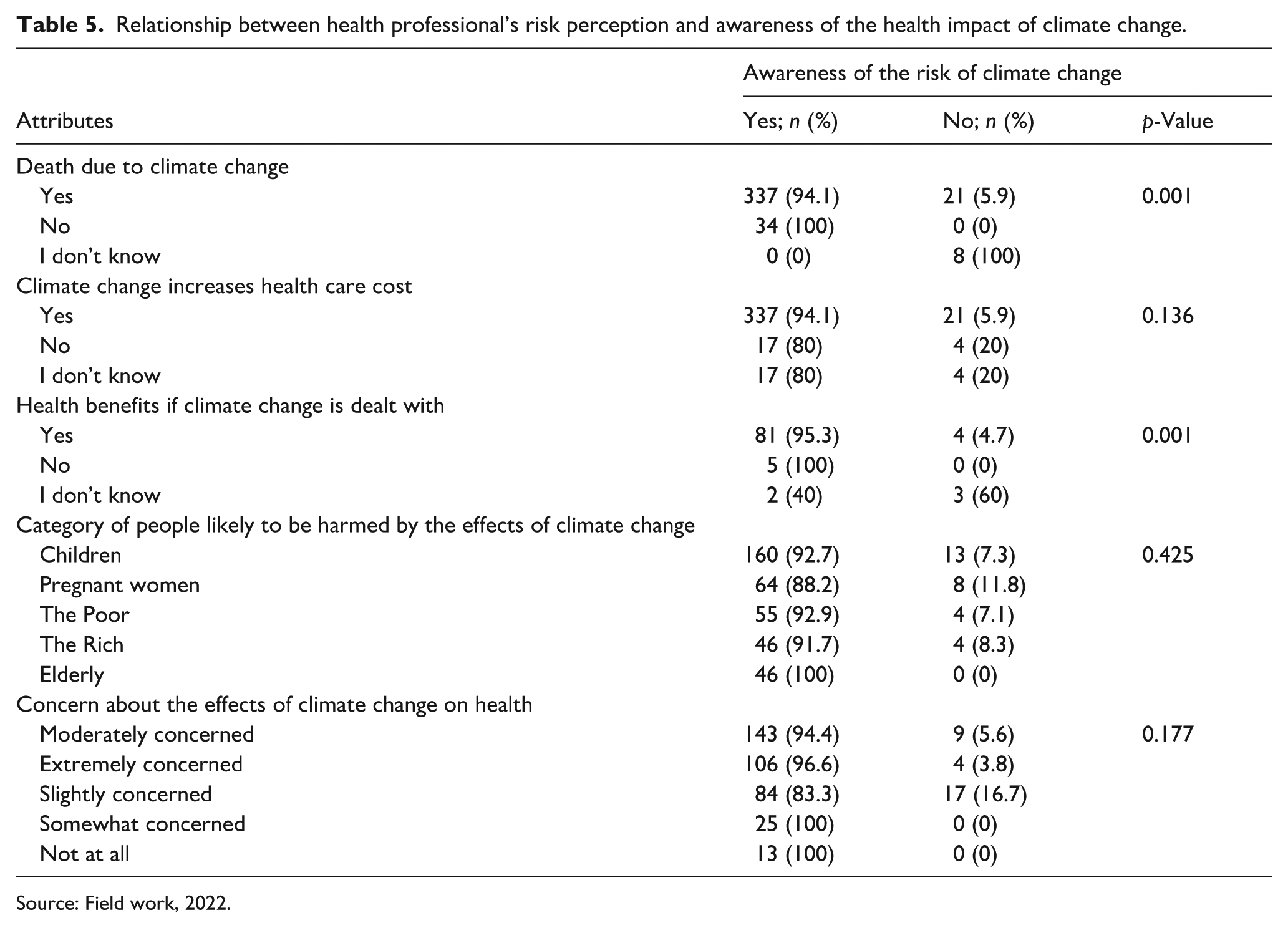
From Table 5 above, results indicated a statistical relationship between respondent’s perception that climate change can lead to death (p < 0.001) and their awareness of climate change. There was also an association between health benefits if climate change is dealt with (p < 0.001) and awareness of the risk of climate change.
Relationship between health professional’s risk perception and awareness of the health impact of climate change.
Source: Field work, 2022.
Table 6 above represents the extent of climate change increasing the likelihood of these diseases. It can be observed that all six diseases associated with climate change have a mean score greater than 2.5. It can therefore be concluded that there was a general likelihood of an increase in the above diseases due to climate change as indicated by respondents.
Diseases associated with climate change.

Source: Field work, 2022.
Figure 3 displays the problems associated with climate change 18% stated drought as the problem associated with climate change, 15% stated the cancers, 14% noted malaria, 13% skin conditions, another 13% indicated respiratory conditions, 12% stated eye infections and 10% stated flooding.

Problems associated with climate change.
Table 7 above shows how health professionals view climate change impact on nutrition, floods, drought, mental health and heatwaves. The mean score of 2.50 and above indicates a general likelihood of the statement, and a mean score below 2.50 indicates a general unlikelihood of the statement. All five factors have a mean score more than 2.50, and hence there is a general likelihood of nutrition being impacted by climate change as indicated by respondents.
Risk of climate change.

Source: Field work, 2022.
From Table 8, the findings indicate that all actions towards climate change mitigation have a mean score greater than 2.50. Therefore, it can be concluded that there is a greater likelihood of mitigating climate change through these actions, as indicated by the respondents.
Actions towards climate change mitigation.

Source: Field work, 2022.
From Table 9, certain factors were identified to be beneficial towards climate change mitigation efforts. The mean score of 2.50 and above indicates a general likelihood of the statement, and a mean score below 2.50 indicates a general unlikelihood of the statement. It can be observed that all actions that positively affect health and climate have a mean score greater than 2.50.
Co-benefits of climate change mitigation.

Source: Field work, 2022.
From Table 10 above, the majority of the respondents agreed to the above highlighted environmentally sustainable and energy practices at all health facilities as one of the driving policies to mitigate the impact of climate change.
Policy and practice for climate change (N = 400).

Source: Field work, 2022.
Discussion
Since climate change poses an existential threat to humans, public knowledge and awareness are key ingredients that will aid in addressing the canker. Sound knowledge of climate change is believed to be a viable antidote necessary to address the problem because knowledge shapes people’s behaviour to put up attitudes which will inure to the benefit of the environment and thus eschew attitudes which contribute to global warming.10,11
From this current study, all respondents were fully aware about the concept of climate change. This corroborates the revelation by Ejembi and Alfa 12 in a study conducted on the general perceptions of people towards the concept of climate change in Africa, where authors observed strict evidence of a general awareness of the concept of climate change across the various African communities they studied.
With respect to the extent of human and natural activity on climate change, more than half of the respondents indicated that both human and natural activity are responsible for climate change, this finding affirms the observations made by Ebi et al. 1 who opined that the changes in global climate occasioned by both internal changes within the climate ecosystem and external variabilities including both human-induced and naturally induced factors have evidently shown that weather and climate are always. Majority of the respondents agreed that human activity is responsible for climate change, this affirms the evidence given by Prentice et al. 13 that humans are changing earth’s climate causing the atmosphere and oceans to be warmed.
Moreover, the majority of respondents emphasized that both developed and developing countries are equally vulnerable to the effects of climate change, this finding corroborates the observations made by Dubey et al. 14 who opined that history records widespread disasters, famines and disease outbreaks triggered by droughts and floods which are exerting worst effects in poor countries but even the richest industrial societies are not immune. This finding however reveals that, the effects of climate change is no respecter of country, irrespective of whether that country is economically advanced or not.15 Hence, the phenomenon of climate change should be given equal attention by all countries across the globe.
On the effects of climate change, less than half of respondents believed rising temperature, sea level rise, melting glaciers and drought are some of the effects of climate change. This finding corroborates the observation made by Werndl 16 who opined that, the atmosphere and oceans have warmed, accompanied by sea-level rise, a strong decline in Arctic sea ice, and other climate-related changes. The remaining minority indicated rising temperature, melting glaciers, flooding and drought as the effects of climate change and this finding from this study affirms the position of Morgan et al. 17 who observed that while drought which is a natural phenomenon caused by changes in weather patterns due to reduced or less rainfall than usual reduces the water available for washing and sanitation and also tends to increase the risk of disease.
The mental and social picture towards climate change is largely influenced by the perception of individuals. However, it is important to add that catalysts such as ideological orientations of individuals, socio-economic and socio-demographic characteristics of individuals all influence the perception and the mental picture individuals carve about climate change. 18 Many definitions have been given to explain risk but in all of it, the underlying factor is that, there is the likelihood of an individual experiencing the effect of danger. 11 It also defined as the probability of an adverse effect and the magnitude of its consequence. All risk concepts have one element in common; a distinction between reality and possibility. 11
From this current study, the results indicate that, gender, age, religious affiliation and country of study had no statistical association with respondent’s awareness of the risk of climate change. This however means that, the gender, age, religious affiliation and country of study of health professionals has nothing to do with their perception of risk on climate change. On the other hand, respondents rank in health service had a statistical relationship with their awareness of the risk of climate change.
Also, the findings from this study further indicates that, a majority of health professionals had the perception of risk that climate change can lead to death. This finding affirms the position of Morgan et al. 17 who opined that, in 1998 the severe flooding that hit West Bengal was accompanied by cholera outbreak which triggered 16,590 cases of the diarrheal disease and further led to 276 deaths with a 1.7% case fatality rate. There was a statistical relationship between respondent’s perception that climate change can lead to death and their awareness on the health impact of climate change. Illustrating that perception of death as a result of climate change makes health professionals aware of the negative health impacts posed by climate change.19
This finding corroborates the observation made by Ramanathan et al.20,21 where they stated that, climate change has a higher propensity to affect human health through indirect routes especially through ecological and biological processes which drives communicable disease transmission.
Another majority of respondents had the perception that climate change increases health care cost. This is an indication of the fact that health professionals had the perception that climate change has the potentiality of increasing health care cost.22 This finding affirms the position of UNECE 23 where they observed that, in the WHO Europe region, there is a burden of climate change, including premature deaths and morbidity and is estimated to be equivalent to around $1.6 trillion in 2010 represents 10% or more of GDP in almost half of the countries covered.
It was further observed that a greater majority of respondents had the perception that there can be health benefits if climate change is dealt with. Less than half of the respondents had the perception that children are the category of people likely to be harmed by the effects of climate change, followed by pregnant women, with the least indicating the elderly. Majority of the respondents had varying degrees of concern about the effects of climate change on the health of people with the insignificant few not concerned at all.
It was further observed that there is a general likelihood of nutrition, floods, drought, mental health and heat waves being increased by climate change. These findings simply mean that, climate change has a high probability to increase nutritional challenges (disorders), increase floods, increase droughts, increase mental health challenges (disorders) as well as increase heat waves as indicated by respondents who are health professionals in the study. These findings are in tandem with similar observations made by other researchers.24,14
The immense benefits of climate change mitigation cannot be overemphasized as it is the lead pathway towards the newly envisioned renewable energy world. 23 There are many activities that are capable of reducing Green House Gas (GHG) emissions and its benefits goes beyond contributing to climate change mitigation alone. From the UNECE report in 2016, it was stated that, the drastic reduction of the emissions of fossil fuels through pollution of the air are the most visible co-benefit of climate change mitigation and wields a positive health and environmental benefits to people. Furthermore, areas like heightened sustainability of ecosystems, efficiency use of natural resources and economic security are the other benefits climate change mitigation can bring to human populations.25
From this current study, in order to ascertain the potency of some actions towards climate change mitigation, it was observed that all actions towards climate change mitigation were capable of ameliorating the menace. These actions included: Buying and use energy light bulbs and appliances, Using less air conditioning during dry season, Purchasing and using solar panels, Carpooling at least a couple of days per week, Using public transport even if you own a vehicle, Walking and cycling instead of using fuel-based cars always. These findings agree with earlier observations found in literature. 23
On the potency of some factors that impact positively on health and climate, the study reveals that all these actions positively affect health and climate. Such actions included: Giving up red meat, Walking and cycling instead of using cars, Reducing rural-urban migration, Reducing air pollution from emission of fossil fuel. This finding affirms the position of UNECE where its report inn 2016 stated that, the drastic reduction in fossil fuel emission through pollution of the air and the accompanying environmental benefits are the most visible co-benefit of climate change mitigation. It can therefore be concluded that, the likelihood of these actions impacting positively on climate change and health is very high as revealed by the study. 23
Conclusions
Health professionals are fully aware about climate change but lack a thorough understanding of the scientific aspects of climate change. The general risk perception of health professionals towards climate change impact on health was high. Climate change mitigation is beneficial to human populations. It is therefore recommended that the Ministry of Health and the Ghana Health Service should intensify climate change awareness campaigns across the length and breadth of the country in order to create more awareness about the dangers posed by the canker as well as highlight the actions capable of mitigating the impact of climate change.
Supplemental Material
sj-docx-1-phj-10.1177_22799036251388592 – Supplemental material for Investigating health professionals’ understanding and risk perception of the effect of climate change on health. A cross-sectional study at three hospitals in Sunyani, Ghana
Supplemental material, sj-docx-1-phj-10.1177_22799036251388592 for Investigating health professionals’ understanding and risk perception of the effect of climate change on health. A cross-sectional study at three hospitals in Sunyani, Ghana by Antwi Joseph Barimah, Mansurat Abdul-Ganiyu, James Dumba, Rebecca Dorcas Commey, Angelo Guapem Osei-Tutu, Yaw Boakye Nketiah, Bernard Opoku Amoah, Larry Agyemang, Owusu Kwadwo and Grace Osei Yeboah in Journal of Public Health Research
Footnotes
Acknowledgements
We express our heartfelt gratitude to the health professionals specifically doctors and nurses at the Regional Hospital, SDA Hospital and Sunyani Municipal Hospital for their willingness to partake in the study.

Author contributions
AJB and MAG conceptualized the overall study with its goals and aims. BOA retrieved the requisite data from databases. RDC and AGOT played a supportive role in data consolidation. LA wrote the study background and played a supportive role in data analysis. OK played a role in designing the methodology. YBN played a vital role in designing the methodology for the study. JD and GOY played a role in writing discussion of the study. LA and OK supported in the writing, review and editing of the of the manuscript. BOA, RDC and LA did the data analysis for the study.
All authors contributed significantly to the critical revision and approved the final version before the onward submission.
Funding
The authors received no financial support for the research, authorship and/or publication of this article.
Declaration of conflicting interests
The authors declared no potential conflicts of interest with respect to the research, authorship and/or publication of this article.
Data availability statement
Data included in article/Supplemental Material/referenced in article.
Supplemental material
Supplemental Material for this article is available online.
References
Supplementary Material
Please find the following supplemental material available below.
For Open Access articles published under a Creative Commons License, all supplemental material carries the same license as the article it is associated with.
For non-Open Access articles published, all supplemental material carries a non-exclusive license, and permission requests for re-use of supplemental material or any part of supplemental material shall be sent directly to the copyright owner as specified in the copyright notice associated with the article.
