



Abstract
Objective:
The study investigates the mediating role of job crafting on the relationship between workplace social support and employee mental health.
Method:
The research utilized a survey method to obtain data from respondents in selected government departments operating within the Eastern Cape Province of South Africa. A total of 289 usable responses were obtained for analysis with the ordinary least squares regression-based path analysis being conducted using the Hayes Process Macro to quantify the direct effects of the hypothesized relationships.
Results:
The direct relationships show support for the relationships between (a) workplace social support and job crafting and (b) workplace social support and employee mental health. In terms of the mediation results, job crafting was observed to partially mediate the association between workplace social support and employee mental health.
Conclusions:
The study establishes that job crafting is the preeminent antecedent of employee mental health compared to workplace social support. This suggests that employees who take proactive steps to modify their work environment tend to experience greater mental well-being. The findings call for an urgent need to promote organizations that not only encourage job crafting but supportive workplace behaviors in promoting mental health.
Introduction
Calls exist in the literature for need to prioritize research focused on the health of employees especially their mental health. Needed to be in place are measures that assist in supporting health experiences within the confines of the workplace.1,2 One such important way this can happen is through encouraging aspects related to job crafting. This refers to the physical and cognitive fluctuations employees make in the role or social boundaries of their work. 1 Furthermore, job crafting is a behavior-specific act that varies between work team-mates that involves determining the task boundaries of a job (either physically or cognitively). 1 Some scholars Rastogi and Chaudhary 3 and Wrzesniewski and Dutton 4 have viewed job crafting, as an extension of job design which involves self-initiated change behaviors that workers participate in with the goal to align their jobs with their own preferences, purposes and desires.
Workplace social support has been studied from varying perspectives. For instance, Kossek et al. 5 looked at the influence of general and work–family-specific supervisor and organizational support. This was done in the form of a meta-analysis. On the other hand, Harris et al. 6 examined different the forms of workplace social support that could potentially act as antecedents of job satisfaction. In this case, Harris et al. 6 used multiple regression to measure the predicting power that work social support had on job satisfaction. Other researchers, Bowling et al. 7 tried to explain possible antecedents of workplace social support by investigating reciprocity or attractiveness. The present research is, however, concerned with testing the impact that job crafting has on employee mental health. Furthermore, this research also examines the relationship between job crafting and workplace social support. Last, the influence of workplace social support on employee mental health is also tested. The following section explores the motivation and research problem for the present study.
Motivation and research problem
It is apparent that social support in the workplace is a key factor in job satisfaction. Prior research by Mensah et al. 8 suggested that social support from the organization, supervisors and co-workers has proved to improve job satisfaction, especially at the internship level. In addition, some scholars then suggested that work-related social support determines employee performance and job leaving. 9 The processes and contents of employment relationships have been explored against health outcomes such as employee mental health, 10 but job crafting and workplace social support were not factored in. Numerous related studies have therefore not fully addressed how job crafting and workplace social support could act on employee mental.
None of the above-mentioned studies tested how job crafting directly influences three important factors affecting employees, namely, workplace social support and employee mental health. However, the research in question, explores a unique model that has not previously been measured in related studies. This therefore becomes an attempt to comprehend the extent to which job crafting impacts employee mental health at the same time examining its direct influence on workplace social support.
Theoretical stance
Organizational support theory (OST)
The OST was theory developed by. 11 In the OST, an employer is perceived as valuing and supporting employees through concern of their well-being while striving for the promotion of the organization’s values. 11 The OST is founded on the advancement, nature and outcomes of perceived organizational support (POS). 12 Furthermore, the OST posits that employees develop a perception of support as a reaction to their socio-emotional needs being met including also the harmony in the environment they work in. 11 The OST therefore becomes imperative for this study as is concerned with outcomes of workplace social support that could include employee mental health as argued in the context of this study. Figure 1 presents the proposed theoretical model.

Theoretical model.
Workplace social support and job crafting
Workplace social support refers to the extent to which work colleagues render support and assistance to each other in the place of work.1,2 Job crafting is built upon of three conceptually different elements, namely: increasing job resources, increasing challenging job demands and reducing hampering job demands. 13 These three elements are viewed as direct antecedents of workplace engagement. Potentially a conducive workplace environment encourages job crafting behaviors. 1 In turn such a workplace environment also affects the well-being of employees. 14 More specifically, Slemp et al. 14 argue that job crafting impacts the three sub-factors of workplace well-being, namely, workplace positive affect, workplace negative affect and job satisfaction. Other scholars, Bakker et al. 15 have suggested that workplace engagement which consists of vigor, dedication and absorption is driven by job crafting. Such ideals of work engagement stem from a supportive social support system in the workplace. Based on this, it is expected that:
Job crafting and employee mental health
Job crafting is a promising workplace strategy that employees can use to increase their work-related well-being. 16 According to Peral and Geldenhuys 17 an employee is said to be engaged in job crafting when there is change in the manner, they perform their job. Due to the lack of empirical research on job crafting activities at work until recently, there is at present no underlying motivational theory that explains how job crafting can affect work outcomes. 18 One possible answer to this gap lies in exploring the relationship between job crafting and employee mental health to address this gap.
Job crafting behavior can decrease burnout since burnout comes from psychological strain, and such burnout and strain negatively impact job satisfaction. 19 From a study within a different context such as Gautam and Gautam, 20 focusing on the banking industry, it is suggested that service climate and emotion regulation buffer the effects of stress on turnover intention, workplace social support which may similarly mediate the relationship between job crafting and employee health. Slemp and Vella-Brodrick 18 found out that job crafting predicts employee mental health. In their study, which aimed at determining the role of job crafting in the promotion of flow and well-being, Devotto et al. 21 found out that job crafting had a direct impact on positive mental health. Sakuraya et al. 22 are of the view that job crafting may decrease negative aspects of mental health, such as psychological distress, as well as improve positive aspects, such as work engagement. Based on the literature and empirical findings provided, the following hypothesis is formulated:
Workplace social support and employee mental health
Workplace social support is the degree to which individuals perceive that their well-being is valued by workplace sources, such as supervisors and the broader organization in which they are embedded and the perception that these sources provide help to support this well-being. 5 In short, workplace well-being refers to positive mental health in the workplace.23–25 Nahum-Shani et al. 26 posit that receiving emotional support is likely to adversely affect the health and well-being of an individual. Hsieh and Tsai 27 investigated how the role of workplace social support and gender affect the relationship between work stress and the mental health of military personnel in Taiwan. Their study’s findings revealed that social support from supervisors and colleagues is a crucial factor in buffering the effect of work-related stress on the performance of military personnel. 27 The findings of Gautam et al. 28 emphasize that peer support plays a pivotal role in enhancing training effectiveness, outperforming supervisory support in some contexts which aligns with the notion of the present study that workplace social support has a significant impact on employee health. For this reason, we propose that:
The mediation of job crafting on workplace social support and employee mental health
Job crafting can be hypothesized to have an influence not just on the experience but also the outcome of work for employees. Potentially, such experiences can affect issues related to employee well-being positively or negatively. 29 A conducive environment of support is needed to allow for this. 30 Efforts of workplace support can include provision of training to employees, potentially enhancing their contribution to the job. 31 Others posit the necessity to address workplace stressors that affect not just the outcome of work but also the experience of work. 20 This has also the potential to assist employees work better especially in high-pressure environments. 32 Drawing from social exchange theory, supportive workplace relationships provide essential resources that enable employees to manage workload and foster a climate of psychological safety, ultimately improving employee well-being. 33 Based on this the following hypothesis it is proposed that:
Methodological aspects
This study followed a quantitative methodology with a positivist approach to research, focusing on gathering empirical objective data through measurements to test whether the hypothesized model is probable. 34 Additionally, this study used the survey method associated with a correlational design since it enables the study to collect large amounts of data in an inexpensive and short time frame. 35 Lastly, this study used the cross-sectional design, where data will be collected at a singular point in time. 36
Research participants
This study made use of convenience non-probability sampling, where participants are chosen based on their availability and convenience. 36 In terms of the inclusion and exclusion criteria of research subjects, the researchers ensured that only participants under the employ of public service entities of the Eastern Cape Province of South Africa were allowed to participate. Reasonable considerations were made for obtaining quality data which include ensuring that the employees had to have at least worked for a full calendar month to provide any meaningful responses to the questionnaire. Additionally, only participants that provided full consent were made part of the study and those that did not provide consent were completely excluded from the study. The study focused on three public service entities in the Eastern Cape Province of South Africa. A total of 500 questionnaires were distributed amongst the entities, and a total of 289 questionnaires were returned and deemed usable for the analysis stage, yielding a response rate of 58%.
Measuring instruments
To estimate the primary variables of the research, the authors used instruments from previous studies. The fifteen-item Job Crafting Questionnaire (JCQ) 37 was used to measure task crafting, cognitive crafting and relational crafting. An example item reads, “I introduced new approaches to improve my work.” In a study done in South Africa by Makhubele et al., 38 they found that the JCQ had Cronbach alpha coefficients of 0.79, 0.82 and 0.73, respectively, which shows that the instrument is reliable. In addition, various studies have found the JCQ to be reliable and valid.39–42
Workplace social support was measured using a 12-item scale focusing on supervisor and co-worker support adapted from previous studies. 43 An example item reads: “I feel comfortable asking my co-workers for help if I have a problem.”
Employee mental health was measured using a 6-item scale on mental health (K6), the Kessler Psychological Distress Scale. 44 For the mental health scale, respondents were asked to indicate how they had felt during the past 30 days concerning (a) nervousness, (b) hopelessness, (c) restlessness or being fidgety, (d) depression, (e) everything requiring effort, and finally, (f) worthlessness. An example item reads: “During the past 30 days, I have often felt hopeless.” The scale was also found to be reliable.45,46 In addition, the K6 has been validated in several studies. 47 All scale items were measured on a five-point Likert scale. All scales met the required threshold on reliability and had a rating of 0.70 or more as required. 48
Research procedure and ethical consideration
The questionnaire was distributed to the participants to complete, and various ethical considerations were considered. Ethical approval was granted by the University of Fort Hare, and the ethical approval reference number is CHl151SHAR01. Participants were informed of the aim and objectives of the research prior to completing the questionnaire, and their informed consent was obtained. Additionally, ethical issues such as voluntary participation, benefits-risk analysis, anonymity, confidentiality and protecting the participants from any harm were upheld in the study. Also, participants were informed of how their information would be managed and stored and how the results would be made available.
Statistical analysis
The Statistical Package for the Social Sciences (SPSS) version 29 and AMOS version 29 were used for data analysis. A confirmatory factor analysis (CFA) was conducted using AMOS to confirm the validity of the measurement tools. On the other hand, Cronbach’s alpha coefficient and the Joreskog rho were used to establish reliability and composite reliability. The ordinary least squares regression-based path analysis using the Hayes process macro for SPSS 49 was utilized to quantify the direct effects of the hypothesized relationships. The mediation effect was examined using the significance of the indirect effect in the established model.
Research findings
Demographic characteristics
Table 1 shows the respondents to the study.
Demographic characteristics.

Based on Table 1, the respondents in this project consisted of 289 male and female employees. Table 1 also notes that most employees worked at the Department of Public Works and had more than 6 years of permanent experience. In terms of employment status, almost 70% of the participants were in permanent employment status.
Confirmatory factor analysis and reliability analysis
The research instrument was subjected to validity and reliability assessment prior to hypotheses testing. To achieve this, confirmatory factor analysis (CFA) and reliability analysis were conducted. Since the measurement scales for the research tool were adopted from established questionnaires, literature was used as a guide on the empirical factors for these measurement scales. Table 2 details the CFA results of the measure.
Confirmatory factor analysis and reliability output for the single factor measurement models.

alpha = the Cronbach’s alpha coefficients; AVE: the average variance extracted; CFA: confirmatory factor analysis; CR: composite reliability as measured by the Joreskog rho coefficient.
Table 3 details the model fit indices for the established measurement models.
Model fitness indices for the established measurement models.

CFI: the comparative fit index; CMIN/DF: discrepancy/chi-square divided by degree of freedom; RMSEA: the root mean square error of approximation; SRMR: the standardized root mean square residual; TLI: the tucker Lewis index.
For the CFA, AMOS was used, and some commonly used model fit indices and their criteria were adopted to examine the goodness-of-fit of the measurement models. These model fit indices include the chi-square value degrees of freedom ratio (CMIN/DF), the comparative fit index (CFI), the Tucker-Lewis index (TLI), the standardized root mean square residual (SRMR) and the root mean square error of approximation (RMSEA). Regarding reliability, Cronbach’s α coefficient was used, and values larger than 0.70 50 were considered satisfactory levels of internal consistency, and those around 0.6 51 were considered acceptable.
In addition to internal consistency, composite/construct reliability (CR) was also assessed using the Joreskog rho coefficient. 52 According to Hair et al., 53 a minimum value for CR should be 0.70 for the construct to be deemed reliable. Another component of interest was convergent validity which was assessed by using the average variance extracted (AVE), where AVE > 0.50 was considered a good and satisfactory level of convergent validity. 54 A minimum value of 0.50 for AVE is recommended, but some studies in the literature indicated that values < 0.50 are acceptable, provided the CR values are >0.60.54,55
Job crafting: Firstly, validity and reliability analysis was conducted on the 15-item job crafting scale. The factor loadings ranged from 0.697 to 0.966 (see Table 2), showing satisfactory and acceptable loadings. Due to the items loading on each established factor structure, Factor 1 (two-items) was named “Task crafting,” Factor 2 (four-items) was named “Cognitive crafting” and Factor 3 (two-items) was named “Relational crafting.” The value of the average variance extracted for these factors is greater than the required minimum of 0.50, thus the convergent validity for these factors is deemed adequate. The internal consistency of these factors is statistically acceptable since all the values are more than 0.70 for all the factors, with an overall Cronbach alpha of 0.739.
Assessing the composite reliability, the results show that the values of CR are also more than 0.70 for all the factors and the composite variable of job crafting. This shows that the reliability and composite reliability are adequate for the established measurement model for the job crafting measurement tool. Examining the fitness of the established measurement model (see Table 3), the fit indices indicate that the job crafting model had an acceptable fit for the data. Thus, CMIN/DF is 3.479, which is <5, and SRMR is 0.034, which is <0.05, are both regarded as acceptable and good fit, respectively. On the other hand, CFI is 0.977 whilst TLI is 0.962, which are all above 0.95 and considered a good fit for the model. The measurement model had an RMSEA of 0.093 with 90% CI (0.068–0.119), indicating an acceptable model fit for the job crafting measurement model.
Workplace social support: A CFA and reliability analysis were also conducted on the 12-item workplace social support scale. The most parsimonious model was achieved with six items loading on two factors with all loadings above 0.65 (see Table 2). Assessing the items for each factor, the established factors were named co-worker support (Factor 1) and supervisor support (Factor 2). The AVE for all the factors is greater than the required minimum of 0.50. Thus, the convergent validity for the established factors is deemed adequate. The internal consistency of these factors is statistically acceptable since all the values are more than 0.70 for all the established factors, with an overall Cronbach alpha of 0.875. In addition, the Joreskog rho for measuring composite reliability was more than 0.70 for all the factors, showing that the reliability and composite reliability are adequate for the established measurement model. Examining the fitness of the established measurement model (see Table 3), the fit indices indicate that the workplace social support measurement model had a reasonably good fit for the data. Thus, CMIN/DF is 1.679, which is <3, SRMR is 0.030, which is <0.05, whilst CFI is 0.996 and TLI is 0.992, which are >0.95, suggesting a good fit. The RMSEA is 0.049 with 90% CI (0.00–0.092), also indicating a good model fit for the workplace social support measurement model.
Employee mental health: The employee mental health validity and reliability analysis are also presented in Table 2. The CFA was conducted on the 6-item mental health measurement tool, and the most parsimonious model was achieved with 4 items. The factor loadings were all above 0.55 for the retained items. The average variance extracted was 0.433, indicating an acceptable level of convergent reliability, as a composite reliability (CR) of less than 0.50 can be accepted, provided the composite reliability exceeds 0.60. This aligns with the works of Lam, 56 Huang et al., 57 as well as Maruf et al., 58 who asserted that the average variance extracted (AVE) value should be at least 0.50 or above; however, an AVE value of more than 0.40 is acceptable if the composite reliability (CR) value is adequate. Thus, the convergent validity for factor 5 is also deemed adequate.
The internal consistency shows a Cronbach’s alpha coefficient of 0.750, which reveals a statistically acceptable level of reliability for the employee mental health tool. In Table 3, the model fit indices indicate that the mental health measurement model had a good fit for the data. Thus, CMIN/DF is 2.359, which is <3, and SRMR is 0.024, which is <0.05, which are both regarded as a good fit. Further, CFI is 0.989, and TLI is 0.968, which are all >0.95, indicating a good model fit for the established mental health measurement model. All the measurement models have fulfilled all the model fit requirements and thus are suitable for building linkage between factors measuring job crafting, workplace social support and employee mental health within the sampled population.
From the established measurement models a full measurement model was established and assessed. The maximum likelihood estimation procedure was used. The resultant full measurement model is shown in Figure 2.

Full measurement model. CMIN/DF = 2.710. CFI = 0.942. TLI = 0.930. SRMR = 0.066. RMSEA = 0.077 with 90% CI (0.067; 0.087).
Figure 2 shows high factor loadings, suggesting a good and satisfactory fit for the respective items and constructs. All items from the separate single-factor measurement models were retained in the full measurement model. Examining the overall assessment criteria for model fitness, the full measurement model showed generally an acceptable fit.
Table 4 reports on the mediation results.
Mediation analysis to determine the mediating effect of job crafting on the relationship between workplace social support and employee mental health.

JC: job crafting; M: mediator variable; MH: employee mental health; WSS: workplace social support; X: predictor/independent variable; Y2: outcome/dependent variable.
Number of bootstrap samples for percentile bootstrap confidence intervals: 10,000.
Significant effect at alpha = 0.05.
Summary of hypotheses testing
In terms of hypothesis 1 and informed by Table 4, the results revealed that workplace social support had a significant direct and positive effect on job crafting (β = 0.204, t = 2.979; p = < 0.001). The higher the levels of reported workplace social support is public service employee behaviors of job crafting.
In terms of hypothesis 2 and informed by Table 4, the results revealed that job crafting had a significant direct and positive effect on employee mental health (β = 0.103, t = 2.945; p = < 0.001). The higher the levels of reported job crafting are related to better levels of employee mental health.
In terms of hypothesis 3 and informed by Table 4, to establish whether workplace social support has a direct and positive relationship with employee mental health, the direct effect of workplace social support on employee mental health was examined. Thus, while controlling job crafting, workplace social support was reported to be a significant predictor of employee mental health (β = 0.492, t = 11.883, p = < 0.001).
In terms of hypothesis 4 and informed by Table 4, a 95% bias-corrected confidence interval based on 10,000 bootstrap samples indicated that the indirect effect (β = 0.024) was positive and statistically significant (95% CI (0.005–0.050)). Thus, employees reported greater employee mental health even after considering workplace social support’s indirect effect through job crafting.
The summarized findings in Figure 3 are consistent with partial mediation. Higher levels of workplace social support were associated with employee mental health scores that were approximately 0.024 points higher, as mediated by job crafting. In conclusion, job crafting mediates the relationship between workplace social support and employee mental health. This is a complementary partial mediation since the direct and indirect effects are both positive and statistically significant.
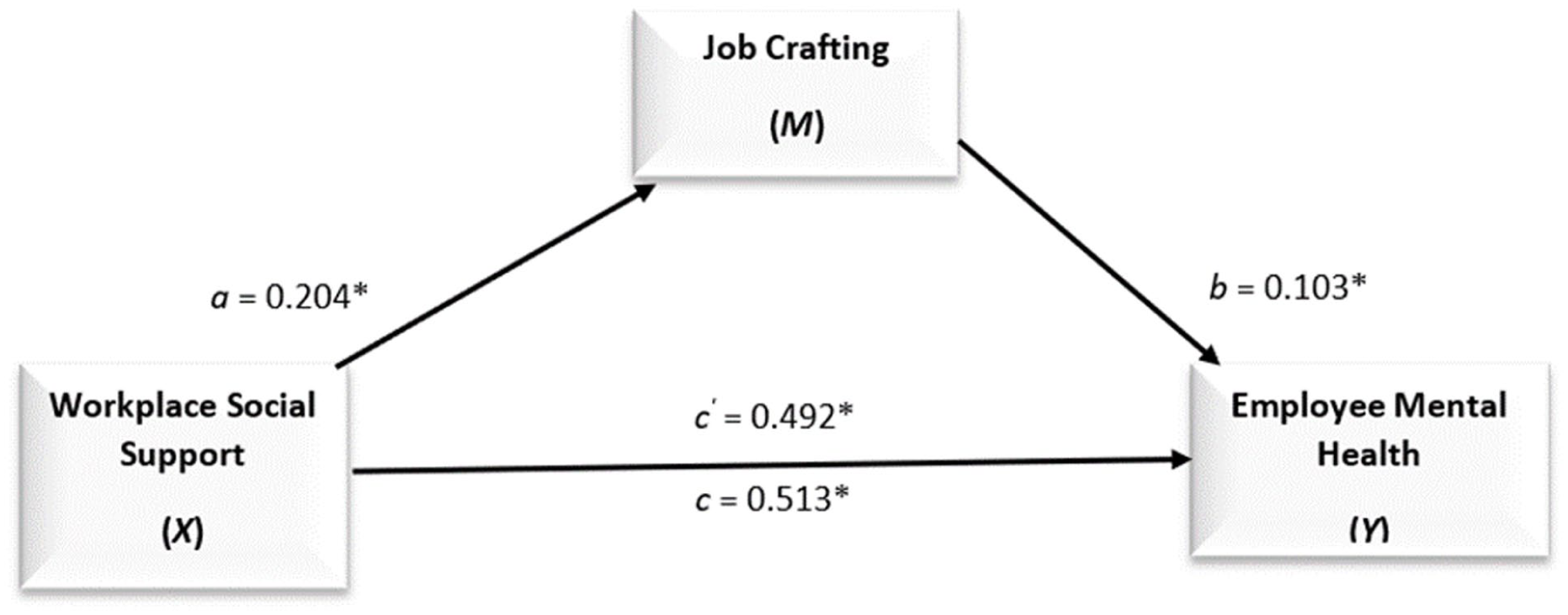
Summarizes the mediation analysis tests. Conceptual model for the mediating effect of job crafting on the relationship between workplace social support and employee mental health. All effects are unstandardized. *p < 0.05.
Discussion
The study investigated the mediating role of job crafting on the relationship between workplace social support and employee mental health. The study found that there is a significant positive relationship between workplace social support and job crafting. This aligns with results from a meta-analysis by Rudolph et al. 59 The thinking here could be that workplace social support interactions involve resource exchange and sharing, motivating employees to adjust their job boundaries. 60 In essence, timely assistance, valuable feedback, and being valued can go a long way to assist employees. 61 Potentially such workplace social support can lead to proactive behaviors at work especially amongst employees. 62 The findings suggest that workplace social support is a key factor in promoting job crafting, a proactive process where employees align their roles with their skills, interests, and needs.
The study also revealed a significant positive correlation between job crafting and employee mental health. This finding confirms previous studies and shows support for the interaction between job demands and job resources. 63 By enhancing autonomy and flexibility, employees can effectively balance work and personal life demands and customize their work to suit their preferences. 64 The finding of the study also aligns with previous research that has shown job crafting to be important in improving the mental health of employees.65–67 This state of being potentially assist employees to better to better cope with job demands, thereby reducing stress and preventing burnout. 68
The study revealed that workplace social support significantly affects employee mental health. Employees who receive support from colleagues and supervisors’ benefit from resources that reduce stress, alleviate loneliness, and enhance their sense of belonging. Recent systematic reviews by Bavik et al., 69 Koelmel et al., 70 Kelloway et al., 71 and Harunavamwe and Ward 72 have emphasized the critical role of social support in enhancing employee mental health. These reviews highlight social support as a key factor in promoting mental well-being among employees. The findings suggest that a supportive work environment is crucial for improving mental health by providing resources to help employees cope with stress and feel more connected and valued at work.
The study found that job crafting acts as a mediator in the relationship between workplace social support and employee mental health. According to Miraglia et al., 73 employees are more likely to fully utilize their skills when they have sufficient resources to manage job demands. Therefore, when employees receive support in the workplace, they are better positioned to engage in job crafting, which helps them address job demands effectively. This, in turn, enhances their mental health. The results imply that workplace social support can improve mental health indirectly by enabling employees to tailor their jobs to better meet their needs, thus fostering a healthier work environment.
Theoretical implications
The study offers significant theoretical implications that deepen our comprehension of the dynamic interplay among workplace social support, job crafting, and employee mental health. Firstly, it validates the direct impact of workplace social support on job crafting, expanding on Rudolph et al.’s 59 findings by illustrating how supportive interactions can actively motivate employees to adjust their job roles to align with their strengths and preferences. This underscores the crucial role of a supportive work environment in fostering job crafting, in line with the Leader-Member-Exchange (LMX) theory and the Job Demands-Resources (JDR) model. Furthermore, the study confirms that job crafting has a positive effect on mental health, consistent with the JDR model and Hobfoll’s 68 conservation of resources theory, suggesting that proactive role modifications can alleviate stress and enhance overall well-being. By showing that job crafting mediates the relationship between workplace social support and employee mental health, the study provides empirical evidence that social support indirectly enhances mental health by enabling job crafting. This insight enhances our understanding of how social support can promote mental well-being by empowering employees to customize their work experiences. In conclusion, these findings advance theoretical perspectives on how workplace social support and job crafting interact to impact employee mental health, underscoring the pivotal role of a supportive work environment in fostering job satisfaction and psychological well-being.
Practical implications
The study offers several practical implications for general practitioners and organizational leaders aiming to enhance employee well-being. Firstly, it highlights the importance of fostering a supportive work environment, emphasizing that effective social support from colleagues and supervisors can significantly boost employees’ job-crafting behaviors. Practitioners should focus on cultivating a culture of support through regular feedback, resource sharing, and collaborative interactions. Additionally, the study underscores the value of providing employees with autonomy and flexibility in their roles, which can facilitate job crafting and subsequently improve mental health. By implementing practices that encourage job crafting, such as allowing employees to adjust their tasks and responsibilities to better fit their skills and interests, organizations can help reduce job stress and enhance overall job satisfaction. Furthermore, the study’s findings suggest that investing in social support systems and training programs for managers to support their teams better can lead to improved employee mental health and performance. Overall, creating a work environment that supports job crafting and provides robust social support not only benefits individual employees but also contributes to a more engaged and resilient workforce.
Conclusion
The study concludes that workplace social support significantly enhances job-crafting behaviors among employees, positively impacting their mental health. This highlights the importance of a supportive work environment in facilitating job crafting and improving psychological well-being. The findings emphasize the value of social support and job crafting in enhancing employee mental health, suggesting that organizational strategies should prioritize fostering supportive interactions and providing employees with autonomy to customize their roles to their strengths and preferences.
Limitations
The cross-sectional design limits the ability to establish causality and observe changes over time. Additionally, the use of convenience sampling may restrict the generalizability of the findings to other contexts or populations. Approaching the study through probability sampling could provide more objective findings.
Future research scope
Future research could benefit from longitudinal studies to better understand causal relationships and changes over time. Including a broader range of organizations and regions in the sample could enhance the generalizability of the results. Moreover, exploring the impact of different types of social support and job crafting strategies on various dimensions of employee well-being could provide more nuanced insights. Investigating how individual differences, such as personality traits or job roles, interact with social support and job crafting could offer valuable information for developing tailored interventions. Overall, future studies should aim to build on these findings to elucidate further the mechanisms through which workplace support and job crafting contribute to employee mental health.
Footnotes
Acknowledgements
We would like to thank government agencies that were part of the study for their support.

Consent to participate
Informed consent was collected from every participant.
Author contributions
TSM was responsible for the conception, methodology, data analysis and interpretation of results. TC was responsible for the conception managing the literature searches and writing, final write-up of the manuscript. ETM was responsible for the conception, interpretation of results, and final write-up of the manuscript. WC was responsible for the conception, discussions and final write-up of the manuscript.
Funding
The authors disclosed receipt of the following financial support for the research, authorship, and/or publication of this article: The authors received financial support for the research, authorship, and/or publication of this article from the South African Medical Research Council.
Declaration of Conflicting interests
The authors declared no potential conflicts of interest with respect to the research, authorship, and/or publication of this article.