




Abstract
Background:
Chronic exposure to whole-body vibration (WBV) is a significant contributor to work-related musculoskeletal disorders (WMSDs) among motorcyclists. In Malaysia, these riders experience a higher prevalence of WMSDs compared to non-occupational motorcyclists. This study aimed to quantify WBV exposure among food delivery riders in Eastern Peninsular Malaysia and to identify predictors of WBV exposure exceeding the Exposure Action Value (EAV) as defined by the EU Vibration Protection Directive 2002/44/EC.
Methods:
A cross-sectional study was conducted among 191 food delivery riders in Eastern Peninsular Malaysia. WBV exposure was measured using a calibrated Larson Davis HVM 100 Human Vibration Meter with a tri-axial accelerometer seat pad, following ISO 2631-1 standards. Data were analyzed using Blaze Software and SPSS 24.0. Daily Vibration Exposure, A(8), was calculated and compared with EAV and Exposure Limit Value (ELV). Multiple logistic regression was used to determine predictors of WBV exposure above the EAV limit.
Results:
The mean (SD) A(8) value was 0.624 (0.317) m/s², which exceeded the EAV limit. Three riders surpassed the ELV limit. Significant predictors of WBV exposure above the EAV included increased average working days (aOR = 1.56; 95% CI = 1.11, 2.19; p = 0.011), presence of WMSDs (aOR = 2.93; 95% CI = 1.37, 6.28; p = 0.006), and lack of motorcycle suspension service (aOR = 0.39; 95% CI = 0.19, 0.82; p = 0.012).
Conclusion:
Food delivery riders in Eastern Peninsular Malaysia are frequently exposed to high levels of WBV exposure. These findings underscore the urgent need for interventional studies and preventive measures to reduce WBV exposure and mitigate the prevalence of WMSDs among this vulnerable occupational group.
Keywords
Introduction
Whole Body Vibration (WBV) has been extensively studied in the occupational world due to its association with various WMSDs. Chronic exposure to WBV has been linked to conditions such as Low Back Pain (LBP), spinal degeneration, and disorders in other body parts. 1 Recent studies have further emphasized the prevalence of WMSDs among workers exposed to WBV. For instance, a systematic review by Burström et al. found strong evidence linking occupational WBV exposure to an increased risk of LBP and sciatica. 2 In addition, there was a significantly high prevalence of LBP, shoulder, neck and ankle pain among dumper operators in Indian mines who were chronically exposed to WBV compared to the control group. 3 Furthermore, WBV has also been demonstrated to directly cause lumbago, sciatica, and intervertebral disk herniation and degeneration. 4
The impact of WBV on the human body depends on various factors, including vibration intensity, seating composition, footwear type, and overall body posture. Specific frequencies can affect different physiological systems, such as inducing muscle fatigue at 4.5 Hz 5 and visual disturbances between 20 and 90 Hz. 6 Digestive system disorders have also been observed in workers exposed to vibrations from 4 to 5 Hz, which are transmitted through car seats. 7 Krajnak highlighted the potential long-term effects of WBV on the cardiovascular system and cognitive function. 8 Understanding human responses to vehicle-induced vibration requires careful consideration of frequency, direction, and duration, as these variables significantly influence the level of discomfort experienced by riders. 9
Factors influencing WBV magnitude can be categorized into human, environmental/working, and tool-related factors. Human factors include both modifiable (e.g. BMI, posture) and non-modifiable (e.g. pre-existing medical conditions, age) aspects. 10 However, non-modifiable risk factors, such as pre-existing medical conditions such as scoliosis and aging factors, can also affect the outcome. Environmental factors encompass road conditions and working hours,11,12 while tool-related factors include equipment age and seat types.12,13 Recent studies have also emphasized the role of psychosocial factors in WBV perception and its health effects. 14 Occupational motorcyclists, including food delivery riders, are particularly vulnerable to WBV exposure. Numerous studies have reported a high prevalence of WMSDs among these workers.15,16 Additionally, research has shown that different seating postures and conditions can substantially alter the transmission of WBV through the seat pan and backrest, highlighting the importance of seating ergonomics in mitigating WBV exposure. 17
Based on existing literature, this study focuses on three key predictors of WBV exposure: average working days, presence of WMSDs, and motorcycle suspension maintenance. Longer riding durations increase cumulative vibration exposure; WMSDs may reflect chronic biomechanical strain; and poor suspension maintenance is known to heighten vibration transmission from the vehicle to the rider’s body. These factors have been independently associated with elevated WBV exposure across occupational groups in prior studies and therefore justify their inclusion as predictor variables in this study.18–20
The rapid growth of the gig economy, especially during the COVID-19 pandemic, has further increased the number of workers exposed to these risks. 21 Terengganu, located on the east coast of Peninsular Malaysia, has also experienced significant growth in gig-based food delivery services. 22 According to the Department of Statistics Malaysia, Terengganu recorded 558,500 registered motorcycles in 2022, reflecting a high reliance on motorcycle transportation relative to its population. 23 This surge has led to an increase in the number of riders navigating diverse terrains, including hilly areas and poorly maintained urban roads, potentially elevating their risk of WBV exposure. Studies have highlighted that food delivery riders often face precarious employment conditions, a lack of safety regulations, and job insecurity, all of which can influence their riding behaviors and safety.24,25
Despite the growing concern, food delivery riders remain a relatively understudied group in Malaysia regarding occupational hazards like WBV. Understanding the predictors of WBV readings that exceed permissible levels according to ISO 2631-1 standard is crucial for developing effective interventions to reduce WMSDs among this workforce. This study aimed to quantify WBV exposure among food delivery riders in Eastern Peninsular Malaysia and to identify predictors of WBV exposure exceeding the Exposure Action Value (EAV) as defined by the EU Vibration Protection Directive 2002/44/EC. In addition, we hypothesize that occupational and mechanical factors are significant predictors of WBV exposure exceeding ISO 2631-1 thresholds among food delivery riders in Terengganu.
Material and methods
Study population
This was a cross-sectional study conducted among 191 food delivery riders in Terengganu, Malaysia. This study took place between July 2021 and May 2022. The sample size was calculated using two proportion formula, with alpha of 0.05 and 80% power. All riders were comprehensively explained regarding the objectives and study design. Written informed consent was obtained prior to participation. This study used the snowball sampling method where the leader of the riders, known as “Captain Riders,” acted as the seed. The ethical clearance was given by the Universiti Sains Malaysia Ethical Committee (JEPeM; USM/JEPeM/21030230).
Data collection
Potential predictors variables
A self-reported proforma was administered to gather information on demographic data: age, height(cm), weight(kg), gender; work-related factors: work experience, average trips per day, average working hours per day, average working days per week; and vehicle characteristics: motorcycle type, engine power, manufacturer, service frequency, suspension service frequency.
The prevalence of WMSDs was assessed using the validated Malay-translated Standardized Nordic Musculoskeletal Questionnaire (M-SMNQ). 26 The test –retest validity demonstrated an existence of strong kappa agreement values of at least 0.75. The M-SNMQ was a self-administered questionnaire consisting of 11 questions of binary responses either “Yes” or “No” for 8 specific body regions namely neck, shoulders, upper back, lower back, arms/elbow, thighs, knees, and feet according to 4 period of prevalence which were lifetime, 12 months, 1 month, and 7 days. Participants completed the questionnaires outside of working hours, with an estimated completion time of 30 min.
Whole-body vibration measurement
The measurement of WBV was done in accordance with the ISO 2631-1 Standard. 27 A triaxial accelerometer seat pad was placed on each motorcycle seat, adhering to the ISO 2631-1 guidelines for anatomical positioning and accelerometer direction, as shown in Figure 1.

Triaxial seat pad placement on motorcycle.
A calibrated Larson Davis HVM 100 Human Vibration Meter with a tri-axial accelerometer seat pad, compatible with ISO 2631-1, was used to measure the vibration produced by the motorcycle to the rider’s body. The riders were asked to use a paved road, slow down at any road bumper, or avoid holes to control the environment. In addition, several precautionary instructions were given to enhance the measurement’s validity, such as the riders needing to sit on the accelerometer seat pad constantly, even on bumpy roads, and riding the motorcycle as they were on regular delivery shifts. The vibration was measured in three core axes, which were fore/aft (x), lateral (y) and vertical (z), and the data was transferred into Blaze Software.
Furthermore, the vibration measurement was done following the evaluation of health comfort and perception in ISO 2631-1-1997 where Wk used to measure z direction and Wd used for x and y directions. The vibration total value of weighted root-mean square (r.m.s) acceleration was measured using the formula shown in equation (1). The WBV was measured in Daily Vibration Exposure, A(8) using the formula shown in equation (2). The measurement time was started when riders started to deliver their orders and the time was stop when their arrived at the same starting point approximately around 20 min per delivery session. The exposure time was then converted into 8-h weighted using given formula. The same measurement was repeated among 191 riders using the same vibration meter.

Equation 1: Vibration total value of weighted root-mean-square (r.m.s) acceleration (Where awx, awy, awz are weighted r.m.s accelerations with respect to the orthogonal axes x,y,z, respectively; kx, ky, kz are multiplying factors).

Equation 2: Daily Vibration Exposure, A(8; Where awli is the frequency-weighted r.m.s. value of the acceleration, determined over the time period Ti; l = x, y, z; kx = ky = 1,4 for the x- and y-directions; kz = 1 for the z direction; T0 is the reference duration of 8 h (28,800 s)).
The daily vibration exposure (8-hour weighted) measured and then was compared to the EAV and ELV as required by the EC Vibration Protection Directive 2002/44/EC. 28 The EAV value, in accordance with the legislation, is 0.5 m/s2, while the ELV value is 1.15 m/s2.
Statistical analysis
The data were analyzed using IBM SPSS version 24.0 software. All categorical variables were presented using frequencies and percentages, while continuous variables were described using mean (SD). The proportion of respondents was explained in a correct percentage. Univariable analysis was done using simple logistic regression to analyze the predictors of WBV above the EAV limit value. All variables that showed p-value < 0.25 and were considered to be important were selected to be tested further using multiple logistic regression tests. The preliminary final model was obtained after conducting variable selection using Forward Likelihood Ratio (Forward LR) selection and Backward Likelihood Ratio (Backward LR) elimination methods. There was no significant possible two-way intervariable interaction in this study. Variance Inflation Factors (VIF) were checked and found to be less than 10, which indicated that there was no multicollinearity present in the preliminary final model. Hosmer-Lemeshow test, classification table and area under receiver operation characteristic (ROC) curve were used to check for the model fitness. For this study, the Hosmer-Lemeshow test was statistically not significant (p = 0.907). The classification table showed 72.6%, and the ROC area under the curve was 73.2% with p = 0.001, which indicated the model was fitted.
Results
Characteristics of respondent
In this study of 191 food delivery riders, the majority were male (92.7%). The mean age of the riders was 27.6 years (SD = 5.76). The mean body mass index (BMI) was 26.1 (SD = 6.54), with average height and weight being 166.1 cm (SD = 14.08) and 73.2 kg (SD = 20.62), respectively. The work experience distribution among the riders was nearly equal, with similar proportions having worked for less than 1 year and more than 1 year. On average, riders completed 19 delivery trips and worked 10 h daily, with an average of 6 working days per week. Based on the Malay-Translated Standardized Nordic Musculoskeletal Questionnaire (M-SNMQ), the 12-month prevalence of WMSDs among the riders was notably high at 74.9%. The characteristics of the respondents are summarized in Table 1.
Characteristics of food delivery riders and motorcycles used in eastern Peninsular Malaysia (n = 191).
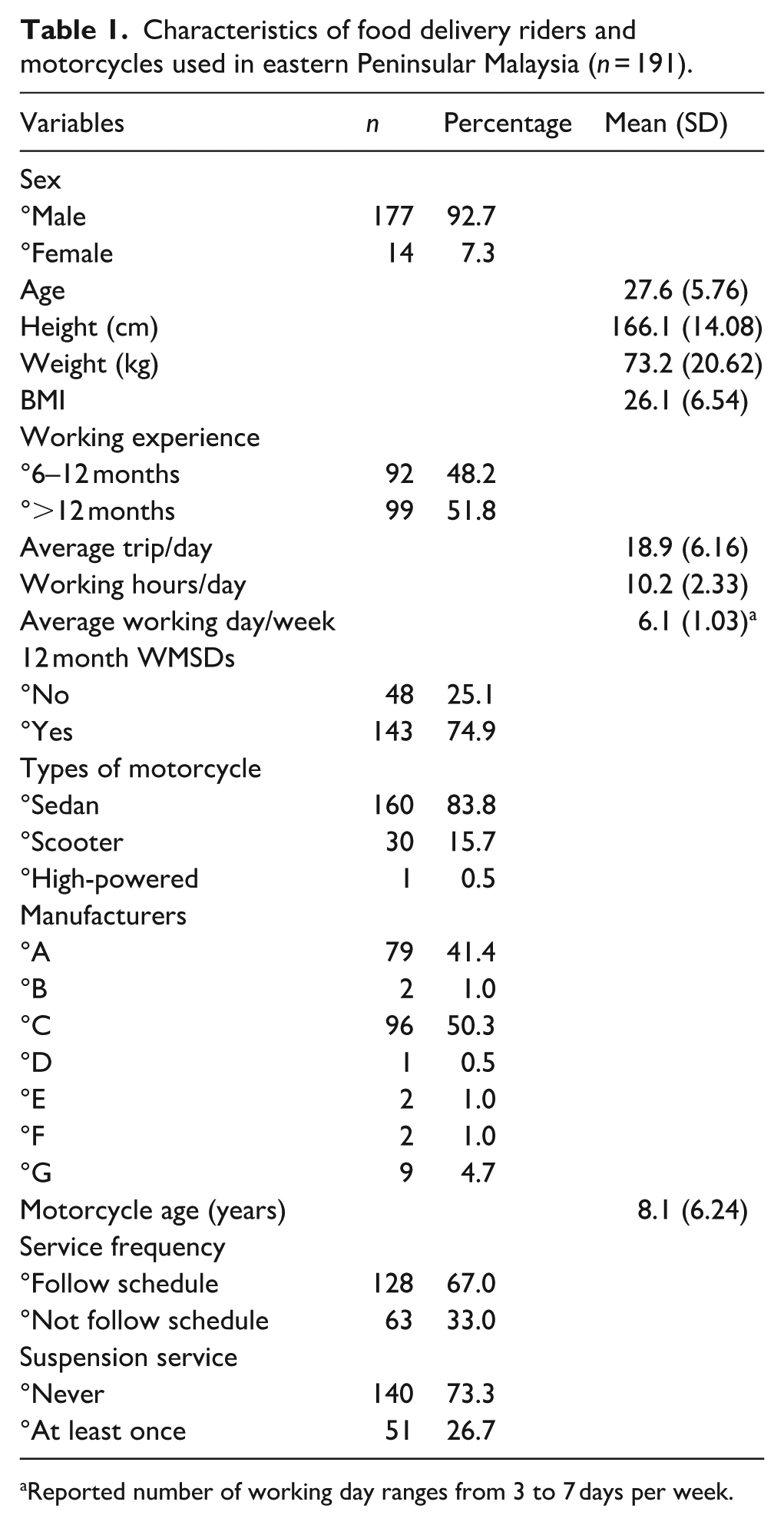
Reported number of working day ranges from 3 to 7 days per week.
Motorcycle characteristics
Most food delivery riders (83.8%) used sedan-type motorcycles, 15.7% used scooters, and only one rider operated a high-powered motorcycle. Brand “C” was the most popular manufacturer, accounting for 50.3% of the motorcycles used, with seven different manufacturers represented overall. The average age of the motorcycles was 8.1 years (SD = 6.24). Notably, 33.0% of riders reported not adhering to the manufacturer’s recommended service schedule. Furthermore, a significant proportion (73.3%) of riders had never serviced or replaced their motorcycle’s suspension since purchase, as shown in Table 1.
WBV measurement
Upon measurement of WBV exposure, most riders (69.6%) had Daily Vibration Exposure, A(8) ranges between 0.500 and 1.149 m/s2. However, three had Daily Vibration Exposure, A(8), more than 1.15 m/s2, as shown in Table 2. Meanwhile, the mean (SD) of calculated Daily Vibration Exposure, A(8), was 0.624 (0.317) m/s2. The Daily Vibration Exposure, A(8), experienced by the riders range from 0.009 to 1.896 m/s2.
Daily vibration exposure, A(8) among food delivery riders in eastern Peninsular Malaysia (n = 191).

Predictors of WBV
Table 3 shows three variables, namely average working day per week, Work-Related Musculoskeletal Disorders (WMSDs), and suspension service, which had a significant association with WBV above the EAV limit. Based on multiple logistic regression, this study suggested that each additional working day per week was associated with a 1.56-fold increase in the odds of exceeding the EAV threshold (95% CI: 1.11, 2.19; p = 0.011). Meanwhile, those with WMSDs were found to have 2.93 times the likelihood (95% CI: 1.37, 6.28; p = 0.006) to have WBV above EAV compared to those who did not have WMSDs. Finally, the riders who had their motorcycle suspension being serviced had 0.39 times (95% CI: 0.19, 0.82; p = 0.012) less likely to have WBV above EAV.
Predictors of WBV above EAV limit among food delivery riders in eastern Peninsular Malaysia using multiple logistic regression (n = 191).

Multiple logistic regression. Constant = −2.227. Forward LR methods were applied. No multicollinearity and no interaction between the variables. Hosmer-Lemeshow test, p = 0.907. Classification table was 72.6% correctly classified. Area under receiver operating characteristics (ROC) curve was 73.2%.
Discussion
In this study, there was a high prevalence of WMSDs based on the M-SNMQ, which was 74.9%. The same high prevalence can be seen in many other studies involving occupational motorcyclists; the main complaint was LBP.15,16,29 This study also revealed that the mean WBV exposure presented as Daily Vibration Exposure, A(8), exceeded the EAV limit as legislated by the EU Vibration Protection Directive 2002/44/EC. 28 The directive lays down the following limit values for Daily Vibration Exposure (A8): EAV at 0.5 m/s2 and ELV at 1.15 m/s2.
In-depth, only 55 riders had Daily Vibration Exposure (8-h Weighted) less than 0.50 m/s2. While the majority of them (71.2%) had Daily Vibration Exposure (8-h Weighted) that exceeded the EAV limit value. Among those, three riders had Daily Vibration Exposure (8-h Weighted) values that exceeded the ELV limit value. Compared to other types of transportation, only 30% of train operators in the large metropolitan subway system in New York have Daily Vibration Exposure exceeding the EAV limit value. 30 Similarly, real-time vibration monitoring among agricultural tractor operators also showed frequent exceedance of WBV action thresholds, particularly along the vertical axis, reinforcing that informal or outdoor vehicle occupations face substantial vibration risks. 31 In addition, the mean WBV among metropolitan bus drivers in the United States also exceeded the limit values. 32 However, in comparison with another motorcyclist group, an even higher proportion of riders (>90%) had WBV values exceeding the upper boundary of the Health Guidance Caution Zone among riders in Taiwan. 33 The same result was shown in a study by Chen et al. 34 among urban motorcyclists where more than 50% of the respondents had exceeded the vibration exposure limit.
According to EC Directive 2002/44/EC, employers must take control measures based on hierarchy of controls to reduce vibration exposure and improve the quality of life among the riders. In particular, employers must establish and implement technical organizational measures, such as appropriate training programs and the provision of auxiliary equipment to reduce vibration exposure, such as special seats. Biodynamic studies have identified critical resonance frequencies of the human body in response to WBV, which vary depending on sitting posture and direction of vibration and these findings reinforce the need to account for mechanical and anthropometric factors in WBV risk assessments. 35 In addition, the directive also emphasizes immediate action to reduce vibration exposure that exceeds the ELV limit value, where, in any event, all workers must not be exposed to WBV exceeding the ELV. 28
This study also revealed that with an increment of 1 day of work per week, the odds of having WBV above the EAV was 1.56 (95% CI: 1.11, 2.19; p = 0.011). This association was based on a continuous scale where each additional working day per week increased the odds of exceeding the EAV. The reference point was the baseline value of working days, with the average being 6.1 (SD = 1.03), ranging from 3 to 7 days per week. The same conclusion can be seen in many other studies in various transportation industries where longer working days increase the likelihood of workers exceeding WBV limit values.36,37 In this study, working hours were not significantly associated with vibration dose exceeding the EAV limit value. This might be due to variation in working days, from 3 to 7 days of work. The cumulative exposure to WBV was relatively low for those with longer working hours but fewer working days. However, with constant working days, many studies suggested that longer working hours would cause significantly higher WBV and are most likely to exceed the limit value.38,39 In other words, the vibration dose is directly proportional to the cumulative duration of exposure.
According to this study, the riders who complained of WMSD symptoms were almost three times higher to have WBV exceed the EAV limit value. The relationship between vibration dose and WMSD symptoms was vastly discussed in occupational health. Many studies have proved the significant positive association between WMSDs among workers and WBV, especially low back pain.3,40,41 As mentioned in the early part of this study, WBV significantly affected the physiological changes in the human body, especially the musculoskeletal system. The degenerative effect of the spine was among the results when the human body underwent chronic high-dose vibration. 42 Furthermore, the effects of vibration were also seen in many other disorders, such as Hand-Arm Vibration Syndrome, Raynaud’s phenomenon, Gastrointestinal symptoms and others when the chronic vibration was focused on a particular anatomical site.43–45
Suspension was among the aspects affecting the vibration dose delivered to the body. In this study, it was concluded that the riders who had their motorcycle’s suspension being serviced had a lesser risk of WBV exceeding the EAV limit value. This aligns with previous findings where seat transmissibility and vertical vibration direction were identified as significant contributors to rider discomfort and increased vibration exposure, particularly in seated occupational tasks. 46 In many studies, the type of suspension has been proven to play an important role in reducing vibration exposure.47,48 The optimization of the suspension function can reduce the motorcycle pitch when there is sudden acceleration or deceleration; thus, this will reduce the WBV exposure toward the riders. 49 Furthermore, improper maintenance or the use of non-standard parts can exacerbate vibration issues as inadequate suspension maintenance could increase vibration transmission to the rider’s body. 20 Additionally, the effectiveness of suspension systems can degrade over time, and without standardized servicing protocols, the intended benefits may not be realized.
In this study, most riders used sedan motorcycles while working. However, the types of motorcycles used were not significantly associated with WBV. This could be due to disproportionate distribution of motorcycle types among the riders where only one rider used high-powered motorcycle, and 55 others used scooter type. However, in a study among motorcyclists in China, the WBV exposure was significantly high in riders with sedan motorcycles. 33
This study has several limitations. First, WBV exposure was measured at a single time point, which may not capture the variability of exposure across different days, riding routes, or environmental conditions. WBV measurement captured only a 20-min riding session per rider and may not reflect the cumulative daily exposure, especially considering waiting time or idling periods. Second, the cross-sectional design limits the ability to infer causal relationships between WBV exposure and its predictors. Future research should consider adopting longitudinal designs combined with wearable or sensor-based monitoring systems that allow for continuous, real-time measurement of vibration exposure during actual riding conditions. This would enhance the accuracy and ecological validity of WBV assessments and provide deeper insight into exposure dynamics among food delivery riders.
Conclusion
In conclusion, the food delivery riders had a high risk of developing vibration-related illnesses, especially WMSDs, as the WBV exposure experienced by the riders exceeded the EAV limit. In this study, several factors were found to be significantly associated with WBV exceeding EAV limit value, namely increasing average working days, presence of WMSDs and motorcycle suspension, which never being serviced. These three major factors must be taken into consideration by the employer in order to improve the quality of life and health of the riders. Importantly, three riders exceeded the ELV of 1.15 m/s², indicating exposure levels with a well-documented risk of adverse health effects. The majority of riders also surpassed the EAV of 0.5 m/s², highlighting the urgency for preventive measures in this occupational setting. Additionally, the result of the study will likely be the basis of other interventional studies to reduce WBV exposure to the lower level, thus reducing the prevalence of WMSDs among this neglected group. We recommend implementing targeted interventions to mitigate WBV exposure among food delivery riders. One potential measure is the provision of subsidized or standardized suspension servicing programs, ensuring that maintenance practices effectively reduce vibration transmission. Additionally, developing educational campaigns to raise awareness about the importance of proper motorcycle maintenance and safe riding practices could further alleviate WBV risks. Collaborations between government agencies, employers, and rider associations would be instrumental in implementing these interventions.
Footnotes
Acknowledgements
The authors would like to express their gratitude to all the food delivery riders involved in this study, especially the captain rider.

Informed Consent
Informed consent was obtained from all subjects involved in the study. Written informed consent has also been obtained from the respondents to publish this paper.
Author contributions
Conceptualization, A.D. and R.N.; methodology, A.D.; software, N.A.A.; validation, N.A.A. and S.M.H.; formal analysis, E.A. and S.M.H.; investigation, E.A.; resources, N.A.A.; data curation, A.S.M.J.; writing—original draft preparation, E.A.; writing—review and editing, A.D., I.S.M.B. and E.A.; visualization, S.M.H.; supervision, A.D. and R.N.; project administration, S.M.H.; funding acquisition, A.D. All authors have read and agreed to the published version of the manuscript.
Funding
The authors disclosed receipt of the following financial support for the research, authorship, and/or publication of this article: This research was funded by Universiti Sains Malaysia through a postgraduate development incentive grant (USM/PPSP/PG/2.0/06(21)) and the School of Medical Sciences, Universiti Sains Malaysia for funding the APC.
Conflicting interests
The authors declared no potential conflicts of interest with respect to the research, authorship, and/or publication of this article.
Data availability
The data are not publicly available due to privacy and confidentiality.
Institutional review board statement
This study was conducted in accordance with the Declaration of Helsinki and approved by the Institutional Review Board of Universiti Sains Malaysia (USM/JEPeM/21030230, 22 June 2021).