




Abstract
Background:
Regular assessment of patient satisfaction is crucial for healthcare providers to evaluate and improve the quality of services offered. However, research on patient satisfaction, particularly in Cameroon, remains limited. This study aimed to assess patient satisfaction levels with the healthcare services at the Yaoundé Central Hospital using the PSQ-18 questionnaire.
Design and methods:
A hospital-based cross-sectional study was conducted from September 2022 to March 2023, involving outpatients aged 18 and above who willingly consented to participate. A modified version of the PSQ-18 questionnaire was utilized to evaluate satisfaction across 10 hospital variables.
Results:
The study included 385 participants, with 264 uninsured and 121 insured. The overall satisfaction rate was 90.9%. Satisfaction level for insured patients was 98.3% and 87.5% for not insured patients. Variables such as diagnosis, information provided by healthcare personnel, and equipment quality received high satisfaction scores. However, both insured and uninsured patients expressed dissatisfaction with specialist waiting times. Binary logistic regression revealed significant difference, with uninsured individuals being 8.5 times more likely to be dissatisfied compared to insured counterparts (95% CI 2.0–36.0; p = 0.0006). Large family size of more than 5 persons was the only factor that significantly increased the risk of dissatisfaction with health services.
Conclusions:
These findings highlight a critical policy gap that needs intervention now. Targeted policy interventions are needed to help uninsured Cameroonians afford high-quality healthcare. For population-wide healthcare access, this gap must be closed. Therefore, the national universal health coverage scheme must be expanded and improved to reach all 10 Cameroon regions.
Introduction
Patient satisfaction is a vital metric of healthcare quality and a fundamental element of health system efficacy. As a multifaceted construct, it encapsulates patients’ experiences, perceptions, and expectations concerning the healthcare services they receive. 1
The Patient Satisfaction Questionnaire, PSQ-18 has been validated for various contexts, assessing aspects of healthcare experience to enhance patient satisfaction. 2 It evaluates reliability, assurance, responsiveness, and empathy. Healthcare practitioners and entities can adapt and administer the PSQ-18 to identify improvement areas and make adjustments accordingly. 3
Research indicates that globally, satisfied patients are more inclined to comply with treatment regimens, sustain follow-up care, cost of care, and enhance health outcomes. 4 Nevertheless, the literature indicates that patient satisfaction in numerous low- and middle-income countries, such as Cameroon, remains inadequately examined, resulting in considerable deficiencies in comprehending the determinants of satisfaction in these contexts. 5
In Cameroon’s healthcare system, categorizing patients based on their insurance status enables a thorough analysis of how coverage affects patient experiences and satisfaction. By comparing these distinct groups, this research aims to reveal possible disparities in healthcare delivery. This shows how insurance could affect patients’ views on healthcare quality, access, and overall satisfaction. This is especially crucial in a setting where universal health coverage is still being developed, and out-of-pocket costs remain a major obstacle to healthcare access for many people in Cameroon.
Cameroon’s healthcare system is characterized by a mixed model of public and private healthcare provision. The system is structured across three levels: primary (health centers and integrated health centers), secondary (district and regional hospitals), and tertiary (central and specialized hospitals). 6 Financing predominantly involves government budget allocations, out-of-pocket payments, and limited health insurance schemes. 7
Despite these structured efforts, out-of-pocket payments (OOP) remain the dominant financing mechanism, leading to healthcare access and quality inequities. As of 2020, only approximately 30% of the population had some form of health insurance coverage, leaving a significant portion of the population vulnerable to financial barriers in accessing healthcare. 8
Studies on patient satisfaction in Africa, including Cameroon, identify critical challenges such as long waiting times, limited availability of medical supplies, and negative staff attitudes.
Numerous factors can influence patient satisfaction, such as cost, the patient’s level of education, facility cleanliness, medication availability, waiting time to see a specialist, the attitude of healthcare workers, and the availability of well-trained personnel. 9
Specific studies in the region highlight variations in patient satisfaction. A study in Hadiya Zone, Southern Ethiopia, assessed satisfaction among insured and uninsured adults using outpatient services at public health institutions. Influencing factors included insurance status, family size, residency, waiting times, and the availability of tests and medications. 10
Research from Nigeria found that service delivery at a family medicine clinic is influenced by experiences with physicians, pharmacists, lab scientists, nurses, record officers, and the clinic’s cleanliness. The results indicate that effective communication positively affects patient satisfaction. 11
These findings underscore the importance of Universal Health Coverage (UHC) in addressing financial barriers and ensuring equitable access to quality healthcare, as it directly influences key factors that drive patient satisfaction. 12
While there have been a few isolated studies on patient satisfaction in Cameroon, these have been limited in scope and methodology. For instance, a 2022 study by Ngequih Tumasang et al., in the Northwest Region examined patient satisfaction in primary healthcare settings, focusing primarily on maternal and child health services. However, that study used a different assessment tool and was geographically restricted. 13 Another study explored patient satisfaction at the Bamenda Regional Hospital, but it did not comprehensively analyze the differences between insured and uninsured patients nor use the PSQ-18 questionnaire. 14
The existing research has typically addressed narrow segments of healthcare services or specific patient groups. In contrast, our study aims to provide a more comprehensive assessment using the PSQ-18 questionnaire, with a unique focus on comparing satisfaction levels between insured and uninsured patients at a central hospital. This approach addresses a significant gap in the current literature by offering a more holistic view of patient experiences across different healthcare coverage statuses.
This knowledge gap offers a substantial opportunity for comprehensive research, particularly in the context of the impact of healthcare coverage status on patient perceptions of service quality.
Consequently, this study aims to explore the determinants of patient satisfaction with healthcare services at a public hospital in Cameroon, using a modified version of the widely-recognized Patient Satisfaction Questionnaire Short Form (PSQ-18).
By pinpointing the elements that impact satisfaction, this research helps to fill the evidence gap and provides practical recommendations for policymakers and healthcare providers to improve service quality and equity in Cameroon.
Design and methods
Study design and setting
Our study was a hospital-based cross-sectional study conducted from September 2022 to March 2023. The research was carried out at the outpatient service department (OPD) of the Central Hospital Yaoundé, located in the Center region of Cameroon. This hospital was founded in 1933 15 and is one of the largest and leading public referral hospitals in Cameroon and the city of Yaoundé (the administrative capital of Cameroon), where it sees approximately 200,000 patients yearly. It serves as one of the leading reference hospitals, offering both outpatient and inpatient services across all specialties, and is equipped with advanced medical facilities, which is why the hospital was selected. The hospital also has multiple specialized departments that can accommodate a large number of patients and offers a wide range of medical services, including advanced surgical procedures, various specialized medical departments, emergency care, diagnostic services, and specialized treatment centers. 16
Target population of study
The research focused on adult outpatients (patients who visited the hospital for diagnosis or treatment but did not require an overnight stay) aged 18 and older attending general and specialist outpatient clinics. To ensure comprehensive and reliable patient feedback, participants were required to have visited the hospital at least three times before the study, thereby capturing more meaningful insights into the hospital’s service quality.
Inclusion criteria
- Both insured and uninsured outpatients aged 18 years and older accessing outpatient services
- Patients with a minimum of three previous hospital visits
- Individuals providing written informed consent
Exclusion criteria
- Critically ill patients unable to communicate
- Individuals who declined study participation
Sample size determination
The sample size was estimated using Cochran’s sample size formula. 17 Since the proportion of patients who are satisfied with healthcare services using the PSQ-18 questionnaire in Cameroon was not known, the following assumptions were taken: proportion satisfaction of 50%, 18 because the true proportion of satisfaction/dissatisfaction is unknown, 95% confidence level and error margin of 5%.

Where: n = minimum sample size; Z = 1.96, critical Z-value at 95% confidence interval. The calculation gave a sample size of 385 respondents.
Sampling technique
The study participants were selected from the outpatient consultation department (OPD) of the hospital using a modified systematic sampling method. 18 Due to hospital confidentiality policies restricting access to exact patient records, we adopted an alternative approach to determine the sampling frame and interval. Based on discussions with hospital administrators, we estimated that 50–70 eligible adult outpatients visited the OPD daily, which is typical for a referral hospital of this size. Using a conservative estimate of 50 patients per day over the 7-month study period, we projected a population of 7500 eligible patients. With our calculated sample size of 385, the theoretical sampling interval was determined by dividing the estimated sample population by the sample size giving 19. For practical implementation, we adapted this approach by selecting every fifth patient from the daily queue in the waiting room. The researcher then systematically approached patients with queue numbers 5, 10, 15, 20, etc. This modification accommodated several constraints: inability to access complete patient lists in advance, variation in patients meeting the inclusion criteria, and potential refusals to participate. To ensure the reliability of patient responses, only patients who had visited the hospital at least three times previously were eligible for inclusion. This criterion helped exclude those with limited experience of hospital services, whose responses might not accurately represent typical patient experiences. Each selected patient who met this criterion was invited to participate in an interview using a pre-tested modified version of the standard Patient Satisfaction Questionnaire Short Form (PSQ-18).
Participation was entirely voluntary. Selected patients received written informed consent forms explaining the study objectives before interviews proceeded. If any selected patient declined participation or did not meet the inclusion criteria, the selection process proceeded with the next eligible patient in line. If no candidates met the criteria on a given day, data collection would continue the next day. Throughout the study period, the principal investigator was present at the hospital’s OPD each morning, and no individual participated in more than one interview. This approach maintained systematic selection principles while addressing the practical constraints of the hospital environment until the required sample size was achieved.
Data collection tool
The modified standard PSQ-18 questionnaire was pre-tested over a 2-week period on 15 outpatients at the Yaoundé Central Hospital who voluntarily consented to participate, comprising 5 insured and 10 uninsured individuals.
Pre-testing was done because this is the first time this questionnaire has been used in Cameroon. Therefore, it was important to test its suitability for our study.
After the pre-test was conducted, the PSQ-18 questionnaire was modified several times based on patient feedback and administrative recommendations to suit our study.
Our modified questionnaire introduced several key changes to adapt the original PSQ-18 to the Cameroonian context. One of the significant adjustments was the merging and rephrasing of satisfaction questions that were separate in the original PSQ-18. For example, questions assessing satisfaction with healthcare workers’ attitudes and respect were combined or simplified, making them less distinct from the original version. Some questions were omitted, such as those evaluating the convenience of office hours, which were deemed less relevant.
Notably, original question 5 (“I think my doctor’s office has everything it needs to provide complete medical care.”) was excluded based on recommendations from local staff, reflecting differences in healthcare settings between the U.S., where the PSQ-18 was developed, and Cameroon.
In addition, the original PSQ-18 uses a 5-point Likert scale with options ranging from “Strongly Agree” to “Strongly Disagree,” including a neutral “Uncertain” option, which allows respondents to express indecision or neutrality. In contrast, our modified questionnaire employs a 4-point scale from “Very Dissatisfied” to “Very Satisfied,” eliminating the neutral choice. This adaptation compels participants to lean toward satisfaction or dissatisfaction, providing a more decisive standpoint. The change in response labels focuses exclusively on satisfaction rather than agreement, making the scale more intuitive in evaluating patient experiences. These modifications aim to simplify the response process, enhancing comprehension and usability in a Cameroonian context where the original scale may be less familiar or applicable.
Furthermore, the revised questionnaire introduced a more comprehensive section on socio-demographic characteristics, which are not found in the original PSQ-18. These additions aim to gather detailed information about patients’ backgrounds, such as their employment sector and income level, providing deeper insights into how these factors influence patient satisfaction in Cameroon.
Overall, the modifications were made to ensure the questionnaire was culturally appropriate, contextually relevant, and capable of capturing the unique healthcare dynamics specific to the Cameroonian setting.
For the main data collection process, patients who provided their consent were interviewed using closed-ended questionnaires to gather basic information. The researcher administered the questionnaire face-to-face in either English or French, depending on the participant’s language preference.
The questionnaire had two sections: A and B. Section A contained 13 questions about participants’ socio-demographic information including age, gender, religion, relationship status, employment, address, education level, insurance provider, insurance duration, monthly income, chronic diseases, and household size. Section B assessed patient satisfaction with 10 aspects of healthcare services at Central Hospital Yaoundé, featuring questions with responses from 1 (very dissatisfied) to 4 (very satisfied).
Data management and analysis
The questionnaire was systematically checked for errors during data entry. Participant questionnaires were compiled into a booklet and securely stored to prevent loss of information. Computerized results were password-protected for privacy. Only the researcher accessed patients’ statistics to maintain confidentiality.
Descriptive statistics were computed to determine the frequencies, percentages, mean, median, standard error, and standard deviation of the responses obtained from participants.
The dependent variable in our study was patients’ perceived satisfaction with the quality of healthcare services received at the Central Hospital Yaoundé. This variable was later coded as “0” and “1,” where “0” indicated dissatisfaction, and “1” represented satisfaction.
To calculate the overall satisfaction of our patients, the 10 selected healthcare components were evaluated and assigned a point value. The points were then summed up to a total of 40 (the highest possible score for any patient) and further categorized into two main groups: anyone with a score between 0 and 20 was considered dissatisfied, and anyone scoring above 20 was considered satisfied (Table 1).
Process to rank satisfaction variable, from 10 selected healthcare components.
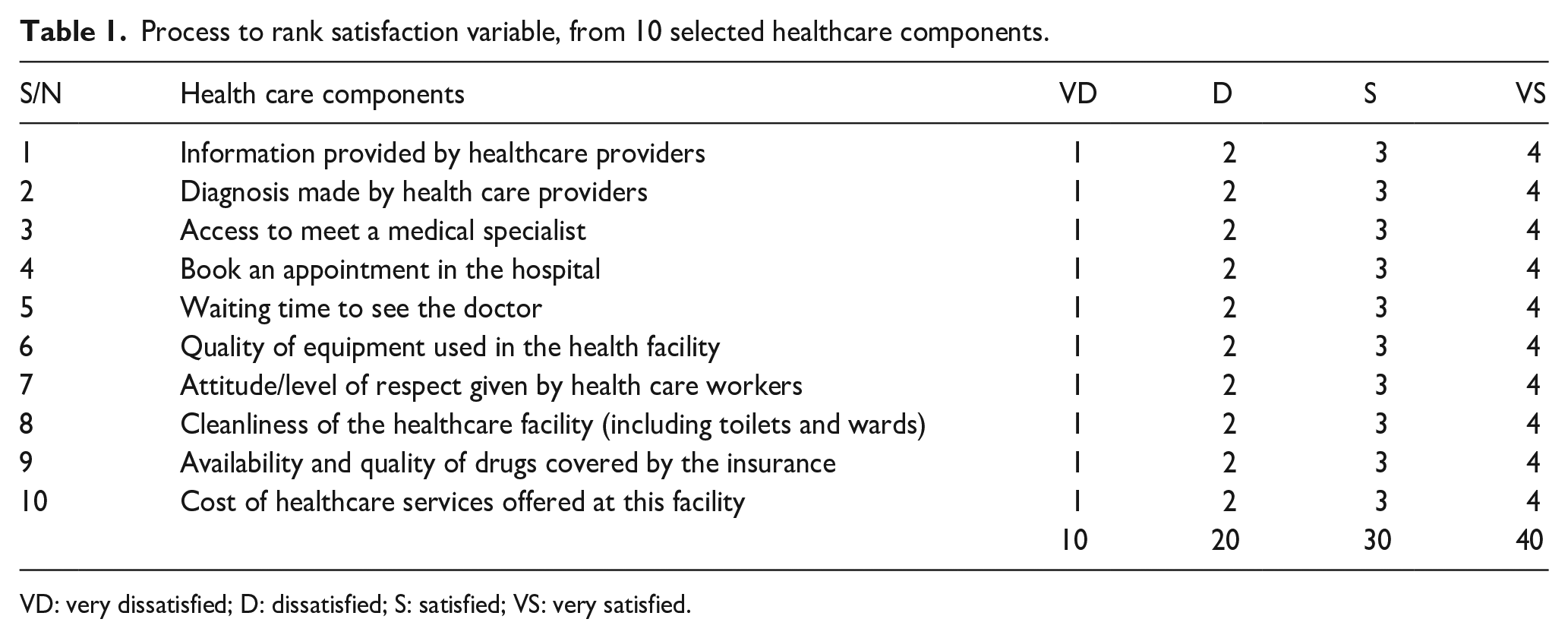
VD: very dissatisfied; D: dissatisfied; S: satisfied; VS: very satisfied.
To identify predictors of patient satisfaction, a chi-square analysis was conducted between dependent (satisfaction) and independent variables (sociodemographic characteristics).
A binary logistic regression test was utilized to compare satisfaction levels between insured and uninsured patients.
Furthermore, binary logistic regression was also computed to identify which of the 10 hospital variables were significantly associated with patients’ satisfaction.
Data analyses were performed using IBM SPSS Statistics version 26. 19 Statistical significance was set at a p-value of less than 0.05. Results were presented in tabular and graphical formats.
Results
The study comprised 385 participants, with 68.6% uninsured and 31.4% insured. The mean age was 39.37 ± 12.58 years. The majority were female (58.2%), aged 26–35 years (34.5%), employed in the private sector (28.6%), and holding an undergraduate degree (44.9%). Most participants were Christians, urban dwellers, with male household heads, earning less than 86 US dollars per month, and belonged to households with three to five members (Table 2).
Socio-demographic factors.

Overall satisfaction level
Based on the procedures described in Table 1 for determining overall satisfaction, it was found that 90.9% of the patients expressed satisfaction with the healthcare services provided by the hospital (Figure 1).

Overall satisfaction of study participants.
Difference in satisfaction level between insured and not insured patients
The level of patient satisfaction with health services among insured and not insured patients was also calculated and insured patients recorded a satisfaction of 98.3% and 87.5% for uninsured patients. A binary logistic regression was further calculated to obtain the odds ratio between satisfaction levels concerning insurance status. The results showed a statistically significant difference between satisfaction levels among the insured as compared to the non-insured. The patients with health insurance were 8.5 times more likely to be satisfied as compared to the not insured patients (95% CI 2.0–36.0; p = 0.0006).
This is illustrated in the Table 3 below.
Binary logistic regression of satisfaction level by insurance status.

indicates p-value < 0.05 indicating significance.
Individual healthcare variables influencing satisfaction levels with respect to insurance status
Out of the 10 distinct healthcare variables assessed, both insured and uninsured patients were most satisfied with the diagnosis provided by the healthcare providers. This was closely followed by the information supplied by the healthcare providers and the quality of the equipment they used. However, both insured and uninsured patients expressed the highest dissatisfaction with the waiting time to see a specialist (Figure 2).

Individual Satisfaction of the 10 health care services in the total population.
Chi-square analysis of 10 healthcare variables significantly associated with satisfaction levels
The 10 selected health component variables were subjected to a chi-square analysis to determine their significant associations with satisfaction levels.
The result showed significant associations between satisfaction levels and several factors, including information provided by health care providers, diagnosis, access to a medical specialist, ease of booking an appointment, quality of medical equipment, and cost of health care (Table 4).
Chi square analysis of 10 health care variables associated with satisfaction.

indicates p-value < 0.05 indicating significance.
Factors associated with satisfaction with healthcare services
A binary logistic regression analysis was performed to identify the factors that had a significant association with satisfaction levels. First, individual crosstab analysis was performed on all selected sociodemographic variables to determine which variables should be entered into our logistic regression model. Seven variables were ultimately chosen for inclusion in the logistic regression model. In addition, the cross tabs allowed us to choose which variable group would serve as the reference group in our model. The variable with the highest satisfaction was selected as the reference group.
In the analysis, variables with a p-value < 0.05 were considered significant. Odd ratios with 95% confidence intervals were used to assess the strength of factors associated with patient satisfaction with health services and insurance status.
Our analysis revealed several significant factors influencing patient satisfaction. Insured patients were significantly more satisfied than uninsured patients. Patients with higher education levels also reported greater satisfaction. Conversely, larger families (with more than five members) were more likely to report dissatisfaction. Finally, female patients reported higher levels of satisfaction than male patients. Variables such as age, income, and the presence of chronic disease did not show significant associations in the multivariable analysis. (Table 5).
Logistic regression analysis of factors associated with patient satisfaction.

indicates p-value < 0.05 indicating significance.
Discussion
Our study revealed that overall, most of our patients were satisfied with the healthcare services offered at Central Hospital Yaoundé (Figure 1). The statistics collected (Figure 2) revealed that both insured and uninsured patients expressed the highest levels of satisfaction with the accuracy of diagnoses, the quality of information provided by healthcare workers, and the standard of medical equipment. Further analysis (Table 4) included variables that impact patient satisfaction with healthcare services, including the convenience of scheduling an appointment, the ease of meeting a specialist, and the cost of maintaining health care. Central Hospital Yaoundé, with its status as a leading reference hospital, attracts patients from both within and beyond its immediate vicinity.
As one of the major public hospitals in Yaoundé and Cameroon, it is furnished with cutting-edge medical equipment and staffed by exceptionally skilled medical scientists. In contrast to other healthcare institutions, which frequently encounter deficiencies in medical staff, Central Hospital Yaoundé is able to sustain a fully staffed and competent workforce, so guaranteeing a steady and effective patient care. It often handles complicated cases and emergencies referred from smaller private hospitals that lack the required equipment or expertise, as a referral hospital. The extensive ability to deliver unique care in urgent circumstances greatly enhances patient trust and contentment with the services obtained. Collectively, these elements contribute to the hospital’s high levels of patient satisfaction with healthcare services.
In contrast, the factors that fueled dissatisfaction among both insured and uninsured patients were primarily long waiting times, cleanliness of facility, and the attitude of healthcare workers. Long waiting times are a common issue in many healthcare settings, particularly in busy public hospitals like Central Hospital Yaoundé, where high patient demand can often lead to delays in receiving care. Patients, whether insured or not, typically expect timely medical attention, and prolonged waiting can increase frustration and reduce overall satisfaction with the healthcare experience. This delay may also heighten anxiety, especially for patients seeking urgent care or dealing with discomfort, further amplifying dissatisfaction.
Our findings align with a study carried out in Bangladesh by Hasan et al. which stated that the increased waiting time to access health services significantly decreased patient satisfaction. 20
Additionally, studies show that the cleanliness of a healthcare facility and the attitude of healthcare workers play a critical role in shaping patients’ perceptions of care quality. 21 Even when medical treatment is effective, negative interactions with staff, such as perceived rudeness, lack of empathy, or poor communication can overshadow the benefits of clinical outcomes.
Patients expect not only medical expertise but also compassionate and respectful treatment, and when healthcare workers fall short in this regard, it can leave a lasting negative impression. In both insured and uninsured patients, dissatisfaction with healthcare services is often a reflection of these interpersonal dynamics and the emotional toll of waiting for care, regardless of the technical quality of the treatment they ultimately receive.
That notwithstanding, binary logistic regression analysis (Table 3) exposed that insured patients were 8.5 times more likely to be satisfied with the quality of these services as opposed to uninsured patients. The binary logistic regression (Table 5) found that insurance status was also a strong independent predictor of patient satisfaction. This discrepancy in satisfaction can be attributed to several factors.
First, insured patients likely experience less financial burden when accessing healthcare services, as insurance coverage typically offsets or reduces out-of-pocket expenses.
This financial security enables them to seek timely and more comprehensive care, leading to higher satisfaction. Additionally, insured patients often have faster access to medical specialists, diagnostic tests, and higher-quality treatment options, which may not be readily available to uninsured patients.
Consequently, insured patients are more likely to feel that their healthcare needs are met effectively, leading to significantly higher satisfaction levels compared to uninsured patients.
Our study’s findings contrast with a similar study conducted by Duku et al. on the perceptions of healthcare quality in Ghana. In their study, insured patients reported lower satisfaction with healthcare services compared to uninsured patients. Moreover, previously insured individuals exhibited an even greater decline in their perception of healthcare quality. 22 This discrepancy was attributed to the experience of insured patients under Ghana’s National Health Insurance Scheme (NHIS), where longer waiting periods resulted from processing insurance claims. Uninsured patients, on the other hand, paid out-of-pocket, which led to quicker access to care and shorter waiting times.
Furthermore, two distinct Ugandan studies offer contrasting perspectives on patient satisfaction. The research by Tindyebwa et al. in Kampala examined private health insurance expectations, 23 finding that uninsured patients displayed higher satisfaction due to lower service expectations. Conversely, the Kisiizi Hospital study in Rukungiri District 24 revealed that uninsured patients reported higher satisfaction levels, attributed to their appreciation of basic services despite potentially limited resources, challenging conventional assumptions about healthcare satisfaction.
In contrast, our study in Cameroon found that insured patients were significantly more likely to be satisfied with their healthcare services compared to uninsured patients. This increased satisfaction among insured patients can be attributed to the financial relief provided by insurance, which reduces the economic burden of healthcare costs and offers access to better services and advanced medical equipment. These contrasting results underscore the importance of considering how insurance structures, patient expectations, and the quality of care interact to influence satisfaction levels in different healthcare settings.
On the other hand, the findings from a study conducted by Shure et al. at Deder General Hospital in eastern Ethiopia 25 and that of Rad et al. in Southern Ethiopia 10 as well align closely with the results of our study. In both studies, insured patients reported higher levels of satisfaction with healthcare services compared to their uninsured counterparts. This similarity underscores a common trend where insurance significantly enhances patient satisfaction.
In the studies from Ethiopia, insured patients experienced greater satisfaction, which was associated with several positive factors, including reduced financial burden and access to a higher standard of care. These findings are consistent with our results, where insured patients also reported greater satisfaction. In both settings, insurance appears to play a crucial role in improving the patient experience by alleviating the financial pressures of healthcare costs and facilitating access to better quality services and advanced medical equipment. The correlation between insurance status and satisfaction in both studies highlights the benefits of having insurance coverage. For insured patients, the relief from out-of-pocket expenses and the assurance of comprehensive care contribute significantly to their overall satisfaction. Settings.
The findings from the study conducted in Bantul, Indonesia, reveal a notable similarity with our results as well. In this study, a significant statistical difference in patient satisfaction levels between insured and uninsured patients was observed, with insured patients being 34.76 times more satisfied than those without health insurance. 26 This stark contrast highlights the substantial impact of insurance on patient satisfaction.
The significant increase in satisfaction among insured patients in Indonesia, as reflected by the 34.76-fold difference, also underscores the positive influence of insurance on the healthcare experience. This trend is consistent with our findings, where insured patients also exhibited notably higher levels of satisfaction, attributable to the financial relief and access to superior care provided by their insurance coverage.
Our study went ahead to analyze which factors significantly influenced patient satisfaction with healthcare services. This analysis revealed that larger families, defined as households with more than five members, were significantly more likely to report dissatisfaction with healthcare services. Moreover, insured patients, those with a university level of education, and females reported greater satisfaction (Table 5).
This finding suggests that several underlying factors, such as financial strain, time constraints, and resource scarcity, may contribute to the dissatisfaction experienced by these families. Larger families often face greater financial burdens, making it more challenging to manage healthcare-related expenses, including the cost of treatments, medications, and transportation to and from the hospital. These compounded pressures can negatively affect the overall healthcare experience, as family members may delay or forego care due to cost concerns, further exacerbating their dissatisfaction.
Similar studies provide context to our findings. For instance, a study conducted in Kenya found that larger households often reported lower levels of satisfaction due to financial challenges in accessing healthcare services, particularly in rural areas where resources are limited. 27 This study supports the notion that financial strain is a significant factor for larger families, as it can hinder access to adequate healthcare and contribute to dissatisfaction.
Our results showed that education level is significantly associated with satisfaction where patients with higher education were nearly three times more likely to be satisfied compared to those with lower education. This could be attributed to the fact that higher education may have enabled patients to navigate the healthcare system more effectively and better communicate their needs, leading to increased satisfaction. Additionally, educated patients may have a greater understanding of the constraints faced by healthcare providers, fostering realistic expectations.
A study by Babatola et al. in Nigeria corroborated our findings, revealing that urban, educated patients demonstrated higher healthcare satisfaction. 28 While this study aligns in recognizing the impact of education, they diverged in family size considerations, our research showed larger families experienced higher dissatisfaction, potentially due to financial pressures and resource constraints, whereas the Nigerian study did not find family size to be a significant factor.
In contrast to our findings, a study by Jafari Kelarijani et al. in Mazandaran province, Iran, revealed that patients with higher education levels demonstrated lower satisfaction, attributed to their elevated expectations of healthcare services. 29 This divergence highlights the complex and context-specific nature of patient satisfaction across different healthcare settings and cultural contexts.
Lastly, our findings indicated that female patients were more likely to report higher satisfaction, a trend challenged by Ahmed et al.’s study, which revealed that females were less satisfied with healthcare access and quality due to lower trust and confidence. 30 This contrasting research underscores the nuanced and variable nature of gender-related patient satisfaction across different healthcare contexts.
The discrepancy between these findings highlights how various factors can vary in their impact on patient satisfaction depending on the specific healthcare context. This underlines the need for healthcare facilities to tailor services to the unique needs of their populations.
Strengths and limitations of study
This study has several strengths that offer valuable implications for both clinicians and policymakers, especially within the Cameroonian healthcare context. By addressing the significant gap in research on patient satisfaction from the perspectives of both insured and uninsured patients, an area with limited prior study in Cameroon, the findings provide a more holistic understanding of patient experiences with healthcare services. This dual focus allows for a more nuanced approach to improving healthcare services, offering insights that are critical for tailoring interventions to the unique needs of different patient groups.
For clinicians, the study highlights key factors that influence patient satisfaction, such as family size, insurance status, and access to healthcare resources. By recognizing that uninsured patients and larger families are more likely to be dissatisfied, healthcare providers can adjust their services and communication strategies to better meet the needs of these vulnerable groups.
From a policy perspective, the study underscores the importance of expanding health insurance coverage and addressing the disparities between insured and uninsured patients. The fact that insured patients are eight times more likely to be satisfied indicates that increasing access to insurance can significantly enhance patient satisfaction. Policymakers can use this data to drive reforms that strengthen insurance programs, improve resource allocation, and ensure equitable access to quality healthcare services.
While this study offers valuable insights into the socio-demographic factors influencing patient satisfaction with healthcare services, an area with limited research in Cameroon, it’s important to acknowledge that the cross-sectional design restricts the ability to determine cause-and-effect relationships, meaning the findings should be interpreted with a degree of consideration. Since the study captures a snapshot of associations at one point in time, further research is needed to explore how these relationships may evolve or interact over time. Despite this limitation, the study provides a solid foundation for future work in this area.
Conclusion
Our study demonstrates that a significant majority of 90.9% of patients, including both those with insurance and those without, expressed complete satisfaction with the services provided by Central Hospital Yaoundé however insured patients experienced significantly higher levels of satisfaction compared to uninsured patients.
This disparity is attributed to the financial relief and improved access to comprehensive care provided by insurance coverage. While both insured and uninsured patients reported high satisfaction with diagnoses, information quality, and medical equipment, common issues such as long waiting times, facility cleanliness, and healthcare worker attitudes negatively impacted patient satisfaction across the board. Our study revealed key determinants of patient satisfaction, highlighting the significant roles of insurance status, education level, and gender, with insured, highly educated females more likely to report positive experiences. Conversely, larger families demonstrated increased dissatisfaction, likely due to complex socioeconomic pressures and resource constraints.
These findings underscore the importance of addressing systemic challenges, such as waiting times and facility maintenance, to enhance the overall patient experience. Expanding health insurance coverage could further improve satisfaction by reducing financial burdens and enhancing access to quality care. Future research should explore the dynamic nature of these relationships over time to better inform healthcare policies and practices. In addition, promoting patient education and ensuring gender-sensitive healthcare services can further enhance satisfaction.
It would also be valuable to consider conducting intervention studies to assess the effectiveness of targeted strategies aimed at improving satisfaction, particularly for larger families and uninsured individuals. Exploring these areas could offer deeper insights and contribute to the development of more effective strategies to enhance patient satisfaction and overall healthcare quality.
Significance for public health
The research conducted at Central Hospital Yaoundé provides significant insights into the factors influencing patient satisfaction, particularly distinguishing between insured and uninsured individuals. The study highlights the higher satisfaction levels among insured patients due to reduced financial burden and easier access to healthcare services. Additionally, it reveals the challenges faced by both insured and uninsured patients, such as long waiting times, cleanliness, and healthcare worker attitudes, which impact overall satisfaction. By addressing these systemic issues and expanding health insurance coverage, policymakers can significantly improve healthcare accessibility and quality. Furthermore, the study revealed key determinants of patient satisfaction, highlighting the significant roles of insurance status, education level, and gender, with insured, highly educated females more likely to report positive experiences. Conversely, larger families demonstrated increased dissatisfaction, likely due to complex socioeconomic pressures and resource constraints. This emphasizes the need for tailored interventions to address the unique challenges faced by larger households. Overall, the findings offer valuable implications for improving healthcare delivery, patient experience, and policy reform in Cameroon, contributing to the broader goal of achieving Universal Health Coverage.
Footnotes
Acknowledgements
The authors are grateful to Enow Abunaw Pauline, Dr. Raymond Chinedum Nge, Eba Marvlyn, Fenangi Chiara Nainkwi, Patrick Loweh Aciin, Prof Dr. Yücel Demiral, and Doç. Dr. Cemal Hüseyin Güvercin in the realization of this project.

Ethical considerations
Administrative authorization was gotten from the Yaoundé Central Hospital on the 25th of May 2022. Next, ethical approval was obtained on the 6th of June 2022, from the Dokuz Eylul University, Faculty of Health Sciences, Ethics Committee (Decision No: 2022/20-19).
Consent to participate
All participants were provided with a written informed consent. The ethical principles which was adhered to at all times during the study are those stated in the Declaration of Helsinki, 31 which was developed by the World Medical Association for medical research involving human participants.
Author contributions
ANC initiated and wrote the main manuscript. NJLN assisted in the data analysis. AK proof read the manuscript. BK supervised the writing of the manuscript. All authors reviewed the manuscript.
Funding
The author(s) received no financial support for the research, authorship, and/or publication of this article.
Declaration of conflicting interests
The author(s) declared no potential conflicts of interest with respect to the research, authorship, and/or publication of this article.
Data availability statement
All information and data for this research will be made available upon request.