




Abstract
Background:
This study aimed to determine the association between self-medications with nonsteroidal anti-inflammatory drugs (NSAIDs) and the purchase of branded and over-the-counter medications in Peru.
Design and methods:
This secondary analysis used a representative survey of Peru from 2014 to 2016. The exposure variable was self-medication with NSAIDs, defined as “the purchase of NSAIDs for oneself without a prescription.” The outcome was the purchase of branded and over-the-counter medications. Crude prevalence ratios (cPR) and adjusted prevalence ratios (aPR) with their respective 95% confidence intervals (95% CI) were calculated.
Results:
Of the total of 2158 participants, 52.80% were women with an average age of 40.24 years. The prevalence of self-medication with NSAIDs was 68.21%, whereas the rates of purchasing branded and over-the-counter medications were 63.78% and 13.16%, respectively. The adjusted Poisson regression analysis showed an association between self-medication with NSAIDs and the purchase of branded (aPR = 1.18; 95% CI: 1.12–1.25; p < 0.001) and over-the-counter (aPR = 2.38; 95% CI: 1.95−2.90; p < 0.001) medications.
Conclusions:
Approximately 7/10 users who self-medicate with NSAIDs chose branded medications, whereas nearly 1/5 opt for over-the-counter medications. Self-medication with NSAIDs was associated with a higher likelihood of purchasing branded and over-the-counter medications.
Introduction
Nonsteroidal anti-inflammatory drugs (NSAIDs) are the most used medications worldwide and in Peru given their easy availability without the need for medical prescription1,2 and well-known analgesic, anti-inflammatory, and antipyretic effects.3–5 This trend significantly affects the pharmaceutical market and the monitoring of patients’ consumption habits. 6 In addition to their benefits, they have harmful adverse effects when used inappropriately. 7 Despite this, the prevalence of polypharmacy and inappropriate self-medication with NSAIDs remains high.1,8
Several factors affect the choice of medicines, and advertising by pharmaceutical industries is a significant driver 9 as they heavily invest in marketing to promote product sales. 10 In addition to fewer adverse effects, this choice may be linked to the perception of safety, trust, quality, and effectiveness associated with the brand. 11
Another factor to consider is whether the chosen medication is generic or branded, with cost considerations playing a key role. In the United States, dispensing branded medications incurred an incremental annual cost of $270 million for patients compared to their generic equivalents. 12 This cost could increase in the coming years, as prices for the most commonly used branded medications have doubled in the last 5 years. 13 This could affect therapy adherence and interruption caused by increased out-of-pocket spending, 14 unlike the use of generic medications, which has been associated with better adherence probably owing to their costs. 15 In developed countries, prescription medications are replaced by over-the-counter medications, potentially affecting patients’ out-of-pocket expenses. However, there is concern about their use given the higher frequency of adverse effects and less followup,16,17 particularly in self-medicating individuals. 18 These adverse effects include risk of gastric and small intestinal mucosal lesions, cardiovascular disease, kidney injury, hepatotoxicity, intracerebral hemorrhage, or respiratory tract inflammation and infection. 3 However, NSAIDs may be relatively safe when prescribed at a low dose and shortest time (≤10 days). Exceptions would be for patients at risk of developing NSAID-exacerbated respiratory diseases and patients with prior myocardial infarction who are receiving antithrombotic therapy, asthma, and history of renal disease. 19
Several studies have shown the characteristics of NSAID use among the general and vulnerable populations, as well as self-medication.20–24 To the best of our knowledge, no study has evaluated the choice of branded or over-the-counter medications among patients who self-medicate with NSAIDs. Peru, similar to other South American countries, has a fragmented health system, and restrictions on access to health services. 25 This forces users to seek other alternatives to solve their ailments, such as home remedies or self-medications. 26 Therefore, older adults prefer branded medications instead of over-the-counter ones, 27 which could be also observed in the case of NSAIDs. Therefore, this study aimed to determine the association between self-medication with NSAIDs and the purchase of branded and over-the-counter medications among Peruvian users.
Methods
Study design
This is a cross-sectional analytical observational study through the secondary analysis of the fourth questionnaire of the National Health User Satisfaction Survey 2014–2016 (ENSUSALUD) of the National Institute of Statistics and Informatics of Peru and the National Superintendency of Health of Peru (SUSALUD). ENSUSALUD was a nationally representative survey that aimed to obtain information on the functioning of Health Service Providing Institutions (IPRESS) based on the information provided by users and providers of said services. 28
Population, sample, and sampling
The study population consisted of people aged ≥15 years who purchased medications for themselves, their partner, or their child at a pharmacy or drug store near IPRESSs nationwide. 28 Two-stage probabilistic stratified sampling was conducted at 181 IPRESSs. 28
The primary sampling units were the IPRESSs of the Ministry of Health and regional governments (MINSA-GR), Social Health Insurance in Peru (EsSalud), Health Services of the Armed and Police Forces (health services), and private sector clinics (CSP), which were randomly selected. The secondary unit was the users of pharmacies and drug stores who were chosen nonprobabilistically by convenience. 28 In total, 25 strata correspond to the 25 political regions of Peru based on which the expansion factors were estimated. Inference was limited to care in the outpatient medical consultations of IPRESSs within the country.
Eligibility criteria
All participants aged >18 years who had purchased at least one NSAID for themselves at a pharmacy or drug store close to a healthcare facility were included. Participants who had missing data on some of the variables of interest were excluded (Figure 1).

Flowchart of the selection of participants included in the analysis, ENSUSALUD 2014–2016.
Variables
Two outcomes were considered: the use of branded NSAIDs, defined as “the purchase of at least one branded NSAID,” and the use of over-the-counter medications, also defined as “the purchase of at least one over-the-counter medication.” Both variables were constructed from the registry of medicines purchased by users and were classified using the Pharmaceutical Products Health Registry of Peru (https://www.digemid.minsa.gob.pe/rsProductosFarmaceuticos/). For both variables, duplicate coding was corrected by a third author as performed previously in other studies.27,29,30 In Peru, all medications are authorized by the Ministry of Health. According to their name, they are marketed as branded or generic medications: branded drugs use a name assigned by a pharmaceutical company, whereas generics are named by the drug’s active ingredient. Furthermore, the condition of sale, such as controlled or over-the-counter sale, refers to the need for a medical prescription or lack thereof. According to Peruvian law, doctors, dentists, and obstetricians are healthcare professional qualified to issue a medical prescription.
The main exposure variable was the practice of self-medication, which considered participants who purchased medications for themselves without a prescription and those who did not show the prescription at the time of the survey, as described in previous studies.27,29
According to the literature, the following as confounding variables were considered: sex (female or male), age (18–39, 40–59, or ≥60 years), educational level (higher university, higher nonuniversity, high school, primary, or lower), language (Spanish or Quechua/others), health insurance (yes or no), type of institution (drug store or pharmacy), and geographic region of residence (metropolitan Lima, other regions of the coast, mountains, or jungle).
Ethical aspects
ENSUSALUD is a free, open-access database that belongs to the SUSALUD service (http://portal.susalud.gob.pe/blog/category/base-de-datos/). All potential participants provided verbal consent to participate in the survey. No identifying information was collected from participants to ensure the confidentiality of their responses. Furthermore, this study involved a secondary analysis of free data without personal identifiers that comply with international regulations; thus, it is exempt from ethics committee review.
Statistical analysis
The ENSUSALUD databases corresponding to the period from 2014 to 2016 were downloaded in SPSS format and then exported and analyzed using STATA v16.0 software (TX, StataCorp LP). All sampling patterns were analyzed according to stratum and weighting factor, considering the complex sampling design of ENSUSALUD and using the svy command.
In the descriptive analysis, categorical variables are expressed as frequencies and percentages with their respective 95% confidence intervals (95% CIs). Numerical variables are presented as averages with their 95% CIs. The chi-square test with Rao Scott correction for complex sampling was used to determine significant differences between the independent variables according to the proposed outcomes.
Generalized linear models of the Poisson family were made to determine the association between self-medication with NSAIDs and the purchase of branded and over-the-counter medications, and prevalence ratios with their respective 95% CIs were reported. An adjusted analysis was performed considering the confounders and based on an epidemiological criterion. To evaluate collinearity, the variance inflation factors were determined by setting an accepted value at <5. A p-value of <0.05 was set as significant.
Results
This study analyzed a sample of 2158 adults who purchased NSAIDs for themselves (Figure 1). Of these, 52.80% were women, the mean age was 40.24 (95% CI, 39.61−40.87) years, 39.42% lived in the jungle, and 37.36% had secondary education. Furthermore, 62.03% had health insurance, and 85.00% bought their medications at pharmacies. The frequencies of self-medication with NSAIDs, purchase of branded medications, and purchase of over-the-counter medications were 68.21%, 63.78%, and 13.16%, respectively (Table 1).
General characteristics of users of drugstores and pharmacies, ENSUSALUD 2014–2016 (n = 2158; N = 634,464).

Weights and the design effect of the complex survey sampling were included.
Among patients who self-medicated with NSAIDs, a higher proportion of participants self-medicated with branded (66.20%) and over-the-counter medications (16.23%) and among participants aged 18–39 years (60.36%). Conversely, a lower proportion of those had health insurance (58.33%) and purchased their medications at a pharmacy (84.69%). Furthermore, the highest and lowest proportions of participants who self-medicated resided in the jungle (42.8%) and mountains (13.26%), respectively (Table 2).
General characteristics of users of drugstores and pharmacies according to self-medication.

Weights and the design effect of the complex survey sampling were included.
Refers to the statistical significance obtained from the comparison of the proportions between the categories of the variables considering the complex sampling of the survey.
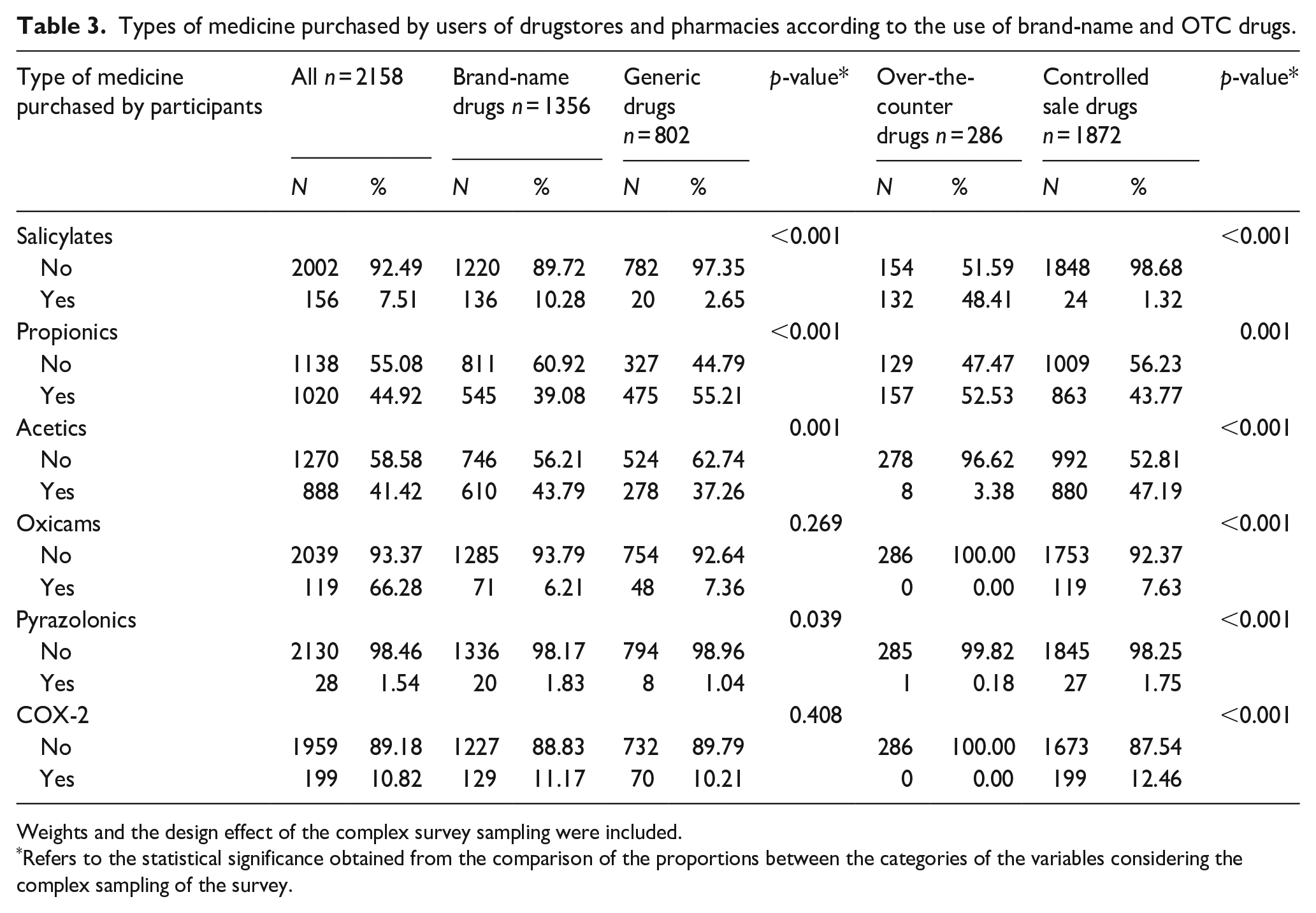
The most frequently acquired NSAIDs were oxicams (66.28%), propionics (44.92%), and acetics (41.42%; Table 3). According to NSAID types, the proportions of self-medicating users of propionics (49.90% vs 34.25%; p < 0.001) and salicylates (8.64% vs 5.10%; p < 0.001) were higher. In contrast, the proportions of self-medicating users of acetics (38.54% vs 47.61%; p < 0.001), COX-2 (6.90% vs 19.24%; p < 0.001), oxicams (4.81% vs 10.52%; p < 0.001), and pyrazolones (1.54% vs 2.11%; p = 0.002) were lower (Table 2). Moreover, salicylates (10.28% vs 2.65%; p < 0.001), acetics (43.79% vs 37.26%; p = 0.001), and pyrazolones (1.83% vs 1.04%; p = 0.039) were more likely to be purchased as branded medications compared with propionics (39.08% vs 55.21%; p < 0.001; Table 3).
Types of medicine purchased by users of drugstores and pharmacies according to the use of brand-name and OTC drugs.
Weights and the design effect of the complex survey sampling were included.
Refers to the statistical significance obtained from the comparison of the proportions between the categories of the variables considering the complex sampling of the survey.
Furthermore, salicylates (48.41% vs 1.32%; p < 0.001) and propionics (52.53% vs 43.77%; p = 0.001) were more likely to be purchased as over-the-counter medications compared with controlled sales. Conversely, acetics (3.38% vs 47.19%; p < 0.001), oxicams (0.00% vs 7.63%; p < 0.001), pyrazolones (0.18% vs 1.75%; p < 0.001), and COX-2 (0.00% vs 12.46%; p < 0.001) were less likely to be purchased as branded drugs (Table 3).
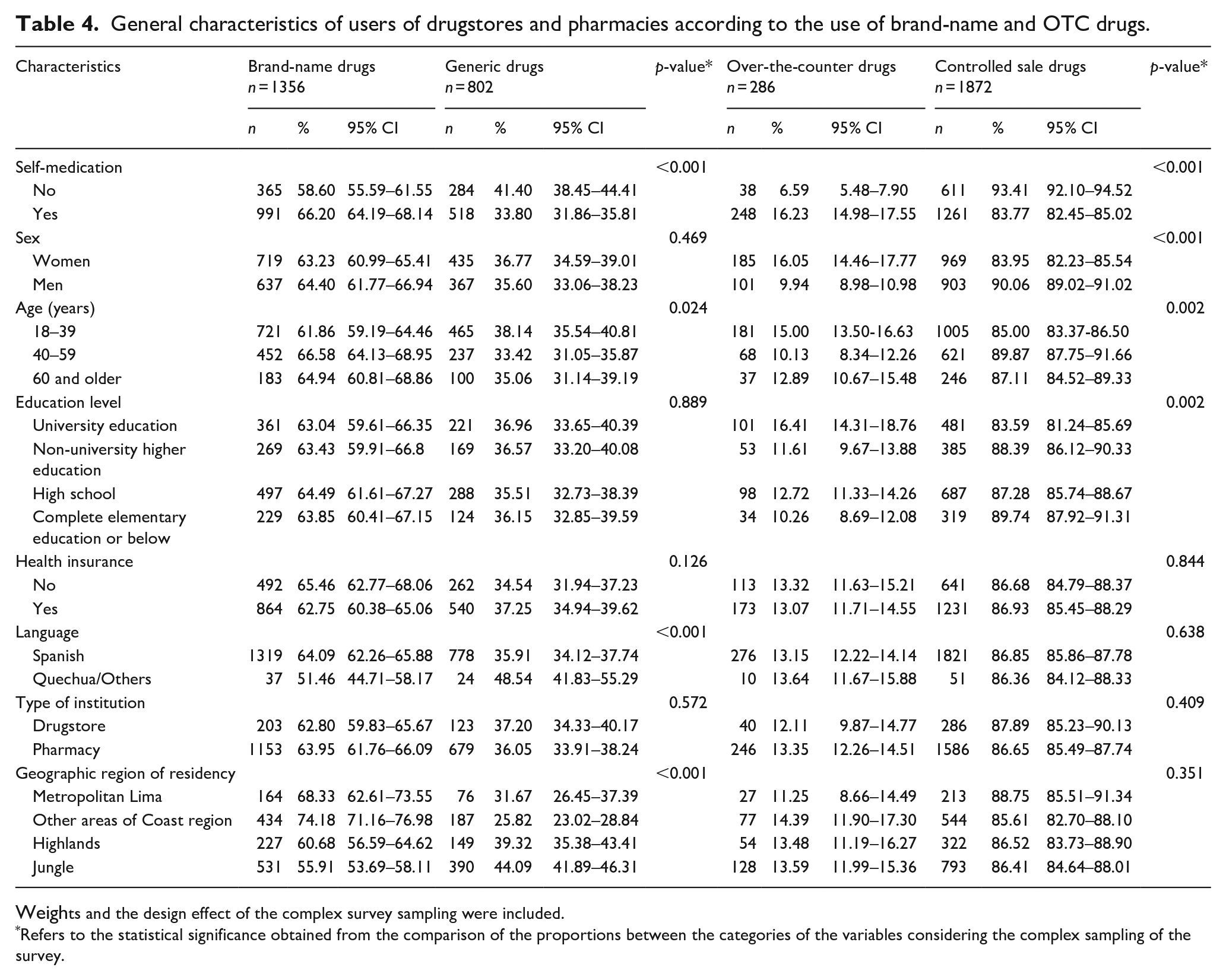
Branded NSAIDs were more frequently purchased by self-medicating participants (66.20%), those aged 40–59 years (66.58%), and those who resided in other coastal areas (74.18%) than by those who lived in the jungle (55.91%; p < 0.001). The purchase was lower among those who spoke Quechua or other languages than those who spoke Spanish (51.46% vs 64.09%; p < 0.001; Table 4). As for the over-the-counter NSAIDs, the purchase rate was higher among those who self-medicated (16.23%), those aged 18–39 years (15.00%), and those with a university education (16.41%). However, men had a lower purchase rate than women (9.94% vs 16.05%; p < 0.001; Table 4).
General characteristics of users of drugstores and pharmacies according to the use of brand-name and OTC drugs.
Weights and the design effect of the complex survey sampling were included.
Refers to the statistical significance obtained from the comparison of the proportions between the categories of the variables considering the complex sampling of the survey.
A significant association was found between self-medication with NSAIDs and the purchase of branded medications in the crude (crude prevalence ratios [cPR]: 1.13; 95% CI: 1.07−1.19; p < 0.001) and adjusted (aPR: 1.18; 95% CI: 1.12−1.25; p < 0.001) analyses. A greater probability of purchasing over-the-counter medications was found among those who self-medicated in the crude (cPR: 2.46; 95% CI: 2.01−3.01; p < 0.001) and adjusted (aPR: 2.38; 95% CI: 1.95−2.90; p < 0.001) analyses (Table 5).
Association between self-medication with NSAIDs and the use of brand-name and OTC drugs in users of drugstores and pharmacies.

A generalized linear model of the Poisson family was carried out with link log considering the effect of the design and the weights of the complex sampling of the survey.
Adjusted for age, sex, education level, language, health insurance, geographic region of residence, and type of institution.
Discussion
This study primarily reveals that 7 out of 10 participants self-medicated with NSAIDs, predominantly opting for propionics and salicylates. It was more common for them to self-medicate with branded NSAIDs; in those cases, acetics, salicylates, and pyrazolones were more common. Finally, an association was found between self-medication with NSAIDs and the purchase of branded and over-the-counter medications.
The frequency of self-medication with NSAIDs was similar to that reported in most investigations in other countries. In a narrative review that conducted a systematic search in various databases and found 24 articles related to self-medication with NSAIDs, the prevalence of self-medication was >50% in 70.3% of articles, whereas the prevalence was <50% in 25% of articles. 31 The discrepancies were attributed to the differences in the sociodemographic characteristics of the samples, study methods, populations, and data collection instruments. 31
Regarding the NSAID types, the review proposed that the most purchased drugs for self-medication were ibuprofen, diclofenac (25% of articles), and aspirin (16.65% of articles). 31 This is consistent with our results, where propionics and salicylates were the most purchased in both generic and branded medications. Although our results do not explain this choice, it may be related to the reasons behind purchasing these medications. In 41.67% of the articles, NSAIDs were used to relieve headaches; in 20.83%, they were used for menstrual cramps; and in 16.67%, they were used to relieve fever and toothache. 31 Briefly, NSAIDs are used to manage health issues that individuals may not consider requiring medical consultation, often due to the “habitual” nature of self-medication. This tendency could also explain the preference for over-the-counter NSAIDs as observed in this study. Although some NSAIDs in Peru require a medical prescription, the supervision is lax, and practically all are available over-the-counter, where the purchasing decision may be influenced by advertising. A study conducted in metropolitan Lima revealed that 70% of their respondents indicated that advertising influences their decision to purchase NSAIDs at the pharmacy. 32
Furthermore, our results show sex differences in self-medication with over-the-counter NSAIDs, with women purchasing them the most. This is inconsistent with the results of another study performed in our country, which revealed that men were generally associated with self-medication. 2 A possible explanation could include the most frequent reasons for NSAID use that are more common among women, such as menstrual cramps and headache. 31 In addition, the age-adjusted incidence of pain of any type is higher among women. 33 Similarly, patients with higher education levels tended to use over-the-counter medications, which, although other studies have shown similar results, 34 is not a universal finding. 35 Although we did not examine the reasons for these findings, other authors propose that individuals with higher educational levels tend to have better health knowledge about diseases and medications, higher self-confidence in making appropriate decisions about self-medication, and less faith in the quality of formal health services. 34
The improvement of universal insurance coverage in Peru has increased the likelihood of receiving care at a health facility. 36 Although out-of-pocket spending remains a public health problem, 37 this improvement enhanced access to NSAIDs, as indicated by the results of this study. However, these improvements are not homogeneous, with some gaps still unresolved in some regions such as the jungle, 38 with the highest proportion of people self-medicating with NSAIDs. Interestingly, the lowest self-medication rate was observed in mountainous regions, even if both regions are generally associated with self-medication. 2 The unique use of traditional medicines for conditions typically treated with NSAIDs could influence these findings, 39 as well as whether self-medication is self-perceived as being responsible or not. 40
This study showed that 7 out of 10 people who self-medicate with NSAIDs prefer branded medications. Although we did not explore the reasons behind these preferences, they may be attributed to the demand for branded medications as a result of the limited availability of generic medications at healthcare facilities. 41 Furthermore, the sales strategies of private pharmacies, which prioritize the marketing of branded products, along with the prevalent perception that generic medications are inferior to branded ones, may affect this choice. 42 Moreover, there is distrust in the use of generic medications, mainly due to concerns regarding their therapeutic effect, potency, or adverse effect. 43 In Peru, they are perceived as less effective and more likely to have side effects, and branded medications are preferred even if they have the same price as the generic ones. 11 This preference for branded medications is often associated with lower levels of health literacy and education. 44 Conversely, the preference for generic medications is associated with the perception of a mild illness, self-initiated treatment, or individuals feeling adequately informed about these drugs. 45 As in self-medication in general, advertising can also influence their choice 32 and is aimed at populations with more purchasing power. This could explain our finding that patients from the jungle or those speaking indigenous languages, which are traditionally vulnerable populations, 46 tend to purchase fewer branded NSAIDs.
The present results have implications for public health, highlighting the widespread and indiscriminate use of NSAIDs, which poses a significant challenge to healthcare systems worldwide. This indiscriminate use is associated with the risk of serious or life-threatening complications 47–49; thus, policies are needed to mitigate their overuse. Although self-medication is the problem, medical consultations offer an opportunity to educate patients about the adverse effects of NSAIDs 50 and inform them about reports from pharmacovigilance services regarding identified adverse effects. 51 Furthermore, concerns are increasing about the purchase of commercial medications at the expense of generic ones, requiring a policy aimed at facilitating their purchase. The “Reference Prices” methodology is used in European countries, where the government’s health system calculates and finances each medicine according to this criterion. If a medical prescription includes a drug with higher price, the pharmacist is obligated to replace it with a generic one. 52 However, in countries such as Peru, where laboratories encourage self-medication and invest high amounts in advertising, 10 control and regulations have begun in the last decade. Therefore, the list of essential generic drugs was recently modified, and they must be available in pharmacies, drug stores, and private services. 53
Limitations
This study has some limitations. First, given the secondary cross-sectional design, it is not possible to establish a causal relationship between self-medication with NSAIDs and the proposed outcomes. However, an epidemiological approach was followed to adjust for confounders. Second, many variables were obtained from participants’ self-report. However, the questions were asked at pharmacies and drugstores after participants had purchased their medications, which could reduce selection bias. Third, unmeasured variables, comorbidities such as chronic pain, which forced continuous use of NSAIDs, or socioeconomic status and limited the use of health insurance and forced self-medication, must be considered. Fourth, the results were influenced by manner by which the survey collected information on the two main variables. Despite these limitations, this study provides information representative of the Peruvian population.
Conclusions
This study revealed a widespread and indiscriminate use of NSAIDs in Peru; most of it was with the purchase of branded medications. Thus, patients must be educated about the adverse effects of NSAIDs and policies aimed at facilitating the purchase of generic drugs.
Significance for public health
This study aimed to determine the association between self-medication with nonsteroidal anti-inflammatory drugs (NSAIDs) and the purchase of branded and over-the-counter medicines in Peru to gain a deeper understanding of the factors that influence the treatment decisions of the Peruvian population. Data from 2158 participants were analyzed, the prevalence of self-medication with NSAIDs was 68.21%, and the rate of purchase of branded medicines was 63.78%. Prevalence data of self-medication are crucial for the design of public health interventions and policies that promote safe and effective use of medicines while addressing challenges related to accessibility, affordability, and confidence in generic products. By identifying gaps in health knowledge and practices, this study can help inform educational programs aimed at improving health literacy and promoting healthier behaviors in the Peruvian population.
Footnotes
Consent to participate
All potential participants provided verbal consent to participate in the survey
Declaration of conflicting interests
The author(s) declared no potential conflicts of interest with respect to the research, authorship, and/or publication of this article.
Funding
The author(s) received no financial support for the research, authorship, and/or publication of this article.
