




Abstract
Background:
The high number of smokers in Indonesia, including adolescents, causes high morbidity due to smoking. Reducing the incidence of smoking-related disease in Indonesia needs to be done by reducing the number of smokers. This can be done by preventing smoking as early as possible, including during adolescence. The study aimed to assess the prevalence of adolescent male smokers and determine the social environment and facility support that influences smoking behavior in adolescent males aged 15–18 years in Surabaya, Indonesia.
Design and method:
A cross-sectional study was performed from 1st October 2021 to 31st January 2022 on adolescent males aged 15 to 18 from senior high schools in Surabaya. 369 respondents completed a self-administered questionnaire about social environment and facility support that influence smoking behavior. The questionnaire result of the questionnaire was computed using bivariate analysis to examine the relationship between social environment, facility support, and smoking behavior.
Result:
Of the 369 eligible participants, 95 (25.7%) were smokers, while the remaining 274 were not. The factors affecting smoking among adolescents were families influence (p = 0.000; PR = 4.805; CI = 2.923–7.900), friends influence (p = 0.000; RP = 3.987; CI = 2.4906.383), and advertisements influence (p = 0.000; RP = 3.137; CI = 2.275–4.325). Facility support was not found to be too influential (p = 0.399; RP = 0.767; CI = 0.472–1.245). Familia influence was the strongest factor in smoking among adolescent males aged 15 to 18.
Conclusions:
Integrated programs and policies are needed to prevent and rehabilitate adolescents from smoking behavior. Improving their understanding of the health impacts of smoking is also needed.
Introduction
Smoking causes various health problems, such as tuberculosis (TB) and cancer, among others.1,2 Smoking at a young age can also be a dominant factor in the occurrence of chronic obstructive pulmonary disease. 3 Moreover, smoking can cause an increase in cardiovascular diseases, such as stroke, which will also increase disability-adjusted life years (DALYs). 4 In 2019, the tobacco use prevalence among adolescents across 133 countries reached 19.33%. 5 Indonesian Basic Health Research in 2018 reported a 9.1% smoking prevalence among adolescents at the age of 10 to 18 years. This number was higher than that in Indonesian National Health Indicator Survey in 2016 (8.8%) and Indonesian Basic Health Research in 2013 (7.2%). 6
A previous study showed that 50% of Indonesia’s population smoked cigarettes from the age of 15 to 19 years, and 30% of the population in Surabaya aged at least 10 years had smoked. 7 A previous study reported that several factors contribute to the high number of adolescents who smoke, such as personal, environmental, and community factors. 8
Smoking often occurs due to the influence of the environment, friends, and family members.9,10 This is in line with Green’s research, which found that three factors support a person’s behavior. These factors are predisposing factors, enabling factors, and reinforcing factors. 11 Adolescence is a very prominent transition period to adulthood. Unstable emotions often occur because this is the development stage, and it is very easy for adolescents to be influenced. However, tobacco has been the most preventable cause of death and illness for decades, meaning adolescent smoking should be easily prevented. 12 Previous Studies found that smoking became a risk factor the diseases such as cardiovascular disease, stroke, and chronic kidney disease at a productive age.13–15
Prevention approaches have included peer education, banning smoking in public areas, restricting cigarette advertising, and increase the tax on cigarette. However, the number of adolescent smokers is still high.16,17 A study that assessed intervention by banning smoking in public areas demonstrated that 67.4% of adolescents did not comply with the policy. 18 Another study reviewed 12 articles that found positive effects on behavior due to the tobacco use prevention program. It also reviewed three articles that found no effects. They also found that a school-based program had no significant effects on changing smoking behavior. 19
According to several studies conducted in The Gambia, Ghana, and Sierra Leone, there are significant relationships between the affordability of cigarettes and the high smoking rate among adolescents. Raising cigarette prices by 1% can effectively deter kids from trying cigarettes for the first time at a rate of 0.7%.20–22
According to the 2016 National Health Indicator Survey in Indonesia, 17.2% of male adolescents were smokers. This was higher than the female adolescent smoker rate (0.2%). It can be concluded that men are more likely to smoke than women due to their masculinity and higher self-esteem. 23 According to a previous study, 32.4% of 145 students at a high school in Surabaya smoked or vaped. 24 A prior study reported that online and offline tobacco advertising, promotion, and sponsorship (TAPS) played a big role in influencing adolescents to smoke. 25 Another study found that 485 retailer markets sell cigarettes within a 250 m radius of a school, and 281 sellers admitted selling their cigarettes to young people. 26 Due to the limited information about determinants of adolescent male smokers aged 15 to 18 years in Surabaya, a study was conducted on this demographic. This study aimed to assess the prevalence of adolescent smokers, as well as determine whether social environment and facility support influence smoking behavior in adolescent males aged 15 to 18 years in Surabaya, Indonesia.
Design and methods
Setting and participants
A cross-sectional study on adolescent males was conducted in Surabaya from October 2021 to January 2022. The 369 participants aged 15 to 18 years attended an academic or vocational high school in Surabaya, Indonesia. The participants participated by completing a self-administered 46-question survey about factors influencing cigarette smoking behavior in adolescent males in Surabaya. Consent forms and information about the survey including objectives and procedures were provided before respondents filled out the survey.
Measures
The survey used was an adaptation of the previous research survey from Baharudin which included factors that influence smoking behavior in adolescents. 27 Participants needed to self-report their identifying information such as name, age, education information, environmental conditions, and facilities that support their smoking. They also received some questions about their knowledge, attitude, and action toward smoking behavior.
High School Type consists of “SMA” stands for “Sekolah Menengah Atas,” which is a Senior high school, while “SMK” stands for “Sekolah Menengah Kejuruan,” which is a vocational high school. The main difference is that SMA focuses on academic subjects and prepares students for university education, while SMK provides practical skills and vocational training for specific careers or industries
Smokers were considered to be those who had smoked more than 100 cigarettes in their lifetime. Those who had smoked more than 100 cigarettes in their lifetime but had not smoked recently were considered ex-smokers. Finally, those who had not smoked more than 100 cigarettes in their lifetime and were not currently smokers were considered non-smokers. 28 All participants were asked if their social environment and facility support can influence their smoking behavior.
Statistical analysis
This study’s data were collected through an online survey. The examination was carried out using univariate analysis to explain the respondents’ characteristics. A bivariate analysis with a chi-square test was also done to explain the relationship between social environment and facility support with smoking among adolescent males aged 15 to 18 years in Surabaya. The social environment variable is the driving factor for smoking in adolescents, and it includes the influence of family, friends, and advertising. Meanwhile, the facility support variable includes the respondents’ pocket money and the distance between their home and the nearest cigarette store.
We also calculate the prevalence ratio (PR). The prevalence ratio indicates how much more (or less) prevalent the condition is in the exposed group compared to the non-exposed group. If PR > 1, it suggests a higher prevalence in the exposed group. If PR = 1, it indicates similar prevalence in both groups. If PR < 1, it suggests a lower prevalence in the exposed group. Binary logistic regression was also used to compare the odds of the most influential variables. All analyses were considered statistically significant with a two-sided p value of less than 0.05.
Result
From the 268 high schools in Surabaya, 369 eligible male students between the ages 15 and 18 years were invited to participate in this study. Most participants were 17 years old (n = 141; 38.2%), while the youngest participants were aged 15 (n = 34; 9.2%). The mean age was 17 years (Table 1). Most participants were in the 12th grade (n = 166; 45.0%) and went to academic high schools (n = 190; 51.5%). Of all the participants, 95 respondents smoked (25.7%) and the other 274 respondents did not smoke (74.3%). The respondents mostly smoked due to their family’s influence (42.2%; p < 0.05) and friends’ influence (40.3%; p < 0.05). These factors both played a big role in shaping this behavior among respondents. Offline and online advertisements such as banners and social media ads also influenced this behavior because many young people have social media and can easily know about cigarettes (54.1%; p < 0.05). Facility support became an enabling factor for this behavior (24.9%; p > 0.05). This was due to their pocket money and stalls or kiosks selling cigarettes around the school or home freely (Table 2).
Frequency distribution of respondents characteristics.

percentage of frequency.
Relationship between social environment, facility support, and smoking behavior.
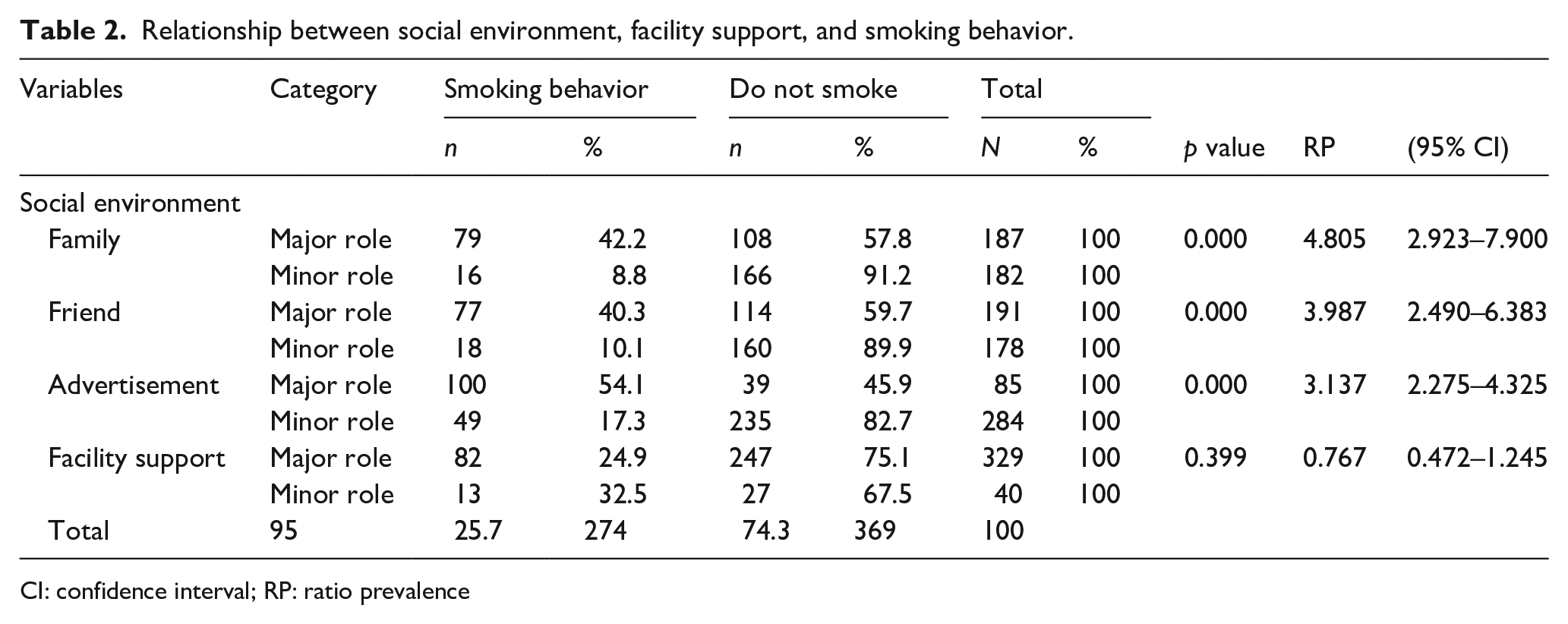
CI: confidence interval; RP: ratio prevalence
A bivariate analysis with a chi-square test was used to analyze the relationships between each variable and smoking. The results showed that smoking occurred 4.805 times more in adolescents with families who also smoked (p < 0.05; CI = 2.923–7.900), indicating that this is a risk factor. The results also indicated a significant relationship between friends’ influence and smoking. Adolescents smoked 3.987 times more around friends that smoked than friends who did not smoke (p < 0.05; CI = 2.490–6.383). There was also a significant result showing that adolescents who had seen cigarette advertisements smoked 3.137 times more compared to those who had never or had rarely seen them (p < 0.05; CI = 2.275–4.325). There was no significant relationship found between facility support and smoking (p > 0.05; RP = 0.767; CI = 0.472–1.245).
Discussion
The social environment factor was divided into three variables that can influence smoking behavior, such as family influence, friend influence, and advertisement influence. Each variable was categorized into two, namely have a role and less of a role that can influence smoking behavior among adolescent males aged 15 to 18 years in Surabaya. We found that 79 respondents out of 95 (42.2%) who smoked admitted that they have family members
The last social environment factor is the advertisement factor. There are many forms of cigarette advertisements, such as big banners, promotion and funding from the cigarette company, TV or radio ads, and advertisements on social media. It was found that 46 out of 95 respondents (54.1%) who smoked admitted that advertising could influence their smoking, especially advertisements on social media. Many teenagers have access to social media as well as the many advertisements shown on it. It was shown that advertisement is a risk factor that can influence adolescents to smoke. This means that the more cigarette advertisements there are, the more who smoke, which influences their smoking behavior. We also found that having family members who smoke impacted their other family members to smoke especially the younger ones. From the test, we concluded that the more family members have smoking behavior, the more adolescent males are at risk for smoking. Another study also found that there was a positive correlation between the number of severe smokers among teenagers and the influence of their families. 29
Friends influence also played a big role in adolescent smoking. There were 77 respondents (40.3%) who smoked due to their friends influence. This means that this is also a risk factor. It can be concluded that adolescents with more friends who smoke have a higher risk of smoking. A previous study showed that peers who smoked and had close interpersonal bounds with subjects positively correlated with the continuation of smoking, depending on their friends behavior. 30
Adolescents will smoke. A prior study reported a high prevalence of smoking in low and middle-income countries that were being targeted by cigarette companies to produce and promote their tobacco products.
Adolescents who have seen cigarette Advertisements have a higher risk of smoking compared to those who have never or have rarely seen cigarette advertisements. 31
Another factor that can influence adolescents to smoke is facility support, such as pocket money and easy access to cigarettes. In Indonesia, there are many kiosks that openly sell cigarettes around schools or homes. As a result, teenagers are very vulnerable to being exposed to cigarettes. It was found that 82 out of 95 respondents (24.9%) had access to cigarettes through facility support. However, facility support was not found to have a significant relationship with smoking. A previous study reported that facility support can influence adolescents to smoke. 32 This may have happened because each study has differences in location and form of facility support.
A multivariate test was also conducted to see which were the strongest factors that led to smoking among adolescent males aged 15 to 18 years in Surabaya. The results showed that families greatly influence smoking incidence, followed by friends and advertisements (Table 3). This is in line with a previous study that reported parents who smoked and cigarette advertising were high-risk factors for smoking among adolescents. 33 Another study demonstrated that adolescents with parents who smoked were 2.0 and 2.5 times more likely to be smokers as well. 34
Interaction between variables.

Conclusion
There is a significant relationship between social environments (family, friends, and advertisements) and smoking among adolescent males aged 15–18 years in Surabaya. It is necessary to hold integrated programs and policies to prevent and rehabilitate these adolescents. These interventions should involve all parties. This includes the government as a policy marker, as well as these adolescents schools, homes, and surrounding environments. Adolescents also need to improve their understanding of smoking effects.
Footnotes
Acknowledgements
The authors would like to thank the Department of Epidemiology, Biostatistics, Population Studies and Health Promotion, Universitas Airlangga. Additionally, the authors would like to thank all of the senior high school students in Surabaya who took the time to complete the questionnaire.
Availability of data and materials
The datasets used and/or analyzed this study are available upon reasonable request from the corresponding author.
Contribution
TF and RA conceived and designed the study, including the research instruments used. RA collected the data. TF and KA conducted the statistical analysis and interpretation of the findings. TF wrote the initial draft and the final manuscript. KA critically reviewed and finalized the manuscript. All authors read and approved the final version of this manuscript.
Declaration of conflicting interest
The author(s) declared no potential conflicts of interest with respect to the research, authorship, and/or publication of this article.
Funding
The author(s) received no financial support for the research, authorship, and/or publication of this article.
Ethics approval and consent to participate
Ethics approval was given by the Research Ethics Committee of the Faculty of Public Health Universitas Airlangga, Surabaya, Indonesia (ethical approval code: 01/EA/KEPK/2021). The respondents that participated in this research also have filled in the informed consent form.

Significance for Public Health
The number of smokers in Indonesia is very high, which causes high morbidity rates due to smoking. Adolescents are susceptible to smoking because of their environment. This study contributes by determining the factors that influence smoking among adolescents in Surabaya, Indonesia. It also shows that it is necessary to hold integrated programs and policies to prevent and rehabilitate adolescents who smoke.