




Abstract
Background:
Errors or cases that occur in health care organizations are very fatal because they can reduce the quality of life of patients and the worst is cause the death of the patient. One of the appropriate tools to be applied in analyzing cases/problems that occur in Surabaya Islamic Hospitals is root cause analysis. The complaints were addressed to the medical services, medical support, general, administration and verification, information systems and management, and finance sections.
Design and methods:
This research uses secondary data on hospital patient complaints in 2022 and is supported by the results of online interviews with the head of marketing public relations. Secondary data was processed through a six stages of root cause analysis and analyzed with the help of a fishbone diagram to determine the root cause of the problem in the health care sector.
Results:
There were 261 complaints received by customer service addressed to the medical services, medical support, general, administration and verification, information systems and management, and finance departments. There are eight root causes found in Surabaya Islamic Hospital inpatient complaints. This proves that there must be improvements/ interventions made by the Surabaya Islamic Hospital to overcome inpatient complaints.
Conclusions:
Inpatient complaints at Surabaya Islamic Hospital prove the need for a number of interventions/improvements, especially in the field of human resources, namely the level of discipline, skills, empathy, communication, limited medical, and financial staff.
Introduction
Complaints are often a problem for certain companies or institutions. Because this is a form of feedback that customers usually convey to the company and are more likely to be negative. 1 Generally, complaints occur because customers are dissatisfied with the standard of service provided by the company. If it continues to occur and there is no good handling, complaints will have a negative impact on the company’s future sustainability. 2
Hospital as one of the institutions engaged in health services is also inseparable from patient complaints. 3 Every patient in the hospital has the right to obtain quality health services in accordance with professional standards and standard operating procedures. 4 If this is not fulfilled, of course they have the right to submit complaints about the discrepancies in the services received through a complaint report.
Patient complaints have become a global issue. NHS Hospital and Community Health Services (HCHS) in England recorded 116,247 complaints in 2018–2019. This number of complaints increased compared to 2017–2018 which was only 113,989 complaints. 5 In Indonesia, patient complaints are still common, as many as 196 complaints were received by Permata Medika Semarang Hospital in the 2016–2018 period and 10% of them took a long time to resolve. Most complaints were caused by administrative problems and officer communication. 6 This is also in line with patient complaints at UMM Hospital which occurred due to poor attitude and communication of officers. 7 Meanwhile, complaints at M.H.A. Thalib Kerinci Regency Regional Hospital occur due to several problems with doctors and inpatient services. Although complaints always occur, the service is still not good. 8
According to Law no. 44 of 2009 concerning Hospitals, every patient in a hospital has the right to obtain quality health services in accordance with professional standards and standard operating procedures. 9 Likewise, every patient has the right to submit a complaint for the services they receive. 10 In 2020, the most customer complaints at the Surabaya Islamic Hospital occurred in February as shown in Table 1. Meanwhile, from March to December there was a decrease in complaints. This can be understood because of the COVID-19 pandemic that hit Indonesia so that more activities in health services are carried out through online consultations. So that the space for submitting complaints is limited to the distribution of google forms, google reviews, and patient whatsapp.
Percentage of complaints by month.

Errors or cases that occur in health care organizations are very fatal because they can reduce the quality of life of patients and the worst is cause the death of the patient. Therefore, root cause analysis can be one of the right tools to be applied in the analysis of cases/problems that occur. Root cause analysis is a proactive method for responding to system vulnerabilities. 11 So, this report will discuss the description of complaint handling and identification of the causes of the most patient complaints at the inpatient services of the Surabaya Islamic Hospital in 2020.
Methods
This research uses a descriptive approach. Data collection uses complaint data from Surabaya Islamic Hospital from January to December 2020. The Surabaya Islamic Hospital complaint data was processed through a simple root cause analysis stage and analyzed with the help of a fishbone diagram to determine the root cause of the problem.
There are six stages in conducting root cause analysis, especially in the health service sector. First, define the event (determining the problem to be identified). The tools used in this research are evidence-based data collection through complaint data. Second is find causes, used are brainstorming and fishbone charts. To facilitate the identification of causes, several health service-based categories can be used human factors, environmental issues, information issues, methods and processes issues, equipment issues, leadership issues, and external factors. Third, find the root cause. Fourth is find solutions, this can be done through brainstorming. Fifth is take action, proposed improvements that have been defined are carried out. Sixth is measure and assess, measurement and assessment are carried out regarding how effective the proposed improvements can be to deal with the problems that occur. 12 However, in this research, the root cause analysis carried out only reached the fourth stage, namely finding solutions. This is because the research conducted was only limited to providing recommendations to the hospital, not to the implementation and monitoring stages. This research has gone through an ethical test with number No.115.EC.RSIAY.06.2022. was carried out at KEP RSI Surabaya A. Yani.
Results
Identification of patient complaints
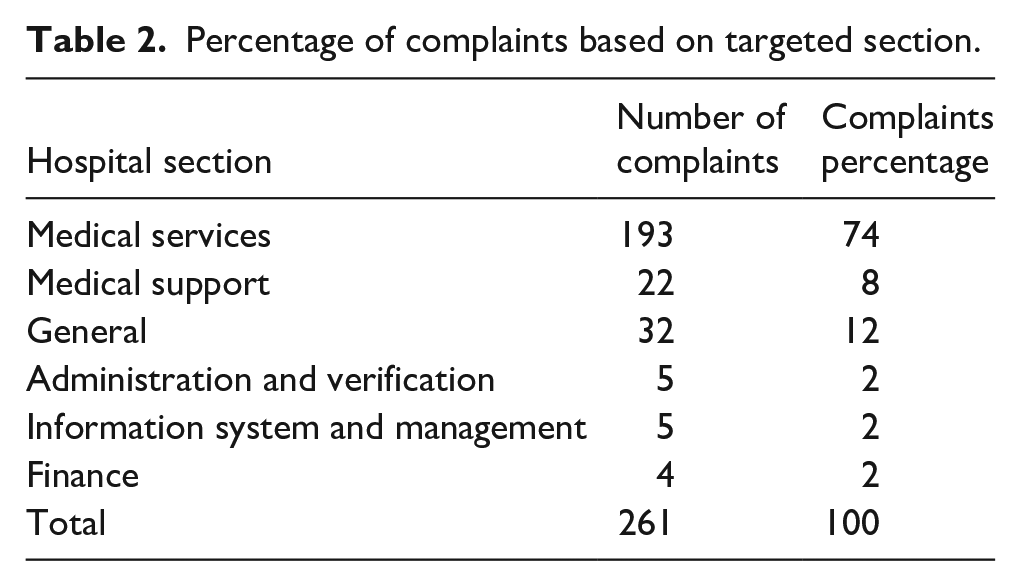
The first stage in root cause analysis is to determine the problem to be addressed. This stage is carried out by analyzing the Surabaya Islamic Hospital patient complaint data throughout 2020. Although only based on data, this evidence-based data collection method has the advantage of being able to obtain precise and accurate problems. The results of data analysis show that there are 261 complaints received by Customer Service in the public relations section of Surabaya Islamic Hospital. The complaints were addressed to the medical services, medical support, general, administration and verification, information systems and management, and finance sections.
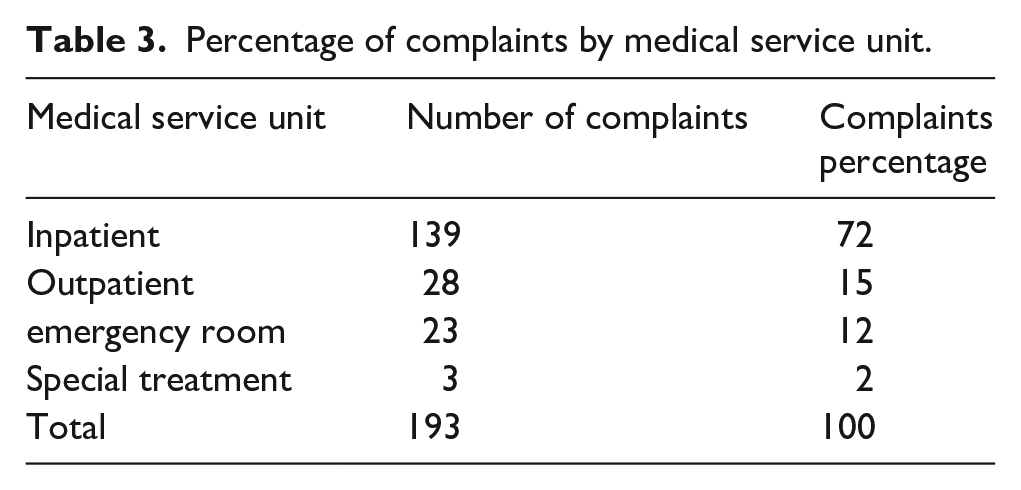
Based on Table 2, most complaints are intended for medical services, namely 193 complaints or 74% of the total incoming complaints. This proves that the most problems occur in the medical service department. Medical services at the Surabaya Islamic Hospital consist of outpatient units, inpatient care, special care, emergency department, and spiritual development. The results of the study of the data show that inpatients received the most complaints from patients throughout 2020 as shown in Table 3. Therefore, in this study the problem that was taken was that the most complaints were directed at the inpatients of the Surabaya Islamic Hospital in 2020.
Percentage of complaints based on targeted section.
Percentage of complaints by medical service unit.
Identify the cause of inpatient complaint problems
Identification of the causes of inpatient complaints was carried out by reviewing inpatient complaint data obtained from the complaint data of Surabaya Islamic Hospital in 2020. Then, the findings of the causes of the problem are presented in a fishbone diagram. This fishbone diagram illustrates the causal relationship of inpatient complaints. In the fishbone diagram, the causes of the problem are categorized. Table 4 shows that 139 complaints in Surabaya Islamic Hospital inpatient care are categorized into six causes of problems consisting of human factors as many as 27 complaints (19%), environmental issues as many as 26 complaints (19%), information issues as many as 15 complaints (11%), methods and processes issues as many as 28 complaints (20%), equipment issues as many as 43 complaints (31%).
Category cause problem.

Determining the root cause analysis of inpatient complaint problems
At this stage, the primary problem causes are developed into secondary problem causes and so on until the root cause of the main problem is found through brainstorming. Brainstorming was only done by the researcher and did not involve many people. The complete identification of causes to the root cause of the problem is presented in the Figure 1. There are eight root causes of the problem found consisting of undisciplined doctors, poor maintenance of facilities, construction that is not up to standard, violation of visiting rules, limited human resources, lack of skills, miss communication, doctors and nurses lack of empathy. Based on the root causes of the problems that have been determined, then the overall root causes of the problem are presented in Table 5 along with the recommended solutions provided.

Fishbone diagram of inpatient complaints.
Root causes analysis and recommended solutions.

Table 5 shows a summary of the root cause analysis and solutions to the root problems found. There are eight solutions that can be done by Surabaya Islamic Hospital in overcoming its problems, namely through the implementation of a reward and punishment system, adjusting the doctor’s schedule, disciplining the collegium, routine monitoring of inpatient room facilities and follow-up, budgeting funds in the strategic plan to improve the structure of the inpatient room, socializing rules and periodic checks on visitors, recruiting new staff and using hospital management information systems, as well as education and training for medical and non-medical staff. Through a series of solutions, it is expected to be the key to the hospital’s success in reducing complaints from patients and their families.
Discussion
Improvements must be made immediately to address these root causes. The first solution is related to doctors’ indiscipline in conducting visits. Some inpatient doctors do not comply with visitation hours either offline at the hospital or online. The existence of rewards and punishments for medical and non-medical staff is expected to make staff more qualified and responsible for the tasks assigned. Reward and punishment can be verbal (praise/reprimand) or non-verbal. Based on research, rewards have a direct effect on nurse performance. 13 Research at the Dungus Madiun Lung Hospital shows that work discipline is strongly influenced by the reward and punishment system. 14 In addition, adjustments must be made to the visit schedule for doctors, so that doctors are more flexible. In addition, there must be discipline carried out by the collegium to discipline doctors and other staff. Through these solutions, it is hoped that there will be no more delays in doctor visits or poor service provided by nurses and doctors to patients.
Maintenance of supporting facilities in hospitals is very important. Facilities that are not suitable for use will affect the effectiveness, efficiency and sustainability of services in the hospital. 15 Maximum service quality has a positive and significant effect on customer satisfaction. 16 Therefore, before the inpatient room is used by patients, officers must be ready to check all facilities and immediately replace if there are damaged facilities and also always clean every corner of the inpatient room. Even when there are patients, staff must clean every day in the morning and evening.
Regulations regarding the spatial structure of hospitals have been incorporated into the law. Through the budgeting of funds in the hospital’s strategic plan, it is hoped that renovation of hospital buildings can be carried out. Because every hospital should ideally be free from flooding. Every hospital building must meet the flood peil while maintaining environmental harmony in accordance with the provisions set in each region. Where the peil in question is an elevation or point of height expressed in meters as a guideline in building a building. 17 So that Surabaya Islamic Hospital needs to update the structure of the inpatient room to meet building standards.
Violations of visiting rules that occur can be resolved through enforcing existing visitation rules in the hospital. Socialization of hospital visitation rules and increasing the activeness of officers/ safeguards around during visiting hours is one way that can be done. Currently, socialization can not only be done directly, but also online. Especially in the current COVID-19 era, strict visiting rules must be conveyed to comply with guidelines, including health protocols, visit flow, hour restrictions, and standards for the number of visitors. 18
Human resources is the most important aspect for hospitals. Without sufficient human resources, services to patients will be hampered. Some patients who complain about unresponsive nurses, long handling, long waiting times for inpatient registration, and overloaded patients are enough to prove that the handling and registration process is less effective and efficient. Through staff recruitment, it is expected that inpatient handling will be more responsive so that excellent service to patients can be provided. The thing that needs to be developed for hospitals is the hospital management information system. Minister of Health Regulation Number 82 of 2013 concerning hospital management information systems states that the communication information technology system processes and integrates the entire flow of hospital service processes in the form of coordination networks, reporting and administrative procedures to obtain precise and accurate information, and is part of the health information system. 19 The implementation of hospital management information systems in hospitals is very helpful in processing data. A study proves that if in the past data entry took 1 h, but after the implementation of the hospital management information system it only took 15 min. 20 In addition, coordination and communication between units in the hospital must be improved so that the administrative process in the hospital runs better.
Education and training are conducted in order to improve the knowledge, skills and attitudes of medical and non-medical staff. The higher the education that nurses have, the better their performance. Nurses who have attended training have good performance. Concluded that education and training are directly related to performance. 21 Therefore, to avoid mistakes that have been made by Surabaya Islamic Hospital nurses in handling patients, it is necessary to conduct education and training for nurses. In addition to training to improve skills, there is a need for education and training in effective communication. A good and correct way of communicating with patients can reduce the obscurity of information, both between staff and between staff and patients. Relationship with the patient can be maintained properly. One of the important things in providing good quality service can also be seen from the aspect of empathy for patients. Through education and training, it is expected to increase empathy between staff and patients or between staff. Empathy is giving sincere and personal attention to patients with an effort to understand the patient’s wishes. 22 Aspects of empathy that can be carried out by medical personnel toward patients are asking about patient complaints and problems, officer responses to patient complaints, and how officers can recognize patients well. 23 In addition, empathy can also be shown by maintaining speech and not causing noise that can disturb the patient’s condition.
Conclusion
It is important for hospitals to analyze the complaints received. There are eight root causes found in Surabaya Islamic Hospital’s inpatient complaints. This proves that there must be improvements/ interventions made by the Surabaya Islamic Hospital to overcome inpatient complaints. So that it can improve service and customer satisfaction. The eight solutions are the application of reward and punishment system, adjustment of doctor’s schedule, collegium discipline, routine monitoring of inpatient room facilities and follow-up, budgeting funds in the strategic plan to improve the structure of the inpatient room, socialization of rules and periodic checks on visitors, recruitment of new staff and use of hospital management information systems, as well as education and training for medical and non-medical staff. Hopefully the results of this study can be used as a reference to improve hospital services. Suggestions for future research are to apply other methods in searching for the root causes of problems and each problem is explored in more detail and detail.
Footnotes
Acknowledgements
The authors appreciate Universitas Nahdlatul Ulama Surabaya and Hungarian University of Agriculture and Life Science for the support and facilitation during this research work.
Author contributions
B.S contributed to data validation, the extraction of data from gray literature sources, and original conception of this research. A.A.A, Y.T.L, and E.A.W. provided the original draft preparation and contributed to reviewing and editing the manuscript.
Data availability
The data supporting this study findings are available from the corresponding author upon reasonable request.
Declaration of conflicting interests
The author(s) declared no potential conflicts of interest with respect to the research, authorship, and/or publication of this article.
Funding
The author(s) received no financial support for the research, authorship, and/or publication of this article.
