



Abstract
Introduction
Large-scale social restrictions imposed by the government that was used to control the spread of COVID-19 drastically changed the routines of the population, including non-communicable diseases (NCDs). Since the beginning of the COVID-19 outbreaks around the world, the management, and outcomes of patients infected with underlying comorbidities, such as cardiovascular disease, hypertension, and diabetes mellitus (DM), have become a very important problem. Researches show that Covid-19 patients with a history of T2DM have a worse clinical profile 1
According to the Takalar District Office 2022, the number of people with DMT2 is 2769 patients, marking a 13.3% increase from 2400. In this study, our target population of four health centers was selected from eight health centers in the Takalar regency that are active in the Chronic Disease Management Program (PROLANIS) The population of DM patients from four public health Center (PHC) was 1852 of 2769 DMT2 patients. From the results of a preliminary study of the characteristics of T2DM patients with female group sex as many as 1098 people (59%), the most age groups were in the 55–65 age group is 78%. Most of the occupations were in the category of not working and retirees, namely 822 people (44.3%), Long-suffering more respondents who suffered from DM 5 years as many as 1482 people (80%), and most DMT2 consuming drugs compared to insulin injections, namely 1340 (72%).
People with T2DM belong to a vulnerable group and are advised to self-isolate to prevent COVID-19 infection. Furthermore, this population should reduce face-to-face social contacts, stay at home and leave only for important reasons. The lifestyle of T2DM patients has a fundamental impact on the inability to be able to control their blood sugar levels. 2 Physical activity (PA) plays an important role in the improvement and maintenance of physical and mental health and changes in glycemic control 3
Increased physical activities are one of the most important cornerstones of treatment in patients with T2DM. Previous studies reported that increase in physical activities has been proven to be effective and can increase metabolism (blood sugar, lipid profile). With the Covid-19 pandemic conditions, Community Health Center (Puskesmas) with its Chronic Disease Management Program (Prolanis) and routine exercises should be able to improve self-management through physical activities of T2DM patients. Then, a reminder to carry out physical activities through mHealth app is highly required.
Experts recommend that multidisciplinary interventions are often impossible to implement in real life due to limited human resources and the high cost of long-term care. In addition, geographically isolated patients cannot easily access educational programs in person or face-to-face. Therefore, it is necessary to develop innovative approaches to improve physical activities of patients with T2DM. mHealth app comes as an answer to this need.
Some studies reveal that mHealth and evidence-based interventions by implementing public health programs offer the possibility to improve general health care problems and, more specifically, problems related to T1DM and T2DM.4,5 Studies examining the app related to blood sugar control by measuring several variables (self-care, self-efficacy, BMI, Blood pressure, lipid profile, Blood sugar, and HB1AC) showed significant change in the self-management of T2DM patients by being able to improve the primary outcomes (Hb1Ac and lipid profile) and secondary outcomes (self-care, self-efficacy, and motivation). 6
Studies show that in supporting T2DM in managing their physical activities, mHealth still requires more features, interactive contents, and the support of theories to help them manage their physical activities. It is not easy to change their habits to be more physically active. By increasing social supports, self-efficacy, cognitive, and knowledge, people will change and maintain their level of physical activities. SCT is very suitable for understanding PA health behavior because of the interaction of the individual, environment, and behavior. 7 SCT-oriented interventions have been effectively observed based on systematic reviews finding that the interventions are the most important for improving health behaviors and have proven to be able to control glycemic levels for a longer and longer-lasting duration in T2DM. 8
The mHealth or eHealth applications developed specifically for DM are very diverse with different display features. Several previous studies by presenting an application feature such as tracking blood glucose levels, monitoring diet, and weight, and providing health literacy (HT).9,10 However, the available evidence on the effectiveness of specific mHealth adapted through SCT is limited, therefore this study presents an overview of the application design for an integrated/programed DMT2 PA program with ADA Recommendation standards adapted through SCT. SCT adapted through mHealth PA through evidence-based practice through HT feature in PA, SE, feature which is defined as the belief that a person has in himself to do programed PA, reminder feature to unify the involvement of T2DM patients in PA, mHealth is designed as a daily schedule by guiding patients DMT2 in integrated and programed PA activities, features social support through PA videos and ceremonies that can improve DMT2 self-management. SCT developed through an application that is used to promote disease management, facilitate behavior modification and is able to facilitate self-management and adherence to programed PA, so that self-management of T2DM patients can run optimally.
Research methods
The type of this study was a mixed method sequential explanatory design and related to the application of mHealth Diabetes Physical Activity in Takalar Regency. The first step was to use qualitative methods with rapid assessment procedures in developing the application of SCT in mHealth app. At this stage, data or information collection is carried out using documentation studies, in-depth interviews, and observations using field notes on DMT2 patients, families, or caregivers, and conducting FGDs with health workers, IT experts, and sports experts. Determination of informants using purposive sampling technique by determining the criteria of the informants. The tools and instruments used are arranged based on the SCT concept and then translated into questions that are expected to be able to explore in-depth and broad information from participants. Data processing and data analysis are carried out continuously until complete and saturated by dividing four stages, namely data reduction, data presentation, data analysis (content analysis), and drawing conclusions and verification. SCT The second step was to validate and test the app through usability testing. The final step was intervening the development of mHealth app using quasi-experimental designs with pretest-posttest with control group related to the effect of mHealth Diabetes Physical activity (PA) intervention in controlling blood sugar (GDP, HbA1c and lipid profile) in T2DM patients. The first group was the mHealth diabetes Physical activity (PA) intervention group; the second intervention group was a group monitored through Whatsapp group; and the third group was the group with physical activity module but without monitoring. This research has been approved by the Ethics Committee of the Faculty of Public Health, Hasanuddin University (Number: 3179/ UN4.14.1/TP.01.02/2022).
Research steps
This research focused on developing the application SCT into mHealth that is modified from Social Cognitive Theory Bandura 1986 and PERKENI 2019. 7 (Figure 1) The approach used in this study was exploratory sequential mixed methods. This study was carried out in three steps (Figures 2 and 3). Step 1 was a qualitative study using the maximum variation purposive sampling technique 11 The participants involved were T2DM patients, client families, or caregivers, healthcare workers, and sports experts, using in-depth interviews and observations using field notes and on health workers and sports experts using Focus Group Discussions (FGDs). Step 2 was the analysis of the development of the mHealth app. This analysis will be a reference for supporting the development of the mHealth app. At this stage, usability testing was tested on 10 respondents with an intervention duration of 1 week. 12 Step 3 was the use of quantitative methods using Quasi-experiment with pretest-posttest with control group. The flow involved three groups. The first group was the mHealth diabetes Physical Activity (PA) app intervention group; the second intervention group was with the health diabetes physical activity module monitored through Whatsapp group; while the third group was the control group having Diabetes physical activity health module but without monitoring. This study was conducted at three PHCs (Puskesmas Polongbankeng Selatan, Puskesmas Pattallassang, Puskesmas Polut ) in Takalar Regency with a total sample of 90 respondents with the study sample calculated by a sample size formula. 13 The inclusion criteria for participants are Patient with T2DM with aged ≥18 years old, Diagnosed with T2DM by a doctor and Medical records. The Exclusion criteria ever used application of Diabetes apps, Patients with a history of gestational diabetes mellitus and T1DM. Participants completed the informed consent prior to their participation, which beforehand has been reviewed and approved by the Ethics Board of the Research Institute

The theoretical framework adopted from SCT of Bandura 1986, Smith 2020 and PERKENI 2.
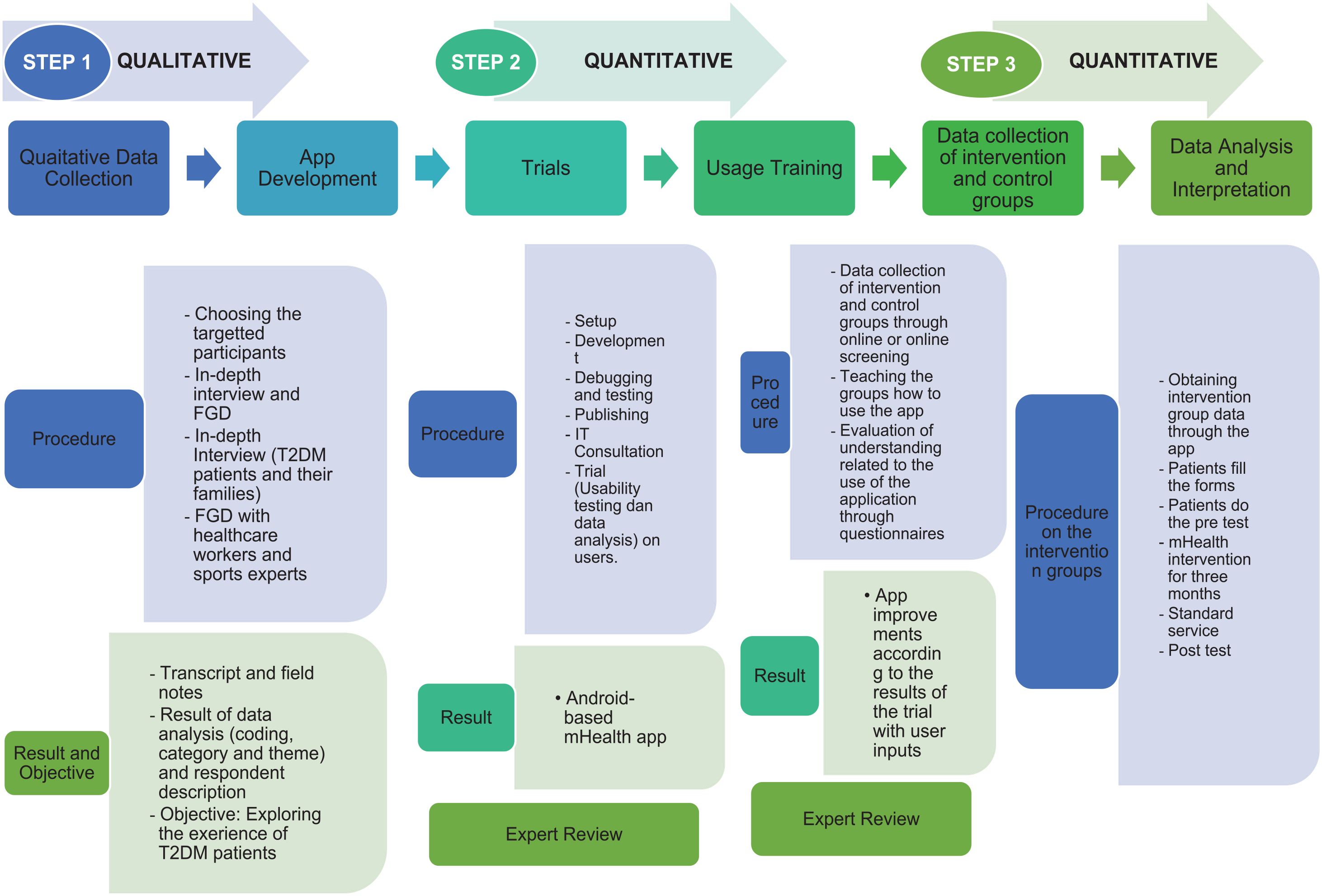
Research steps.

Research flow.
Data analysis and instruments of validity and reliability
The data of this study were analyzed using the Independent t Test and T2 Hotelling tests with SPSS software. The questionnaire instrument that measures self-efficacy in T2DM patients used the Exercise Self-Efficacy Scale (ESES) which is a valid, reliable, and stable tool to assess self-efficacy in T2DM in Indonesia. 14 This instrument has a content validity index (CVI) score of 0.80–1.00. The Cronbach alpha of the Indonesian version of DQoL-BCI is A Cronbach is 0.78, 0.80, and 92 which means it shows adequate results. The level of knowledge of patients was measured by The Indonesian Version of Diabetes Knowledge Questionnaire (DKQ-24). Meanwhile, the measurement of the ability to perform physical activities was carried out with IPAQ measurements using MET (Metabolic Equivalents of Task). The usability testing instrument used was PSSUQ (Post-Study System Usability Questionnaire). This PSSUQ has 16 questions with a scoring system using a scale from 1 to 7 (from strongly agree to strongly disagree).
MHealth apps
mHealth is supported by features that are responsive and easy to operate and meet user needs for applicable information about DMT2 and PA management. mHealth consists of several features such as; Personal data (name, date of birth, gender, duration of diabetes mellitus diagnosis, medication, oral (insulin injection)), cognitive/knowledge: DM concept, management, prevention of acute, and chronic complications, PA, SOP, and video. This application is designed with a reminder feature for patients to exercise according to the American Diabetes Association’s physical activity recommendations. An alarm notification will appear to the user if the DMT2 patient does not do physical activity in a day. This application is also supported by a testimonial from a DMT2 patient who has successfully improved his self-management through physical activity. Through this application, patients will be encouraged to want to improve good self-efficacy with the social support feature in the application because they are directly connected via WhatsApp groups.
Impacts expected from this study for public health
The hypothesis in this study is to test SCT on the application of mHealth Diabetes Physical Activity (PA) to control blood sugar levels of T2DM patients. SCT theory was developed by increasing social support, self-efficacy, cognitive, knowledge in T2DM patients for physical activities. mHealth app-based education is specifically designed for blood sugar control programs through integrated/programed physical activity interventions through ADA standards.
American College of Sports Medicine and the American Diabetes Association recommends to take 150 min exercise per week and additional endurance training of at least 2–3 days per week parallel to pharmacological treatment. Physical activities allow patients to be able to control their blood glucose that directly circulates and increases the sensitivity of tissues to insulin, lowers the risk of cardiovascular disease and mortality. Based on the results of a study by, 15 common ADA barriers to physical activity in adults in Indonesia are behavioral problems related to self-efficacy, lack of time, low self-motivation, feelings of discomfort, feelings that physical activities are unpleasant or boring, fear, hurt, lack of support from family and friends, and an unsupportive environment, which then encourages researchers to find strategies and solutions to improve their abilities in terms of physical activity management. Therefore, mHealth, which has been tested through qualitative research, presents several features: reminder, diabetes and treatment information, motivational, and self-efficacy quotes, communicative and interactive contents with an integrated physical activity video display (Brisk walking) based on SCT theory, especially to prevent an increase in blood glucose levels (HbA1c).
Conclusion
Contents/features: Reminder on diabetic information integrated based on SCT theory was developed systematically through the development of qualitative methods and through trials of the mHealth PSSUQ (Post-Study System Usability Questionnaire) app so it is important to get recognition from the publication of the results of advanced studies.
Footnotes
Acknowledgements
Appreciations to the Ministry of Cultural Education, Research, and Technology, Takalar Health Office, and Hasanuddin University.
Declaration of conflicting interests
The author(s) declared no potential conflicts of interest with respect to the research, authorship, and/or publication of this article.
Funding
The author(s) disclosed receipt of the following financial support for the research, authorship, and/or publication of this article: Thanks to the Ministry of Cultural Education, Research, and Technology for providing grants for this study.
Ethics approval
Hasanuddin University Review Board