



Abstract
Background:
Maternal mortality rates and human development indexes can reflect a country’s quality of health services. During the COVID-19 pandemic, these two achievement indicators are predicted to experience significant changes, and both have an interrelated relationship.
Objectives:
To find the relationship between maternal death due to COVID-19 and the Human Development Index (HDI) in East Java, Indonesia.
Design and methods:
A cross-sectional analytic study was carried out by processing secondary data from the provincial department of health regarding maternal mortality due to COVID-19 in East Java in 2020 and the HDI data from the Indonesian Central Statistics Agency. After that, the data were analyzed statistically using SPSS Statistics.
Results:
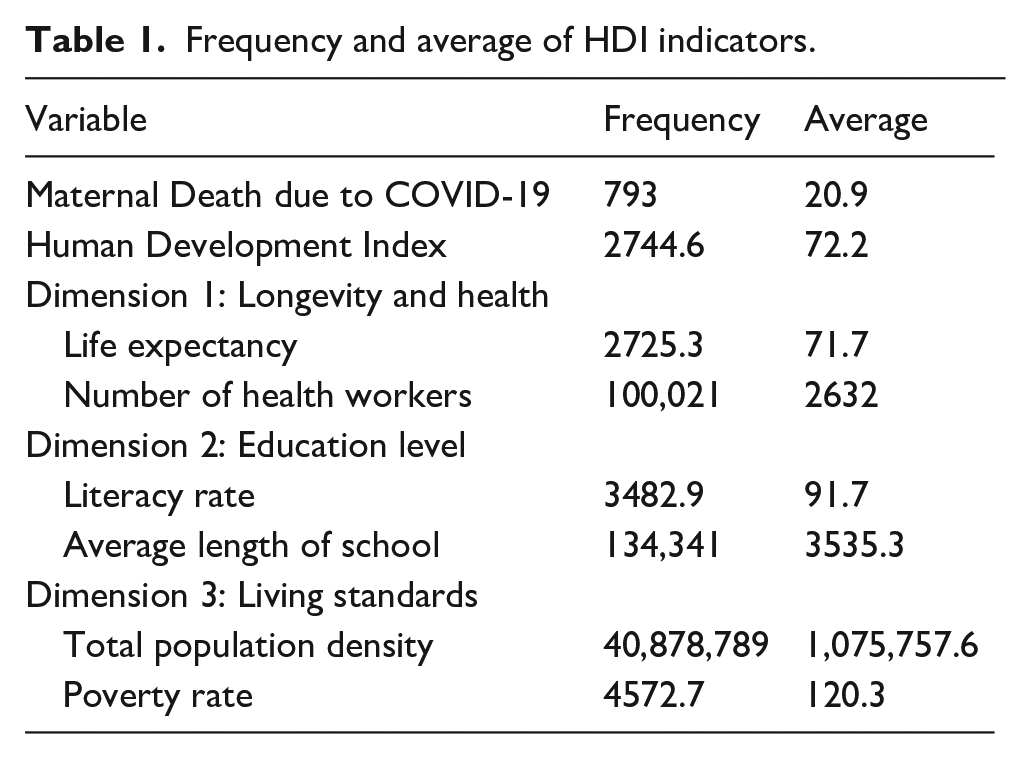
The number of maternal deaths due to East Java’s COVID-19 during 2020 was 793 out of 1280. Furthermore, the HDI reached 2744.6, the first dimension contains life expectancy reaching 2725.3, and the number of health workers 100,021. In the second dimension, the literacy rate reaches 3482.9, and the average length of schooling is 134,341. Moreover, the last dimension contains a total population density of 40,878,789, and a poverty rate of 4572.7. Statistical analysis results show a positive relationship between maternal mortality due to COVID-19 and HDI, with a p-value of 0.008.
Conclusion:
There is a significant relationship between maternal mortality due to COVID-19 and HDI. However, the link between maternal mortality and COVID-19 related to the detailed dimensions contained in the HDI is not statistically related.
Introduction
The high number of cases and death rates due to COVID-19 impact various aspects of social life, economy, and community welfare.1,2 According to the COVID-19 Task Force, the peak incidence of COVID-19 has also increased maternal deaths due to COVID-19. 3 The high maternal mortality rate illustrates the low level of healthy living, so it has the potential to cause a national decline in domestic life from the socio-cultural and economic sides.4,5
East Java Province was ranked second with the highest COVID-19 cases in Indonesia, with additional information stating that many pregnant women had confirmed COVID-19 or had the status of suspected patients.6,7 The maternal mortality rate in East Java is 11% of Indonesia’s total number of maternal deaths. During this pandemic, there was a 100% increase in maternal deaths in 10 districts/cities in East Java. In semesters 1 (January to June) in 2018 and 2019, there were 225 and 263 maternal deaths. Then, in 2020, there was an increase to 292.8,9
The high number of COVID-19 cases is directly proportional to the Human Development Index (HDI) increase.10,11 HDI is one of the calculations carried out by the Indonesian Central Statistics Agency (BPS), which explains how the population can access the results of development in obtaining income, health, and education. HDI is formed by three primary dimensions, namely long and healthy life, knowledge and a decent standard of living. 12 Indirectly, HDI can become a benchmark to explain how the population can access the health sector, especially women. If the quality of life of women is low, the human development index in the country is also low.12–14
Therefore, the researchers are interested in determining whether there is a relationship between maternal mortality rate and HDI, especially the availability of adequate resources to provide quality maternal health services on each of the essential dimensions of HDI.
Method
This research used a cross-sectional analytic study by collecting and processing secondary data regarding maternal mortality due to COVID-19 in East Java province, Indonesia, in 2020. This research data includes maternal mortality due to COVID-19 associated with the Human Development Index (HDI) and three dimensions divider. These dimensions include dimension 1, longevity and health, dimension 2, education level, and dimension 3, living standards.
The data sources are secondary data obtained from maternal mortality reports (LKI) issued by the provincial health office and maternal mortality data on the Maternal Perinatal Death Notification (MPDN) application system. Other data were also obtained through the official account of the Indonesian Central Statistics Agency (BPS).
The data presents data in East Java Province, which consists of 38 districts/cities. Data processing was carried out using SPSS Statistics version 25 with the Chi-Square method to measure the relationship between the independent variable (HDI and its three constituent dimensions) and the dependent variable (maternal death due to COVID-19). Using this method, the significance value with the relationship between factors is <0.05. The Ethics Committee has approved this research from the Faculty of Medicine, Universitas Airlangga, with letter number: 79/EC/KEPK/FKUA/2022.
Results
The research obtained the amount and the average of maternal deaths due to COVID-19 and HDI indicators according to the number of areas in East Java, that is, 38 districts/cities. Then we divided them into two groups, namely the below-average and above-average groups, based on the average number in East Java Province (Table 1).
Frequency and average of HDI indicators.
The statistical analysis results show a relationship between maternal mortality due to COVID-19 and HDI (p = 0.008), but there is no relationship between maternal mortality due to COVID-19 and each of the basic dimensions of the HDI itself (Table 2).
Analysis of the independent variables on the dependent variable.

Cannot be tested statistically because the number of columns does not meet.
Discussion
The Human Development Index (HDI) is the gold standard for evaluating a nation’s level of development, measuring a nation’s capacity in three dimensions: life expectancy, educational attainment, and living standards.12,15 It is considered one of the most significant covariates concerning the COVID-19 mortality rate. Our study showed that lower COVID-19 mortality rates positive relation with higher HDI. This is crucial because the answer to this query affects the societal validity of HDI. Additionally, this outcome might encourage more nations to prioritize human development potential over economic growth. This is essential if the world is to respond to the subsequent health crises. The results of this study found a relationship between high HDI and higher mortality rates, Although, another study found that rising life expectancy, income levels, and educational attainment may contribute to a Maternal Mortality Rate (MMR) decline. 16 This differs from developed countries where MMR is not directly proportional to HDI. This is because developed countries, like many countries in Europe, already have good numbers in each HDI dimension, making people not have many difficulties getting high-quality maternal health services. However, another reported that handling COVID-19 resulted in more significant fatalities in several high HDI nations, such as those in North America and Europe, than in low HDI nations.3,10 This may have happened because many aspects were hampered during the COVID-19 pandemic, so this needs to be a particular concern. 11 We need to understand that the increase in the HDI rate should not go hand in hand with the increase in maternal mortality because the maternal mortality rate should decrease every year, not increase.
The HDI dimension is closely related to life expectancy and the number of health workers. Although statistically, the results of the analysis show that there is no relationship between life expectancy and the number of health workers with maternal mortality due to COVID-19, several studies have shown that there is a decrease in the number of health workers working during the COVID-19 pandemic, both health workers who must undergo self-isolation, intensive care or even death due to COVID-19 are suspected to be the cause of the high maternal mortality rate in many countries.7,17 This is because health services are not optimal with limited human resources in providing antenatal care, childbirth, postpartum, and newborn care. The availability of competent and skilled health workers plays a vital role in increasing access to quality maternal health services.18,19
In addition, in the second dimension, namely the level of education, the related components are the literacy rate and the average length of schooling. From the results of the analysis, there is no link between educational attainment and COVID-19 Maternal Mortality. This can happen because access to education does not reflect the level of women’s awareness, especially about pregnancy or reproductive health.4,20 For example, women who graduate from universities with non-health majors do not necessarily understand the basic concepts of how to maintain a healthy pregnancy. However, another research stated a woman who graduated from junior high school or high school who works as a cadre in the community who mainly helps in health education activities and plays a role in screening high-risk pregnancies in the community has better awareness about reproductive health. 21 Another study stated that lower levels of maternal education are associated with higher maternal mortality even among women who can access facilities that provide intrapartum care. 22 More attention should be paid to broader social determinants of health when designing strategies to reduce maternal mortality and achieve the Sustainable Development Goals (SDGs) so that this level of education does not always indicate maternal awareness of maternal health, which is closely related to maternal mortality.19,23
Moreover, the third dimension, namely the standard of living, focuses on assessing the total population density and poverty level. A significant global health hazard has been the highly contagious disease COVID-19. Infectious diseases are expected to spread rapidly in locations with high population density as residents are more likely to be in close contact with one another. 24 These areas include big cities with poor urban environmental management and infrastructure. 25 Other study stated that the spread of Covid-19, however, is not related to population density, according to recent research showing that there is no significant difference in maternal mortality. 26
Among the three provinces in terms of population density. This study compares three provinces in Indonesia that have different population densities. 27 Densely populated areas can also reflect that there are many social activities within the community, so it is likely that this area is considered a metropolitan center that can accommodate financial institutions, businesses, government activities, and the availability of a health care system that is superior to areas with lower density.27–29
Conclusion
There is a positive relationship between maternal mortality due to COVID-19 and the human development index (HDI). However, the link between maternal mortality due to COVID-19 and the detailed dimensions of the HDI (longevity and health, education level, and standard of living) are not statistically related. Therefore, for further research with similar topics, it is possible to explore other factors that have relationship potential between maternal mortality due to COVID-19 and the human development index, then use a different type of analytical approach from the research that has been done at this time.
Footnotes
Acknowledgements
The researchers acknowledge to staff of the Family Health Division of the Department of Health in East Java Province, who gave support during the research.
Declaration of conflicting interests
The author(s) declared no potential conflicts of interest with respect to the research, authorship, and/or publication of this article.
Funding
The author(s) disclosed receipt of the following financial support for the research, authorship, and/or publication of this article: This research was funded by a grant from Universitas Airlangga with the number: 212/UN3/2022.