



Abstract
Backgrounds:
The government’s strategy in reducing the high infant mortality rate (IMR) in Indonesia is to place midwives in the village and use the Integrated Management of Young Infants (MTBM) guidelines that integrate all steps through early detection and effective treatment. Midwives have not shown maximum performance in neonatal coverage and neonatal complications, each of which has not reached the target. This study aims to analyze the effect of self-efficacy and work engagement on task performance in the Pamekasan Public Health Center Work Area.
Designs and methods:
This research was conducted as an analytic study with a cross-sectional study. A sample of 151 village midwives in each Puskesmas’ working area, was then analyzed and interpreted to test the model with SEMPLS.
Results:
Conclusion:
The findings show that self-efficacy and work engagement can help improve the performance of village midwives in detecting neonatal emergencies.
Introduction
The Infant Mortality Rate (IMR) represents health services’ ability, quality, and capacity. 1 Indonesia has categorized IMR into three groups; Neonatal Mortality Rate (AKN), Infant Mortality Rate (IMR), and Toddler Mortality Rate (AKABA). Viewed from the age group, 69% of deaths occurred in the neonatal state, with 80% of all neonatal deaths reported in the first 6 days of life. 2 This is closely related to the Sustainable Development Goals (SDGs), one of which is to end infant mortality by reducing the Neonatal Mortality Rate to 12 per 1000 live births. 3 Based on empirical evidence on Neonatal Mortality, 88.6% were early neonatal deaths (0–7 days) and 11.4% were late neonatal deaths (7–28 days). 4
The strategy implemented by the government in reducing the high Infant Mortality Rate (IMR) in Indonesia is to place midwives in villages. Midwives must be adequately skilled to provide health services based on established standards, especially those in villages, as they spearhead maternal and child services to increase PWS-KIA coverage. 5 These midwives are required to have good, active, and dynamic abilities, for the community to welcome and acknowledge them. This is especially important as the program to reduce MMR and IMR in Indonesia is 73% determined by the expertise of midwives in serving patients, especially village midwives. 6
The PWS-KIA report in Pamekasan Regency in 2020 showed that the coverage figures in the working area have not yet reached the intended targets, consisting of Minimum Service Standards for Neonatal Visit 1, Complete Neonatal Visit Coverage of 100%, and Neonatal Complication Coverage of 80%. The average monitoring results further revealed that the coverage of Neonatal Visit 1 was 86.76%, Complete Neonatal Visit Coverage was 84.31%, and Neonatal Complication Coverage was 63.11%. All of these pointed out the fact that the performance of midwives has not been fully optimal. Meanwhile, individual performance is defined as behavior that can be controlled by said individual, which is relevant to organizational objectives. 7 In line with this, the performance itself is the result of behavior carried out by an employee. 8
Performance appraisal through the midwife’s task is influenced by the self-efficacy factor. Midwifes with high level of self-efficacy are apparently able to improve the performance of midwives in antenatal and other midwifery services. 9 Self-efficacy becomes a core component in maximizing overall performance 10 and the impact agent bringing about an improvement in the performance of midwives. 11 Empirical evidence shows that work engagement is important for health professionals 12 driving the quality of care and requiring attention from nursing and midwifery managers. Other studies have also stated the importance of work engagement in professional nursing. 13 The quality of nursing care is getting better because of the work engagement of nurses. 14 The purpose of this study is to empirically prove that self-efficacy affects the performance of midwives in detecting neonatal emergencies through work engagement as a mediation.
Design and methods
This analytical research with a cross-sectional design was carried out through observation once at the same time, without providing intervention on the variables being researched. It was conducted at 21 Community Health Centers in Pamekasan Regency from November 2021 to January 2022. The research population consisted of 268 village midwives. Then, cluster sampling was used to determine the number of samples, obtaining 151 village midwives. These 151 midwives who met the inclusion criteria were invited to fill out several questionnaires.
The variables of this research consist of self-efficacy (independent variable), task performance (dependent variable), and work engagement (intervening variable). The instruments to collect the data were in the form of questionnaires. There were three questionnaires, one for each research variable, distributed to respondents. Before the respondents filled out the questionnaires, the researcher provided Pre-Research Explanation (PSP). After that, the respondents were given an informed consent form to fill out to declare their willingness to become respondents in this research. The data that had been collected were processed and analyzed using Structural Equation Modeling (SEM) based on variance called Partial Least Squares (PLS).
This type of research is correlational research. Correlational research examines the relationship between variables. Researchers seek to explain a relationship, estimate, and test based on existing theory. A cross-sectional study was chosen for this study. A cross-sectional study emphasizes the measurement/observation of variable data only once at a time. All variables were assessed simultaneously at one time. This research was conducted in 21 Regional Health Centers of Pamekasan Regency. The population in this study was all village midwives in the Pamekasan District Health Center area of 249 midwives. This study has a large population, so the researchers used samples taken from the population. The sample in this study was some of the village midwives at the Pamekasan District Health Center with 151 midwives. The results of the calculation of the sample size are eligible for analysis with PLS that the sample size is based on the strength of the statistical test (80%), the significance of the path coefficient (0.20), and the level of significance (5%) is a minimum of 142–155. 15
The sampling technique in this dissertation research uses cluster sampling (sampling area). This research technique is used in two stages, namely, the first stage is to determine the sample stage in the area or region and the next stage is to determine the people in the area randomly. The variables of this study consisted of exogenous variables (X), namely self-efficacy, endogenous variables, namely the performance of village midwives (Y), and mediating variables, namely work engagement (Z). The research instrument used for data collection is a questionnaire. The questionnaire consists of a self-efficacy questionnaire through the GSE, 16 a questionnaire of work engagement through UWES-17, 17 and a performance questionnaire based on two dimensions—task and contextual performance 18 was adopted and modified by the researcher. The data processing in this study was analyzed both descriptively and inferentially. Descriptive analysis was through a frequency distribution consisting of the measured aspects, while, inferential analysis in this study uses SEM (Structural Equations Modeling) based on Partial Least Squares.
Results
The number of respondents in this study was 151 village midwives. The results of this study present data on the characteristics of respondents and tables of variable frequency distributions and analysis results. Table 1 describes the characteristics of the sample of this study, namely 151 village midwives who participated in this study and shows that most of the village midwives who are respondents are Gen X (35–50 years old). Gen X is a generation level that can adapt to change and has a way of dealing with problems with their own choices. 19 Gen X’s weakness is not adapting to technology. 20 Gen X has an independent personality, but this behavior also shows a lack of commitment due to the ability to adapt quickly to change. 21 Most of the midwives have a diploma III education background and are civil servant village midwives. Midwives with civil servant status may be a driving force in carrying out their duties and responsibilities. Almost half of the village midwives in the Pamekasan district health center have worked for 11–15 years. The working period is related to the experience possessed by the midwife while carrying out her duties and responsibilities because it is considered that midwives who have experience can carry out their duties well.
Characteristics of respondents.

Term of service turned out to be able to motivate employees, which had an impact on performance. 22
In the next stage, the data were analyzed using SEM-PLS with two tests, namely testing the measurement model (outer model), and testing the structural model (inner model).
Measurement model (outer model)
The measurement model (outer model) is used to test the validity and reliability of the model. The first test for the outer model is convergent validity. In Table 2, the results of the convergent validity test show that eight indicators representing the variables are declared valid or meet convergent validity because they have an outer loading value of >0.7. The next test is that all variables have an Average Variance Extracted (AVE) value of more than 0.5, meaning a set of valid variables.
Convergent testing of construct validity.

Measurement models (Outer models) are the first step to determining the level of validity and reliability. Convergent testing of convergent validity occurs if it has a value of loading factor (outer loading) showing a value >0.7 which means that the indicator is valid to explain the factor. However, the value of the loading factor 0.5 of 0.6 is considered sufficient for early-stage research.23,24 Then, the AVE value >0.5 explains the validity of the construct indicator by 50% 25
Based on Table 2, all variables have an outer loading value >0.7, which means that all of the indicators above are valid. While the AVE value of the five constructs >0.5 means that the construct is declared valid. There is a need to do discriminant validity testing. Discriminant validity is assessed by measurement cross-loading with the construct 24 in Table 3 and the last stage of testing the outer model is to test the reliability by looking at composite reliability and Cronbach’s alpha in Table 4.
Discriminant test results validity.

Reliability test results.
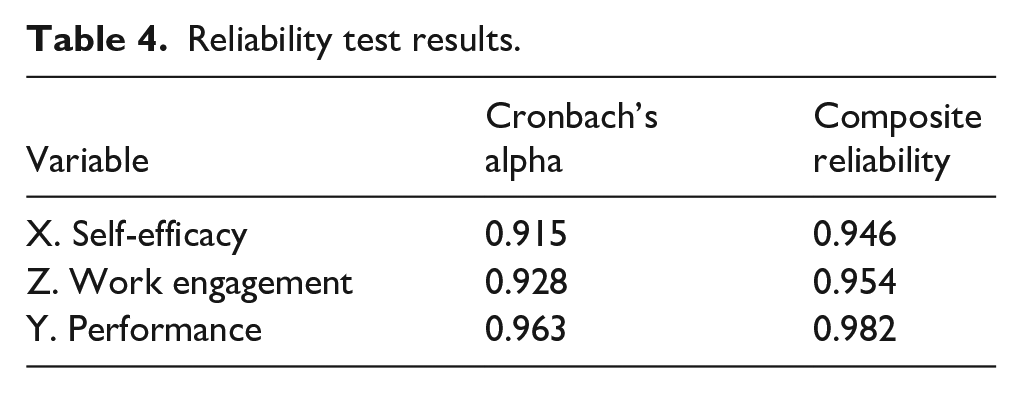
Based on Table 4, it shows that the value of composite reliability >0.7, which means that all constructs in the measurement model (outer fashion) stated reliability (reliable). Reference value for composite reliability is 0.6–0.7 and Cronbach’s alpha >0.7. 25 The stages of testing the model (outer model) that have been carried out are declared valid and reliable, then testing the structural model (inner model) is performed.
Structural model stage (inner model)
The structural model (inner model) is a specification of the relationship between latent variables based on the substance of the researcher. Table 5 shows the value of the coefficient of determination (R square). The test results show the value of R square (R2) where the performance value is 0.519, meaning that the constructs of self-efficacy and work engagement simultaneously affect performance by 0.519 or 5.19%. The work engagement value itself is 0.521, meaning that self-efficacy affects 0.521 or 5.21% of work engagement.
Value of coefficient of determination (R square).

The value of Q square states in this study was 0.467 or 46.7%. This means that the model in this study has a predictive relevance value, where the model used can explain the information in the study of 46.7% (Table 6).
Q-square value.

Table 7 shows that self-efficacy has no direct effect on performance (t statistic 0.315 < 1.96; p-value 0.753 > 0.05), self-efficacy has an effect on work engagement (t statistic 13.98 > 1.96; p-value 0.000 < 0.05), while work engagement has an effect on performance (t statistic 11.426 > 1.96; p-value 0.000 > 0.05). Indirectly, self-efficacy will affect performance if it is through work engagement (t statistic 7.392 > 1.96; p-value 0.000 > 0.05). These results are also described in the path diagram in Figure 1 below.
Testing direct and indirect effects.


Path diagram of Self-efficacy on Performance mediated by Work Engagement.
Discussion
Researchers found the results of structural equation modeling showed a total mediating role of work engagement on the midwife’s self-efficacy and performance. This mediating role provides new insights into the influence between self-efficacy, work engagement, and midwifery performance. Previous research revealed that self-efficacy is positively related to work engagement.26,27 However, this study showed that self-efficacy was not able to affect the performance of midwives in the early detection of neonatal emergencies, although it was able to explain the performance of midwives. The findings of this study are not in line with previous findings which stated that self-efficacy is proven to be a core component in maximizing overall performance. 10
Self-efficacy has high levels of influence on decision-making by driving positive and productive expectations and overconfidence but does not have the effort to provide a good strategy and performance. 28 Overconfidence makes self-efficacy high so the performance becomes negative. 29 Self-efficacy causes overconfidence, thereby increasing the likelihood of making a mistake. Self-efficacy is capable to affect performance when the individual’s self-confidence is able to be controlled. 30 This study also shows the role of work engagement in mediating self-efficacy on performance; work engagement has a full mediating influence on self-efficacy and performance of midwives, meaning that, without work engagement, a midwife’s self-efficacy is not able to improve its performance in detecting emergencies in young infants. Empirically, work engagement is thought to be an indicator of employee readiness to expend more effort to help superiors. So work engagement is positively related to task performance and contextual performance. 31 When midwives have high self-efficacy, they indirectly invest energy in their work to increase higher performance through work engagement, which is related to individual tendencies to behave. Work engagement fully mediates self-efficacy in the performance of midwives. The role of work engagement as mediation allows midwives to persist when encountering or encountering difficulties, or things not according to plan. If the midwife does not have work engagement, then self-efficacy does not affect the performance of the midwife, even though the midwife has high self-efficacy.
The high work engagement dimension is shown in the dedication dimension. Dedication means that midwives feel valuable in carrying out their duties. A high dedication of midwives shows strong involvement by midwives and being enthusiastic about providing services to infants using MTBM guidelines. So that midwives can detect neonatal emergencies well, which means that midwives perform well. Work engagement can provide explanations and give an impact that, with their abilities, individuals feel needed in their organizations, resulting in a good performance. This understanding also connects work engagement as an encouragement or psychological capital that encourages someone to be more involved in their work. The role of work engagement psychologically occupies and carries out organizational roles. Engaged individuals work passionately and feel a deep connection to the organization. 32
The role of work engagement as a mediation on self-efficacy on performance is because midwives with work engagement will pay attention to what they are doing. After all, they care about doing their job properly. Midwives become aware of their environment and actions and will work harder to do their job properly. Engagement also enhances innovation, by offering solutions to avoid future safety incidents, streamline processes and improve performance. A highly confident employee is thus likely to be more engaged and has a high level of performance. To some extent, these findings provide evidence of an indirect relationship between self-efficacy, work engagement, and performance. 33 Employees must have self-efficacy, which can encourage work engagement to improve employee performance. 34 Previous findings conducted on nurses stated that nurses who have work engagement work according to their job responsibilities so that they show good performance. If work engagement is present in nurses, nurses will provide good health services and achieve the mission of the hospital. 35 Work engagement is a mediator variable because it can lead to individual persistence and individual intensity at work, thereby increasing performance. 36 Individuals who are involved in their work tend to do more tasks to provide superior performance in achieving organizational goals. 37 Employees with high self-efficacy will be able to complete tasks according to their job desk under any conditions and situations. When the work is done well, then work engagement increases with responsibility and they are more involved in their work, and enjoy their work to achieve good performance and realize the achievement of the organization’s vision and mission. 35 Employees who are engaged in their work tend to do more in their duties and provide superior performance in achieving organizational goals and tasks. 38
Human resources are the foundation on which the organization stands. Job involvement is positively related to performance. Overall, there is a strong emphasis on the need to increase understanding of self-efficacy and work engagement to improve the performance of midwives in detecting neonatal emergencies. Midwives work more diligently when they feel psychologically attached to the midwifery profession. Midwives are human resources who must have in-depth special abilities and expertise, especially in emergency or complicated conditions. Midwives must have a broad understanding and be able to solve problems with a high level of complexity because failure to complete a task will make a worker more stressed, especially if the task is not clear, orders overlap, schedules conflict, and there are job demands that are too high. This finding has practical implications for organizations by considering training programs that focus on developing midwives’ self-efficacy to promote their work engagement so that they can contribute to performance. This is a form of intervention to improve performance; these findings can also be duplicated for use by other organizations.
Conclusion
Self-efficacy affects the performance of midwives in detecting neonatal emergencies through work engagement. The midwife has not yet optimally mastered the field she is working on, in this case detecting neonatal emergencies through the integrated management of young infants, so the performance of midwives is not considered optimal, which is indicated by the lack of contextual performance dimensions. However, a high dedication dimension shows midwives have feelings of pride, are very enthusiastic, and feel it is important to carry out comprehensive and quality midwifery care for infants, including providing emergency first aid to young infants, and will improve the performance of village midwives as shown in high task performance dimensions.
Footnotes
Acknowledgements
Postgraduate School Universitas Airlangga and Pamekasan Public Health office.
Declaration of conflicting interests
The author(s) declared no potential conflicts of interest with respect to the research, authorship, and/or publication of this article.
Funding
The author(s) received no financial support for the research, authorship, and/or publication of this article.
Ethics approval and consent to participate
This research received the Ethical Clearance Certificate No: 53/EA/KEPK/2022 from Airlangga University Health Research Ethical Clearance Commission. Informed consent was obtained from all participants and all methods were carried out by relevant guidelines and regulations.
Significance for public health
The village midwife is a network of the Puskesmas. The Village Midwife implements the Local Area Monitoring – Maternal and Child Health (PWS-KIA) program in one village/kelurahan in the working area of the Puskesmas. The village midwife is placed and resides in one village within the working area of the Puskesmas. The purpose of placing midwives in villages is to improve the quality and equitable distribution of health services to reduce maternal and infant mortality rates, because maternal and child health (MCH) plays a role in community health development efforts. This article describes the motivational factors in the form of self-efficacy and work engagement that affect the performance of village midwives. The performance of the village midwife is divided into task performance and contextual performance.
