




Abstract
The use of complementary and alternative medicine (CAM) is increasingly popular for the management of diabetes mellitus (DM). The aim of this study was to conduct systematic review of any types of complementary and alternative medicine for glycemic control of diabetes mellitus. Four databases was used in this study, the CINAHL, PUBMED, SCOPUS, and ProQUEST. The systematic review were reported according to the PRISMA guidelines. The keywords were used according to medical subject headings (MeSH) in this study were diabetes mellitus AND complementary and alternative medicine AND blood glucose levels or blood sugar or blood glucose. Articles were limited to 2015–2021 and only in English language. We obtained 231 articles from these databases: CINAHL six articles, PUBMED 85 articles, SCOPUS 66 articles, PROQUEST 74 articles. Then, the final results recorded 17 articles. The results of a systematic review showed the effectiveness of natural products as CAM for glycemic control of DM, namely Berberis aristata/Silybum marianum, fenugreek seed, bitter melon, cinnamon or whortleberry supplements, a combination of herbal plants (C. spinosa, R. canina, and S. securigera), Nigella sativa, Mulberry juice, chicory, chamomile tea, and bell pepper juice combined with an integrated approach of yoga therapy. Mind body practices such as auditory guided imagery (AGI), qigong and tai chi exercises, and relaxation. Whole system approach, such as acupressure. Health care providers consider CAM for DM management.
Introduction
Diabetes mellitus (DM) is a chronic disease that happens due to either the inadequacy of insulin production by the pancreas or the inability of the body to use insulin effectively. Insulin is hormone that regulate the blood sugar. DM is major cause of heart attack and stroke, and damage the blood vessel of eyes, kidney, and nerves. 1 DM is still worldwide problem. 2 The prevalence of DM is increased rapidly in developing countries compared to developed countries. By 2019, an estimated 1.5 million deaths were due to this disease and 2.2 million deaths were due to an increase in blood sugar in 2012. 1
There are many challenges in the management ofdiabetes mellitus. 3 The first treatment of DM is to use an antihyperglycemic medicine, but the use of this conventional medicine also has adverse effect. 4 So that complementary and alternative medicine (CAM) is starting to become an option for the treatment of chronic diseases such as metabolic disorder. 5 The National Center for Complementary and Alternative Medicine in the United States stated that CAM is a group of the health system, health practice, and health product considered as not part of conventional medicine. Complementary medicine is used with conventional therapy whereas alternative medicine is used as a substitute for conventional therapy. 6 More than 400 plants and substances are evaluated for DM treatment especially DM type 2. 7
The use of CAM has become increasingly popular for the treatment of DM in that it is related to minimal complication and minimal cost. Moreover, CAM is become an option considering that cultural and psychosocial factor, 8 health belief 9 as well as value related to religion. 10 The survey in Canada about the use of alternative remedies showed that 44% were taking supplements and 31% were taking alternative medications. 11 The percentage of diabetic patients who used CAM in United States is larger than that in Australia with 57% 12 and 25% consecutively. 13 Furthermore, people in various countries are still dependent on CAM for treatment such as Asia and Africa. 14
This study aims to review the most-common CAM used to control glycemic in patients with diabetes mellitus. CAM intervention for DM can be divided into two major categories namely mind-body practice (including meditation, relaxation, and aromatherapy) and natural products (including herbal medicines, vitamins, minerals, and supplements). Additionally, there are some of whole system alternative medicine approach (including traditional Chinese medicine, acupuncture, and reflexology). 15
Research methods
Literature search strategy
This article used a systematic review design and followed previous study to guide the review, 16 the PRISMA guidelines was used to report the systematic review. 17 The study using CINAHL, PUBMED, SCOPUS, and PROQUEST database from January 2015 to September 2019. The keywords were used according to medical subject headings (MeSH) in this study were “diabetes mellitus AND complementary and alternative medicine AND blood glucose levels or blood sugar or blood glucose.” Tables were created to assist the result of this study.
Inclusion criteria
We searched original studies and already published it. Exclusion articles were article not in the English language, not full paper article, not in human, and not master or dissertation. The population in this study was individuals with, Type 1 diabetes mellitus (T1DM), Type 2 diabetes mellitus (T2DM), and gestational diabetes mellitus, 18 the intervention was complementary and alternative medicine, the type of study was randomized controlled trials (RCT), and the outcome was glycemic control. Observational studies, non-randomize control, and case control studies were not included in this review.
Intervention
Complementary and alternative medicine was categorized into mind-body practices (e.g. hypnosis, CBT, relaxation, biofeedback, meditation, aromatherapy), natural products (e.g. herbs, vitamins, minerals, and supplements) and whole system approaches (e.g. traditional Chinese medicine, reflexology, acupuncture, homeopathy). 15 The intervention used in the study was one of these interventions or a combination.
Outcome
The original articles included in the study was glycemic control for diabetes mellitus patients, such as lowering A1C blood glucose level, fasting blood glucose, random blood glucose, or oral glucose tolerance testing. 19
Risk of bias
Two independent authors screened articles. The research methodology was evaluated using the JBI Critical Appraisal checklist. 20 The checklist consisted of questions that were used to appraise the original articles. Scores less than 50% were excluded from the study to avoid bias (Table 1).
Risk of bias.

1.Was true randomization used for assignment of participants to treatment groups?, 2.Was allocation to treatment groups concealed?, 3.Were treatment groups similar at the baseline?, 4.Were participants blind to treatment assignment?, 5.Were those delivering treatment blind to treatment assignment?, 6.Were outcomes assessors blind to treatment assignment?, 7.Were treatment groups treated identically other than the intervention of interest?, 8.Was follow up complete and if not, were differences between groups in terms of their follow up adequately described and analyzed?, 9.Were participants analyzed in the groups to which they were randomized?, 10.Were outcomes measured in the same way for treatment groups?, 11.Were outcomes measured in a reliable way?, 12.Was appropriate statistical analysis used?, 13. Was the trial design appropriate, and any deviations from the standard RCT design (individual randomization, parallel groups) accounted for in the conduct and analysis of the trial?
Results
Figure 1 showed the data extraction process. We obtained 231 articles from these databases: CINAHL six articles, PUBMED 85 articles, SCOPUS 66 articles, PROQUEST 74 articles. Then, we removed duplicate article six articles. We screened on title and abstract, then we got 37 eligible articles. Further, we exclude the articles that did not include in our criteria, such as population, intervention, study type, and outcome. Seventeen articles were included in our systematic review.

Flowchart of the study selection.
Natural products (herbal products, vitamins, and supplements)
Natural products in the systematic review were Berberis aristata/Silybum marianum, fenugreek seed, bitter melon, cinnamon or whortleberry supplements, a combination of herbal plants; C. spinosa, R. canina, and S. securigera, Nigella sativa, mulberry juice, chicory, chamomile tea, and also bell pepper juice combined with the integrated approach of yoga therapy (IAYT) (Table 2).
Systematic reviews of natural product for diabetes mellitus published since January 2015 until September 2021.

The results of the study showed that Berberis aristata/Silybum marianum had positive effect on glycemic control in type 1 diabetes mellitus (T1DM) compared to the control group, one tablet at lunch and one tablet at dinner, for 6 months. 21 Fenugreek seed (FS) has beneficial to reduce fasting blood sugar in type 2 DM (T2DM) compared to the control group. 5 g FS powder was consumed mixed with water, three times daily, for 8 weeks. 22 Bitter melon has positive effect to reduce blood sugar in patients with type 2 DM (T2DM) compared to the control group who received a placebo capsule. Bitter melon was consumed twice a day for 12 weeks. 23 The combination of herbal plants, C. spinosa, R. canina and S. securigera was as effective as glycemic control in type 2 DM (T2DM) patients. This combination was consumed two tablets, once a day. 24
The use of cinnamon or whortleberry supplements as an additional treatment could reduce blood sugar levels in type 2 DM patients. This study divided respondents into three groups, the cinnamon group, whortleberry group, and placebo groups. Respondents received cinnamon (1000 mg/day) or Caucasian whortleberry (1000 mg/day) for 3 months. Blood sugar levels decreased in the cinnamon or whortleberry supplement group compared to the placebo group. 25 Chicory was also used as a supplement for type 2 DM patients and had effect to decrease fasting blood sugar. Chicory was consumed 10 g daily for 2 months. 26
Nigella sativa oil 1350 mg/day, for 3 months in newly diagnosed with type 2 DM patients had effect to decrease fasting blood sugar, 2 h post-prandial, and A1C compared to metformin. 27 Mulberry leaves (1000 mg) was given three times a day with meals, for 3 months had effect to decrease post prandial blood sugar levels compared to placebo in type 2 DM patients. 28 Chamomile tea has an effect as a glycemic control (3 g/150 ml with hot water) among type 2 DM patients, three times a day after meals for 8 weeks compared to a control group. 29
Bell pepper juice with the integrated approach of yoga therapy (IAYT) for four consecutive days had effect to reduce post prandial blood sugar levels compared to the control group who only received the integrated approach of yoga therapy (IAYT) in type 2 DM patients. 30
Mind body practices
Mind body practices in this study were auditory guided imagery (AGI), qigong and tai chi exercises, and relaxation. The study showed that auditory guided imagery (AGI) accompanied by music for 5 days with a duration of 7 min, two times a day, had effect to reduce blood sugar in children with type 1 DM (T1DM). 31 Another study was qigong and tai chi exercise for 12 weeks. This study divided groups into three groups; qigong, tai chi exercise, and placebo. The results of the study showed that qigong had better effect on reducing fasting blood sugar in type 2 DM (T2DM) patients. 32 Another study showed that relaxation had effect to reduce fasting blood sugar in type 1 DM (T1DM) patients compared to the placebo group. The intervention was carried out for 8 weeks (Table 3). 33
Systematic reviews of mind-body practices for diabetes mellitus published since January 2015 until September 2021.

Whole system approach
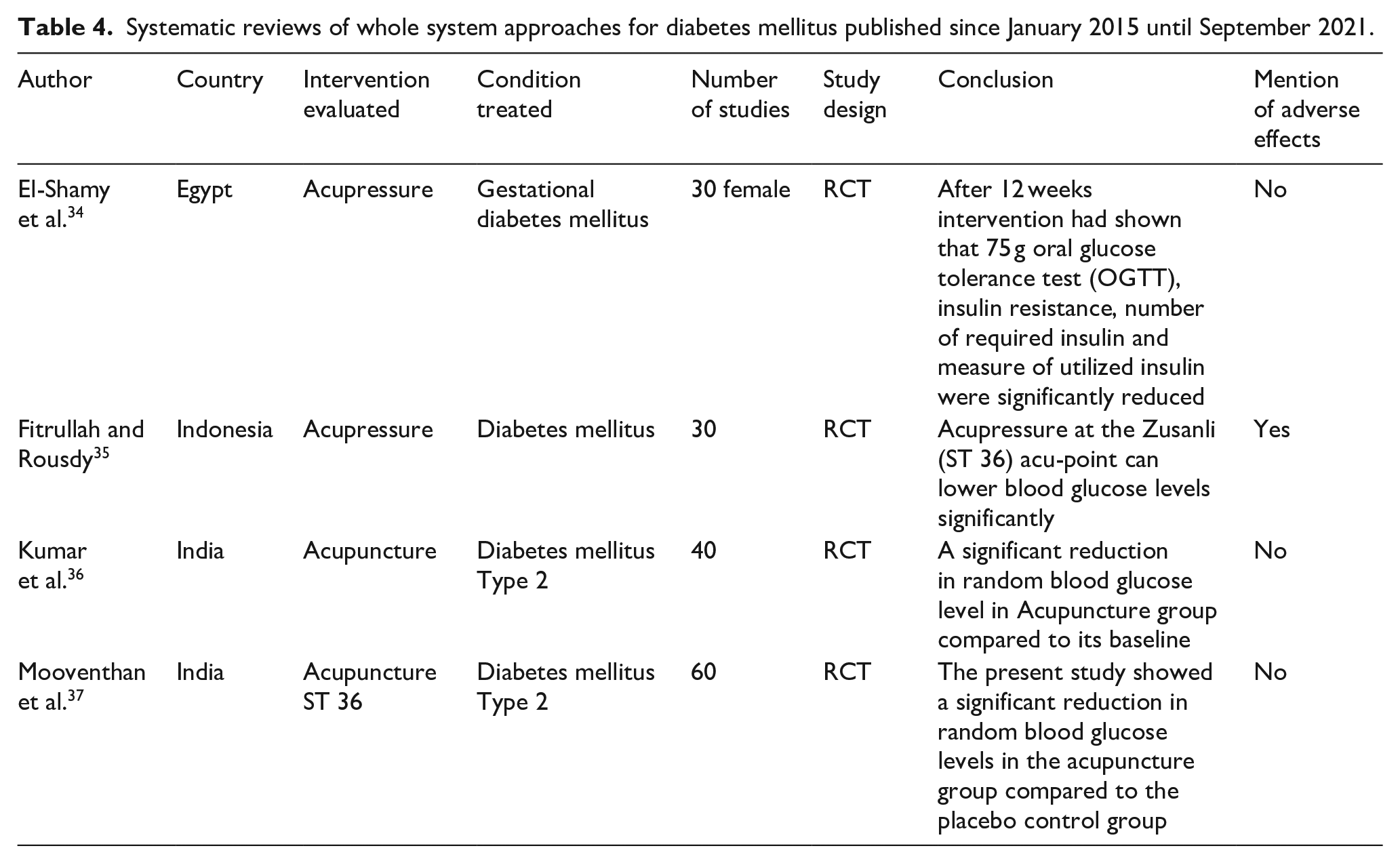
The whole system approach in this study is acupressure at certain points. The study showed that acupressure on ST36, BL23, and BL13 for 12 weeks, 3 min, three sessions/week had effect to reduce blood sugar levels in gestational diabetes mellitus compared to the control group who only performed antenatal care. 34 Another study showed that acupressure on Zusanli point (ST-36) for 30 min had effect to reduce blood sugar in diabetes mellitus. 35
Another study also showed that acupressure on CV-12 (Zhongwan) for 30 min. This study showed that 30 min of CV-12 had effect to reduce blood sugar among type 2 DM patients compared to the placebo group that received stimulated at the right side of the abdomen (1-cun in beside the CV-12). 36 Furthermore, acupressure on ST-36 (Zusanli) for 30 min was also effective in lowering blood sugar compared to the control group at the placebo point (Table 4). 37
Systematic reviews of whole system approaches for diabetes mellitus published since January 2015 until September 2021.
Discussion
The aim of this study was to conduct a systematic review the most-common CAM used to control glycemic in patients with diabetes mellitus published in the last 5 years ranging from 2015 to 2021. Seventeen articles are included to investigate the effect of CAM to control blood sugar in patients with diabetes mellitus, including natural products, mind-body practice, and whole system approach.
Natural product
Natural products, such as medicinal plants and supplements, are the product widely used in CAM for patients with DM. This is aligned with a previous study which states that natural product is the popular complementary health in the United States. 38
Berberis aristata/Silybum marianum
Berberis aristate/ Silybum marianum is medicinal herbs originated from Asia and Southern Europe, but now it can be found in many countries around the world. 39 This plant contains antioxidant. In this literature review, Berberis aristata can be added with insulin therapy as a glycemic control for patients with DM type. 40
Fenugreek (Trigonella foenum-graecum)
Fenugreek is an herb that has a special scent and grows in India and some countries in South Africa. 41 Fenugreek contains alkaloids and steroidal saponins which can be used as an antidiabetic agent. 42 This literature review uses fenugreek seeds to decrease fasting blood sugar. 22
Bitter melon (Momordica charantia)
Bitter melon has been frequently used as a therapy for decreasing blood sugar in diabetes mellitus. Bitter melon, a member of the Curcurbitaceae family, is a plant that grows in tropical areas such as Amazon Basin, Africa, Asia, the Caribbean, and Southern America. It has green leaves, yellow flowers, and its fruit like a cucumber. Bitter melon extract has a similar structure to animal insulin. The frequent adverse effects are hypoglycemia and dizziness, 43 while in this study there is no serious side effects when the intervention was conducted. 23
Whortleberry (Vaccinium arctostaphylos L.)
The Iranian people widely used whortleberry as a traditional medicine. 44 It has been reported to have antioxidant, anti-cancer, anti-inflammatory, and anti-hyperglycemia properties.45,46
Cinnamon (Cinnamomum)
Cinnamon is a sweet spice that is commonly used in Greece and Rome. This plant is stated in Bible and Chinese texts. Cinnamon, originated from Sri Lanka and part of India, is a tropical plant that has affects blood sugar, body mass index (BMI) 47 and insulin. 48
Chicory inulin
Chicory is an agricultural crop from continental Europe. This herb has been widely consumed in various countries in Western and Eastern countries. 49 Chicory has been reported to have function as a prebiotic, 50 and to decrease blood sugar level. 51 This article review found that chicory inulin could lower the level of fasting blood glucose. 26
Nigella sativa
Nigella sativa, an original plant from Mediterranian to Western Asia and Northern India, is widely produced in India, Bangladesh, Nepal, Sri Lanka, Iraq, and Pakistan. 48 This plant contains active substances known as thymoquinone and has antioxidant effect. 52 In addition, Nigella sativa can reduce appetite and weight, and glycemic control. 53
Bell pepper (Capsicum annuum L.)
Bell pepper (Capsicum annuum L., also known as chili pepper, has been used by native Americans. The essential substance of this plant is an alkaloid known as capsicinoids. It has been reported that bell pepper is the main source of vitamin C. Also, bell pepper contains antioxidant. 54 In this research, bell pepper was combined with yoga so that it can be used as a management of DM type 2. 30
Mulberry leaves
Mulberry is commonly grown in the mountain of the tropical area for instance Asia, Middle East, and Southern America. 55 It leaves has an advantage for the treatment of DM type 2. Mulberry leaves can be a useful complementary food to lower postprandial blood sugar according to Riche et al. 28
Chamomile tea
Chamomile, having the Latin name Chamomilla recutita L., is a medicinal herb from Europe and Western Asia. Chamomile flowers are commonly used as tea for medicinal purpose. 56 The result of the research by Zemestani et al. 29 found that chamomile has anti-hyperglycemia and antioxidant properties.
Traditional herb.
Several herbal medicine combinations consisting of Capparis spinosa, Rosa canina, Securidaca securigera, Silybum marianum, Urtica dioica, Trigonella foenum-graecum, and Vaccinium arctosphylos is used to glycemic control in patients with DM type 2, and there was not found any adverse effect. 24
Mind-body practice
Mind-body practice focus on physic and psychological approach for instance relaxation (breathing exercise and guided imagery), tai chi, yoga, and music therapy. Auditory guided imagery (AGI), qigong and tai chi, and relaxation are used in this review.
Auditory guided imagery (AGI)
Auditory guided imagery is a psychological intervention by listening to relaxing music and verbally described on images formed in the mind in order to feel relaxed and focus. 57 Moreover, the feeling of relaxation that appeared by auditory guided imagery has a glycemic control effect and improves the quality of life in patients with DM type 1. The result of this review stated that AGI has a decrease of blood glucose effect in children with DM type 2 at a short period of time. 31
Qigong and Tai Chi
Psychical activity is needed to manage blood glucose in diabetic patient. 58 Qigong is a breathing exercise and is an essential part of Chinese medicine. 59 This exercise affects blood sugar. 60 Tai chi also originated from China and slow-motion such as dance and integrates musculoskeletal, breathing, and meditation. 61 Tai chi can be used as a chronic DM management since this exercise can alleviate fasting blood glucose. 62 This review found that qigong is more effective for managing patients with DM type 2 than tai chi. 32
Relaxation
Stress triggers chronic hyperglycemia. Relaxation is known to reduce blood glucose levels so that it can be used for treating patients with DM type. 33
Whole system approach
The whole system approach in this study is acupressure at several points. Acupressure has been practiced in Traditional Chinese Medicine (TCM) for 5000 years. Acupressure involves pressing several points on the body. This technique can stimulate the production of endorphins in the brain, relieve pain, and enhance comfort. 63 The result of the review showed that acupressure could be used as glycemic control in patients with gestational diabetes mellitus 34 and diabetes mellitus type 2.35–37
Limitation of the study
The articles of the systematic review still have some limitations, such as the sample in the articles was still too small and duration of the study and follow up. However, the articles in this study mentioned the adverse effects. Further study is needed to conduct study related to the potential interaction of CAM therapy with medicine
Conclusion
CAM for glycemic control of diabetes mellitus are natural product, mind body practice, and whole system approach. The results of the systematic review showed that natural products were the most widely used type for glycemic control of DM, but the side effect must be considered when using these natural products.
Footnotes
Acknowledgements
We would like to thank LPDP for their support of this study.
Author contributions
The authors contributed equally.
Declaration of conflicting interests
The author(s) declared no potential conflicts of interest with respect to the research, authorship, and/or publication of this article.
Funding
The author(s) disclosed receipt of the following financial support for the research, authorship, and/or publication of this article: The work was supported by LPDP Indonesia.
Ethics approval
This study is systematic review and the protocol of this study was registered at Prospero number CRD42021287919.
Significance for public health
Complementary and alternative medicines has been increasingly and become public interest. CAM practice have emphasized health promotion and being a part of public health. In addition CAM practice is also increasingly popular for the management of diabetes mellitus (DM)due to minimal complication and minimal cost. Those, the aim of this study was to conduct systematic review of any types of complementary and alternative medicine for glycemic control of diabetes mellitus. The result of this study provided the evidence for health care provider for using CAM for glycemic control.