




Abstract
Introduction:
COVID-19 affects lifestyles, including those of undergraduate students who are one of the most vulnerable populations. This study aimed to describe changes in lifestyle-related behaviors and assess the correlation between the perceived risk of COVID-19, social support, perceived stress, and lifestyle changes among undergraduate students during the pandemic.
Design and methods:
A total of 547 students from 32 provinces in Indonesia completed online questionnaires comprising four measures: perceived risk of COVID-19, the Lifestyle-related Behavior Questionnaire, the Multidimensional Scale of Perceived Social Support, and the Pandemic-related Perceived Stress Scale.
Results:
Undergraduate students who lived with their families had healthier lifestyles than students who lived alone (p = 0.007). Furthermore, The Pearson’s correlation showed a significant correlation between lifestyle changes with perceived severity (r = 0.107; p < 0.05), social support (r = 0.237; p < 0.001and pandemic-related stress (r = −0.304, p < 0.001). Higher perceived severity of COVID-19 and social support were associated with a healthier lifestyle, whereas increased stress correlated with a less healthy lifestyle.
Conclusion:
Psychological factors correlated with lifestyle changes of Indonesian undergraduate students during the pandemic. Therefore, psychological aspects should be more considered by relatives and institutions to ensure healthier lifestyles of students.
Introduction
The emergence of COVID-19 has posed a major threat to various aspects of people’s lives worldwide, including socioeconomic, education, physical and mental health. Some popular and effective measures implemented by global leaders to reduce virus transmission include lockdown, home confinement, travel restriction, work from home, and online learning. These measures would significantly affect physical and psychological health, which might adversely impact lifestyle habits, including dietary patterns and physical activities.1,2
One of the most vulnerable populations during COVID-19 is undergraduate students. 3 Along with being in a transitionary period from adolescence to early adulthood, they are also in a critical life stage wherein most mental health problems start to occur, which could affect their later development. 4 Moreover, the ongoing pandemic is a significant stressor during this transition period due to limited physical and social activities and uncertainty about the situations. Previous studies have reported sudden changes in lifestyle-related behaviors among university students during the pandemic.5,6
Generally, its impact on each student’s lifestyle may differ. Some students may be more motivated and realize the importance of maintaining good physical and mental health during the lockdown, whereas others could experience increased stress and anxiety due to compulsory home quarantine leading to unhealthy lifestyles, such as increased sedentary behaviors.7,8 Therefore, the internal and external psychological resources might be associated with the magnitude of lifestyle changes during a health crisis.
An internal factor that can influence lifestyle changes during COVID-19 is perceived stress. Several studies have shown an increase in students’ anxiety, depression, fear, boredom, and academic stress.9–11 Higher levels of stress as an impact of COVID-19 can disrupt the maintenance of a healthy lifestyle, including regular physical activity and sufficient sleep. For instance, stress may lead to the consumption of high-sugar food that encourages the production of serotonin, which positively affects mood 12 and sleep quality. 13
Moreover, past studies suggested that perceived risks of COVID-19, such as severity and vulnerability, were associated with the adoption of more protective behaviors, such as social distancing, wearing face masks, or using hand sanitizers.14,15 Risk perception could also be related to lifestyle changes, and hence, it is important to assess individuals’ perceptions of COVID-19 risks and how these influence healthy lifestyle-related behaviors.
From the external aspect, social support is linked with healthy behaviors, such as physical activity. 16 It is viewed as support perceived by individuals from their social relationships. 17 The support can be received from various sources, such as family, friends, relatives, social groups, and larger communities. During previous pandemics, the need for social support was reported to increase as a common coping strategy. 18 A study in Spain also showed that high social support and good stress management during the pandemic were associated with a healthy lifestyle. 19
As university students have a higher risk regarding the pandemic’s impact, it is necessary to examine the potential changes in lifestyles and their association with psychological aspects. To the best of our knowledge, there are few studies investigating individuals’ psychological factors linked with lifestyle changes during the pandemic, specifically in Indonesia. Therefore, this study aimed to assess the correlation between the perceived risk of COVID-19, perceived social support, and stress level with changes in lifestyle-related behaviors among undergraduate students in Indonesia during the COVID-19 pandemic.
Design and methods
Study design
This research used a cross-sectional method. After receiving approval from the research ethics committee from Universitas Andalas with No. 432/UN.16.2/KEP-FK/2021, the data was collected through an online survey from August to September 2021. Online questionnaires were created using Google Forms and distributed through social media platforms.
Research participants
A total of 547 undergraduate students from 32 provinces in Indonesia were recruited through convenience sampling. The criteria included: students at universities in Indonesia, aged at least 18 years, access to the Internet, and willing to take part after reading the informed consent form. The participants could only complete the online questionnaire once to avoid data duplication.
Measures
Before data collection, the measures went through the adaptation process, such as translation from English to Bahasa and expert judgment by two experts in psychology and nutrition. The revised instruments were then created using Google Forms for further testing.
Demographic information
This includes gender, province of origin, domicile during the pandemic, and parents’ average income. Information about exposure to COVID-19 was also asked, including whether they browsed information about it, they had been infected, a relative had been infected, and a relative had died from COVID-19. These questions were dichotomous (yes or no responses).
Perceived risk of COVID-19
This measure assessed an individual’s perception of severity (“How severe is the development of COVID-19 cases in Indonesia?”), harmfulness (“How harmful is COVID-19 to your health?”), susceptibility (“Do you feel susceptible to being infected with COVID-19?”), worry (“Are you worried about being infected?”), and fear (“Are you afraid of being infected?”). Each aspect was measured with a single item. All the answers were in the form of a Likert scale with a score of 1 (not at all) to 5 (significantly). Higher scores represented a higher perceived risk of COVID-19.
Lifestyle-related Behavior Questionnaire
This comprised 20 items in Bahasa asking about changes in lifestyle-related behaviors during the pandemic, including eating habits (14 items), physical activities (3 items), sleep habits (2 items), and anxiety levels (1 item). 20 One of the items was “During COVID-19 pandemic, how has your probability of skipping one of the main meals (breakfast/lunch/dinner) changed?” Responses ranged from significantly increased to significantly decreased, and the overall score was shown as the average score. A positive score on this measure indicated a healthier lifestyle, while a negative score indicated a less healthy lifestyle. This translated scale had a Cronbach’s alpha of 0.705.
Multidimensional Scale of Perceived Social Support (MSPSS)
This comprised 12 items in Bahasa measuring perceived support from friends, family, and significant others during the pandemic. 21 One of the items was “I can count on my friends when things go wrong during the pandemic.” Responses ranged from 1 (strongly disagree) to 5 (strongly agree). A higher score on this scale depicted a higher perceived social support during the pandemic. Cronbach’s alpha of the translated scale showed overall reliability of 0.921, and each subscale showed 0.934 (significant others), 0.920 (family), and 0.914 (friends).
Pandemic-related Perceived Stress Scale
This was a 10-item scale in Bahasa that assessed the stress level experienced by individuals during the pandemic. 22 One of the items was, “I have felt as if something serious was going to happen unexpectedly during the pandemic.” Responses ranged from 0 (never) to 4 (always). Participants with a higher score indicated a higher level of pandemic-related stress. This translated scale yielded a Cronbach’s alpha of 0.758.
Statistical analysis
Data obtained from the questionnaires were analyzed using the statistical software which was Stata version 16. Demographic data were presented using descriptive statistics, whereas mean difference tests were employed to determine whether there were any significant differences in lifestyle changes based on demographic data. Pearson product-moment was used to assess the correlation between psychological variables and lifestyle changes. A p-value less than or equal to 0.05 is considered statistically significant.
Results
Differences in lifestyle changes based on demographic characteristics
Table 1 describes participants’ demographic data in percentage and descriptive statistics (mean and SD). As shown, most were female (79.5%) and living with family (81.4%). Nearly half were from Sumatra islands, had normal body mass index, and average parents’ income of less than IDR 2 million per month.
Demographic characteristics regarding lifestyle changes (N = 547).
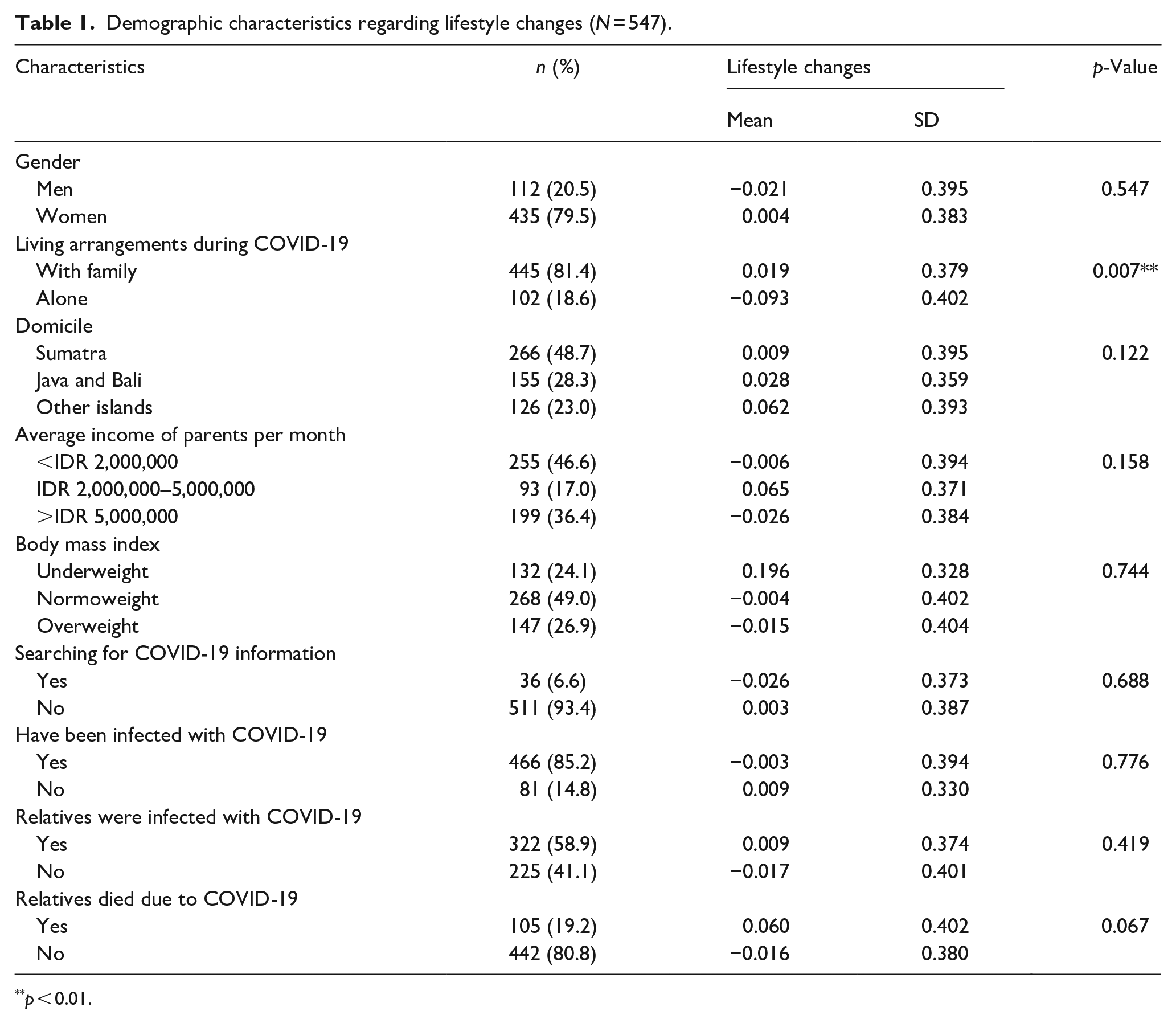
p < 0.01.
Moreover, mean difference tests were employed to determine any significant differences in lifestyle changes based on demographic characteristics. Table 1 shows that there was a significant difference between students who were living with their families and living alone during COVID-19 (p = 0.007). In other words, changes in the lifestyle of students who live alone tended to be less healthy.
Lifestyle changes among undergraduate students
Figure 1 depicts the descriptive statistics of lifestyle changes divided into three categories, such as increased change, no change, and decreased change. The data were presented as the percentage of 20 lifestyle-related behaviors.

Lifestyle changes of undergraduate students in Indonesia during COVID-19 pandemic.
As shown, more than half of participants reported healthier eating patterns during the pandemic, such as increased intake of immunity-boosting food (51.74%) and nutrition supplements to boost immunity (61.79%), increased support from family and friends in healthy eating (66.54%), and higher interest in learning healthy eating tips (56.12%). As expected, around 40% had reduced fast food consumption, whereas the same percentage reported no change in the consumption of sweetened beverages and snacks. According to the physical activities, there was increased participation in leisure and household chores (54.48%) and sitting and screen time (76.78%). However, most participants exhibited higher stress and anxiety levels during the pandemic (66.18%). Regarding sleep patterns, approximately a third revealed no significant change in the quality and quantity.
Factors associated with lifestyle changes
To test our hypothesis, a Pearson’s correlation was conducted for all variables. As Table 2 shows, participants felt that COVID-19 was a severe situation (M = 4.44 out of 5), and this was significantly correlated with a healthier lifestyle (r = 0.107; p < 0.05). However, there was no significant correlation between lifestyle changes and other risk perceptions.
Correlation analysis of factors associated with lifestyle changes among undergraduate students in Indonesia (N = 547).
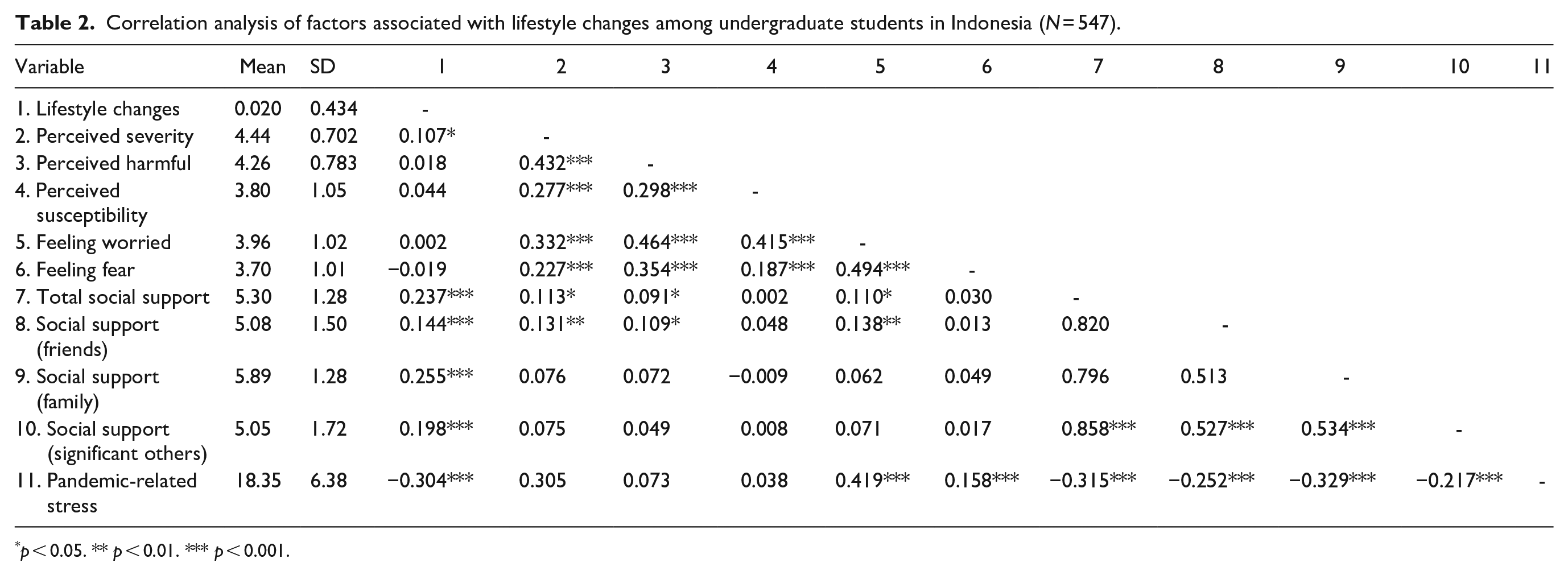
p < 0.05. ** p < 0.01. *** p < 0.001.
From the analysis, perceived social support had a significant positive correlation with lifestyle changes (r = 0.237; p < 0.001). Specifically, social support from the family had a higher correlation (r = 0.255; p < 0.001). Moreover, the results showed that pandemic-related stress was negatively correlated with lifestyle changes among undergraduate students (r = −0.304, p < 0.001). This means that a higher stress level would be associated with a less healthy lifestyle.
Discussion
To the best of our knowledge, this was one of the first studies to examine the relationship between the perceived risk of COVID-19, social support, pandemic-related stress with lifestyle changes among Indonesian undergraduate students. Moreover, we also aimed to describe changes in lifestyle-related behaviors and compare them based on the demographic data to discover the impact of COVID-19.
As a response to the global health crisis, most educational institutions worldwide have implemented distance learning to slow the spread. Hence, most students decided to return to their hometowns, whereas some chose to live near the campus due to various factors. The lifestyles of 18.6% of participants who lived alone during the outbreak were unhealthier than those who lived with their parents. Consistent with this result, Wu et al. 23 also reported that students living with their families have fewer health-related issues. The restrictions on the food selections and rules regarding lifestyles within the households are likely to be important factors for this.
This result can also be explained by some studies conducted before the pandemic, which suggested that undergraduate students who lived away from family struggled to practice a healthy lifestyle, were more sedentary, 24 and had unfavorable dietary habits.24,25 As most students are independent for the first time, have less experience, and lack time to prepare healthy meals, they tend to eat ready-made food or frequently eat out at restaurants. 25 Their lifestyle habits have worsened during the pandemic as there was limited availability of healthy foods, and school-from-home policies required students to sit for a long time in front of the computer, making them more sedentary.
In this study, the correlation between the perceived risk of COVID-19 and lifestyle changes was also assessed. We found that the perception of severity had the highest mean (M = 4.44 ± 0.702). The results depicted that most respondents perceived that the development of COVID-19 in Indonesia was moderate to significantly severe. As the pandemic has affected people worldwide, previous research on students at the University of Toronto also showed that 96.5% perceived it as moderate or significantly severe. 26 Perceived severity was positively correlated with lifestyle changes, but it showed a weak correlation (r = 0.107). The other four items, such as perceptions about being harmful, susceptibility, fear, or worry about being infected with COVID-19 were not significantly associated with lifestyle changes. This finding might be because the students thought they had fewer co-morbidities, so they had a lower risk of infection and fatality. A study by Bechard et al. 27 suggested that the adoption of health behaviors was directly associated with its perceived benefits and not the perceived risk of COVID-19.
This study also found that perceived stress had a significant negative correlation with lifestyles changes. This means that a higher stress level was associated with more reported harmful lifestyles. Consistent with this finding, previous studies have also demonstrated that higher stress levels were related to poorer lifestyle habits, including eating behaviors, 28 sleep quality, 29 and physical activity. 2 It is reasonable that stressed people are more likely to develop unhealthy or emotional eating because they tend to have a high craving for unhealthy foods, specifically, those containing high fat and sugar.30,31 Eating these “comfort foods” are believed to reduce the negative feelings associated with stressful conditions. 32
Our analysis also showed that social support was significantly and positively correlated with lifestyle changes during COVID-19. The higher social support perceived by students was associated with healthier lifestyles. Adequate support is a protective resource for individuals during negative life events, including pandemics because it can mitigate the negative effects of social restrictions implemented by the government and provides the ability to adopt effective coping mechanisms.33–35
Moreover, numerous studies have also shown that sufficient social support was a key factor in adherence to a healthy lifestyle for various samples.36,37 This might be because support received from others is important in motivating individuals to engage in health-promoting behaviors consistently. Interestingly, support from the family had a higher correlation with lifestyle changes than other sources. Indeed, home isolation and distance learning policies have enabled family members, particularly parents, to monitor and maintain their children’s health closely, resulting in more positive lifestyle changes.
Although significant findings were reported, there are some limitations regarding the measurement. First, this study used online self-report questionnaires, which may lead to recall bias. Second, the questionnaires validated in this study were the Bahasa adaptation, and the perceived risk of COVID-19 measure was constructed for this study without validation. Future studies could validate the questionnaire before doing their research. Moreover, as the research design was a cross-sectional study, causal relationships between variables could not be explored. Further study could investigate other possible variables affecting the extent of lifestyle changes in pandemics. Unfortunately, the obtained result in the present study only represents the population of Indonesian undergraduate students, which cannot be generalized to the whole population.
Despite the limitations, to the best of our knowledge, there has been no prior research investigating lifestyle changes during the pandemic and its associated variables, specifically in Indonesia. Moreover, a relatively large number of undergraduate students recruited from around 32 provinces in Indonesia indicated a fair representation of the population. Therefore, this study has depicted psychological factors associated with lifestyle-related behaviors of Indonesian young adults during the COVID-19 outbreak. These findings suggest the importance of early detection of stress and easier access to social support for undergraduate students to maintain positive lifestyles.
Conclusion
In conclusion, this study has shown that some psychological aspects such as perceived severity, social support, and pandemic-related stress were correlated with lifestyle changes. Higher social support and perceived severity were associated with a healthier lifestyle during the pandemic, with social support from the family having the highest correlation. Meanwhile, higher perceived stress was linked to unhealthier lifestyles. Moreover, students who lived with their families reported a more positive lifestyle than those who lived alone. Therefore, to ensure undergraduate students have a healthier lifestyle during the outbreak, more attention should be given to providing social support to undergraduate students, whereas educational institutions should focus more on promoting stress management to lower students’ perceived stress due to the pandemic.
Footnotes
Acknowledgements
The authors wish to thank the Faculty of Medicine, Universitas Andalas, Indonesia, for providing funds for this research.
Author contributions
FK and LS had substantial contributions in all aspects: design of the research; collection, analysis, and interpretation of data; and the manuscript writing process. LS revised the manuscript critically for important intellectual content. FK submitted the final manuscript for publication. All authors have read and approved the final version of the manuscript and agreed to be accountable for all aspects of the work.
Declaration of conflicting interests
The author(s) declared no potential conflicts of interest with respect to the research, authorship, and/or publication of this article.
Funding
The author(s) disclosed receipt of the following financial support for the research, authorship, and/or publication of this article: The research was fully funded by the Research Grant Scheme from the Faculty of Medicine, Universitas Andalas, Indonesia, with the contract number: 18 /UN.16.02/DP/PT.01.03/2021.
Ethics approval and consent to participate
Ethical approval was granted by the research ethics committee from Universitas Andalas with number 432/UN.16.2/KEP-FK/2021.
Informed consent
Online informed consent was obtained from anonymized participants prior to participating in this research.
Significance for public health
Due to the COVID-19 outbreak, the government has demanded that educational institutions implement distance learning to reduce virus transmission. This policy may make abrupt changes in the lifestyles of undergraduate students. The present study was one of the few studies investigating the association between psychological aspects such as the risk perception of COVID-19, social support, and pandemic-related stress with lifestyle changes among Indonesian undergraduate students. The findings of this study would highlight the importance of psychological factors that may impact the changes in lifestyle-related behaviors.
Availability of data and material
The datasets used and/or analyzed during the current study are available from the corresponding author on reasonable request.