




Abstract
This article explores how entrepreneurial culture is constructed in a university setting through the discursive practices of students engaged in entrepreneurship communities. Drawing on discourse analysis and a theoretical framework that integrates identity theory, organizational culture (Schein), communities of practice (Wenger) and symbolic anthropology (Geertz), the study examines how students make sense of entrepreneurship as a cultural and identity-forming phenomenon. Empirical data were collected through thematic interviews with student entrepreneurs active in multidisciplinary university-based communities. The analysis identified three primary discourse categories: personal, communal and normative, each reflecting different dimensions of how students internalize and legitimize entrepreneurship. The findings reveal that entrepreneurial culture is not transmitted through formal teaching alone but emerges from peer interactions, shared narratives and symbolic practices that collectively shape identity and belonging. Entrepreneurial communities function as catalysts, offering both emotional resonance and social validation that make entrepreneurship a meaningful and attainable path. The study contributes to entrepreneurship education literature by demonstrating how discourse not only reflects but also actively constructs entrepreneurial realities in higher education. Implications are drawn for how institutions can support identity-sustaining structures that extend beyond individual courses and foster inclusive entrepreneurial ecosystems.
Keywords
Introduction
Entrepreneurship has emerged as a vital catalyst for innovation and economic renewal, particularly within university ecosystems where students are increasingly encouraged to explore entrepreneurial paths. Stronger employee engagement and the ability to innovate will lead to greater added value and organizational success. The need for new business ideas and companies that create jobs is a generally recognized fact. This is all about entrepreneurs who can play a major role in this transition (Brodie & Osowska, 2021; Inoubli & Gharbi, 2024; Swain & Patoju, 2022).
The concept of entrepreneurship is often associated with a person’s strong commitment to the object of doing, as the ability to handle wholes and implement practical measures. In universities, entrepreneurship is often studied within the framework of individual study courses and degree programmes. Although entrepreneurial career is considered as an attractive choice of career among university students, entrepreneurial intentions are rarely realized in practice (Otache et al., 2024). One of the reasons influencing this is weak effect of courses in creating an opportunity for the formation of a broader university-wide culture that supports entrepreneurship (Harima et al., 2021, pp. 1443–1444).
The strategy of LAB University of Applied Sciences is to support students’ entrepreneurship in a wide area, as part of their degree, by creating a form of empowered activity that supports entrepreneurship, wherein students complete their studies in RDI activities of the university and cooperate with local business life. The content of the entrepreneurship courses has been developed and the way they are conducted has been changed to better reflect the context of business life. Communities that support entrepreneurship have been established and their activities are supported in many different ways. At the pedagogical level, entrepreneurship coaching is associated with carrying the benefit in the transition of students to local employment and in generating new business ideas and start-ups. To achieve this, a strong entrepreneurial culture is needed. The vision of entrepreneurship education in LAB University of Applied Sciences is that entrepreneurship studies form up a dynamic entity which breaks present bottlenecks emerging in the timing of offering university courses and combining them with local business life cases.
Objective
The purpose of the article is to understand the construction of students’ entrepreneurial discourses as a base of the entrepreneurial culture in a multidisciplinary university community. The two studied student stakeholder groups were interviewed to capture diverse perspectives on how entrepreneurial culture is experienced and constructed within the university. These groups represented different roles and levels of engagement in entrepreneurial activities, offering a broader and more nuanced understanding of the phenomenon. The first stakeholder group comprised students who are members of LUT Entrepreneurship Society (LUTES). LUTES is a non-profit entrepreneurship society with a mission to inspire and help students become entrepreneurs. Members do study at LUT University or LAB University of Applied Sciences aiming to develop themselves, learn about growth entrepreneurship and start their own start-up. LUTES was founded in 2011, and in the end of the year 2024, the number of members was 597. As the second largest student entrepreneur community of Finland, LUTES has established its position as one of the LUT University group actors, and it functions as a strong accelerator for the members who participate in events and projects.
The second stakeholder group of the study was students of the business administration bachelor’s degree programmes, who do carry out their studies as team entrepreneurs in the cooperative. In the 2010s, educators of LAB University of Applied Sciences (then known as Saimaa UAS) developed an Experimental Development Ecosystem (Juvonen & Kurvinen, 2018, p. 84). The ecosystem offers students a platform for studying content knowledge (in this case, marketing as a major), applying knowledge in real customer projects of the cooperative and reflecting what has been learned by doing with other team members and the team coach.
Both of these student entrepreneur communities are located close to each other in LUT University Lappeenranta campus. Their physical existence creates the foundation for broader student entrepreneurship activities, which are also supported by university courses, entrepreneurship coaching and incubator activities.
The key factors influencing the construction of entrepreneurial culture were identified and analysed from thematic interviews of students. The aim of the study is to increase the understanding of the emergence of communities in activities that promote entrepreneurship within university studies and entrepreneurial spirit of the students.
In this study, the following research questions are addressed:
What kind of discursive factors influence the formation of an entrepreneurial culture in the university environment among stakeholders? Which are the most important values and assumptions associated with entrepreneurship in the university context among stakeholders?
These research questions emerge directly from the theoretical framework, integrating perspectives from identity theory, organizational culture (Schein, 1994), communities of practice (Wenger, 1998) and symbolic anthropology (Geertz, 1973). The first question aims to uncover the structural, cultural and communal factors, such as peer networks, entrepreneurial communities and institutional support, that act as catalysts in shaping a university’s entrepreneurial culture. This is grounded in the understanding that entrepreneurial identity is socially constructed and reinforced through cultural practices, norms and participation within a given community (Rocha et al., 2024, p. 13).
The second question focuses on the shared values and tacit assumptions. Schein’s (1994) deeper cultural layers underpin entrepreneurship in the university context. These include beliefs about risk, autonomy, failure and social impact, which often remain unspoken but guide behaviour and identity formation. By examining these assumptions, the study seeks to map the symbolic and normative landscape of entrepreneurship, helping to explain how entrepreneurship becomes a meaningful and legitimate identity among students and other university stakeholders.
Together, the questions address both the cultural structures that enable entrepreneurship and the subjective meanings that sustain it, offering a comprehensive view aligned with the multidimensional theoretical framework.
Identity, Community and Culture in Student Entrepreneurship
Entrepreneurship in the university setting is no longer limited to formal business creation; rather, it is increasingly recognized as a broader process of identity construction, cultural adaptation and meaning-making. Universities serve not just as educational institutions but also as cultural and social systems in which students encounter alternative ways of thinking, working and being. For many, involvement in entrepreneurship marks a deep personal transformation, one shaped as much by social environments and symbolic experiences as by formal learning (Ollila & Middleton, 2017, pp. 136–139).
This theoretical framework draws upon entrepreneurship education, identity theory, organizational culture theory (Schein, 1994) and symbolic anthropology (Geertz, 1973) to explain how entrepreneurial communities serve as both catalysts and containers for student entrepreneurial identity. It provides a lens through which to interpret interview data focused on how students engage with entrepreneurship, and how community, motivation and cultural meaning coalesce in their developmental process.
Identity Formation in Student Entrepreneurship
Building on this integrative lens, it is important to explore how entrepreneurial identity itself emerges and evolves within student experiences. Unlike static personality traits or skill-based models, identity-based approaches emphasize entrepreneurship as a socially embedded and self-reinforcing process (Donnellon et al., 2014, pp. 490–493). For students, the development of an entrepreneurial identity involves a reconfiguration of self, often in contrast to the more passive or receptive role of the student.
Nielsen and Gartner (2017, pp. 137–141) argue that student entrepreneurs typically experience identity plurality: simultaneously embodying the roles of ‘student’ and ‘entrepreneur’, which may conflict in terms of values, time orientation and behavioural expectations. The management of this tension is a key. Some students resolve it by integrating both identities (balanced identity), while others prioritize one over the other, leading to periods of identity dissonance or reorientation.
To further understand the role of community in this identity negotiation, we turn to the cultural and symbolic systems embedded in entrepreneurial environments. As Ashforth and Mael (1989, pp. 21, 23–24, 26) explain, individuals are motivated to act in alignment with salient identities. Thus, when the ‘entrepreneur’ identity becomes more salient, through community support, recognition or successful venture experiences, students increasingly internalize entrepreneurial values and behaviours. But this process is not linear. It unfolds over time, often catalysed by rituals, peer interaction and social reinforcement, which are culturally structured within entrepreneurial communities (Decker-Lange et al., 2024, p. 1260).
Entrepreneurial Communities as Cultural Systems
A core feature of this framework is the recognition that entrepreneurial communities function as cultural systems, not merely as support networks. They provide the symbolic environment in which entrepreneurial identities can be safely explored, expressed and reinforced. According to Schein (1994), every organization or community operates on three interrelated cultural levels:
Artifacts (visible symbols and practices): These include start-up competitions, pitch decks, branded hoodies and hackathons. They are the visible expressions of entrepreneurial culture but only scratch the surface. Espoused values: These include shared beliefs such as ‘failing is learning’, ‘make impact’ and ‘disrupt the status quo’. These norms guide interaction and shape expectations. Basic underlying assumptions: These are deeply held beliefs—such as the idea that value must be created, autonomy is preferable to hierarchy and uncertainty is an opportunity. These assumptions define what is taken for granted within the community.
These cultural layers provide a foundation for interpreting the symbolic actions and rituals that dominate student entrepreneurial spaces. Participation in a demo day, for example, is not just an event; it is a ritualized performance that conveys belonging, ambition and commitment to entrepreneurial values. Similarly, being accepted into an incubator cohort signals not only competence but also alignment with the community’s assumptions about who is ‘worthy’ of support.
Schein’s (1994) model allows us to analyse how visible practices are often grounded in, and inseparable from, deeper worldviews. A community that outwardly values ‘growth mindset’ or ‘resilience’ may, at the underlying level, promote narratives of personal transformation, meritocracy and impact.
The Role of Symbolic Anthropology: Meaning-making in Entrepreneurial Practice
Clifford Geertz’s (1973) theory of thick description and symbolic anthropology deepens this framework by addressing the interpretive nature of social practices. Geertz suggests that cultural practices, such as rituals, language or ceremonies, derive their meaning from their context and must be understood as texts that members interpret.
Entrepreneurial communities are full of such texts: the start-up pitch, the co-founder story and the ‘fail fast’ anecdote. These are not neutral communication tools, but symbolic acts that signal affiliation, reinforce norms and help individuals locate themselves within shared narratives.
Such symbolic practices are not isolated; they resonate within broader motivational structures that drive students’ engagement with entrepreneurship. Geertz (1973) emphasizes that meaning is layered, and rituals or practices often encode multiple cultural messages. For example, a start-up bootcamp may function on one level as skill development and on another as an initiation rite, separating the ‘committed’ from the ‘curious’. These practices produce social differentiation and belonging, both crucial in identity formation.
This approach is particularly useful in understanding how students make sense of their entrepreneurial experiences, often framing them in ways that reflect collective meanings (e.g., ‘pivoting’, ‘scaling’, ‘impact’) rather than isolated actions. It also explains why certain symbols like entrepreneurial failure are imbued with positive value in these communities, unlike in traditional academic contexts.
Motivation: Autonomy, Belonging and Purpose
Drawing from self-determination theory (Ryan & Deci, 2000, p. 68), entrepreneurial motivation can be understood through the lens of intrinsic psychological needs: autonomy, competence and relatedness. Students are more likely to engage deeply in entrepreneurial activities when these needs are met.
Entrepreneurial communities are especially powerful in satisfying these needs:
Autonomy: Students define their own problems, form their own teams and create their own solutions, breaking away from the constraint of predefined assignments. Competence: Through feedback, iteration and public pitching, students gain a sense of mastery over complex tasks. Relatedness: The social bonding in communities of practice satisfies the human need for connection and shared purpose.
When these elements align, students are not merely participating for extrinsic benefits (grades, certificates), but because they find personal fulfilment in the entrepreneurial journey. According to Ryan and Deci (2000, pp. 69–70), this motivational alignment contributes to long-term engagement and supports the internalization of entrepreneurial identity.
Peer Influence and Narrative Infrastructure
Yet motivation alone does not account for all the social dynamics at play. Peer influence, particularly through storytelling, adds another layer of meaning-making. Entrepreneurial communities are shaped not just by programmes and mentors but also by peer dynamics. As Pinheiro et al. (2023, pp. 756–758) and Fellnhofer (2018, pp. 223–224) emphasize, narratives told by near-peers, fellow students who have launched ventures, are particularly influential because they are perceived as attainable.
These peer narratives function as a form of cognitive scaffolding: they help students imagine themselves as entrepreneurs, provide examples of how to respond to challenges and offer moral justification for taking risks. Peer stories are not only motivational; they also provide templates for identity construction (Fellnhofer, 2018, p. 224).
This aligns with Donnellon et al. (2014, pp. 490–493), who argue that students engage in discursive identity work, telling stories that locate their entrepreneurial efforts within meaningful trajectories. For example, reframing a failed start-up as a ‘learning journey’ mirrors the values of the community and justifies continued participation.
The Temporality of Entrepreneurial Identity and Community Detachment
While peer narratives play a critical role during the university experience, the sustainability of entrepreneurial identity post-graduation also warrants closer examination (Harima et al., 2021). When students leave the university and its community structures, the symbolic and practical supports for their entrepreneurial identity may dissolve. Without continued reinforcement, some revert to more conventional identities (employee, graduate) even if they retain entrepreneurial values (Harima et al., 2021, p. 1449).
This underscores the importance of building identity-sustaining bridges, such as alumni entrepreneur networks, post-graduation accelerators or peer advisory boards. These structures can maintain narrative continuity and prevent disconnection from entrepreneurial self-conception (Harima et al., 2021, p. 1456).
Moreover, it highlights the fundamentally situated nature of entrepreneurial identity. Identity is not something one owns internally, it is enacted and affirmed in relation to others, within specific cultural and institutional frames (Harima et al., 2021, p. 1457).
Context: Entrepreneurship as Discourses
The context of the research is built from students’ interviews about entrepreneurship, how entrepreneurship is talked about and made meaningful by students themselves, revealing not only personal motivations but also the social, cultural and institutional frameworks in which entrepreneurial aspirations are embedded. The language used in interviews is not only a means of communication. The shaping of an individual’s understanding of the world, the structure of social reality and the dynamics of relationships between individuals and groups can be also be interpreted through the language used. Discourse analysis as a research method offers a multidisciplinary approach to understanding the complex interplay of language used, power and social structures. It allows us to define the values that influence people’s understanding of the world around them (Wodak & Meyer, 2001, p. 14).
In practice, discourse analysis means a systematic analysis of spoken or written language, which examines the ways of expressing things, through which language builds individual meanings, shapes social interaction between people and reflects the social structures of society (Wodak & Meyer, 2001, p. 18). The analysis focuses on spoken or written texts, taking into account the features and details of the expressed language in wider sociocultural contexts. When examining discourses, the aim is to reveal the implicit assumptions, meaning systems, ideological prejudices and power relations behind language use.
One of the key special features of discourse analysis is the idea of a close relationship between the language used and power. The French sociologist Michel Foucault (1972, pp. 40–49) emphasized the importance of the language used as a tool of social control. Discourse shapes and generates social norms that can be used to marginalize certain groups and produce new power structures. Thus, discourse analysis is coloured by the meaning of ideology. Spoken language is never neutral, but always contains some degree of ideological assumptions, which in turn reflect the dominant beliefs, values and social structures of society (Van Dijk, 1998, p. 200). With the help of discourse analysis, these ideological backgrounds and hidden assumptions conveyed by language can be revealed. The constructionist view emphasizes that our perception of the world is not based solely on objective facts, but is shaped by value-laden discourses. By looking at discursive practices, certain social categories, identities and hierarchies can be revealed, as well as their construction and reinforcement.
Research has shown that student entrepreneurship is not merely a matter of intention or skills, but a deeply situated process of identity work shaped by community belonging, symbolic environments and shared narratives (Donnellon et al., 2014, pp. 490–493; Nielsen & Gartner 2017, pp. 135, 137–139, 141). As such, discourse becomes the site where meanings are constructed, contested and legitimized. For example, entrepreneurial aspirations are often articulated through language that emphasizes autonomy, change-making and purpose (Fellnhofer, 2018, pp. 223–224), while simultaneously being constrained by institutional expectations and the academic role (Ollila & Middleton, 2017, pp. 136–140, 143).
Discourse analysis makes it possible to examine how these meaning systems operate: how entrepreneurship is framed not only as a career path but also as a moral, cultural and social identity. It also allows for the exploration of hidden assumptions, such as what counts as ‘real’ entrepreneurship and whose voices dominate the conversation around entrepreneurial success or legitimacy (Ashforth & Mael, 1989, pp. 21, 23–24, 26; Harima et al., 2021, pp. 1442–1444, 1450).
In the university context, entrepreneurial discourse is shaped by communities of practice (Wenger, 1998), in which students learn through participation, symbolic rituals (e.g., pitch events) and peer interaction. These discourses, and the language used within them, affect students’ sense of belonging, the norms they internalize and ultimately the extent to which they see themselves as entrepreneurs (Brodie & Osowska, 2021, pp. 1288–1290; Pinheiro et al., 2023, pp. 756–758). By analysing the linguistic patterns and discursive structures within student narratives, this study aims to reveal how entrepreneurial culture is constructed and how it might be more inclusively developed within the university ecosystem.
This makes discourse analysis not just appropriate but also essential in uncovering the deeper ideological, symbolic patterns and social dimensions that shape entrepreneurial engagement of students. It enables the questioning of dominant assumptions, reveals marginal or alternative voices, and contributes to a more nuanced understanding of how entrepreneurship education could evolve beyond formal teaching to embrace identity, culture and shared meaning.
Research Design
The empiric part of the study was carried out in LAB University of Applied Sciences, Finland, between March and May 2025. Two stakeholder groups of student entrepreneurs were interviewed by semi-structured interviews. Eight interviews were conducted: seven individual interviews and one group interview of seven people. The selection of students for interviews was voluntary. Both groups were sent a message informing them about the study and asking those interested to register with the researcher. All registered students met the predefined criteria (at least second-year LAB student). The research followed the Finnish National Board of Research Integrity (TENK) guidelines, which states that ethical questions associated with research in the humanities and social and behavioural sciences relate mainly to the interaction between researcher and research subject, which may involve unpredictable factors. It is always the researcher who bears responsibility for the ethical and moral decisions involved in the research. Ethical review applies only to precisely defined research configurations. This research did not contain information that would have been defined by ethical guidelines.
The interviewees of the study were selected using judgement sampling. The method advocates itself when the research object is limited to a certain group of people and when the studied phenomenon is relatively limited (Hirsijärvi & Hurme, 1995, pp. 58–59). The researcher selects the sample based on judgement. This is usually an extension of convenience sampling.
Strauss and Corbin (1998, pp. 201–213) emphasize a close connection between data collection, analysis and writing while developing the theory of the study. At the beginning of the research project, the researcher is at the starting point, entering a new field; it is useful to apply open sampling techniques, based on random sampling or simply by moving and observing the field. Within the development of analysis (in this case, the coding procedure) and theory, the researcher has to form the perspective of the study and use more direction in sampling. This is because the collected data should emphasize the phenomenon studied and give answers to questions which have risen from the modelling of the theory. The amount of data also depends on the discretion of the researcher. Generally, when the data cannot give any new answers to or insights into the previously mentioned questions, they are theoretically saturated. Because of the researcher’s subjective influence on the sampling process, the term ‘sample’ could be replaced by the term ‘discretionary taking’ (Eskola & Suoranta, 1998, pp. 60–61; Silverman, 2000, p. 104)
The total number of students interviewed was 14 in the study. Data saturation was assessed during analysis, and no new themes emerged after the 12th interview, supporting the adequacy of the 14 interviews for capturing discursive variation. The duration of the interviews varied from 50 minutes to 1 hour and 10 minutes, with the exception of the group interview, which lasted 1 hour and 40 minutes. At the total, data included approximately 47,500 words as transcribed files.
The analysis of the interviews followed the principles of discourse analysis. The texts were approached according to the principles of grounded theory, which is a method of analysis used to uncover social relationships and behaviours of groups as social processes (Strauss & Corbin, 1998). In the analysis, attention was paid to the root causes, features and requirements of entrepreneurship presented by the students.
Technically, interviews were carried out as Microsoft Teams meetings while they were recorded and transcribed by the AI of the software. Then, transcribed interviews were checked, typos made by AI were corrected and the files were downloaded into Atlas TI, a computer-assisted qualitative analysis software. The coding process included open, axial and selective levels. At the open level, the data were read through, and 28 codes were created, after which the connections and cause-and-effect relationships between the categories were analysed. At the level of axial coding, the main concentration of analysis was focused on the interconnections of the codes. At the third level of the coding procedure, selective coding, the main interest of analysis was on the reference to the texts of the codes and their order. The interest was focused on texts that belonged to the most interesting code families concerning the research questions and the data. Through the analysis process, three primary categories, including 15 coded discourses were identified.
Results
In the interview data, discourses surrounding entrepreneurship were structured into three primary categories: personal, communal and normative discourses. These categories not only reflect how students perceive and relate to entrepreneurship but also reveal how they actively construct and shape their entrepreneurial identity and how it is legitimized through their narratives.
Personal Discourses: Entrepreneurship as Identity and Self-expression
Personal discourses were the most prevalent in the material. Within these, entrepreneurship primarily emerged as a means of self-realization, societal impact and acting in accordance with one’s values (Table 1). Many respondents framed entrepreneurship as a mindset or a life attitude, emphasizing autonomy, personal responsibility and the pursuit of meaningful work. A strong motivational basis for entrepreneurship was evident: becoming an entrepreneur was portrayed as a conscious decision to achieve something individual and significant. The lack of an individual and meaningful idea was cited as the biggest obstacle to one’s future entrepreneurial career. However, entrepreneurship was also perceived as a challenging path, with traditional career options seen as easier and more secure. Despite this, the intrinsic motivation tied to one’s own business idea and the sense of fulfilment it produced were described as outweighing the benefits of salaried employment.
I find myself to be more interested in a big success than a modest kind of or average … I’m happy to not have money … but if I’m intended to pursue something bigger …
Personal Discourses Existing in the Interviews.
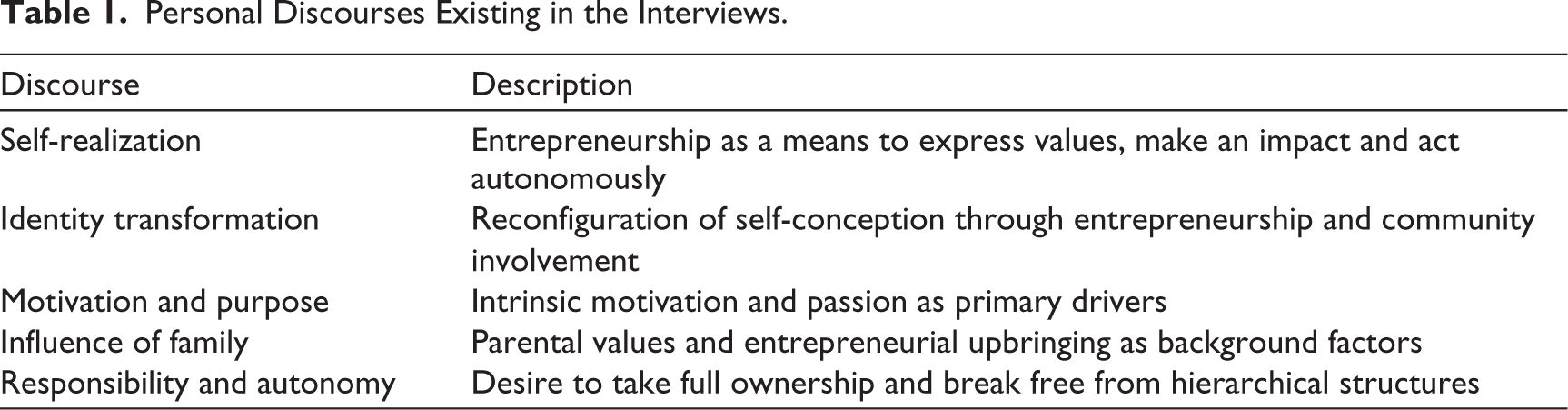
Several students described how their way of thinking, life direction and self-conception had transformed through entrepreneurship. For instance, belonging to an entrepreneurial community was said to have ‘changed my mindset’, entrepreneurship became a way of life, shaping self-understanding. It opened up a new language and way of acting, which others outside the community initially did not recognize. In developing your own business idea or running a company, you encounter things that only others in a similar situation can understand. Thus, identity is not fixed but rather a dynamic, reflexive process, in which entrepreneurship acts as a catalyst for transformation.
For some interviewees, their entrepreneurial identity had begun developing already in youth, influenced in part by their family background, particularly the values and example set by parents. Nevertheless, family background did not appear in the data as a determining factor; rather, students actively shaped their identity based on their personal motivation. In this view, entrepreneurship was not merely a career choice but deeply intertwined with personal growth, value formation, as an autonomous responsibility for one’s own future and long-term self-reflection. Discourses related to self-actualization were notably common across the data.
once you step into this world (entrepreneurship), you want it to change. Your mindset changes in such a way that you no longer want to just do something—you want to be part of something that actually creates change …
Communal Discourses: The Power of Networks and the Space for Becoming an Entrepreneur
Communal discourses in the data emphasized the emergence of entrepreneurship within communities, such as LUTES or cooperative ventures (Table 2). A career as an entrepreneur does not seem to be a common thought when starting studies, but with increasing competence and community involvement, ideas become possible and confidence in one’s own abilities is strengthened. Many students stated that they would not have become interested in entrepreneurship without these networks and events, which provided both inspiration and practical support for developing business ideas.
the entrepreneurial community gave me so much that I wouldn’t have started doing this if I hadn’t been part of it …
Communal Discourses Existing in the Interviews.
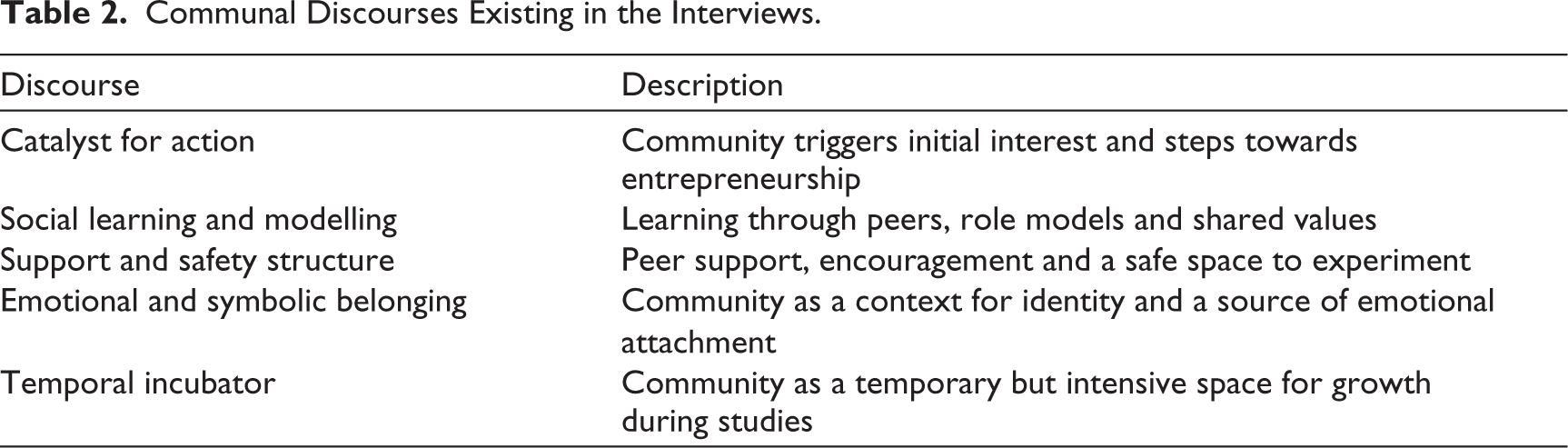
The role of community in entrepreneurial development was positioned in multiple ways. First, communities served as enablers, offering resources and networks necessary for developing and implementing business ideas. Entrepreneurial societies organized regular networking events and training programmes that not only expanded students’ competence and connections but also provided inspiration and exposure to new possibilities.
Second, communities acted as catalysts, sparking initial interest and motivation towards entrepreneurship. In this function, the entrepreneurial community did not merely support or facilitate pre-existing entrepreneurial intent; rather, it sparked the very interest and motivation towards entrepreneurship. The community acted as a transformational space, where latent potential was activated, identities were reshaped and entrepreneurial action became thinkable and doable. In these accounts, being in proximity to other like-minded individuals, seeing others pursue ideas and participating in events created the conditions of possibility for entrepreneurship to be imagined as a viable, even exciting, path. The catalytic effect here is relational: entrepreneurial desire emerges through interaction and observation, not isolation.
Third, communities provided a support structure, maintaining motivation and offering peer support throughout the entrepreneurial journey. The atmosphere of encouragement and positivity was a recurring theme in the interviews, although its tangible benefits varied depending on how long and intensively the individual had been involved in the community.
It’s been a great platform and I’ve gotten some really good contacts there. And these ES communities always seem to attract a certain kind of people, those who actually do things, not just talk about them. So it creates this positive cycle, a kind of ‘good hamster wheel,’ where ideas gain traction and it’s really easy to start implementing them because of that go-getter spirit.
The level of participation in events was often perceived as directly proportional to the level of commitment to the community. Students ranked their own or another student’s commitment based on how actively they participated in joint events.
For some, the community became an integral part of their entrepreneurial identity. Shared values and a culture of doing shaped their self-conception and direction. Entrepreneurship, in these cases, was largely defined by activities within the community. As a result, the continuation of entrepreneurship beyond the university context appeared uncertain, especially if the business idea had been incubated entirely within that campus-based ecosystem.
Normative Discourses: The Value and Meaning of Entrepreneurship
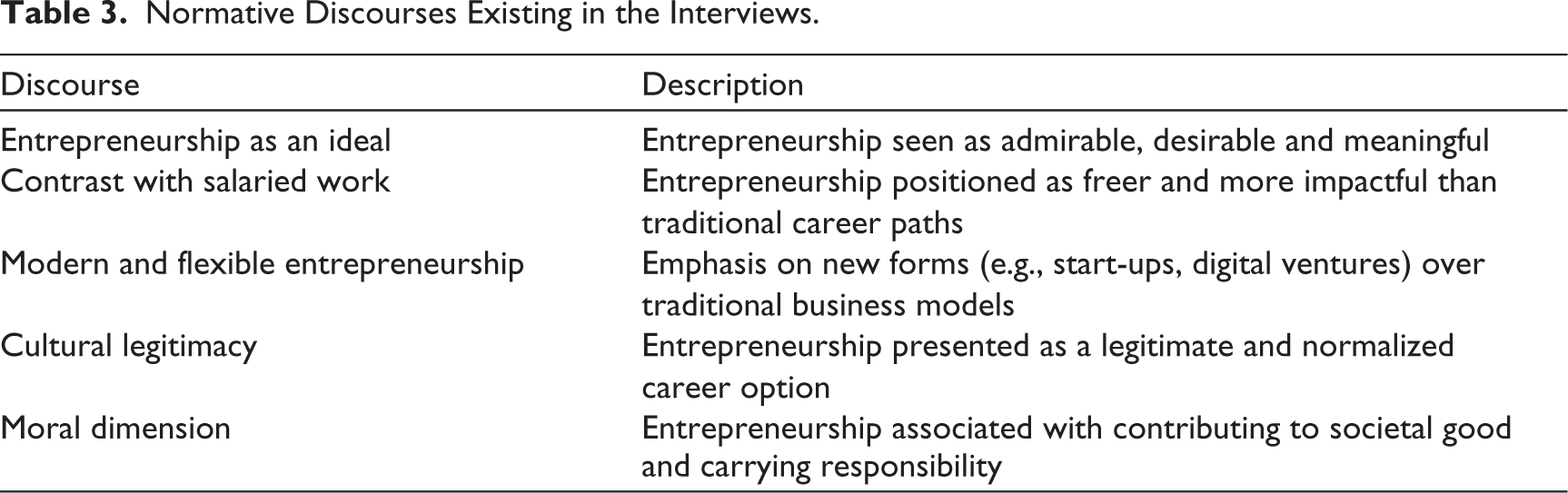
Normative discourses in the data defined what is considered acceptable, admirable and desirable in the realm of entrepreneurship (Table 3). These narratives constructed entrepreneurship not only as a personal career choice but also as a culturally legitimized mode of action, often positioned in contrast, sometimes opposition, to traditional career paths.
Normative Discourses Existing in the Interviews.
In this respect, there is a clear contradiction in the data. Students often emphasized in their speeches that student entrepreneurs do not differ in identity from other student groups (e.g., compared to students who are actively involved in subject organizations). However, in normative discourses, the role and status of entrepreneurs as a special group that changes society was emphasized.
Three dominant normative frames emerged: First, entrepreneurship was primarily framed as an ideal: a bold, aspirational way of acting, not merely a means of income generation. Many interviewees explicitly contrasted entrepreneurship with conventional salaried work, which they described as routine and less meaningful. In contrast, entrepreneurship was portrayed as a pathway to freedom, creativity and the opportunity to make a meaningful impact; a way to ‘do something that actually creates change’. This impact was also connected to the broader societal function of entrepreneurs as job creators and contributors to national economic vitality.
I’m 31 now. All my friends in my age … they have cars and houses … but for me … I’m happy to not have money or social status for years … if I’m intended to pursue something bigger.
This discourse of socially valuable action was tied to a high moral motive: entrepreneurship as a form of social contribution, unavailable through traditional employment. Rather than personal gain, these narratives emphasized meaning, influence and a desire for transformation, aligning closely with neoliberal, individual-responsibility-oriented ideals, in which ‘success’ and ‘impact’ are fused with the entrepreneurial ethos.
Second, some students articulated a modern and flexible conceptualization of entrepreneurship, where start-ups, self-employment and digital businesses were contrasted with traditional brick-and-mortar entrepreneurship. This framing represented a shift from rigid, physical business models to adaptable, multi-modal entrepreneurship. The prevailing understanding had changed: entrepreneurship was now seen as diverse, mobile and tailored to individual values and life situations.
entrepreneurship no longer means doing just one thing … it can be flexible.
In this discourse, entrepreneurship was constructed as the future form of work, aligned with the values of younger generations: autonomy, meaningfulness and flexibility. It was not merely a livelihood but a cultural position, symbolizing freedom and self-actualization in a digital and globalized world.
Third, although students strongly emphasized the meaning and courage of entrepreneurship, broader societal frameworks, such as policy, structural support, labour markets or social security, were largely absent from their narratives. Entrepreneurship was not positioned in relation to the welfare state or institutional contexts, but rather remained within personal and culturally normative discourses.
This discursive silence may indicate that entrepreneurship has become an individualized phenomenon, in which responsibility, success and failure are framed primarily as outcomes of personal choice, rather than systemic conditions or collective processes.
Conclusions
This study explored how an entrepreneurial culture is discursively constructed within a multidisciplinary university context, focusing on the perspectives of student stakeholders from two entrepreneurship communities. Through discourse analysis, it became evident that the cultural foundations of student entrepreneurship are not solely rooted in individual intention or institutional structures but are formed through social interaction, symbolic practices and shared values that shape both identity and motivation.
Discursive Factors Influencing the Formation of Entrepreneurial Culture
The first research question asked: What kind of discursive factors influence the formation of an entrepreneurial culture in the university environment among stakeholders? The analysis reveals that the formation of entrepreneurial culture is deeply dependent on the discursive practices through which students construct their entrepreneurial identities. These practices are not merely communicative but performative; they do not just describe reality, they constitute it.
A key factor was the presence of entrepreneurial communities, such as LUTES and cooperative ventures, which served as catalysts for entrepreneurial identity development. This finding aligns with Wenger’s (1998) theory of communities of practice, where identity is formed and sustained through participation and shared learning. Within these communities, entrepreneurial discourse created a symbolic world where autonomy, risk-taking and purpose were normalized and admired.
Drawing from Schein’s (1994) model of organizational culture, the study identified all three cultural levels: artefacts, espoused values and underlying assumptions within student entrepreneurial communities. Events such as pitch nights and start-up weekends operated not only as practical opportunities but also as rituals imbued with meaning, helping to reinforce collective identity and belonging. These findings highlight the importance of recognizing cultural–symbolic structures, not just practical or instructional formats, as foundational to fostering entrepreneurship.
In line with Geertz’s (1973) symbolic anthropology, the language and rituals observed within these communities were not value neutral. Instead, they were dense with cultural significance and helped create a symbolic environment in which entrepreneurship was perceived not merely as a career path but as a way of life and self-expression. The empirical material showed that this discursive world offered students a framework within which they could author and legitimize their own entrepreneurial trajectories.
The results also confirm Donnellon et al.’s (2014, pp. 490–493) insight that entrepreneurship education must be understood as identity work. Students were not passively receiving knowledge but actively constructing new understandings of themselves through peer stories, group reflection and symbolic practices. Their spoken narratives, framing failure as learning or autonomy as purpose, were performative acts of identity construction.
Furthermore, peer influence was critical. As Pinheiro et al. (2023, pp. 756–758) and Fellnhofer (2018, pp. 223–224) argue, the impact of near-peer narratives, stories of fellow students launching ventures, offered not only models to emulate but also emotional validation. In the empirical data, many interviewees explicitly credited their community peers for giving them ‘permission’ to see themselves as potential entrepreneurs. Thus, culture is not transmitted vertically from institution to student, but horizontally through peer discourse.
These findings support the use of discourse analysis as a method for investigating not just what students think about entrepreneurship but also how they come to think in the ways they do. Entrepreneurial culture is not a fixed institutional construct; it is a dynamic discursive space shaped by shared language, experiences and rituals.
Values and Assumptions Underpinning Student Entrepreneurship
The second research question focused on identifying the most important values and assumptions associated with entrepreneurship in the university context. These were most clearly articulated within normative discourses, where students positioned entrepreneurship as meaningful, future-oriented and morally valuable.
Three dominant themes emerged:
Entrepreneurship as an ideal, Contrast with traditional work, and Flexibility and autonomy.
Entrepreneurship was seen as a path to self-actualization, not merely economic gain. This idealistic framing aligns with Ryan and Deci’s (2000, pp. 68–71) self-determination theory: autonomy, competence and relatedness were evident across the data as key motivational pillars. Students felt most engaged when they could define their own goals, solve real-world problems and work in supportive peer groups, conditions that university entrepreneurial communities actively fostered.
The contrast with traditional employment, often portrayed as constrained, hierarchical or less fulfilling, was a recurrent theme. This tension reflects Nielsen and Gartner’s (2017, pp. 135, 137–139, 141) concept of identity plurality, where the entrepreneurial identity must be negotiated in relation to other societal roles. The valourization of entrepreneurship as a morally and culturally superior identity, linked to innovation, freedom and impact, underscores how deeply ideological these discourses are.
Importantly, the data also revealed what was absent from student discourse. Broader structural or institutional concerns, such as social safety nets, labour regulations or political–economic systems, were rarely mentioned. Entrepreneurship was framed as an individualized responsibility, echoing neoliberal ideologies where success and failure are personal, not systemic (Harima et al., 2021, pp. 1442–1450). This absence may reflect how dominant discourse within entrepreneurial communities filters what is visible and sayable.
These findings reinforce the importance of symbolic and cultural analysis. As Schein (1994) notes, the most powerful aspects of organizational culture are those taken for granted. The unspoken assumption in many interviews was that entrepreneurial success stems primarily from personal effort, creativity and mindset, rather than policy support, funding ecosystems or market conditions. Discourse analysis thus enables us to expose and critically examine the underlying ideological frameworks shaping student entrepreneurship.
Broader Conclusions and Implications
Taken together, the findings suggest that entrepreneurial culture in the university is best understood not as a fixed system or a predefined set of practices, but as a discursive and symbolic formation, co-produced by students through language, interaction and community engagement. Entrepreneurship, in this context, emerges as a lived experience, one that is continuously shaped by social belonging, personal meaning-making and institutional framing. This interpretation carries several critical implications:
Pedagogical design: Entrepreneurship education should shift beyond the conventional focus on tools, business models or technical skills. Instead, it should intentionally create symbolic and cultural spaces where students can author and rehearse entrepreneurial identities. Practices such as peer storytelling, shared rituals, and reflective narrative work play a central role—not as add-ons, but as foundational mechanisms that support identity formation and value alignment. Institutional strategy If universities aim to nurture sustainable entrepreneurship, they must invest in long-term community structures that outlast individual programmes or events. This includes support for student-led ecosystems, alumni engagement and identity-sustaining networks beyond graduation. As Harima et al. (2021, pp. 1456–1457) emphasize, entrepreneurial identity is context-sensitive and fragile; if the symbolic and practical scaffolding is withdrawn, the identity may dissolve—even when entrepreneurial intent remains. Discourse awareness Universities and educators must reflect critically on the discourses they legitimize in entrepreneurship programmes. Which stories are amplified? Whose identities are made possible, and whose are marginalized? What assumptions about success, failure, risk and value are being subtly reproduced? Addressing these questions requires a reflexive institutional stance and an openness to plural definitions of entrepreneurship.
In conclusion, this study contributes both theoretically and practically to our understanding of how entrepreneurial culture is constructed within university environments. It highlights the interplay of identity, community and meaning, offering a multidimensional lens through which to view entrepreneurship, not just as a skillset, but as a culturally embedded, narratively enacted and socially negotiated process. In this view, entrepreneurship is not simply taught; it is spoken into being.
Footnotes
Data Availability
The interview data from the study will be stored in accordance with the Finnish Personal Data Protection Act (1050/2018). The law obliges the data holder to protect the privacy of the individuals to whom the data relates. The interview data cannot therefore be disclosed to third parties or made publicly available.
Declaration of Conflicting Interests
The author declared no potential conflicts of interest with respect to the research, authorship and/or publication of this article.
Ethical Considerations
In Finland, ethical review of non-medical research involving human participants is based on a set of guidelines drawn up by the Finnish National Board on Research Integrity TENK. This particular research follows the guidelines for ethical review in research with human participants intended for research designs where ethical review is not regulated separately in the Medical Research Act (488/1999). The research did not contain precisely defined research configurations in which the researcher must request an ethical review statement from a human sciences ethics committee. The interview data for the study were collected between March and April 2025. The interviewees participated in the study voluntarily and were informed about the purpose of the study and the issues related to the processing and storage of the data. The interview data were processed and stored in accordance with the Personal Data Protection Act (1050/2018) in force in Finland. The study has followed the ethical principles of research.
Funding
The author received no financial support for the research, authorship and/or publication of this article.