




Abstract
Higher education institutes (HEIs) have sought efficiency through mergers and consolidations. These bigger units have been studied regarding organizational culture, performance and efficiency but rarely from an individual perspective. In this study, we focus on a micro-level examination of how the people of the merging organizations make sense of the new organization’s strategy and the cooperation required to implement it. The collaboration of recently consolidated HEI is studied by interviewing 18 employees with different positions. We applied systematic methodology for conducting qualitative analysis research. The findings indicate that clearly expressed strategy and purposeful goal-setting combined with a certain level of flexibility help employees implement strategy and cooperate with their new colleagues. However, the goal of cooperation must be genuine, which requires resources, clear roles and honest praise after success. The study contributes to HEI merger literature by highlighting the means and roles of individuals in coping with the uncertainty caused by the merger of two previously independent organizations.
Introduction
The global competition in higher education has forced higher education institutes (HEIs) to seek more visibility and efficiency from larger units (Välimaa et al., 2014). This has led to mergers of HEIs throughout Western countries, although mergers have not been shown to lead directly to efficiency or competitive position (see, e.g., Johnes & Tsionas, 2019). Mergers are formal organizations intentionally formed by two or more previously independent organizations (Harman & Harman, 2003). Depending on the formal structure, mergers are specified as mergers and acquisitions, consolidations, takeovers and fusions, to name a few (Sulkowski et al., 2019). The challenges of university mergers have been studied in terms of organizational cultures and leadership styles (Locke, 2007), identities of the unit (Puusa & Kekäle, 2015) and performance or efficiency (Paul & Berry, 2013).
These studies have in common the need to harmonize the operating methods, practices and organizational cultures of the previously independent universities, not so much to create new ones. What is often missing is a micro-level examination of how the people of the merging organizations function before and after the merger, how they understand, for example, the need to merge and the new organization’s strategy goals and operating methods.
Each merger process is unique; even mergers within the same country or state differ significantly (Nokkala & Välimaa, 2017). Therefore, mergers are often approached through a case study (Sulkowski et al., 2019). Instead of a retrospective HEI merger case, this study focuses on one of the latest examples of HEI mergers in Finland that is still ongoing. The consolidated HEI started its operations at the beginning of 2020, just before the coronavirus shook the whole world and changed the operations of universities significantly. Currently, the studied HEI is trying to stabilize its operations. We focus on a micro-level analysis of how the key actors of the HEI make sense of the Institution’s new, post-consolidation strategy, position themselves and others in it, and construct an understanding of the cooperation required to operationalize this strategy.
The research question requires the analysis of freely formed interpretations, their understanding and actions according to them. The critical sensemaking heuristics are well suited to that because they allow not only the linking of goals given by the management but also the simultaneous emergence of individually made interpretations. We apply Gioia’s (2021) systematic methodology for doing qualitative research in analysing and representing the findings of the interview data.
According to our analysis, purposeful goal-setting without too high expectations and packed with appropriate resources paved the way for cooperation in the new merger. Achieving the goals requires collaboration between several units, but operators still expect clearly stated roles and responsibilities and to receive resources and praise for their units. This allows the organization’s management to create opportunities for success that improve motivation and make individuals and teams recognize their own and each other’s impact through small successes towards the overall goal.
In the following chapters, we first shed light on critical sensemaking and cooperation literature. After that, we describe the case HEI and the methodological choices of the study. We then turn to the findings, summarized in Table 1 and described in more detail after that. Finally, we discuss the results, compare them to previous studies and consider how they help HEI management in merger situations.
Critical Sensemaking and HEI Mergers
The strategy of small wins (Weick, 1984) means breaking down significant challenges into more minor problems, the solution of which leads to a chain of small successes. This way, the challenges become easier to understand and solve, encouraging action and motivating actors. Solving one challenge at a time gives individuals feedback on appropriate action. This idea was later refined into the sensemaking theory (Weick, 1995), where understanding is built based on the activity and its feedback.
In sensemaking, people give and construct meanings for the things they experience. We realize it only when we can no longer act routinely (Weick, 1995, p. 14). Since individuals and organizations are rarely able to stop and create an understanding of a new issue before action, knowledge is only built retrospectively. Then, we fit our previous experiences and expertise into further information and settle for an explanation that is probable and plausible in the prevailing situation (Weick, 1993).
In organizations, structuring the unknown and unstable is both a pragmatic and a social sensemaking process. It is practical because everyone needs an understanding of themselves and their skills to recognize the meaning of their work and the correct ways to operate to reach the organizational goals. On the other hand, it is social because it also requires an understanding of the tasks and roles of others to work jointly together (Allard-Poesi, 2005; Weick, 1995, p. 29).
A strategic plan or defined goals often guide the organization’s operations. The critical sensemaking perspective (Helms Mills, 2003; Helms Mills & Mills, 2000; Thurlow & Helms Mills, 2009) emphasizes that sensemaking is not democratic and free but linked to the context and the power relations in the prevailing situation. These can appear, for example, as formal instructions or a given organizational structure but also as adopted organizational culture or practices.
The general operating models, guidelines and practices formed through sensemaking within organizations reflect the organization’s identity, and therefore, it is not easy to deviate from them (Helms Mills & Weatherbee, 2006). In the same way, different roles (principal, manager, expert and researcher) take shape in organizations, which give others prior expectations about how individuals will act in a particular situation (Weber & Glynn, 2006). Deviations from expectations cause uncertainty, which forces individuals to construct a new understanding of the matter. According to Helms Mills and Weatherbee (2006), those with formal positional power in the organization define who is heard. However, organizational rules (Mills & Murgatroyd, 1991) can be understood in different ways in different departments of the same organization, depending on who has been given positional power or socially accepted power to guide the formation of the unit’s understanding (Thurlow & Helms Mills, 2009). Creating an atmosphere of psychological safety (Edmondson, 1999) increases the possibility of learning and accepting new collective understanding.
Uncertainty also appears when organizations start to cooperate. According to Vlaar et al (2006), the formalization of cooperation helps to reduce uncertainty between organizations because it encourages actors to focus on essential issues and initiates between the parties. An extreme example of cooperation is merging two organizations into one official entity.
Ismail et al. (2018, p. 238) studied mergers and acquisitions in terms of group cohesion, meaning the extent to which group members ‘trust, are loyal, interact and participate in’ activities despite the changes in the group. The study showed that the temporary organizational culture highlighting individual performance, and risk-taking negatively influences group cohesion, especially in HEI mergers. Instead, organizational justice, that is, fair treatment such as clear rules and guidelines given by the management (Tyler & Blader, 2005) and information, salaries and job scope before and after the merger, positively influences group cohesion. According to Andrews et al. (2008), strong cohesion promotes the company’s organizational citizenship, commitment and overall performance.
In this study, we continue Ismail et al.’s (2018) study about employees understanding of HEI mergers. In the next chapter, we will describe our research design and case HEI merger through which we will approach employees’ understanding of the cooperation needed to implement the post-consolidation strategy.
Research Design
This article aims to discover how the HEI’s individuals make sense of the new strategy, position themselves and others and construct an understanding of the cooperation in the newly merged HEI. The qualitative research approach was chosen due to its methods, such as theme-based interviews’ ability to provide data where insights to questions ‘how’ and ‘why’ something is expressed as it is expressed could be made.
Even though the authors agree that every observation is theory-laden, and there is only a small possibility for gaining theory-free knowledge (Denzin & Lincoln, 2005), the lenses the qualitative research approach offers are the most promising starting point. The researchers have also recognized a need to continuously reflect on their values and assumptions when interpreting the results. Researchers benefit from multiple methods when studying complex phenomena where events result from multiple factors coming together, perceived with the filter of an individual’s bias.
Based on Denzin (2009), there are four ways to deploy triangulation: data, investigator, theory and methodological. In this study, investigator and data triangulation have been utilized to gain insights into how interviewees have made sense of ‘what is going on’ within the HEI’s change process.
Case LAB University of Applied Sciences
One of the most recent Finnish HEI mergers was chosen as the research case because one of the authors had worked there before the merger. The other author was employed later by the new organization and was, thus, able to bring new views to the case. The employment allowed the authors to monitor the activities closely and personally know many of the organization’s employees, including the HEI’s management.
The case organization, LAB University of Applied Sciences (LAB), was established by merging two Universities of Applied Sciences, one in South Karelia and the other in Päijänne-Tavastia, Finland. Owned entirely by the Lappeenranta-Lahti University of Technology, LAB receives comprehensive support services, including communications, IT administration, research, development and innovation. LAB is recognized as Finland’s fifth- or sixth-largest HEI (Kannisto et al., 2021), depending on the calculation method.
Initial steps towards the merger began in 2018, involving collaborative groups from both predecessor institutions. These groups assessed the existing situation and planned necessary transformations for the new HEI. Key leadership roles were filled during this period, with the complete management team in place by 2019. Extensive preparations for the merger escalated in August 2019.
In early 2020, LAB commenced operations with five divisions: dusiness, design, health, technology and a language centre. Additionally, it established four primary focus areas: design, health, innovations and sustainability, each incorporating four specific content themes. The organizational structure adopted was a matrix model, where personnel, barring RDI directors, were assigned to units (matrix columns) intersecting with the four focus areas (matrix rows). These focus areas were instrumental in leveraging resources across all units to enhance RDI and educational cooperation and clarify LAB’s strengths.
By Autumn 2021, LAB transitioned to a new structure centred around growth platforms derived from previous content themes. Fifteen growth platforms developed two-year action plans to drive LAB’s progress in RDI, education and industry collaboration. In December 2021, four growth platforms received additional funding from the institution.
These strategic actions were designed to optimize the educational content and experience for students, staff and partners, aligning with LAB’s ambition to evolve into an ‘Innovation University’ that excels in providing RDI-informed education.
Data Collection
Data for the article were collected between April 2022 and April 2023. Eighteen theme-based interviews within the HEI among employees in different positions (principal, manager, expert and researcher) were carried out, transcribed and analysed. The interviews were deployed as teams meetings, and the content was recorded and later automatically transcribed into text utilizing MS Word 360 features. The automatic transcription captured about 85% of interviewees’ expressions in the correct format, so every transcription needed a manual inspection and some corrections. The automatic transcription saved much time at the beginning of the analysis.
In addition to theme-based interviews, as a secondary data source, many field notes from different types of meetings, workshops and strategy documents were available for researchers. One of the authors had participated in the planning and initiating of the consolidation and had thorough notes from that time. Since the beginning of 2022, the article’s authors have met once every second week. The current development of the HEI has been one of the subjects in those dialogues. The authors have also been participating in developing a roadmap for one of the HEI’s focus areas (innovations). During the preparation process of the roadmap, much discussion about the HEI’s current situation occurred. The innovations focus area has also had a monthly meeting where progress in RDI and other issues has been presented and discussed. During these meetings, there has been time for open reflection on ‘what is going on’. To summarize, plenty of secondary data sources have been available, so the research has benefitted from data triangulation.
Data Analysis
The analysis started with an open coding phase done independently by two authors, where interesting phenomena from the material were brought out, and the first preliminary findings were made. The open coding phase started inductively with no pre-existing seed categories or theoretical framework, thus following the grounded theory approach (Corbin & Strauss, 2008; Glaser & Strauss, 1967).
Authors continued to group and categorize the open coding independently, sometimes exchanging ideas about their findings. The authors discussed their findings, compared them and tried to figure out what happened during the merger process. Typical topics in these discussions were ‘What was discussed?’, ‘How was it discussed?’ and ‘How do these phenomena relate to each other?’ Also, the interview data were compared to other data sources and experiences of the researchers, revealing topics not brought up by interviewees. This offered another valuable viewpoint for the analysis.
One of the analysing authors continued in the direction of axial coding and a constant comparative method (Glaser, 1978), and the other followed Gioia and Chittipeddi’s (1991) framework. In this article, we present our findings according to the latter approach. However, both approaches have a lot in common, such as the fact that at the beginning, the informants’ concepts are used, from which the researcher gradually, as the interpretation progresses, identifies congruent categories that are finally condensed into theoretical concepts.
At the beginning of the analysis, no preset concepts were used, but the exciting data extracts were highlighted and labelled as open coding. This kind of practice, free from previous theoretical concepts, follows the principles of Gioia’s (2021) systematic methodology for qualitative research.
Quite soon, however, the first categories started to emerge. The researchers interpreted the first-order analysis as giving ‘voice to the informants’ (Gioia et al., 2013, p. 3) and grouped them into second-order themes or categories, each having something in common. Many comments were related, for example, to roles and responsibilities or to differences in interpretation between management and employees about what the merger means from the point of view of doing work in the new HEI. These categories were further aggregated into theoretically loaded aggregate dimensions called metaphors by Gioia and Chittipeddi (1991).
Findings
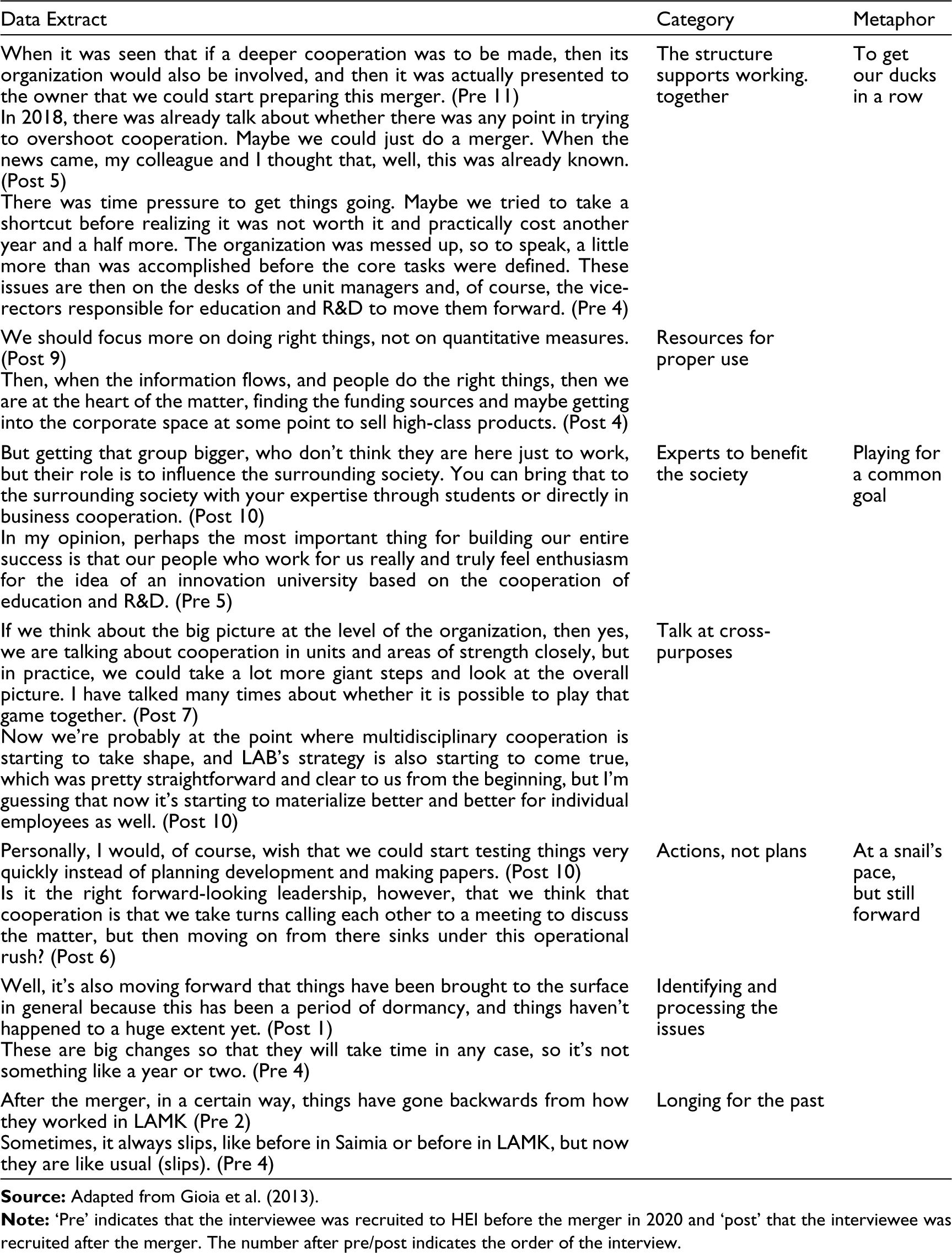
The findings are summarized in Table 1, following the illustration by Gioia and Chittipeddi (1991). Each aggregated dimension, that is, metaphor, is then discussed in detail.
Findings About How the Key Actors of the HEI Make Sense of the Institution’s Post-merger Strategy and Cooperation.
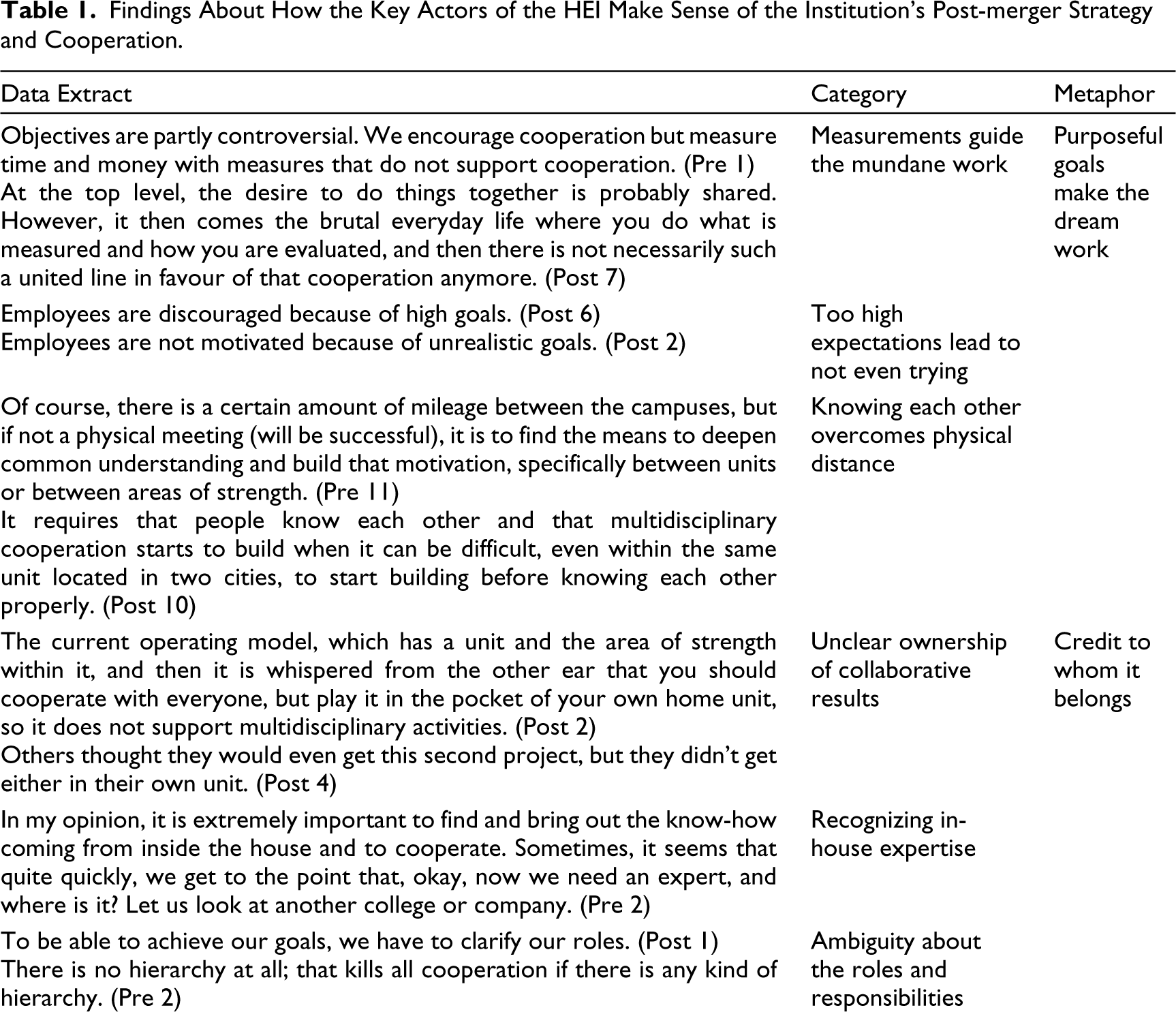
Purposeful Goals Make the Dream Work
Although cooperation between units and personnel was seen as a common objective, the measurements were not seen to support this cooperation. Cooperation was seen as an ideal future, ‘a desire’ that was very different from practical, mundane work. Measurements were commonly said to guide the practical work but did not favour cooperation among the faculty. Measurements were differentiated from the shared and desirable future and understood as controversial.
The interviewees attached measurements and the act of measuring quite negative meanings. It was accepted that outcomes are measured and evaluated. Employees made sense of measurements to embody what is expected from them, which is very different from the highlighted need to cooperate. However, measurements were also kept too high for motivation. People say they will do what is measured but are not encouraged or motivated to do that. The measurements were given controversial meanings. On the other hand, they guided the work, but on the other, they were set so high that they discouraged people from doing their work.
People did not comment much on the sources of motivation, but if there was motivation, it exceeded, for example, barriers brought about by the physical distance between the two campuses or barriers between units. In our data, ‘knowing each other properly’ seemed to precede action to cooperate. Even though versatility was appreciated, it was not something you wanted to do to yourself with strange people. Knowing each other motivates people to act together and thus create a shared understanding.
Credit to Whom It Belongs
Quite often, people, especially those having power over employees, were worried about the results slipping in favour of another unit. Cooperation was considered a secondary goal, even if it had an official or mutually accepted status. This was reflected in the units so that employees were asked to cooperate, but in such a way that it benefitted their unit. Working together and multidisciplinary was important in cooperation, but people still wanted to stick to the results. However, the results of cooperation are not anybody’s results and working towards that might benefit others, in the end, was not encouraged.
Identifying the expertise tied to individual employees and utilizing it in cooperation seemed to be a challenge anyway, and expertise could be sought further away from one’s organization when needed. Although this was not directly stated, cooperating with outsiders could be related to the desire to keep the results of the cooperation with oneself or in one’s unit without the risk of them ending up in someone else’s ‘pockets’. This same desire could also be connected to the need to define the roles of the members or parts of the organization. Without clear definitions, achieving the goals seemed to be impossible. With role setting, however, people did not want to increase bureaucracy because it was seen to ‘kill all cooperation’ at the latest. Clarifying the roles was felt to predict better how the results of the cooperation could be shared among the participants.
To Get Our Ducks in a Row
In addition to roles, structure for cooperation was also longed for. The structure was especially important at the beginning of the merger process. The merger was perceived as evident, and when it was finally announced, it did not surprise anybody. Also, the positioning of unit managers and rectors as coordinators of cooperation reflects the need to define roles and structure and organize cooperation. Still, the organization had to happen gradually and in small steps, supporting core tasks to make cooperation possible. Significant changes only ‘mess up’ cooperation. This way, understanding the core tasks or goals precedes organization, which again precedes cooperation needed to achieve the goals.
Identifying core tasks or ‘the right things’ qualitatively was seen as a necessity. If they were discovered, and people were engaged to complete them, the overall goals and selling ‘high-class products’ were considered potential. This reflects the need to allocate resources to use better.
Playing for a Common Goal
The key to success was to recognize one’s inner motivation or ‘enthusiasm’ and utilizing it to benefit the community. The HEI was understood as an organization of experts, but not all of them were seen to have a societal impact. However, it was hoped that this group of influencers could grow.
The impact was not seen to fall due to a lack of competence. On the other hand, ‘a lot more giant steps’ were perceived as possible if they were taken together. The societal impact was seen as a game that needed to be played together. Multidisciplinarity as a goal was, however, ‘starting to take shape’, making the LAB strategy actual. Some said that the strategy was clear for them from the beginning of the merger but not necessary for other employees. This reflects that strategy organizationally made sense but might be challenging to understand for individuals.
Still, playing towards a common goal was seen as a process that progressed iteratively. Stepping back and seeing ‘the big picture’ would help individuals understand their position in the game, and sometimes, it necessitated that somebody talks and takes the power to lead the way for others.
At a Snail’s Pace, but Still Forward
Cooperation was slow, and some impatiently hoped for faster progress rather than planning and discussing. The discussion was not considered irrelevant, but mobilizing what was planned seemed to ‘sink under operational rush’. In other words, bringing things ‘to the surface’ allowed people to identify the challenges, create a common understanding and slowly open the way for cooperation. On the other hand, the cooperation between previously independent HEIs was such a big change that it was only natural that not huge progress had happened ‘in a year or two’.
However, slow progress enabled people to compare the current situation to the previous one. The merger was not only a step forward; sometimes things were evaluated as having ‘gone backward’. This was considered a ‘slip’ longing for the past, especially by those who did not have the past in the previous HEIs. For them, there was only one organization and its culture, not an attempt to combine two organizations with different practices.
Slow progress and a need for intermediate steps reflect the strategy of small wins (Weick, 1984). However, the goals of the new HEI were set so high that the staff hardly saw their opportunities to help achieve the goal. Thus, interviewees probably did not talk about success or achievements. Instead, they reported difficulties in mundane work, and these everyday challenges led to frustration. Suppose Weick’s (1995) statement that people create their understanding through their experiences is true in a merger situation. In that case, top managers should offer as many positive experiences as possible regarding the chosen strategy and goals. Breaking down goals into sub-goals is one way to increase the chances of success. In a positive sense, this kind of action is undemocratic and contrary to Weick’s (1995) pure, value-free construction of meaning because competent management can guide the unfolding understanding of their subordinates.
In addition, public praise or, as in our material, recognition of competence works as one way to create feelings of success. However, this is a balancing act between individuals and larger groups. The working method of the HEI we studied favoured cooperation, but the data showed a conflict between the interests of the unit and the whole organization.
Discussion
This study focused on a micro-level analysis of how the HEI’s key players made sense of the post-merger strategy and the cooperation aimed at its implementation. Our analysis brought forth five factors that promote cooperation in the context of HEI mergers.
The first is related to purposeful goals that make the dream of cooperation work. As it had been previously done with colleagues, they already knew that mundane practical work was something that people were ready to continue after the merger. It served as a familiar organizational framework with shared practices, thus enabling the continuum of psychological safety and familiarity (Edmondson, 1999). Mergers disrupted everyday work, and the set quantitative goals were understood as disrupting interventions that cut the ordinary and forced people to cooperate between campuses and organizational units that were previously unknown to them. In this way, the ideal of cooperation could not be realized in practice because its goals were considered so unrealistic that everyday work was no longer enough. Through critical sensemaking heuristics, we were able to identify how people construct meaning based on how plausible (Weick, 1993) they find different things. For example, the quantitative goals given by the organization were interpreted as more credible goals than, for example, statements of goals presented in the company’s strategy. This can lead to, for example, that those working in the units work mainly for the numerical goals of their own unit, despite the stated goal of cooperation.
The second factor that promotes cooperation is that credit for cooperation and its results is given to the right people. In our data, the difference between the official goals and the practical work was dramatically manifested in how employees were asked to act in a whisper, regardless of the goals, only for the benefit of their unit. Whisperers used socially accepted power (Thurlow & Helms Mills, 2009) against official authority and over the employees. It shows that although, on the one hand, it was reported at the manager level that the strategy and goals were evident from the beginning, they had not been adopted or understood as their own goals guiding their work. The managers balanced between strategic and practical goals. This reflects that the roles and responsibilities were still unclear at HEI’s level, although there was a commonly accepted view that the same tasks should be deployed in all units and on both campuses. This led to a situation where, in theory, there was one HEI-level process or way of operating. However, in practice, several slightly different ways of operating were used. Such an operating model gained social acceptance and became as a formative concept (Helms Mills & Mills, 2000) for the organization.
To distribute honour according to merit, the organization’s members should know their internal resources and skills. The complexity of management structures was seen in the interviews several times. There were different levels of management in the HEI, which slowed down actions at the operational level. In some cases, employees expressed uncertainty about whether they could proceed with some actions and/or to whom they should ask for permission. This indicated that reality did not always match the expectations placed on specific roles and positions (see Weber & Glynn, 2006).
The third element reflects the need to organize cooperation, as stated by Vlaar et al. (2006), or to get organizational ducks in a row. The merger was not a surprise to anyone, but the organizational support of the cooperation lagged behind the change. According to data, changes were made quickly, sometimes going back to previous versions, in which case the employees did not have time to adapt and adopt the changes. Small gains were not achieved when a quick, significant change was immediately aimed for. Expressions related to success were almost totally missing from the interview data. Many comments, however, discussed the need or necessity to succeed. There were also some single comments containing sarcasm towards change by stating that ‘it is always easy to succeed with it.’ However, the interviewees were optimistic that the organization had all the required resources. However, they just have not been able to utilize them to the full extent so far. Partly, it was because the exact focus of the activity was still missing.
Fourth was a need to play for a common goal. The talk and action were not in line. This was related to the need for a supporting structure in terms of a shared playbook, rules according to which the cooperation should have played. Again, positive expectations for the future were identified from the data, but the official discussion about cooperation was not always embodied in practice. On a personal level, some individuals had recognized their role and playing field and had a broader impact on society, but for some, HEI was still just a job with no greater value. This way, the HEI did not support group cohesion or commitment, often seen as prerequisites for the organization’s success (Andrews et al., 2008).
Finally, the need for small iterative progress was longed for, although it was criticized as only plans and papers or continuous discussions that do not lead to anything. Planning was seen as a top-down requirement, which until now hindered cooperation. Things were moving forward at a snail’s pace but still forward. Freedom to experiment and quick tests reflect the need to act before detailed plans and, this way, get feedback about the potential of the action. For Innovation University, as stated in the strategy, the experiments reflected the opportunity for innovations to emerge. People brought up past successes and identified differences in current activities. The difference between the past and the present served as a cue that the current activity was weaker, and the data did not bring out anything that worked better now. If the goals were split into smaller and achievable goals, the need for cooperation would have been easier to understand. According to Weick (1984), it is easier to succeed in smaller goals, leading to a positive experience and, thus, a positive understanding of what is central in the organization. The small goals also encourage you to work harder than unrealistic goals, and they let you stop from time to time to review the results of your work. This way, getting feedback retrospectively on the operation is possible, which guides the meaning we construct (Weick, 1993).
Conclusion
The individual employees and their cooperation are essential for organizational success, especially during the merger. The purposeful goals make the dream of cooperation work. The goal is understood as an ideal state, which is challenging to identify if sufficient resources are not allocated to its pursuit. Practicality, freedom of action and acceptance of different operating models allow striving for challenging goals. A challenge as such does not lead to an undesirable outcome. However, combined with weak resources and unclear organizational structures, roles and responsibilities, it is considered so utopian that it does not encourage trying.
Organizations with a long history must fit their previous practices during a merger. This requires structure, clearly expressed strategy and future-oriented targets, and time and flexibility for organizations, teams and individuals to find their way to implement these new strategies. Thus, successful mergers in HEIs and probably in other knowledge-intensive fields would benefit from facilitating intermediaries who help employees balance their past and present.
Footnotes
Acknowledgements
We thank Meri Jalonen (LAB University of Applied Sciences) for the assistance in data acquisition and comments on the manuscript. This case is a revised and enlarged version of the original case titled: Orchestrating the emergence of an innovation university, presented at 12th International Conference of Management Cases 2022, organized by the Birla Institute of Management Technology, Greater Noida, India, on 1–4 Dec 2022.
Declaration of Conflicting Interests
The authors declared no potential conflicts of interest with respect to the research, authorship and/or publication of this article.
Funding
The authors received no financial support for the research, authorship and/or publication of this article.