




Abstract
Previous strategy management studies have devoted scant attention to the role of trust in the strategic management process (SMP). The purpose of this study is to investigate trust in the management of a grocery trade business. Prior literature was reviewed to deepen the current understanding of trust in the SMP, and then explored through a case study on a Finnish grocery retail company, Kesko Ltd. The study was conducted by employing a qualitative research methodology and is based on an interview with the president of Kesko, who is intensively involved in the SMP. This study stresses the consideration of trust development in strategy work. The findings indicate that trust considerations in the strategic choices of the top management team can provide efficiency, innovation, and engagement in strategy implementation.
Research Questions
In this article, we ask how trust develops during three phases of the strategy process: strategy formulation, strategic choices, and strategy implementation.
Links to Theory
Our analysis of trust development focuses on the five most operationalized dimensions of trust: (a) ability and competence, (b) benevolence, (c) integrity, (d) affective-based trust, and (e) cognitive-based trust (McEvily & Tortoriello, 2011). Strategic management is separated into three interlinked phases: strategic formulation, strategic choice making, and strategy implementation (Johnson et al., 2008).
Phenomenon Studied
The case focuses on trust development in the strategy management process.
Case Context
The context of the case is a participatory strategic management process in a large Finnish grocery retail chain in a highly competitive and concentrated market. The role of trust development was studied in the case company between the K-retailers, who are independent entrepreneurs, and Kesko management staff and actors responsible for management and constant development of the business model.
Findings
This study shows how trust emerged as a result of participatory practices and dialogue between actors from different levels of organization in the strategy formulation phase. Increased understanding and contribution to strategy empowered top management to make new and brave strategic choices. This study illustrates how consistency between the strategic choices and actions for implementation enhanced trust among the organizational actors, who felt a sense of enhanced engagement in the implementation of the new strategy in their everyday work.
Discussions
This study highlights the role of trust in strategy formulation, strategic choices, and strategy implementation. It contributes to the understanding of trust in the SMP, which has not been widely researched in previous literature. Based on our results, we suggest that trust between parties is earned and evolves at each of the three stages of the SMP.
Introduction
A good strategic management process (SMP) and strategy are crucial for organizations to gain a competitive advantage in the market. Changes in the operating environment, such as challenging competitive situations and digitalization, necessitate the use of more proactive processes to develop and review business strategies. In Finland, two main grocery retail groups, K-Group and S-Group, have about 80% of the market share of grocery trade combined. This strong duopoly has made the grocery market highly concentrated, but also competitive.
This case study examines the role of trust in the SMP. The focus was motivated more by induction than deduction. When the authors of this article interviewed the president of a grocery business, the interview was aimed at producing data on strategy work. Interestingly, the interviewee started to highlight the importance of trust in the participative strategy process, which involved a multitude of actors and partners. When examining the interview data closely, it was noticed that multiple elements of trust were given an important role in each stage of the strategy process from the perspectives of different actors in the grocery retail chain.
By examining the strategy process and using the trust development framework, this case illustrates how trust develops in a close contract-based partnership. Our study focuses empirically on the experiences of a top manager and explores how trust develops through participatory social processes in the SMP. In particular, we are interested in how trust develops during the three stages of the SMP and creates a competitive advantage for the company.
Although strategy and its main processes have been intensively studied in management literature, surprisingly few have focused on the role of trust (see for exception Malkamäki et al., 2019). Trust ties together the stages of the SMP. Previous strategy-relevant studies (e.g. Jarzabkowski & Spee, 2009) have emphasized that more research is needed on embodied strategy practices, such as emotions and motivations, as well as strategy-making technologies. Previous studies (e.g. Schmidt & Brauer, 2006) have also stressed the impact and importance of top management and high-ranking executives (such as presidents and CEOs) in strategy implementation. However, more research is needed on the collective strategy work of organizations. We aim to contribute to this research gap and strategy literature by showing how trust is manifested and the role of trust in the SMP.
This article is structured as follows. First, the concept of strategy is briefly discussed within the theoretical framework. Second, the multidimensional concept of trust is presented. After introducing the case company and the qualitative research methodology used in this study, the results of the content analysis on trust-building practices and the consequences for the SMP are presented. The ‘Discussion’ and ‘Conclusion’ sections present the main results and key contributions of this work to the strategic management literature.
Strategy and Strategic Management
Strategy defines the direction and scope of an organization over the long term. According to Johnson et al. (2008), strategic management is categorized into three phases: understanding the strategic position of the organization, making strategic choices for the future, and strategy implementation. Strategy formulation includes planning, where the focus is to diagnose the strategic position and develop guiding policies. Implementation includes the actions undertaken to achieve the planned goals. In practice, the elements of strategic management do not follow a linear sequence, they are interlinked and provide feedback to each other (Johnson et al., 2008).
The main weaknesses of strategic management are linked to the implementation stage. Even when strategy is successfully formulated, strategy implementation is a challenging phase in the SMP (Mintzberg, 1994; Sołoducho-Pelc, 2017). To implement a new strategy initiative, the support of different organization members is a crucial determinant of success (Burgelman, 1983). Thus, strategy combines a set of actions taken by organization members (Mantere, 2013) as collective strategy work. Strategizing in organizations has traditionally been viewed as a task for high-level managers, who have a wider view of the actions than lower-level actors. However, when empowerment is distributed among stakeholders, they bring divergent values to the work (Abdallah & Langley, 2014; Mintzberg & McHugh, 1985).
The Dynamic and Multidimensional Nature of Trust
The interest of researchers in the role of trust in organization management has continued to grow (Ikonen, 2013; Inkpen & Currall, 2004; Malkamäki, 2017; Rousseau et al., 1998). Within organizational trust literature, trusting in and between organizations is considered a sensitive matter and a difficult phenomenon to study (Möllering, 2012). Many definitions define trust and trustworthiness as a state of mind (McAllister, 1995; Rousseau et al., 1998). Jagd and Fuglsang (2016, p. 328) state that studies of trust as a process and practice create an alternative perspective, where trust is seen as related to people’s presence and engagement in practice. According to McAllister (1995, p. 25), trust is defined as ‘the extent to which a person is confident in, and willing to act on the basis of, the words, actions, and decisions of another’. Using this definition, McAllister (1995) identifies two dimensions of trustworthiness: cognition-based and affect-based. In this study, we analyse the role of trust development in the context of the SMP of Kesko actors who are responsible for the ongoing development of the business model and store concepts for chain operations management, and K-retailers, who are independent entrepreneurs.
The dimensions of trust and trustworthiness are numerous. According to Mayer et al. (1995), three components are viewed as key determinants of trust. Interpersonal or organizational trustworthiness is based on the experience of an individual concerning individuals’ or organization’s functional (a) ability, (b) benevolence, and (c) integrity (Mayer et al., 1995). Ability refers to a group of skills, competencies, and characteristics of an organization or individual. Organizational trustworthiness related to benevolence (Gillespie & Dietz, 2009) refers to the perceived organizational action that stakeholders interpret as indicating genuine care and concern for the organization’s well-being. Integrity includes features of organizational practices, such as fairness, justice, and consistency, which stakeholders consider acceptable (Mayer et al., 1995). The basis of Mayer et al.’s model (1995) is to understand how parties process information about others’ trustworthiness, thereby deciding how much risk to take with them. As such, this model represents a cognitive approach to trust (Schoorman et al., 2007).
Many scholars distinguish between cognitive and affective aspects and different bases of trust (Lewis & Weigert, 1985; McAllister, 1995). Relation-based trust has an affective basis, and character-based trust has a cognitive basis (Dirks & Ferrin, 2002; Gillespie & Mann, 2004; McAllister, 1995; Zucker, 1986). Cognitive-based trust refers to rational knowledge-based expectations about the partner’s past performance, behaviour, and aims on which predictions of future performance can be built (McAllister, 1995; Weber et al., 2004), such as trustworthiness (Mayer et al., 1995; Tomlinson, 2005). Affect-based trust reflects the feelings that people have for one another (McAllister, 1995; Williams, 2007). It includes an individual’s feeling of being competent, feelings of safety and caring, a sense of autonomy and empowerment, consistency, and fairness in social relationships and congruence between the values of the individual and the organization (Savolainen, 2014). Sołoducho-Pelc (2017) states that once cognition-based trust is formed, it affects the way in which members receive, process, and interpret the information from co-members, which in turn may affect the outcomes.
McEvily and Tortoriello (2011) have emphasized that knowledge-based cognitive and emotional affective trust should not be classified separately, but that trust should be seen as a hybrid form in which both types develop together in a dynamic process. This view is shared by many scholars who are convinced of the multidimensional nature of trust and the factors reflected in motivation, as well as cognitive processes and conditions (Blomqvist, 2002; Kramer, 1999; Lewis & Weigert, 1985; McAllister, 1995; Möllering et al., 2004; Schoorman et al., 2007; Sloan & Oliver, 2013; Weber et al., 2004). In addition, Sloan and Oliver (2013) found that critical emotional incidents could serve as turning points in the development of trust in the partnership process, and negative emotions could be transformed into positive ones.
Trust is also acknowledged to be both a relational phenomenon and an institutional one. Relational trust evolves gradually over time via interactions between the trustor and trustee (Lewicki & Bunker, 1996; Mayer et al., 1995). However, interaction requires continual face-to-face contact, which is not always effective for business (Bachmann, 2011). In the current age of information technology, non-personalized institutional trust is a vital form of trust in business (Bachmann, 2011; Giddens, 1990). Bachmann (2011) states that institutional trust in individuals is reflected in their trust in the success of the organization and in the positions and roles of the organizational actors and teams. Thus, trust in practitioners is extended with the perception of role-based trust (Kramer, 1999).
In this study, attention is paid to understanding the cognition-based and affect-based trust-building elements of interaction and events for practitioners engaged in the SMP. Two dimensions of trustworthiness that are of particular interest in the present study are cognition-based and affect-based trust.
Methodology
This study adopts a qualitative case study approach that incorporates rich details on one case organization and interpretations of this case from the perspective of the people involved in it (Eriksson & Kovalainen, 2015). Conducting a case study requires a researcher to have profound knowledge and understanding of the phenomenon in the chosen case and access to the key informants (Eriksson & Kovalainen, 2015). Two of the authors of this article interviewed the president of the grocery business.
The purpose of our case study was not to draw generalizable conclusions as an objective of our research. The interviewee was a key player in strategy work, able to talk about it in its various stages, including the importance of trust. He was carefully selected so as to increase the reliability of this study. The first author of the study knew the interviewee in advance through their shared work history, which served to improve openness and the smooth and confidential conduct of the interview.
To ensure ethical practices and maintain trust between the interviewers and interviewee, the researchers explained that the research would be presented at a general level in connection with strategy work. This study focuses on the research topic and its relevant issues in detail, but does not reveal any trade secrets or company-damaging information. In addition, the interviewee was given the opportunity to comment on this case study prior to publication.
The data were collected from one open-ended, recorded, and transcribed 60-min interview conducted in February 2019. The data comprise information from the interview and company website, which was used in the case company description and as secondary data for understanding the company’s current strategy. Inductive content analysis was applied, with a focus on qualitative content analysis in the SMP and depiction of the structures and practices that developed trust in the strategy work.
Case Company
The case company, Kesko Ltd., is a Finnish listed trading sector company operating in the grocery, building, and technical and car trade business. Kesko’s divisions and chains act in close cooperation with K-retailer entrepreneurs under the chain business model, wherein independent K-retailers run retail stores in Kesko’s chains (Kesko, 2018). Independent K-food retailers are responsible for customer satisfaction. Kesko and K-stores form the K-Group, Europe’s third largest trading company. In 2018, it employed some 41,000 people, and recorded retail sales worth approximately €13 billion (Kesko, 2018).
In 2018, Kesko’s strategy was developed in four levels, starting with a wide and more generic concern-level strategy. This was followed by devising field-level strategies for different industries. Within the fields, separate strategies were created for each chain and for the most central functions.
The strategic goal for the K-Group grocery trade division is profitable growth in all channels. According to Kesko’s annual report (2018), strategy execution has seen good progress, with positive developments in customer numbers, sales, and market share. Online grocery sales have also grown significantly. The case company, Kesko, has defined the following strategic objectives: (a) becoming the most customer-oriented and inspiring food company, (b) developing and modernizing the store network, (c) providing a seamless omni-channel customer experience, (d) developing retailer entrepreneurship as a competitive advantage, and (e) expanding the food service business (Kesko, 2018).
Findings
At Kesko, strategy work proceeds in a process-oriented manner. In practice, this consists of the following phases: (a) strategy formulation including strategic positioning and planning, (b) strategic choices, and (c) strategy implementation.
Strategy Formulation
Kesko’s strategy is being processed with a new operating model, and more people than ever are now involved in strategy work. Compared to the previous planning processes, hundreds of participants, Kesko’s main organization actors, and K-retailers now serve as active strategy makers. The president of the grocery business emphasized that this has been ‘a big change’, because the involvement of people in the strategy planning phase has contributed to making the strategies more tangible. The president underscored the improved understanding of the strategy work and the positive feelings attributable to it.
In practice, strategy making is done for different business units and chains of the organization. Industry-specific strategies are based on the Kesko corporate strategy, while chain-specific strategies are still being developed within the industries. Simultaneously, the strategies have become increasingly refined. The president of Kesko’s grocery business describes the course of the event as follows:
Nowadays, we include more people [in the strategy planning/work]. First, we decide upon a wider and generic Kesko group level. Next, we make field-level strategies (for different industries). Inside the fields, we devise strategies for each chain. We draw up strategies for the most central functions. The number of people participating [in the strategy planning/work] has increased significantly to several hundred, or indirectly even to some thousands. In any case, we have several hundred active strategy makers. This marks a big change from earlier on, because it has contributed to making the strategies more tangible. Moreover, given that this is a process, it also increases people’s commitment. People love to think about the strategy work… It [involving people in the strategy planning] requires a lot of training and particular tools are needed to guide people about how they may participate in the [strategy planning process].
A comprehensive number of people (Kesko management staff, personnel from different organization levels, and K-retailers) were involved in strategy work at the different levels of the organization. Organizational actors were recruited on the basis of their job description and expertise to participate in the strategy discussion. Based on the interview, they felt inclusiveness in the work and committed to implementing the strategy. Thus, the strategy simultaneously becomes more concrete and understandable from the viewpoint of practical work. Involving people in the strategy planning entailed considerable training, and specific tools were needed to guide people in their participation. Training increased their understanding about the meaning of strategy in their daily work and raised their confidence and trust in the competence of Kesko’s management.
The collective strategy formulation process creates opportunities for new and brave strategic choices. Trust between partners creates a change in attitudes, in turn leading to a culture of receiving and listening. Thus, the most essential issues are focused upon without fear, and new directions can be forged in discussing the strategic choices and implementing them. An atmosphere of confidence raises the effectiveness of addressing challenges, and pseudo-friendly meetings can be dispensed with. Participation in the strategy work encouraged the employees to question things and become much braver when pondering strategic issues from different perspectives, which can be seen as a sign of fostering knowledge-based trust.
We can focus on the most essential factors without fear. Trust has an effect on strategic choices. You can truly ponder meaningful issues now, which you did not dare earlier. It affects choices and implementation…Trust is like a foundation—if there is no trust, people will talk jargon, and the meetings will not add any value.
Strategic Choices
Trust in strategic choices arises as a result of the first strategy work process. Strategic choices are made by top management, but the discussions and data gathered from strategy formulation process direct their choices and perspectives. The importance of strategy in business management is now perceived as a guiding principle in daily work.
Ultimately, making choices, namely strategic choices, is always the responsibility of the senior management. However, the process as a whole directs these choices, the data collection and the pondering over the choices; it is a wide-ranging process. The opposite is also true. After making the strategic choices, the strategy must be executed by putting it into practice and thinking about what this entails for the operations in your unit. What does it mean to your work? Thus, strategy implementation must trickle downwards.
Making retrospective sense of his earlier experiences, the president of Kesko commented that retailers had been expressing some doubts about the background of the strategic choices made by top management. Involving retailers in the strategy work increased their understanding about the strategies that affected their daily work and improved the feeling of team spirit, which is observed as affective-based trust.
If the retailers do not know how the strategic choices are formulated, it is difficult for them to trust that the strategic choices are correct and genuine. This then creates speculation and inefficiency. The situation can worsen to the extent that people start to doubt if the [strategic] choices are even true. They suspect some other motive [behind the strategic choices]. When that happens, the business and its people suffer. But if trust exists, then we [Kesko and K-retailers] are on the same side of the table, and you can skip several stages. The effectiveness then reaches a different level.
The importance of strategic choices becomes apparent to K-retailers and actors on the different organization levels when they are involved in the strategy formulation phase. Moreover, participating in the analysis and planning of the strategy imparts a feeling of ownership; the choices are ‘our’ choices, and efficiency improves in many areas when retailers perceive that their goals are aligned with those of the Kesko management.
I can notice the difference when I talk with the merchants about the new strategic alignments that will change our operations considerably and bring us several advantages. Previously, talking about such matters was simply a waste of time. It was impossible to get them through. No doubt, it [trust] is a great force.
Strategy Implementation
The strategy implementation phase requires communication between the representatives of Kesko Group’s top management and K-retailers in order to form a common understanding of translating the strategy into daily practice for all personnel. Consistent operations generate confidence and inspire enthusiasm, allowing Kesko’s organization actors and K-retailers to act according to the strategic guidelines. Thus, it is crucial that the words and actions are consistent. Consistency in talk and actions can be seen as knowledge-based trust that generates the commitment to the strategy implementation.
When we have made a decision, we implement it consistently. All that we have outlined, we have invested in. The effect of putting our words and discussions into actual practise has such an empowering effect. It energizes people.
Kesko’s organization structure is specific; as entrepreneurs, K-retailers can potentially earn a competitive edge over their main competitors. According to Kesko’s new strategic choices, K-retailers are given more power and responsibility, so in addition to implementing the elements of the chain’s concept, they must define a trade-specific business idea and strategy. This definition is provided to help them differentiate from competitors in their own market.
As the following interview extract shows, the new strategy includes a business idea created by K-retailers themselves to gain a competitive advantage. In line with the current strategy, the retailer is responsible for the business idea of its store as well as its implementation. Thus, the role of K-retailers is strengthened. A common understanding was built regarding how K-retail entrepreneurship adds value as a competitive factor.
In practice, for us, the new strategy means that we have made a conscious choice to give more power to the retailers. However, this power is also accompanied by responsibilities. Retailers are allowed and expected to make individual choices for their own business ideas. However, we also expect that common elements [of the strategy] are fully implemented. Their own business ideas are an addition [to the strategy] that they are expected to build. This would include the aspects that help them differentiate themselves in the market. Thus, our alignment has changed.
Kesko’s strategic choices create enthusiasm and innovation, which facilitate a competitive advantage and success. In other words, when a K-retailer has the opportunity to influence matters within their own role and area of responsibility, that opportunity creates a competitive advantage that manifests as an increase in sales.
The strategic choice is to build more customer-oriented and inspiring grocery shops. The K-retailer I met this morning told me that now they fully believe [in the strategy]. They were very inspired and told me that the store sells the best sushi in Europe. In fact, their idea has evolved to such an extent that the store sells completely different elements compared with those of the main local competitor. They have maximized the difference, resulting in doubled sales in three years and outperforming the sales of the main competitor.
As demonstrated in the following quotation, when the parties (Kesko actors from different organizational levels and units, and K-retailers) rely on each other, their attitude towards failure is that ‘one cannot always succeed, but failures can teach one something’. In a climate of mistrust, the causes of failure are speculated upon, which does not improve the situation or strengthen confidence between parties.
We have many examples to prove that many a time, things may not go as planned. However, in an atmosphere of trust, we can all accept the consequences and learn from them together. Without trust, failures are interpreted only as a sign of something going wrong, which feeds the distrust.
The trust placed by K-retailers in Kesko’s strategy created their commitment to implement the strategy. Consequently, Kesko and K-retailers successfully gained a competitive advantage, as evidenced by the growth in sales and success in the retail market. Nevertheless, all these achievements are based on dialogue between K-retailers and Kesko’s actors during an extensive strategy formulation phase.
Involving the retailers in the strategy formulation raised their understanding about the strategy in their daily work and improved the feeling of team spirit, which is observed as affective-based trust. Thus, the understanding of Kesko’s strategy and knowledge-based trust in the competence of its management improved among the K-retailers as a consequence of The SMP change.
Discussion
Previous strategy studies devote scant attention to the role of trust in strategy work and implementation. Our study contributes to the importance of trust in the SMP, which has not been widely researched in previous literature. Even if Ansoff’s (1987) theory of strategic action plan has emphasized the participative nature of the strategy process, during which the same actors serve as strategy planners as implementers, Lau and Rowlinson (2011) note how, in reality, planners are usually a separate group of people from the implementers, even if trusting relationships are created through collective effort during the strategy process. Our study illustrates how trust development of strategy work is achieved by involving many personnel working in different positions in the large grocery retail chain. Benefits are seen through involving different organization levels and stakeholders (in this case, K-retailers) in the strategy formulation phase and giving them power and responsibility for the strategy implementation. In this way, trust from the contract-based partners (K-retailers) and personnel towards the organization and the strategic choices of top management emerged.
Even though the relationship between strategy and structure was not the focus of this study, it is important to note how structure affects strategy work in providing opportunities and creating limitations. The unique structure of the K-Group, a close business partnership between Kesko and independent K-retail entrepreneurs, gives the K-Group a competitive advantage. Kesko Group’s new strategy creation was founded upon its existing structure understanding that the structure includes strategic capabilities, and it was important to consider how to deploy and utilize these resources. Trust is developed as an ongoing process over time based on experiences of cooperation framed by the SMP, which consists of the structural factors, policies defining cooperation, and communication procedures.
Based on our results, we suggest that mutual trust between the parties is earned and evolves at each three stages of the SMP: (a) strategy formulation, (b) strategic choices, and (c) strategy implementation (Table 1). Our study shows how in the strategy formulation phase, both cognitive- and affective-based trust emerged between actors in the strategy workshops as a result of the dialogue between actors from different levels of organization. Thus, both trust dimensions developed in a dynamic strategy work process (see McEvily & Tortoriello, 2011). In the company, the strategy formulation phase was conducted through participative practices. Collective strategy formulation enhanced common understanding of what strategy means in practice for each unit, chain, and store in the strategy implementation phase, and fostered commitment towards new evolving strategy. During the strategy workshops, affective-based trust emerged as a result of involving actors from different levels of the organization. This study illustrates how fostering a sense of inclusion materialized in intensified shared sensemaking processes and feelings of empowerment, and daring to share opinions and understandings, which raised team spirit. In the strategy formulation phase, the development of both cognitive- and affective-based trust made understandings more tangible and increased commitment to strategy process in the different levels of the organization.
Trust-building Elements and Manifestation of Cognitive and Affective Trust in the Strategic Management Phases
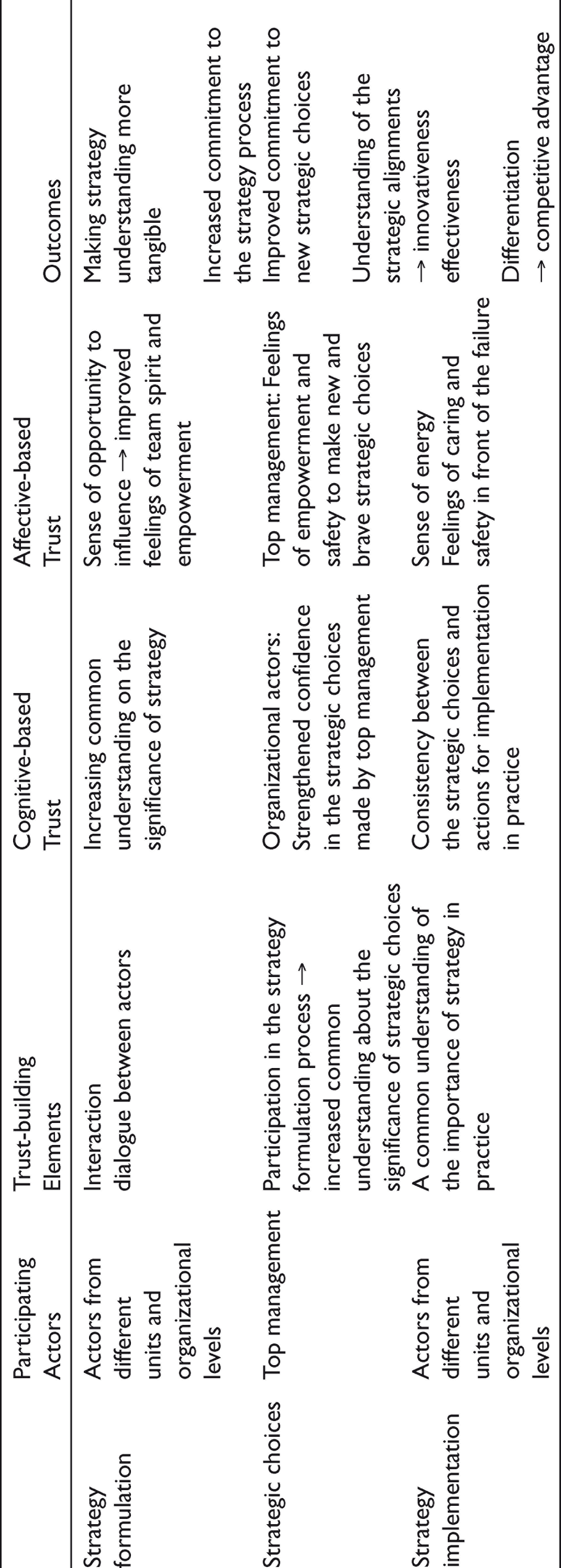
Top management of Kesko is responsible for making the strategic choices for the K-group, which are based on the strategy formulation stage. Our study shows how, from the organizational actors’ point of view, participation in the strategy formulation process enhanced cognitive-based trust emergence by increasing understanding of the background of strategic choices made by management. Among the organizational actors, cognitive-based trust was strengthened towards Kesko’s top management as a trustworthy decision-maker and increased the faith in the strategic choices to engender competitive advantage. As the study illustrated, the strategic choices made by top management were felt as ‘our choices’. Thus, both cognitive-based and affective-based trust evolved simultaneously as a hybrid form (McEvily & Tortoriello, 2011). The study also showed how participation of the organizational actors in the strategy formulation phase fostered affective-based trust among the top management, which emerged as feelings of safety and empowerment to make new and brave strategic choices. Cognitive-based trust among organizational actors improves efficiency as a result of the acceptance of the strategic goals and commitment to the new strategy (McAllister, 1995; Weber et al., 2004).
In the strategy implementation phase, a common understanding of translating the strategic guidelines into practise materialized. In this critical phase of the strategy process (Mintzberg, 1994), both and affective-based trust manifested. The study showed how the consistency between the strategic choices and implementation enhanced cognitive-based trust among the organizational actors, who felt a sense of energy and empowerment in the implementation of the new strategies. Mintzberg (1994) claimed that organizational strategies are often not actually implemented. The engagement of organizational actors and partners in the development of the strategy makes them responsible for the implementation (see Sołoducho-Pelc, 2017). In addition, this study highlights that cognitive and affective trust between parties is crucial for effectiveness at each stage of the strategy work. From the perspective of the relationship between trust and strategy, our case intensively described how a successful strategy and its implementation are based on commonly agreed upon goals and policies.
Conclusion
The purpose of this study was to provide a better understanding of trust associated with strategy work in the grocery trade business. Thus, by combining the SMP and the concept of trust, this case study deepened the current understanding of the SMP in an organizational context. This study offered a multidimensional image of the importance of trust in strategy work. Both cognitive and affective trust emerges in collective strategy work, not only through willingness and internal motivation to formulate but also via the implementation of the strategy as a team.
Often, top management of organizations strives to improve performance and strategy implementation through organizational change (Malkamäki, 2017). Our study suggests that it is important to identify the potential of an existing organizational structure and leverage it. This requires leadership and a shared understanding of strategic goals and roles to achieve them.
Our study emphasized that a common understanding of strategy arises from interaction and dialogue among actors rather than just occasional discussions between individuals. Thus, guided forums for cooperation and dialogue are needed. Understanding the importance of strategy may also require training. Participation must take place in a planned and appropriate way in different discussion forums, not by chance.
These findings point to managerial implications. In a close contract-based partnership relationship (such as that of Kesko and K-retailers), the importance of trust plays a significant role in dealing with challenging and sensitive issues and finding new viewpoints in strategy making. First, our results suggest that a robust belief in a common goal creates team spirit between parties. Second, involving actors from different levels of the organization in strategy making generates feelings of competence and appreciation. Third, understanding the importance of strategy as a tool in daily work and being aware of the roles in strategy implementation create commitment and action towards the common goal. Involving people in strategy work is essential to share a common understanding of the strategy and the roles of all partners in implementing it. Thus, we underscore the importance of feelings about genuineness and the competence of all parties in the collaboration. These aspects produce commitment, innovation, and important inputs that help achieve the common goal and lead to success.
Finally, this study—based on one interview—focused on trust development in the SMP between partners operating in a firm contractual relationship. Although one interview might be seen as a limitation, it enabled us to explore the topic and describe it in depth and explicit detail. Future studies should focus on exploring trust building in the SMP for different industries and contexts. More research is also needed to explore participatory and collective strategy work opportunities and obstacles from a trust perspective. In addition, it is essential to explore the potential of structural factors for strategy work and trust creation as an intangible resource in collaboration.
Footnotes
Declaration of Conflicting Interests
The authors declared no potential conflicts of interest with respect to the research, authorship, and/or publication of this article.
Funding
The authors received no financial support for the research, authorship and/or publication of this article.