




Abstract
The European colonial project of the nineteenth century has had long-lasting effects on the colonized. Although the transfer of political power from colonial to independent governments (political decolonization) was in most countries accomplished during the post-World War II era, economic decolonization has remained an incomplete project in many countries. Current patterns of production and export specialization in most former colonies, especially on the African continent, are a clear example of an incomplete decolonization project. Both the structure of the economy and economic activities have continued to be shaped by colonial and neocolonial power relations, which are evident in former colonized countries continued of supplying raw materials to the global economy. As the data presented in this article show, this has thwarted most efforts of former colonies (the Global South) to industrialize by building adequate productive capabilities. It is argued in this article that to the extent that the building of productive capabilities undermines the colonial and neocolonial economic relations and logic, it constitutes a fundamental act of decolonization. Industrialization in this sense is an act of decolonization because it enables countries to reduce various types of dependence on which the colonial and neocolonial project is anchored.
Keywords
Introduction
In a paper that examines factors that influence what a country produces and exports, Hausmann et al. (2007) start by asking two questions: why countries produce what they do and whether what a country produces matters. Mainstream economic theory explains why countries specialize in producing and exporting what they do in terms of factor endowment, that is, a mixture of a country’s natural, physical, and human capital, together with the type of institutions that determine what a country produces and exports. In this view, history and power relations between countries have no influence on what a country ends up specializing in; this is believed to be shaped purely by economic forces. This article takes a different view, arguing that what a country produces and exports is shaped by past and current power relations between countries and not purely by factor endowment. It is these power relations between countries that shape a country’s structure of productive capabilities, which, in turn, determines what a country ends up specializing in. The article argues that the process of building productive capabilities (industrialization) in developing countries has been inhibited by enduring colonial and neocolonial relations. Building productive capabilities is, therefore, a fundamental act of decolonization.
In the current context, African and many Global South countries have not freely chosen to specialize in producing and exporting raw materials. The past and current patterns of production and export specialization on the African continent have been shaped by colonial and neocolonial power relations, which have continued to operate in subtle ways, especially after the political liberation of the continent. The main mechanism through which industrialization in formerly colonized countries has been obstructed is through the control of domestic capital accumulation processes by advanced and former colonial countries (Baran, 1956). The fact that colonial and neocolonial relations have continued to determine the scope of economic activities on the continent is an indication that the project of decolonizing the continent and the broader Global South has remained an incomplete one (Chitonge, 2018). In this sense, successful industrialization of the African continent constitutes an act of decolonization, because it is through such actions that the continent can liberate itself economically by being able to determine freely what to produce and export, based on the continent’s available natural, human, and physical capital. Decolonization here is understood as the process of decentering colonial structures, power relations, and relations of dependence and domination (Grosfoguel, 2007; Ndlovu-Gatsheni, 2015; Tuck & Yang, 2012).
Industrialization, understood broadly as a process of building productive capabilities, affords African and Global South countries the freedom to produce and export high-value goods and services. In other words, industrialization is a means to strengthen economic and, ultimately, political sovereignty, because it not only enlarges the scope of what a country or region can do with its natural and human capital but also enables countries to build stronger and diverse productive capabilities (Chitonge, 2025). Low levels of industrialization, which have been a dominant feature of former colonized countries everywhere, as illustrated in the data presented below, particularly in Africa, suggest that former colonized countries have little say on what they can produce and export to the global market. Thus, to the extent that industrialization enlarges a country’s economic and political autonomy, it is an act of decentering the colonial economic structures and relations because it generates forces that undermine the colonial economic logic (Baran, 1956).
However, successful industrialization in most former colonies has proved to be a difficult project to accomplish precisely because it requires going against the status quo; it requires contesting the current configuration of global economic and political power and privileges. Unlike political decolonization which is marked by formal (de jure) dislodgment of imperial powers from the colonies, decolonizing the current economic power and privileges is more difficult because the lines of battle are muddled and hidden by global trade, finance, capital markets, and knowledge and technological systems. Contrary to the view that the obstacles to industrialization in developing countries originate entirely from within (Warren, 1973), there are measures employed by industrialized countries to maintain the power and privileges they currently enjoy.
The Essence of the Colonial Project
There have been extended debates on what was the main rationale for the European colonization of the nineteenth and twentieth centuries (Chitonge, 2021). 1 Some analysts have argued that nineteenth-century European colonization was primarily a product of the rivalry among European powers to assert their dominance in global affairs (Rimmer, 1978). Other analysts see colonization as a natural process through which advanced nations of the world seek to spread their cultural, political, religious, technological, and economic influence to other parts of the globe—the “civilizing mission” argument. Those who look at colonialism from this angle see it as a project that was beneficial to humankind, including the colonized who are said to have benefited in ways that they could not have imagined if the European powers had not conquered the world (Bauer, 1975; Daniels, 2005; Gilley, 2017).
But there are analysts who see the colonial project as purely an economic project, driven by the internal dynamics of maturing capitalism, which necessitates the conquering of far-flung parts of the world to secure sources of raw materials but also to open investment outlets for over-accumulated capital (Hilferding, 1912/1981; Lenin, 1917). Yet, other analysts view the colonial project as essentially a class project that only benefits a few capitalists in the imperial nations at the expense of the general public (Hobson, 1902). The European colonial project is sometimes seen as a purely irrational project, an “objectless disposition” regarded as an atavistic European trait of warring and territorial acquisition (Schumpeter, 1955).
Although there are different views on what the colonial project was all about, the common factor is that the colonizing powers, by expanding their territorial control, were pursuing their interests. It matters less whether the colonizers were motivated purely by economic imperatives, religious and philanthropic reasons or by a mere irrational pursuit of territorial grandiosity. Whatever the motive for colonization, the key issue is that the interests of the colonizing powers never coincided with those of the colonized. Various forms of resistance were widely mounted by the colonized against imperialism, and the mere fact that the process of conquering the colonized societies always involved the use of force, violent repression, and displacement of local communities (Smith, 1988) suggests that the “concrete interests” of the colonizing powers and the colonized diverged. This is why decolonization is fundamentally a process of asserting and centering the interests of the colonized.
Walter Rodney (1972, p. 77) made this point more poignantly, arguing that when it came to commerce, “European decision-making power was exercised in selecting what Africa should export in accordance with European needs.” It is the needs and interests of the European elite that provided the rationale and momentum for the colonial project. The interests of Africans and other colonized people were not only disregarded, but suppressed whenever these were expressed by local people. Because the colonizing powers assigned themselves the position of superiority in their relationship with the colonized, they assumed that they knew well what was good for natives, even if the colonized disputed this.
The Colonial Economic Logic
From an economic perspective, the colonial project was driven primarily by the need to secure raw materials, investment outlets, and markets for a rapidly industrializing Europe following the British Industrial Revolution. To secure raw materials needed for the expanding manufacturing industries in Europe during the nineteenth century, the colonizing powers enacted laws and implemented policies which discouraged the growth of indigenous manufacturing industries and local markets. Local manufacturing activities and markets were wiped out through strategic measures meant to convert the colonies into suppliers of raw materials for the colonizing centers (Baran, 1956; Moshi, 1981). A classic example is the destruction of the Indian textile industry by the British to prevent competition and create a market for British textiles (Hobson, 1902; List, 1909). Similar strategies have been reported in different parts of the African continent, particularly in West Africa (especially Nigeria and Cote d’Ivoire), which had well-developed technology and capacity for manufacturing fabric and other textile products. The local textile industry was wiped out by the colonial policy, which encouraged the importation of European textile products (Kilby, 1975).
Moshi (1981), writing about the Tanzanian experience, shows that indigenous manufacturing technology, such as iron works and metallurgy, cloth making, salt refining, irrigation systems, and shaft digging, were all wiped out by the colonial government to create a market for European products but also to induce the flow of raw materials to Europe. It is not surprising that this was the outcome of the colonial project, given that its primary motive was to subordinate the interests of the colonized. This is the expected internal logic of colonial capitalism where
[c]apital rapidly creates for itself an internal market by destroying all rural handicrafts…by transforming into exchange values commodities that were theretofore produced as direct use values—a process that results spontaneously from the severance of the worker (albeit serf) from land and ownership of his means of production. (Baran, 1956, p. 312)
Not only that, controlling what the colonies produced was a natural flow from the colonial economic logic: subordinating the interests and aspirations of the colonized by stemming off competition in critical economic activities such as manufacturing. In the words of Fieldhouse (1971, p. 600): “[t]he distinctive feature of an imperial economic system was that the metropolis could, within limits, create a formal framework for economic activity and in some degree determine the character of development. This capacity, indeed, differentiated ‘formal’ from ‘informal’ empire in the economic sphere.”
Controlling economic activities in the colonies gave the metropolis the monopoly over many things, including the type of commercial policy to be implemented. In several instances, the colonial government employed anti-local industry trade policy tactics to discourage industrial growth in the colonies during the 1920s and 1930s. In Tanzania, for example, according to Moshi (1981, p. 83),
[i]n the late 1920s, a Japanese Match factory was set up to produce matches in the country. The factory had to collapse because of heavy excise duty which was imposed on it by the colonial government in order to protect their import market. The early 1930[s] witnessed another attempt of discouraging local industries when a local firm set up three factories to manufacture binder twine (from sisal) for export.
There are two main reasons why imperial governments discouraged the growth of local manufacturing industries in the colonies. One of the reasons is that if colonies were to produce textile products, matches, or binders, this would displace the export market for firms producing similar goods in the colonizing countries. When goods imported from the mother country are produced locally, the commercial advantage enjoyed by the metropolitan government is undermined. The second, but related, reason is that when the Tanzanian local firm, for instance, develops the productive capabilities to process the sisal into binder twine instead of exporting raw sisal, companies in the metropole that use sisal as an input may not have full access to the raw materials they need to sustain production. Securing raw materials for metropole manufacturing was one of the factors widely acknowledged to be the pillars of the colonial economic rationale (Ake, 1981; Chitonge, 2021; Fieldhouse, 1971; Moshi, 1981; Rodney, 1972; Wilson, 1975). Thus, the emergence of local manufacturing industries in the colonies and ex-colonies posed a real threat to the colonial enterprise.
Industrialization Under Colonial Capitalism
Hans Singer’s (1950) incisive analysis of industrial development in the periphery explains the mechanism by which the relationship between industrialized and developing countries hinders industrial development in the latter. Apart from Singer, Paul Baran (1956), in The Political Economy of Growth, offered a useful analysis of industrial development in the periphery, focusing on the issue of lack of momentum for internal capital accumulation, which hindered industrialization. According to Baran (1956), industrialization in the periphery can only start when the process of capital and surplus flows between the center and the periphery is reversed. Although Baran (1956) covered many issues related to the development of capitalism in peripheral and dependent territories, he focused on the dynamics of industrialization under colonial capitalism.
For Baran, the spread of capitalism from Western Europe to colonized countries through the imperial project led to a dialectical relationship that shaped the destiny of developing countries in such a way that industrialization at the center only led to a lack of economic and technical progress in the periphery. As such, for developing countries to achieve economic progress, they have to reverse the forces that tie them to the center in a subservient position—they have to overcome the condition of subordination. This is because the forces generated by the spread of colonial capitalism, “control now as they have controlled in the past the destinies of the underdeveloped capitalist countries, and it is the speed with which and the processes by which they will be overcome that will determine these countries’ future economic and social development” (Baran, 1956, p. 300). To overcome these forces successfully, economic decolonization through industrialization is indispensable.
Baran (1956) argues that while the process of industrial growth in the leading capitalist countries was sustained by an internal momentum built through the creation of internal markets for capital, labor, and commodities, that process in developing countries is dictated by advanced capitalist countries, which treat internal markets in developing countries as adjuncts of Western markets. The first step in the process that leads to this situation is the destruction and displacement of local industrial activities and markets, which are turned into markets for Western final and capital goods. In Baran’s words (1956, p. 130),
[w]hatever market for manufactured goods emerged in the colonial and dependent countries it did not become the ‘internal market’ of these countries. Thrown wide open by colonization and by unequal treaties, it became an appendage of the ‘internal market’ of Western capitalism. While significantly stimulating industrial growth in the West, this turn of events extinguished the igniting spark without which there could be no industrial expansion in the now underdeveloped countries. At a historical juncture when protection of infant industry might have been prescribed even by the sternest protagonist of free trade, the countries most in need of such protection were forced to go through a régime of what might be called industrial infanticide which influenced all of their subsequent development.
Baran here is making an interesting point that colonization created a relationship in which European imperial nations had total control over the economic activities in the colonies, such that they could direct and shape local markets and structures of specialization in colonized countries to align with their own interests. The result: industrial growth at the center but industrial infanticide in the periphery. As noted above, the strategies used to weaken industrial development in the colonies differed, but all of them were a product of deliberate legislation and policy calculation. For example, it was common among colonial powers in Europe to adopt an open trade policy in the colonies yet shielding their economies with significant protective measures, including tariffs (Hobson, 1902).
Hobson (1902), who is one of the fiercest critics of British imperialism, presented a three-stage explanation of why industrialization in the periphery can undermine the colonial logic. In the first stage, there is a normal exchange of goods between the two; in the second stage, the colonizing power invests capital to gain control over resources in the colonies, and in the third stage, the capital invested during the second stage leads to the development of what he calls “capital and the organizing energy,” either by the natives themselves or the Europeans. For Hobson, it is during the third stage that things do not work in favor of the European colonial powers. With specific reference to China, Hobson (1902, p. 329) argues that
…fully equipped for the future internal development in all necessary productive powers, such a nation may turn upon her civilizer, untrammelled by need for further industrial aid, undersell him in his own market, take away his other foreign markets and secure for herself what further development work remains to be done in other underdeveloped parts of the earth.
Although Hobson (1902) is coming from a different perspective, he highlights the idea that industrialization in the colonies ultimately undermines the colonial economic rationale because it endangers the hegemony of the colonizing powers over underdeveloped countries.
Lenin (1917) also considered the possibility of capital-exporting imperial countries unintentionally undercutting themselves but maintained that the disparities in productive forces between the colonies and colonizing powers cannot be remedied except by the use of force (war). Thus, the key instrument for undermining the colonial economic logic in underdeveloped countries is to build productive capabilities.
Industrialization Under the Colonial Project
While there has been a great deal of literature on colonialism and now decolonization, this debate has largely focused on the political power relations. Very little attention has been given to the economic structures and instruments employed to consolidate the subjugation of the interests of former colonized peoples. While the political apparatus through which the colonized societies were controlled has been rolled back, the economic apparatus continues to operate through subtle neocolonial structures and relations (Nkrumah, 1966). One area where the economic subordination of the formerly colonized is clearly visible is in the forces that shape what the former colonized countries produce and export to the global economy.
While the condition of low levels of industrialization in developing countries has predominately been explained in purely economic terms, there are other subtle ways that have stifled industrialization in developing countries. One key example is the structure of the global financial system, which has created conditions of perpetual capital scarcity in developing countries by making it difficult for these countries to mobilize resources domestically due to huge capital outflow (most of it illicitly AU/ECA, 2015). And when developing countries want to borrow from capital markets, they are charged exorbitant interest rates which often lead to sovereign debt crises. For instance, an UNCTAD (2023, p. 10) report admitted that
[c]ountries in Africa borrow on average at rates that are four times higher than those of the United States and even eight times higher than those of Germany. High borrowing costs make it difficult for developing countries to fund important investments, which in turn further undermines debt sustainability and progress towards sustainable development.
The preservation of colonial structures and relations of production in colonized regions of the world are sustained by siphoning capital needed to build industrial and productive capabilities from developing countries. Africa is one region where the colonial economic structures of subordination and exclusion are probably most evident, with the continent largely retaining the role of supplying raw and semi-processed commodities to the global economy. It is in this context that the lack of industrial development is a reminder of the unfinished liberation project in Africa and other countries of the Global South.
This is why industrial development is so sought after by both developed and developing countries (Singer, 1950), that countries do everything they can to keep ahead, even if it means committing espionage (Amsden, 1989). The importance of industrialization in the colonial project was acknowledged by a senior French politician, Jules Ferry, who was a strong advocate of the policy of expanding French colonies, by arguing that “colonial policy was the daughter of industrialisation” (Wilson, 1975, p. 72). Similarly, Goldstone, the British Prime Minister at the time of the Berlin Conference, argued that the role of the British colonial policy was to advance the interests of British commerce and industrial enterprises (Wolf, 1974).
The Importance of Industrialization
The discussion above highlights the point that industrialization was central to the colonial project, and it remains an important instrument for both developed and developing countries seeking to strengthen their economic and political sovereignty. Although industrial policy has been vilified in some quarters for being a highway to introducing inefficiency in the economy (Pack & Saggi, 2006), many countries, including advanced economies, have embraced industrial policy of one kind or another (Aiginger & Rodrik, 2020; Cherif & Hasanov, 2019). There are many reasons why countries seek to industrialize and why countries that have already industrialized make every effort to keep their position on the industrial ladder. One of the reasons is that industrialization is synonymous with economic development (Warren, 1973) in the sense that there is no country with high levels of industrial capabilities that is underdeveloped, just as there is no country with low levels of industrial development classified as a developed country (Chitonge, 2018). The UN Economic Commission for Africa’s (UNECA, 2016, p. 31) Economic Report on Africa argues that “[t]hroughout the history of capitalism, the manufacturing sector has been the engine of economic development. Very few countries have developed without developing a strong manufacturing base—so much so that the term ‘industrialised country’ and ‘developed country’ are often used interchangeably.”
The reasons given for elevating industrialization, particularly manufacturing, as the engine of growth include the fact that manufacturing activities can be a source of rapid productivity growth, as more advanced techniques and instruments of production are deployed.
Industrialization and Productivity Growth
Apart from employment creation, industrialization, is widely sought after because it contributes to raising productivity. As one of Kaldor’s laws of growth postulates, a growing manufacturing sector contributes to raising economy-wide productivity mainly because of its spillover effects in other sectors, induced by the sector’s strong backward and forward linkages (Kaldor, 1966). A dynamically growing manufacturing sector can induce productivity growth if the sector contributes to initiating the transfer of resources, including labor, from low- to high-productivity activities. When this happens at a significant and sustained scale, the economy reaps allocation and production efficiency gains, which play a significant part in sustaining economic growth (McMillan et al., 2014). Although productivity growth in an economy can be achieved through growth in other non-industrial sectors, it is the greater spillover effects from the manufacturing sector that are more advantageous when it comes to raising economy-wide productivity levels. For example, rising productivity in the manufacturing of inputs such as agricultural machines, chemicals, and equipment used in the agricultural sector contributes to raising productivity in other sectors (UNECA, 2016). This is partly because the manufacturing sector, as noted above, acts as the innovation node from which technology is distributed to other sectors.
Industrialization and National Sovereignty
The other major factor why industrialization is sought after by all countries is that the productive capabilities that accumulate as a country undergoes industrial development lead to greater choice of what activities firms can engage in. For countries with low levels of industrial development and productive capabilities, the very fact that they have limited capabilities to manufacture intermediate and final goods means that the choices of what firms can do are limited. As a result, most firms in developing countries end up specializing in low value-added activities, usually the extraction of natural resources which reinforces the relationship of dependence on industrialized countries for different things, including finance capital, inputs, ideas, technology, and markets for primary commodities. Thus, by promoting industrialization in their respective countries, industrialized countries put themselves in a position of advantage when compared to developing countries.
Industrialization and Employment
Since the manufacturing sector in an industrializing economy is at the heart of the industrial sector, industrialization has in the past widely been regarded as a process of deepening and diversifying manufacturing capacity and capabilities. In an industrializing economy, the manufacturing sector contributes up to a third of GDP. However, the share of manufacturing sector in total national output in recently industrializing economies has been much lower, a phenomenon that has been referred to as premature deindustrialization, characterized by a declining share of manufacturing employment in total employment, as well as falling share of manufacturing value added (MVA) in GDP (Felipe et al., 2017; Rodrik, 2015). For example, manufacturing share in total employment in the United Kingdom peaked at 34% in 1970, 27.5% in Japan in 1973, and almost 28% in South Korea in 1989. But the peak for China was only 17% in 2010 (Felipe et al., 2017, p. 3), and it has been much lower for late industrializers.
If we look at the industrial sector in general, while the share of the sector in total employment has declined in industrialized countries such as the United Kingdom, the United States, Canada, France, and Germany, these countries still enjoy a much higher level of industrial employment than the average for the developing world (Figure 1).
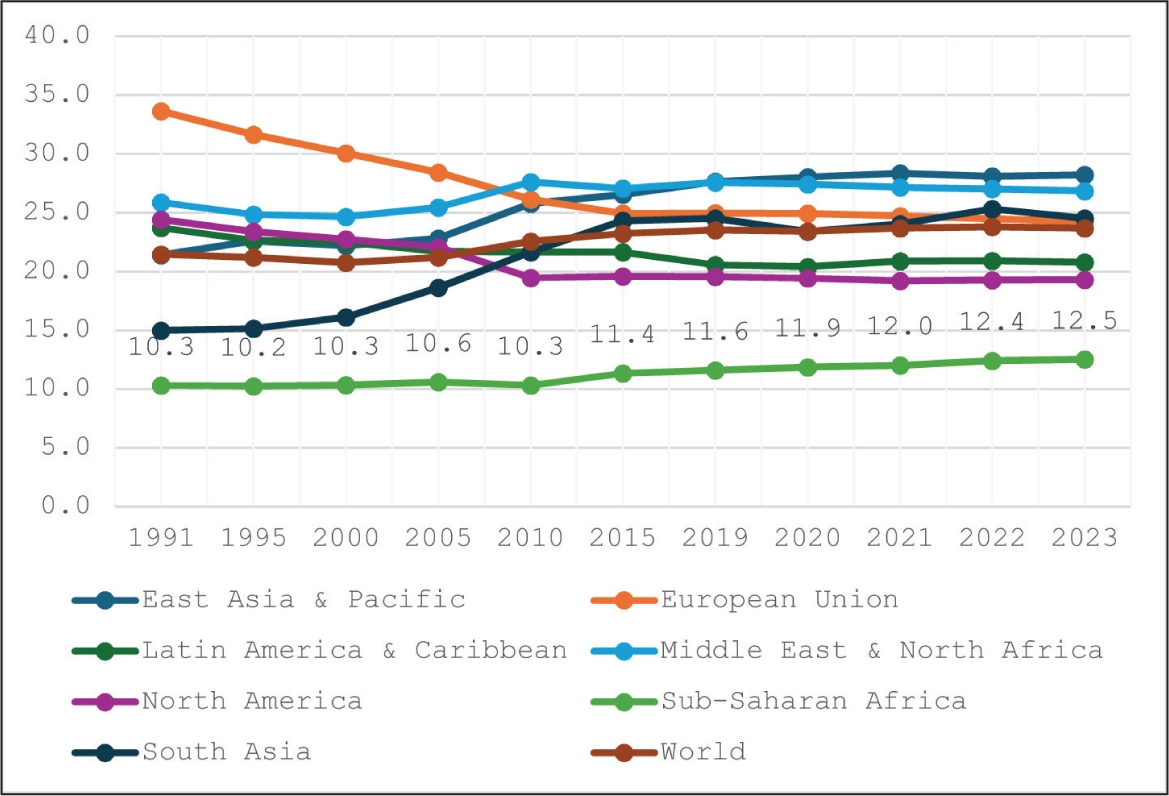
In terms of industrial sector employment as a reflection of the complexity and depth of the sector, Africa has been an outlier over the past three decades. This is a clear reflection of the failure to decolonize African economies. The Middle East and Asia, in general, have experienced significant levels of decolonization in this regard.
If we focus on manufacturing share in employment, the situation is even worse in Africa. Industrial share in total employment on the continent averaged 5% in 1960, rising to 9% by 1990, but declined and has stagnated at around 7% over the last three decades (Figure 2).
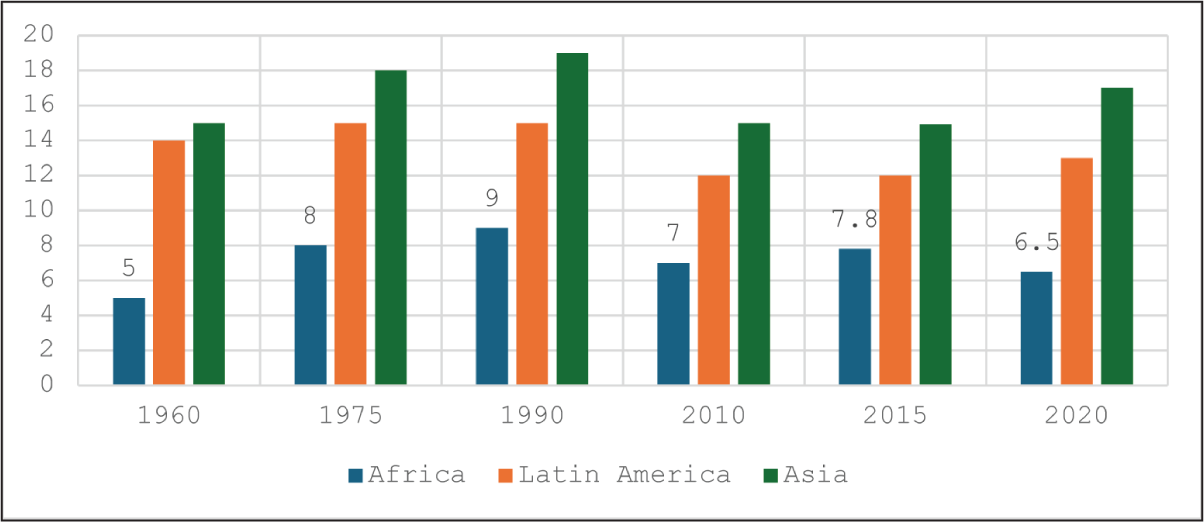
We see a similar trend in Latin America and Asia, though these two regions have maintained manufacturing employment at a higher level compared to Africa.
The reasons for the declining share of manufacturing in total employment include technological changes that are “rendering manufacturing more capital and skill intensive, reducing the employment elasticity of industrialization and the capacity of manufacturing to absorb large volumes of unskilled” (Rodrik, 2014, p. 52).
However, although the potency of the manufacturing sector to create jobs has declined, it has remained an important sector for developing countries seeking sustainable and inclusive economic growth. In countries where industrial development has not occurred to a significant degree, the levels of formal employment have remained low, with a larger share of the labor force absorbed in agriculture and urban informal services, particularly retail and personal services (UNIDO, 2016). The low levels of industrial development in developing countries in Africa and the broader Global South are a sign that these countries are battling to create employment and improve income, living standards, and the well-being of the majority of the people.
Even if the manufacturing sector’s ability to create jobs has been declining, building productive capabilities in these economies is one way to increase the opportunities for wage employment and high earning and more productive participation of the majority of people in the economy. In the current context, where industrialization has been elusive in most countries, labor productivity in these countries has remained low even in cases where large portions of the labor force have shifted from agriculture into the urban services sector. This shift, which has been a sign of structural transformation in the past, has contributed little to improving the income and living conditions of people, as a UNIDO (2016, p. 9) report observes:
[w]hile people have moved out of rural areas and the share of agriculture in employment and value added has dropped since the 1960s, the primary beneficiaries have been urban and often informal services, not manufacturing. African labour has tended to move from agriculture to services, and while services have had much higher productivity than agriculture, their productivity gains over time have been very limited. Thus the transformation of some of these economies has not been in an enabling environment where transformation could be translated into decent income opportunities.
The failure to transform these economies structurally is a sign of a persisting colonial economic logic manifested in the inability to build productive capabilities. It is difficult, as the African experience has shown, to decenter the colonial and neocolonial economic relations without industrial development, which is central to addressing the different forms of dependence and domination introduced through colonization.
In terms of the levels of MVA, it is also clear that this has been low in Africa, Asia, and Latin America when compared to industrialized countries. If we look at MVA per capita, which is the best measure of manufacturing capacity and the levels of productive capabilities in a country, taking into account population size, there is a huge gap between developed and developing countries (Table 1).
Developing Country Manufacturing Value Added Per Capita, 1990–2021 (USD 2015).
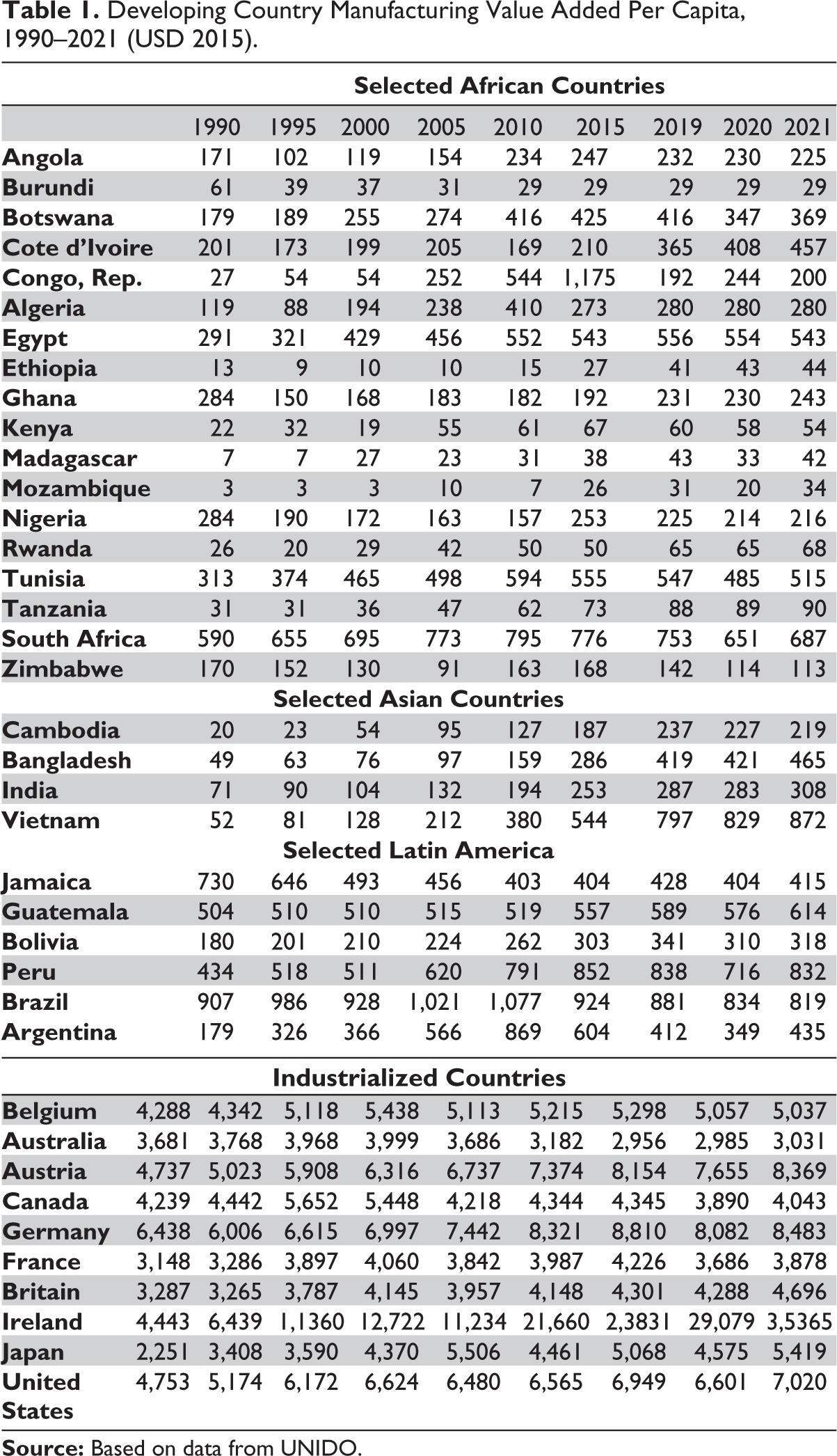
Even in Latin America and Asia, where the manufacturing sector has been relatively larger, their MVA per capita is only a tenth of the average for developed countries. In the African case, we see that there is very little manufacturing value addition taking place, with countries such as Burundi, Rwanda, Ethiopia, Madagascar, Mozambique, and Tanzania reporting consistently less than USD 100 of MVA per capita for the past three and a half decades.
The low manufacturing value-adding situation is reflected in the low and declining share of manufacturing in total export, especially for the African continent (Figure 3). But this also attests to the failure to transform the colonial economy on the continent, with export of primary commodities still the dominant feature of an overwhelming number of countries.
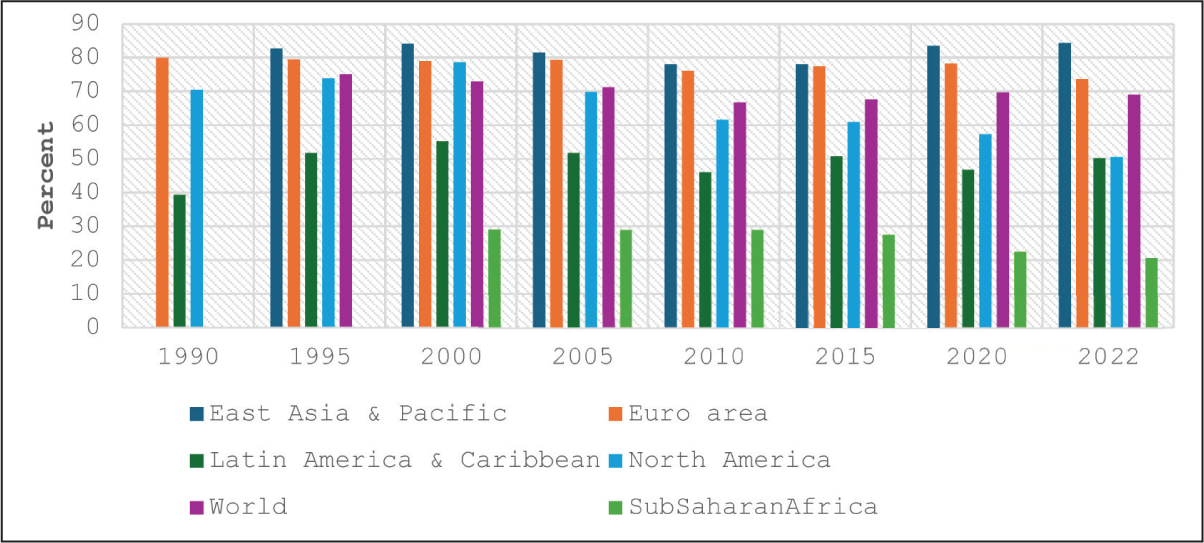
While manufacturing share in total export in Asia has now surpassed that of Europe and North America, the levels for Africa have remained agonizingly low, declining from about 30% in 2000 to 20% in 2022. This is a confirmation of the declining levels of productive capabilities on the African continent, relative to other regions of the world. The ratio of Africa’s productivity per work relative to other regions also confirms the low levels of productive capabilities on the continent (Table 2).
Ratio of Africa’s Productivity Per Worker to Other Regions (%).
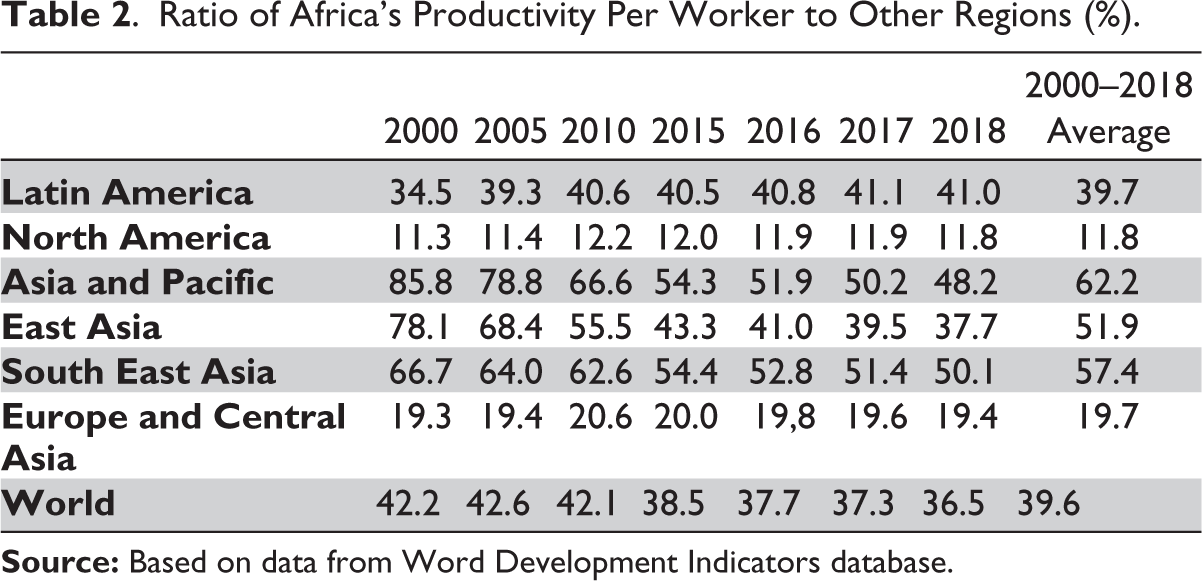
The continent’s level of productivity was only a tenth of North America’s, one-fifth of Europe’s, and two-fifths of Latin America and East Asia in 2018. While the continent has been slowly catching up with other regions, the productivity gap is still large, especially when compared to leading countries in North America and Europe. One could argue that the African continent, in terms of building productive capabilities, has experienced low levels of decolonizing the economies, perhaps reflecting the view that colonialism was deepest and most destructive on the African continent (Rodney, 1972).
Industrialization and Capital Mobilization: Breaking the Vicious Cycle
Industrialization is central to decentering the colonial economic logic because it creates the opportunity for countries to move from low- to high-value-adding activities, which play a huge role in domestic capital mobilization. In the absence of a diverse set of productive capabilities, the tea farmers in Kenya, Tanzania, and Uganda have little option but to sell the raw tea leaves to a Belgian firm that processes tea leaves into tea, just like the cocoa farmer in Ghana and Cote d’Ivoire can only sell cocoa beans to a Swiss firm to process them into chocolate. The Swiss chocolate firm that buys cocoa beans from farmers in Ghana transforms these primary products into final goods, and by doing so adds and captures the lion’s share of the cocoa value chain, compared to the farmer and, by implication, the government of Ghana. In the case of the coffee value chain, some estimates show that coffee growers in Africa and Asia only capture 5% of the value generated from these commodities (Museveni, 2023). In the case of the lithium ion battery, countries that supply raw materials only capture less than 2% of the value chain, while countries with firms which assemble, market, and distribute the battery component capture up to three-quarters of the value chain (Chitonge, 2025).
At face value, this may appear as though it is the farmer or mine owner who is disadvantaged in this situation. But ultimately, it is the entire tea- and cocoa-growing country that is disadvantaged in that it can only tax the 5% income received by the coffee growers, while the Swiss government can tax the 60% to 70% income earned by the chocolate makers. Not only that, the Swiss company, because it captures a high value from the cocoa value chain, can accumulate capital faster and improve its productive capabilities to ensure that it is always ahead. On the other hand, the governments in Tanzania, Kenya, Ethiopia, Uganda, and Ghana, which tax only 5% of the value generated from the cocoa, coffee, and tea value chains, find it difficult to accumulate capital to build productive capabilities to increase their choices around what to do with the tea, coffee, cocoa, and lithium ore produced in their countries. As a result of this situation, the tea farmer and the Ugandan government remain capital-scarce, and to access capital for investment, they will have to do everything possible to please the Belgian investors to bring capital to invest in Uganda and Ghana. If the Belgians decide to invest in Tanzania and Uganda, they will recreate the same cycle in which Ugandan and Tanzanian farmers grow tea and get only 5% of the value generated, while Belgian firms process the tea leaves into final products and capture as high as 70% of the value.
The African experience has shown that it has been extremely difficult for African firms and countries to break this vicious cycle introduced through colonization. The crucial issue is not that the Ghanaian government gets little from the cocoa produced in the country; it is about the use made of the surplus generated in the economy (Baran, 1956). In the African case, even the little surplus generated is expatriated to countries where the initial investments came from, sometimes through illicit means including transfer pricing and other tax avoidance tactics (AU/ECA, 2015). The surplus that is generated, no matter how small it is, is not directed to building productive capabilities to enhance industrial production, thereby reproducing the same dynamic at the center of the colonial project (Baran, 1956).
This has perpetuated the cycle where the Ugandan coffee farmer produces coffee but gets only 5% of the value generated, and the Ugandan government only taxes the 5%, while the bulk of that value generated is captured by the Belgium-based firm and taxed by the Belgian government. We see here that Hobson’s (1902) fear that by exporting capital to developing countries, colonial powers were undermining their own interests does not materialize mainly because the receiving countries have not subjected imported capital (FDI) to an internal capital accumulation logic. The surplus produced by FDI does not feed into the local processes of building the host country’s productive capabilities; instead, they are expatriated to sending countries where the secondary multiplier effects occur (Singer, 1950).
Someone might argue that no one prevents Uganda, Ghana, Kenya, Ethiopia, or Tanzania from setting up or inviting firms that can process the tea leaves and the coffee beans into final products as long as such firms can make a profit. The situation is, however, much more complex than just establishing local firms; it involves building complementary productive capabilities to enlarge the country’s production structure, and this is where industrialization and industrial policy come in (Ocampo, 2020). What is clear, though, is that industrialization as a dynamic process of building productive capabilities puts a country in an advantageous position, while lack of industrial development perpetuates conditions of disadvantage and dependence. The dependence created reinforces the condition of low productive capabilities, and with that, limited choices people and the country have.
Industrialization as an Act of Decolonization
Now that we have shown why industrialization, manufacturing in particular, is vital to a developing country’s decolonization project, we turn to the issue of how industrialization constitutes an act of decolonization. Decolonization here refers to any act that seeks to undo the colonial project of subordinating the colonized. In this sense, decolonization is not just an act of reclaiming political independence by dislodging a colonial regime; it is much deeper than merely restoring the political kingdom (Grosfoguel, 2007; Ndlovu-Gatsheni, 2015). Colonialism as a multi-dimensional project with economic, cultural, epistemological, religious, and racial overtones (Chitonge, 2018; Grosfoguel, 2007) was carried out through a simple logic of subordinating the interests of colonized people. Thus, any act that seeks to decenter this logic and structures of subordination is an act of decolonization (Tuck & Yang, 2012). In this sense, to the extent that industrialization contributes to decentering the economic logic and structures of subordination, it constitutes an act of decolonization. To illustrate how industrialization constitutes a form of decolonization, it is important to show how industrial development in the colonies and ex-colonies undermines the colonial economic logic.
Industrialization Undermines Structures of Domination
There are three ways in which industrialization of developing countries undermines the colonial economic logic. First industrialization in developing countries leads to the destruction of the structures that sustain domination. This can occur, as we indicated above, when a developing country initiates an organic process of mobilizing capital for domestic investment to build productive capabilities. Productive capabilities built in the periphery not only increase the autonomy to choose what a country can produce and export but also enable a developing country to redirect the secondary multiplier effects of investments into the domestic economy. By facilitating the mobilization of capital to build more productive capabilities, industrialization in developing countries plays a central role in reversing the colonial economic logic.
Second, industrialization in the periphery is an act of decolonization because it undermines the colonizer’s source of raw materials and the outlet for investments. Imagine for a moment a situation where most African countries build on the continent, the capabilities to process platinum into catalytic converters; lithium, cobalt and manganese into lithium-ion batteries; cocoa beans into chocolate; raw diamonds into various diamond products; and critical energy transition minerals into renewable energy products. This would dramatically shift the power relations between African countries and the outside world. The continent would not just be confined to the role of supplier of raw and semi-processed commodities; it would have more say on what happens to natural capital in its territory, but also the process of mobilization and deployment of financial and physical capital.
Third, industrialization in the periphery can undermine the colonial and neocolonial rationality and interests by creating competition for markets, technology, and skills. The productive capabilities built in the periphery, through industrial policy, would undermine the different structures of dependence that sustain colonial and neocolonial relations. As soon as peripheral countries begin to industrialize to a significant level, they would reduce their dependence on industrialized countries for capital goods, technology, financial capital, inputs, and consumer goods. When this happens, colonial relations, which thrive on subordinating the interests and aspirations of the colonized would be severely undermined.
Countering the Colonial Economic Logic: Some Examples
When the conversion of raw sisal into a rope or mart occurs in Tanzania, it radically alters the economic dynamic and position of industrialized countries. First, this means that more value is added to sisal and possibly captured in Tanzania through tax and spending of sisal workers in the local economy—activating Hirschman’s (1969) consumption linkage. When the process of adding value to raw materials becomes secular in a developing country, it reduces a developing country’s different types of dependence, including dependence on imported finished consumer goods and FDI, since the high value captured in the country is made available for investment through a domestic capital accumulation and mobilization strategy.
The second important dynamic is that by manufacturing matches or marts out of the raw materials from Tanzania, the country can gradually build skills and improve the technology needed to produce these products more efficiently and, eventually, at lower costs. In the long run, this process becomes vital to building productive capabilities not only in the sisal value chain but also in other value chains using the lessons and experience gained from the processing of sisal. With more productive capabilities built over time, the country can have more autonomy in terms of what it can produce and what it can do with its other natural resources. In the long run, a country can overcome the colonial structure of subordination through which developing countries are consigned to the role of supplying raw materials to industrialized countries.
If colonizing nations allowed colonies to build their industrial capabilities, they would be undermining their own interests including access to raw materials and monopoly access to markets for capital and inputs (Wilson, 1975). We see this relationship still playing out in the relations between the African Union (AU) and the European Union (EU), which has prioritized immigration as the main pillar of their cooperation, with industrialization of Africa not even mentioned (Chitonge, 2024). As noted above, industrialization, manufacturing in particular, constitutes an important means of raising individual, household, and national incomes and wealth, and with these, national power and privilege on the international scene (List, 1909).
Conclusion
This article has argued that industrialization as a process of building productive capabilities constitutes an act of decolonization. Industrialization is an act of decolonization in the sense that it provides developing countries with the instrument to build productive capabilities, which can enable them to decenter the structures of subordination created by the colonial project. The article has illustrated that the critical point in deploying industrialization as a strategy of decolonization is to initiate the process of domestic capital mobilization, which plays a critical role in building productive capabilities through which a country can escape from subordination and dependence. But if industrialization is so central, how can countries in the Global South achieve this, and why have they not done so?
As the experience of developing countries shows, industrialization is not an easy thing to do, partly because industrialized countries are doing everything possible to keep their privileged position, as the unfolding trade wars instigated by the Second Trump administration are clearly highlighting. It is precisely because industrialization disturbs the status quo of global economic power configuration that it constitutes a strategy of decolonization. Because industrialization seeks to reconfigure power, it faces resistance from those who are in positions of advantage. In this sense, seeking to industrialize is a struggle perhaps more subtle than the political liberation struggle. The growing sentiments of economic nationalism manifested in trade wars are just an expression of the desire of the major economic powerhouses to maintain their dominant positions and keep developing countries in subservient positions. Developing countries can challenge their subordinate position by industrializing.
Footnotes
Declaration of Conflicting Interests
The author declared no potential conflicts of interest with respect to the research, authorship, and/or publication of this article.
Funding
The author received no financial support for the research, authorship, and/or publication of this article.