



Abstract
In the 2010s, the Pakistan Kissan Ittehad (PKI) emerged in Punjab as a militant movement that brought together different fractions of agrarian producers against the IMF-proposed removal of electricity subsidies for agricultural tube wells. The article draws on fieldwork with the PKI in 2018–2019 to understand its trajectories since its contestation of one aspect of the agenda of structural reform. I argue that the analytical framework of “agrarian populism,” which has recently come back into use to understand agrarian politics, poses limitations in differentiating agrarian movements from each other. By focusing on how the PKI navigates the intersection between the agrarian, national, and ecological questions, the article shows how the movement has approached agrarian market reform, ecological crisis, and national development. Through this discussion, it undertakes a critical assessment of the PKI and situates it with longer histories of class differentiation, agrarian change, and ecological transformation.
Introduction
Marxist political economy has continued to struggle with theorizing the rupture in ties between agrarian movements and left-wing political parties in South Asia since the late 1970s. 1 The rise of several independent farmers’ movements led to the debate on “New Farmers” Movements in India (1994), which presented a polarized outlook between “agrarian Marxists” (Banaji, 1994; Brass, 1994 a, b, c) and “agrarian populists” (Lindberg, 1994; Omvedt, 1994). Much of the broad contours of this debate have continued to shape the analysis of agrarian movements in South Asia today (Mehta & Sinha, 2022). This is despite Baviskar and Levein’s (2021, p. 1341) more recent declaration that the debate is “no longer adequate for the agrarian milieu of the twenty-first century” because of long-term transformations in markets, ecology, and agrarian and non-agrarian economies. The challenge posed to the liberal thesis of the “end of history” (Fukuyama, 1992) by the rise of right- and left-wing politics and politicians around the globe has brought the term “populism” back into vogue to explain this departure from the “norm.” Amidst this wider trend, the analysis of “agrarian populism” has come back into agrarian studies (Akram-Lodhi, 2022; Bernstein, 2019; Borras, 2020).
This article focuses on the Pakistan Kissan Ittehad (PKI), a mass-based agrarian movement that emerged in central and southern Punjab, Pakistan, in the 2010s, around the neoliberal restructuring of electricity markets. A recent work by Aftab and Ali (2023) has categorized the PKI as “agrarian populist” and as advancing the interests of rural capitalists over owner-peasants (Aftab & Ali, 2023, p. 85). Like other contemporary agrarian movements in South Asia, the PKI presents an analytical challenge that requires agrarian Marxists to engage with the substantive changes in agrarian class formation, patterns of reproduction and accumulation, the ecological limits to agriculture, longer histories of agrarian politics, and the contemporary crisis of national development. The PKI is the first movement that has managed to build a cross-class alliance of differentiated agrarian producers in Pakistan’s countryside in forty years. 2 It will be argued here that the agrarian populist label limits our understanding of why the PKI emerged and its implications for the political agrarian question today. Based on fieldwork with the PKI in the districts of Pakpattan, Arifwala, and Sahiwal between November 2018 and May 2019, 3 it will be shown how the PKI articulates the intersection between the agrarian, national, and ecological questions on how this allow us to explore the material and discursive contradictions within the movement around peasant differentiation, agrarian reform, and the ecological crisis in Punjab.
The first section of the article will discuss the limitations of the agrarian populism framing by focusing on two of its streams: “Agrarian Marxism” (Bernstein, 2019; Brass, 2020; Pattenden, 2023), which argues that popular agrarian movements ignore the class question in the countryside; and a more positive reading (Borras, 2020), which sees these movements as offering an alternative to the rise of right-wing populism. It will be argued that an analysis of how movements situate themselves in relation to the agrarian, ecological, and national questions offers a more useful framework for critical engagement with contemporary agrarian politics. The second section focuses on how PKI was able to draw on the intersection of the ecological and agrarian question in the 2010s to forge an agrarian class alliance around the increase in cost of extracting groundwater forced through by IMF-led structural reform in Pakistan. The third section will discuss how the PKI’s development of a broader politics of agrarian reform around the 2019 potato price crash has led to tensions within differentiated agrarian producers. The fourth section will discuss how the PKI positions itself as a mediator of the ecological question and the limits of its approach in being able to provide a broader vision to address the falling water tables across Punjab. The final section discusses the PKI articulation of the intersection between the agrarian and national question by proposing small-to-large scale commercial farming as a solution to Pakistan’s debt and development crisis.
Agrarian Populism and Its Limits
As mentioned in the introduction, recent developments in agrarian studies have brought the term “agrarian populism” back into use. In their article on the PKI, Aftab and Ali (2023, p. 87) read it as an “agrarian populism in that it bundles different rural-based groups and classes into ‘the people of the land’ to preserve farmer livelihoods by advocating for remunerative pricing, improving the terms of trade between industry and agriculture, and opposing the corporatization of agriculture.” Based on this categorization, they ask “what class interests do PKI-affiliated agrarian populisms represent and serve in how they align with broader politics at regional and national levels?” (Aftab & Ali, 2023) The answer offered is that the “PKI’s discourse underplays the divergence of interests through an ideology of kisan populism buttressed by village-level caste linkages and a patronage–clientelist type politics, whereby access to state is reciprocated by political support” (Aftab & Ali, 2023, p. 89). They highlight Borras’s (2020) distinction between right-wing and left-wing agrarian populisms, but in their analysis of the PKI, they argue that the movement does not qualify as either left- or right-wing agrarian populism.
Talking about the broader political economy of Pakistan, Aftab and Ali (2023, p. 105) themselves argue against “narratives of right-wing or authoritarian populism” because they “can obscure [the] broader political economy [of Pakistan].” If indeed narratives of “populism” can obscure political economy, the label also obscures our understanding of agrarian movements. In the case of the PKI, the label “agrarian populism” obscures the ways in which the PKI’s class alliances between large-scale commercial leasehold farmers and small owner-cultivators have contested neoliberal agrarian market reform. The contemporary academic critique of the PKI, as well as the 2020 Indian farmers’ movement, are still shaped by the NFM debate of the 1990s, where Brass (1994a, b, c) and Banaji (1994) dismissed newer agrarian movements in India for their “class composition” without discriminating between how movements positioned themselves, vis-à-vis trade, corporatization, and agroecology. This approach reduces the political agrarian question into a simplified class question, and thus it fails to recognize the multidimensionality of the political agrarian question, which includes the question of sovereign industrialization, food security/sovereignty, the relationship between industry and agriculture, the place of gender, and the broader ecological contradictions within the agro-industrial enterprise under capitalism. Even Bernstein (2018, p. 1146), traditionally skeptical of agrarian populism(s), accepts that “the challenges facing any Marxist agrarian politics would be helped by a critical engagement with the most progressive of today’s agrarian populism, and the diverse rural struggles it embraces, rather than dismissing a priori all agrarian populism as necessarily and equally ‘wrong’ and ‘reactionary’.”
There have been two key positions on agrarian populism within Marxist political economy. The first of these has been a consistent critique of “agrarian populism,” which traces the position to Lenin’s (1913) criticism of the Narodniks. Advocates of this position (Banaji, 1994; Bernstein, 2019; Brass, 1994a, b, c, 2020) have criticized “agrarian populism(s)” for being class blind and ignoring the complex class relations of the rural–urban/agrarian–industrial relationship under capitalism. This tendency has largely failed to distinguish “popular” from “populist,” and has characterized most mass-based agrarian movements as regressive. Bernstein (2022) and Pattenden (2023) have argued against too much focus on “the agrarian” and have pushed for a shift towards “classes of labor” in and outside the countryside. Such a framework that brings together the rural and urban, and that classifies agrarian producers as petty commodity producers cannot provide a theory of movements concerned with farmers, peasants, and pastoral or agrarian land. The agrarian, thus, runs the risk of going missing in the “agrarian question.” Unsurprisingly, this position comes into question with the insistence of agrarian social movements around the world that the future of land and farming remain political questions tied to national development and resolving the ecological crisis.
The second position takes the political agrarian question as a starting point and sees “agrarian populism” as a key site of resistance and space for the development of alternate trajectories. It rejects the charge that agrarian movements are reactionary and focuses instead on their politics. Borras (2020, p. 3) defines populism as the “deliberate political act of aggregating disparate and even competing and contradictory class and group interests and demands into a relatively homogenised voice.” Based on this classification, Borras (2020, p. 4) also argues that the terms right-wing and left-wing populism are “like bookends, i.e., as ideal types or as heuristic tools…[which] allow us to see a dynamic continuum, rather than fixed categories”; moreover, contemporary populisms are defined by “internal contradictions” and “antagonisms.” The key challenge facing this position is how to differentiate between the kind of politics practiced by different agrarian movements. Addressing this question, Borras refers to the Philippines Peasant Movement, the Landless Workers Movement (MST) in Brazil, and the Sindicato Obrero del Campo (Rural Workers Union) in Andalusia to argue that neither of these are “a perfect fit in the description of classical agrarian populism,” in that “none of these movements are nostalgic-romantic, conservative, reactionary, or utopian; none of these are class blind in their political work; none of these are anti-industrialisation” (Borras, 2020, p. 12) This raises the question of whether the label “agrarian populism” offers any analytical insights into these very different movements. Referring to “right-wing populism,” Borras argues that it is being used due to the “lack of a better term” (Borras, 2020, p. 3). The same could be said about the term “agrarian populism,” which runs the risk of failing to identify how particular movements situate themselves in terms of the key elements of the political agrarian question today.
The current framing of agrarian populism, despite some shifting of terms, continues to piggyback on the class reductionist legacies of European Marxism, which included a more foundationally “anti-peasant logic.” Moyo et al. (2013) argue that one of the ways in which this manifests is the de-linking of the agrarian and national questions. This translates into reading agrarian movements as localized, rather than presenting alternate trajectories of national development. Developing a more holistic critical analysis of contemporary agrarian movements in the Global South requires paying attention to
[A]n appreciation of the longue durée of agrarian transformation, the new dynamics of land alienation and resistance, and the role of small producers in national development. These are the concrete issues with which all dimensions of the agrarian question must contend, including gender, ecology and regional integration. (Moyo et al., 2013, p. 111)
This translates into locating the emergence and trajectories of development of movements within concrete political economies, shaped by colonialism, neo-imperial development agencies, and self-interested elites.
The Political Ecology of the Rise of the PKI
Punjab’s agriculture was integrated into the global food market in the late colonial period in South Asia. This integration meant that even small agrarian producers have had to rely on agrarian markets for reproduction and accumulation. Moreover, reproduction and accumulation in agrarian Punjab remained a battle with the rapidly changing ecology, which has moved from being a semi-arid region to having perennial irrigation through canals and to ground water irrigation through tubewells within the twentieth century. The ecological limits of human intervention in the countryside have been all too obvious, with agrarian production threatened by water logging and salinity caused by the canal network, and groundwater depletion caused by tubewells. Situated within a global agrarian market and a tense ecological balance, left-wing farmers’ movements in the colonial and national developmental periods contended with the interface between agrarian, national, and ecological questions (Rashid, 2023). The emergence of an independent farmers’ movement, PKI, in 2010, owed itself to the alignment of these three questions in the neoliberal period.
In 2008, the International Monetary Fund (IMF) began to pressure the Pakistan People’s Party (PPP)-led coalition government to initiate “structural reforms,” including removing subsidies for electricity for agricultural tube wells. 4 The fact that this pressure came immediately after Pakistan’s third major transition to democracy is no surprise. While it was accepted that such a decision would cause distress for farmers, no one expected that it could lead the countryside to erupt in revolt after three decades of relative calm since the 1980s. The Okara peasant movement that had promised to stir a bigger revolt in the early 2000s (Akhtar, 2006; Rizvi, 2019) remained localized to a struggle for tenant rights at military farms. The right-wing Jamaat-i-Islami’s Pakistan Kisan Board and left-wing Awami Workers Party-affiliated Pakistan Kissan Committee were largely restricted to issuing press releases. By the mid-2011, agrarian producers were up in arms under the umbrella of the newly formed PKI, surrounding the offices of electricity utilities and sitting parliamentarians, burning electricity bills, staging roadblocks, and taking out rallies of thousands.
Chaudhry Rizwan, General Secretary of the PKI-Khokhar group, recalls the formation of the PKI as an “accidental convergence” (Interview, December 2018). After the subsidy withdrawal in 2011, farmers had begun to receive massively hiked electricity bills. In the General Secretary’s words, “[n]ews came to us that farmers had begun spontaneously burning their electricity bills in Multan and Burewala. We called a meeting of tube-well owners at the Arifwala Grain Market. Over 200 farmers showed up. This was the start of the PKI.” Rizwan himself is now a large-scale commercial farmer who, along with his brothers, cultivate over a 1,000 acres per year on lease, which the family built from a much smaller landholding of under five acres in the 1970s. The Multan and Burewala protests that Rizwan mentions were being led by Anwar Gujjar who, along with Rizwan and Khalid Khokhar, formed the PKI. Within six months, the PKI was able to create active units in 18 districts. 5
The PKI had managed to build a well-organized and militant kisan organization spread across the province, which included small-, middle-, and large-scale agrarian producers in the province, all united by the shared threat to the cost of extracting groundwater. Rather than “ideology” or “populism,” it was the cost of operating tube wells as an agricultural input that united the differentiated classes of agrarian producers. Rizwan explained, “[t]he PKI built its membership around tube wells. Tube wells are a collective thing. The two-acre farmer uses them as well as the 100-acre one” (Interview, December 2018). Long-term shifts in how agrarian producers in Punjab access water played a critical role in allowing the formation of this agrarian class alliance.
The PKI membership base was brought together through their integration within the same processes of political ecology. The British colonial government began to settle Punjab agrarian colonies through building an extensive network of canals and barrages starting in the 1880s. Until the 1960s, canals continued to remain the main source of water for agriculture, as well as the key reason for land degradation through water logging and salinity. The first private agricultural tube wells began to appear in the late 1950s, followed by a project funded by the US State Department in the 1960s to install public tube wells to deal with the growing issue of water logging in previously irrigated lands (Clark & Ghaffar, 1968). Having received state support, the growing electrification of rural Punjab meant that by the mid-1960s, private tubewells had begun to be installed by agrarian producers (Table 1). This “tubewellization” of Punjab created an enabling environment for planting the more water-intensive seed varieties that were set to be introduced in the Green Revolution in 1965. This led to major changes in agrarian structure and relations of production in Punjab.
Change in Use of Agricultural Inputs in West Punjab, 1950–1970.
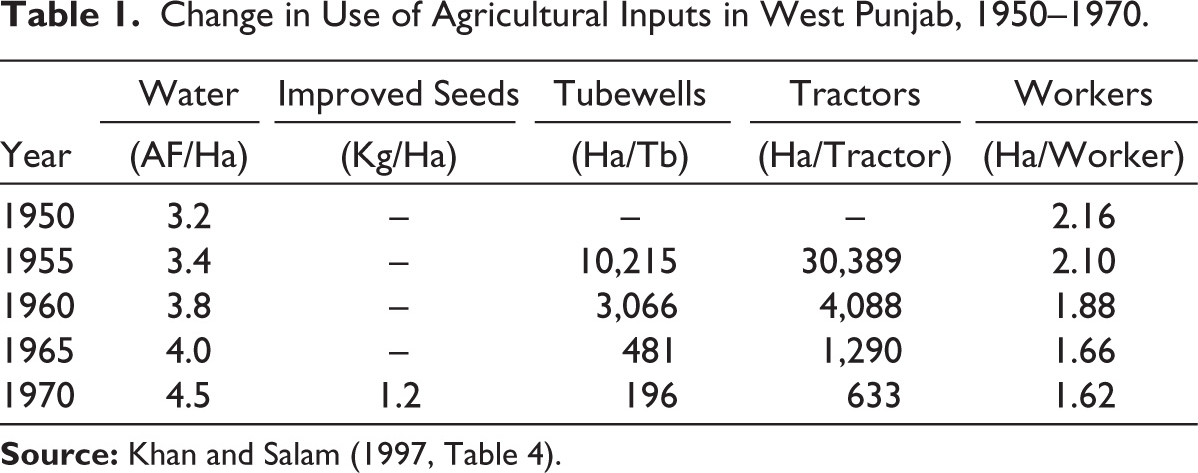
The changes in political economy and political ecology brought by the shift from canals to tube wells played a critical role in forging the PKI’s opposition to removing agricultural tube-well subsidies. The fact that it had happened due to Pakistan’s indebtedness to the IMF and international financial institutions (IFIs) was also critical. The PKI managed to force successive political governments to acknowledge an “agricultural emergency” in the country, with “Kisan Packages” promising subsidies and benefits worth hundreds of billions of rupees to farmers announced almost yearly. 6 Despite the agricultural support packages, the PKI continued to be criminalized by successive governments, with attempts to reach the provincial and federal capital being met with road blocks and arrests. “We were militant. The decision to remove tube-well subsidies hit farmers were it hurts most. Everyone was ready to take to the streets,” stated Chaudhry Ashraf, the PKI-Khokar Arifwala General Secretary (Interview, January 2019). Ashraf himself cultivates around 20 acres of land, which puts him at a larger scale of operation than most of the PKI base. Between 2011 and 2014, the PKI was able to deal with repressive state tactics, including arrests and attempts to cut their electricity connections, through mass mobilization. For a period of three years, dozens of arrest warrants were issued, and hundreds of farmers were arrested at protests, as Punjab’s villages began to become a “no-go zone” for state officials. The PKI managed to instill fear in both elected and unelected state officials. In May 2013, the government finally restored the subsidy on agricultural tubewells after three years of protests by the PKI, which slowed the neoliberal restructuring of agrarian markets. However, as the next section shows, the vagrancies of liberalized agrarian markets present a far more complex challenge for rural movements mobilizing around agrarian reform in the current conjuncture.
Navigating Class and Markets
During the struggle to reduce agricultural tube-well tariffs, the PKI also began to re-position itself as a mediator in the relationship between agrarian producers and agrarian markets. Compared to a clear political position around tube-well tariffs, which represented the shared interests of differentiated agrarian producers, the PKI’s positions on agrarian market reform have been met with resistance from small farmers. This section draws on the mobilizations around the potato price crash in early 2019 to show how the public position of the PKI was challenged by low participation on the part of small and large potato growers due to differential access to capital. Where small farmers had to bear the brunt of the crash by deciding to sell their crop cheap or destroy it, larger growers were able to put their harvest in storage to avoid being seriously impacted by the price fall during harvest.
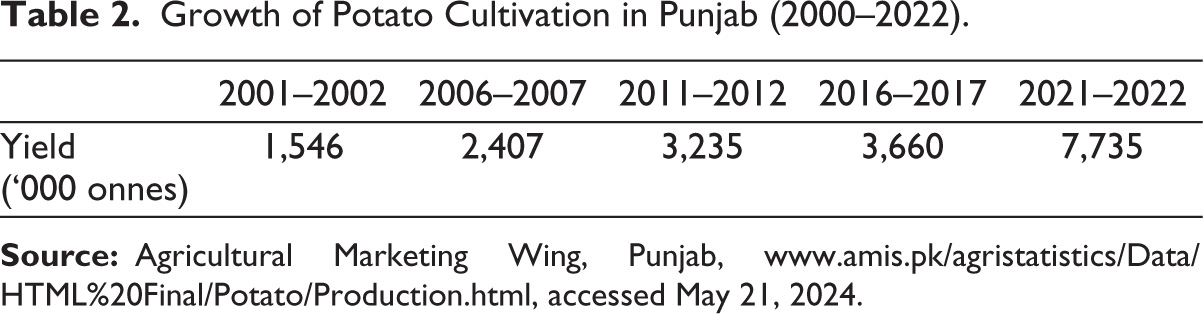
Potatoes have fast become one of the major commercial crops in Punjab, having replaced sugarcane and cotton, which have lost their attractiveness to farmers due to market capture, ecological distress, and disease. Potato prices began to spike around the global food crisis of 2008–2009, when farmers reported making Rs. 200,000 per acre in profits or more. This led to an exponential growth in potato cultivation in Punjab as an alternate commercial crop. The stunning rise of the potato crop over a relatively short period of time itself reflects the critical role played by cash crops in reproduction and accumulation in the Punjab countryside. In this period, large farmers began to shift their cultivation to potatoes, continuously increasing leased-in parcels of lands, while small farmers also began to lease-in small parcels of land to grow the ostensibly profitable crop. Even simple reproduction requires a significant cash influx, which has meant that even small farmers in Punjab have dedicated a part of their produce towards markets. The speculative potato market continues to operate in booms and bursts, which can lead to both small and large farmers losing out significantly. During fieldwork, numerous stories were reported of mid- to large-scale commercial potato growers who had “lost everything” (Fieldnotes, December 2018) due to the high cost of cultivation and highly volatile price of the crop. Despite these stories being heard multiple times across the three districts, potato cultivation has continued to grow spectacularly, doubling between 2016–2017 and 2021–2022 (Table 2).
Growth of Potato Cultivation in Punjab (2000–2022).
During the potato harvest in January 2019, the price of potatoes crashed. Large-scale producers hedged their risk by putting their harvest in cold storage. Small-scale producers could not afford to pay the cost of storage, which meant a choice between selling at a loss or destroying the crop. At the PKI monthly meeting in Arifwala in January 2019, Mohammad, who had cultivated 10 acres of potatoes, explained:
We already borrow money for cultivation each season. How can we borrow Rs. 400 more per bag when the price falls like this? The middlemen will not offer us loans, especially when they know they can force us to sell to them our potato harvest at a low price. They will be the ones making the profits when the prices eventually rise. (Fieldnotes, January 2019)
Potato cultivation is particularly expensive, with the cost per acre ranging from Rs. 80,000 to Rs. 110,000 per acre in 2019, depending on whether land and machinery were owned or leased. In comparison, the cultivation of wheat was costing around Rs. 25,000–30,000 per acre, and maize around Rs. 40,000 per acre. The price offered in the market for purchasing a 120 kg bag of potatoes was under Rs. 600 per bag. With an average yield of around 100 bags per acre, potato growers on average were losing at least Rs. 30,000 per acre if they sold their harvest in the current market.
Back in 2014, the PKI unloaded a truck of potatoes in front of the Punjab Assembly after a march on the provincial capital of Lahore. These protests were directed against the import of duty-free potatoes and vegetables from India, which were cheaper and led to a drop in the price offered for the same crops grown in Pakistan. The PKI had not only demanded that the government stop agricultural trade with India, it also asked for the “same support the Indian government gives its farmers.” 7 Being directed externally, these protests were able to build a broad coalition amongst agrarian producers as well as support from other associations in the agricultural chain, including the Potato Growers Society, Cold Storage Association, Fruit and Vegetable Market Association, and labor groups who picked potatoes. 8 The PKI responded to challenges faced by potato growers by arguing that the state needed to protect national agriculture. There was a contradiction built into the demand: the mega-growth in potato production in Punjab was, in fact, heavily reliant on access to food markets in Central Asia, Southeast Asia, and the Middle East. Potato cultivation in Punjab was not being driven by concerns for domestic food security but was instead aimed at maximizing profits for Punjab’s agrarian producers within globalized food markets.
This positioning has meant that the PKI has struggled to develop a coherent narrative or response to fluctuations in potato prices. This also opened up tensions within the mass base which it failed to address. In late January 2019, the PKI held a well-attended meeting of over 500 agrarian producers at the Railway Ground in Pakpattan to announce protests around the low price of potatoes. Punjab General Secretary Chauhdry Rizwan began to address the gathering: “Our kisan brothers who cultivated potatoes are suffering. The government needs to announce a support price and open trade routes with Afghanistan…” In the middle of the speech, a group of attendees interrupted it to chant “[p]otato growers are not amongst us. They don’t support our protests.” Rizwan responded through advocating for unity, stating that “[w]e cannot break the unity of all kisan. One day, we support them, the next day, they will support us.” The group was unconvinced and began to respond, when another PKI leader from the stage began to raise the slogan “Kisan Ittehad, Zindabad!” (“Long live farmers’ unity”) (Fieldnotes, January 2019). While this could be called the deployment of an “agrarian populist” slogan to address potential conflict between the interests of differentiated growers, the sloganeering did not in fact lead to a resolution of the brewing dissent amongst the ranks of the PKI.
There were three sets of issues. First, there was a divergence in the interests not just of potato growers and non-growers but within the differentiated agrarian producers who grew potatoes. Back in their villages, small- and medium-scale agrarian producers who had grown potatoes shared stories of the losses that they had already suffered, with some already having ploughed over their land with the potato crop inside to save on the cost of harvesting. “The demands of the PKI leadership are too little and too late,” Ahmed said at Dera Bodlan, a colonial-era village around 20 kilometres far from Pakpattan; “[w]e have already suffered losses on this crop, and cannot wait for weeks for prices to recover as the next crop cycle will suffer” (Fieldnotes, February 2019). Another small potato producer, Usman, who had cultivated five acres of potatoes had loaded a truck and sent it to Karachi’s market in search of a better price close to the export market, but only increased his losses on this crop: “[i]t was cheaper than cold storage and I had been told the Karachi market is still offering better rates,” Usman said (Fieldnotes, February 2019). Larger growers, such as Rizwan, had moved their harvest into cold storages, due to the availability of capital, while Pakistan’s ongoing border skirmishes with Afghanistan resolved themselves.
Second, situated in this context, the PKI has failed to present a solution to the potato price volatility issue because it suits some of the largest potato growers in its ranks. During almost a decade of protests around potato prices, the PKI has demanded input subsidies, support prices, stopping agricultural imports, supporting agricultural imports, and enforcing zoning for potato cultivation to stop overcultivation. It claims that these measures are necessary to make Pakistan’s farmers competitive in the domestic and international market. PKI president Khalid Mehmood Khokar told the press “[o]ur agricultural products [are] uncompetitive in the international market due to a high cost of production. We can barely compete with India because of the subsidies and facilities the Indian farmer gets from the government.” 9 India keeps popping up in their discourse as both a competitor that needs to be neutralized and a model that needs to be replicated—ironically, with little recognition of the challenges faced by Indian farmers themselves, until the 2020 Delhi Kisan Morcha forced a slightly more serious reckoning with the fact that perhaps all was not well across the border too.
Third, there was an element of tokenism around the protest plans, which seeped into the strength of the mobilization around the early 2019 protests. After the Railway Ground public meeting, the PKI leadership decided to hold an impromptu rally where they walked around 200 yards to the main road and chanted, “Give us a good rate for potatoes!” for around half an hour. (Fieldnotes, January 2019). A follow-up protest in Lahore was announced in front of the Punjab Assembly, but it was not clear whether there would be much support, and only around 500 protestors arrived at the Punjab Assembly and left without meeting any government officials. One of the PKI leaders stated that potato farmers were not very reliable in protests. The small protests did push the government to announce that it was looking into finding a solution. The PKI announced a second march to Lahore in February, but quickly abandoned it when prices began to rise.
The Ecological Contradictions of the PKI
The PKI has maintained its cross-class rural alliance through addressing the intersection between the agrarian and ecological questions. It advocates state support and technological solutions as the way forward against water shortages. In addition, it plays a critical role in helping its members’ access local electricity and water officials to address any concerns that arise in billing or receiving their share. Its discourse around falling water tables in Punjab takes the shape of a combination of techno-fixes and miracles, which reflects longer-term contradictions between the Punjab farmer and ecological crises caused by intensive farming.
The issues of the cost and access to water have continued to come up in the long history of agrarian politics in Punjab. Agricultural tube wells were introduced in the 1960s as a technical solution to the ecological problems caused by the canals, which were rendering large tracts of land unfertile due to water logging and salinity. This meant that farmers were allowed to install and operate tube wells at highly subsidized rates to reduce the water table. Agrarian producers were aware that ground water could not replace canal water, which brought with it a new layer of fertile topsoil and reduced the need for fertilizer use, but tube wells offered flexibility and access to “unlimited” groundwater, which suited the high-yielding seed varieties introduced in this period. The consequence of decades of unchecked tube-well use was that groundwater levels began to fall drastically due to overextraction.
In the Sahiwal division, ground water levels are falling in every village. New tube wells are being constructed to replace old ones which have been rendered useless due to the falling water table. In one village, Chak Jaffar Shah, the old tube well from the 1970s, already re-dug several times, was no longer viable and was being replaced by a turbine. Over the last four decades, water tables have fallen from 30 to 50 feet underground to over 350 feet underground. “The deeper the water extracted, the more saline and contaminated it is. But with canals so unreliable, what choice do we have but to dig deeper for water,” narrates Abdullah, a member of the PKI-Gujjar from Chak Jaffar Shah (Fieldnotes, March 2019). The deeper the well, the higher it costs to dig and install a motor strong enough to pump water up. This consumes more power, and more power means a higher variable cost.
The expansion of tube wells across the region has been key in the depletion of the Indus Basin’s aquifer. Seepage from the canal system means that groundwater levels remain in a precarious balance: either rising too much (from the 1900s to 1970s) or falling significantly (from the 1980s to now). The PKI’s membership consists of agrarian producers who have relied on the tense relationship between modern hydrology, canal water, and groundwater. Multiple arrangements for building and operating tube wells have emerged. In villages where landholding sizes are relatively small and leasehold farming has not become dominant, it is common to see tube wells that are collectively owned and operated with mutually agreed timetables. On lands operated by large landowners or large leasehold farmers, there can be over a dozen tube wells owned and operated by the same farmer. There are many arrangements in the middle, for example, where small farmers are allowed to use the tube well owned by a larger farmer for a fee or by agreeing to use their own diesel.
The future of water in Punjab is critical to the PKI, which came together around tube wells. In its public meetings, agrarian producers consistently bring their electricity bills to understand and push for problems within them to be resolved. It is quite usual for the PKI leadership to go to electricity officials after a public meeting and raise concerns about the bills received by farmers. In February 2019, the PKI announced its opposition to a newly applied motor tax on tube-well operations, which it promised to oppose with street force (Fieldnotes, March 2019). However, it does not provide a solution to the threat posed to agriculture in Punjab by the depleting water table. In the March 2019 meeting at Pakpattan, Chaudhry Rizwan announced that the PKI leadership was negotiating with the “irrigation department and district management to desilt the canals,” which would both increase the availability of canal water and also increase groundwater recharge for tubewells (Fieldnotes, March 2019).
In the same meeting, the challenges of digging for groundwater came up repeatedly, which included an aged farmer, Tufail, talking about the “miraculous” sprouting of water when all hope had failed:
My crops were rotting after my tube-well stopped pumping water. I decided to install a turbine. Labourers came and dug a well that was 400 feet deep. There was still no water. They dug a deeper well, but there was still no water. I had already spent over Rs. 300,000 digging wells. I asked them to dig another well. No water came out again. People told me that my land had been cursed. Then, I decided to sit near the well and pray all night. In the morning, I was woken up by one of the labourers who said water had begun to flow from the well. This was a miracle.
Tufail raised parallels with the miraculous sprouting of water in his land to the story of how water sprouted from the Arabian desert for the Prophet Abraham, his wife, and child in the middle of severe distress. The 400-strong audience of farmers heard the story with mixed levels of attention. Many continued to chat amongst themselves. There were no claps as Tufail left the stage, but there were a few “mashallah” (Praise Allah) from the audience (Fieldnotes, March 2019).
Tufail’s narrative captures the growing groundwater crisis where tube wells are in fact a poisoned chalice. Agrarian producers are forced to reckon with groundwater depletion when their tube wells run dry. One mid-scale farmer, Bilal, at the meeting told me:
Whis is an issue that all farmers are facing. We need our tube-wells to work because we cannot rely on canal water anymore, but every few years, we need to re-dig the tube-well, because the water level has fallen. Even then, you can’t be sure that the water is going to be useable. Most of the groundwater in this area is saline and is not suitable for farming, but we make do with what we can get. (Fieldnotes, March 2019)
Ground water and soil depletion are serious issues. Much of the agrarian practices in the region developed in the colonial period when water was plenty and high-water usage through the canals was actively encouraged for revenue purposes. This was then followed by three decades from the 1960s onwards when the Pakistani state, with World Bank and USAID support, actively encouraged the installation and use of tube wells. Groundwater depletion in this period was considered a good thing, even if it meant using more water than was essential for healthy crop growth. The PKI understands the link between groundwater and surface water, but it remains wedded to techno-fixes: replenishing canal water will be enough to solve the ground-water crisis, and the tube wells need to be kept functional. The “miracles” of water sprouting on Tufail’s land will stop occurring if the contradictory relationship of the Punjab farmer to the ecological reproduction of the agrarian landscape of Punjab is not addressed directly.
“Prosperous Farmers for a Prosperous Pakistan”: The National and Agrarian Question in the PKI
Developing a politics around the intersection of the agrarian, ecological, and national questions has been crucial for the successes of the PKI. It has also failed to gain support from differentiated agrarian producers when it has been unable to address these questions for them. Having faced a significant economic burden due to IMF dictates and the removal of tube-well subsidies, the PKI continues to articulate that it stands for an alternate vision of national development. While this might be dismissed as “populism,” it is important to pay attention to these narratives in a context where all mainstream political parties have been promising to implement the IMF’s agenda of liberalizing all markets more fully. Grounded in the ecological and economic contradictions of the neoliberal period, the PKI articulates a place for post-Green Revolution farmers in the national development of Pakistan.
Instead, the PKI presents an alternate path: supporting commercial farmers can lead Pakistan out of debt dependency and towards development. It remembers the threat posed by national debt on reproduction and accumulation across agrarian classes. The PKI presents farmers as a pillar in national development, and successful agrarian accumulation as a solution to the transnational debt crisis. This envisions a crucial role for the state in supporting farmers and navigating constraints such as price collapses, access to capital, ecological distress, and technological change. In lieu of these, it asks the government to provide subsidies, support modern agricultural research, and reform agricultural markets in favor of farmers.
In a context where there are no other popular movements
10
to consistently mobilize against the debt-driven restructuring of the Pakistani economy, the PKI must be seriously and critically engaged with as offering another path to national development. At the Pakpattan meeting in March 2019, Pakpattan president Chaudhry Sabir articulated this vision well:
Fifteen years ago, each Pakistani had Rs. 15,000 per person debt. Now, it is Rs. 100,000 per person.
11
If farmers are supported, if they get the fair price for their produce, then Pakistan will be able to eliminate its debt problems and its economy will grow. (Fieldnotes, March 2019)
Key members in the PKI vocalize the loss of sovereignty over economic policy due to the country’s indebtedness by invoking the struggle against the tube-well subsidy removal and raising concerns about new taxes being imposed by the government due to foreign imperatives.
The PKI has also advocated for modern research into seeds and technologies conducted by state and non-state enterprises in Pakistan. “We are a unique movement. The PKI even protested in Islamabad in 2015 12 against moving the National Agricultural Research Centre and stopping the sale of some of its unused land,” says Chaudhry Rizwan (Fieldnotes, March 2019). The PKI leadership consistently talks about the need for agricultural research, bringing advanced seeds, and supporting the technological advancement of agricultural practices in the country. “One of the major reason’s Pakistan’s farmers are not doing well is the lack of agricultural research. We don’t get the latest seeds or technology. BT cotton in Pakistan has failed because we only introduced the oldest variety,” said Chaudhry Rizwan during a meeting at the Arifwala Townhall in March 2019 (Fieldnotes, March 2019). It also organizes sports festivals, such as kabaddi festivals, in collaboration with seed and fertilizer companies. The PKI has also organized protests to ensure that state-led agricultural research continues uninterrupted. Rather than teaming up with transnational seed companies, the PKI positioned itself in favor of private and public seed research in Pakistan, and offered to collaborate on creating seed demonstration farms with advanced research.
The PKI has also advocated for state interventions within agrarian markets that “benefit” most agrarian producers. The PKI’s overall vision for agrarian markets continues to advocate subsidies and support prices, as well as protecting and supporting farmers within international food markets. In district food markets, the PKI has protested against open bidding and for the appointment of small farmers to district agricultural market committees outside the offices of the district commissioner. These effectively constitute interventions that contest the flows of agrarian surplus in the existing agrarian political economy and advocate for a greater share by farmers instead of traders and the food processing industry.
Some elements of the PKI’s articulation of the intersection between agricultural and national development seem incomplete. Does it want open borders or closed borders? Does it want support prices or open pricing? Should there be zoning of particular crops or not? The PKI has changed its position on these questions depending on circumstances, as has been discussed in the sections earlier. It is also important to recognize that it is a movement of agrarian producers that survived the mass dispossession of the colonial period, the Partition, Green Revolution, and the subsequent removal of supports and subsidies for agriculture in the neoliberal period. It is certainly not a movement of landless agricultural workers, dispossessed former peasantries, or even small-scale cultivators today. Thus, its position on the intersection between the agrarian and national questions reflects these limitations and is certainly not presented as a panacea. This does not mean that its position on agricultural research, market reform and on creating a sovereign path of development cannot offer key insights for those looking to understand the political agrarian question and its intersections with the ecological and national questions in the Global South today.
Conclusion: Contradictions and Synergies in the AQ, NQ, and EQ
Focusing on the specific interventions of the PKI within concrete agrarian class relations, political-economic changes, and ecological transformations allows us to gain a better understanding of contemporary farmers’ movements. Writing about the 1980s wave of farmers’ movements in India, Banaji (1994) articulated that “the farmers” movements are essentially conservative movements that seek to reinforce the existing property relations and consolidate a broad-based and diversified rural capitalism where rural industrialisation is not left to the large business groups” (Banaji, p. 239). This article hopes to have shown that farmers’ movements facing liberalizing agrarian markets, ecological distress, and a national developmental crisis in South Asia cannot simply be dismissed as conservative. In a changed rural landscape after the Green Revolution, progressive agrarian politics will need to engage with these serious questions. The agrarian, national, and ecological questions are very much entangled today, and the success of contemporary movements, much like older left-wing agrarian movements in Punjab, lies in addressing the relationship between agrarian and national development (Rashid, 2023).
This does not mean that the PKI adequately addresses these questions. Instead, this is meant to caution against the expanded use of the “agrarian populism” framework, which can lead to one-dimensional readings of agrarian movements based on their class composition. Instead, by taking seriously how the PKI interfaces with the agrarian, ecological, and national questions, the hope is to develop a sustained critical engagement with how agrarian movements in the Global South are engaging with the structural reform of agrarian markets, trade, access to technology, seeds, water pricing, water usage, debt, and the trajectories of national development. These engagements by mass-based movements need to be taken seriously to understand the political agrarian question of our times.
Engaging with how contemporary movements interface with agrarian markets, ecology, and national development can allow for a closer reading of their strengths and weaknesses. In the face of an ecological crisis, the PKI’s vision for the challenge to agrarian reproduction remains limited to techno-fixes. The growing adoption of solar technologies for powering agricultural tube wells across field sites has taken the political edge out of the original unifying question of electricity prices. This has also increased the exploitation of the water resources of the Indus aquifer. While this is unlike other South Asian movements which advocate “peasant agroecology” and a more harmonious relationship between ecologies and agrarian practices, the PKI’s position reflects the contradictions of Punjab’s integration into the global agriculture and food markets through colonialism in the late nineteenth century.
The PKI has raised the question of national sovereignty over agricultural policy, technology, and trade. Despite the contradictions within these positions noted earlier, engaging within movements like the PKI opens up room to understand how politics is being shaped by the complex interaction between ecological crisis, transnational debt, and neoliberal reform. In its early period, the PKI succeeded in allowing differentiated agrarian producers to demand reform and restructuring of agrarian markets to support their interests, and present an alternate trajectory to development that prioritizes national interests over transnational creditors. Its failure to address the agrarian, ecological, and national questions together reflects some of its class and ideological limitations. The PKI’s inability to consistently address the concerns of its differentiated class base has weakened it significantly in recent times. The PKI has mobilized countrywide protests in May 2024 around the fall in wheat prices, which, unlike potatoes, are protected by support prices and government procurement. 13 The ongoing wheat import scandal could unite farmers in Pakistan once again. 14 Even if it fails to do so, the PKI’s ongoing mobilizations continue to show the continued existence of co-related political agrarian and national questions.
Footnotes
Declaration of Conflicting Interests
The author declared no potential conflicts of interest with respect to the research, authorship and/or publication of this article.
Funding
The author received no financial support for the research, authorship and/or publication of this article.