




Abstract
The intervention of popular forces—what Marx termed the “sixth” great power among the five European “great powers” of his time—remains fundamental to the current systemic transition. This article seeks to clarify the evolving character of the contradiction between imperialism and the working people of the Third World. Drawing on Samir Amin’s notion of “polycentrism,” it is argued that the current transition, marked by the protracted decline of the capitalist system, still presupposes “delinking” from the worldwide law of value and the forging of sovereign development paths on a popular basis. Such a transition can only be fulfilled by the intervention of workers and peasants in the peripheries of the system. Key elements of the current systemic rivalry are discussed to illuminate the challenges, with special focus on the expansion of labor reserves and the character of peripheral social formations today.
Introduction
The history of the twenty-first century accelerates with every passing month and year. Systemic rivalry has entered a new phase with the outbreak of war in Europe and the genocide in Gaza. There is now much speculation and apprehension over the direction of change and the character of the emerging order. Our task remains to sharpen our tools of analysis so that the transition to an alternative system may be properly illuminated.
We must recognize, first and foremost, that the historic contradiction between imperialism and the working people of the Third World remains the principal contradiction. Whatever speculations there might be over “multipolarity,” this principal contradiction has not been overcome. But, of course, both aspects of this contradiction have continued to evolve. Monopoly capitalism in its collective imperialist form has been in permanent crisis since the mid-1960s, and since then has become generalized, globalized, and financialized (Amin, 2019; Yeros & Jha, 2020). This systemic crisis is accentuated by the rise of China and a new array of anti-imperialist alliances. The matrix of resistance, nonetheless, consists in the workers and peasants of the Third World who constitute the popular basis of sovereignty while also the world’s growing labor reserves.
Peripheral social formations have obtained distinct characteristics with the massive growth of labor reserves beyond any historical precedent. These reserves are concentrated in the South and, contrary to what might have once been expected, they are not transitioning to a fully proletarianized workforce. The overall trend is toward a condition of generalized semiproletarianization, an enduring phenomenon and determinant of the character of entire social formations (Yeros, 2023). One key feature of these social formations is advanced social polarization and a deep crisis of social reproduction. A related feature is the insurrectional politics which they generate. Over and over again, we have witnessed social upheavals striking like lightning bolts from one region to the next, but which are, on the most part, weak in ideological orientation and political organization.
We may confidently speak of a world pre-revolutionary situation (Yeros, 2021a, 2021b). As argued before (Yeros, 2021b, p. 26), “[w]e can be certain now that mass mobilizations and serial insurrectional outbreaks will occur throughout this decade and that they will amount to much more than a passing phase of social unrest.” We have witnessed at least two revolutionary situations over the past 25 years, in Zimbabwe and Venezuela, and others are today unfolding in the Middle East among the Axis of Resistance. The armed insurrection in Gaza, more than any other, has epitomized the nature of this historic contradiction today. To be sure, the maturity of revolution is uneven from one country or region to the next. But the objective conditions are essentially shared in the Third World and political synergy operates on a world scale.
The current systemic transition is commonly being perceived as a move from “unipolarity” to “multipolarity.” Such terms have entered our political lexicon, but it is not entirely clear what they mean to us. They require adaptation, if they are to be deployed for our purposes. Whichever terms are preferred today, the real task is to operationalize what Samir Amin conceived as a transition to “polycentrism” by means of national and regional “delinking” (Amin, 1980, 1987, 1990). More than a fight among “great powers” for world supremacy, polycentrism envisions sovereign and popular development for the nations and regions of the Third World, in the transition to socialism. Delinking entails the separation from, or suppression of, the worldwide law of value dominated by collective imperialism, for the purpose of forging autonomous development paths on a popular basis.
The notion of “great power politics” among multiple competing states predates the rise of imperialism under monopoly capitalism. Presuppositions about such politics informed European rivalries and their outward expansion at least since the seventeenth century. However, it was in the twentieth century, during the Cold War, in the hands of the US political science, that such a notion gained theoretical attention on the basis of specific philosophical claims and scientific ambitions concerned with governing the relations among “great powers” (Mearsheimer, 2001; Morgenthau, 1948; Waltz, 1979). Its priorities lay with the “national interest” in a state of “anarchy,” seeking either a “balance of power” among the bigger players or “revision” of their relations.
The limitations of such thinking, whether as diplomatic convention or imperialist pseudoscience, are self-evident. They were noted long ago by Marx when “five great powers” vied for supremacy. What really counts, Marx affirmed, is the “sixth” great power, the revolutionary proletariat. Thus, he wrote in February 1854 (Marx, 1953):
[…] we must not forget that there is a sixth power in Europe, which at given moments asserts its supremacy over the whole of the five so-called “great” powers, and makes them tremble, every one of them. That power is the Revolution. Long silent and retired, it is now again called to action by the commercial crisis and by the scarcity of food.
We intend to draw on the notion of “polycentrism” bequeathed by Amin to illuminate the systemic transition from capitalism to socialism. Amin went so far as to rewrite the entire history of transitions among modes of production and grapple with the challenges of peripheral social formations under capitalism (Amin, 1976). Our point of departure, as per Amin, is the protracted decline of the capitalist system in its obsolescent monopoly stage (Amin, 2003; Yeros & Jha, 2020). Under such conditions, the systemic transition still presupposes delinking from the worldwide law of value in the interest of workers and peasants in the peripheries. This ultimately must be our measure of transition.
The key elements of the current systemic rivalry will be discussed below, as well as the challenges of the transition to polycentrism. Special attention will be given to the growth of labor reserves and the resulting social formations in the peripheries, which are as much the source as the measure of systemic transition.
On Systemic Rivalry: Who Won the Cold War?
The collective imperialism of the Triad (United States, European Union, Japan) evolved after World War II (WWII) under the leadership of the United States to provide strategic coherence to the expansion of monopoly capital against the East and South. Its purpose was to defeat all obstacles to monopoly capitalism, whether socialist or nationalist, including the Soviet system and the emergent Third World. This was the essence of the systemic rivalry of the Cold War (Amin, 2003; Moyo & Yeros, 2011). Its origins are to be found in the two great anti-imperialist events of the twentieth century: socialist revolution and national liberation.
It is conventionally held, based on the theory of “polarity,” that this was a “bipolar” world with an added nuclear component. US strategists were either willing to find “balance” in this scenario, or otherwise push toward the total defeat and dismemberment of the Soviet Union. The Soviets knew full well what was at stake, having been invaded by multiple armies after the October Revolution and then made the ultimate sacrifice in WWII to defeat the invading Nazi army. However, the Soviets, too, once victorious, came to preach balance as “peaceful coexistence” between the “two systems” during the Khrushchev years. At that time in the 1950s, neither the Americans nor the Soviets were inclined to see any competition other than their own.
Nonetheless, this view was shattered at Bandung when the erstwhile colonial subjects, as independent nations, resolved to make their own stand in the interest of their own people. The Third World thus came into existence among ex-colonial, underdeveloped, and oppressed peoples as a political project of national liberation, solidarity, development, and world peace. The advance of national liberation movements in the Third World transformed the world into a three-way systemic rivalry whose motive force was precisely the principal contradiction between imperialism and the oppressed peoples of the Third World. In other words, the contradiction between imperialism and anti-imperialism was much broader than what notions of “bipolarity” would admit, as national liberation struggles became the actual driving force of postwar systemic rivalry. They found in the Soviet Union a systemic counterweight to imperialism, if not also direct support, while the logic of the East–West conflict itself became imprisoned in the liberation struggles of the peripheries. It is no coincidence that the most dangerous nuclear confrontation of the Cold War took place on account of the Cuban revolution.
It has also been said that the West “won” the Cold War. Triumphalist neoliberals in the 1990s took the lead to posit the “end of history.” The most notorious was Fukuyama (1989), who envisioned the final and permanent victory of capitalism and liberalism over any other historical contenders. Their “realist” alter egos meanwhile contemplated the ways and means of a “unipolar” world: Was it a “moment” or a “structure” (Layne, 1993; Wohlforth, 1999)? Was it bound to regress to “multipolarity” (Waltz, 2000)? Was it natural to seek balance or maximize power (Mearsheimer, 2001; Snyder, 2002)? Still others declared their angst about the “imperial overstretch” of great powers or their “clash” with non-Western civilizations (Huntington, 1993; Kennedy, 1987).
One of their great feats was to impose their concepts on us. Not only did they spread their neoliberal and culturalist theories, but increasingly also theories of “polarity” and “geopolitics.” They found interlocutors in theorists of “hegemony,” whether of “Gramscian” or “Hobbesian” persuasion, for whom every world historical “cycle” required, not a club of great powers, but one single “hegemon” to lead it, in the absence of which “chaos” would be prevail (Arrighi & Silver, 1999; Gilpin, 1981). To this day, these highly ideological formulations obscure much more than they reveal (Yeros, 2021a).
The fact remains that there was no clear Western victory in the systemic rivalry of the Cold War. What happened after the 1960s was a retrograde attempt to rescue collective imperialism from its permanent decline. Financialization, re-dollarization via the oil market, new waves of capital exports, military escalation, and technological leaps relaunched collective imperialism. Certainly, this revenge consolidated the neocolonial transition of the countries of the Third World and pushed the Soviet system beyond its limits, the two being closely positioned in the correlation of forces. Yet, it would be more appropriate to see in this late phase of neocolonialism a long impasse in the systemic transition. For the basic contradictions of monopoly capitalism were never resolved; and financialization, capital exports, and militarization, despite the technological leaps involved, all become elements of secular decline.
The net balance of the Cold War was not entirely in favor of imperialism. Despite sealing the neocolonial transition, with the notable exception of China, the relaunch of collective imperialism did not reverse decolonization. That is, it failed to overthrow the generalized system of national sovereignty obtained by the peoples of the Third World with the help of the Soviet Union. Even after almost half a century of neoliberalism, the national sovereignty regime has not been suppressed or overcome. To be precise, the regime of national sovereignty is in a process of degradation (Moyo & Yeros, 2011; Yeros & Jha, 2020). It results from constant imperialist aggression and deep social crisis, evident most clearly in the gigantic growth of labor reserves. This has created conditions for the emergence of neofascist forces from within and has even produced new semicolonial situations in a series of countries that have succumbed to imperialist invasion and territorial fragmentation. However, the point remains that the general regime of national sovereignty has not been overthrown to this day, and this is a sacrosanct victory of the peoples of the Third World.
Nor, for that matter, did the end of the Cold War put an end to the communist movement, despite the collapse and dismemberment of the Soviet Union. The communist movement retreated, but it also underwent transformations to the point of making a spectacular comeback, especially in China. The most important development experience unfolding without major interruption over the last 70 years has occurred under the leadership of a Communist Party, transforming China into the major contender against collective imperialism. We will return to this point. Suffice it to pose the obvious question once again: Is it still possible today to say that the West won the Cold War?
It would be more accurate to say that the impasse of late neocolonialism is being challenged by the renewed advance of anti-imperialist forces from various directions, which this time find a counterweight in China. Thus, a simplistic analytical focus on “great powers” remains unhelpful. Nationalism in the peripheries has been radicalizing; and China’s trajectory has remained closely linked to the Third World. We may even be more emphatic: the future of China, like the Soviet Union before it, will depend on its relationship with the Third World and on the fate of the latter. As Amin (2013) warned, China could still fall into the imperialist trap if it does not deal properly with its internal and external contradictions; to avoid the trap, China must, in his words (Amin, 2013, p. 14),
tenaciously pursue the objective of reconstructing a polycentric international political system, respectful of all national sovereignties, and, to this effect, act to rehabilitate the United Nations, now marginalized by NATO… [This] entails the priority of reconstructing a “front of the South” (Bandung 2?) capable of supporting the independent initiatives of the peoples and states of the South.
The transition to an alternative system can only mean the breaking of the current neocolonial stranglehold so that delinking can become a generalized possibility for the countries and regions of the Third World. China can go a long way to unhinge economic relationships from the existing “dollar-finance-oil” nexus via new strategic partnerships.
However, an alternative monetary, financial, and commodity nexus will not in itself determine the content and course of delinking among the working peoples of the peripheries. It must be remembered that during the whole of this current phase of primitive socialist accumulation, which China has undergone, the labor reserves of the Third World have continued to expand. The rise of China and the rise of the Third World are not automatically in a positive relationship. Nor can the positive potential of this relationship be postponed to a later date. The stakes for the Third World are even higher today, given that global warming has accelerated and climate change will take its greatest—indeed, catastrophic—toll on working people located in the massive labor reserves concentrated in the tropical and semitropical regions. This makes the transition to polycentrism an urgent and existential matter, requiring the intervention of none other than the working peoples of the Third World.
The Resumption of the Cold War
The systemic contradictions that led to the long neocolonial impasse are now intensifying. If the emergence of China is the force that took the most effective advantage of the decline of collective imperialism and undermined the economic infrastructure of late neocolonialism, NATO’s (North Atlantic Treaty Organization) violent confrontation with Russia in Ukraine and the armed insurrection and genocide in Palestine are a turning point. Overall, the infrastructure of neocolonial rule is under severe pressure.
China’s New Great Leap Forward
The correlation of forces of the systemic rivalry has obtained characteristics quite different from those of the twentieth century. The fall of the Soviet Union has been superseded by the rise of China which has been treading on the Triad’s very own terrain of trade, finance, investments, and technology. Recall that the Soviet Union did not have substantive economic relationships with most of the Third World, the notable exceptions being China in the 1950s, India and Egypt after Bandung until the 1970s, and post-revolutionary Cuba until the Soviet Union’s demise. Overall, the weight of the Soviet Union’s relationship was on political-military assistance in national liberation struggles. China, by contrast, has inverted the priorities by placing investment and trade at the forefront of its relationships. China has become the main trading partner of every single country in the Third World almost with no exceptions. In this sense, the world economy has transitioned to a China-mediated trading system.
The success of China in repositioning itself in the international division of labor in such a way, developing the forces production under a sovereign planning system, and the lifting of its people out of poverty is the greatest feat of any Third World country. That this has occurred under dollar dominance and military encirclement is also the greatest threat to imperialism (Kadri, 2021; Sit et al., 2013; Wen, 2021). China has used to its advantage the permanent crisis of monopoly capitalism by opening its borders to the Triad’s multinationals, exporting industrial commodities to satisfy the West’s consumption needs, and recycling its surpluses back to the latter’s capital markets. However, it has also raised the possibility of undermining the Triad’s centralization and concentration of capital that sustains imperialist rent. This is the real threat to imperialism.
The question of how China has done so is subject to controversy. What is certain is that imperialism recognizes the vitality and resilience of the Chinese system with utmost concern, even if it does not praise it. China has integrated itself into the world economy while leveraging institutional innovations in its central planning system to shield itself from the worst consequences of integration and maintain its own development agenda. It is the country that has navigated the challenges of economic transformation with the most clarity, innovation, and agility, without giving up the essential gains of the revolution, especially in its agrarian and state sectors, which remain fundamental to China’s trajectory (Wong et al., 2020). China has operationalized in its own unique way the original meaning of “state capitalism” (Lenin, 1965), in the form of “socialism with Chinese characteristics,” and reaffirmed that capitalism can only function for the benefit of the people of the peripheries under the control of a revolutionary force which the Communist Party embodies.
One of the most basic features of China’s sovereign development strategy, as Wen (2021) has demonstrated, has been its ability to absorb shocks and diversify economically within the institutional contradiction of its dual urban–rural structure inherited from the Revolution. In Wen’s words (Wen, 2021, p. 14):
[i]n terms of social stabilization, Rural China (comprising three irreducible dimensions: the peasants, the rural areas and the agriculture, known as the “sannong,” the three agrarian sectors) has played an important role as a shock absorber to the cyclical economic crises (approximately one in every ten years) caused by urban industrial capital in the last 70 years. This has been the case especially in the last 40 years of reform, which has seen China turning crises into opportunities.
Since the reforms, the rural areas have undergone decongestion by the transfer of 400 million working people to urban areas in an orderly manner. This in itself has been an extraordinary feat that has presented new opportunities for economic transformation and absorption of the workforce into new industries and services.
Yet it has also presented new challenges for the agrarian sector and the country’s ability to absorb shocks. 1 These are now the new contradictions to be resolved, as envisioned by the Party in the policy of rural revitalization. Although China has fared markedly better than any other country, it has not been spared of the more general expansion of labor reserves (Jha & Yeros, 2023a; Prasad & Yeros, 2024), as we will see in the next section. Nor has it evaded the phase of productive overcapacity and the rise of high finance alongside the formation of labor reserves. It is under these conditions now that the new rural–urban contradiction will weigh on China’s ability to maintain its orientation against imperialism and its external policy toward the Third World.
The question facing the current systemic rivalry is tied up with the future of China’s economic relations with the Third World. This most recent round of primitive socialist accumulation has had a global dimension, also unlike anything we have seen before. The least that can be expected is what is currently pursued. China must continue to circulate its surpluses via the Belt and Road Initiative, alongside its other strategic initiatives, such as the BRICS, the Asian Infrastructure Investment Bank, and the Shanghai Cooperation Organization; build new and modern infrastructure in the South; share advanced technologies; and plant the seeds of peripheral industrialization. This strategy has already been shifting the correlation of forces, mainly in Asia, but also in the other regions of the South.
Yet, this will not be the decisive strike against the neocolonial system. The decisive strike will not come from China, but from within the rest of the Third World itself. China will not single-handedly displace the worldwide law of value to the point of favoring widespread capitalist peripheral industrialization, nor will it suppress the law of value outside its borders to produce public utilities sufficient to the task of addressing the grave crisis of social reproduction faced by working people. The polycentric transition will not depend on China alone, just as national liberation did not depend on the Soviet Union.
Such an assessment has been once again confirmed by recent events that have accelerated the systemic transition, namely the outbreak of war in Europe and the insurrection and genocide in Palestine.
Outbreak of War in Europe
Russia, as the main heir to the Soviet Union—integrating a large part of its territory, its people and its memory, and benefiting from its technological capacity, energy resources, and nuclear energy—has remained a key obstacle to NATO’s expansion. The focus of the dispute returned to Ukraine, which has always been of superior strategic value in the designs of NATO, as of the Nazis before it. Ukraine’s transformation into the spearhead of imperialism, and Russia’s resistance, has marked a major escalation of systemic rivalry given that NATO’s object has been none other than Russia, a fellow Permanent Member of the Security Council of the United Nations.
It remains important to grasp the nature of this conflict. NATO’s instrumentalization of Ukraine was anything but an exercise of sovereignty by Ukraine. Recall that national self-determination is, above all, an anti-imperialist formula for the exercise of popular power (Lenin, 1972). The instrumentalization of Ukraine through a coup, the promotion of neo-Nazi forces in the state apparatus, its tutelage by NATO, and the launch of a war against Russian ethnic minorities in the east of the country, in Donbas, was precisely an act of liquidation of sovereignty. Ukraine plunged into a simulated semicolonial situation without being directly occupied and divided but nevertheless reprogrammed to launch a war against itself and to point offensive weapons at neighboring Russia. Any further attempt to incorporate the country into NATO, with troops and missiles on the border, was obviously a casus belli for Russia. Russia had the right to intervene.
This crucial intervention was carried out against a consolidated NATO-Neonazi Axis. Over the past two years, a horrific war has been fought at the expense of the Ukrainian people and the youth on both sides recruited into the war. Far from its supposed liberal ideals, NATO has shown once again that it has no qualms about supporting Nazi forces outside its borders, whatever the human cost, and sponsoring wars overseas, by raising the stakes with ever-increasing budgetary allocations and transfers of heavy weaponry. NATO also doubled the size of its land border with Russia with Finland’s entry into the alliance in April 2023. An extensive front against Russia has thus taken shape once again with a supremacist ideology. NATO’s capacity for provocation and escalation of conflict is a given, even if there is currently evident exhaustion with the war.
The role of economic resistance on the part of Russia is also notable. In addition to blocking NATO’s military advance, it has also successfully confronted the unilateral sanctions regime, safeguarding its currency and establishing new trade partnerships. Moreover, the heavy sanctions imposed on Russia and the freezing of 300 billion of its dollar assets have reinforced Russia’s convergence with China and Iran. Such a strategic partnership today has presented new possibilities for economic relations and the oil trade outside the purview of the dollar and Wall Street—that is, outside the operational mechanisms of the unilateral sanctions regime. These fissures also promise to expand the space for maneuver for the Third World in terms of finance, trade, investment, and technology, especially those under sanctions.
However, a caveat is in order. The war in Ukraine has also served as a tragic warning about what happens when a more vulnerable country is unable to sustain a policy of positive nonalignment toward states that are more capable of defending their strategic interests. After all, this was the most important historic lesson of Bandung: the reason for positive nonalignment was precisely the preservation of weaker states against their own incineration in a conflict among the bigger powers.
Insurrection and Genocide in Palestine
If the war in Ukraine is an extension of the East–West dimension of the Cold War, the war in Palestine, which broke out on October 7, 2023, is the essence of the enduring North–South conflict. This is a classic situation of settler colonialism sponsored by imperialism, one of the last unresolved colonial questions of the previous century, and the most consequential for the systemic transition in the twenty-first. The Zionist state never retreated from its essential function, which is to dominate the peoples of the region, degrade their sovereignties, and control energy resources and trade routes.
The genocide against the Palestinian people is clear proof of the barbarism of collective imperialism led by the United States and the fascist nature of its strategic aims. We have witnessed declared ethnic cleansing against a people under occupation, perpetrated by the Zionist state and supported by the United States, the United Kingdom, and the European Union. As of the beginning of January 2024, at the time of South Africa’s recourse to the International Court of Justice for the crime of genocide, over 23,000 Palestinians had lost their lives in the three months since the insurrection of October 7, 70% being women and children, over 50,000 sustained injuries in the bombings, and another 7,000 disappeared under the rubble. If there were still any doubts about the civilizational character of the West, they turned to dust in the bombing of Gaza.
The armed insurrection in Gaza, on the back of the Ukraine war, effected a qualitative leap in the polarization between North and South. It intensified the world’s principal contradiction when no other effective action to resolve this colonial question or defend the peoples of the region was being pursued outside the Axis of Resistance underpinned by Iran. Other semi-peripheral powers, such as those in the region that have sought closer relations with China via the BRICS, namely Saudi Arabia, Egypt, and United Arab Emirates, have effectively pursued a policy of “multi-alignment” in the course of this systemic rivalry—a very different policy from positive nonalignment. By multi-alignment, they have remained within the military bloc of the West and even moved to normalize relations with the Zionist state, while inaugurating new economic and political relationships with the East, including China, Russia, and Iran.
As such, the insurrection in Gaza is an indication of how the current systemic rivalry is likely to evolve: while the semi-peripheral powers seek to play in all directions on the global chess board in this new phenomenon of multi-alignment, the working people of the Third World, trapped and asphyxiated in labor reserves, will rebel and force the systemic transition forward. The insurrection in Gaza is the quintessential intervention in our time of Marx’s “sixth” great power.
What Are the Limits of Collective Imperialism?
The main strategic alliance organizing monopoly capital in its phase of generalization, globalization, and financialization is NATO. NATO has maintained its effective cohesion and its insistence on expansionism and aggression, given that NATO’s sole purpose has always been the destruction of the obstacles to monopoly capitalism. After the collapse of the Soviet Union, the alliance devoured Eastern Europe and expanded its operations into Africa and Asia. Apart from the US military bases maintained in Japan and South Korea and other countries in the East, a new security pact has now been forged by the United States with Australia and the United Kingdom (AUKUS) to include a nuclear component, coupled with the expansion of US naval presence in the South China Sea and the military buildup in Taiwan. This is threatening to turn Taiwan, which has extensive economic relationships with both China and the United States, into another Ukraine. Respect for the One-China policy, which has hitherto been the cornerstone of US–China diplomatic relations, has been all but abrogated.
The contradiction, nonetheless, is that the same monopolistic logic, once generalized, globalized, and financialized, undermined the social pacts and the material pillars of the social democratic experiment, causing wages to stagnate and full employment to erode. Under such conditions, the return to fascism was a matter of time on both sides of the Atlantic. There are even those who believed that neofascism would create a crisis in NATO and that the arrival of Trump would put its liberal essence in check. But liberalism was never NATO’s raison d’être, this being rather the generalization of monopoly capitalism. Should there be a tactical or strategic divergence in NATO, it will not be on account of an ideological conflict with liberalism but sheer inter-imperialist dispute.
The only possibility of debilitating cracks appearing within NATO is by implosion of one or more Western governments under popular pressure. We cannot rule out this possibility in our time, although the proletariat in the West still lacks organization and historical consciousness. But the neoliberal-neofascist dynamic directed by the monopolies inside national arenas has taken over the entire North Atlantic and set it on a path of decline and social polarization which fuel revolts. Moreover, the marginalization of immigrant communities of African and Asian origin adds a crucial factor in driving the revolts. The massive demonstrations against the Palestinian genocide have in many cases propelled racially oppressed communities to the forefront of the political dynamic. These fissures will deepen. The exact ideological coloring of any cracks remains unpredictable, and we know that fascism is pouncing at every turn. However, in the twenty-first century, the course of this dispute is no longer predetermined.
Peripheral Social Formations Today
The most flagrant aspect of the world of work in this late neocolonial phase of imperialism is the massive growth of labor reserves concentrated in the peripheries of the system. 2 Marx has essentially been vindicated in his postulates on the general law of capitalist accumulation which manifests itself in the secular growth of labor reserves (1990, pp. 762–802). Given the extent and durability of this reality today, what consequences does it have for peripheral social formations and for systemic transition?
The late neocolonial situation has caught the peripheries in a systemic trap. It has produced social formations destined to grow as labor reserves via a generalized process of semiproletarianization, whereby differences between peasants and workers become more blurred. As previously defined (Yeros, 2023),
the semiproletarianized condition [is] that in which a workforce over a significant period of time, such as a generation, does not come to rely on wages and salaried employment for its social reproduction despite having lost all or part of its means of production, but maintains or actively seeks a combination of wages, petty incomes, and simple use values, alongside care work and the social policies of the state.
This has marked a new and long phase of primitive accumulation, whereby whole societies are transformed by capitalism and remain necessary to its functioning, insofar as international value transfers are concerned, yet their social reproduction is marginal to the wage relation. A fuller proletarian condition in the peripheries remains unattainable under monopoly capitalism, even in highly urbanized settings. The historical significance of this phenomenon remains to be grasped. It is no exaggeration to say that “the apex of proletarianization on a world scale was reached in the twentieth century, after which the capitalist system proceeded to produce ever-larger contingents of non-proletarian working people” (Prasad & Yeros, 2024). This must be acknowledged as a distinct and enduring phase in the formation of entire societies in this long decline of capitalism.
The systemic trends become apparent when we look at the evolution of employment by status and sector over the last 30 years of neoliberalism, as provided by the International Labour Organization (ILO, 2023). 3 The overall trend in the last 30 years concerns a dramatic global agrarian transition, entailing a rapid evolution of inter-sectoral relations among regions and reorganization of the employment structure of the workforce. 4 Since the early 1990s to the early 2020s, the 30-year period for which ILO data is most accessible, the relative size of the working-age population on a world scale engaged mainly in agriculture has declined but without significant absorption in industry, while labor has been channeled toward services but even more so outside the workforce.
Evolution of Inter-sectoral Relations
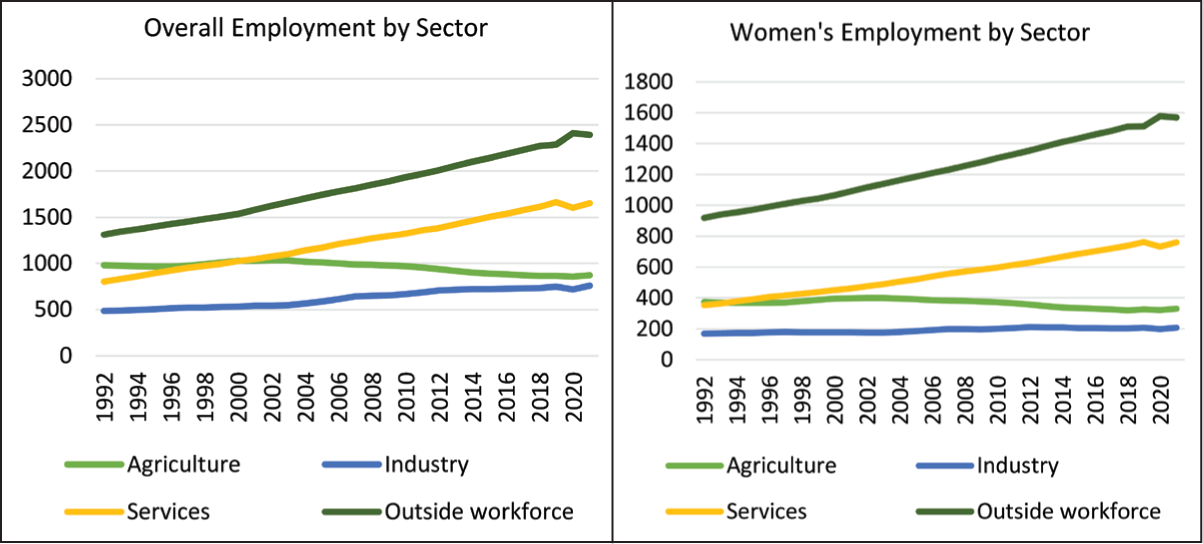
As indicated in Graph 1, in the period 1992–2021, from the nearly one billion people among the economically active population (not considering their dependents under 15 and the elderly above 64) working mainly in agriculture in the early 1990s, of which 374 million were women, 30 years later this workforce had declined to 872 million overall and to 329 million for women. Meanwhile, industrial labor increased by 274 million overall, from 484 million to 758 million (still below agriculture), which only 37 million women have joined in the course of expansion. A much greater change has occurred in services where labor has doubled in size overall, from 803 million to 1.6 billion, for men and women in equal measure (for women, in absolute numbers, from 353 million to 760 million). However, the largest movement by far has been outside the workforce, from 1.3 billion to 2.4 billion overall. This has hit women the hardest, rising from 919 million to 1.6 million: over half of the world’s working-age women (55%) are outside the workforce, compared to nearly one-third (30%) of working-age men. As has been argued (Prasad & Yeros, 2024), “[t]he labor reserves today, apart from the untold human tragedy which marks their expansion, are also clearly convulsed by the mobilization of gender cleavages throughout the circuit of production and social reproduction.”
The regional differentiation over the 30-year period is of further interest for specifying the character of the social formations (Graph 2). The agrarian transition in Africa has seen the relative weight of labor engaged directly in agriculture decline from 39% to 29%, but in absolute numbers it has actually grown from 144 to 229 million people. Labor in industry has more than doubled in absolute numbers, yet its relative weight has remained steady at a low of 7–8%. In other words, relative to the total population, industrial expansion has not made a difference in labor absorption. The major changes are found in services, where labor has increased from 17% to 23%, a threefold expansion in absolute numbers, and in the shift outside the workforce, which has more than doubled in size, to nearly 40%. 5
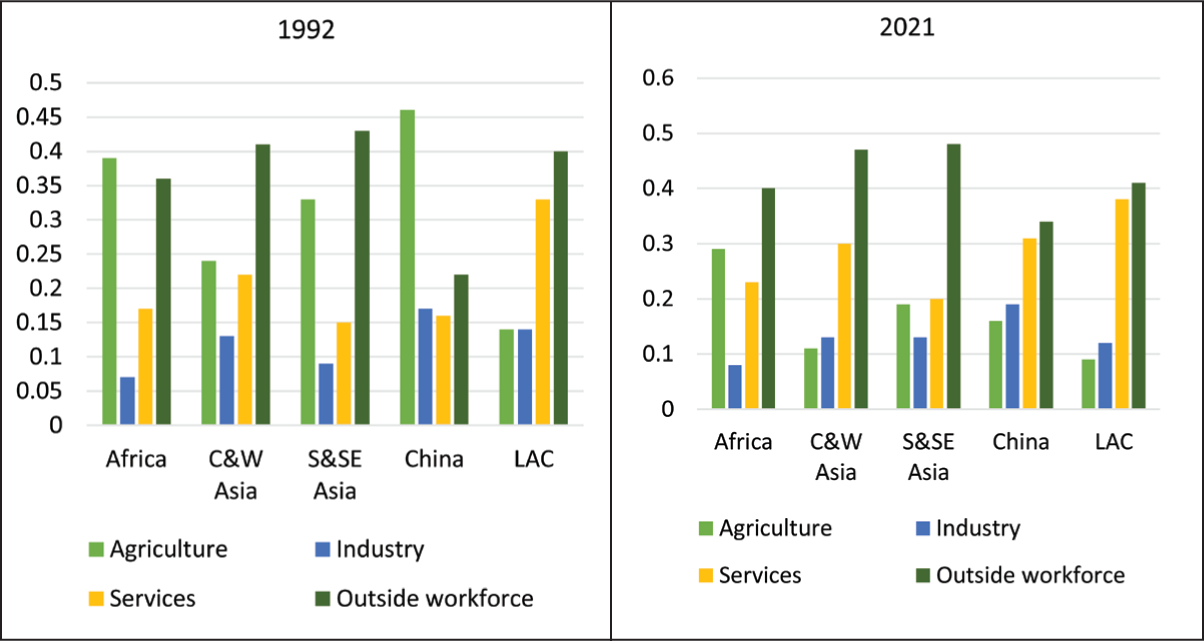
In South and Southeast Asia, the labor force engaged in agriculture also declined in relative terms even more sharply, from 33% to 19%, but in absolute numbers agricultural labor increased, from 347 to 369 million. Industrial labor nearly tripled in absolute numbers but in relative terms, it was a much lesser leap, from 9% to 13%. Employment in services more than doubled from 157 to 388 million, but in relative terms, the leap was not much higher, from 15% to 20%. Meanwhile, the contingent of working-age people outside the workforce also doubled, rising to 48% overall, and especially for women which reached a dramatic 69%, in 2021.
In Western and Central Asia, the weight of labor in agriculture declined in both absolute numbers and in relative terms, from 24% to 11%. Industrial labor increased in numbers but remained unchanged at 13% of working-age people, while labor in services doubled in absolute size, rising from 22% to 30% of the working-age population. Again, the transition has weighed heaviest among working-age people pushed outside the labor force, who also doubled in size, to reach 46%.
Meanwhile, Latin America and the Caribbean followed yet a different agrarian transition in this 30-year period, whereby the size of the working-age population engaged mainly in agriculture increased slightly, from 39 to 41 million, but continued to decline in relative terms from already the lowest level among the other regions to an even lower level, from 14% to 9%. Industrial labor increased slightly in absolute numbers but also declined from 14% to 12%, this being the only region that suffered a real decline in industrial labor. In this case, the service sector absorbed most of the shift out of agriculture and industry, doubling in size to 180 million and rising from 33% to 38%, followed by the contingent outside the workforce which rose to 192 million, at 40% of the population overall.
The trajectory of China clearly stands out from the rest, even if it has not been spared of the adversities of agrarian transition. Labor engaged directly in agriculture declined very sharply from 380 to 184 million working-age people, corresponding to staggering drop in relative terms, from 46% to 16% of the working-age population. Industrial labor increased from 141 to 212 million, corresponding to a relatively small rise from 17% to 19% of the working-age population, but still leading ahead of other categories—and ahead of all other regions in proportional terms in 2021. Service-sector jobs nearly tripled in number to 356 million, registering a rise from 16% to 31%, while the working-age population outside the workforce doubled in size to 386 million and rose quite sharply in relative terms, from 21% to 33%—marking one of the key contradictions internal to China discussed earlier.
Employment Structure of the Workforce
An analysis of the employment structure of each macro-region adds further to our understanding of peripheral social formations (Graph 3). In Africa, the full wage relation pertains to a small minority of working people, as low as 16% in 2021 (and an even smaller minority among women, 9%). Proletarianization more than doubled in absolute numbers but grew only slightly in relative terms, by one percentage point overall over the whole of 30 years. The largest contingents of working-age people overall and for women specifically are in own-account labor (28% overall and 24% for women specifically) and outside the workforce, where 47% of working-age women were situated in 2021. Similarly, in South and Southeast Asia, proletarianization grew from 14% to 18% (and 7% to 11% for women) marking once again a very low level of full proletarianization over the 30-year period. The categories that most receded, both overall and for women, are those of own-account labor (from 30% to 23% overall and 14% to 10% for women) and contributing family labor (13% to 7% overall and 15% to 8% for women). Again displacement of women outside the workforce is by far the most pronounced reality.
In Western and Central Asia proletarianization increased sharply from 29% to 34% overall (20% to 26% for women). However, the rate of expansion overall was similar to those pushed outside the workforce, which in the case of women reached 58%. In this combined region, the categories that most receded, both overall and for women, are those of own-account labor (from 17% to 11% overall and 10% to 6% for women) and contributing family labor (10% to 4% overall and 12% to 5% for women). A starker differentiation thus emerges in this region between the proletariat proper and those placed outside the workforce, the other categories being pressed in the middle.
General Employment by Status in the South, 1992–2021 (million).
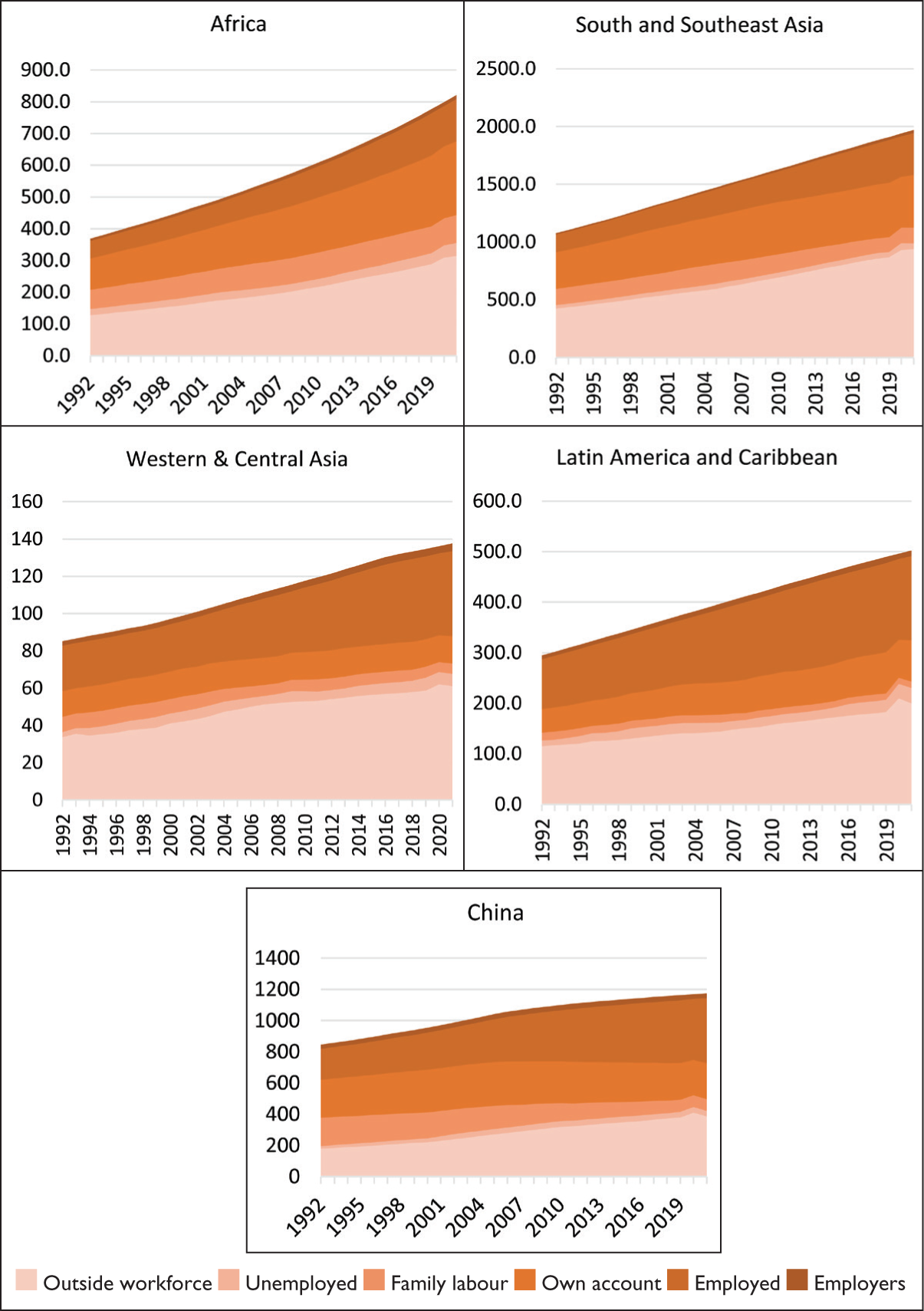
The region of Latin America and the Caribbean is at a similar level of proletarianization as that of Western and Central Asia and behind China. However, proletarianization actually receded in this period overall, from 34% to 33%, while at the same time advancing among women from 23% to 27%. This was accompanied also by a decline of women outside the workforce, from 58% to 52%, while overall this category increased only slightly from 39% to 40%, which suggests that a larger number of male working-age people fell outside the workforce. The tendency that is starkest in this region, despite receding in proletarian labor, is the shift of women into wage labor from all other categories, especially from outside the workforce, except for the unemployed category, which also more than tripled in numbers to reach 6% percent in 2021.
Finally, China further shows that the proletariat proper is the largest component of the workforce overall at 36%, rising steeply from 23% in this 30-year period. The trajectory of women in proletarianization has followed closely the overall trend, although the working-age female population outside the workforce remained the largest category among women and grew proportionally from 27% to 39%. It is further notable that, similar to the other regions of Asia considered above, the categories that most receded in China, both overall and for women, are those of own-account labor (from 29% to 20% overall and 19% to 16% for women) and contributing family labor (21% to 6% overall and 29% to 9% for women). The agrarian transition in China has witnessed a massive exit from agriculture as well as a more balanced absorption in industry and services, although it has not been spared of the growth of working-age people outside the workforce.
Peripheral Social Formations in the Systemic Transition
We may draw some provisional conclusions to the extent allowed by these macro-regional data. Rapid, dramatic, and multiple shifts have been taking place in the short span of 30 years. These shifts are historically unprecedented in their speed and magnitude. Overall they do not bode well for working people in the peripheries of the world economy given the character of this process of semiproletarianization. The trajectory of China remains in a different league in this agrarian transition, with more balanced inter-sectoral and industrial absorption, even though it has also accumulated very substantial reserves. However, the other regional social formations have seen rapid agrarian transition with slow proletarianization, slow industrial absorption, fast-growing service sectors with precarious labor, and very large numbers of working-age people being pushed outside the workforce. The trajectory of working-age women is in all cases different form that of men, generally at lower levels of proletarianization and lower levels of participation in all categories except for those outside the workforce where the presence of women is concentrated.
These tendencies are set to continue unless a meaningful systemic transition occurs. While shifts in the correlation of forces are ongoing, the real measure of systemic transition over the next generation, until 2050, will be the capacity to absorb effectively the working people of the South in industrial employment, in both urban and rural areas, and to rebalance inter-sectoral and rural–urban relations on a sustainable basis. It is the case in most regions that sovereign and popular development in the twenty-first century will require decongestion of urban areas and reinforcement of rural areas at a higher and dignified level of social reproduction. A rural revitalization plan would be required everywhere, alongside urban reform. Clearly, a sovereign and popular development path is an existential question for the working people of the South in this first half of the twenty-first century.
These tendencies are also set to define the struggles of the current generation. While the full range of political forms is always present—from the progressive to the reactionary, from the more organized to the more diffuse, from the peaceful to the armed—it is the case that semiproletarianized social formations exhibit tendencies that are distinct. On one hand, there is an intense struggle for social reproduction within and without the wage relation. This takes the form of struggles over rural and urban land, natural resources, and the commons more generally, including social services. Women have a strong presence in such struggles, as well as the social layers that are most oppressed within the racial, caste, and other social cleavages that organize class relations. It also takes the form of struggles by small producers over market access, price structures, and regulated production arrangements, especially the peasantry, but also the urban service economy which has seen the organization of informal and precarious workers for more regulated markets. These struggles, to be sure, do not exclude the established organized private or public sector workers and their unions, or student movements, all of which remain key in the correlation of forces. However, they are distinct and basic struggles in these social formations as they have evolved. Moreover, they are struggles that have unique potential to organize politics across the rural–urban divide in light of the challenges required over the next generation.
A final feature concerns the insurrectional pressures that galvanize these social formations. Social crisis and insurrection have gone hand in hand in the formation of massive labor reserves. Insurrectional pressures, both armed and unarmed, have been constant and widespread across the peripheries. Some—very few—gave way to revolutionary situations, as in Zimbabwe and Venezuela. Short of a revolutionary outcome, they nonetheless escalated all the way to state power to the point of confronting imperialism in a sustained manner. Other insurrectional pressures have instantaneously spread across countries, such as in the Arab Spring, to yield diverse outcomes from coups and repression, to military invasions in Libya and Syria, and armed struggle and continuous radicalization with the taking of state power in Yemen. Still, other mass struggles have coalesced around peaceful organized protests, as in India, to sustain an enduring confrontation under difficult conditions against the government, with significant victories in the short term.
More recently, in the Sahel, in Mali, Burkina Faso, and Niger, mass discontent has found expression in revolts within the military and popular mobilization around it, with anti-imperialist ideology and mass appeal. Other mass struggles, as in Latin America and the Caribbean over the last three decades, have gone through phases of ebb and flow and remain indeterminate. For those mass struggles that led to electoral victories, such as in Chile, Colombia, Peru, and Bolivia, the loss of electoral support to reactionary forces remained a constant threat, including via coup d’état and imperialist intervention. Peru, Bolivia, and Brazil, among others, succumbed to coups, while the latter two also managed to reverse them. Haiti, which has seen massive social struggles over this whole period, has also been subjected to serial coups and foreign occupation and remains under the threat of impending invasion once again.
The armed insurrection in Gaza on October 7 and the ensuing war in the region is a continuation of the Arab Spring struggles, the Islamic Revolution in Iran before it, as well as the longer struggle against settler colonialism in Palestine. The Axis of Resistance, which traverses Iran, Iraq, Syria, Lebanon, Yemen, and Palestine, represents a new phase in regional anti-imperialist struggles with a massive militant and popular component among these semiprolarianized populations. These struggles, with all their particularities, are not unique in their social basis or the social crisis from which they spring.
Concluding Remarks
The question remains: for whom will systemic transition be? The principal contradiction persists between imperialism and the working peoples of the Third World, that is, the permanently semiproletarianized peasants and workers of the world’s peripheries. If and when the proletariat of the imperialist centers dislodges itself from its alliances with imperialism and its supremacist logic, a broader front may begin to be visualized.
However, until then, the struggles for systemic transition over the following generation must mean very concrete things in the affirmation of sovereignty: absorption of the massive labor reserves of the Third World via rural and urban industrialization, stabilization of rural–urban relations, and mass production of public goods for addressing the crisis of social reproduction. The timeframe is also crucial: this transition must take place by the middle of the century if the catastrophic growth of labor reserves in these times of global warming is to be reversed. Is there really any other measure of polycentrism?
It remains the case that polycentrism can only be obtained by means of central planning and a new mix of property relations in the productive base of the peripheries. The erosion of the global infrastructure of late neocolonialism which is underway today will not be enough for the type of transition that is necessary. The popular factor will thus remain determinant in the changing fortunes of working people in the Third World and the planning systems that are required. The “sixth great power,” as Marx reminds us, is the only source, the only measure, and the only guarantee of the transition to polycentrism.
Footnotes
Acknowledgements
Versions of this article were presented at the conference on “Contemporary Popular Movements in India: Challenges, Prospects and Solidarities,” Jawaharlal Nehru University, New Delhi, June 9–10, 2023; the Training Course of the Union of Socialist Youth in the panel on “The New Global Order, the Climate Emergency and Socialism in the World—Is Marxism Still Relevant?” Itapecerica da Serra, São Paulo, December 6, 2023; and the SMAIAS-ASN Summer School on “Rural and Urban Industrialization: Towards a Great Leap Forward”, Harare, February 5-9, 2024. I thank the participants for their comments and discussion.
Declaration of Conflicting Interests
The author declared no potential conflicts of interest with respect to the research, authorship, and/or publication of this article.
Funding
The author received no financial support for the research, authorship, and/or publication of this article.