



Abstract
The present study reveals differences in brand engagement, brand loyalty and brand evangelism among single or no parented young adults. It was found that persons who were raised without one or both parents for at least three years show higher emotional connectivity to brands compared to their counterparts from a control group. A widely recognized structural equation modelling technique—partial least squares method—has been applied in order to test the research hypotheses. Two Baltic States, namely, Lithuania and Latvia, served as an empirical basis of the study. The results of the research are relevant not only to business related disciplines, such as marketing and management, but also to other social sciences fields presuming the existence of more psychology-related differences among single or no parented persons.
Introduction
Central and Eastern European (CEE) countries are characterized by a high number of divorces (Manea & Rabušic, 2020), with the Baltic States being constantly placed above the EU average (Maslauskaite et al., 2015). Divorce of the parents’ places children in a socially insecure position, which is amplified not only by a substantially increased financial fragility but also by intolerance, bullying practices and various forms of ostracism from their friends and classmates (Amato, 2014).
The number of children who were raised by only one of their parents, or even by relatives, significantly increased in some CEE countries after joining the EU, which triggered or intensified workforce migration to Old EU countries (Dapkus et al., 2011). It has been demonstrated that the long absence at least of one of the parents have a significant impact upon the socio-psychological development of the child (Hetherington & Arasteh, 2014). The situation affects the maturation of their character (Tough, 2012), cognitive abilities (Vezzetti, 2016) and even the economic rationale of their actions (Tartari, 2015). Although it is recognised that single-parented or orphaned persons may differ in their overall behaviour (Meghdadpour et al., 2012; Zayas, 2015), no substantial scientific efforts have been undertaken to reveal the impact of orphanage or being single-parented on the consumer behaviour or market decisions of that particular group of consumers. So the present article addresses a scientific vacuum that still exists in terms of revealing whether and in what way the absence of at least one of the parents during childhood affects young adolescents’ attitudes towards brand loyalty (BL) and brand evangelism. The constructs, which are significantly dependant on a latent psychological factor of a consumer (Hsu, 2019; Zhang et al., 2020), may presumably be affected by growing at least without one of the parents. In order to do this, we raise the following research question: Do differences in BL and brand evangelism among single-parented or orphaned persons persists? The present article aims at fulfilling this scientific void referring to evidence from the Baltic States. Two different cross sectional surveys were conducted to obtain the data for the analysis. A structural modelling technique—partial least squares (PLS) method—was employed as a primary research tool.
It is generally considered that the longer a person lives, the more they adjust to the surrounding environment and form their habits according to the existing social norms and rules displaying social conformity behaviour (Smaldino & Epstein, 2015). So in order to better capture the effect of the lack of one of the parents during childhood onto the consumer behaviour, the scope of the study was narrowed to young adolescents, who were exposed to this social conformism phenomenon a relatively short time.
Findings of the current study expands the knowledge about the consumer behaviour of particular under-researched groups and provides initial starting arguments in trying to explain some phenomenon in consumer behaviour that does not fall under the classical marketing or behavioural economics viewpoint (Chetty, 2015; Thaler, 2016; Trusov et al., 2009).
The present article starts with an overview of the prevailing theoretical streams about the nexus of brand engagement (BE), BL and brand evangelism. The methodological part of the article presents the hypotheses raised by studies in the area, conceptual model, short description of the data and methods employed for the study, and main reliability indicators of research models used for its purpose. The results and discussion section explains the obtained results. The conclusions section generalises the derived scientific insights, comments on research limitations and offers future research directions.
Literature Review
Recently the ‘Holy Trinity’ of the marketing, namely BE, BL and brand evangelism, has been studied from various additional aspects. It is generally assumed that BE is directly related to BL—the latter being considered to be a more complex construct (Adhikari & Panda, 2019; Hollebeek, 2011; Veloutsou, 2015; Zheng et al., 2015). This is not always an undisputed case, as France et al. (2016) place BE as focal in forming all other brand-related constructs. The high order BE was also studied by Dwivedi (2015). The role of commitment in a formation of BE and BL has been an object of interests of Raïes et al. (2015). Solem (2016) focuses on the participative element of consumers in the formation of BE and BL. Consumer participation in social networks is also central in a study by Jayasingh (2019) on relationships between BE and BL. When studying brand satisfaction, Fernandes and Moreira (2019) looked for the equilibrium between the emotional and functional relationships in forming BE and BL. Brand identification through value congruity was a dominant subject in the study by Rather et al. (2018b) on BE and BL. The approach was subsequently followed by Kaur et al. (2020) extrapolating it to virtual communities. Brand-based consumer–consumer interactions is considered to be an antecedent both to BL and BE by Helme-Guizon and Magnoni (2019). Khan et al. (2016) focused on a positive experience as the main determinant in building BE and BL. The nexus between perceived quality, BE and BL is focal to Shanahan et al. (2019) studies. Shanahan et al. admitted that the hierarchical order of the aforementioned constructs is still not fully distinguished. The importance of mediating effects in the BE and BL link was stressed by Vacas de Carvalho et al. (2020), showing that different mediators can facilitate or completely severe it. Different aspects of value perception serve as a determinant for distinctiveness in the formation of BE and BL (Ismail et al., 2020). This view is supported by Leckie et al. (2017) in explaining BE and loyalty behaviours in the service sector. Heterogeneity of a BE concept was also confirmed by Dessart et al. (2019). Algharabat et al. (2020) offers to include consumer-based brand equity concept when studying BE and BL. Rather et al. (2018b) supplemented this BE—BL relationship with brand equity.
The second chain in the BE–BL and brand evangelism nexus is composed of BL and brand evangelism, where BL is typically seen as a proxy for brand evangelism (Doss, 2014; Scarpi, 2010; Shaari & Ahmad, 2016). This is also true for green brands (Panda et al., 2010). Beyaz and Gungor (2021) confirm the positive relationship between BL and brand evangelism, although pointing out at the brand experience and brand satisfaction as necessary components to the formation of brand evangelism among the most emotionally related brand fans. Some researchers in their brand evangelism studies opt to avoid a BL, instead focusing on brand trust and brand identification as an antecedent of brand evangelism (Ashkani & Esfidani, 2017). The approach of avoiding BL in brand evangelism studies is supported by Shaari and Ahmad (2016) who consider brand trust and brand community commitment to be the main prerequisites for brand evangelism. Such studies threatening the almost established BL—brand evangelism connection provide additional support to the rationale of our research. Another theoretical sprout challenges the influence vector from the BL to brand evangelism and considers brand evangelism to be a precondition for BL (Cestare & Ray, 2019). Adding further complexity to the BL-brand evangelism puzzle.
Some studies try to draw a clear dependency between BE and brand evangelism (Harrigan et al., 2021), although in this case a lot of mediating and moderating effects can be observed (Nyadzayo et al., 2020; Rajendiran & Dorai, 2020; Samala & Singh, 2019). Wallace et al. (2014) add a brand love to BE—brand evangelism equation in an online research of self-expressive brands. Kumar and Kaushik (2020) argue that experience plays the main role in forming brand the engagement—brand evangelism duality. Al Nawas et al. (2021) go further and exploit the direct relationship between brand experience and brand evangelism. Experience is also focal in the framework for creation of brand evangelists proposed by Kang et al. (2020).
Methodology
Hypotheses and the Study Model
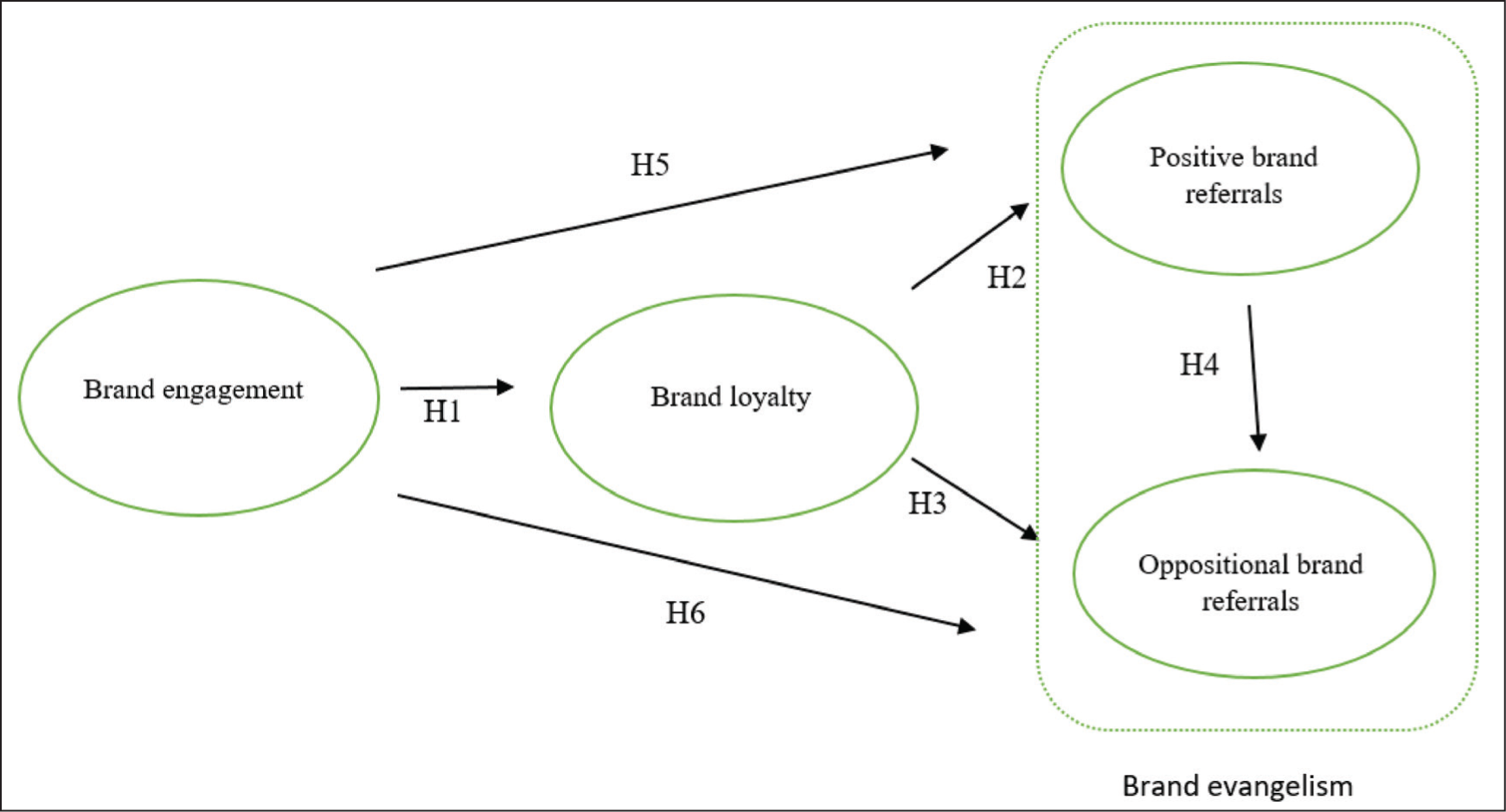
A lot of scientific sources focus on a chain between BE and BL as inseparable steps towards the investigation of higher orders of customer-brand relationship phenomenon (Goldsmith, 2012; Leckie et al., 2016; Rather et al., 2018a) considering BE to be a direct proxy for BL (Solem, 2016). It is found to be true with all types of engagement, namely, affective, cognitive and behavioural engagement (Dessart et al., 2019). Not all studies take this relationship as granted, as a lot of mediating effects have been documented (Helme-Guizon & Magnoni, 2019; Nagaraj & Singh, 2018), especially when the study is expanded to involve young consumers (Samala & Katkam, 2019). So in order to test this relationship among the adolescent population, we formulate our first hypothesis as follows:
H1: For the young adolescents, BE affects BL, ceteris paribus.
The relationship between BL and brand evangelism is much less conclusive. Although recent studies point at the existence of such an interconnection, there BL may lead to brand evangelism (Panda et al., 2020; Saputra & Pranoto, 2021) a significant number of studies failed to unconditionally confirm this duality (Choudhury et al., 2019; Riivits-Arkonsuo et al., 2015). As young consumers are more prone to stronger brand relationships (Ismail & Spinelli, 2012; Otero & Wilson, 2018), we expect to reveal a positive relationship between BL and both brand evangelism components, such as involvement in spreading positive and oppositional brand referrals (Becerra & Badrinarayanan, 2013; Cheng & Yu, 2021). This leads to the following hypotheses:
H2: For the young adolescents, BL affects positive brand referrals (PBRs), ceteris paribus. H3: For the young adolescents, BL affects oppositional brand referrals, ceteris paribus.
Inner components of the brand evangelism and its mutual interconnections are still an under-researched side of management science (Harrigan et al., 2021; Kang et al., 2020). It is assumed that persons who are engaged in spreading BBRs are also inclined towards oppositional brand referrals (Marticotte et al., 2016; Hayes et al., 2018), although Liao et al. (202o) argues that consumers disposition towards oppostional brand referrals has deeper and more distinctive psychological antecedents compared to a positive word of mouth. This insight about different roots of PBRs and oppositional brand referrals explains the fact why some influential studies do not find a positive correlation between the aforementioned constituent parts of brand evangelism (Matzler et al., 2007). To address this uncertainty among young adolescents, we formulate the fourth hypothesis:
H4: Young adolescent persons spreading PBRs are also engaged in opposite brand referrals, ceteris paribus,
The most recent studies focused upon the direct relationship between BE and brand evangelism while avoiding intermediary constructs (Pornsrimate & Khamwon, 2021; Rajendiran & Dorai, 2020). Although solid evidence of a direct positive correlation between BE and brand evangelism is scarce, Sharma et al. (2021) have found a positive relationship between the trends in BE and brand evangelism. Harrigan et al. (2021) document although not very strong, but statistically significant path coefficients between BE and brand evangelism. To test if this innovative approach is applicable to young adolescents, we have constructed the following hypotheses:
H5: For the young adolescents, BE affects PBRs, ceteris paribus. H6: For the young adolescents, BE affects oppositional brand referrals, ceteris paribus.
The effect of being single-parented on a person’s emotional development has been widely documented (Dunifon & Kowaleski–Jones, 2002; Hosokawa & Katsura, 2019; Marusak et al., 2018; Neel et al., 2018). Single-parented children are more exposed to various forms of ostracism or even discrimination (Levine, 1982; Mabuza et al., 2014). Such discrimination has been widely recognised as having significant cognitive and emotional effects (Gibbons et al., 2004), which display their footprints even in adolescence (Carter et al., 2019). In addition, single-parented children show lower scores at school (Nonoyama-Tarumi, 2017) and are characterized by the increased risk of various levels of emotional disorders (Kessler et al., 2001; Ogundele, 2018; Peterson & Zill, 1986). The entirety of the earlier observations suggest that having grown without at least one of the parents for a long period of time, adolescents will show statistically significant differences in their perception of such emotional constructs as BL (Fernandes & Moreira, 2019; Hwang & Kandampully, 2012) or brand evangelism (Harrigan et al., 2021; Panda et al., 2020;). So the following hypothesis was constructed for the purpose of the present study:
H7: BL and brand evangelism of a person who experienced a long absence of at least one of the parents during childhood differ from that of the adolescents growing in full families, ceteris paribus.
The relationship between researched constructs and hypotheses are represented in Figure 1.
Data Collection and Reliability Indicators
The data necessary for the study covered by the present article was collected by employing two different cross-sectional sampling procedures. The first model is based on the data obtained through the questionnaire based on the internet platform accessible through the link shared through social networks. All contacts on the social networks were asked also to share the link to the survey with as many contacts, as possible. No additional actions in terms of engaging respondents were taken in order to have the sample as random as possible. The obtained answers were analysed in Model 1 and were referred to as a control group (Irmak et al., 2005; Teo et al, 2018).
The contact data of the individuals who were for at least three years raised without one or both of their parents were obtained through the social support divisions of five Lithuanian and two Latvian municipalities, and a non-profit organization providing social support for the disabled, struggling with financial difficulties or otherwise requiring socio-psychological support in Lithuania. The link to the survey was sent directly to the contacts to their e-mail addresses or Facebook Messenger. The message contained a short introduction to the study with a guarantee for confidentiality. Due to this technique, the data-obtaining procedure cannot be considered based on a random sampling. This fact puts additional constraints in applying statistical techniques for data processing (Lajer, 2007), although in real-life situations, random samples can sometimes be hard to obtain (Murty, 1984). Therefore, in applied studies, some deviations are acceptable and are not considered to significantly compromise the results (Dorofeev & Grant, 2006). The responses received were analysed in Model 2. Due to ethical concerns, only persons aged 18 years or over were selected for the participation in a research. To better capture the effect of the absence of at least one of the parents during childhood onto consumer behaviour of young adults, the survey also excluded individuals over 25 years of age.
In total, 341 surveys for Model 1 and 224 for Model 2 were suitable for the research after having checked the normality of distribution of the data using Kolmogorov-Smirnov test, which is highly recommended in questionnaire surveys (Tomic et al., 2018). In Likert scale-based studies, it is suggested to analyse not only a mean value but also a median value, as sometimes mean is biased by the influence of outliers and does not fully reflect the true picture. Therefore, in this study, we employed both mean and median trying to reveal the most important components of each construct. In order to measure a dispersion, the standard deviation was computed.
The already validated scales selected for the study were adjusted to specifically fit the purpose of the current study. The selected BE scale was constructed accepting scale from The BE scale was adopted from Xi & Hamari (2020). BL scale was adopted from a study by Molinillo et al. (2017). As respondents were asked to think about their favourite brands in soft drinks and chocolate bar categories, the modifications were made to Becerra & Badrinarayanan (2013) scale for the brand evangelism components (PBRs and negative brand referrals).
In order to check the reliability of the scales, Cronbach alpha coefficient was calculated for both models. In Model 1, BE scale shows 0.891, BL 0.814, PBR 0.789 and for oppositional brand referrals (OBR) it was 0.774. Model 2 Cronbach alphas was BE 0.806, BL 0.778, PBR 0.742, OBR 0.716, respectively. In all cases, in both models, Cronbach alpha is above the threshold of 0.7, which is considered to be a limit for a reliable study (Amrhein et al., 2017), so all employed scales are suitable for the further consideration.
PLS research method, a frequently used tool (Chin, 1998) under Structural equation modelling (SEM) umbrella, was selected as a study method. It is being widely employed in various social sciences (Selin & Versand, 1995; Schuberth et al., 2021; Thien, 2019; Vinzi et al., 2010), marketing (Cheung et al., 2020; Hair et al., 2019) and psychology (Rönkkö et al., 2015; Sawatsky et al., 2015) studies. It is also a highly recommended instrument for the relatively small sample size studies (Chin & Newsted, 1999). The data obtained from the survey was analysed using the SmartPLS 3.3.3 software version.
A bootstrapping approach (500 re-samples for each model) was selected seeking to assess whether the presumed relationships between the researched variables truly exist in both models as it is presented in conceptual model depicted in Figure 1. For the path analysis a p level below .05 (*p < .05) is selected, which is acceptable in social-science-related studies (Amrhein et al., 2017). For the verification of structural model, R2 and Q2 (Stone-Geisser criterion) as well as goodness of fit (GoF) index were computed. The obtained values for aforementioned indicators are presented in Table 1:
Structural Model Reliability Indicators.
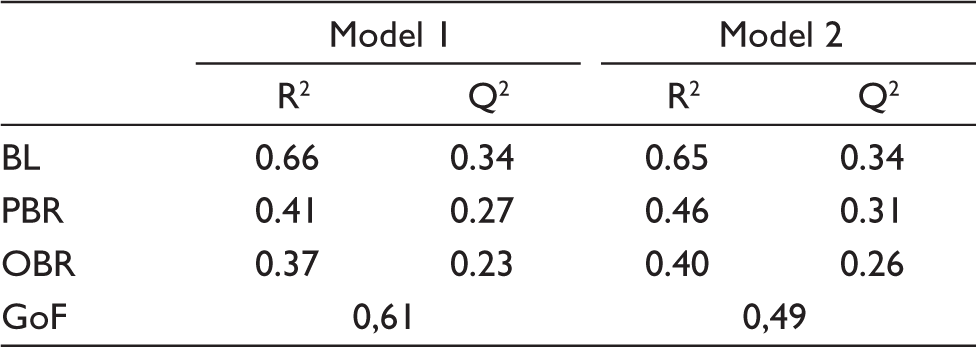
In Model 1 the R2 ranges from 0.37 to 0.66, which means it explains from 36.97% to 66% of data variance. For Model 2, these figures range from 0.40 to 0.65, explaining from 40% to 65% of data variance. Although these numbers are not extremely high, it is still considered sufficient for the acquiring robust results (Chin, 1998). The GoF criteria is 0.61 for Model 1 and 0.49 for Model 2. In both cases it is above the 0.36 threshold (Henseler et al., 2009), so both models can be classified as of a good fit and satisfactory predictive power.
Results and Discussion
First, we embark on descriptive statistics in analysing our data. We are aware of the limitations of using parametric tests with an ordinal data, although we consider our samples to be suitable for the conditional application of the parametric techniques (Norman, 2010). Further in our research, we follow Wolverton et al.’s (2016) suggestion about supplementing descriptive statistics of ordinal data with additional research techniques (in our case—SEM).
The main descriptive statistics of the Models used in the study is presented in Table 2:
Descriptive Statistics of the Studied Constructs.
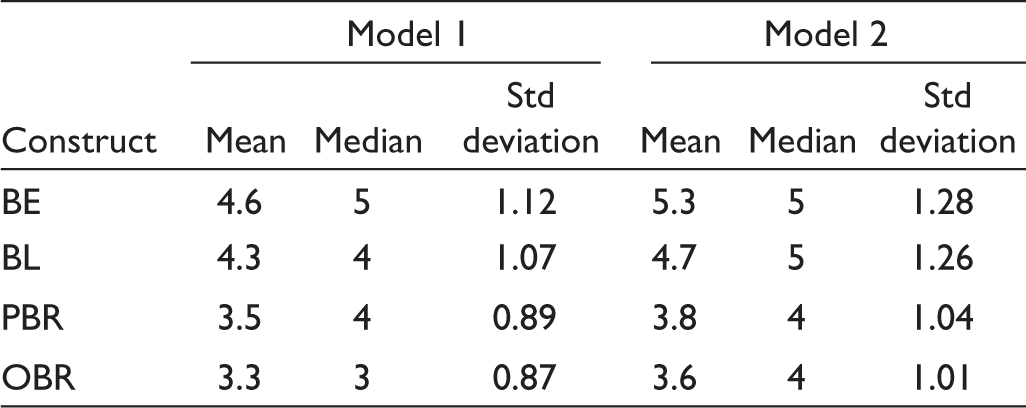
The data presented in Table 2 indicates that there might be a statistically significant differences between Group 1 (control group) and Group 2 (individuals raised for a long period of time with at least one parent absent) as Model 1 shows slightly lower mean values for the constructs being considered. However, the median values differed only for two out of four of the constructs. This seems to be consistent with the arguments of Mooi and Sarstedt (2011) about the necessity to include both mean and median indicators into research. An independent samples t-test (Table 3) was conducted with a purpose of checking if these differences between Group 1 and Group 2 are actually significant.
Results of Independent Samples t-test.
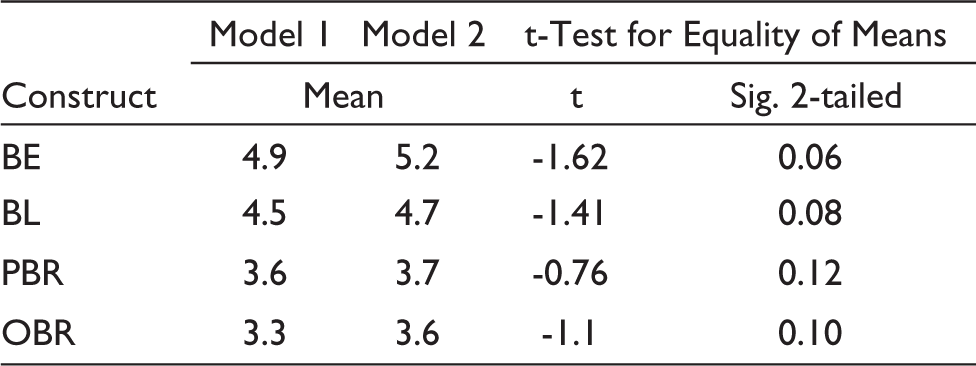
Although not substantial, the differences in means from Model 1 and Model 2 were found to indicate not only higher figures for the brand evangelism constructs (PBR and OBR) for Group 2, which was anticipated, but also higher mean values for BE and brand love. These findings allow us as to presume that young adolescents who experienced childhood without at least one of the parents are more prone to emotional connectivity with their most favourite brands. This should also lead to a higher satisfaction or higher presumed quality of their favourite brands, as high emotional connectivity to the brand is seen as a proxy for both the presumed quality and satisfaction by the brand (Bigne et al., 2020; Lee et al., 2009). The aforementioned results support H7 of this study.
In order to test the other hypotheses raised as part of the study and in trying to reveal more differences between persons raised in full families, as opposed to adolescents raised parentless or in a single parent family, we conducted a path analysis for both Model 1 and Model 2. The obtained path coefficients and upper and lower bounds of the 95% confidence interval are presented in a Table 4:
The Computed Path Coefficients for the Researched Models.
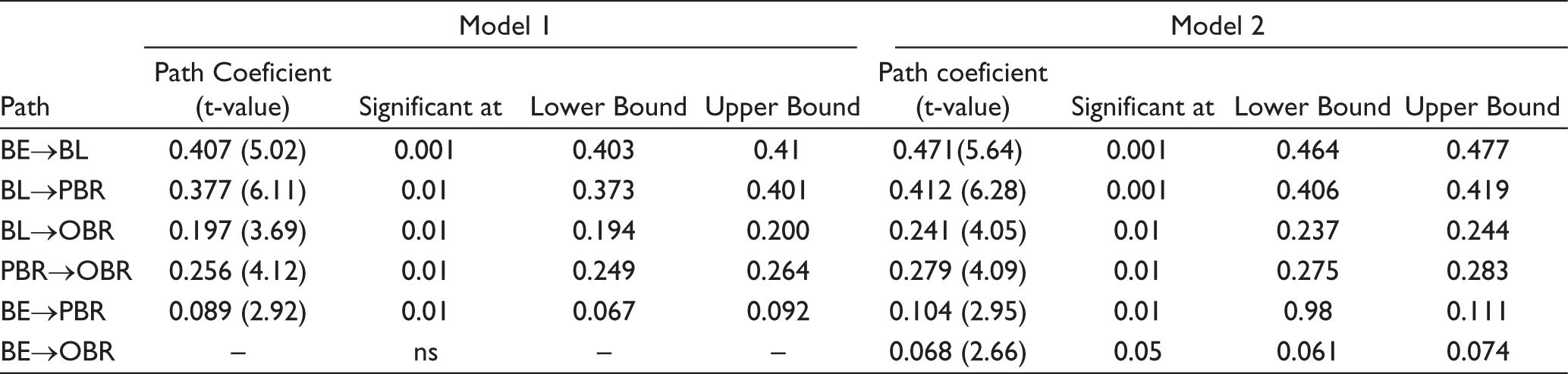
The positive statistically significant relationship was found to exist in all the researched cases except one (influence of BE onto oppositional brand referrals). So we can ascertain that all of our hypotheses, except H6, were confirmed. H6 was only partially confirmed, as statistically significant results were obtained only for Model 2. The strongest relationship between the constructs studied was found between BE and BL and it was confirmed in both models at *p <0.001. The weakest relationship among the constructs researched was confirmed in both models between BE and PBRs. That allows a conclusion that although showing emotional attachment to the brand, the respondents are rarely inclined to spread a positive word-of-mouth about the brand. If the person loves the brand, they are more disposed, although moderately, towards sharing positive information about the brand (path coefficient 0.377 in Model 1 and 0.412 in Model 2). The willingness to be engaged in opposite brand referrals is quite a debatable issue (Marticotte et al., 2016) and, despite the confirmed relationship between PBR and OBR in both models (path coefficients 0.256 and 0.279 respectively) as well as BE and OBR in Model 2 (path coefficient 0.068), it is still not clear how often the inclination towards opposite brand referrals is really converted into ‘trash talking’ (Japutra et al., 2018). We think this specific phenomenon should be studied more thoroughly in order to obtain more robust and multifaceted evidence. The obtained quite low path coefficients also add some arguments supporting the idea about the necessity for more in-depth studies of OBR.
The results of the study covered by the present article are consistent with Leckie et al. (2016), and Fernandes and Moreira’s (2019) findings about the relationship between BE and BL. Our findings supported Becerra and Badrinarayanan‘s (2013) considerations about BL’s role as a proxy for brand evangelism. Although the study did not fully confirm the impact of BE onto brand evangelism (OBR), yet, challenged by some existing evidence (Nyadzayo et al., 2020), it partially supported the arguments of Hollebeek (2011) and Sharma et al. (2021) about distinctiveness of such concepts as BE, BL and brand evangelism. So it may be presumed that the relationship between the aforementioned notions are more multifaceted and not absolutely one-directional.
Conclusions
The findings of the study covered by the present article should be considered relevant not only to Central and Eastern Europe, where labour migration is still an important issue, having social, economic and even cultural footprint (Engerbsen et al., 2013; Genelytė, 2018; Snel et al., 2015). Fairly high divorce rates are a characteristic of many Western countries (Strban, 2016) and the findings of the current study may also have implications to those societies. Of course, due to higher standards of living in Western countries, the absence of one of the parents during childhood may have less impact on children/teenagers, and a less significantly expressed financial deprivation; thus, the findings of the study may be considered less relevant. This study serves as a starting point in studying the impact of the absence of at least one of the parents onto the consumer behaviour in young adolescent age, providing initial documentation about the existence of such effect. We proved that being at least single-parented for a long period of time has impact on the formation of various attitudes towards most popular brands. If further analysed, the findings may help to explain differences in consumer behaviour in various countries, which sometimes is hard to describe from the classical marketing viewpoints (Kapferer & Bastien, 2017). The revealed difference between Group 1 and Group 2 may also have a substantially wider echo in other social science disciplines. If the young consumers who at were least one-parented differ in their BL and brand evangelism intentions from those raised in full families, there also may be other differences in their psychographic characteristics that were not yet discovered.
The disclosed inclinations towards stronger brand evangelism among persons who have grown for a longer period of time without at least one of the parents may also be utilized from the managerial perspective. It is quite likely that those raised in a single-parent family are likely to be more willing to act as brand ambassadors and more thoroughly work during promotion campaigns. In order to get more comprehensive data about the impact of the absence of at least one of the parents during the childhood onto the customer habits in the adolescent age, is it worth looking into the difference in consumer behaviour of those lacking one or both parents? Does the time period that the child/teenager spent without one/both parents have impact on various market decisions? How long in the adolescent age does this effect last? How does this effect differ in developing and developed countries? The presence of possible mediating effects could also be an interesting subject for a study. A limitation of this study is not a very big sample size, especially for Model 2. A not entirely random sampling technique also could impose some bias into results, despite the satisfactory statistical reliability indicators. In view of the aforementioned, a continued survey covering a significantly higher number of respondents would also be useful in developing further knowledge about the impact of the absence of at least one of the parents during childhood onto future consumer behaviour.
The possible limitation of our study lay in the fact that there may be additional factors, which may impose some mediating effects to our researched relationship. The investigation of possible mediators could also serve as additional research direction.
Footnotes
Declaration of Conflicting Interests
The author declared no potential conflicts of interest with respect to the research, authorship and/or publication of this article.
Funding
The author received no financial support for the research, authorship, and/or publication of this article.