




Abstract
Recent studies have addressed the technological and cognitive motivational factors influencing e-learning. However, research investigating the comparative analysis of psychological factors that influence the academic motivation of e-learners and their interconnection has not been reported. Considering the array of psychological challenges faced by the student community in the current pandemic, a detailed look at the sudden transition and its impact on the academic motivation of learners is imperative. This paper examines the impact of psychological factors on the academic motivation of learners in pre-COVID and COVID times. Further, the significant difference in academic motivation during the period is also studied. A structural equation modelling (SEM) analyses the data obtained in two phases—phase 1 (Pre-COVID) and phase 2 (COVID)—from executive business management students of India. To the best of our knowledge, this is the first study that looks at the academic motivation of learners using three different theoretical lenses. Findings suggest that all psychological factors influence the academic motivation moderately/strongly during both the phases, except attention during pre-COVID. However, increased focus on attention and need for relatedness is suggestive during exigencies like COVID. The validity of second order measures, that is, extrinsic motivation, intrinsic motivation and amotivation, fortifies the findings and makes a substantial contribution to the body of the knowledge in e-learning motivation. The study details the research and practical implications of the findings.
Keywords
Introduction
The lack of learner motivation is identified as a prime hindrance to digital learning. It increases the cognitive load, affects performance and reduces learner’s effort and capabilities, and negatively influences the academic achievement of the learner. Motivation is identified to be the primary requirement in instructional design, where low motivation inhibits the level of learning effectiveness, especially in digital learning. Research identifies lack of learner motivation to be a major concern during COVID-19 (Aboagye et al., 2020) as well.
In this context, several studies have reported the need for high motivation of learners for e-learning success (Cidral et al., 2018; Eom & Ashill, 2018). The literature indicates a striking retention rate of 3% to 15% on Massive Online Open Courseware (MOOC; Jordan et al., 2014) primarily accounting to lack of learner motivation through the course. Rostaminezhad et al. (2013) observe that lack of motivation as a major cause of high drop out among Iranian students registered in an online course. Studies report that complete transition to e-learning during COVID has led to a sharp decline (17%) in learner participation (Bylieva et al., 2020). This underscores the need to compromise on the cognitive load (Mukhtar et al., 2020) due to lack of learner motivation during the pandemic. A quantitative study based in St. Petersburg observes a sharp decline in learner participation, when the learner was forced to complete online learning owing to COVID restrictions. Sustaining learner motivation has been a constant challenge under normalcy, and with this additional enforcement to completely online mode of learning, the difficulty is anticipated to increase many folds.
In response to the aforementioned issues, several authors have identified various psychological factors influencing the motivation of learners using different theoretical lenses along different geographical locations and applying different techniques. For instance, Burt et al. (2013) investigates the influence of instructor support on the fulfilment of basic psychological needs impacting the academic motivation of university students in the United States. A mixed method study (Huang et al, 2006) using the attention, relevance, confidence and satisfaction (ARCS) theory observes that the instructional feature of the tutorial under consideration influences the constructs attention and the motivation of the learner. Authors (e.g., Chen & Huang, 2002) have also identified the use of expectancy theory in establishing the relationship between behavioural intention and academic motivation of the learner. A case study by Gustiani (2020) observes adverse impact of the forced transition on the both the intrinsic and extrinsic motivation of the learner. The aforementioned studies have invariably used multiple regressions in developed knowledge economies such as the United States, the United Kingdom and Germany.
Being economical, flexible and easy to deliver without the constraints of time and distance, e-learning is an attractive option for developing knowledge economies. A report by KPMG and Google suggests the need for developing economies to ignore the errors made by developed economies and to focus on a hybrid learning model addressing various psychological factors attributing to improved learner motivation. Andersson and Gronlund (2009) identify that individual characteristic, like the motivated learning behaviour (Csizér & Dornyei, 2005), plays a more decisive role in e-learning success among learners from developing knowledge economies than that from developed economies. Despite all this, the literature has not explored the relationship between the psychological factors and the academic motivation of the learner in general and under exigencies like COVID’19 in a developing economy like India with relatively high potential for e-learning due to large population and high student-to-faculty ratio (Choudhury & Padhi, 2018).
Although, various theories have been independently used to capture the essence of academic motivation using psychological factors, such as attention, behavioural intention, need for autonomy, need for relatedness and need for competence, for a better representation of academic motivation, a holistic approach is suggested. Unfortunately, a single theoretical lens would not be able to capture all the aforementioned factors. Hence, to fill this gap, the use of combined theoretical lenses (Olasina, 2019), namely, self-determination theory (SDT) theory, ARCS theory and the theory of planned behaviour (TPB) to explain the inter-relationship, is imperative to capture these multiple psychological constructs.
Additionally, motivation is a multilevel and multidimensional construct (Deci & Ryan, 2000) influenced by several socio-demographic factors, Therefore, mere adoption of the studies based in developed knowledge economies leads to erroneous outcomes in the context of developing knowledge economies like India, particularly for a long-term executive MBA course where the socio-demographic aspect has not been studied. Thereby, there is a need for understanding the relationship in an emerging economy like India to verify the inter relationship.
Thus, the present study would like to address the following research questions:
RQ 1: What psychological factors influence the academic motivation of learners in a long-term synchronous online business management course in general and during COVID’19? What is the inter-relationship among these factors? RQ 2: Subsequently, what strategies are to be implemented by the stakeholders to improve the learners academic motivation?
To answer these research questions, we investigate the relationship using combined theoretical lenses as stated earlier using 414 data points from learners enrolled in long duration online MBA programmes across five tier-one business schools in India during pre-COVID times, that is, 2018. Further, the same set of questions were circulated among another set up respondents in the same set up during COVID, that is, January 2021. This time we received 316 data points. The outcome suggests a positive relationship of the psychological factors with academic motivation, where behavioural intention and need for competence of the learner are of the highest importance during pre-COVID and COVID times, respectively.
The rest of the paper has been alienated into six sections. Section 2 reviews the literature and Section 3 provides the rational for the hypothesis development. Section 4 describes the research methodology, and the data analysis and results are given in Section 5. Section 6 concluded the study and shares the implication for theory and practice along with paving the way for future research.
Literature Review
Motivation is understood to be a psychological phenomenon; however, Vallerand et al. (1992) operationalized the term in an educational setting. Academic motivation is defined by a student’s desire as reflected in his/her approach, persistence and level of interest regarding academic subjects when the student’s competence is judged against a standard of performance or excellence (Moos & Marroquin, 2010). Academic motivation of a student may be caused by the motivation to learn, the motivation to excel in a setting, or the motivation to use the knowledge for self or social advancement (Schiffrin & Liss, 2017), and it can be either intrinsic or extrinsic. The literature observes that intrinsically motivated people have better academic performance than extrinsically motivated people (Schiffrin & Liss, 2017)—a steep decline is observed in intrinsic motivation of learners as they attain adolescence (Gnambs & Hanfsting, 2016).
The extant literature establishes the relationship between academic motivation and several psychological factors such as faculty support (Burt et al., 2013), resilience of learners (Reynold & Weigand, 2010) and basic psychological needs (Burt et al., 2013; Gnambs & Hanfsting, 2016). As given in Table 1, most of these studies were based in the United States, Germany, Taiwan or Tehran, and they analyse the cross-sectional data using multiple regression. It is evident that the number of studies on developing economies are few, especially in India, which has a huge potential for e-learning.
Literature on Motivation in E-learning in the Recent Decade.
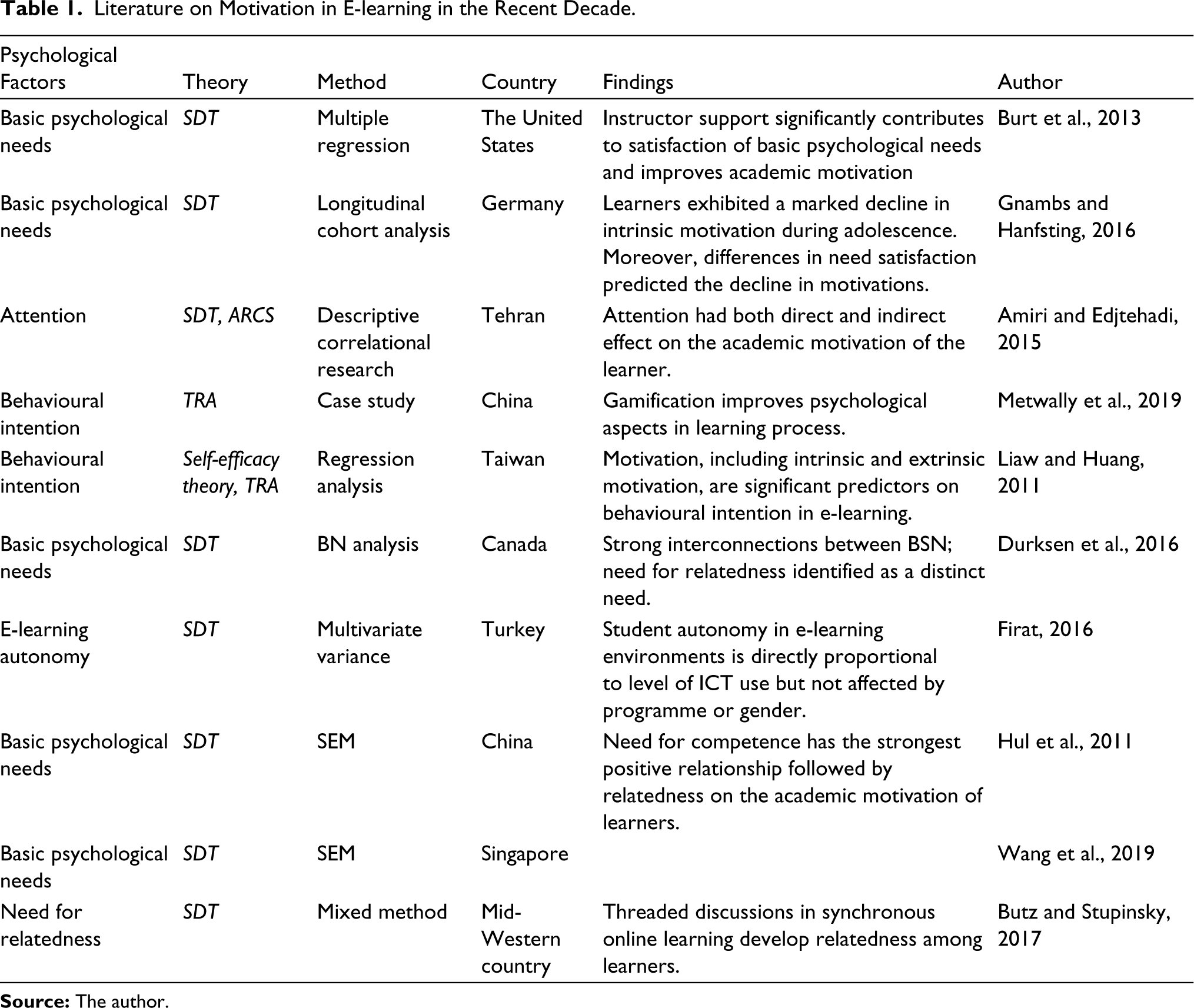
Sustenance of attention is imperative to learner motivation (Schunk & Mullen, 2012) The literature suggests both direct (Amri & Edjtehadi, 2015) and indirect (Amri & Edjtehadi, 2015) positive relationship between attention and the academic performance of online learners when the academic performance is measured in marks obtained .Empirical studies have confirmed the validity of ARCS model for the systematic design enhancing the attention of instruction in e-learning settings with regard to lowering drop-out rates (Keller & Suzuki,2010). Also, applying attention-based motivational enhancements through gamification (Hamzah et al., 2015) and mass e-mails (Hue et al.,2018) improves learner motivation in e-learning. Most of the studies used quantitative methods such as multiple regression or confirmatory factor analysis to explain the relationships.
Chen and Lou (2002) use judgemental modelling based on expectancy theory to identify behavioural intention of the learner as a significant predictor of learner motivation. A study in Taiwan (Liaw & Huang, 2011) uses the self-efficacy theory to establish a positive relationship between intrinsic and extrinsic motivation on the behavioural intention of the learner using the blackboard system. The behavioural intention of the learner is formed as a result of ‘conscious decision-making processes’ (Venkatesh et al., 2003), which can be influenced by several expectancy factors associated to the outcome as postulated by expectancy theory. It is understood to have the closest conceptual link to whether a person would engage in an act of volition. Hence, the motivation of a learner towards a particular academic subject or course is certainly driven by the intention to learn. Authors (Liaw & Huang, 2011) have primarily used case-based or regression analysis to understand the relationship of behavioural intention to academic motivation.
Basic psychological needs for autonomy, competence and relatedness are innate, and meeting these needs is ‘essential for ongoing psychological growth, integrity, and well-being’ (Deci & Ryan, 2000, p. 229). A Hong Kong-based study (Chiu, 2021) identifies SDT needs to gratify learner engagement and motivation in spite of COVID. The literature identifies these three basic needs to be universal determinants of intrinsic motivation and persistent qualitative academic performance on satisfaction of these needs (Burt et al., 2013; Jang et al., 2009; Roca & Gagné, 2008).
Within SDT, autonomy is understood as the inherited fundamental propensity of any living organism to be self-organized and self-ruled (Varela, 1979). Encouraging learner autonomy has been most instrumental to academic performance (Giesbers et al., 2013) and intrinsic motivation (Deci & Moller, 2005; Huang & Liaw, 2007) especially in synchronous e-learning. Niemiec and Ryan (2005) observes lack of autonomy to hinder the intrinsic motivation of a competent student, while a longitudinal cohort analysis by Gnambs and Hanfsting (2016) suggests that when autonomy needs are not satisfied in school, the intrinsic motivation of learners decline as they approach adolescence. Most of the studies employ multiple regression analysis to establish the relationship between need for autonomy and learner’s motivation using SDT theory.
Validation of competencies can contribute to the satisfaction of competency needs of the learner and thereby improve his/her academic motivation (Burt et al., 2013). Various factors such as support from the instructor (Burt et al., 2013), optimal challenge and positive feedback (Deci & Moller, 2005) are understood to satisfy the competency needs of the learner, subsequently improving their academic motivation. Need for competence is reported to have a direct positive relationship with both intrinsic (Halvari et al., 2009) and extrinsic motivation (Wang et al., 2019). An SEM-based study in China (Hui et al., 2011) finds need for competence to have the strongest positive relationship with academic motivation in comparison to other basic student needs (BSNs). Even though SDT and SEM have been widely used in Asian countries such as Singapore, China and Tehran to understand the competency needs of learners, no study addresses the Indian e-learners in the context.
The SDT underscores the importance of perceived relatedness for context-specific motivation (Deci & Ryan, 2000), thereby emphasizing the urge to create meaningful (Burt et al.,2013) and supportive environments (Legault, 2006). Interventions such as threaded discussions (Butz & Stupinsky, 2017) and faculty interaction (Meeter et al., 2020) are known to influence the social environment (Roca & Gagné, 2008) and relatedness needs in a synchronous learning environment. Bayesian network analysis by Durksen et al. (2016) found relatedness to be a distinct need where a learner tends to internalize (Deci & Moller, 2005; Niemiec & Ryan, 2009) the behaviours and values in their social environment in order to feel a sense of belonging within that environment. Most of the studies use SEM to establish the relationship. Thus, the concept of the three basic psychological needs proved to be essential for integrating research results related to both intrinsic and extrinsic motivation.
Several studies have addressed the issue of e-learning motivation in European (Wild et al., 2002) and Asian (Mahmod et al., 2005) countries; however, not many studies have been conducted in the Indian context. Considering the growing young population and rising gross enrolment ratio in the country, it is imperative to understand what influences the motivation of e-learners in India. E-learning outcomes have also been evaluated in different contexts such as short and (Caca˜o, 2017), long duration (Akyol, 2008) technical course (Bappa-Aliyu, 2012), and asynchronous (Ogbona et al., 2019) and synchronous (Francescucci & Rohani, 2019) environment. For example, Bappa-Aliyu (2012) finds e-learning suitable for technical education whereas Blass and Weight (2005) opine that online learning medium is not suitable for an MBA course in total. Authors have also expressed their reservations in online delivery of certain subjects in MBA such as business statistics (Grandzol & Grandzol, 2010) and marketing (Estelami, 2014). Considering this division in opinion among the researchers, understanding the motivational aspects become increasingly important. The glaring question is what factors influence the academic motivation of learners enrolled in executive MBA programme, which the present study would like to address.
Other studies suggest that the forced implementation of completely online mode due to the pandemic has increased the anxiety, stress and difficulty in completing assignments (Aguilera-Hermida, 2020) among learners, thereby affecting their motivation (Ramirez et al., 2021) and subsequent learning experience. The academic performance due to the enforcement has also been adversely affected (Aguilera-Hermida, 2020) in the process. Therefore, there is an increasing need to understand the learner’s voice in this regard. A case study by Gustiani, 2020 observes a negative impact of the forced transition on the both the intrinsic and extrinsic motivation of the learner, while a few studies find an improved academic performance (Gonzalez, 2020) of learners due to interventions such as online reading of a book (Yustina et al., 2020) case-based teaching (Rahm et al., 2021), WhatsApp group interactions (Susilawati & Supriyatno, 2020) and continuous emphasis on subject relevance during COVID-19. Although there are several documented improvements in the academic performance, it is imperative to understand how the academic motivation of the learner changed under such exigency. Hence, researchers, scholars and practitioners must trace the likely consequences of the holistic influence of the psychological factors on the academic motivation of learners in general and during COVID-19.
Hypothesis Development
Based on Chang et al. (2016), this study defines attention as the arousal of curiosity of the subject matter to be delivered online. Learner’s sustained attention in synchronous online learning (Schunk & Mullen, 2012) is influential for detecting learner motivation and may diminish with time (Keller, 1999). Holding to the attention of the learner in the physical absence of the instructor in a possibly distanced and reclusive learning environment calls for the importance of the first ARCS category, attention. This category emphasizes the need for gaining attention, curiosity building and sustenance of active engagement of the learner by employing various techniques such as interactive video graphics and animations to hold the attention of the learner to the academic course for learning to take place. The idea is also to bring about variability in the pace of offerings to avoid boredom on account of adaptability—more so in exigency situations like COVID, where synchronous learning is the predominant mode of continuing learning. Instructional manipulation has been understood to be vital to the success of e-learners; however, the influence of gaining attention of the learner on his/her academic motivation during COVID or otherwise is yet to be established. Therefore, the first hypothesis that is proposed is:
H1: Attention of the learner is positively associated to his/her academic motivation of the learner under the following situations: (a) pre-COVID and (b) during COVID. H1c: Additionally, the relationship in H1 is significantly higher during COVID, compared to that in pre-COVID times.
Behavioural intention is formed as a result of ‘conscious decision-making processes’ (Venkatesh et al., 2003). Several factors guide our behaviour or become the cause of intention towards a behaviour. The potential learners must believe in the course and consciously decide to invest their time and money, which makes it imperative for investors to understand the behavioural intention (George & Sunny, 2021) of the potential learners using the digital system. Kim et al. (2011) observe no significant relationship between learners’ intrinsic motivation and e-learning usage, while Liaw and Huang (2011) find a significant positive relationship between motivation and behavioural intention of learners in Taiwan. Also, Asvial et al. (2021) observe behavioural intention of the learner to be a key factor in effective e-learning during COVID. Considering the varying results of studies based on the effect of the behavioral intention of learners on their motivation among Asian respondents, the following is hypothesized:
H2: Behavioural Intention of the learner is positively related to the academic motivation under the following situations: (a) pre-COVID and (b) during COVID. H2c: Additionally, the relationship in H2 is significantly higher during COVID, compared to that in pre-COVID times.
Basic Psychological Needs
The SDT has been identified as one of the most established theories to approach motivation (Durksen et al., 2017, p. 7; Sett, 2015) and the guiding framework for this study, as the theory positions learning on a continuum (Durksen et al., 2017) towards intrinsic motivation and discusses motivation in a social context with scope for need satisfaction. The literature identifies the three basic needs, need for autonomy, competence and relatedness, to be universal determinants of intrinsic motivation and persistent qualitative performance on the satisfaction of these needs (Roca & Gagné, 2008). Authors observe SDT to be instrumental in determining the motivation of learners (Roca & Gagné, 2008) on e-learning platforms.
Need for Autonomy
Chirkov (2009) emphasizes recognition of the basic need for autonomy of learners for their academic development. The learners are expected to take charge of their own learning process and exhibit high-end learning autonomy in the physical absence of the instructors. While research on traditional learning identifies structured autonomy support for learners to be essential for effective learning (Guay et al., 2008), studies conducted on learners in a synchronous e-learning environment also validate the results (Chen & Jang, 2010). Also, a study on higher education of students in Hong Kong (Chiu, 2021) observes a strong association between autonomy needs and learner engagement energized by his/her motivation. However, Deci and Ryan (2000) suggest that learners’ extrinsic motivation towards academic subjects can vary depending on the relative autonomy offered. The literature suggests that learners on a digital platform experience difficulty regulating their learning process; however, a highly self-regulated learner experiencing autonomy in real-time is expected to be high on academic motivation in a synchronous e-learning environment (Hood et al., 2015). But was the felt autonomy needs and its impact on academic motivation any different during COVID? To understand this, we hypothesize as follows:
H3: Need for autonomy is positively related to academic motivation of the learner under the following situations: (a) pre-COVID and (b) during COVID. H3c: Additionally, the relationship in H3 is significantly higher during COVID, compared to that in pre-COVID times.
Need for Competence
The COVID inadvertently forced the learning community to acquire complex skills in terms of understanding conceptual complexity, concepts acquired for reasoning, which they otherwise acquired in traditional classrooms. Further, they were expected to apply the acquired knowledge in a novel situation with apt flexibility. This developed skill of applicability is assumed to influence the inherent need of competence of the learner to interact effectively with his environment. This sense of competence is especially applicable in a synchronous e-learning, wherein the learner uses more advanced tools like videoconferencing to help limit delays in monitoring activities by providing timely content-related feedback by both students and tutors. While a lot has been spoken about this acquired competence of teachers, the competency needs of the learners and its influence on their academic motivation during COVID has not been given much attention. In this context, it is imperative to understand the influence of competence needs on academic motivation in general and during COVID. Therefore, the fourth hypothesis proposed for the study is as follows:
H4: Need for competence is positively related to the academic motivation of the learner under the following situations: (a) pre-COVID and (b) during COVID. H4a: Additionally, the relationship H5 is significantly higher during COVID, compared to that in pre-COVID times.
Need for Relatedness
Transactional distance is identified to be a major discouraging factor for learners in an online learning environment. Therefore, it is observed that meeting the relatedness needs of a learner can have a significant effect on academic motivation. In a study conducted on students’ relatedness in a hybrid synchronous learning environment, Holzberger et al., (2014) observe that learners high on self-efficacy exhibit high relatedness; however, the relatedness scores of learners portray no difference among online and offline learners. Learners were used to continuous interaction with peers and faculties during the pre-COVID era. This sudden transition to a completely online mode has limited it to remote interaction only. Even though research suggest synchronous e-learning environment to facilitate contact moments and feedback (Giesbers et al., 2013) among the participants making interactivity convenient, it would be interesting to observe if this forced tradition marked any change between the relatedness needs and academic motivation of learners during COVID. Going by the results, it is imperative to study the influence of need for relatedness in the context. The fifth hypothesis therefore is as follows:
H5: Need for relatedness is positively related to the academic motivation of the learner under the following situations: (a) pre-COVID and (b) during COVID. H5a: Additionally, the relationship in H5 is significantly higher during COVID, compared to that in pre-COVID times.
Academic Motivation
Academic motivation of a student may be caused by the motivation to learn, the motivation to excel in a setting, or the motivation to use the knowledge for self or social advancement. Thus, academic motivation can be intrinsic, that is, directly arising from the interests of the subject exerting effort or extrinsic, that is, as a means to fulfil the interests of the subject exerting effort. Gnambs and Hanfsting (2016), in a study in the traditional learning environment, observed a declining academic motivation with absence of fulfilment of need for autonomy, competence and relatedness. In a few studies (e.g., Gottfried, 1990; Rovai et al., 2007), a high positive correlation was observed between academic motivation and the independent variables considered. For instance, Rovai et al. (2007) observed higher intrinsic motivation of online learners enrolled in graduate and undergraduate courses. In a study developing an integrated e-learning system to enhance the academic motivation of learners, Koike et al. (2005) emphasized timely and adequate learning materials instrumental to academic motivation. Academic motivation of learners is also observed to be influenced by their online learning readiness (Horzum et al., 2015). Artino and Stephens (2009) observed a significant difference between the academic motivation of graduate and undergraduate online learners. Considering the varying influence of factors on academic motivation as stated earlier and the similarity in conceptualization of motivation in SDT, the study looks at motivation from the lens of SDT.
Methodology
To test the proposed (hypothetical) model, an online questionnaire-survey was conducted using Google docs in two phases. In phase 1 (pre-COVID), a questionnaire was circulated in January 2019, and the same questionnaire was circulated to similar students admitted to the same course a year later in January 2020. The data obtained was analysed using a series of uniform steps in both the phases. First, we provide the demographic characteristics of the respondents followed by the analysis results of reliability and validity of the data, results of confirmatory factor analysis (CFA) and finally the hypothesis testing results. Structural equation modelling (SEM) is employed to test the multivariate relationships hypothesized among the various psychological factors of motivation in e-learning and the outcome variable of academic motivation. SEM is a method where we analyse the inter-relationships among the constructs/items more prominently if it is based on construct-level analysis. The inter-relationship is established using a path diagram, and the path-coefficients are measured using standardized or unstandardized regression weights, which is most predominantly followed by simultaneous equation method for determining the path coefficients of the involved constructs. Hence, SEM is used for analysing construct-level or unobserved variable-level inter-relation. Whereas in case of item level analysis, where all the items are measured using an item level scale, authors have suggested alternative methods such as regression analysis or quantile regression (Padhi & Mukherjee,2021). Also, our data followed normal distribution, and finding enough data points for calculating quantile level analysis was difficult, which is a basis for SEM analysis. The IBM-SPSS version 25 was used for the analysis of the descriptive statistics, tests of assumption and CFA, followed by SEM.
Measurement Scale and Questionnaire Design
This study identified the various scales in the extant literature that have measured the constructs; attention, behavioural intention, need for autonomy, need for relatedness and need for autonomy, and are validated in different contexts. All the constructs were measured using a five-point Likert scale from strongly disagree (1) to strongly agree (5). The initial questionnaire underwent a pilot test of 35 field experts of participating institutions to better fit the context of the study.
The outcome variable was measured using the Academic Motivation Scale (Utvær & Haugan, 2016) having 28 items. A sample item is ‘I attend my e-learning class for the pleasure I experience while surpassing myself in my studies’. To measure the independent variable attention, we used the IMMS (Huang et al., 2006). A sample item is ‘E-class is eye catching;. This study uses a three-item Behavioural Intention Scale (Alharbi & Drew, 2014) to measure the behavioural intention of the learners. The items in the scale asked for ‘continuance intention’ of the learner. The basic psychological needs were measured using the Basic Student Needs at Work (BSNW; Durksen et al., 2016), which has its roots in the SDT.
Few items were made more clear and compact for a better readability and understanding of the items of the scales. The final questionnaire contained measures drawn from the existing literature related to attention, behavioral intention, basic psychological needs and academic motivation as shown in Appendix A. It comprised 54 closed-ended items to measure five latent variables used in the study.
The academic motivation was defined by Vallerand et al. (1993) as a second order construct with three sub-dimensions. The three sub dimensions, extrinsic motivation, intrinsic motivation, and amotivation (Utvær & Haugan, 2016), were adapted from the well-cited literature (e.g., Chu, 2010)
Data Collection
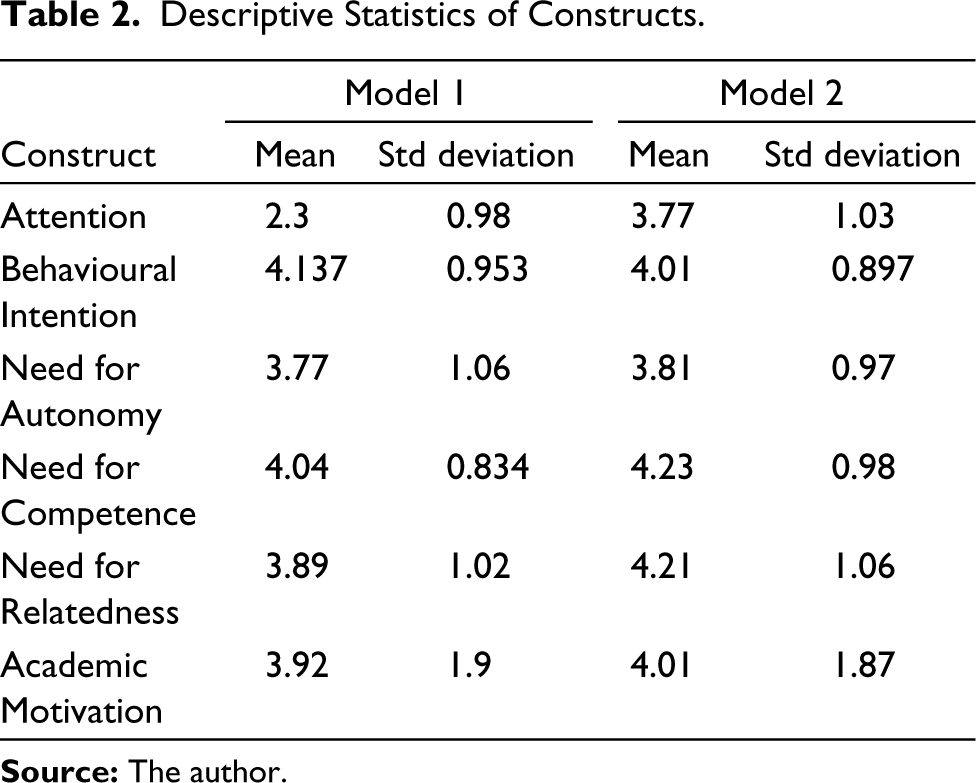
Our sample for both phase 1 and phase 2 included students enrolled in interactive distance learning programmes in four different tier one management institutes of India. The questionnaire was circulated online using a Google doc. The number of questionnaires sent out were 1,200 each time, and the final number of responses were 414 in phase 1 and 307 in phase 2. Table 2 represents the descriptive statistics of the constructs for both phases.
Descriptive Statistics of Constructs.
Addressing Common Method Variance
Common method variance (CMV) was controlled in both the phases by using procedural and statistical remedies such as random arrangement of items to break the monotony of the respondents, reverse coding of items, educating the respondents that there are no correct or incorrect answers, assuring them about the pure academic motives behind the survey and the anonymity of their responses, and pressing on voluntary survey. The pilot survey allowed us to conduct exploratory analysis and testing for reliability and validity of measures adaptation in the context. Clear and concise directions were shared on both occasions with the respondents about the research and procedure for filling the questionnaire.
Factor Validity and Reliability Analyses
The present study uses four scales, namely, BNW Scale (Durksen et al., 2016), Academic Motivation Scale (Utvær & Haugan, 2016), Behavioral Intention (Alharbi & Drew, 2014) and the Attention Scale (Huang et al., 2006)—those are already established in the literature. However, the established scales have been used for a different population comprising of students undertaking a management course delivered completely online by four different business schools in India. The items in the scale were also modified to fit the context and make it more meaningful for the set of respondents chosen for the study. The Cronbach’s alpha value for all five constructs exceeded the usually accepted value of 0.70 (Nair & Das, 2012), suggesting a high correlation between the observed value and the true value. The values of Cronbach’s alpha have been represented in Table 1. Also, the average variance extracted (AVE) was > 0.5 (Hair et al., 2013) in both the phases.
Hypothesis Testing and Structural Model
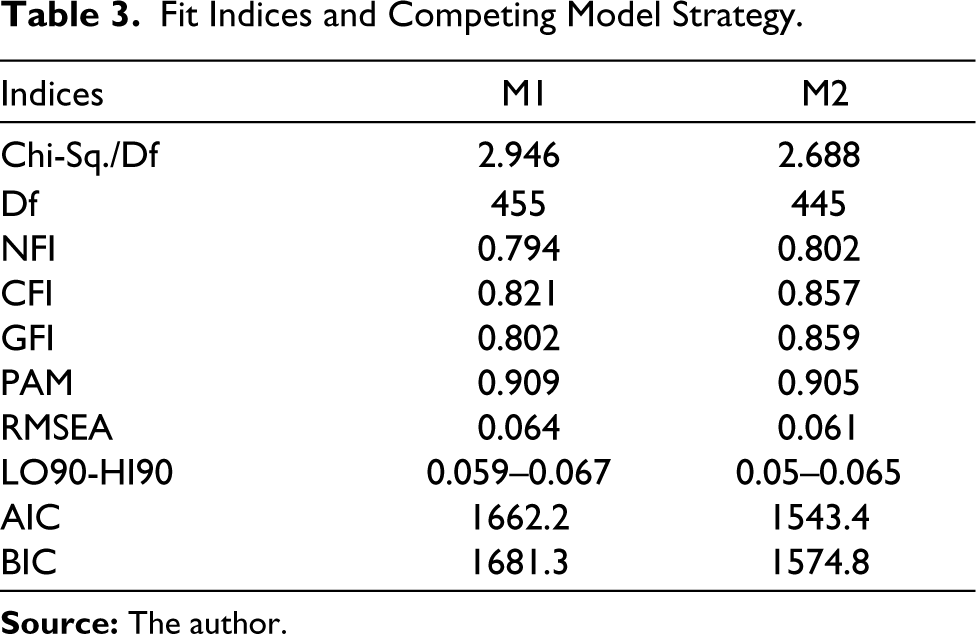
We measured the proposed measurement model MI (phase1) and M2 (phase 2) using AMOS 20/SPSS 25 to test the hypothesis. The fit indices suggested a good fit of data for the model (M1), with corresponding fitness indices as follows: χ2/Df = 2.695, GFI = 0.802, NFI = 0.794, CFI = 0.821 and RMSEA = 0.064. The same factors confirm for the phase 2 data as well, as reported in Table 3. It was found that even though the interrelationship among all five independent variables did not hold true, the basic psychological needs in the existing models exhibited a strong co-variance.
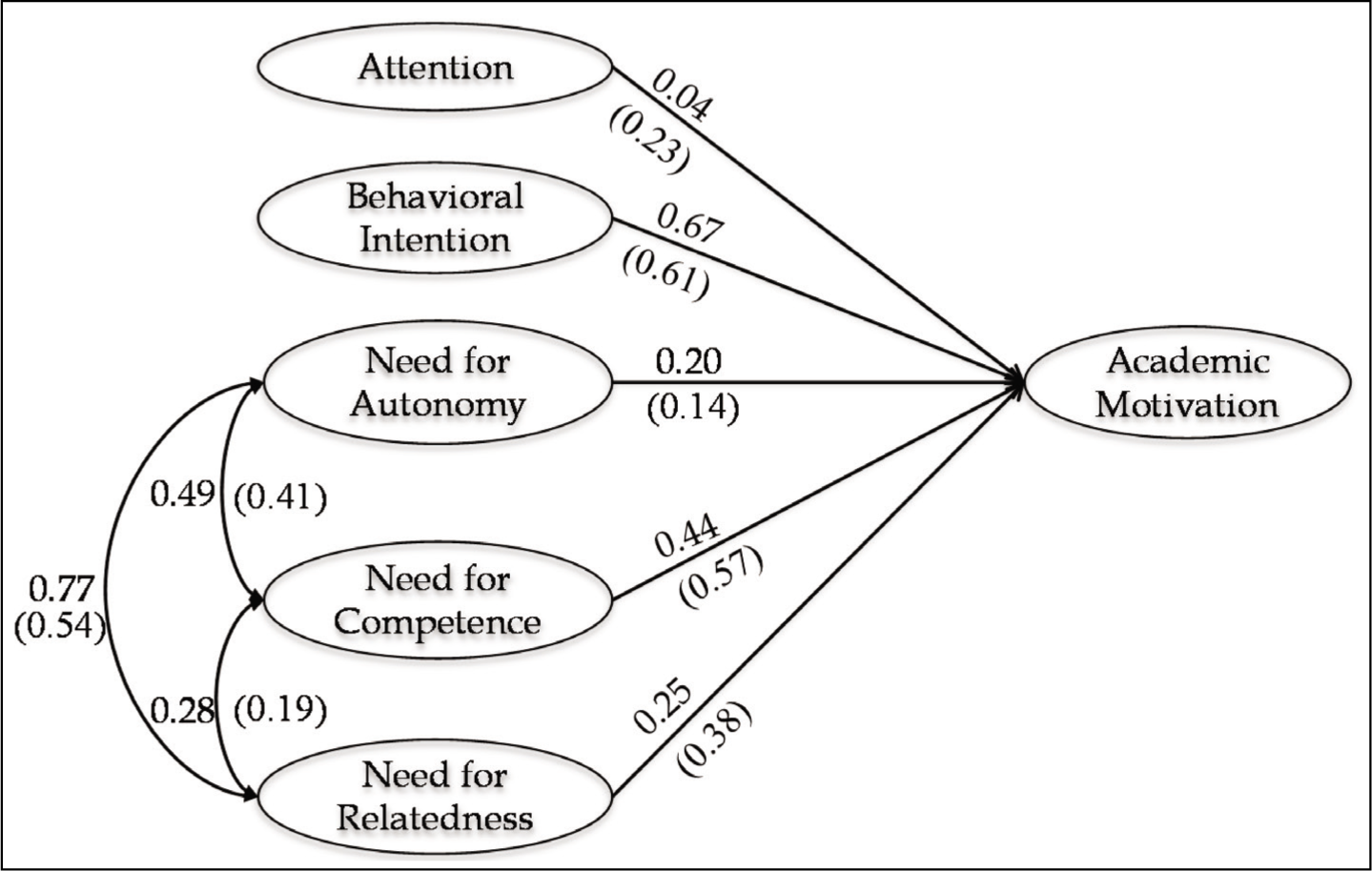
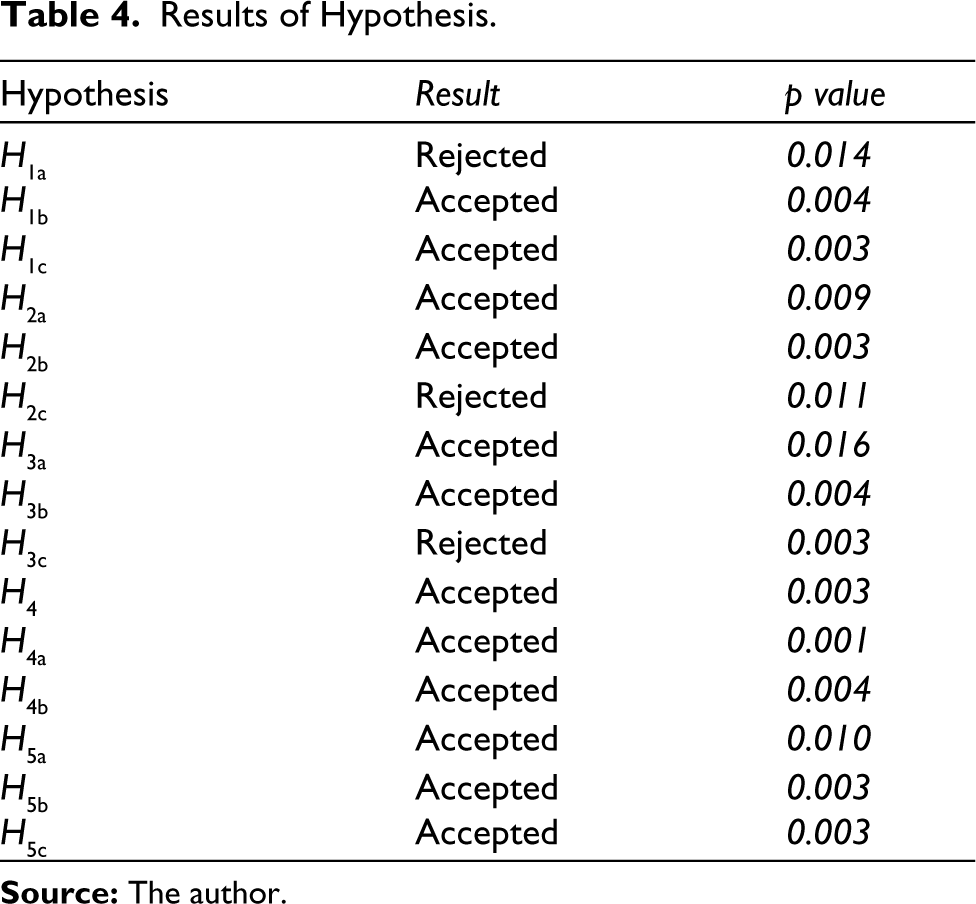
Based on the model, the statistical significance of the path-coefficient among the constructs was considered to test the hypothesis. The data supported 12 of the 15 hypotheses considered in this study. The number given in the parenthesis in Table 3 depicts the value for phase 2 data. H1a (relationship between attention to academic motivation in pre COVID) was rejected (β = 0.04, t = 1.26, p = 0.104) at p < 0.05 level of significance whereas, the same relationship during COVID was accepted (β = 0.23, t = 2.11) all other hypotheses H2a and H2b through H5a and H5b were accepted at p < .05 level of significance. The test statistics are as follows: H2a (relationship between behavioural intention to academic motivation) was accepted (β = 0.670, t = 2.34 (2.17)), H3a and H3b (relationship between need for autonomy to academic motivation) were accepted (β = 0.20, t = 2.14 (2.01), and H4 (relationship between need for competence to academic motivation) (β = 0.44, t = 2.56 (2.48) and H5 (relationship between need for relatedness to academic motivation) were accepted (β = 0.250 t = 2.33 (2.12)).
Fit Indices and Competing Model Strategy.
The path model for phase 1 evinced that attention negatively predicted academic motivation (β = 0.04; as shown in Figure 1). However, the attention of the learner yielded a stronger positive effect on the academic motivation of the learner during COVID. The basic psychological needs, need for autonomy (β = 0.20, (0.14)), need for competence (β = 0.44, (0.57)) and need for relatedness (β = 0.25, (0.38)), is also observed to positively predict the academic motivation of e-learners during both the phases. The basic psychological needs also exhibited a strong co-variance among themselves. The β value for the co-variance between need for autonomy to need for competence is found to be 0.49 (0.41). The β for need for competence and need for relatedness is 0.77 (0.54) and the need for relatedness and need for autonomy is found to be 0.37. The test results for the hypotheses are represented in Table 4.
Results of Hypothesis.
Discussions and Implications
The current pandemic enforced an unplanned global transition of traditional learning to a completely synchronous online mode for continuing education. The digitally synchronized mode of holding formal classes is becoming the new normal, thereby making it increasingly important to understand the change in learners’ attitude and behaviour due to the enforcement. The literature suggests that motivation shapes the attitude and behaviour of the learner in an educational environment and is understood to be crucial to e-learning success. Thus, understanding the motivational bases of e-learning before and during COVID is a pre-requisite for identifying the psychological processes underlying desired learner behaviour and subsequent e-learning effectiveness during the pandemic.
At the pre-set of such advancements in academia, and the confining health emergency, it was imperative to understand the factors that instigate learners’ motivation towards an academic course over a period. The need for learner motivation in successful e-learning has been long realized; however, research is skewed towards cognitive and technological aspects of the learning environment. Also, a strong theoretical foundation in enhancing the academic motivation of learners is imperative to e-learning success. It is observed that all six dimensions of the learning environment, namely, learner, instructor, course, design, technology and environment (Asoodar et al., 2016), influence the learner’s motivation. Also, the SDT is predominantly used in the e-learning literature along with other relevant theories such as the TRA, the EVT and the ARCS.
The CFA validates the factor structure, where the independent factors are considered as first order constructs and the dependent factor is considered as the second order construct, comprising of three first order constructs. Subsequently, the study validates the conceptual model in both phase 1 and phase 2 using path analysis (SEM). The results of SEM validate the conceptual model proposed that reports a direct positive association between the basic psychological needs and the academic motivation of the learner during both pre-COVID and COVID times. Need for competence exhibits the strongest relationship during pre-COVID times, while the related needs exhibit the strongest relationship during the COVID times. However, a strong covariance is observed between the basic psychological needs during both pre-COVID and COVID times. This highlights that the basic psychological needs are strongly related in this context, which enforces the stakeholders to consider these needs as a collective measure to improve academic motivation of learners The behavioural intention of the learner is also found to be instrumental to academic motivation during both phases. Surprisingly, attention of the learner is observed to have a positive, yet weak, association with academic motivation for the study under consideration during phase 1, while a stronger association is observed during COVID times. Particularly, the stakeholders need to cohesively understand the learner’s perspective for enhancing their academic motivation during practice. Moreover, behavioural intention as an independent variable strongly influencing academic motivation can be used as a leveraging factor to motivate the learners towards the academic subject.
The test results for H1a suggest a weak but positive relationship, while H1b suggests a very strong relationship, at a 5% level of significance. Considering the path coefficient value of 0.04, the H1a is rejected while H1b is accepted. This result H1a is in contradiction to a quasi-experimental research (Sun et al., 2017) suggesting a strong positive relation between attention and learner’s motivation (both intrinsic and extrinsic). However, the earlier result aligns with H1b. This could be attributed to the learner’s curiosity with regard to technological interventions like Zoom Breakout sessions, during this sudden transition, which may decline in the post COVID era. Also, the learner’s realization that the pandemic is here to stay must have pushed them to focus more on the content to avoid long-term loss. Lack of distraction due to confinement during the lockdown could have generated more attention towards academic subjects as well. Also, the literature reports several pedagogical interventions such as online book reading (Sutarto et al., 2020) and WhatsApp groups (Susilawati and Supriyatno, 2020) taken by the instructors during the pandemic that could have contributed to the increased learner attention as well. This is also reflected in the strong relationship between intrinsic motivation for stimulation (IMS3) and attention (A6 and A5). Efforts were also made to improve the brevity and clarity of the instructional material (Sutarto et al., 2020) and impart it using simpler media to make it more interesting to and eye catching for the learner. This relationship is supported by the strong association between identified extrinsic motivation (EMID 2) and attention (A6). Significant difference is observed in the relationship established in H1a and H1b, and hence, H1c is also accepted.
The data strongly supported H2a and H2b. The sample taken in our study are working executives who normally undertake online degree for either higher qualification, promotion, self-satisfaction or career advancements. Since behavioural intention is rooted out of the conscious decision-making process, our sample exhibits a strong association of behavioural intention to their academic motivation. This result is in line with the result obtained by Liaw and Huang (2011) among learners in China. The study in China considered motivation in general and not the academic motivation. The present study also finds that the behavioural intention of learners has the most significant positive relationship with the learner’s extrinsic motivation followed by his intrinsic motivation during pre-COVID times. This implies that since working executives are domain experts, and business management involves multi-dimensional subjects, the learner’s behavioural intention to learn is in shape. However, a stronger relationship is observed with intrinsic motivation of knowledge (IMK1 and IMK2) and intrinsic motivation of accomplishment (IMA3) during COVID. Considering the significant drop in job market demand and risk involved in future opportunities, learner’s intention to maximize intrinsic gain could have been responsible for the change.
The results substantiated a positive influence of autonomy needs on academic motivation (H3a and H3b). The demographic characteristics suggest that most respondents are employed in the private sector (84.67%) so they might enjoy lesser flexibility in terms of working hours. Since respondents working in private sectors have more time constraints and workload, the need for self-organizing their action and experiencing volition in undertaking the course is expected to be high, as established by the model. This result is similar to the observation of Chirkov and Ryan (2001), in a cross-cultural study among learners from the United States and Russia. Also, need for autonomy (BPNA1) exhibits a stronger association between intrinsic motivation of knowledge (IMK1) and identified extrinsic motivation (EMID3 and EMID4) during COVID. This can be attributed to the increased awareness of self-improvement and personal value owing to hardships and time available for introspection that could have brought about the change. Since the relationship during pre-COVID and COVID times did not vary significantly H3c was rejected.
In a study on Chinese students undertaking secondary school education, Hui et al. (2011) observed the strongest relationship between need for competence and their academic motivation when compared to the other constructs during COVID (H4b). A significant positive relationship was observed during pre-COVID times as well (H4a). Several studies have reported academic achievement of students to be influenced by various competence-related constructs like perceived school competence (Guay & Vallerand, 1996) and felt competence (Schuler et al., 2010). This is in line with the results in our study, which observes a strong positive correlation (H4a) between the need for competence and the academic motivation of learners in the pre-COVID times. A significant positive relationship with need for competence of the respondents in this study can be rooted in their choice to undertake an online business management degree in spite of having jobs and a minimum qualification of bachelor’s degree. The sudden crisis in job market wherein many people lost their jobs could have been the reason for improved competence needs. The stronger association between need for competence (BPNC1), identified (EMID1 and EMID2) extrinsic motivation and introjected extrinsic motivation (EMIN1) also explains the same phenomenon.
In a study, Durksen et al. (2017) employed a Bayesian network to establish the probabilistic relationship between the basic psychological needs in the context of (MOOC). It was observed that participants high on autonomy had an 80.01% probability of having a medium level of competence. However, the need for relatedness was observed to be a distinct need as per the study. This result is in line with the results obtained in the present research suggesting a strong positive association between need for relatedness and academic motivation of learners (H5a and H5b) in both pre-COVID and COVID times. However, the path coefficient (0.57) was much stronger during COVID. A synchronous learning environment (as taken in our study) is expected to evade transactional distance and create an interactive and engaged learning set up, thereby proving the strong association with need for relatedness as found in our study. However, absolute confinement and the resulting isolation from the outer world could be the reason for the increased need for relatedness during COVID. Furthermore, when everybody is following the new normal, it is imperative to follow the subjective norms as suggested by the TPB (Deosthali & Johnson, 2021). This is similar to the observation made by Guiffrida et al. (2008) reporting higher needs of relatedness for learners at home than that in their formal learning environment during pre-COVID times. Interestingly, need for relatedness (BPNR3) exhibited a stronger relationship with intrinsic motivation of stimulation during COVID (IMS1 and IMS2). This can again be attributed to the luxury of being able to digitally socialise in spite of confinement to our homes during COVID.
Limitations and Further Directions
This study contributes to the body of knowledge and scholarly debates on academic motivation. Like any other scientific enquiry, this study too has few limitations, paving the way for future research. First, the sample chosen for this study is tier-one business schools in India, which may vary across different geographies. Second, no objective measure is used to measure the academic performance of the concerned learners and the data is limited primarily to their academic motivation.
A look into the longitudinal data, post COVID to study the motivation of the learners at various intervals can unravel a better understanding of motivational trends under different timeline. It would be interesting to observe how the lack of synchronicity in learning influences the role of other stakeholders in the environment. Further this method of learning analytics (Giesbers, 2013) may unravel several findings to student online learning behaviour and e-learning success.
Footnotes
Declaration of Conflicting Interests
The author declared no potential conflicts of interest with respect to the research, authorship and/or publication of this article.
Funding
The author received no financial support for the research, authorship, and/or publication of this article.