



Abstract
This study conducts an analysis of social media discussions related to high engagement sports brands. More specifically, our study examined the English Premier League (EPL); it sought to retrieve data systematically over the same day, weekly, for a period of five months. After this process, we had built 20 datasets and NodeXL was utilized to analyse the data. After we had this data, we were able to use qualitative observations to identify key users and conversations that formed around the EPL as well as the connections between the conversations that arose from the brand’s posts and the people involved in them. We also analyzed the quantitative data underpinning our network visualisations to provide further insights. The most obvious initial finding was that when the EPL tweets, it prompts a large volume of conversations directly related to these tweets. However, we also noted that EPL tweets also help instigate further, sometimes unrelated, tweets and conversations. More specifically, we identified that the visualized network of conversations was of a broadcast form, which is characterized by messages being generated by a central account (the EPL) and shared by a number of decentralized users. Based on our analysis, we propose guidance around (S)ocial media presence, (C)rafting the message, Planned (i)ntervention, (S)pontaneous follow-up, and (M)essage mortality to form the SCISM framework. This framework is likely to be of interest to brands that wish to promote, sustain and benefit from their instigation of social media.
Introduction
Sports brands have increasingly become a focus for academic researchers and practitioners, which has resulted in numerous studies being published. Inevitably, the breadth and focus of these studies has been impressive, embracing all manner of issues—including brand extensions, brand equity and brand value. Whilst the overall relevance and quality of this body of work is acknowledged, this study nevertheless focuses on an emergent area of research: brands and social media. There is a growing number of studies in this field, although the scope of work remains somewhat limited. In seeking to address this issue, we therefore set out in general to examine social media conversations about sports brands.
More specifically, our research seeks to identify how social media conversations are prompted, what the network form of these conversations is, and what this means for sports brands that utilize social media. In particular, we were interested in high engagement sports brands; that is, those brands with which social media users cognitively and behaviourally engage. Linked to this, we speculated that influencers within such networks would have an important impact upon such matters. As such, the research questions were: what network form do social media conversations for a high engagement sports brand take, who are the important influencers in the network, and what implications these considerations have for brand managers when using social media? Although the nature of social network structures have been considered in recent academic research (Himelboim et al. 2017), there is a lack of empirical research which has examined the network structures of high-impact brands. Moreover, our research questions respond to various calls from the literature—including Burton et al., (2017), who call for further research on the use of social media mentions as a strategic device for promotion. In addition, Sharma et al. (2018) conducted an extensive literature review on the use of SNA and netnography to evaluate usefulness and opportunities for further research. They highlighted the importance of SNA as a method to analyze social networks to derive insights in order to understand more about brand management and future branding decisions.
Context
Sports brands are amongst some of the most visible and successful brands in the world. Global brand league tables illustrate this (Brand Directory, 2018), whilst several influential business publications routinely report rankings of sports brands. The significance of sports brands is reflected in academic literature, with a growing number of studies having been published over the last decade. The notion of a sports brand is a broad one, for example incorporating athletes (Arai et al., 2014), apparel (Aghekyan-Simonian et al., 2012) and competitions (Richelieu et al., 2011). In turn, studies of sports brands have been undertaken in sports as diverse as motor racing (Amato et al., 2005) and surfing (Moutinho et al., 2007). However, we note a preponderance of branding studies pertaining to team sports (such as Bauer et al., 2008), from which we have drawn in framing this study. In particular, existing research into football clubs (like Richelieu and Pons, 2006) is of importance here, notably in the way that branding provides the underpinning for management decisions (Gladden and Funk, 2002) and for consumer engagement (Hollebeek et al., 2014).
The rapid and massive growth of social media (Kaplan and Haenlein, 2010) over the last decade or so has been striking. This has resulted in brands on social media becoming ubiquitous across all industrial sectors. Yet it is arguable that sports brands are amongst the most prominent of social media users, which has resulted in metrics and measures of social media performance being created (for example, Peters et al., 2013). This undoubtedly reflects the visibility and power of sports brands, not least for the way in which consumers often passionately engage with them (Cayolla and Loureiro, 2014). In utilizing social media platforms such as Twitter (Parganas et al., 2015), Facebook (Waters et al., 2011) and Instagram (Anagnostopoulos et al., 2018), sports brands have simultaneously encountered new opportunities, but new challenges too. For instance, social media has enhanced communication with consumers (Mangold and Faulds, 2009) and enabled sharing and co-creation to take place (Filo et al., 2015). At the same time, the unmoderated and viral nature of social media means that brands may sometimes encounter difficulties in managing discussions that take place about them (Baptista et al., 2017).
In this context, we accept there is an almost symbiotic relationship between sport and social media, albeit one that can be problematic. This is embodied in the notion that social media helps to facilitate engagement between brands and consumers via communication (Bruhn et al., 2012). This may variously involve unilateral, bilateral and multilateral communications between brand and consumers, whereby one talks to the other or where there is a dialogue between both parties (which may sometimes involve groups of consumers, possibly other brands too). Communication and talking in connection with brands is not a new phenomenon, and has been examined in the literature (for example, see Lynch and Chernatony, 2004), and we note the significance of work on word-of-mouth (Keller, 2007), electronic word-of-mouth (Chu and Kim, 2011) and viral marketing (Ferguson, 2008). Notwithstanding these bodies of work, we nevertheless assert that social media conversations are increasing, distinctive and worthy of further examination.
In simple terms, a conversation can be defined as a talk between two or more people in which thoughts, feelings and ideas are expressed, questions are asked and answered, and news and information is exchanged. In terms of social media, conversations about brands can be closely linked to co-creation (Ind et al., 2013), prosumption (Ritzer and Jurgenson, 2010) and experiential marketing (Schmitt, 1999), as they not only contribute to dialogue but also to the nature and strength of the brand being talked about. Implicitly, we believe that such social media conversations about brands are both cognitive and behavioural in nature. Drawing from Brodie et al. (2013), we identify this as being ‘engagement’: a process whereby social media users not only think about posts they have read, but also act upon these thoughts. For the purposes of our research, we argue that this involves clicking on a link, viewing content, and then posting user-generated content (both in written and other forms). Given the intensity of social media use by sports fans (Hanna et al., 2011), we additionally argue here that sports brands utilizing social media induces conversations amongst users (in other words, consumers of content) that are sometimes of a highly engaged nature.
We accept that some sports brands are likely to have less engaged users, with consequent effects upon the volume and nature of conversations. However, in, for example, high profile sports where there is evidence of its widespread popularity and of its economic or socio-cultural significance, we believe high brand engagement is often evident amongst social media users (Kim and Ko, 2012). Even so, we contend that within such groups of users, some social media accounts (which may be individuals or organizations) are more influential than others. Hence, as a further dimension to this study, we highlight the relevance of influencer marketing (Murphy and Schram, 2014) and of the growth of online and social media influencers (Kapitan and Silvera, 2016).
A final dimension of our study is at one level a matter of semantic detail, though at another level is more substantial. Social media platforms are often referred to as being networks, consisting of connections and contacts through which communications flow (Tang and Liu, 2011). The implication of this for our study is that conversations do not simply pass from one social user to another. Indeed, the very essence of platforms such as Twitter is that multiple users are involved in multiple conversations about multiple subjects across significant periods of time. We embraced this notion and drew from it in crafting our methodology.
Brand Engagement
For the purposes of this study, we adopt the view that social media conversations about brands are an engagement issue. Van Doorn et al. (2010) see engagement as a behavioural phenomenon, defining it as manifestations that have a brand or firm focus, beyond purchase, resulting from motivational drivers. Dessart et al. (2015), Dwivedi, (2015) and Hollebeek et al. (2014) instead view engagement as being cognitive, emotional and behavioural, while Brodie et al. (2013) subsequently distils the debate into the notion that consumer engagement is essentially a multi-dimensional concept. Vivek et al. (2012) develop this, stressing that engagement represents the intensity of an individual’s participation in and connection with an organization’s activities, which either the customer or the organization initiate. Chakraborty and Bhat (2018) make the point that due to the growth of digital platforms and social media, brands may have less control of their own brand. Furthermore, Khan & Krishnan (2017) note how social media can be used for electronic participation with government, citizens and politicians.
The likes of Brodie et al. (2011) view the process of engagement as being interactive and co-creative, involving a focal point or hub (normally a brand). In turn, this process is characterized as being dynamic, iterative and individualistic. That said, the aggregation of information about individual engagements is highlighted as being important, often for purposes of economy and efficiency, to a brand’s understanding of target audience behaviour. In this context, several studies (such as Cvijikj and Michahelles, 2013; Wirtz et al., 2013) assert that the analysis of social media posts are an important part of our understanding of brand engagement.
Osei-Frimpong and McClean (2018) argue that social media enables brands to connect with consumers by creating and communicating the brand’s story, using brand or brand-related language, images and meanings. This also enables consumers to share their experiences with the brand and integrate them in their expressions (Hammedi et al., 2015), permitting them to build brand knowledge and associations, brand usage intent and motivation to engage in electronic word of mouth (e-WOM) (Luís Abrantes et al., 2013; Habibi et al., 2014; Relling et al., 2016). In turn, Dessart et al. (2015) explain how brand engagement does not take place along a single brand nexus, instead involving a complex network of interactions.
As such, we undertook our study on the basis that brands seek to establish and build engagement with social media users with a view to inducing both, cognitive and behavioural reactions among target audiences. By this, we infer that recipients of brands’ social media communications are likely both to think about and respond to message posts, a process some observers might refer to as a process of co-creation. We accept that this process is nevertheless individualized, though set in the context of a sometimes complex network of related social media activity. In reading, sharing and adding further content to a brand’s posts, we contend that key target audiences (as well as other social media users) do so for a variety of reasons— including for reasons of building self-identity, creating social media communities and sharing information about brands with which they have some degree of engagement.
Influencers
In simple terms, influencers are people who, or entities that, influence others. Research has shown that celebrity influencers can have a positive impact on consumers’ purchasing intentions (Gauns, Pillai, Kamat, Chen, & Chang, 2018). Drawing from the conception of brand engagement presented here, we posit that influence is both cognitive and behavioural in nature. With the onset of social media, notions of influence and influencing have taken on renewed importance, with a sphere of marketing now devoted to the study of influencers (for example, see Freberg et al., 2011). As such, influencers are held as having an important role in instigating, transmitting and sustaining communication. Research has examined how consumers attach to a brand based on a concept known as perceived authenticity, which may also apply in the case of social media influencers (Arya, Verma, Sethi, & Agarwal, 2019).
Whilst it is not intended for this paper to be a study of influence, we do nevertheless acknowledge that in analyzing social media, brands and networks, influencers play an important role and are, therefore, worthy of analysis. Accordingly, we have incorporated influence into the work in anticipation of identifying key influencers in our analysis of social media networks. It is nevertheless important to note that in this study, we do not set out to distinguish between paid influencers and people/entities held as being influential.
In one sense, all social media users either are or have the potential to be influencers, although at different levels and relative to the network considered. If one’s posts are liked, reposted, retweeted or provoke a response, it can be argued that there has been influence of both a cognitive and behavioural nature. Cook and Sheeran (2004) identify subject matter experts, journalists and other semi-public figures, and highly visible public figures, as being amongst the most notable influencers. In turn, different influencers are believed to impact upon many different people in many different ways (Kiss and Bichler, 2008). Studies indicate that such influencers are content creators, characterized by their posting of blogs, videos and so forth (Booth and Matic, 2011). We nevertheless stop short of such a view, instead identifying influencers as those that have large followings (Abidin, 2015), possess desirable attributes (such as credibility, expertise or enthusiasm) (Khamis et al., 2017), or have network significance in terms of connectivity and/or centrality, which enable them to reach a disproportionately large number of other social media users (De Veirman et al., 2017).
Social Media and Networks
Just as the Internet provides a business opportunity (Nagar, 2018), recent evidence illustrates just how important social media has become for brands, with upwards of 90 per cent commonly using two or more platforms (Morrison, 2015). These platforms are variously used by brands in a multitude of ways: for example, engaging customers in dialogues and relationships which in previous eras were virtually impossible to accomplish (Ashley and Tuten, 2015); enabling brands to establish and accentuate positioning (Tsimonis and Dimitriadis, 2014); and adding value to businesses via the monitoring of the large volumes of social media data that are revealed on a daily basis through consumers’ posts on the likes of Twitter, Facebook, Instagram (Peters et al., 2013), and so forth. Moreover, research has examined electronic word of mouth on social media (Kapoor, Jayasimha, Sadh, 2013).
Whatever the perceived benefits of social media, there remain some concerns about how brands should best make sense of the chaos—of which the 30 million+ Facebook messages and 3,30,000 Tweets per minute are evidence (Bagadiya, 2018). Kane (2015) has already called into question the value of what companies are observing and measuring, stressing that many often employ insufficiently robust or rigorous approaches to their analysis of social media data. Furthermore, Kane expressed concerns that social media research is governed by straight-line thinking, when in fact a more dispersed, connected form of research is needed. Indeed, Mount and Martinez (2014) have additionally observed that with a framework through which to convert the mass of user-generated content into knowledge, the business value of social media will remain hidden.
On this basis, Berkman (2013) recommends that the collection of social media data and its analysis should be undertaken on a holistic basis. Kane (2015) develops this notion, noting how important it is for brands in their assessment of social media effectiveness to account for the proximities, interactions, relationships and flows associated with their online presence. Importantly, the significance of Twitter hashtags and trending topics are highlighted because they enable people to find and organize information around a common interest, even if they do not know each other.
The concept of analyzing offline social networks dates back many years, with the identification of network shapes and information flows having been of interest to social media researchers and brands. Network analyses involve, for example, understanding how customers communicate, and can help brands to understand and improve their communications with target audiences (Kozinets, 2015).
With the growth of online social networks, digital tools for Social Network Analysis (SNA) have also been developed. These analytical tools have existed for decades but as social networks have expanded, the tools have become ever more advanced, and the data generated by them richer and broader in scale. Tools such as, for example, NodeXL can be used to analyze social media networks to create SNA diagrams. The diagrams help to reveal different network shapes, which may also reveal other features of a network, including:
How people connect with each other (referred to as nodes); Ties between people (referred to as edges); Identification of the influential or most connected people in a network.
SNA, underpinned by Graph Theory, allows for the mathematical manipulation of sociograms, consisting of a set of nodes and edges. This means that networks can be graphed, with additional information about nodes and edges contained within the graph. A network at its most simple level can be the relationship between objects. Davies (2009, p.5), finds that ‘SNA pays attention to the structural relationship between actors’ which identifies SNA as a method that enables a researcher to conceptualize social structures as a network of social ties. Academic studies using SNA consider how ‘nodes’ connected by ‘edges’ pass information with value academically being the conversation, and that information passes through these networks. As such, Scott (2017) finds that networks contain actors and their relationships with entities, events and interests—such as friendship, love, money, power and ideas (Crossley 2010).
Furthermore, the unit of analysis is not the individual but their embedded connections. De Nooy et al. (2005) suggested that the principle goal of SNA is detecting and interpreting patterns of ties amongst network connected actors (An et al., 2018). Through the process of considering these, SNA highlights the ‘structural relations usually opaque to lay actors, through delineating the ties between parts of social bodies’ (Knox et al., 2006, p. 117). A simple definition is that SNA provides methods enabling visualization, mapping and analysis of social networks. SNA is also further defined through relation to established theory and methods with Scott (2017), finding that it provides vocabulary and measures for relational analysis without the acceptance of a single theory of social structure. Analysis consists of consideration of representation of networks, strength of strong and weak ties within the network, identification of key central nodes within the network and network cohesion—this being measurement of overall network structure.
Methodology
Although various social media analytics tools such as Twitonomy exist, it is important to differentiate these from SNA. The research questions in this paper lend themselves to SNA, in order to analyze network forms over time to derive implications for brand managers. Tools such as Twitonomy are not suited to such questions of network form, so we have selected NodeXL for this study as one of the leading SNA tools. NodeXL has been used as a tool for SNA in a wide range of academic and marketing research studies in order to study the forms of networks. Most recently, research using social network analysis and NodeXL has examined misinformation networks related to COVID-19 on Twitter (Ahmed, Seguí, Vidal-Alaball, & Katz, 2020).
Usually, these studies feature a single snapshot for the analysis of network forms and shapes. In our paper, we analyzed multiple temporal snapshots in order to evaluate how these networks change over time. So therefore, other social media analytics software would have been more suitable for research questions relating to Twitter analytics more broadly, which is not the subject of this particular paper.
Although most social media networks can be analyzed, Twitter is arguably the most open platform and, hence, lends itself to visualizations in network graph form using SNA tools. Similar to geographic trade maps, network graphs highlight information flows, and positions of people and accounts. A network graph can highlight users who are leaders in a discussion, and pinpoint to their location in a network and their connections over time. Behind SNA diagrams, there is numerical data (such as the number of retweets or use of hashtags), which can measure a number of different things. It is possible to analyze these numerical values and equally, to use the data and visualizations for qualitative analysis.
Notwithstanding concerns about the volume of daily social media traffic, we nevertheless maintain that this traffic generates valuable data, which is important for researchers to gather, analyze and make sense of. In our case, we believe that peoples’ social media conversations about brands reveal a great deal about who leads these conversations, how the conversations spread and, ultimately, what this means for brand managers. In particular, we support the use of SNA tools as they help one to understand the flow of communications and the structure of the conversations in which social media users engage.
In order to address our research question, social media conversations of a high engagement sports brand were analyzed. When it comes to high engagement brands, they’re likely to generate a lot of content which may lead consumers to read them, reflect and act on them. This may entail sharing a post or clicking on the like button. On other occasions, this could be generating new content.
In this study we examine the English football league known as the English Premier League (EPL). This league is known as a very successful one, and it attracts massive audiences and generates vast amounts of social media content. The study selected Twitter for the data because it provides access to its data through its Application Programme Interface (API). The rich metadata provided makes Twitter an ideal source when undertaking an SNA study. We selected the official Twitter account of the brand in this case as a way to map out that network. The official Twitter account provided to be sufficient for retrieving data as it also picked up content around mentions and replied to the account.
For the EPL brand, social media data from Twitter was captured on the same day each week, every month, for four months (July to October 2016) using the account name ‘@PremierLeague’. We used NodeXL, which draws the Search API, to capture and analyse the data, which enabled us to qualitatively observe key influencers in conversations about the brand, and the connections between both the people and the conversations—which arose from the EPL Twitter posts. We then took systematic random samples of 1,000 tweets for each month from July to October 2016 to produce Figure 2. For Figure 3 and Table 1, we combined tweets from each month and then extracted an overall sub-sample for further analysis. Our study generated network visualizations, and then examined these in relation to previous literature. A number of quantitative statistics were also generated, providing additional insights into the network, such as influential accounts.
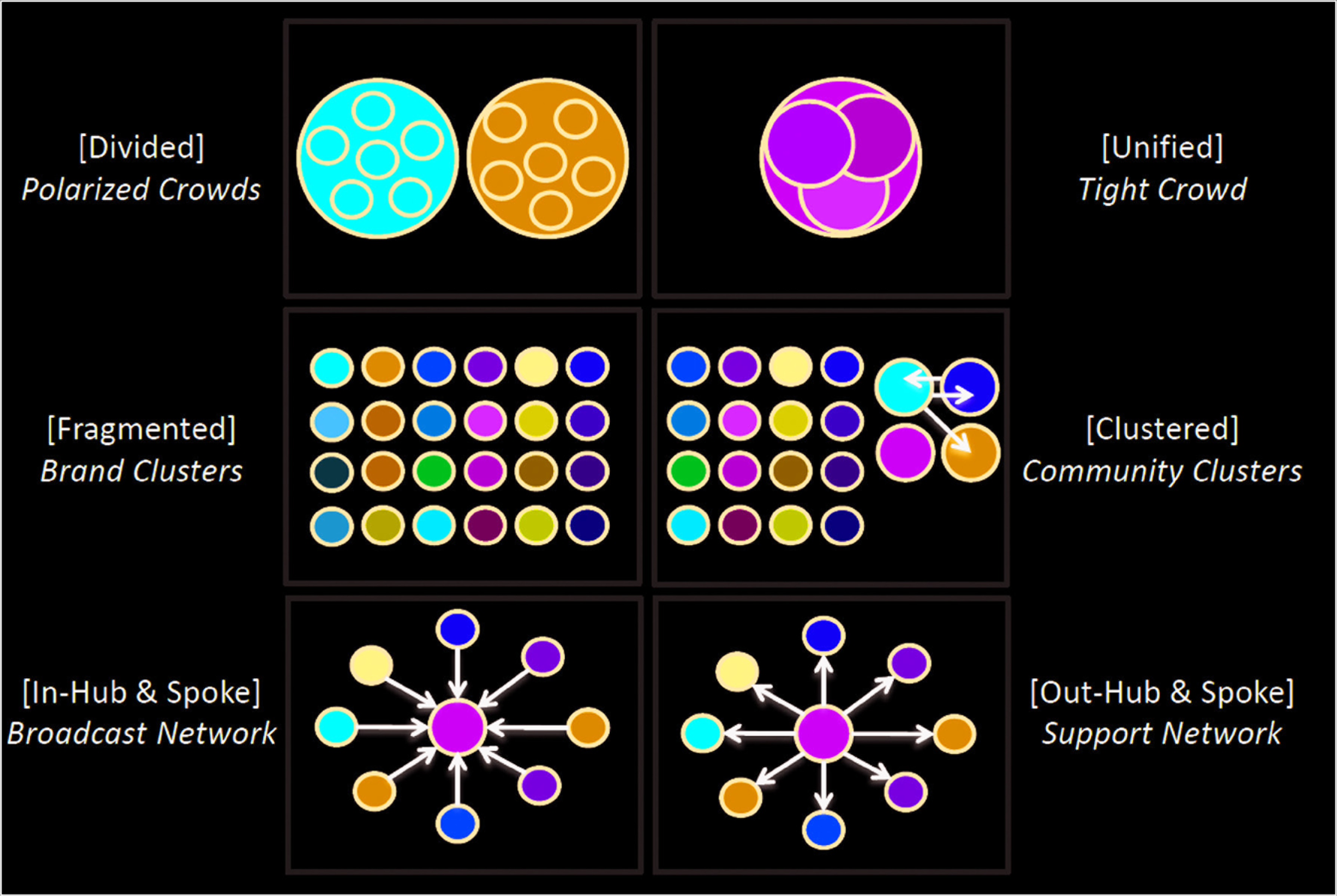
In undertaking an SNA study, we considered tie (edge) strengths and the identification of both, strong and weak ties. Ties represent interactions or information flow where tie weights are used as a gauge indicating the strength of an interaction, frequency of that interaction or the existence of reciprocity. We also gave further consideration to the network structure pattern of ties (edges). Clustering, for example, is considered within networks where individual clusters indicate groups of people with both, strong (whom we contend are influencers) and weak ties to the central protagonist (the EPL). Such clusters are used as a gauge to indicate levels of homophily and transitivity. Furthermore, our analysis considers the interaction between individual clusters and the edges that act as bridges where nodes and ties connect groups with other groups. Previous research has found that networks on Twitter will fall into six types as shown in Figure 1 (from Smith et al., 2014). The first type of Twitter network that can emerge is the ‘polarized network’, whereby groups of users are disconnected. This can occur in topics that may draw in polarized discussions, for example, related to politics where Twitter users may show support to one particular party and/or individual but not the other (Ahmed, 2019). The ‘brand network’ occurs when there are a large number of Twitter users who are tweeting about a topic without mentioning each other (known as a ‘brand cluster’), with only a few smaller groups of users who are having active conversations. A similar network structure to brand is known as ‘community clusters’ where there are many smaller pockets of discussion taking place, accompanied with a brand cluster.
Results
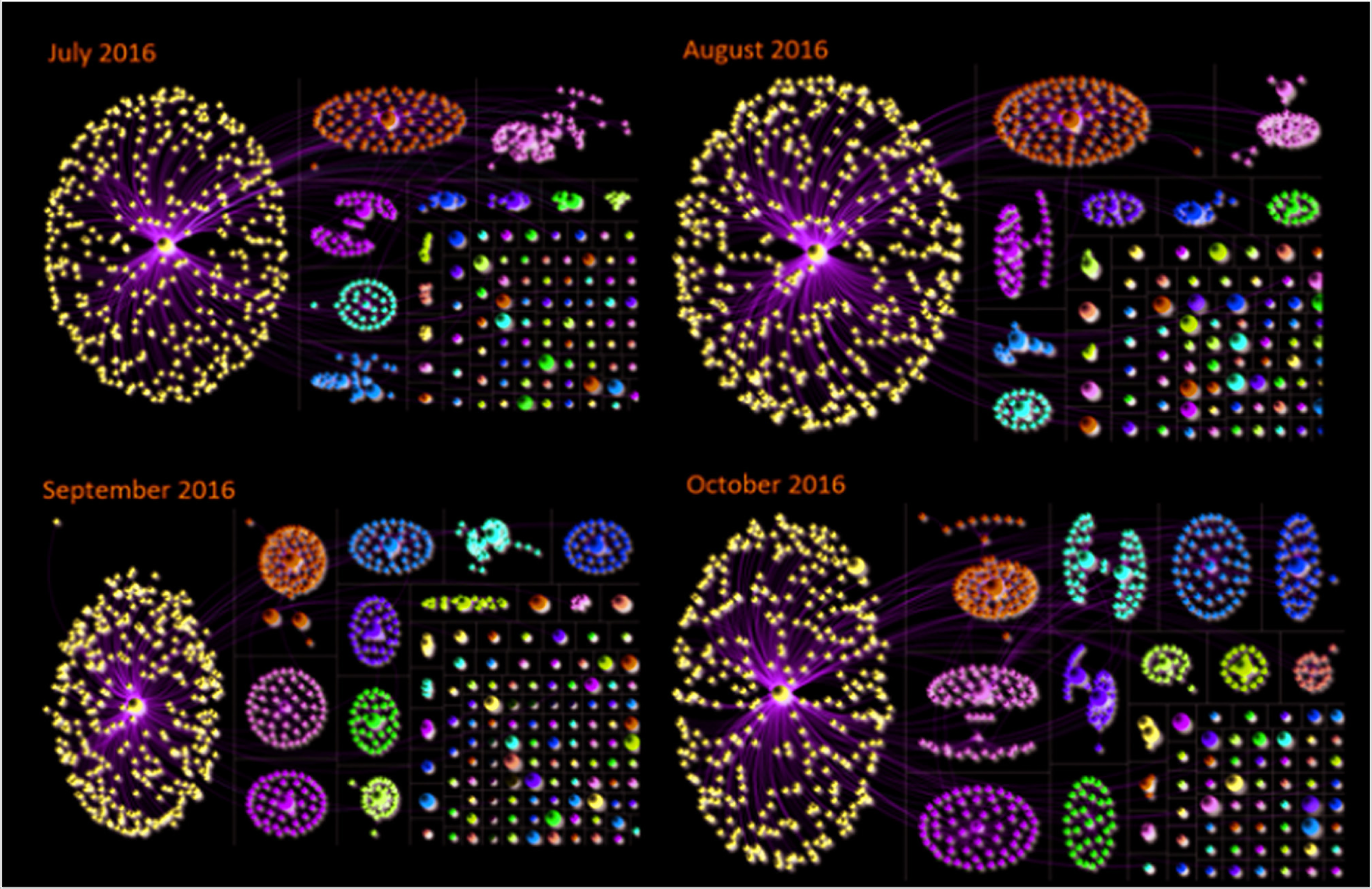
Figure 2 displays the shape of the EPL Twitter account (@PremierLeague) from July 2016 to October 2016, with each individual graph in the four-way comparison highlighting the network structure of the account. A method of interpreting network graphs from Twitter is to examine their structure, and to identify to what extent they match the ‘six types of Twitter networks’ that were outlined earlier. In order to generate Figure 3, we combined data from July 2016 to October 2016 and extracted a systematic random sample to examine the network structure and influential accounts over a four months-long time-period. In each of the network graphs below, there is a line connecting one user to another for each ‘replies-to’ connection, and for ‘mentions’.
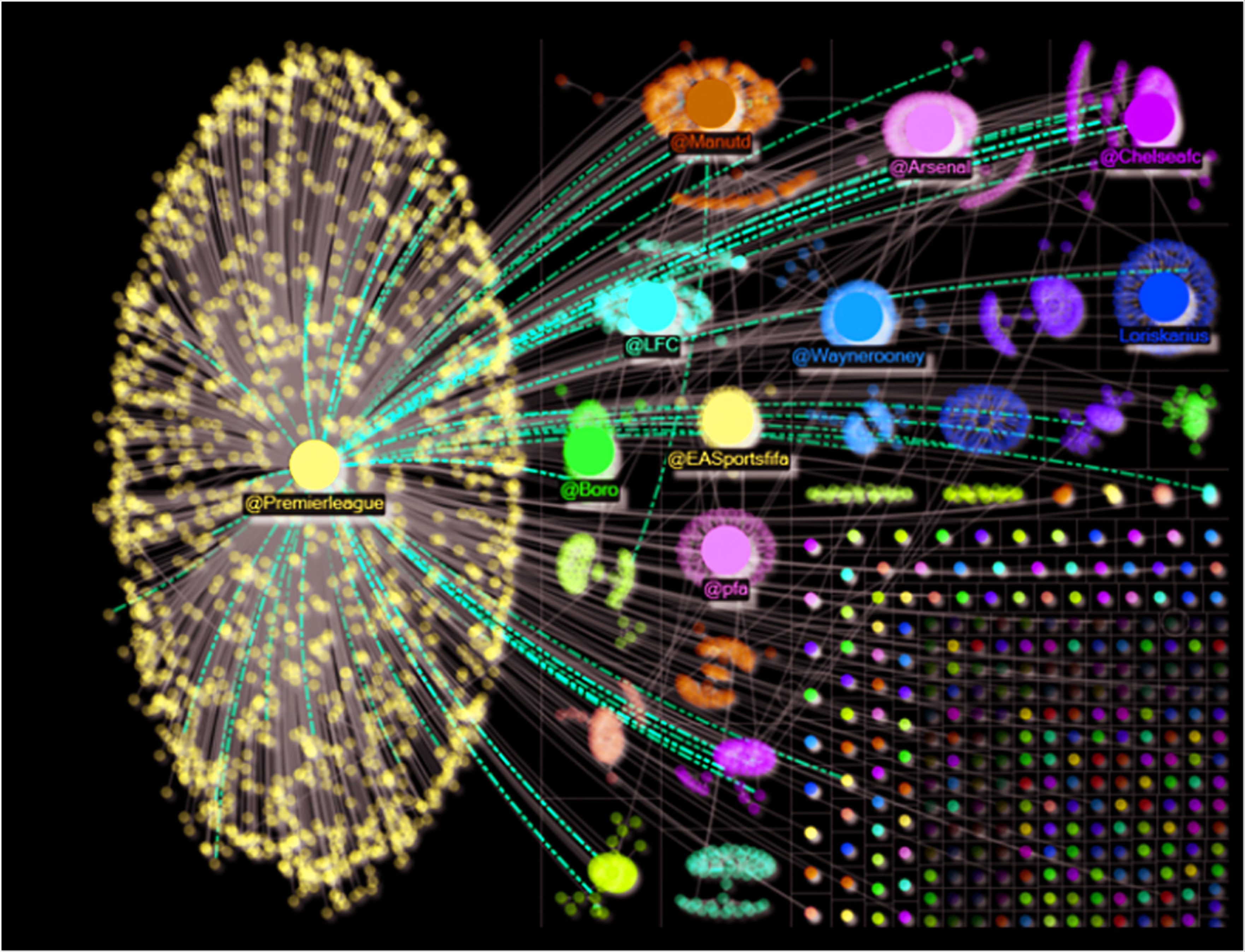
The graph is directed and grouped using the Clauset-Newman-Moore cluster algorithm (Clauset et al., 2004). Furthermore, the graph is laid out using the Harel-Koren Fast Multiscale layout algorithm (Koren et al., 2002).
The most immediate observation to make is the volume of conversations instigated by EPL tweets among Twitter users (depicted on the left side of the visualization). In regards to the possible network types, the four-way comparison above displays how the network structure of the EPL is consistently a ‘broadcast’ because over a four month period, the shape of the network resembles a ‘broadcast network’ corresponding to the six types of Twitter network. As outlined earlier, this means that tweets from the brand (shown centre of the left=most group) are retweeted frequently. Broadcast networks are formed when messages from prominent accounts are retweeted with high frequency, forming a hub-and-spoke pattern.
Typically, brands—as the name suggests—will take the shape of a ‘brand’ network structure from the ‘six types of Twitter networks’ outlined earlier. However, for the EPL account, it appears that it receives much more engagement (demonstrated by its ‘broadcast’ structure) compared to what a brand on Twitter will normally receive—which demonstrates its high-engagement status. The network structure of the EPL also contains other smaller broadcast hubs that have an audience of their own. In Figure 3, we have highlighted the top 10 influential Twitter users and their distribution across the network of the EPL. These accounts are likely to mention ‘@PremierLeague’ in their tweets, and these users will have their own distinct audience. There is a wide range of discussions that are initiated that can be seen on the right hand side of Figure 3. The network of the EPL also has an element of community with a number of smaller groups and clusters where multiple smaller conversations are taking place. To enable comparisons with other network forms, such as brand topic or in-group networks, the reader’s attention is drawn to the work of Hansen et al. (2010) and Kozinets (2015).
Overall, in the SNA diagrams depicted in this study, it is possible to note that once the tweets are sent by the EPL, a number of discussions take place between other teams, players, journalists and fans. Moreover, the football clubs that take part within the EPL form a constellation within the network, with their own unique followers and discussions. We can also more carefully pinpoint associated influential Twitter accounts, as shown in Table 1.
Overview of Most Influential Users for EPL’s Twitter Network (July 2016 to October 2018).
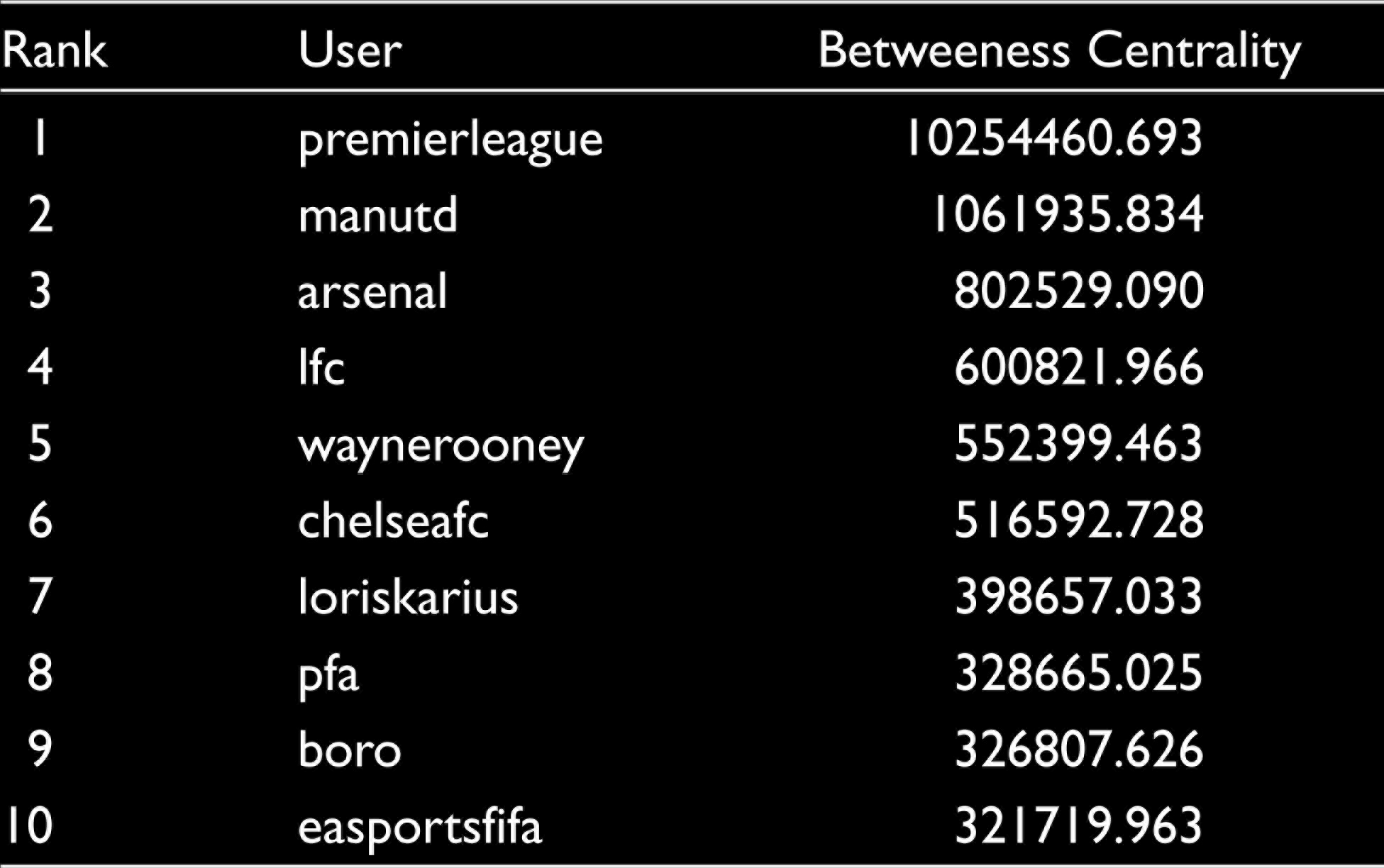
Table 1 displays the top 10 accounts from the analysis of our data, alongside the centrality score associated with the accounts calculated using the betweenness centrality algorithm. This helps to identify nodes that lie on the shortest path to others, and the resulting output is numeric. There is no upper or lower range to the score, and it will vary based on the network examined. The betweenness centrality algorithm score helps identify the account’s key users who are influential in the networks as they act as ‘ties’ between different users. That is, they have followers and connections others do not have, indicating that they may be potentially influential. Figure 4 below provides a simple representation betweenness centrality where node ‘D’ is most influential.
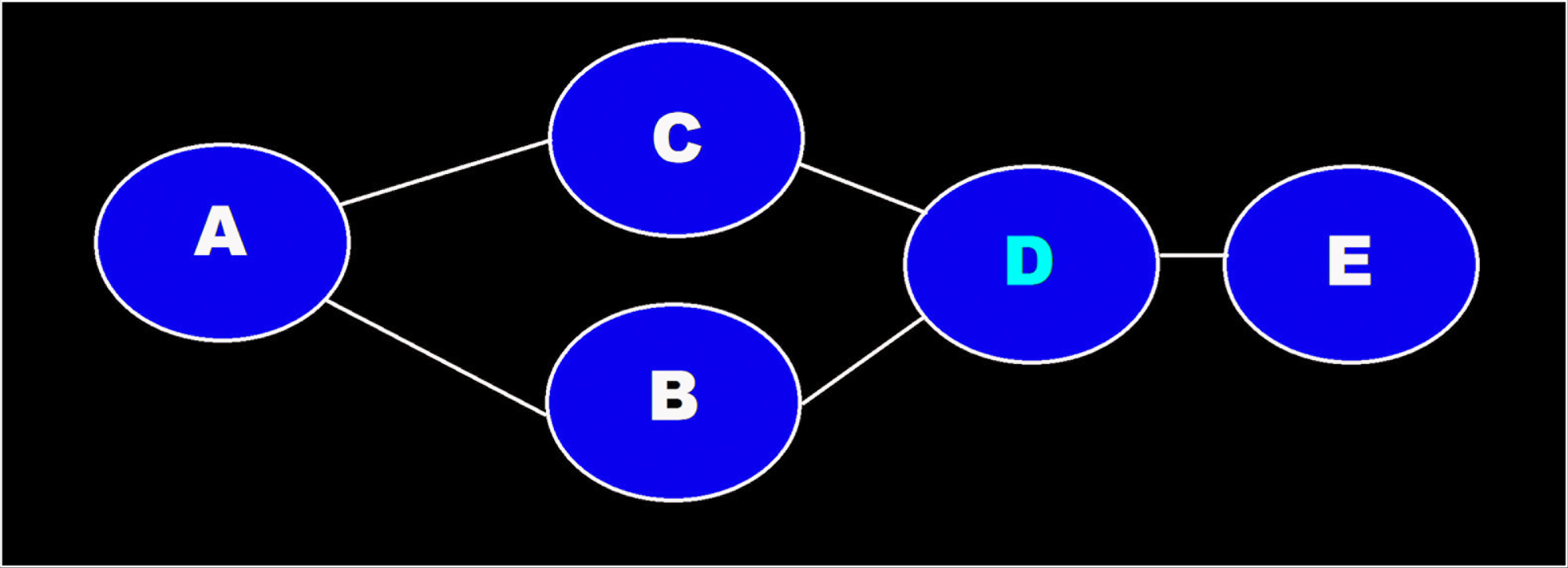
The node ‘D’ (highlighted in red) would have the highest betweenness centrality score in the network represented. This is because if we are to remove D, then the network will lose its connection to node E. On Twitter, therefore, we can think of influential Twitter users among an existing network as having the potential to open up content to new audiences, which may not be included in the network. As highlighted in the case of the EPL account, we found that across four months in 2016, accounts belonging to Manchester United, Arsenal, Liverpool FC, Wayne Rooney and Chelsea FC were among the five which had the highest betweenness centrality. This indicates that these accounts will have followers and audiences outside of the EPL’s immediate network—such that if these accounts were removed from the network, then these audiences would be lost. Information related to influential accounts can be utilized as intelligence, and for the purposes of information diffusion and the rapid cascading of information to new audiences by strategically targeting influential accounts with messages.
Management Implications
Our research is the first empirical study to highlight that people like to talk with and about the EPL as a high engagement brand, and that social media provides an ideal outlet through which to do so. For high engagement brands, networks of conversations typically appear to be dense, with significant numbers of influencers leading them. The EPL network took a broadcast form, indicating that this is the type of brand which usually instigates the most popular social media conversations, but then other users continue and sustain the conversation.
Whether or not this is common for other brands provides an interesting opportunity for further research. In the same vein, our research did not set out to examine the content of posted tweets, hence we can provide no insights at this stage into how different types of social media posts may induce different types of conversation. Again, this would make for an interesting study; for example, assessing whether different types of visual content prompts varying reactions and different conversation structures. Furthermore, we speculate that brands, in the way they craft messages, are also likely to impact on the nature of subsequent conversations. For instance, a post that is simply for information-sharing purposes is likely to result in a different type of conversation to, say, a request from a brand asking users to share opinions with them. As such, there remains some work to be done on understanding the relationships between social media messaging, content, transmission, receipt, cognition and behaviour, and the relationship to the brand.
This implies some broader methodological implications of our work, not least in the way it should inform subsequent studies of this nature. Network mapping undertaken using software such as NodeXL allied to the use of centrality measures, providing some interesting insights, compelling even. We believe that our methodology here does indeed help in deepening our understanding of how information flows around social networks, and who is leading them and creating opportunities for new related studies. Nevertheless, all of us are in the formative stages of social media research; and we, therefore, advocate—at least in the short-term—using multiple data collection methods to triangulate the findings of studies such as ours. To ensure that sporting brands truly understand the social media conversations about them, visualizing networks, understanding who or what influences conversations, how we should interpret data (such as Indegree and Outdegree), the analyzing of contents of the posts and interviewing or observing users should all form the basis of a coherent social media conversation research strategy. This work will, therefore, inform and maximize the use of social media data to create useful insights for scholars and practitioners of social media. It is important to note that as the use of social media platforms may vary by culture and/or region (Krishnan & Lymm, 2016; Krishnan & AlSudiary, 2016), future research could seek to examine other social media platforms.
Notwithstanding these observations, based upon our evidence it can be concluded that people tend to react and take note of brands when they send out messages. However, with the EPL, we note that social media followers may form other groups with their social media connections to talk about the brand. In certain instances, there may be a lot of conversations taking place, and in other situations, there may be less. Furthermore, although a brand may begin a conversation after it makes the first post, the discussion can be driven by other influential accounts or groups of fans. Future research could seek to examine this for other high engagement brands.
Our research leads us to propose the following—SCISM—as a guide for brands seeking to promote, sustain and benefit from their instigation of social media conversations:
(S)ocial media presence Strategically, perhaps tactically too, brands need to decide whether or not they want to play a role in instigating and shaping conversations that social media users engage in about them. Whilst it is inevitably difficult to control what people converse about and how, shaping the narrative is somewhat within their grasp. In making such decisions, brands need to have a sense of what they want to say about themselves, what they want other people to say about them, which people they want to say it to, how they want the conversation to evolve and how long they want it to go on for. This is not simply an issue of paying users to engage in conversations about one’s brand. After all, some paid conversationalists may not have a sufficiently large following to sustain a conversation, while others may be subject to legal constraints if their posts are construed of as being promotional messages; (C)rafting the message Within the aforementioned parameters, understanding what content engages users is important. In our experience, highly visual content (such as photographs and infographics) is especially attractive to many users, inducing considerable ‘share’ and ‘like’ activity. Posts containing film footage, factual information or third-party sites may be less appealing, though in the context of a prevailing conversational narrative that a brand may be seeking to instigate, they may be important. Understanding the way in which a brand’s target audience consumes and responds to social media posts will be a crucial part of this process. So, too, the way in which message-crafting takes place, which indicates the importance of semiotics in knowing how best to create posts that will prompt the kind of conversation the brand is looking for; Planned (i)ntervention Having posted a message on social media, a brand then needs to decide whether it will intervene in the subsequent conversation. Our observation of EPL posts over time showed that in essence, they typically engage in transactional posting. That is, a post is made but then there is no subsequent engagement, which resulted in a broadcast network structure characterizing their social media activity. Clearly, the notion that a brand might intervene in ‘post-post’ is bound-up in the aforementioned two points. However, in seeking to building stronger engagement with the users, moving away from being a transactional leader and broadcaster to a collaborative and co-creating partner requires that brands plan the kinds of interventions they will need to make to sustain a social media conversation for longer; (S)pontaneous follow-up As a conversation evolves, it may become apparent to a brand that it is not of the nature that managers either like or intended. Alternatively, in the natural course of the conversation, opportunities may arise for the brand to make a tactical intervention into it either to take advantage of the emerging narrative or else to exert some degree of control over it. Perhaps the most obvious such form of intervention takes place during the Super Bowl, when brands will often directly respond to specific incidents during the game to promote their brands on social media by, for example, making humorous tweets about the incidents. This requires a good, quick-witted social media team to be in place, though it does show how brands can spontaneously influence conversations; (M)essage mortality One way in which to view a social media post is that it has a finite life. Having made a posting, then possibly made an intervention into a subsequent conversation, a brand will ultimately have to decide whether to exit a conversation or else to simply let it die. Such decisions will inevitably be dependent upon the value a brand might perceive can be derived from a conversation, taking into account the time and resource of the social media team. However, even if managers choose to step back from further discussion, this does not necessarily undermine or end the narrative a brand may be seeking a build-up of via its social media posts. However, ultimately, no matter how deep and wide a brand’s conversation network on social media might be, single messages may have served their purpose and suffer a demise. It’s also notable that previous posts and conversations can also be searched and resurrected over time if a brand wishes to do so.
Conclusions
Social media has quickly become very important for sports brands, providing managers with a dynamic, interactive means through which to engage with consumers. Such is the distinctive nature of the relationship between sports brands and social media, that it can be described as a symbiotic one, enabling the simultaneous fulfilment of respective goals. In particular, it is commonly known that fans like to talk about sports, whilst brands of the nature identified in this paper seek to engage them in such conversations. Social media enables this to happen on a global scale.
In this study, we set out to answer the research question: what network form do social media conversations take for a high engagement sports brand, who are the important influencers in the network and what implications of these considerations have for brand managers when using social media? In case of the high engagement sports brand we selected as the focus for our analysis, we observed that the brand itself was an important instigator of social media conversations. When visualized, these conversations took the form of a broadcast network. A significant feature of this network was the role that influencers took in engaging with and perpetuating conversations (notably the likes of clubs and players that are stakeholders in and constituent parts of the brand being examined). In these terms, we identified several implications for brand managers that have been addressed through an acronym—SCISM.
The literatures pertaining to brands, communications and consumers are long-established and mature. As such, connections between the three concepts are well-understood. Over the last decade, social media has emerged as a new field of research, disrupting conventional approaches to brand research. There is, however, an emerging maturity in the literature on social media, communications and brands. Nevertheless, much of the research published over the last decade is of a formative nature and, as such, there is a paucity of literature addressing the issues we have considered in this study. Consequently, there is much work still to be done, though we hope our analysis of a high engagement sports brand prompts further work in this important, and potentially fruitful, field.
Our work here raises several important issues, specifically around data, techniques of analysis, network form, the nature of communication and the ways in which brand managers seek to address the consequences of them.
The volume of data being generated via social media on a daily basis seems, at times, to be almost incomprehensible. In one sense, this represents a major opportunity for researchers, though in another sense it is hugely problematic as there is an inevitability that issues of representativeness and sampling are all pressing issues. As literature in the field of brands and social media evolves, significant consideration must be given to these issues. In the same way, developing and utilizing data analysis software and techniques appears vital. In our study, NodeXL proved to be an effective way of capturing and visualizing social media data; software is currently effective in gathering and analyzing Twitter data, though that cannot be used when analyzing communications on all social media platforms. Researchers should, therefore, remain vigilant to the possibilities and constraints they might face in this field.
Our finding that communications pertaining to a high engagement sports brand take a broadcast network form is an important one because it highlights Twitter’s marketing potential as broadcast networks are characterized with a large frequency of retweeting. Even so, our study requires replication in the context of other such high engagement sports brands to determine whether broadcast networks are common in this context, or if other network forms are apparent. It would be interesting, too, for the researchers to understand different types of engagement, and what this means for network form and communication. The latter is an especially pertinent observation, as network visualizations reveal how communications are structured in a social network. What is less apparent is the specific nature and content of communications that are instigated by a brand, and how social media users respond to them.
This suggests a need for further study of cognition and response in social media environments. Above all, brand managers and others in the sports field must ensure that they remain aware of and responsive to the challenges being posed by the relentless growth of social media and digital content—especially in the way it impacts upon the work they do. We believe that the focus, methods, results and recommendations for practice presented in this paper make an important contribution in this regard, as this is the first empirical study to carefully examine the social network structure of high impact brands. We believe our study is likely to inform future research and to be of interest to academics and brands interested in better understanding the characteristics of high engagement brands on Twitter. Our study is also likely to be of interest to low-impact brands interested in transitioning towards a high engagement brand.
Footnotes
Declaration of Conflicting Interests
The authors declared no potential conflicts of interest with respect to the research, authorship and/or publication of this article.
Funding
The authors received no financial support for the research, authorship, and/or publication of this article.