




Abstract
The Aranmula Vallam Kali, or Aranmula Snake Boat Race, is the most ancient folk cultural sport of India. It is well known for its unique history and culture. Over the years, due to the social, economic and political alteration and the influence of Western culture and westernisation, this oldest and richest folk sport culture has undergone a lot of transformation. India has vast diverse cultural traditions, traditional expressions and tangible and intangible cultural heritages. It’s time to think about the protection and preservation of our rich, diverse and unique cultural heritage. This article, through field investigation and document analysis method, focuses on cultural ecological adaptation and transformation of the Snake Boat Race from its origin to the contemporary time. The study explores an ecological response strategy from the micro, meso and macro levels, which reshape the value and cultural identity of the Snake Boat Race, improve its existing conditions through system construction and promote the protection and preservation of inheritance folk sport culture. In order to combine material, spiritual and cultural lines, the study also explores a ‘trinity protection and development model’ of linear cultural heritage of the ancient Pampa River.
Introduction
The village is the most basic settlement unit of human society, and the village culture accompanies our country. The evolution of farming civilisation constitutes the foundation of traditional culture and is the realisation of national cultural self-confidence. Village folk sports culture is an important part of village culture, but since modernisation and globalisation, the cultural ecology of folk sports in Indian villages has undergone drastic changes and is facing unprecedented challenge (Pillai & Ramabhadran, 2015). At present, most of the villages in India are disappearing, and according to research, 24 per cent of villages are engaged in non-agricultural occupations. The living soil is destroyed, and many folk sports cultures are gradually disappearing (Indian Census, 2012). The cultural ecology of folk sport is closely related to the generation, survival and development of folk sport, which consists of the natural environment, economic environment and multiple social factors such as social environment and organisational environment (Tianyu et al., 2005). The cultural ecology follows a specific area of the inhabitant with the interaction of the natural environment and the social environment, which adopt and result in a certain degree of stability (Jianlin, 2011). From the perspective of cultural ecological adaptation, the long-term development of folk sports in the rural area not only contributes to improving the macroscopic recognition status of rural folk sports but is also conducive to making ecological response strategies.
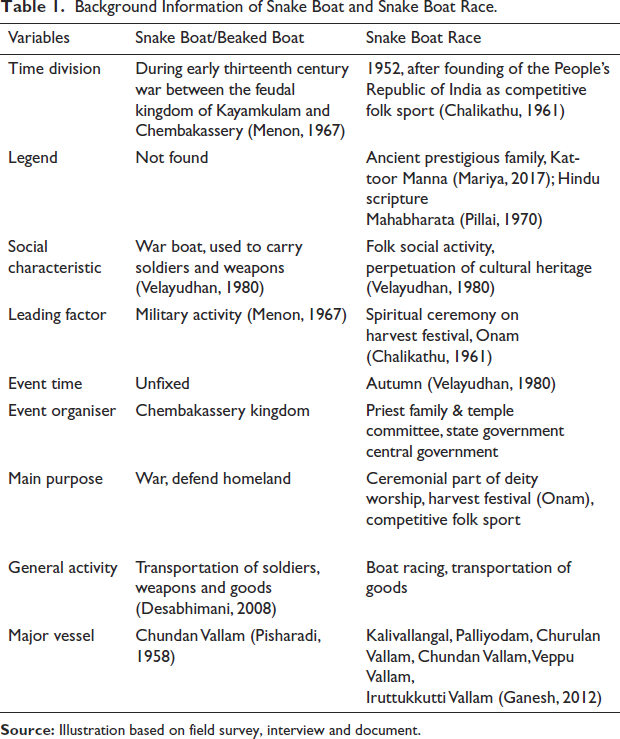
The Aranmula village is located in the Pathanamthitta district of Kerala, in the southern part of India. The village is located at a distance of around 116 km from Trivandrum (the capital of Kerala) and 2,754.2 km from New Delhi (the capital of India). Aranmula village is well known as the cultural capital of Kerala, situated on the banks of the holy river Pampa. Historically, Aranmula is a centre of pilgrimage from time immemorial and a trade post of eminence, when the river Pampa was the chief means of transport. The village also has a very rich cultural history and exotic appearance. Aranmula village is famous for its centuries’ old Parthasarathy Temple and the unique ritualistic feast called Vallasadya. The most popular folk sport activity in the village is the Snake Boat Race, popularly known as Vallam Kali. It is the major competitive folk sport in Pathanamthitta district. Every year the race starts after some ritual activities, such as offering food and flowers to Lord Parthasarathy. The oarsmen of the Snake Boats Race get a feast comprising more than 70 dishes, which is probably one of the largest vegetarian feasts in India. The Snake Boat Race is mainly conducted during ‘Onam’ (the traditional harvest festival), but with the passage of time, it has become a part of other tradition festivals in Kerala (Kerala Tourism, 2021). However, due to modernisation and urbanisation, the Aranmula village cultural ecology has undergone unprecedented changes and the inheritance of the Snake Boat Race faces new challenges. So it is very crucial to find a line that can adapt to the sustainable development of modernisation without affecting the Aranmula cultural ecology. Background Information of Snake Boat and Snake Boat Race is given in Table 1.
Theoretical Framework
This study found an expression on Cultural Ecology Theory, specifically the Ecological Anthropology Approach applicable in this study. In the 1960s, ecological anthropology first appeared as a response to cultural ecology, a sub-field of anthropology led by Julian Steward. Ecological anthropology is defined as the study of relationships between a population of humans and their biophysical environment (Orlove, 1980). This research discusses how cultural beliefs and activities survive within a certain ecological environment and how the transformations take place in the changes of sociocultural environment. Meanwhile, the author tries to create a frame of how within a certain ecological environment the Snake Boat Race metamorphoses and emerges as a competitive folk sport in contemporary time.
Method
This study uses a combination of field investigation and literature review of Aranmula village and the surrounding areas. The study investigates the cultural ecological adaptability and the changes in the mechanism of the Snake Boat Race with the changes of folk cultures in the Pampa River basin. The approach was taken with the inspiring work of Ganesh (2012), who conducted field investigation and document analysis on ‘Indigenous folk exercise as the most important cultural heritage of Kerala’. Pillai (1970) also conducted the same in his ‘Study of cultural identity and richness in Southern India’. Field investigation is defined as a qualitative method of data collection that aims to observe, interact and understand people while they are in a natural environment (Brown, 2008). In this study, a field investigation method such as visiting Aranmula village, interviewing local people and observing and analysing the Snake Boat Race is considered as the direct source of data. In the document analysis approach, the documents are selected on the basis of relevance and significance to folk sports and folk culture of Kerala. For example, important documents, such as ‘The cultural heritage preservation plan of India (Article 49 of the Constitution),’ which outlines the policies and aims of cultural heritage, are prioritised among national planning documents. Measures and notices which inform the current policy of India are also selected from the available resources. A number of other documents released by the Department of Ministry of Culture, which include press release, speech and interview with officials, are given most priority. Apart from these, handbooks, research articles, newspapers, blogs and other resources also taken into consideration.
Findings
In this section, the outline and discussion in relation to main themes emerged with the analysis of document and field investigation. The first part discusses the cultural ecological adaptation in the formation and development of Snake Boat Race. The second and third parts describe the major themes found through investigation, which briefly explain the cultural ecological transformation of Snake Boat Race as a major folk sport in contemporary time and the restoration mechanism of folk sport in the modern era, respectively.
The Cultural Ecological Adaptation in the Formation and Development of Snake Boat
Steward, the founder of cultural ecology, believes that culture and its ecological environment are the same community; a certain culture can only survive and develop in a certain ecological environment (Steward, 1951). The living environment is formed by the interaction between the natural environment and the social environment. These two are the prerequisites for the generation and continuation of sports culture in which diversity, gender and difference in sports culture play a decisive role.
Information of Snake Boat and Snake Boat Race.
The Meaning of ‘Survival’ in the Origin of ‘War Boats’
French sociologist Halbwachs (1967) believes that collective memory means specific community members in the circle sharing the results of memories, and collective memory can be stored in two conditions, that is, the continuous existence of the social interaction and the memory which need to be constantly raised (Coser, 1992). The collective memory of Kerala as a cultural place is specifically noted for its folk sports culture like the Snake Boat Race held every year on the Pampa River with a special spiritual ceremony at Aranmula Parthasarathy Temple. In history, during the thirteenth-century war between the feudal kingdoms of Kayamkulam and Chembakassery in Kerala, King Devanarayana of Chembakassery commissioned the construction of a war boat called Chundan Vallam (Snake Boat). A craftsman named Kodipunna Venkida Narayanan Assari made the Snake Boat. The technical methods for creating these Snake Boats are around eight centuries old, and the Parthasarathi Chundan is the oldest model of Snake Boat (Pisharadi, 1958). With the passage of time, the Snake Boat became a part of the boat racing culture of Kerala, called Vallam Kali (Snake Boat Race), which is mainly conducted during the season of the harvest festival of ‘Onam’ in autumn (Velayudhan, 1980).
Regarding the origin of the Snake Boat Race, there was a myth in the village. During the harvest festival of ‘Onam’, a priest legend, the head of Kattoor Mana (an ancient prestigious family), was a believer of Lord Krishna, waiting to complete his daily ritual of giving food to a poor person, but at that time no poor person came to accept food from him. The priest became worried and started praying to Lord Krishna to fulfil his rituals. After some time, a small boy came and took the food from him. After having the food, the boy disappeared and appeared in Aranmula temple. The priest realised that the boy was not a common boy, but Lord Krishna himself. Remembering the incident, every year on the same day, the priest used to bring a lot of fruits and flowers to the temple of Lord Krishna in a Snake Boat via River Pampa (Mariya, 2017). However, with the passage of time, along with spiritual rituals, the Snake Boat Race became a part of spiritual cultural ceremonies for Lord Krishna.
Although the time difference between these two occurrences are almost hundreds of years, but there is a common factor that exists, that is, the ‘boating skills’. The immersion of the boating skills in Chembakassery Dynasty is inseparable from the early history of Aranmula Snake Boat Race.
Chembakassery Kingdom, the Time When ‘War Boats’ Were Constructed by King Devanarayana
The Chembakassery kingdom was established around the second siege of Kochi in 1504. The kingdom was initially located in the modern-day Kudamaloor in the Kottayam district of Kerala, India. The kingdom owes it origin to the peculiar society that existed in feudal Kerala from the thirteenth to seventeenth century (Menon, 1967). During a war between Kayamkulam and Chembakassery Dynasty, King Devanarayan of Chembakassery consulted with a craftsman Kodipunna Venkida Narayanan Assari and ordered to make war boats by following an old scriptures Sthapathya Veda. The craftsman made a ‘war boat’ called Chundan Vallam, 100 to 138 feet in length with the rear portion rising to a height of about 20 feet, and a long tapering front portion which resembled a snake with its hood raised. Hulls were built of planks precisely 83 feet in length and six inches in width. The ancient design of these boats has survived over centuries, with the same blueprint over 700 years ago.
The Meaning of ‘Survival’ Formed by the ‘War Boats’
The strategic location of the natural defensive border of Chembakassery enabled long-distance waterways, so the powerful war boats were widely used in this area. This region was turbulent for a long time during the Chembakassery Dynasty. The environment of frequent wars forced people to adapt to learn self-defence and naval warfare arts. The emergence of war boats reflects the early survival of the inhabitants of Chembakassery. The people had a common understanding of natural and social environment, and they knew how to achieve coordination with the ecological environment and make space for survival and development. The long-term turbulent social background strengthened people in the naval warfare arts and military skills, which people adapted through the ecological environment (Desabhimani, 2008). The Chundan Vallam warriors showed their bravery and thrilling fighting skills from the beginning of its inception and their boating skills are still reflected in the modern boat racing culture.
The Transformation of ‘War Boats’ from ‘Naval Warfare Activity’ to ‘Spiritual Sports Culture’
Due to inherent natural environmental factors, sociocultural factors and differences in spiritual beliefs, folk sport exhibits a unique form of sport. In order to meet the needs of human survival and development, folk sport has to be based on the above-mentioned elements, and corresponding choices will eventually form different ways of expression (Jones & Badger, 1967). Overtime, the naval warfare of Chembakassery changed from military activity to folk cultural activity through ecological environment as a process of acculturation. Behind this change, there was a gradual disappearance of the military attributes and the demolishing of the Chembakassery Dynasty (Menon, 2016). However, around 1,700 years ago, with the establishment of the Aranmula Parthasarathy Temple in the Pathanamthitta district of Kerala, the war boats were used for a spiritual cultural ceremony, popularly known as Vallam Kali.
‘Snake Boat Race’ Became a Part of the ‘Harvest Festival’
Aranmula village was known as the cultural capital of Pathanamthitta district, situated on the banks of the holy river Pampa. The village was also known as a temple town, a centre of pilgrimage from time immemorial and a trade post of eminence, where river Pampa was the chief means of transport. The Snake Boat Race, which was considered as a spiritual sport culture of Aranmula Parthasarathy Temple, gradually spread out to other districts of Kerala. Over time, the traditional Snake Boat Race became a part of the harvest festival of ‘Onam’, which is one of the biggest festivals in Kerala. The people of Kerala celebrate this festival for 10 days during the Malayalam month of Chingam (as per the Malayalam calendar) (Chalikathu, 1961). The Snake Boat Race went through a major transformation from a spiritual sport culture of Aranmula Parthasarathy Temple to a cultural folk sport of Onam, and gradually it became very popular throughout the whole state of Kerala and other parts of South India.
‘Snake Boat Race’ Became a Platform for Inhabitants of Aranmula to Lead as a ‘Major Folk Sport’
Among all kinds of boat races, the Aranmula Snake Boat Race, popularly known as Aranmula Vallam Kali, is considered as the oldest river boat festival in Kerala (BBC News, 2016). As a sociocultural activity, the Aranmula Snake Boat Race is organised to unite villagers, promote group identity, create bonds of emotional communication and, above all, please Lord Krishna of Aranmula Parthasarathy Temple (Balakrishnan, 1988). As per a Hindu legend in Mahabharata, Arjun, the great master of archery, was once returning with the image of Krishna after a long penance; at that time he faced a huge flood in the Pampa River. A poor low-caste Hindu helped him to cross the river with a raft made with six bamboos. Historically, it was believed that the Aranmula Snake Boat Race was celebrated annually on the Pampa River to commemorate the poor Hindu (Pillai, 1970). The race used to take place on the last day of the harvest festival Onam. Boats ranging from around 100 to 120 feet (30–35 miles) with four helmsmen, 100 rowers and 25 singers participate in a race. The boats move in pairs with a rhythm of music called Vanchipattu (a boat song which is in the form of poetry in the Malayalam language, commonly used during Vallam Kali and related festivals), and after finishing the race, an enormous feast called Valla Sadhya is served in the Aranmula Parthasarathy Temple (Wakankar, 2018). Historically, Aranmula Snake Boat Race was the largest and oldest folk sport culture in Kerala until 1978, when the Government of Kerala declared it as a major folk sport event. In the 2000s, Aranmula Snake Boat Race diversely started as a major competitive folk sport throughout the whole state of Kerala.
The Cultural Ecological Transformation of Snake Boat Race in the Contemporary Times
The life of folk sport is deeply rooted in the heart of the village people. The inheritance and development of folk sport can be implemented, regardless of whether this need belongs to real life or to show spiritual emotions (Nair, 1997). The Snake Boat Race came into being in the period of agricultural civilisation, when the material and spiritual needs of the Aranmula inhabitants were in slow rhythm of convergence. Since time immemorial, the Snake Boat Race continuously accommodated the changes of village cultural ecology and gradually became an indispensable part of villagers’ life. Over the years, boat race teachers teach their own skills and intuitive experience through theoretical and practical demonstration. The advance players can adopt these skills through imitation and practice, but the people who can’t learn these skills easily keep attending the lessons and become a member of the boat racing culture (Pillai, 1977). Since 1952, the Indian village cultural ecology has experienced unprecedented changes, many folk sports relying on traditional cultural ecology to survive and carry out a new round of cultural ecological adaptation (Vasandan, 2005). The study found that, along with Chaundan Vallam, many new models of racing boats, like Kalivallangal, Palliyodam, Churulan Vallam, Veppu Vallam, Iruttukkutti Vallam, etc., came into existent in modern times. The Snake Boat Race Policy has been implemented to a certain extent, for which many changes took place. The changes can be divided into two parts: first, from a spiritual sport culture to a major competitive folk sport by means of ‘changes in external cultural ecology’, and second, the rupture of inheritance skills and technological implementation by means of ‘changes in internal cultural ecology’.
Changes in External Cultural Ecology: ‘From Spiritual Sport Culture’ to ‘Competitive Folk Sport’
Some scholars believe that the external changes of the contemporary village folk sports involve autonomy, spontaneity, publicity, popularity and social organisational structure (Childe, 1961). Over time, the governance policy of India has undergone various sociological transformations. It authorises the people as the masters of the country and implements democratic management and villagers’ autonomy. Until the early 1900s, the priest family and temple committee were traditionally organising and managing the event, but with the passing of time, this traditional genealogical system declined, and the source of cost for this event became a big issue. During the mid-1900s, the Government of India along with the state government took the initiative for managing, organising and developing this popular folk sport culture of Kerala. In 1952, Jawaharlal Nehru visited Kerala and reached Alappuzha (a city in Kerala) by a Snake Boat. The people of Alappuzha welcomed him with a wonderful display of Snake Boat Race. After his return to Delhi, he gifted a silver trophy to the winners of the race, known as ‘Prime Minister’s Trophy’; later the trophy became popularly known as the ‘Nehru Trophy’. After 1952, the Snake Boat Race achieved huge popularity and became one of the most popular folk sport in India. In 2018, the Kerala government made a plan to commercialise and popularise the Snake Boat Race by organising an Indian Premier League (IPL)-like league tournament. The government’s aim is to increase the glamour quotient and prestige of these races while making them more appealing for national as well as international tourists by means of promotion and marketing (Kerala’s snake boat races to get IPL-style makeover, 2017). After the independence of India, the external factors of Snake Boat Race as an inherited spiritual sport culture transferred into a major competitive folk sport through the country’s political, economic and cultural changes.
Changes in Internal Cultural Ecology: ‘The Value of Boat Race’ and ‘Rupture of Inheritance Skills’
Steward, in the 1930s, divided the core of the cultural ecosystem into State of Matter, State of Mind and State of Behaviour. The State of Mind and the State of Behaviour can be included in terms of the internal development mechanism of folk sports. The former determines villagers’ recognition and with folk sports, and the latter determines villagers’ attitude toward folk sports in the practical environment (Kerns, 2003). In the contemporary time, few major issues are found. First, the transformation of the cohesive function of traditional culture leads to a decline in villagers’ sense of identity and participation in the race. Since entering into modern society along with the development of urbanisation, the cultural values and spiritual pursuits have changed. The village life is affected by information technology and the internet. The villagers of Aranmula entertain themselves by watching TV, surfing the internet, etc. and adopt modern Western sports, due to which the Snake Boat Race has lost its social foundation as the main entertainment pastime activity. Second, the requirements of high-quality skills in boat racing make the related skills appear to be faulty. The Snake Boat Race requires a very high level of physical fitness, which is the main reason for the current dilemma of inherit learning skills. The enhancement of racing performance is based on the improvement of fine motor abilities like strength, endurance, balance, coordination, agility, etc., and simultaneously, psychological abilities are also important. The high requirements of physical and psychological abilities for Snake Boat Race are the main reasons for its performance issues, and both of these aspects reflect the changes in the internal folk sports cultural ecology.
The Ecological Restoration Mechanism of the Predicament Folk Sports
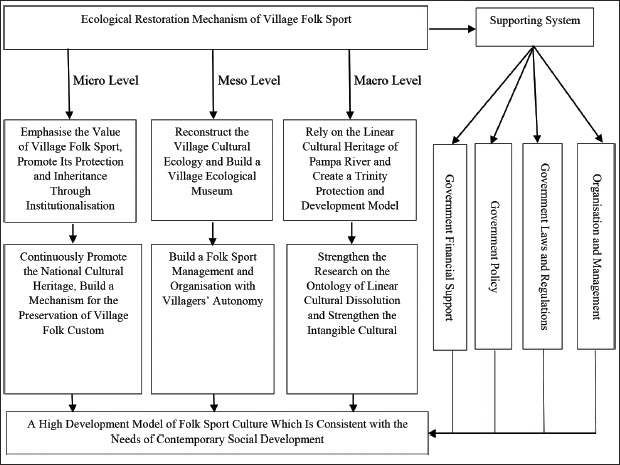
Village folk sport is a special cultural phenomenon, which follows the natural changes in the social environment and continues to make new choices, resulting in cultural reconstruction (Luhmann, 1984). To establish a scientific and reasonable cultural ecological system, this folk sport culture of Aranmula village should adapt an ecological restoration mechanism (see Figure 1).
Mechanism of Ecological Restoration for the Development of Village Folk Sport.
Emphasise the Value of Village Folk Sport, Promote Its ‘Protection’ and ‘Inheritance’ Through Institutionalisation
At the micro level, the cultural ecological restoration mechanism of village folk sport is predominantly based on the protection of folk sports culture. The premise is to re-establish its value and enhance people’s sense of cultural identity (Berkes & Folke, 1992). Recently, the Government of India along with the state government has given importance to the protection of cultural heritage.
The Prime Minister of India Narendra Modi pointed out, ‘The excellent traditional Indian culture created and continued by the Indian people from thousands of years in history is the root and soul of the nation’ (UNESCO, 2015). Folk sport, as an important cultural heritage, is increasing as a public resource that shows the cultural geographical features and promotes cultural self-confidence. Many folk sports become a means of livelihood for the villagers through cultural performances. They reintegrate the daily life of the villagers and radiate new vitality. As the oldest intangible cultural heritage of Aranmula village, the Snake Boat Race should continue to be explored for its special significance and value and continue to be promoted as a national cultural heritage. For the villagers, the race performance can enable them to gain economic benefits. The spirit of boat race can enhance their self-confidence and sense of identity.
The village folk sport protection can be divided into two parts, i.e., static protection and dynamic protection. Static protection refers to taking effective measures for the reservation of folk sports culture, while dynamic protection refers to the protection of inheritance measures such as people, the way of performing inherit skills, etc. Of these, static protection is the foundation, while dynamic protection implies inheritance and promotion. The main intention of static protection is the construction of a folk sport preservation mechanism with modernity. The impact of ideas and the destruction of traditional operating mechanisms have been found in the cultural connotation of Snake Boat Race. At present, the state government has made a systematic record of boat race and database files, which should be strengthened and preserved. At the same time, the researchers at local universities and folk sport research experts should be brought together as honorary consultants of folk customs. The main intention of dynamic protection is the construction of the inheritance mechanism of folk sport. The inheritance mechanism consists of two methods, that is, elite inheritance and school inheritance. Elite inheritance includes the national cultural heritage protection system. The villagers are the representative inheritors of cultural heritage, and the government should actively support these inheritors to carry out the teaching. This method can retain the most essential technology and skills of the Snake Boat Race, but there are limitations in the inheritance group, so it needs to be supplemented by school inheritance. The government can explore the folk sport inheritance mechanism based on school education and school-based courses, for instance, developing a historical and cultural value course, art subjects like craftsmanship of snake boat, folk sport curriculum, and physical education subjects like boat race learning courses, etc. These not only enable to experience the value of the Snake Boat Race but also enhance the pride of Aranmula village folk sport culture.
Reconstruct the ‘Village Cultural Ecology’ and Build a ‘Village Ecological Museum’
At the meso level, the ecological restoration mechanism of village folk sport culture should be based on the overall protection of the village, and an ecological museum should be made in a feasible way. It is encouraged to use traditional craftsmanship to make souvenirs for business, avoid short-term economic damage, increase long-term interests and focus on the overall protection of cultural heritage and other principles. In Aranmula village, these principles can also be used as a reference to actively reconstruct the cultural ecology of the village and to construct the ecological museum.
Aranmula villagers should actively build villagers’ folk sport autonomy. According to the current situation of the village, a tourist management committee and villagers’ self-governing organisations such as a customs institute can be established. The former will be responsible for the planning of performances, scenic spot publicity, tourist reception, logistics services, etc., and the latter will be responsible for the research, teaching, inheritance and innovation of the boat racing culture. These two organisations can take villager autonomy as the core authority and divide the labour among people in the village as a folk custom system. The development of education can provide a good operating mechanism and financial stability. The economic development model of the village should be changed to build folk sport as the core of cultural ecotourism in the village. Aranmula village has beautiful natural scenery and profound historical heritage. The village retains many ancient temples, and the oldest Snake Boat Race folk custom is an advantage for tourist attraction. Therefore, Aranmula village should have an integrated tourism resource to promote the ancient Pampa River, Snake Boat Race, Aranmula Parthasarathy Temple, etc. These can reflect the Snake Boat Race exhibition and folk customs experiential route development. On this basis, a folk sport exhibition hall and a modern folk sport facility like an artificial lake can be built. In addition, attention should be given to the development of folk sport tourism products and increasing the number of tourists. The equipment and costumes of the Snake Boat Race can be processed to create a tour souvenir and demonstrate the unique charm of the village and villagers’ craftsmanship.
Rely on the ‘Linear Cultural Heritage of Ancient Pampa River’ to Create a ‘Trinity Protection and Development Model’
Linear cultural heritage refers to the linear or ribbon-shaped collection of special cultural resources (Vasandan, 2005). At the macro level, the cultural heritage of the Pampa River basin represents the historical and cultural village, waterway and temple. The protection of linear cultural heritage concurrently gives attention to the intangible cultural heritage along with the cultural route. By combining tangible and intangible cultural heritage with the cultural routes, a ‘Trinity Protection Model’ can be made. First, the ancient Pampa River has a rich historical and cultural connotation with Aranmula village. The area of this cultural route should be fully understood and grasped, and the scope of protection should be delineated. To create a trinity protection of waterway, village and temple, we need a well-organised protection plan of intangible cultural heritage based on protection measures and protection level. Second, the tangible cultural heritage and intangible cultural heritage along with the linear cultural heritage should be integrated with a well-organised plan. The excavation of cultural heritage is a feasible way to develop tourism. There are so many historical and cultural villages existing in the area of Pampa River basin, which are suitable for the development of tourism and the creation of high-quality tourism items. In this process, folk sport such as Snake Boat Race can be promoted to various scenic spots and cultural exhibitions to increase visibility. A system engineering, including the external needs of a country’s financial management, government support, legal guarantee, organisational management and other supporting systems, should be built. The ministry should make a strong cultural heritage protection policy that can fully penetrate the community and shape the concept of ‘Home Heritage’.
The Status Quo of Snake Boat Race: The Major Folk Sport of Aranmula Goes Global!
The most popular Snake Boat Race of Aranmula has now gone global. For instance, the Indian community in Canada replicated the famous Kerala boat race in honour of the ‘Azadi Ka Amrit Mahotsav’ which was launched by the Indian government to mark the country’s 75th anniversary of independence. In this event, 2 teams of women and 19 teams of men competed in traditional Snake Boats on the Professor’s Lake in Brampton, Canada (ANI, 2021). Recently, it was announced that the ‘Nehru Trophy Snake Boat Race’ will be held in ‘Ras al Khaimah’ in the United Arab Emirates (The Indian Express News, 2022). Presently, various Snake Boat Race committees of India and other Indian committees are trying to launch the Snake Boat Race in other countries such as Malaysia, Indonesia, Thailand, Vietnam, Oman, the UK and the USA.
Conclusion
The key concept of the cultural ecology of Aranmula village altered with the changes of inheritance. The reason why village folk sport has declined with the passage of time and through generations is mainly because of the ecological adaptability of culture. The emergence and development of the Snake Boat Race has undergone long-term changes. Its contents and forms are constantly adjusted with the changes of the cultural ecological environment, and the material, spiritual and cultural needs are satisfied. So it has a strong, significant vitality. Since entering into the modern era, Aranmula village’s cultural ecological depth, breadth and speed of changes in the ecological environment have become faster than in any other period. The old inheritance mechanism and social function are no longer adapted for the development of a modern society. Therefore, a new round of cultural ecological adaptation is required. The contemporary development of the Snake Boat Race in Aranmula village should start from the perspective of folk sport development. The three-difference stratum in the village, that is, education, folk sport and location, should be renewed. To shape the cultural ecological adaptation mechanism, applying for intangible cultural heritage projects, creating village ecological museums and exploring the protection and development mechanism of the trinity linear cultural heritage should be promoted. To promote sustainable development, it is absolutely essential to explore the Snake Boat Race not only in India but also abroad, which requires the joint effort of all levels of governments and Snake Boat Race committees, established in India and abroad.
Footnotes
Declaration of Conflicting Interests
The authors declared no potential conflicts of interest with respect to the research, authorship and/or publication of this article.
Funding
The authors received no financial support for the research, authorship and/or publication of this article.
