




Abstract
It is commonly held that political leaders favour people of the same ethnic origin. We test this argument of ethno-political favouritism by studying variations in the usage of maternal health care services across groups in sub-Saharan Africa (SSA). More specifically, we link geo-referenced individual-level data from the Demographic and Health Surveys on 601,311 births by 399,908 mothers in 31 countries during the period 1981–2014 with data on the settlement of ethnic groups and their political status. Our results indicate that women benefit from the shift that brings co-ethnics into power, increasing the probability of receiving maternal health care services. The effect strengthens with increased competitiveness around elections. We advance the current literature in four important ways. Firstly, we undertake the first analysis that utilizes shifts in ethno-political status for the same individual, effectively eliminating competing time-invariant explanations to that of shifts in ethno-political status. Secondly, since SSA governments often incorporate multiple groups, we test the effect of patronage on being co-ethnic with cabinet members in general, and not only the president. Thirdly, health services constitute the public good most desired by citizens of SSA. Our measure captures a vital health service that is highly desired across groups. An increase in usage likely reflects genuine trickle-down effects of having co-ethnics in power, a crucial ingredient in building popular support for ethnic patrons. Fourthly, we show that electoral competition is an important conditioner of ethno-political favouritism.
Keywords
Introduction
That political leaders favour co-ethnics materially is a widely held belief among citizens of sub-Saharan African (SSA) (e.g. Posner, 2005), policymakers (Annan, 2004: 12) and scholars (de Luca et al., 2018; Dreher et al., 2019; Golden and Min, 2013; Kramon and Posner, 2013). Ethno-political favouritism and the strong belief in its existence has been offered as an explanation for the ‘diversity debit’ in economic growth, trust and governance (Easterly and Levine, 1997; Kimenyi, 2006; Knack and Keefer, 1997), voting behaviour (Posner, 2005), the paucity of programmatic parties in multiethnic societies (Fukuyama, 2014), violent conflict (e.g. Fjelde and Østby, 2014) and health outcomes (Brockerhoff and Hewett, 2000). Ethnic favouritism encourages a system where citizens support politicians for egoistic economic reasons, causing short-sighted and localized policies with sub-optimal allocation of public infrastructure (Burgess et al., 2015: 1848). Understanding whether regimes work to rectify or reinforce group differences in life chances by favouring their co-ethnics is therefore a pressing concern. This paper builds on a small but growing body of cross-national studies that analyse sub-national variation in ethno-regional favouritism.
We focus on the usage of maternal health care (MHC) services for two main reasons. Firstly, it is central in attaining the Sustainable Development Goal (SDG) of reducing maternal mortality rates (MMRs) to below 70 per 100,000 births by 2030. 1 Reducing SSA’s 546 deaths per 100,000 births in 2015 (WHO, 2015: 58) requires improving access to and usage of MHC. There are often sharp inequalities within countries in terms of MHC usage, and if this is driven by ethno-political favouritism, understanding these dynamics is crucial in overcoming this political obstacle to development. Secondly, and central to our focus, a vital good such as MHC facilitates a venue for understanding ethno-political favouritism. In particular, the relatively equal utility of MHC services across groups and our ability to precisely time its (non-)usage at the individual level for each birth is of great analytical value. 2
Due to low levels of economic development, high levels of ethno-political mobilization and strong ethnic networks – all arguments in favour of widespread ethno-political favouritism (Kitschelt and Wilkinson, 2007) – we focus on SSA, which is the hotbed of this argument. Variations in electoral competitiveness facilitate accounting for selectorate type – a factor often overlooked in analyses of ethnic patronage (Arriola, 2009; van de Walle, 2001). We combine data on the settlement of ethnic groups and their access to state power with geo-referenced data from the Demographic and Health Surveys (DHSs) covering 31 countries during the period 1981–2014 on the access to maternal health services.
Our article makes four significant contributions to the existing literature. First, we tie changes in MHC usage to changes in ethno-political status employing within-individual regressions, effectively eliminating any time-invariant characteristics that affect MHC usage, facilitating the most robust test of ethno-political favouritism in one core outcome to date. Second, building on single-country studies that have identified ethnic favouritism on being co-ethnic with cabinet members other than the premier (e.g. Kramon and Posner, 2016), we conduct the first cross-national analysis of SSA having co-ethnics included in cabinet on patronage. 3 Third, health services constitute the public good most desired by citizens of SSA (Bratton, 2009). MHC constitutes a core health service with relatively equal utility across cultural groups, as it increases mother and infant survival rates substantially (Alkema et al., 2016). Equal utility is crucial, as our measure of favouritism should be equally effective accross groups in attracting popular support to the regime. Analysing MHC usage requires no ecological assumptions, as increasing usage likely reflects genuine trickle-down effects of having co-ethnics in power. This helps address the debate on whether the benefits of having coethnics in power accrue to ordinary citizens (Chabal and Daloz, 1999) or are siphoned off by elites at different stages of the clientelistic distributional system (Posner, 2005; van de Walle, 2001, 2007). Fourth, and relatedly, we show that electoral competitiveness strongly enhances ethno-political favouritism in MHC, consistent with the theory that favouritism is used to stabilize political regimes. The larger the selectorate, the more likely that favouritism manifests itself as local hospitals among ethnic kin.
The remainder of the article is structured as follows. In the second section we present a brief literature review. Thereafter we present competing arguments on ethno-political favouritism, before suggesting an effect contingent on a regime’s selectorate. The fourth section describes the data and analytical approach. We test whether a change in the ethno-political status of an area affects the likelihood of giving birth at a medical facility. The fifth section presents the empirical results. The sixth section concludes. Briefly put, our analyses indicate that women from politically excluded groups are less likely to give birth in a medical facility than women from ethnic groups in power. However, the effect of time since the change in ethno-political status varies depending on the control group used. Moreover, the more competitive the elections the stronger the effect of ethno-political favouritism.
Literature
Over the last few years, studies have demonstrated broad patterns of ethno-regional favouritism using geographic measures of development. 4 For example, Hodler and Raschky (2014) find the state leader’s home-region to have higher night-time light emission – a proxy for development – with stronger effects for areas closer to the leader’s birthplace. The effect kicks in during the third year of reign, and drops quickly when the leader is replaced. For full democracies, no effect is discernible. De Luca et al.’s (2018) analysis of 139 countries finds the political leader’s ethno-region being favoured in terms of night-light emissions (wealth). Again, benefits from having a co-ethnic in power drop quickly after removal. More democratic political institutions have the strongest favouritism-reducing effect across the board, but less so for ethnic favouritism. Analysing 155 countries, Besley and Mueller (2018) find that countries with stronger constraints on the executive have smaller inter-ethnic wealth differences. Ethnic exclusion is related to lower development. Relatedly, analysing the trend in inter-group inequality. Bormann et al. (2016) find politically marginalized ethno-regions to be catching up with included groups generally, except in SSA where the gap is increasing. Weidmann et al. (2016) find ethnically excluded areas to have systematically lower internet coverage, but that it is unclear whether this reflects ethnic favouritism of supporting areas or attempts at quelling political mobilization in opposition areas.
Analyses of SSA have also detected ethno-regional favouritism. In a cross-sectional analysis, Soumahoro (2015) finds a strong positive effect of African presidents on development in their ethnic homelands. Öhler and Nunnenkamp (2014) find the presidents’ birth regions across 27 countries to be over-receiving in terms of aid projects, with the results being driven by infrastructure projects. Similarly, Dreher et al. (2019) find that SSA state leaders are able to direct Chinese but not World Bank aid to their birth regions, and less robustly so, to their co-ethnics. The effect is primarily driven by years where incumbents face upcoming elections.
Several studies utilize high-quality data to probe ethno-political favouritism in select countries. Burgess et al. (2015) find regions aligned with the Kenyan president, and less so, vice-president, to be favoured both in terms of expenditures devoted to road building and the building of all-weather roads during periods of dictatorship, but not under democracy. Briggs (2014) and Jablonski (2014) find project aid in Kenya to be disproportionally directed to the president’s ethno-political regions. The latter also shows an effect of co-ethnicity with coalition partners and for districts electorally loyal to the regime disregarding ethnicity. Crucially, indicating that patronage is impactful, the incumbent benefits electorally from previous aid allocation. Contrary to the favouritist argument, Masaki (2018) on Zambia and Kasara (2007) on SSA find the ethnic stronghold of the president to be disfavoured in aid and being taxed heavier, respectively.
The above studies using ecological measures do not tell whether patronage is consumed by the elite or whether it trickles down so that it can buy popular support. Simply assuming trickle-down can be hazardous, as local elites can capture most funds intended for public infrastructure (Reinikka and Svensson, 2004,) giving the erroneous impression of a region as a whole benefitting. Some studies use individual-level data that enable us to address this lacuna. 5 Kramon and Posner (2016) find co-ethnicity with the Kenyan president, and less so coalition partners, to increase primary and secondary schooling, but to be unaffected by regime type. The effect primarily works via increased school construction. Moser (2008) finds that areas of Madagascar ethnically aligned with the opposition’s presidential candidate receive fewer public goods. Conversely, neither Kudamatsu’s (2009) analysis of infant mortality in Guinea nor Dionne and Horowitz’s (2016) study of agricultural subsidies in Malawi find any effect of co-ethnicity with the incumbent. Thus, there is some evidence on the extent of ethnic favouritism in single-country studies with outcome variables at the individual level, but few cross-national studies impede generalization (Golden and Min, 2013). Studying co-ethnicity with the president in six SSA countries, Kramon and Posner (2013) show that co-ethnics are in some countries better off but in others worse off when it comes to infant survival, primary school completion and access to electricity and water. The effects also vary considerably between services within the same country. Thus, findings are not necessarily transferable across outcomes and countries, as favouritism in one good could be cancelled out by under-provision of another, causing an overall null effect. However, despite important differences between countries, Franck and Rainer’s (2012) analysis of 18 SSA countries finds the presidents’ co-ethnics to experience overall higher primary schooling attendance and completion, higher female but not male literacy and lower infant mortality rates.
Ethno-political favouritism in public goods is argued to be reinforced by ethnically segmented settlement patterns, as they limit the number of potential non-co-ethnic beneficiaries. This facilitates lobbying as it helps overcome collective action problems (Bates, 1983; Kasara, 2007: 159), in particular for geographically fixed services (clinics, schools, roads, etc.) (Kimenyi, 2006: 67). Ejdemyr et al. (2018) find that ethnically segmented electoral districts in Malawi are more likely to have boreholes built, and that MPs’ co-ethnics within these districts are even more favoured. In a working paper, Beiser-McGrath et al. (n.d.) find ethno-political favouritism to affect infant mortality rates in SSA if ethnic settlement patterns are sufficiently segmented.
Although our understanding has improved greatly over the last few years, significant gaps remain. First, when it comes to generalizability, only single-country studies of SSA have been published going beyond analysing co-ethnicity with the president (Burgess et al., 2015; Jablonski, 2014; Kramon and Posner, 2016), despite African governments frequently constituting multiethnic coalitions (Arriola, 2009; van de Walle, 2001). Second, and relatedly, while a common argument rests on the assumption of leaders being constrained by co-ethnics, we should simultaneously consider their general incentives and constraints for gaining or retaining power (Arriola, 2009; Golden and Min, 2013: 74), particularly the type of selectorate a regime relies on. For these two reasons – generalizability and the potentially conditioning effect of institutions – multi-country studies are preferable. In addition, and as mentioned above, in order to better understand ethnic favouritism’s potential for building popular support, individual-level outcomes are superior.
Theory
In contrast to the West where ideologically based parties and other formally organized interests wield power, these exert comparatively little effective pressure on governments in SSA (van de Walle, 2001: 47). While loosely organized urban interest groups have sometimes been argued to fill this void (Bates, 1981), these have proven quite powerless (van de Walle, 2001: 25). Added to the weakness of bureaucracies and lack of press freedom, this has put governments in a situation where they are less constrained by formally organized pressure groups. Despite high urbanization rates and economic changes, ‘modern’ identities and organized civil society along non-ethnic lines have (therefore) been limited (Chabal and Daloz, 1999: 30; Posner, 2005: 84; van de Walle, 2007). Rather, with ethnically segmented settlement patterns, the political salience of ethnicity in SSA is reinforced (Azam, 2001; Robinson, 2017). With ethno-regional loyalties often trumping those to the central state, and governments only holding nominal superiority outside its core areas (Jackson and Rosberg, 1982), they frequently rely on ethno-regional informal networks to secure their hold on power (Boone, 2003; Herbst, 2000; Kasara, 2007; van de Walle, 2007).
While both the salience of ethnicity as an organizing principle and corruption as a political tool is widely recognized, there is some disagreement about the nature of patronage networks, in particular which interests constrain the government, and therefore whom patronage benefits. Is it limited to a few ethnic groups to the exclusion of others, and does it generate tangible benefits to commoner co-ethnics of the ruling coalition or is patronage consumed by the elites? Broadly speaking, the debate on whether neo-patrimonialism is vertically distributive or not can be divided into the ‘Big Man’ favouritist and the ethnic coalition camps.
The ‘Big Man’ view of African politics focuses on leaders’ freedom from formal constraints as well as preference to share the spoils of power with co-ethnics. One version emphasizes politico-cultural factors that are crucial for prestige, influence and legitimacy, arguing that this strongly depends on the number of clients one can entertain. Building on communal links, patrons strive to increase and maintain prestige in their support base, which predominantly consists of co-ethnics (Chabal and Daloz, 1999: 44; Schatzberg, 2001). Despite few formal constraints, leaders’ power ‘rests firmly on commonly recognized and mutually accepted terms’ (Chabal and Daloz, 1999: 38). If violated, patrons can lose social standing and face social sanctions (Chabal and Daloz, 1999; Ejdemyr et al. (2018:1116). Alternatively, ethnic groups are seen as particularly enduring interest groups that compete for state power and the resources attached (Kimenyi, 2006: 69). The popular belief that ‘having someone from their ethnic group in a position of power will facilitate their access to’ state resources (Kasara, 2007: 159; Kramon and Posner, 2016: 2; Posner, 2005: 3) induces citizens to act collectively. Both versions implicitly hold that co-ethnics have the power to remove their national leadership if unsatisfied, affecting governments’ allocative decisions (Chabal and Daloz, 1999: 34). From a leader’s perspective, allocations to co-ethnics are more cost-effective as they know their group’s needs better than those of outsiders and their personal networks allow more efficient in-group channelling of benefits (Dixit and Londregan, 1996), lowering the costs of patronage relative to non-co-ethnics (Kasara, 2007). The ‘Big Man’ perspective views SSA politics as a zero-sum game between groups, creating a sense of advantage or disadvantage depending on whether one’s group is in or out (Horowitz, 1985). The implication of this view is that one should see clear material benefits among commoners from having co-ethnics in power.
While acknowledging ethnicity as an important organizing principle, the ethnic coalition argument holds that the largest threat to SSA regime survival is elites’ personal ambitions, with fears of extrajudicial overthrow dictating government priorities. Rulers seek to co-opt elites across the ethnic spectrum by granting positions in government, the top bureaucracy or military rather than catering to commoners (Arriola, 2009; Bueno de Mesquita and Smith, 2011; Francois et al., 2015; van de Walle, 2001: 95). Thus, despite economic crisis, government consumption, cabinet size and the military’s top ranks have increased (van de Walle, 2001: 58). The aim has been government survival through elite co-optation, reducing the chances of irregular transfer of power (coups, civil wars), but at the cost of socioeconomic development (Herbst, 2000). This co-optation strategy is reflected by an ethnic group’s share of government ministers corresponding with its population size (Francois et al., 2015) and more ethnically fragmented countries having larger cabinets (Arriola, 2009). This provides its beneficiaries with opportunities to derive extralegal parallel income by utilizing the black economy (van de Walle, 2007: 51) or very high public-sector salaries (Azam, 2001), with devastating developmental consequences (Herbst, 2000). Whether patronage extends down the social pyramid or not (van de Walle, 2009: 321) is debated. Some in this tradition hold that co-ethnic commoners benefit sometimes so little from neo-patrimonial rule (Kasara, 2007; van de Walle, 2001, 2007) that the premier’s strong grip on co-ethnics allows him to tax these heavier than non-co-ethnics (Kasara, 2007), although less so under electoral competition (see below). Others are more open to trickle-down from the elite level (Azam, 2001; Francois et al., 2015). Disregarding whether the first or second view prevails, the ethno-inclusive character of governments should predict little difference between commoners of different ethnic groups since most groups are included. Hence, the eventual trickle-down should be spread out quite evenly and thinly in the masses. Whether regimes are really ethno-inclusive or constrained to a few ethnic groups and whether commoners see trickle-down effects of getting their leaders in power leads us to test the following.
Institutional births are more likely in areas experiencing an upgrade in political power.
Ethnic favouritism under multiparty competition
According to selectorate theory, electoral competition for national power shifts regimes’ priorities from accommodating military and other elites into redistributing goods to one’s electoral support base (Bueno de Mesquita and Smith, 2011; van de Walle, 2001). Since voters can overthrow the government, the asymmetry between rulers and ruled is reduced (Kitschelt and Wilkinson, 2007: 4), with commoner supporters of the regime more likely to benefit materially (Kasara, 2007: 161; Min, 2015). In low development settings, electoral competitiveness induces clientelistic responsiveness (Kitschelt and Wilkinson, 2007). Thus, while SSA autocracies have considerably more cabinet members than democracies – as more ministerial posts are needed in order for cross-ethnic coalitions to work (Arriola, 2009) – one should expect leaders to provide commoners with patronage in democracies. For this to be prevalent and following ethnic lines, it should pay off electorally. But does ethnic patronage pay off electorally? Two conditions must hold: (i) voters cannot support co-ethnic candidates irrespective of rewards 6 ; and (ii) material rewards provided by co-ethnics are electorally more effective than for non-co-ethnics.
While Norris and Mattes (2003) and Bratton et al. (2012) find co-ethnicity to increase votes for a candidate, Basedau et al. (2011) find important conditioners of ethnicity’s effect. Ishiyama (2012) finds historical dominance of the governing party to increase the likelihood that voters will support it, thus anticipated patronage trumps pure ethnic-based explanations. Geographically concentrated and discriminated groups vote for the same party, whereas neither subjective ethnic grievances, group size nor ethnic parties affect the likelihood. Ichino and Nathan (2013) find members of local minorities in rural but not urban areas to vote for the candidate of the locally dominant groups in anticipation of material rewards in the form of geographically fixed non-excludable goods (e.g. dispensaries, schools, roads). Jablonski’s (2014) analysis of Kenya and Dreher et al.’s (2019) analysis of SSA detect electoral rewards of ethnic favouritism in aid localization. Finally, individually targeted vote-buying is found to be more electorally rewarding if conducted by co-ethnics (Kramon, 2017; Wantchekon, 2003). Although with clear contextual qualifications (Basedau et al., 2011; Ishiyama, 2012), and voters far from automatically voting for co-ethnics, patronage works and is more effective if provided by co-ethnics. Indicative of this, ethnicity in SSA is particularly salient closer to electoral contests (Dreher et al., 2019; Eifert et al., 2010).
But why do voters respond to co-ethnic candidates’ parochial promises rather than programmatic promises? In a low information–low development setting, promises of ethnic patronage rather than universalistic principles of distribution are often fronted. Candidates’ ability to get development resources to fulfil programmatic promises are highly uncertain, leaving voters little reason to put faith in pre-election programmatic promises (Chandra, 2007: 95). Since patronage is normally given in the implementation stage of policies (Francois et al., 2015: 467), voters tend to focus on the likelihood that a candidate will distribute goods to their group if he successfully gets access to resources (i.e. gets into government). Ethnoreligious traits and those who have benefited in the past are parsimonious predictors of benefits (Posner, 2005). Conversely, improved information is found to weaken the electoral rewards of ethnic patronage (Casey, 2015) and therefore also the salience of ethnicity (Jablonski, 2014: 305; Posner, 2005).
With powerholders often believed to ‘use whatever resources they can control’ to favour co-ethnics (Posner, 2005: 96), appeals of non-co-ethnic candidates are often undermined by co-ethnic candidates asserting that outsiders are making false promises and will eventually favour their co-ethnics. Despite normally finding ethnic favouritism – and corruption in general – morally objectionable (Agerberg, 2019), voters fear being ripped-off if non-co-ethnics end up in power (Posner, 2005: 103). Since co-ethnic candidates’ promises are deemed more credible, they have a comparative advantage (Chandra, 2007: 100; Kasara, 2007: 159; Posner, 2005: 155), particularly if they have provided patronage previously (Dixit and Londregan, 1996). Moreover, having received the goods, co-ethnics may feel more committed to vote for ‘their’ candidate. Recognizing that voters evaluate their performance in ethnic terms, politicians are induced to give patronage according to the same cleavage structure signalling commitment, further reinforcing ethnicity’s salience (Chandra, 2007: 94; Posner, 2005). Ethnic voting in response to patronage also reduces the patron’s surveillance cost of voting patterns (Jablonski, 2014: 302; Kimenyi, 2006: 93). On the other hand, voters do not haplessly support candidates they despise. Absent programmatic parties, ethnic block-voting constitute particularly effective vehicles for organizing political support, as voters increase their bargaining power by acting as an ethnic block. Only collective action will make an electoral difference and empowers voters vis-à-vis the candidate to make her fulfil her promises. All else being equal, the above discussion leads to the expectation of more resources being devoted to co-ethnics in settings with strong popular contestation for power. This leads to the following hypothesis.
The more competitive elections are, the stronger the effect of an area experiencing an upgrade in political status on institutional births.
Data and research design
Maternal health care service usage
MHCs constitute a public good whose provision and usage is likely to be affected by ethnic favouritism. But why do SSA leaders provide public rather than private goods? Few political actors in SSA have had the capacity to build popular support through redistributing individual goods and monitoring reciprocal behaviour (Dionne and Horowitz, 2016: 217; van de Walle 2007). The provision of club goods – local, collective and fixed services intended for all persons within an area – facilitates monitoring aggregate support in an area. With quite segmented ethnic settlement patterns, the cost-effectiveness of club goods in SSA to buy political support is enhanced (Kimenyi, 2006). Physical infrastructure provided by a leader is both tangible evidence of political success and allegiance for the patron and her group (Chandra, 2007; Ichino and Nathan, 2013). This makes the patrons’ homelands rather than individuals likely targets of ethnic patronage (Ejdemyr et al., 2018), hence the reliance on club goods as a tool for attracting support.
In order to garner popular support, leaders should provide goods that are highly valued by commoners (Mason et al., 2017: 707). When Africans are asked, improving health services trumps other public services, with long waiting times being the most frequent problem encountered by African users, particularly in rural areas where coverage is sparse. Indeed, both the satisfaction with health services and having a clinic in the locality affects government satisfaction. Thus, improving public services should be a priority for ‘Democratic governments that seek reelection in Africa’ (Bratton, 2009: 63). Accordingly, the one service to prioritize in order to build popular support would be public health. With their life or death character, MHC services represent a critical dimension of public services. Moreover, an analysis including several ethnic groups should use a measure that is relatively equally valued by different groups. Although usage of MHC services is affected by cultural factors (Ensor and Cooper, 2004), this is arguably a larger problem for other services. For example, favouritism in schooling is more effective for native speakers of the language of instruction (Posner, 2005). Likewise, road building can be affected by strategic calculations around security – calculations that often have an ethnic component.
Analysing MHC usage rather than the presence of health facilities or public expenditures has certain advantages. First, compared to expenditures devoted to public services where elite capture is rampant (Reinikka and Svensson, 2004), our measure directly captures utilization at the individual end-user level. Second, while the stock of a service – its physical infrastructure – persists after ethno-political changes (Kramon and Posner, 2013: 466) – the usage of the same service will be more responsive to those changes, making the identification of an effect of political change more likely. Since the DHS data contain temporal information on usage, we can ascertain that ethno-political change precedes change in MHC use. Capturing individual-level utilization is crucial for understanding whether ethno-political politics are redistributive, since favouritism in public services is a way of attracting mass rather than elite political support. It avoids potential ecological fallacies that come with geographic proxies for wealth.
In SSA, about 39% and 10% of mothers give birth in public- and private-sector facilities, respectively, with 50% delivering outside of health facilities (Alam et al., 2015; Moyer and Mustafa, 2013). Seventy-seven per cent of urban compared to 40% of rural women delivered in a health facility (Østby et al., 2018: 29). The nearest health facility, especially in rural areas, is often far away or otherwise inaccessible with no or impassable roads, strongly affecting use. Transportation problems were reported in 28% of maternal deaths in rural Zimbabwe, compared to 3% in Harare (Overseas Development Institute and the Chronic Poverty Research Centre, 2007). Leaders seeking to reward co-ethnics can build new medical facilities, increase the quality of existing facilities in their regions or improve the overall transport infrastructure. Ex-president Chiluba of Zambia ostensibly had unrestricted access to a ‘slush fund’ that he used to buy political support, with disbursements going to hospitals and other investments he personally favoured (Barraclough, 1998). The capacity of SSA leaders to provide club goods through the state budget should not be exaggerated, however, as the funds available for basic services are often meagre. Partly because of this, evidence of mass-transfers of government expenditures to co-ethnic regions is sometimes surprisingly scant. 7 Therefore, much basic development is delivered by non-governmental organizations (NGOs) and the private sector, but cabinet ministers are quite successful in directing aid projects to their constituencies as a form of ethnic patronage (Dreher et al., 2019; Hodler and Raschky, 2014; Jablonski, 2014). Hence, ethnic favouritism in health infrastructure can come through several channels.
Costs represent another barrier to the use of MHC services, inducing several countries to introduce user fee exemption for specific pathologies or priority groups (e.g. pregnant women), but with mixed evidence of benefits (Witter, 2010). Relatedly, private health care providers might improve access and equity by bringing in much needed resources for health care and allowing governments to focus on underserved populations (Yoong et al., 2010), but containing a steep wealth gradient to maternal use (Campbell et al., 2016: 13). In SSA countries with relatively good MHC services throughout the country, the urban poor have been found to be even worse off than rural residents, underscoring the centrality of the cost barrier (Magadi et al., 2003). Fees, drugs, transportation and foregone income remain major barriers to MHC usage (Johnson et al., 2015). Leaders wishing to reward co-ethnics could provide employment, target aid to co-ethnics or providing cash transfers, unintendedly (yet welcome) reducing the cost barrier to MHC service usage. Alternatively, patrons can simply secure beds in hospital for co-ethnics calling for their help (Chandra, 2007: 95) or directly reduce user fees for MHC services in their home areas. Finally, a by-product of favouritism in education would be increased usage of MCH (Østby et al., 2018). All in all, ethnic favouritism in MHC usage can work via many channels, some intended and some by-products of favouritism in other sectors, some through reducing the accessibility barrier by providing infrastructure, others by increasing the general level of wealth in a region. While this multitude of channels reduces our ability to identify specific channels of patronage for MHC service use, several potential channels reduce the problem of relying on one outcome to study ethnic favouritism (Kramon and Posner, 2013).
In order to assess whether ethno-political status affects MHC usage, we link individual-level geocoded survey data on births from the DHS 8 with geo-referenced data on political inclusion and exclusion from the Geo-referenced Ethnic Power Relations (GeoEPR) dataset (Wucherpfennig et al. 2011). The DHSs contain respondent information on fertility behaviour and access to and utilization of various MHC services covering all births during the five-year period prior to each survey. Surveys are conducted every four to five years in most countries, sampling 7,000–10,000 households throughout the entire country covering urban and rural areas and provinces/states. Women aged 15–49 are interviewed about health, nutrition, family, ethnicity, education, household assets and other demographic factors, with the same questions asked in each survey. We analyse the use of MHC services for all births that happened in the five-year period prior to each survey, using the ‘individual recode data’ files. Our dataset includes 72 surveys in 31 SSA countries, 9 covering 399,908 mothers that gave birth to a total of 601,311 live children in the period 1981–2014. 10 Figure 1 maps all the DHS clusters we analyse.
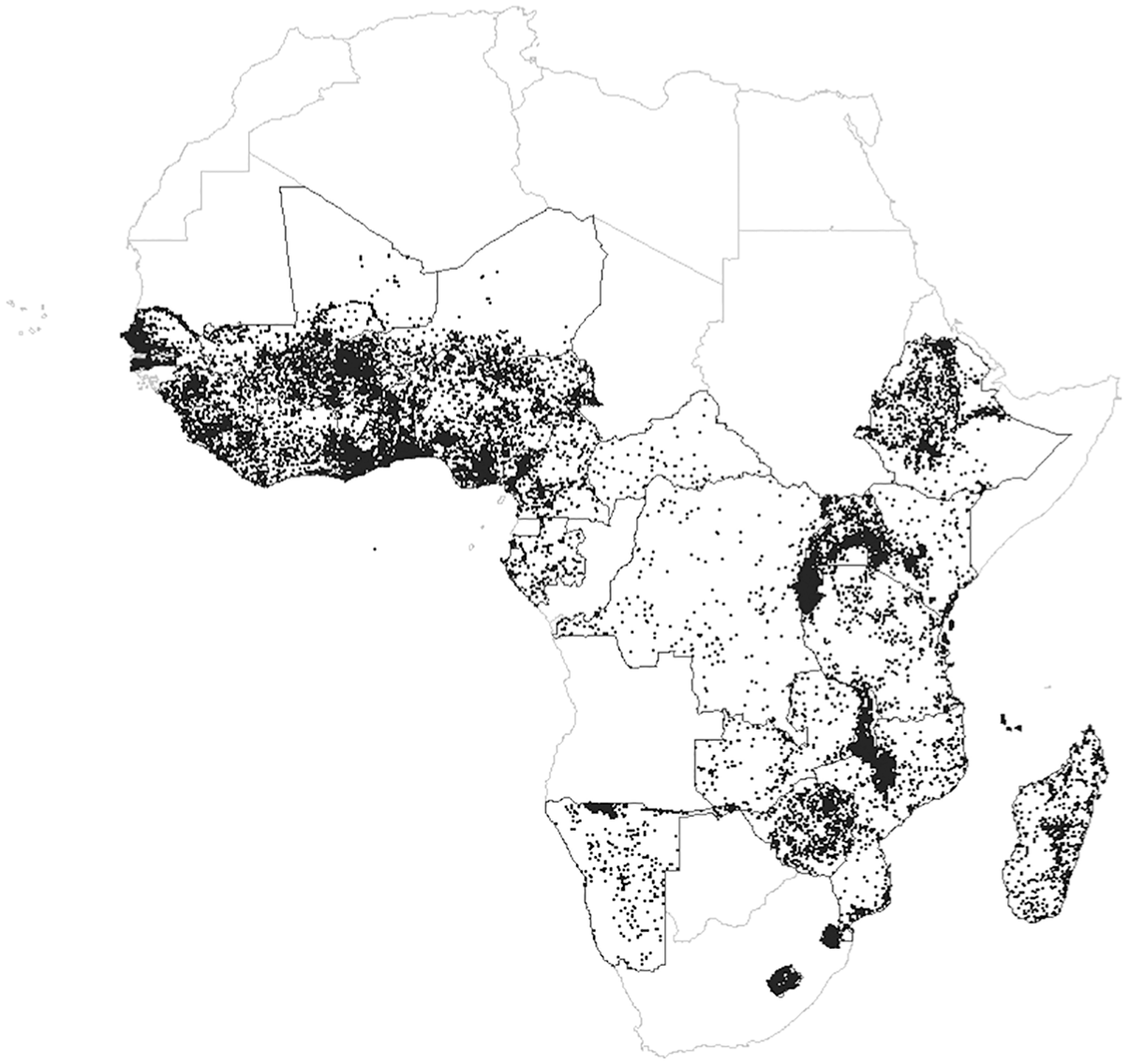
Location of Demographic and Health Survey (DHS) sites in Sub-Saharan Africa, 1990–2014.
In order to capture MHC service utilization, we focus on assistance during delivery. These factors are standard interventions that have been tracked in the DHSs over time and reflect the current recommendation from the World Health Organization to improve maternal health (WHO, 2015). They are also part of the recommended interventions that were used to measure progress towards achieving MDG 5. Our main dependent variable, Delivery in a health facility, takes the value ‘1’ if the delivery happened in a medical health facility (including all types of public and private hospitals, clinics, health centres, health posts), and ‘0’ otherwise. 11 We also include a related variable that measures whether the birth was assisted by a medical professional. The map in Figure 2 shows the geographical distribution of delivery in a health facility by survey cluster including all 72 surveys for the last born in the year preceding the survey. It is hard to see any clear patterns, although MHC services seem to be more widely used in Western and Southern parts of SSA. However, it is important to remember that we have an unbalanced panel, with surveys points from the years 1981–2014. Hence, looking at the distribution within a country in a given survey-round may prove more interesting.
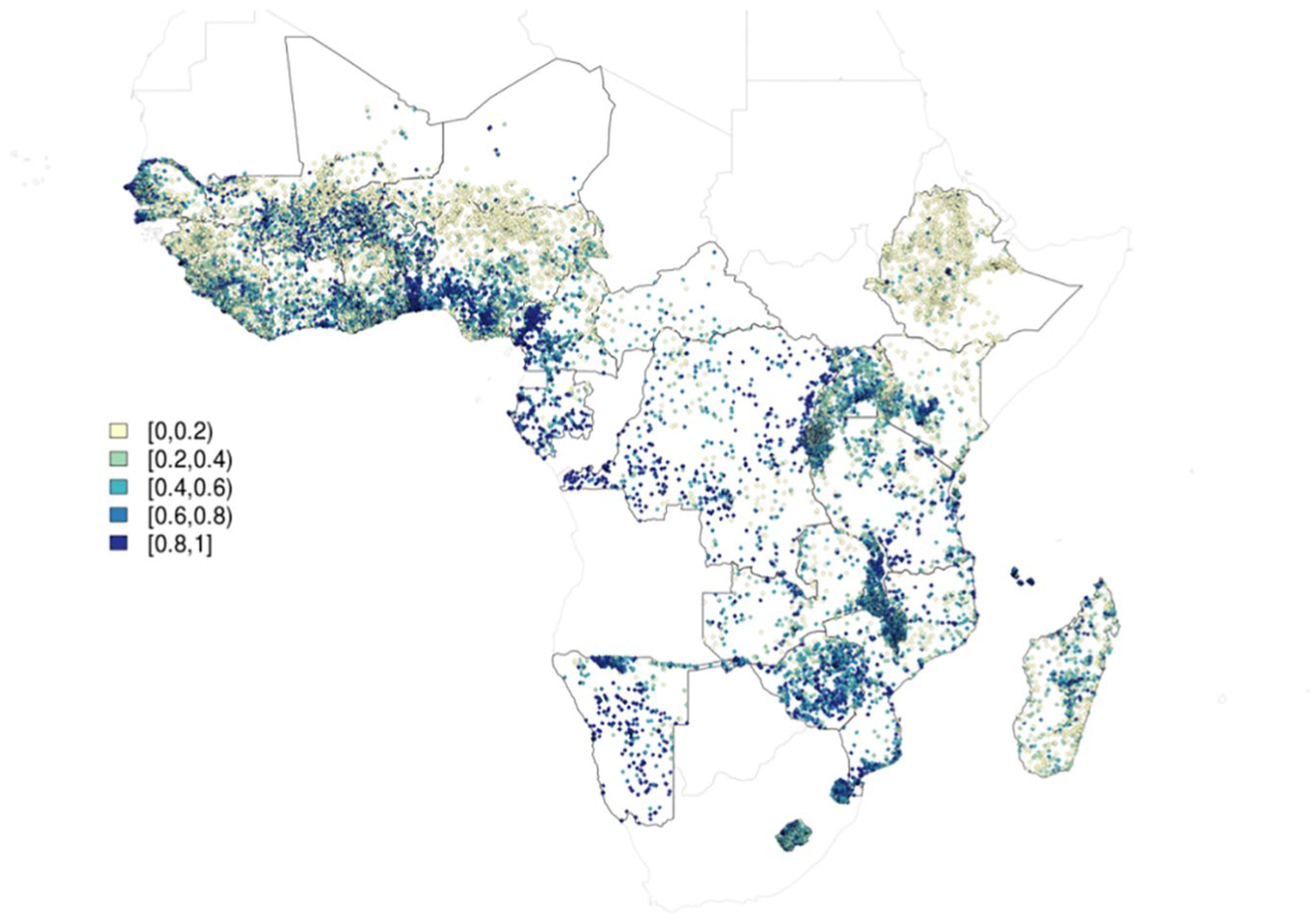
Delivery in a medical facility in sub-Saharan Africa, share (%) by survey cluster, various years.
Figure 3 therefore shows the distribution of deliveries in a medical facility by survey cluster point in Nigeria in the years 2008–2013. Darker colours represent higher shares of women having their lastborn delivered at a medical facility. Women in northern regions clearly have much lower access to professionally assisted delivery than women in southern Nigeria, which fits the general situation in terms of socioeconomic spatial differences in the country (see e.g. Østby and Urdal, 2014). These strong regional inequalities do not necessarily reflect active ethno-political favouritism/discrimination, however.
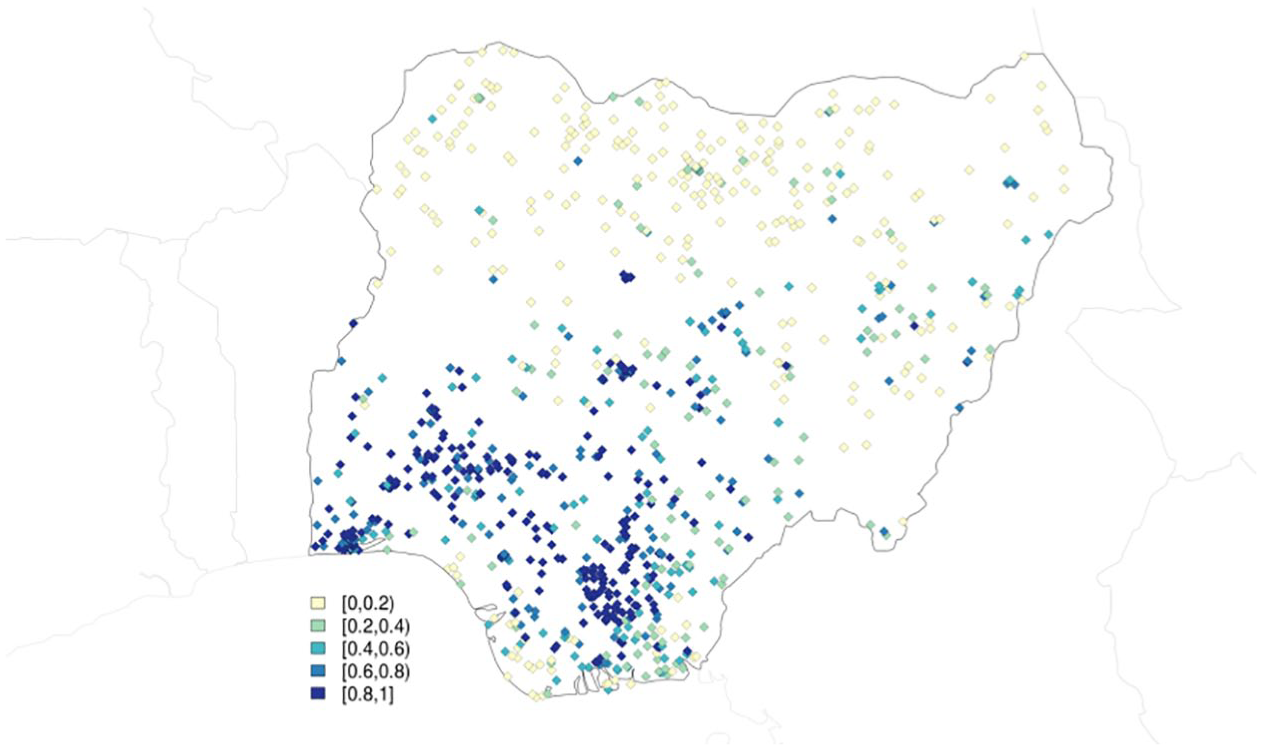
Delivery in a medical facility in Nigeria, 2008–2013, share by survey cluster.
Main independent variables: Ethnic groups’ political inclusion/exclusion
To identify whether political inclusion/exclusion of the major ethnic group(s) in a respondent’s home area has an effect on her MHC utilization, we use the coordinates of the respondent’s cluster to identify the access to executive state power of the dominant ethnic group(s) in the area as well as the number of politically relevant groups in the area. As described above, ethnic groups in SSA tend to live segmented, leaders have weak supervision capacity and patronage is therefore often provided as club goods, that is, they are geographically rather than individually provided. Our independent variable therefore captures whether the dominant ethnic group in a given area is included in government. All units in a given location are coded with the same ethnic power value, either excluded or included.
Our indicators of ethnic group-level political inclusion and exclusion are drawn from the EPR Core Dataset 2014 (Vogt et al., 2015), with the assigned geographical information from GeoEPR 2014 (Wucherpfennig et al., 2011). The EPR Core Dataset 2014 is an updated and extended version of the Ethnic Power Relations (EPR-ETH) dataset Version 2 (Cederman et al., 2010), covering the time period from 1946 to 2013. It includes:
. . . annual data on politically relevant ethnic groups, their relative size as a share of the total population, and their access to executive state power in all countries of the world with a population, in 1990, of at least 500,000, and where ethnicity has been politicized. (Vogt, 2014)
GeoEPR assigns every politically relevant group one of six settlement patterns and, if possible, provides polygons describing their location on a digital map.
In order to relate the data from the DHS to the GeoEPR group-polygons we do a spatial match from the survey cluster point to the GeoEPR polygon. For each individual in a given DHS we record the political status of the group(s) at the location at a given time period. We focus on both whether the group(s) at the survey location controls power alone, shares power with other ethnic groups or is excluded from executive state power (see Vogt, 2014, for further sub-categories). Interview clusters that were not matched with any EPR shape were coded as excluded.
In some areas, more than one group is coded as present by GeoEPR. When these overlapping groups differ in their status, the area is coded as mixed and removed from the analysis. As Figure 4 shows, this category is rare, about 4% of all observations. The small sample size precludes treating it as a separate group, and since it cannot be coded as either included nor excluded respondents living in such areas are excluded from the analysis. Whether it is less rational for leaders to target mixed areas with club goods or if these constitute crucial swing-voter areas that can be persuaded by material goods and therefore are heavily targeted with material goods (Casey, 2015) can therefore not be addressed with our design.
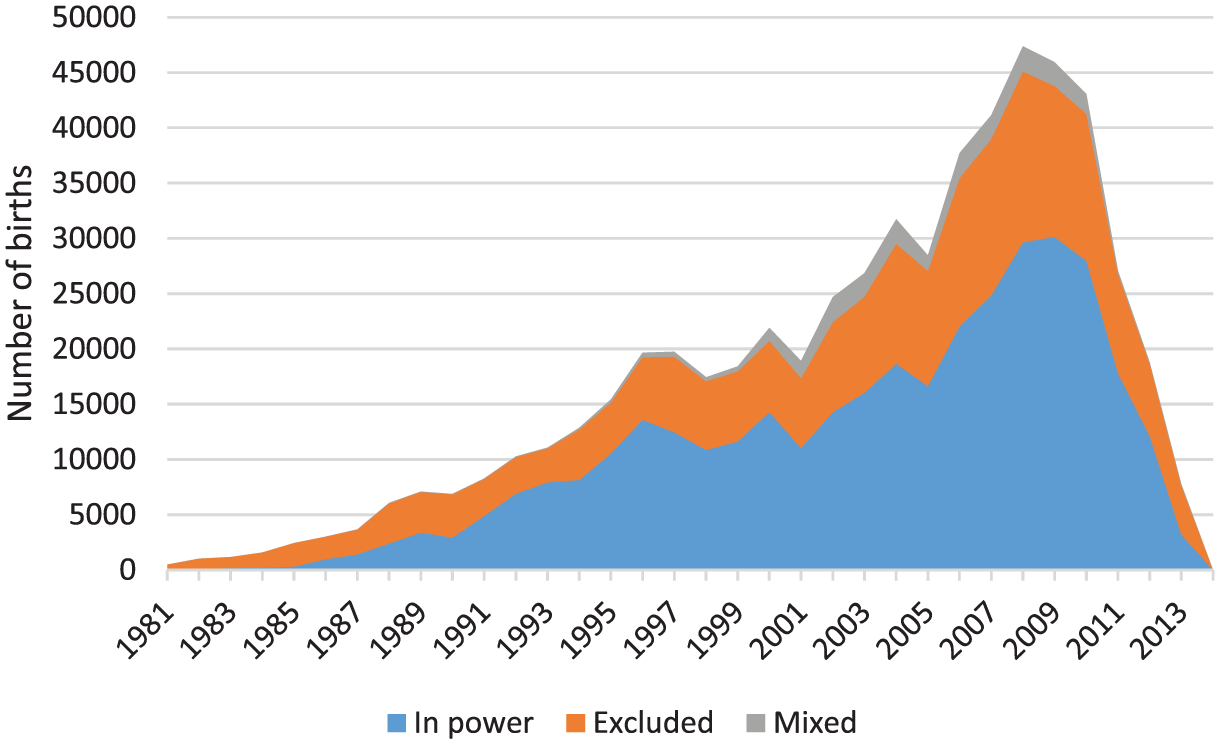
Distribution of ethnic power over time.
Figure 4 shows the distribution of children born in areas where the dominant group is excluded or is in power, or where there is a mix of such groups. Sixty-one per cent of all children are born in regions where the dominant ethnic group is in power; 35% were born in regions where the dominant group is excluded; and 4% were born in mixed areas. However, the figure can be somewhat misleading. That more people were excluded at the start and the end of the time series is not trustworthy. Very few observations are present in these periods. Yet, there is a clear tendency towards more inclusion in the early part of the 1990s. This pattern is also related to which countries spearheaded the trend towards GPS-coded DHSs. Since the majority of the interviews are held in the period 1990–2010, it is not surprising that the clear majority of births are found in this period as well. Yet, there are a substantial number of births from the 1980s as well.
In order to test the conditioning effect of electoral competition in Hypothesis 2, we use the V-Dem variable Clean election index (v2xel_frefair) (Coppedge et al., 2017).
Statistical model
The quantity of interest in this analysis is the change in probability of being born at a medical facility or receiving medical assistance at birth. Our dependent variables are both binary, measured at the individual level, whereas the main independent variable is ordinal and based on (sub-)national geographical areas. Our main goal is to compare the prevalence of institutional births in different areas, as defined by the dominant groups’ power status.
The data is expected to be trended, both due to selection effects and general improvements in both health services and political representation. The selection effect should work as follows: in order to be sampled, older women have to survive longer than younger women. It is not unreasonable to assume that women giving birth at a medical facility 20–30 years ago are more likely to be part of a DHS sample than other women in their cohort. Hence, we should see an over-reporting of institutional births among older women, and hence in the earliest birth years in the sample.
At the same time, there is reason to believe that different countries have different trend lines at different times, and that the average of these is positive, which should lead to the expectation of an increasing number of children born at medical facilities.
Furthermore, as shown in Figure 4, the main independent variable is also changing over time. The share of excluded women is decreasing over time. Likewise, the share of women that experience competitive elections is increasing over time, and these two processes are intertwined, as democratization commonly affects political exclusion.
Our models use mother fixed effects to remove unobserved factors that are constant for siblings. Since EPR includes several cultural groups in one, controls at EPR group level do not suffice, for example, the group ‘Southern’ in Sudan (Toposa, Bari, Nuer, Dinka, etc.), where there are very large differences between groups linguistically, culturally and institutionally. We also use birth-order fixed effects to control for factors that change throughout a birth history. Furthermore, we control for country-specific trends through two different approaches: a country-specific linear trend and a country-specific set of temporal fixed effects.
While we expect an ethno-political upgrade to increase usage of maternal health services, we do not believe this will happen overnight. We therefore interact the political status variable with an interaction measuring time since change. This interaction, however, is very hard to estimate in combination with country-specific temporal fixed effects. We therefore report both country-specific trend specifications.
The models are estimated with an ordinary least squares (OLS) model, using Stata’s xtreg procedure with robust standard errors clustered on mothers. 12 Our model resembles what Angrist and Pischke (2009: 64) refer to as the triple Difference-in-Difference model. The treatment is a positive change in ethno-political status. This is operationalized as the dominant ethnic group in the area changing from an excluded to an included status in GeoEPR.
This treatment is fuzzy, as we expect a lag between the change in ethno-political status and the change in the rate of improvement of maternal health services. The time since the change occurred will therefore also be used as an operationalization of the treatment.
Effect and control groups
We are mainly interested in the effect of a positive change in ethno-political status. There are two ways to estimate the effect of this change. We can either compare those that experience a positive change with a control group that does not share this experience or we can compare positive change with negative change.
The first approach starts out with everyone living in an area that at one point has been coded as excluded. If a change has occurred, we code the time of this change for each birth, whether this birth happened before or after the change and, when relevant, the time since any previous change. The treatment is therefore the combination of the dummy indicating whether the region is ethno-politically favoured and the time since previous change.
The effect group has variation in the time since previous change, whereas the control group has this variable missing. To deal with this problem we use a decay function (Raknerud and Hegre, 1997), which transforms the variable into a proximity to change function, in which 1 is immediately after change and 0 is a point in time far removed from any change. Missing observations can meaningfully be recoded to 0.
A significant number of the control group above never experience any change. By using these observations as a control group, we assume that they are as such equally likely to experience change under equal conditions. However, we do not know that. An alternative specification is to only analyse those areas that actually have had ethno-political change, and then compare positive change with negative change.
The controls for birth year and birth order combine to create a synthetic control group, where we utilize variation among mothers within and between countries and within birth orders as to when the ethno-political change occurs, combined with the birth histories. The birth order is measured by DHS variable bord_0, and birth year is measured by DHS variable b2_0. See Online appendix, Tables 7 and 8, for descriptive statistics.
Empirical findings
Do changes in political power among ethnic groups produce systematic spatial inequalities in terms of usage of basic MHC services? Our empirical analyses indeed indicate that living in an area that is dominated by an ethnic group represented in government is associated with an increased probability of attaining MHC. The size of the effect, however, depends on the control group.
Figures 5 and 6 display the coefficients from six different regressions, with a 90% confidence interval. Figure 5 has Delivery in Medical Facility as the dependent variable, and Figure 6 is based on Professional Assistance During Birth. These two dependent variables correlate at 0.89, but there might be important local differences. Yet, the results are very much similar.
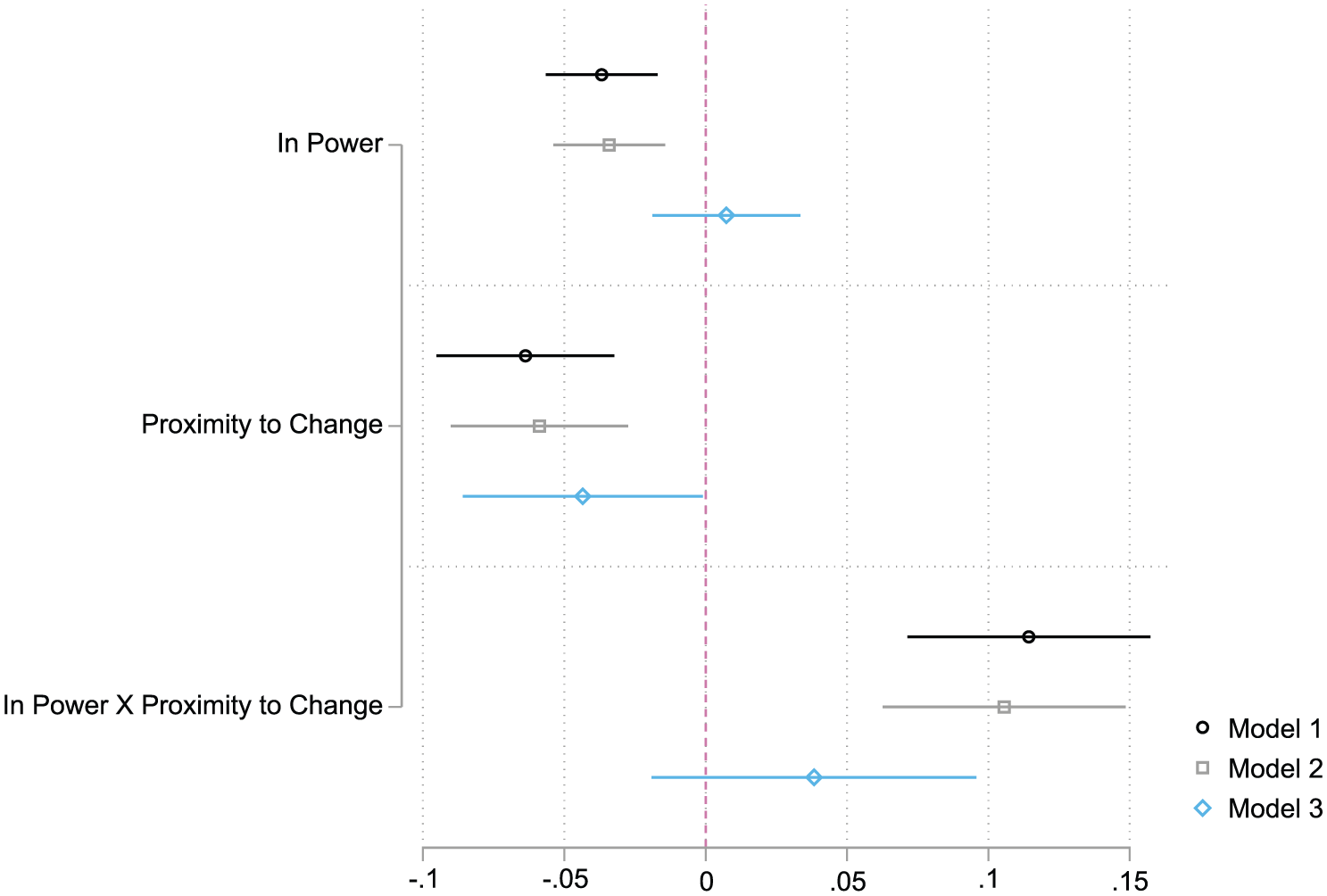
Regression results with Delivery in Hospital as the dependent variable, full control group.
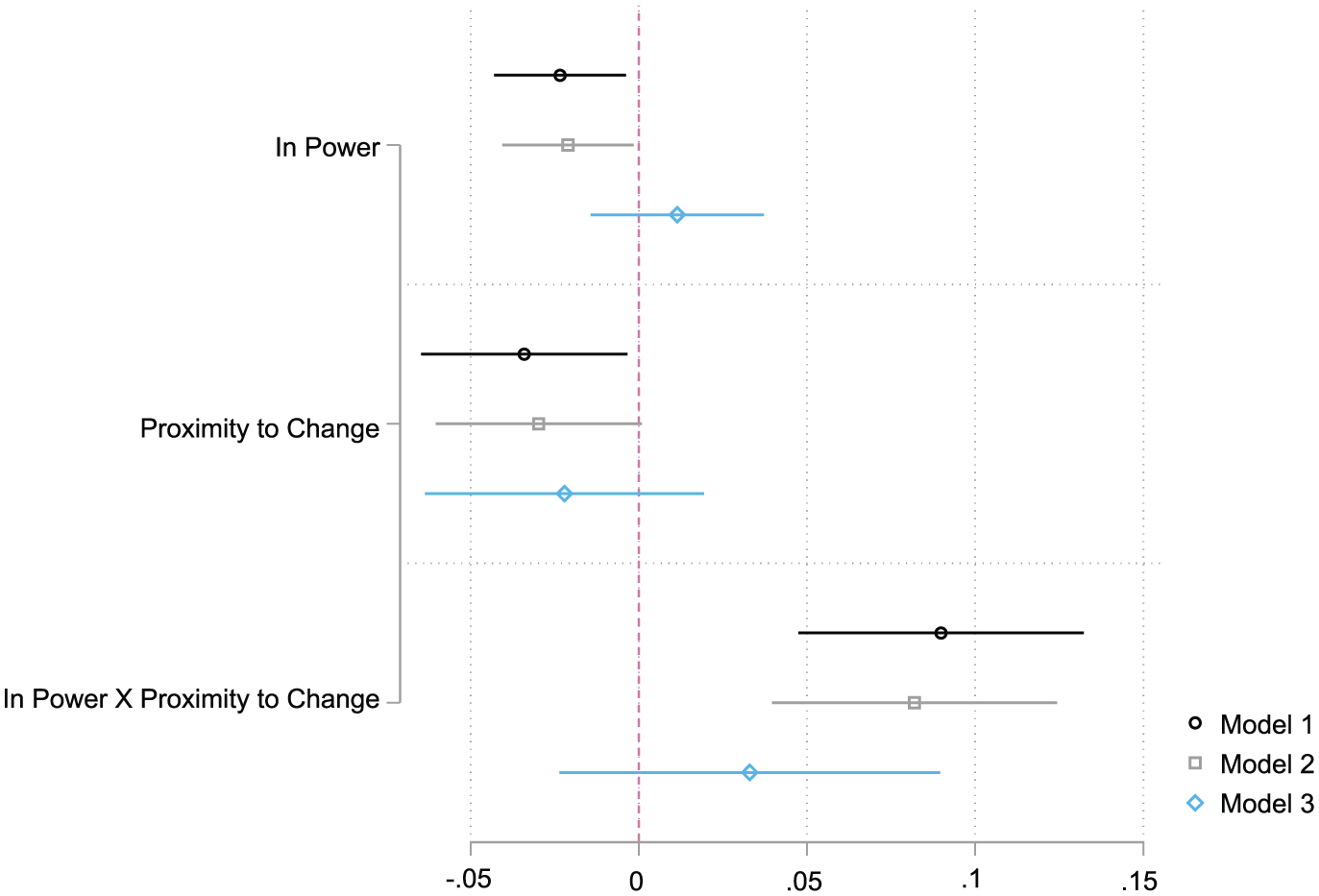
Regression results with Professional Assistance During Birth as the dependent variable, full control group.
Both of these regressions contain a large number of control variables not shown in the figures. The interaction term is the important part. Models 1 and 2 differs from Model 3 in both figures, as the first two have country-specific linear trend controls and the latter has country-specific temporal fixed effects. Models 1 and 2 find that the long-term effect of being in power is negative, as this is when Proximity to Change is zero. The short-term effect is hard to describe from the coefficients alone.
Model 3 in Figure 6 reports three insignificant coefficients, but interaction terms cannot be evaluated solely on the basis of the significance levels in the regression model (Brambor et al., 2006). Figure 7 plots the marginal effect of ethno-political status against proximity to change. Keep in mind that a high value means that change happened recently, whereas a low value means that change in the more distant past. The x-axis is, in other words, a reversed time axis. Interestingly, there seems to be little long-term effect, as the marginal effect at the left-hand end of the graph is small and uncertain. However, a few years after the change (proximity value range 0.3–0.7) there is an effect that is both strong and significant at around 3 percentage points increase in the likelihood of using maternal health services.
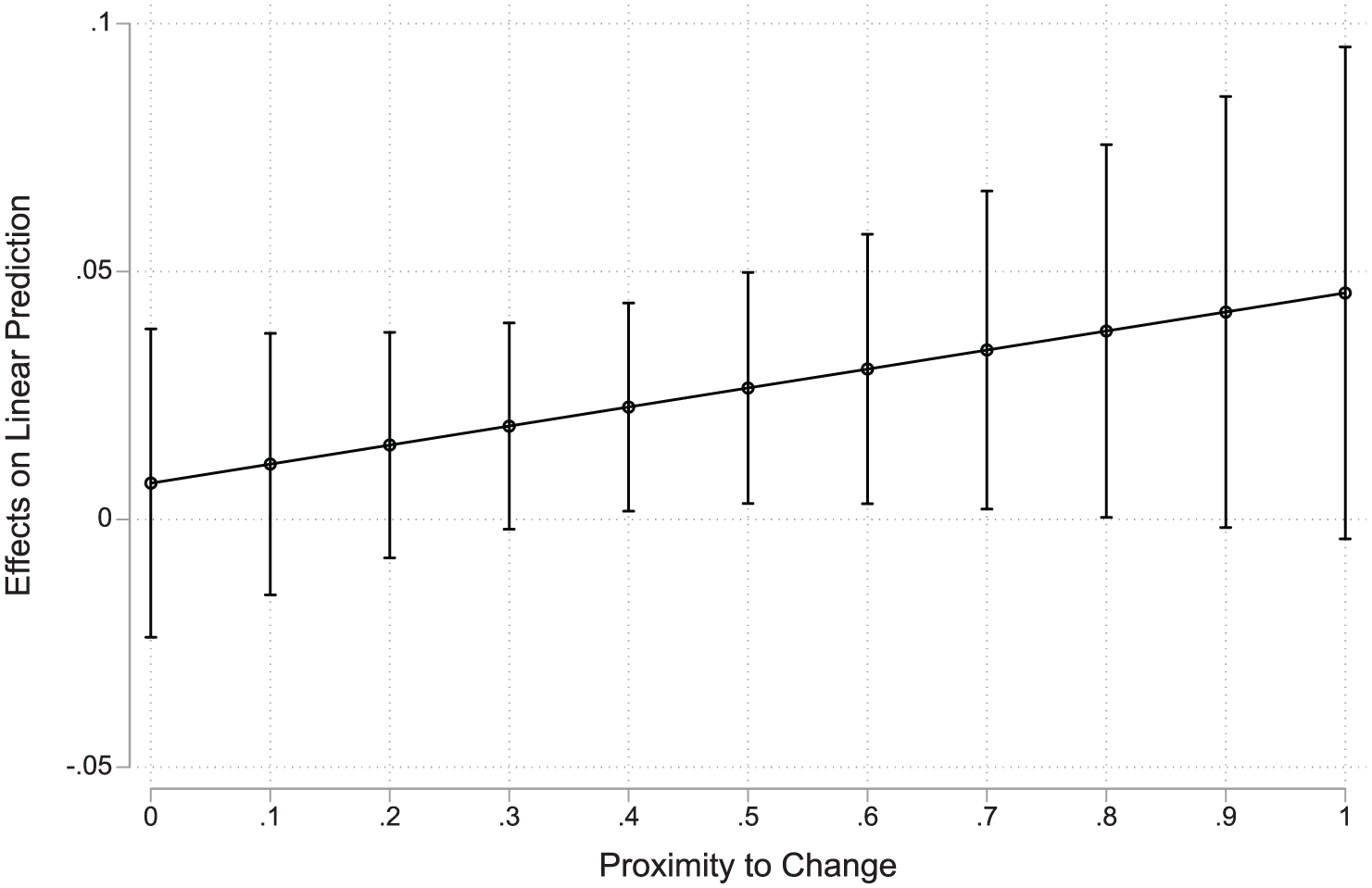
Average marginal effects of ethno-political inclusion.
The estimated long-term effect is surprising. It is not merely an effect of the research design. If we use country-specific trend variables instead of the fixed effects present in Figure 7, the results become even stronger, with a significant negative long-term effect. The finding could indicate a heterogeneous effect. We will investigate this first by altering the definition of the control group and second by adding the competitiveness of elections as a mediator of the effect of inclusion.
Positive versus negative change
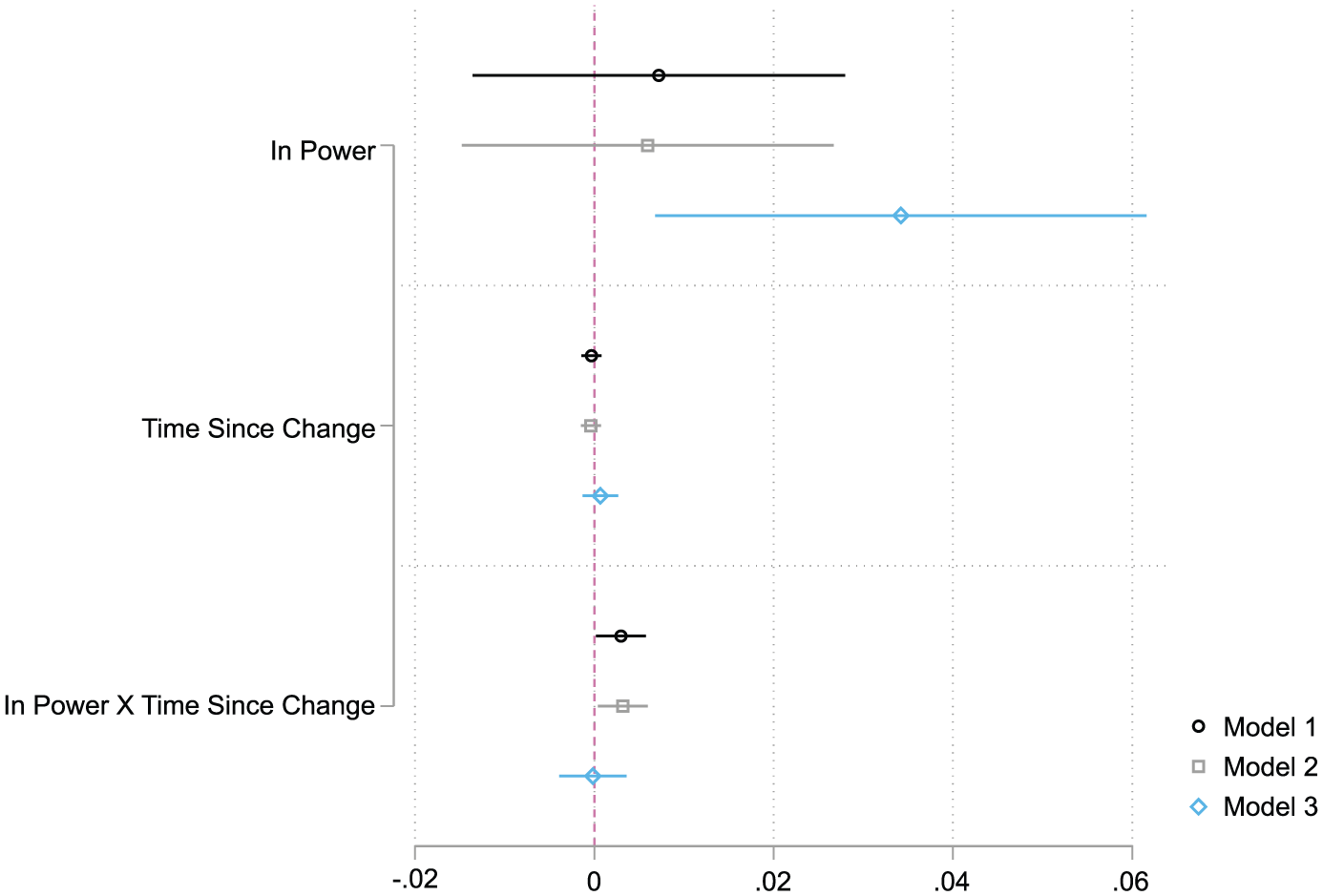
By eliminating all regions that are, for some reason, impervious to change, we are left with a control group that consists of the alternative change, from ethno-political inclusion to exclusion. The results are displayed in Figure 8 and 9.
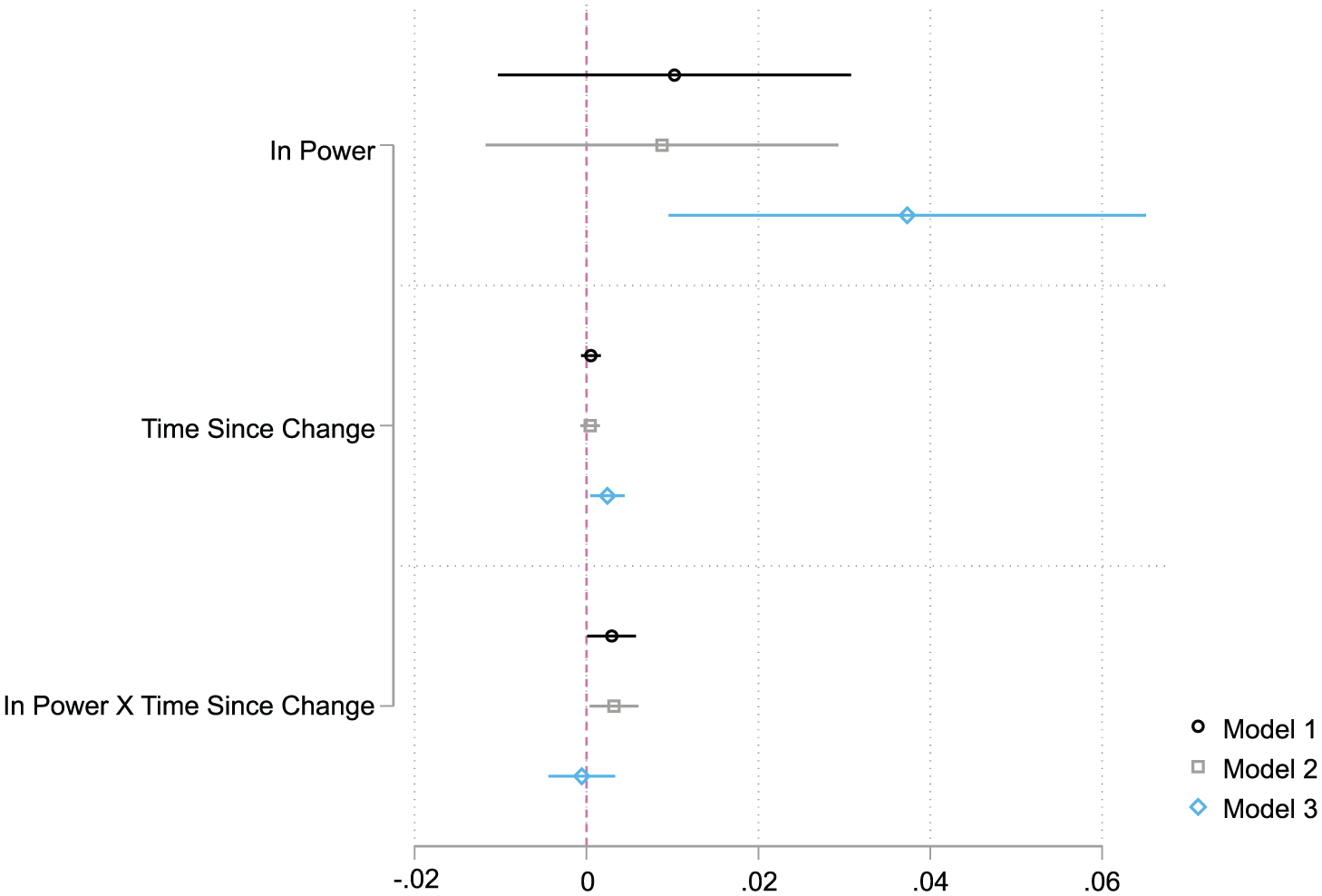
Regression results with Delivery in Hospital as the dependent variable, positive versus negative change.
Regression results with Professional Assistance During Birth as the dependent variable, positive versus negative change.
The immediate effect of moving into power compared to losing power, that is when time since change is zero, is estimated to be positive, but with a large uncertainty. Moreover, time since change does not seem to have an independent effect. The whole effect is found in the interaction term. The longer it is since the area of a given mother experienced an ethno-political upgrade, the more likely she is to receive maternal health services. The effect of political inclusion increases the likelihood of receiving medical support by 0.3 percentage points per year.
The difference between Models 1 and 2 is that Model 1 has mother fixed effects, a country-specific linear trend variable and a linear trend variable for birth order, similar to Model 2, with the exception of fixed effects for birth order. The birth-order fixed effects make very little difference for the estimates of political inclusion.
Model 3 is very different, as it is estimated with country-specific year fixed effects. The result is that the interaction effect is eliminated and that we see a very strong effect from political inclusion. The uncertainty around this estimate is rather large, indicating a heterogeneous effect.
The interaction effects between in power and time since change are the most important part of the analysis. Figure 10 shows a partially different result from Figure 7, but a key issue remains. A few years after a change has occurred, we observe an increase in the likelihood that a woman receives maternal health services. In Figure 10, this effect steadily increases, albeit with very large uncertainties past 10 years.
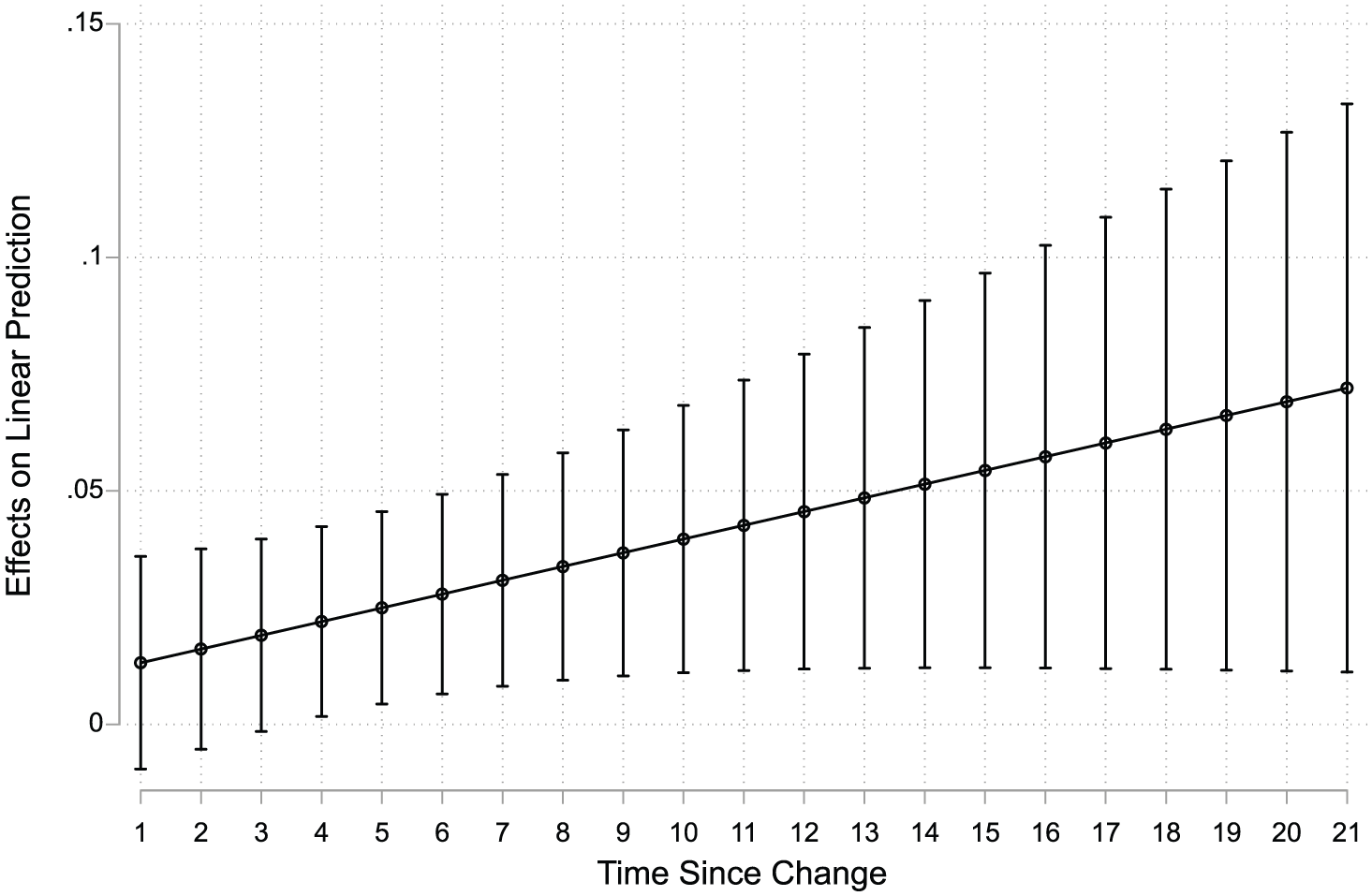
Average marginal effects of ethno-political inclusion.
Free and fair elections
Hypothesis 2 predicts that the effect of ethnic inclusion is contingent upon somewhat free and fair elections. Figures 11 and 12 test this hypothesis and find strong support.
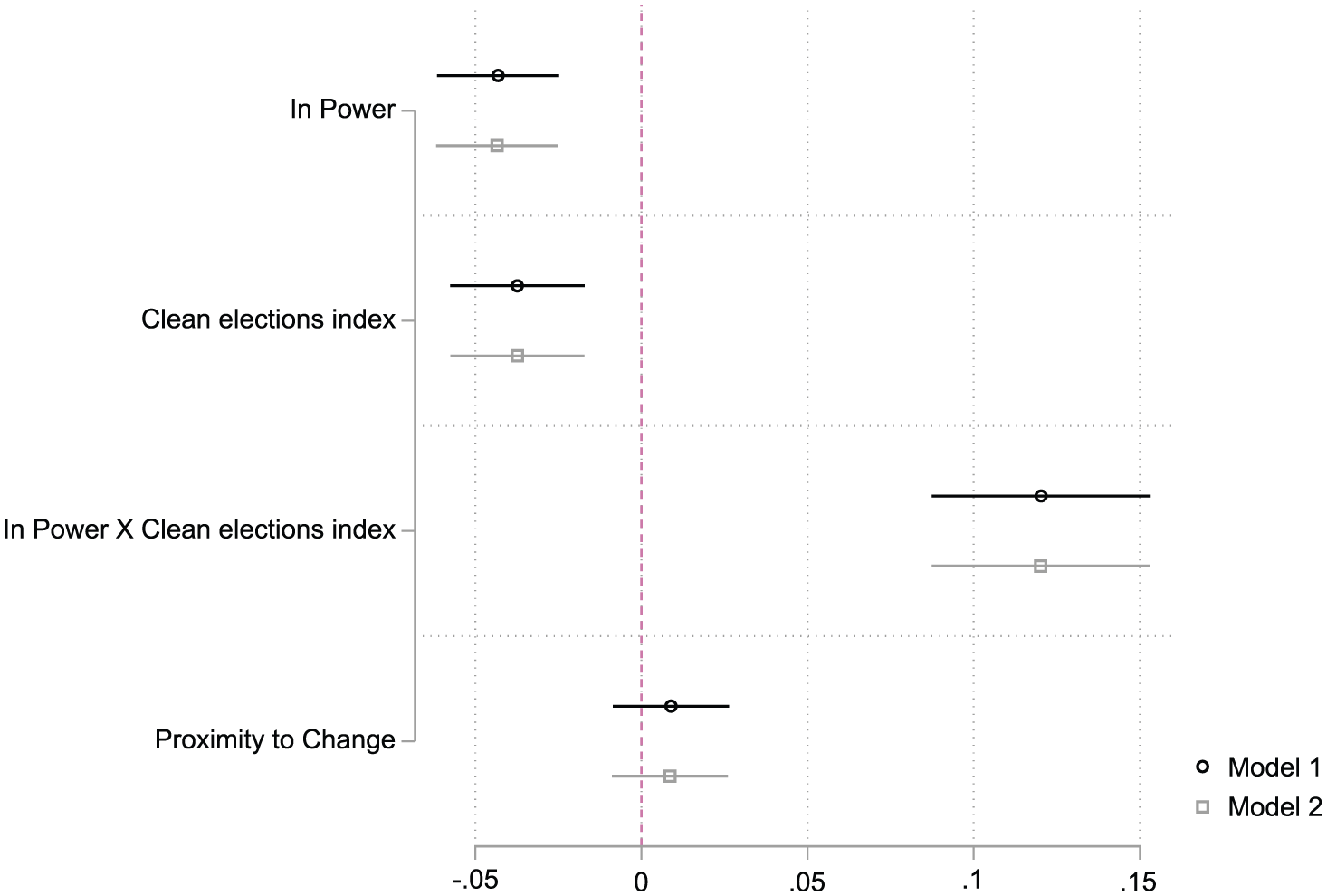
Regression results with Delivery in Hospital as the dependent variable.
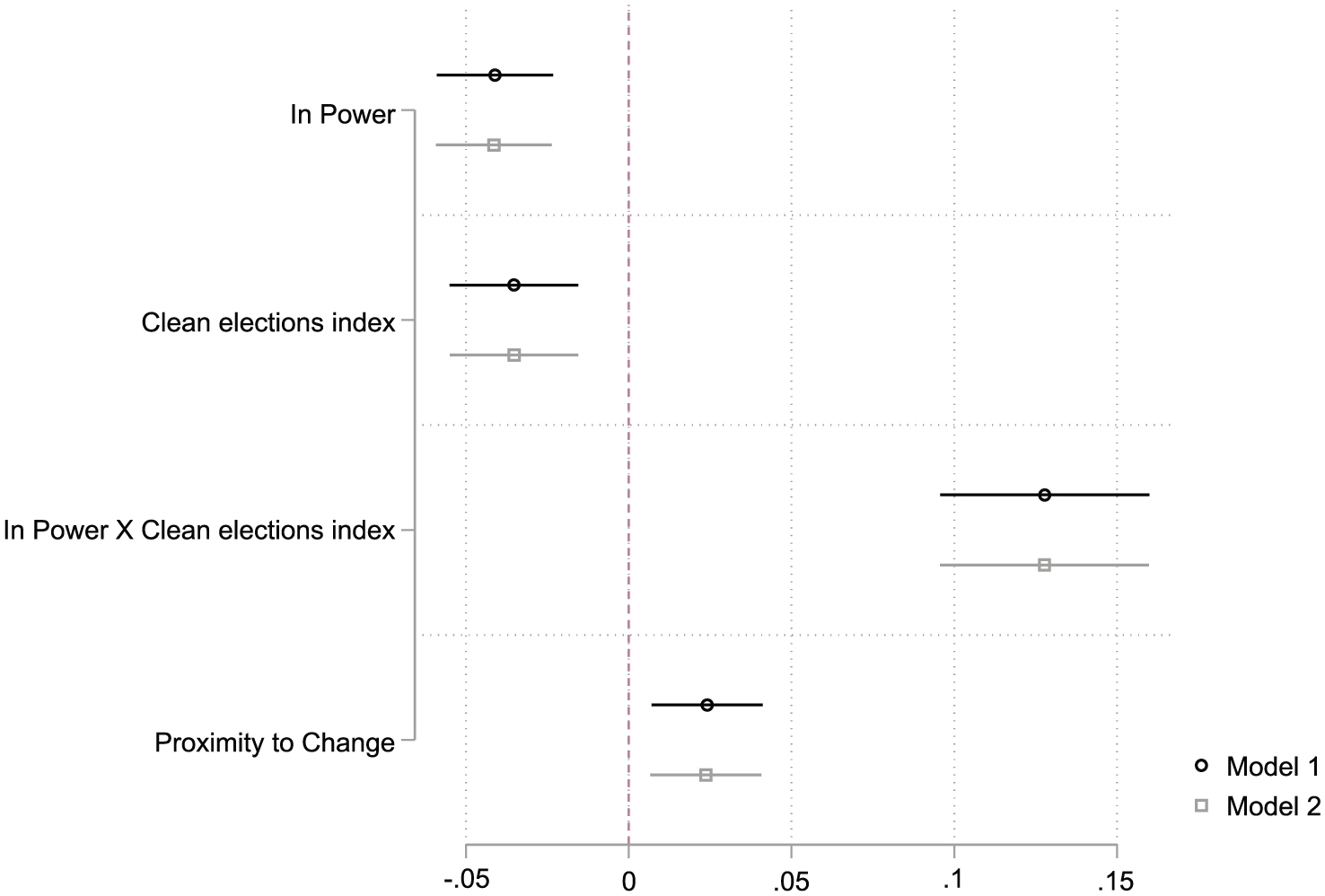
Regression results with Professional Assistance During Birth as the dependent variable.
These models use the control group setup with all excluded regions, similar to Figures 5 and 6, but we cannot use the country-specific temporal fixed effects model (Model 3 in Figures 5 and 6), since the V-Dem Clean Election Index is measured at the country year.
An ethno-political change from exclusion to inclusion with the lowest possible value on this index is actually detrimental, reducing the likelihood of receiving maternal health services by about 4 percentage points.
Likewise, improving the competitiveness of the elections is detrimental for a group that is excluded, but highly beneficial for a group that is represented in the government, as postulated in Hypothesis 2. The interaction term is again hard to interpret on the basis of coefficients, but Figure 13 shows that for values of free and fair elections over 0.5, there is a clear positive effect for included groups. This value is about where Nigeria is today.
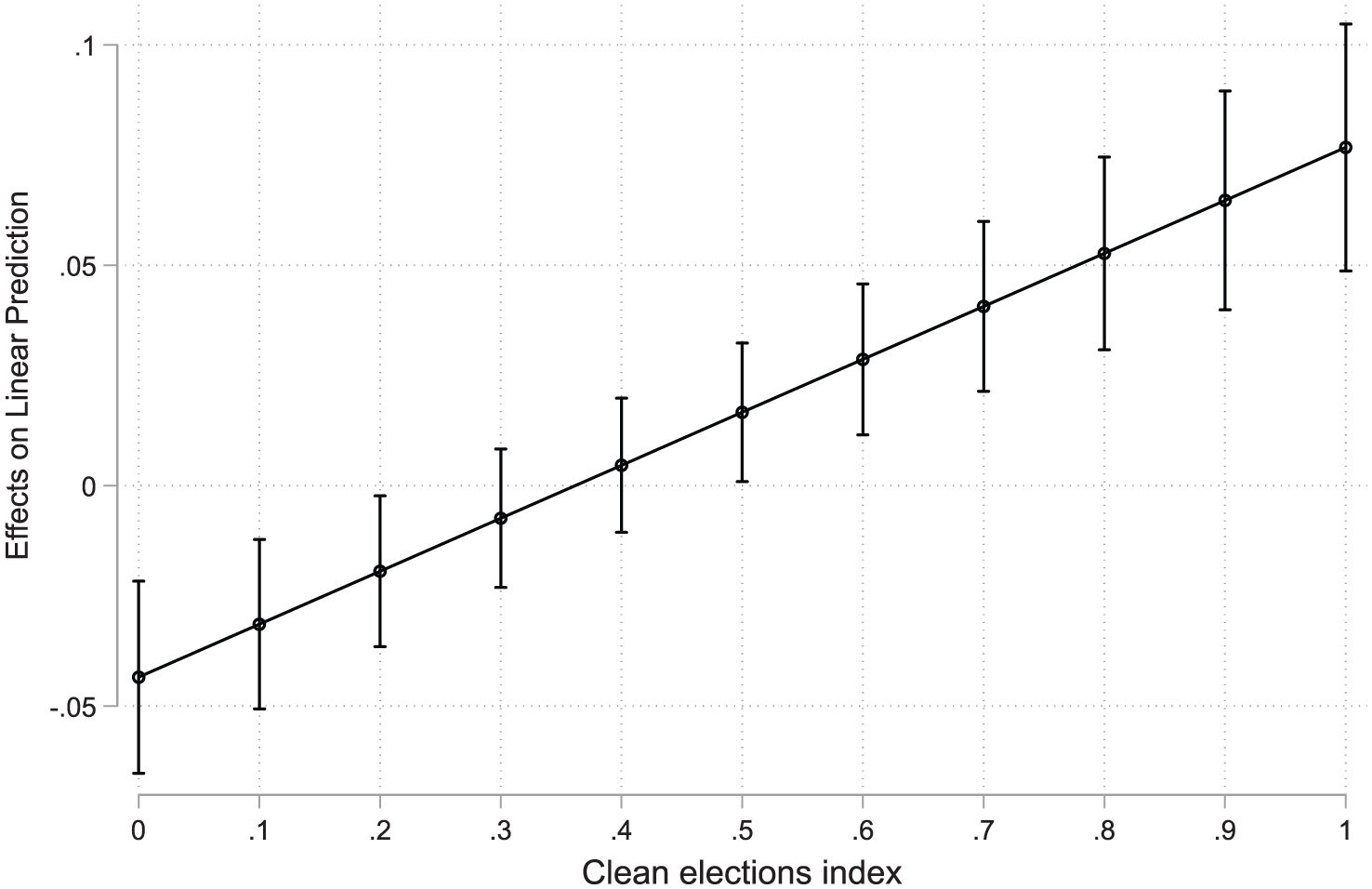
Marginal effect of ethno-political inclusion by free and fair elections.
Conclusion
This paper is a first attempt at testing whether changes in political power among ethnic groups produce systematic spatial inequalities in terms of access to basic MHC services. We expect to find such differences, particularly in conjunction with competitive multiparty elections. Our analysis confirms these hypotheses.
As there is a plethora of potential causes of differences in health services, we utilize variation in and around changes in ethno-political status. We compare women that experience an ethno-political upgrade with two different control groups to find an average improvement of about 2–5 percentage points increase in the likelihood of attaining maternal health services.
Our results indicate that the effect might not materialize for about two to four years. Newly excluded groups start with an advantage in terms of delivery in facility that quite likely stems from having been in power. Furthermore, it takes time, at least six years, for the fruits of being included in government to materialize in significant differences in MHC provision. This makes sense, as medical facilities are primarily a fixed public good, which takes time to establish. While the overall effect is quite weak, the number of children that benefited from having co-ethnics in power number in the thousands.
While we find a stronger effect of ethnopolitical favoritism the more competitive elections are, well-functioning democracies consist of much more than competitive elections. One hallmark of stable democracies is checks on the executive. Ethnic favouritism is argued to occur when political institutions are too weak to constrain governments, and in particular the executive, from carrying out discriminatory policies (Burgess et al., 2015: 1818; Hodler and Raschky, 2014). Although electoral incentives may incentivize more favouritism in democracies, stronger checks on the executive would nuance this relationship. The interplay between electoral competition and effective constraints on the executive should be investigated closer in the future. For instance, if effective, term limits will incentivize incumbents to only reward co-ethnics as long as they are eligible for re-election. Consequently, if lay co-ethnics acknowledge this, they will only vote for ‘their’ candidate as long as rewards can be expected. This should not be exaggerated, however, as a simple trichotomy juxtaposing executive constraints versus electoral competition versus autocracy is insufficient, as some regimes do not fit into this. Indeed, the African regime that was most successful in carrying out ethnic favouritism was the apartheid regime of South Africa. It combined institutionalized checks on executive power with electoral accountability, but only so for a small proportion of the population.
One avenue for further research is to further explore ethnic settlement patterns. If target groups live highly segmented lives, it reduces free riding by non-target groups. Excellent single-country studies of this mechanism have found support for such a claim (see Ejdemyr et al. (2018) on Malawi and Tajima et al. (2018) on Indonesia; see also Beiser-McGrath (n.d.) for an analysis of SSA). Although data on respondent ethnicity is included in the DHS data, these are representative at the national level only (Weidmann et al., 2016: 1152). We have therefore chosen to err on the conservative side by not assuming that these are representative at the sub-national level as well.
Relatedly, single-country studies from SSA (Banful, 2011; Casey, 2015; Masaki, 2018) have shown that in certain contexts, swing rather than core voters are targeted with patronage. More precise data on settlement patterns across countries and, in particular, where there are zones of mixed ethnicity or of groups with unclear political allegiance would allow for competing tests of the core- versus swing-voter debate applied to settings where ethnicity is the most salient dividing line. Furthermore, combining DHS data with opinion-survey data on information and ethnic salience could further nuance our understanding. As Posner (2005) argues for Zambia and Casey (2015) shows for Ghana, if voters receive improved information of candidates, the effectiveness of ethnic scapegoating and other mechanisms to ensure co-ethnic loyalty weakens, and hence the salience of ethnicity in electoral contexts.
If we conceptualize of ethnic groups as coalitions of individuals joining together in order to reduce collective action problems in the pursuit of material benefits (Kimenyi, 2006), relative group size may matter and could also matter in some dictatorships. If a small ethnic group is important for a regime – such as the Alawite in Syria or, arguably, the Tugen during Moi’s regime in Kenya or the whites during South Africa’s apartheid (if one sees that as a semi-democracy) – one could expect genuine trickle-down to co-ethnics also under regimes that are less dependent on broad electoral support (see Burgess et al., 2015, for support on this for Kenya). This could provide some explanation for why single-country studies have detected more favouritism during dictatorship, whereas the sole other cross-national study on SSA that incorporates electoral competition also finds more ethnic favouritism when electoral competition is stiffer (Dreher et al., 2019).
Supplemental Material
Online_Appendix_Ethno-political_favoritism_in_maternal_health_care_service_delivery – Supplemental material for Ethno-political favouritism in maternal health care service delivery: Micro-level evidence from sub-Saharan Africa, 1981–2014
Supplemental material, Online_Appendix_Ethno-political_favoritism_in_maternal_health_care_service_delivery for Ethno-political favouritism in maternal health care service delivery: Micro-level evidence from sub-Saharan Africa, 1981–2014 by Ole Magnus Theisen, Håvard Strand and Gudrun Østby in International Area Studies Review
Footnotes
Acknowledgements
Earlier versions of this article were presented at the PRIO Workshop on ‘Armed Conflict, Maternal- and Child Health, and the Impact of Development Aid in Sub-Saharan Africa’ in Oslo, 22 September 2016, and at the ISA Conference in Baltimore, ML in February 2017.
We are grateful for the participants at these meetings for their helpful comments and ideas. All errors are our own.
Funding

Supplemental material
Supplemental material for this article is available online.
Notes
References
Supplementary Material
Please find the following supplemental material available below.
For Open Access articles published under a Creative Commons License, all supplemental material carries the same license as the article it is associated with.
For non-Open Access articles published, all supplemental material carries a non-exclusive license, and permission requests for re-use of supplemental material or any part of supplemental material shall be sent directly to the copyright owner as specified in the copyright notice associated with the article.
