




Abstract
Natural resources can create state-based and other conflicts through several causal mechanisms. Debate, however, has remained silent on forms of conflict, especially why violent or peaceful collective action occurs. Combining the literatures on nonviolent- and armed conflict with work on the resource–conflict link, we developed a number of hypotheses on how resources affect the conditions under which collective actors such as ethnic groups remain dormant, voice grievances peacefully or engage in violent rebellion. A grid-cell analysis of ethnic groups in Africa largely confirmed our expectation on the effect of resources. Resource deposits increased the risk that violent conflict would occur; the effect was reversed and ethnic groups become dormant when groups living in resource regions were politically included. We also found some evidence that lootable resources fuel violent but not peaceful conflict. However, the non-resource context best explained the difference between violent and nonviolent conflict. Democracy, political exclusion and geography such as distance from capital and transborder ethnic kin were key in explaining why violent and not peaceful protest emerged. Future research should dig deeper into mechanisms of how resources affect forms of conflict and should further study non-resource conditions that can have functionally equivalent effects.
Introduction
Many studies show that natural resources can negatively affect producing states by increasing corruption, economic problems, and violent conflict (see e.g., Hunziker and Cederman, 2017; Le Billon, 2012; Ross, 2012;). However, with regards to conflict onset, empirical outcomes vary. In cases such as Angola, Colombia, the Democratic Republic of Congo (DRC) or Nigeria, armed conflict over natural resources has claimed thousands of lives (Le Billon, 2012; Uppsala Conflict Data Programme (UCDP) Conflict Encyclopedia, 2017). In 2012, protest against working conditions at a platinum mine in Marikana, South Africa left dozens of miners dead (Alexander, 2013). At the same time, many protests in the mining sector remain peaceful throughout. For instance, local ethnic and other groups more often than not protested mining peacefully in Bolivia and Peru (Mähler and Pierskalla, 2014). In a third group of cases, largely under the radar of international media coverage, local groups suffered negative side-effects as a consequence of extraction without any visible mobilization. In these cases ‘dogs did not bark’ nor did they ‘bite’, but remained ‘asleep’. 1 How can we explain these differences? Why do (wo)men or, more specifically, ethnic groups rebel (Gurr, 1970, 2000), and by what means? Under what circumstances do ethnic groups take up arms against the state, when do they voice resource-related grievances in nonviolent manners, and when do they remain dormant?
Recent years have seen an increase in studies addressing the different driving factors for violent and nonviolent protest (for instance Chenoweth and Cunningham, 2013; Gleditsch and Rivera, 2015). However, the insights from this emerging field have yet to be translated to conflicts related to natural resource production. In this study, we made a first effort to integrate these two fields and develop an understanding of when groups in resource-endowed regions engage in dissident collective action violently, peacefully, or not at all. We proposed three main hypotheses using a motive–capacity-based framework. The hypotheses were tested in an analysis that employed a multinomial regression analysis of grid-cell data comprising resource location, ethnic groups’ inclusion into government and the economy, the lootability of resources, other economic and geographic indicators as well as non- or low-level violent ‘social conflict’ and armed conflict events in Africa.
Results suggest that forms of dissident collective action or their absence indeed differ according to the influence of natural resources: resource deposits led to violent rather than peaceful protests in a given region, indicating a strong resource-related motive. The effect was reversed when ethnic groups that had settled in resource-endowed regions participated in the government, reducing the likelihood of all forms of protest. In addition, lootable resources tended to increase group capacity to engage in violent protest, although this result was less robust.
While resources thus partially explained why violent conflict occurs or not, contextual factors arguably better explained the differences between peaceful and violent protest. In particular, political exclusion and geographical factors increased military capacities and explained why violent – and not peaceful – protest emerges; these factors explained the difference much better than resource-related variables. In sum, we conclude that political exclusion or inclusion is the best option to reduce resource-related conflict.
The remainder of this paper proceeds as follows. We first review the relevant literature on the topic. We then elaborate on our key concepts and develop a theoretical framework based on the assumption that collective actions require both motive and capacity. On this basis, we identify corresponding variables and draft a set of hypotheses. In the subsequent section, we outline our empirical strategy to test these assumptions. Section five presents and discusses the results. The final section discusses the contribution of our findings and points to a number of challenges for future research.
Literature review
Two strands of literature are important for our study. This section first summarizes the findings on the resource curse regarding conflict and then proceeds to discuss the state of the art on violent and nonviolent forms of conflict.
Forms of conflict in research on the resource–conflict link
Standard theories on causal mechanisms in the resource–conflict link (Hunziker and Cederman, 2017; Koubi et al., 2013; Ross, 2004; Roy, 2016) agree that resources and conflict are mainly linked through motive and capacity. 2 Dissident collective action can happen only when people are willing to (motive) and capable of (capacity) doing so. Motives for resource-related conflict can originate from undemocratic regimes (Ross, 2001), low rates of economic growth (Brunnschweiler, 2008), a higher price of achieving control of government (Collier and Hoeffler, 2004), lack of redistribution of resource revenues, or local grievances over negative externalities arising from extraction (Rustad and Binningsbø, 2012). Capacities might arise at the local level from looting resources and blackmail surrounding production and transport (Lujala, 2010; Onuoha, 2008) as well as weakening state institutions as a result of national economies’ high dependence on resource production (Basedau and Lay, 2009).
Natural resource production thus impacts political stability through a variety of causal pathways at local and national levels. Regions that produce valuable natural resources are likely to experience a higher risk of instability due to grievances relating to environmental destruction, poor working conditions, or insufficient compensation to local communities.
Some research suggests, though, that such local direct effects of resource extraction are mediated by political inclusion of ethnic and other groups living in resource-producing areas (Asal et al., 2015; Basedau and Pierskalla, 2014; Hunziker and Cederman, 2017). Factors such as ethnic exclusion, ethnic fragmentation, or simply the location of distinct ethnic groups interact with the production of precious resources in ways that can increase (or decrease) the risk of organized violent conflict onset. 3 In addition to such local destabilizing effects, natural resource production can have an impact on the entire population’s motive for insurgency through corruption, low economic growth, and low legitimacy of autocratic systems.
These aforementioned mechanisms explain why conflict related to resources emerges. Importantly, however, they widely neglect the question of what form it takes. Studies typically focus on armed conflict only, but the known mechanisms can result in either peaceful or violent forms of dissident collective action.
To the best of our knowledge, few studies have systematically engaged with different forms of collective action in the resource–conflict link. Regan and Norton (2005) incorporate an aggregate measure of easily extractable resources into their study of nonviolent and violent resistance, finding some counterintuitive evidence that resources reduce the risk of civil war onset. However, their study suffers from a number of shortcomings that include the use of debatable data and concepts and an aggregation at country level unable to capture the local developments that are likely to shape spontaneous forms of political protest.
Another study by Steinberg (2015) presents a formal model that analyses interactions between local groups, corporate extractive actors, and governments that derives conclusions about the likelihood of protest, repression, and public goods provision. However, Steinberg does not provide insights regarding the form of protest, nor is her model tested empirically. Mähler and Pierskalla found a relationship between gas deposits and social conflict events in Bolivia that is conditional on the presence of indigenous groups in the region (Mähler and Pierskalla, 2014). Their findings point to the (conditional) relevance of natural resources, but do not assess whether varying forms of conflict are driven by distinct configurations of covariates. More recently, Hunziker and Cederman (2017) found that resource reserves increase the likelihood of armed conflict, but only separatist conflict, not all forms of armed conflict. However, the authors do not address the question of violent and nonviolent dissident collective action.
Violent and nonviolent forms of conflict
Theoretical and empirical contributions concerned with the onset of violent and nonviolent political collective action have not engaged in dialogue with each other until recently. For the most part, scholars interested in violent protest, including armed conflict (Collier and Hoeffler, 2004; Hegre and Sambanis, 2006; Kalyvas, 2006), and those researching nonviolent collective protest (Della Porta and Diani, 2006; Sharp, 1973) have developed separate theoretical frameworks and empirical studies (but see Gurr, 1970; Tilly, 1978; Tilly and Tarrow, 2007). This separation has started to disappear with the recent publication of global and regional datasets systematically reporting on nonviolent collective action that enables researchers to rigorously compare drivers and effects of violent and nonviolent conflict (Salehyan et al., 2012; Brunnschweiler and Lujala, 2019; Chenoweth and Lewis, 2013).
With the growing integration of these two research strands a number of publications have demonstrated that the drivers of organized violent and nonviolent conflict differ (Chenoweth and Lewis, 2013; Cunningham, 2013 Regan and Norton, 2005). According to Chenoweth and Ulfelder (2015), nonviolent resistance is generally more difficult to predict than more violent forms of dissidence; nonviolent conflict might be driven more by leaders’ agency and determination to overcome adverse circumstances than by structural factors – or this lack or predictability might indicate that models of nonviolent resistance need to be refined (Chenoweth and Ulfelder, 2015).
As far as results are available, several clusters of variables have a diverging impact on violent or nonviolent collective action. Intra-group factors describe characteristics such as group size, degree of fragmentation and concentration, group location, and previous history of protest (Cunningham, 2013; Gleditsch and Rivera, 2015; Raleigh, 2014). For instance, group size and internal fragmentation increase the risk of armed conflict but not the likelihood of nonviolent protests, while a history of nonviolent protest increases the likelihood of peaceful campaigns. Inter-group factors include the relations between groups and with the state such as interaction with competing groups, economic and political discrimination, and state-led repression; these factors also significantly influence the onset of nonviolent as well as violent campaigns (Cunningham, 2013; Pierskalla, 2010; Raleigh, 2014; Regan and Norton, 2005). Political exclusion, for example, tends to increase the likelihood of observing both forms of collective protest, but studies are divided over the significance of the effect (Regan and Norton, 2005 vs. Cunningham, 2013). Government-level factors such as form of political regime and respect for civil liberties, elections, or state capacity seem to additionally shape the choice of collective protest (Chenoweth and Ulfelder, 2015; Cunningham, 2013). Democracy only seems to decrease the emergence of nonviolent conflict, but does not seem to have a significant effect on armed conflict. Lastly, contextual factors such as terrain, population density, or time trends have been shown to have an impact on the onset of forms of conflict (Chenoweth and Ulfelder, 2015; Hegre and Sambanis, 2006). For instance, variables such as rough terrain, oil exports, and ethnic and religious fractionalization seem to only increase the likelihood of armed conflict onset but have no significant effect on nonviolent dissident collective action. Table A in the Appendix summarizes the recent quantitative literature. Most recently, Brunnschweiler and Lujala (2019) have studied the impact of ‘economic backwardness and social tension’ and also compared classical armed conflict with peaceful mass campaigns and found important differences, especially that nonviolent mass movements are more likely to happen in richer countries.
Despite several important insights by these studies, a number of gaps persist. Various variables have not been tested simultaneously in one study (e.g., a high, disproportionate number of young people (age 15-24 usually). (youth bulge) and urbanization) or have yielded contradictory results (e.g., gross domestic product per capita (GDP p.c.)). Moreover, most of the empirical studies focus on specific forms of protest only, namely organized and sustained forms of protest. Thus, they investigate factors that influence the onset of armed conflict versus mass-based social movements and preclude any less organized or less sustained forms of collective political action, such as riots or one-time demonstrations and strikes. In theoretical terms, it might be useful to include the bandwidth of political collective action from its virtual absence (sleep) to the spontaneous or organized form of voicing grievances in nonviolent ways (bark) and lastly violent collective action directed against the state in a spontaneous or organized form (bite). Most importantly, only two studies have tested the influence of natural resources on nonviolent protest, with no or diverging findings (Chenoweth and Lewis, 2013; Regan and Norton, 2005).
In sum, the literature on violent and nonviolent conflict increasingly offers insights into how the determinants of varying forms of collective action differ. These insights, however, neglect the role of natural resources on the form of protest; literature on the resource–conflict link, in turn, remains widely silent on the form of dissident collective action. Generally, there is a certain lack of theorizing on the different forms of collective action.
A framework to explain the form of dissent collective action
Generally, we believe that groups face three basic choices of collective action vis-à-vis the state. Corresponding to figures of speech, 4 we call them ‘sleep’, ‘bark’ and ‘bite’.
Sleep implies a lack of mobilization of a given collective actor for a common cause, that is, practically non-action. Sleep, according to our understanding, does not necessarily exclude the uncoordinated expression of demands and grievances within formal institutions such as particular voting behaviour or unorganized activities of group members within political institutions (e.g., elections or membership in parliament), but it does exclude any form of mobilization outside of political institutions.
Bark requires collective action against a specific policy or the system as a whole to occur outside of regular institutions, but it does not include the use of physical violence. Bark may take different forms such as spontaneous and organized demonstrations, strikes, boycotts, declarations and open letters, press campaigns and the like. The defining feature of barking is the active and visible voicing of collective grievances and demands 5 outside the regular political institutions in nonviolent ways.
Unlike bark, bite necessarily involves violent action, targeted at a specific government policy or the system as a whole. Bite includes various forms of physical violence such as riots, isolated attacks against the government as well as outright rebellion, that is, armed conflict.
Each of the three basic options outlined above is shaped by collective actors’ motivation and capacity to mobilize. The debate on natural resources and other potential determinants of armed conflict has seen a dispute whether it is motive rather than capacity – or the other way around – that explains violence (Cederman et al., 2011; Collier and Hoeffler, 2004). We believe this debate to be theoretically rather unproductive. Obstacles to dissident collective action are nontrivial and in order for collective action to occur, groups have to be both willing to engage in a particular behaviour and also able to do so (Bara, 2014; Collier and Hoeffler, 2004). As Collier and Hoeffler (2004) argue, a crime – and any (collective) action – can only be committed when motive and capacity are present. 6
Taking this reasoning into account, we believe that when no or little capacity exists, it is likely that sleep will emerge. We also assume that differences in motive, for example, the seriousness of grievances over the unfair distribution of resource revenues may shift an actor’s choice between bark or bite. We hypothesized that the particular capacity structure would explain the peaceful or violent form of collective action targeted at the government.
Consequently, we distinguished between political and military capacity. Political capacity includes those conditions that enable groups to engage in peaceful protest (bark). It may include a surrounding condition such as a democratic political system that does not suppress peaceful protest, but also the general capacity of a given group to mobilize. Military capacity refers to specific circumstances enabling groups to engage in bark, that is, violent action such as the availability of weapons, rugged terrain or weak security apparatus (Hegre and Sambanis, 2006). Military action is also comparatively expensive. Access to financial resources, for instance through so called lootable resources (Le Billon, 2001; Lujala, 2010), will provide such funding.
Hypotheses
Which resource-related and other factors provide motive and military or political capacity to groups in order to engage in a peaceful or violent form of collective action, or bring about its complete absence? Most importantly, we have to specify the role of resources therein, particularly the presence of resource deposits, the access of groups to resources, and the lootability of the resources in question.
Our first hypothesis refers to the effect of natural resource deposits, that is, without further specifying any characteristics or context of the resources such as access to them. As natural resources can provide both motive and opportunity (Koubi et al., 2013; Le Billon, 2001), the presence of such resources should make sleep very unlikely. Regarding the form or type of natural resources, however, we have little theoretical reason to believe that their sheer presence makes violent conflict more likely. On average, sleep is unlikely but we cannot assume that the presence of natural resources will make a difference regarding the use of violent or peaceful forms of protest. We hence expect:
H1 (natural resources): The presence of natural resources increases the likelihood of conflict; however, natural resources as such do not make a difference regarding whether protest is peaceful or violent.
In any case, context and especially access to the benefits of resources matter. When people benefit from resources and hence have no reason to develop grievances, it is not only unlikely that protests will emerge but that sleep becomes more likely. Previous studies have shown that ethnicity and resources interact and it matters greatly whether ethnic or other groups have access to these resources, for example, by inclusion in the government (Basedau and Pierskalla, 2014; Hunziker and Cederman, 2017). The second hypotheses hence expects the effect of resources to be reversed when the deposits are in the settlement areas of ethnic (or other socially relevant) groups that are included in the government and are therefore very likely to benefit rather than suffer from ‘their own’ resources. Pertinent country cases include for instance Botswana or many ethnic groups in Gabon. Hypotheses 2 hence expects:
H2 (groups inclusion in resource areas): If natural resources are located in the settlement areas of relevant ethnic groups that are included in the government, sleep is likely to emerge and violent and peaceful forms of protest become less likely.
Our hypotheses thus far specify the differences regarding no protest and all forms of protest or conflict. But what makes the difference regarding bark or bite? Resources can provide two alternative theoretical explanations. First, if resource-related grievances are stronger, it will become more likely that violence will occur. Angrier people are more likely to be violent people. However, the degree of grievance is difficult to measure with the available data only to a certain degree. Moreover, we face many endogeneity issues regarding the form of violence.
We therefore hypothesize a second mechanism that builds on the capacity to engage in violence. As theorized and demonstrated by several studies (Le Billon, 2001; Lujala, 2010; Roy, 2016), lootable resources are more likely to be related to violent conflict. Longstanding civil wars in Colombia, DRC, Myanmar and Sierra Leone have been driven by lootable resources such as narcotics, diamonds, gold and other precious metals. In these and other cases, the resources have been easily accessible to would-be or actual rebels. As the use of violence, especially armed rebellion, is more demanding in organizational terms, we expect:
H3 (lootable resources): Lootable resources provide necessary financial capacity for armed rebellion and thus increase the likelihood of armed rebellion (bite) rather than peaceful protest (bark).
The effects of resources do not occur outside of context (Le Billon, 2012). Generally, we should consider non-resource variables that create motives for dissident collective action such as group exclusion irrespective of resources, or a violent reaction by the state to nonviolent protest. Political capacity for nonviolent collective action includes demographic factors like group size or access to urban populations as well as the repressiveness of the political system. Military capacity for violent collective action comprises geographical and material factors like rugged terrain, groups’ transborder ethnic kin, as well as previous armed conflicts that specifically favoured military, armed action. It is beyond the scope of this paper to theorize the contextual variables individually, however Table B in the Appendix provides an overview on how variables affect protest and its forms. In sum our last hypothesis expects:
H4 (non-resource context): Non-resource factors strongly influence whether violent or peaceful protest occurs. Specifically, factors such as a repressive political system, economic and political exclusion as well as demographic and geographical variables that increase military capacity explain why groups bite and not just bark.
Analysis
Our framework investigates how resources shape the role of motive- and capacity-related factors in fostering different forms of dissident collective action. We adapted a spatially disaggregated analysis of grid-cell years in Africa from 1990–2013 in order to test whether nonviolent and violent events can be linked to grid-cell level motives and capacities for dissident collective action through resources. Such a spatial approach allowed us to investigate fine-grained outbursts of violent and nonviolent collective action and link these outcomes with local motives and capacities such as local levels of development, local groups’ status, or terrain characteristics and resource production.
Two alternative approaches to our question could have been taken: first, a country-level analysis could have traced motives and capacities for sleeping, barking or biting. Some variables like regime type operate at the national level and may thus be more appropriate for a country-level analysis. However, our argument provides the basis for observable implications at a much more refined level that can be tested using data disaggregated at the local level. Natural resource production clearly affects producing regions more directly than non-producing ones, making a spatial element in the resource–conflict link highly likely (Le Billon, 2001; Lujala, 2010; Urdal, 2008). Beyond natural resources, varying development levels, the location of politically relevant discriminated groups, or terrain are only among the many factors that drive the spatial nature of conflict patterns (Buhaug and Gates, 2002; Buhaug and Rød, 2006; Weidmann and Ward, 2010). We expected the same for nonviolent forms of conflict: spatial disaggregation allowed us to analyse these patterns at the appropriate level
Second, a group-level analysis could have attempted to link groups’ grievances and capacities, resource-related or otherwise, to their choice of sleeping, barking or biting. Such an analysis would enable a more direct analysis than a grid-cell analysis that only approximates groups’ incentives and motives; however, it also threatens grave biases against ‘sleeping dogs’. Due to a well-documented reporting bias in favour of more sensational forms of collective action, existing data sets on ethnic groups are biased against groups that remain dormant, as they tend to identify active groups only. As a consequence, a group-based analysis could seriously underestimate the number of sleeping dogs (see Birnir et al., 2015 for promising ongoing data collection). Therefore, we preferred the grid-cell format that promised less bias given the current data availability.
Variables
Our dependent variable was a categorical indicator that consisted of sleep, bark or bite in a given grid-cell in a given year. Following the aforementioned conceptual considerations, we measured sleeping as the absence of any visible collective dissident action against the state outside conventional politics. Bark was measured as the onset of spontaneous or organized forms of nonviolent collective action as reported by the Social Conflict in Africa Dataset (SCAD; see Salehyan et al., 2012). 7 If a grid-cell experienced barking for more than 1 year in a row, we marked the dependent variable as missing unless a change to bite or sleep occurred. Bite was measured as the onset of violent confrontation between groups and the state as reported by SCAD and UCDP-Georeferenced Event Dataset(GED). 8 Figure 1 shows a map with the spatial distribution of bark and bite events per grid cell for the entire time frame.
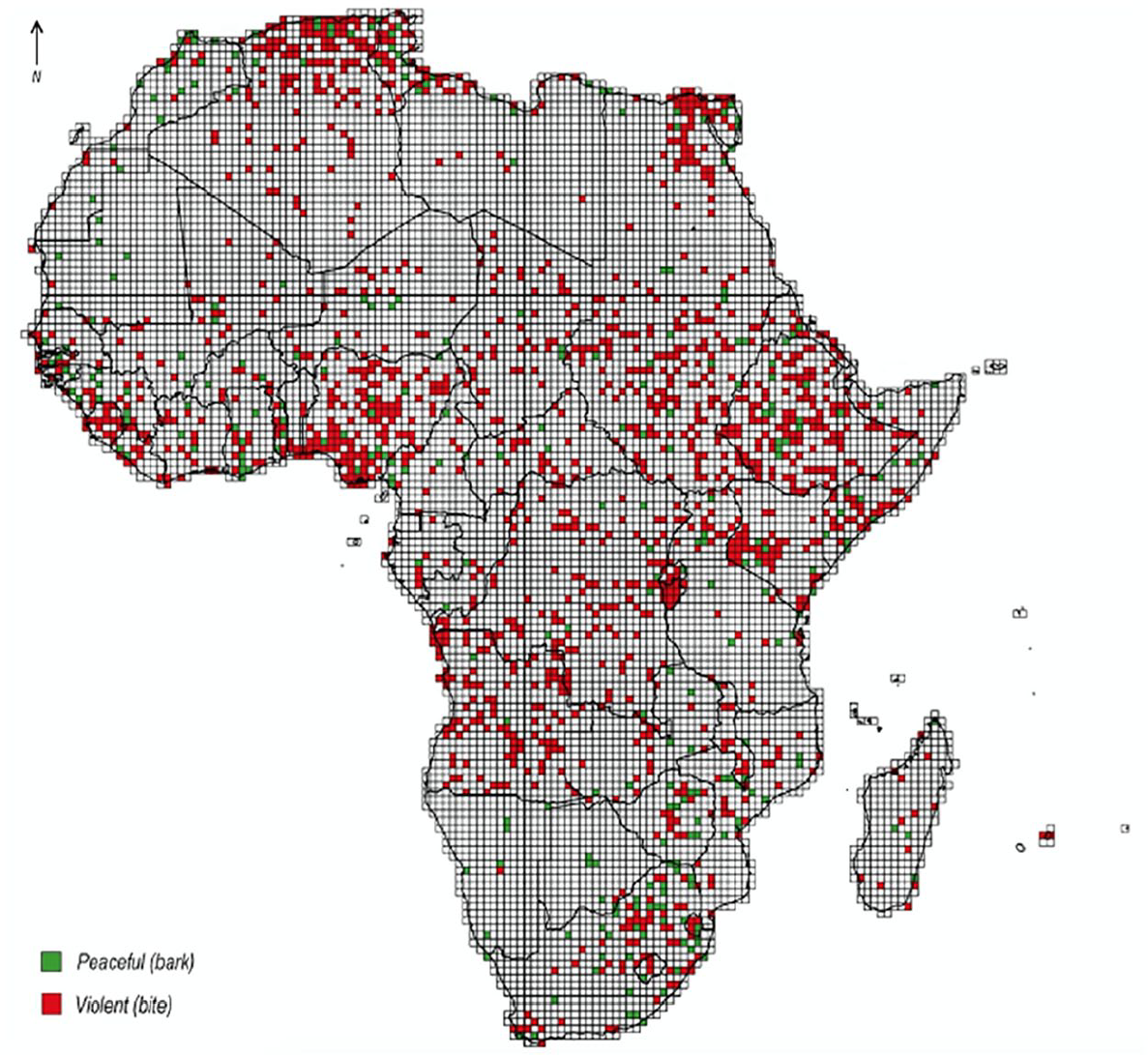
Spatial distribution, bark and bite events, 1990–2013.
The choice of independent variables mirror the theoretical section above. Regarding our main independent variables on resources, we used DIADATA and PETRODATA (Lujala et al., 2005; Lujala et al., 2007) on diamonds, and oil and gas deposits as a source of resource-related variables. Hence, for testing H1, the variable resources was coded 1 (or otherwise 0), when the grid cell contained diamonds, oil, or gas deposits. Offshore deposits were not included as we focused our analysis on local outcomes, not country-level effects. Previous research found no significant effect of offshore oil rents on violent conflict onset (Lujala, 2010).
Most of the other independent variables, including controls, were taken from PRIO-GRID 2.0 (Tollefsen et al., 2012) and GeoEPR 2.0 (Wucherpfennig et al., 2011). Political exclusion was – combined with resources – a key variable for H2, where we expected a reverse effect of resources when groups living in respective areas are included in government and hence should benefit from them. We therefore interacted the presence of resources with the share of groups discriminated (or not) in a given cell. Because certain forms of dissident collective action have a low mobilization threshold (for instance spontaneous riots or protests), we decided against focusing simply on the political status of the largest group. Rather, we looked at the proportion of discriminated groups to get a measure of potential destabilization present in a given area. Nevertheless, most cells were home to only one ethnic group, making the variable essentially binary. In most of our models we used groups with the status ‘monopoly’ in the central government as the operationalization of the interaction with resources.
Regarding H3 on the difference between peaceful and violent protest, we used a measure for lootable resources. We defined as lootable resources (lootable) as secondary or alluvial diamonds, taken from DIADATA, which we coded according to the procedure used for resource deposits.
For H4, we looked at a number of non-resource ‘control’ variables that we expected to affect the relationship independent of resources. As outlined in the theoretical section, there were a number of mechanisms. Given space constraints, we have not engaged in detailed discussions. Table B in the Appendix summarizes our expectations regarding the four hypotheses on sleeping, barking or biting and the individual indicators and data sources separated into motives, and political and military capacity.
Measuring political discrimination can incur bias in the analysis, as discriminated groups are more likely to be reported when they are vocal about their discrimination, and this correlates with the outcome variable. Group-based differences in income may thus be a more reliable indicator of group status as it is not subject to such reporting bias. We used a grid-cell-based indicator that captured the cell’s deviation from the country’s GDP. Nevertheless, we caution against equating political- with economic status.
PRIO-GRID served as the basis for the grid-cell structure of our analysis and contained grids of 0.5 × 0.5 decimal degrees, which translates to a cell of roughly 55 × 55 km at the equator (for more details see Tollefsen et al., 2012). Due to the regionally limited character of SCAD data, we restricted our analysis to the African continent from 1990–2013.
Empirically, we dealt with two limitations regarding the grouping of several control variables into motive and political or military capacity (see Table B in the Appendix). First, both motive as well as political and military capacity can be facilitated at the same time by various conditions. For instance, capacity for violent collective action may derive from transnational ethnic kin but also from a weak security apparatus or rough terrain. 9 Lastly, as we present correlations, we caution against drawing overly ambitious causal inference from our results.
Model specification
To evaluate our hypotheses, we used multinomial logit for grid-cell years with spatio-temporal lags. Multinomial logit is the appropriate estimator because of the categorical character of our independent variable, which can take three values – sleep, bark and bite – and thus is neither binary nor continuous (for which logit or ordinary least squares would have been the estimator of choice). The reference category here was sleep, and the results report the likelihood of bark and bite relative to that reference category.
Spatial lags were included due to the observation that events tend to cluster in space, thus necessitating the construction of a weighted measure of ongoing dissident collective action in neighbouring units (Weidmann and Ward, 2010). We included a spatial lag based on the four surrounding grid-cells lagged by 1 year to account for such spatial dependencies. Further models included an alternative spatial lag based on the eight nearest neighbours.
Results
Table 1 reports the results of multinomial logit regressions. Model 1 shows our basic model with direct effects only at the cell level testing H1. Model 2 adds the country-level variables (political regime, male youth bulge, and military personnel). Model 3 introduces the effect of resource production conditional on political power access to investigate H2, and Model 4 focusses on the effect of lootable resources on dissident collective action in order to test H3. All regressions include a spatial lag and a cubic polynomial for peace years (Carter and Signorino, 2010). The coefficients describe the risk of any given cell experiencing the onset of dissident collective action relative to its absence (sleep).
Sleep bark bite onset, 1990–2013. Multinomial spatial logit.
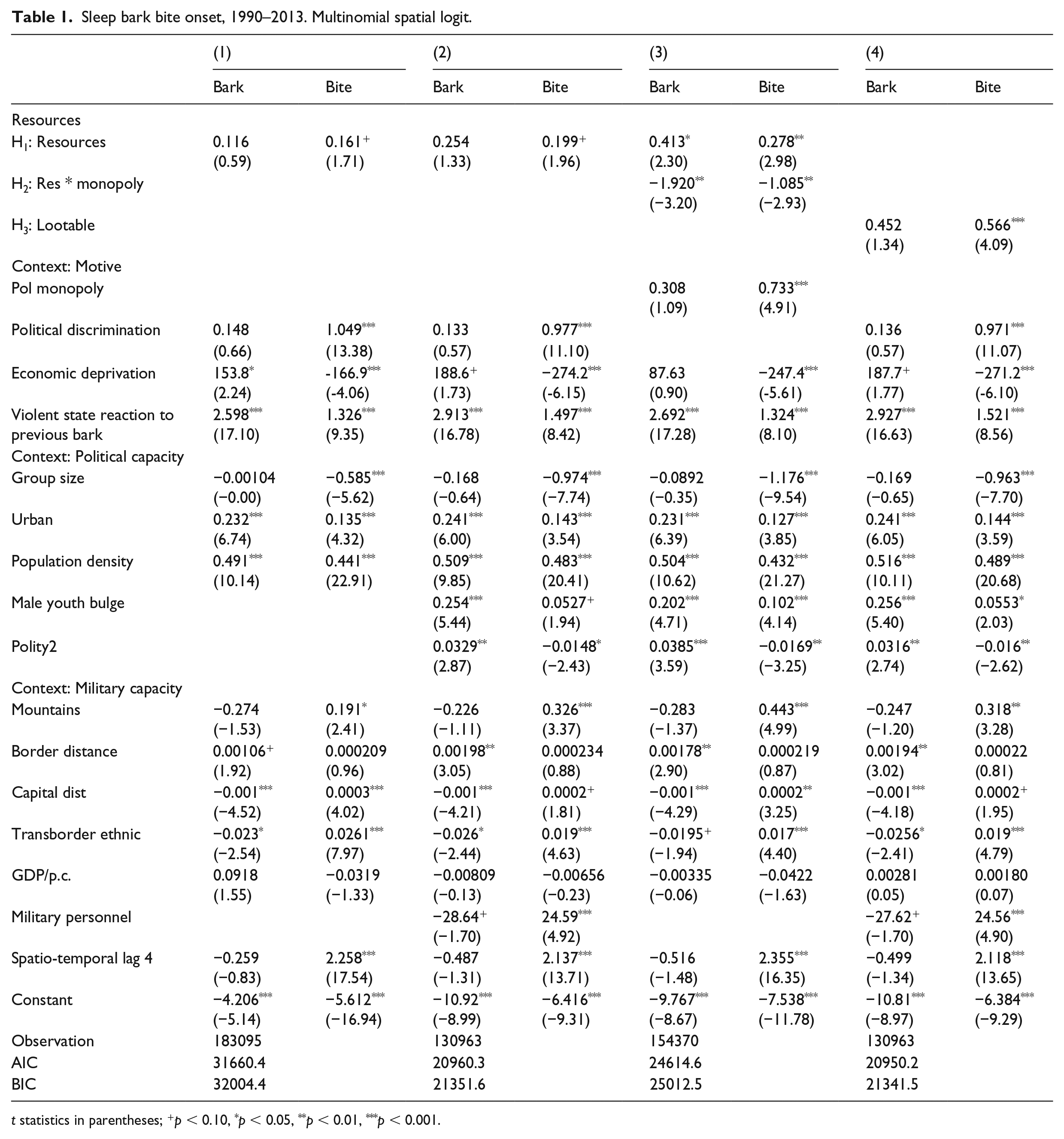
t statistics in parentheses; +p < 0.10, *p < 0.05, **p < 0.01, ***p < 0.001.
As revealed by all models, natural resources helped groups overcome barriers to violent collective action. Resource production in a given region increased the likelihood of violent rebellion, arguably due to grievances relating to environmental and working rights, insufficient compensation and participation of local groups in the revenue generated. However, contrary to expectations by H1, nonviolent protest was not consistently equally affected by resource production. Resources were only robustly linked to bite (and in the models including interaction terms). Theoretically, we may assume that resources provide, on average, stronger motive and thus are more likely to be associated with violence than peaceful dissidence.
When taking into account groups’ access to political power we see that natural resources without groups’ monopoly access to national political power increase the likelihood of barking and biting, but where monopoly groups have access to natural resources, we are much more likely to see sleeping dogs (cf. Model 3). This finding confirmed our expectations formulated in H2. Figure 2 illustrates the interactive relationships for both bark and bite. In line with Basedau and Pierskallas’ (2014) argument we expected this finding to be due to cooptation effects, largely operating on a mechanism of (lack of) motive.
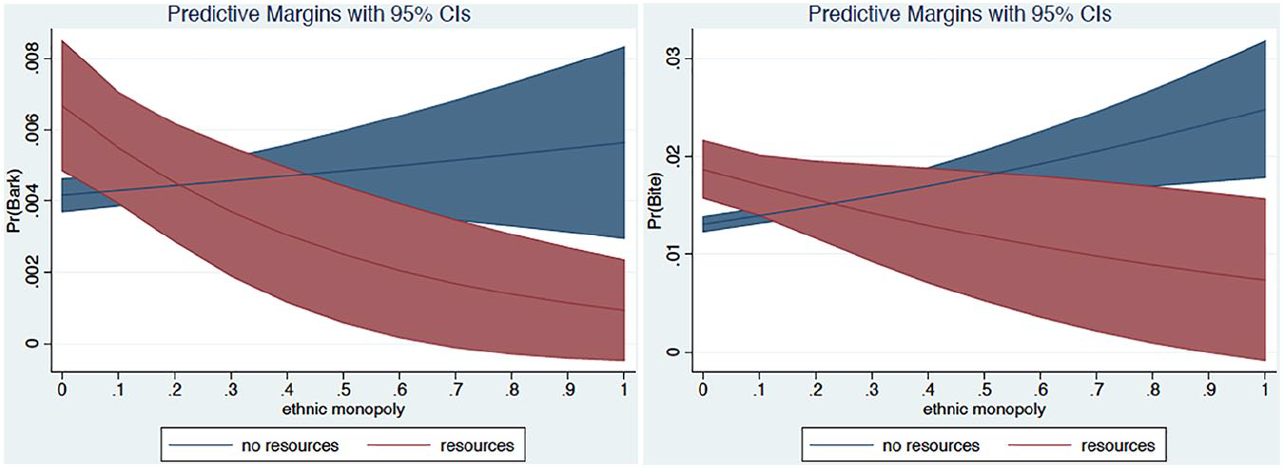
Interaction effects, resource deposits and ethnic monopoly (H2).
Supporting H3 on the role of lootable natural resources in enabling violent collective action, Model 4 provided evidence in favour of the notion that military capacity arises from the availability of easily looted precious natural resources. However, the significance of the effect was sensitive to dropping the military personnel or economic deprivation variables from the model (not reported) and we thus caution against drawing overly confident conclusions. Lootable resources have been connected with conflict duration rather than its onset (Lujala, 2010). The effect could become more robust when investigating conflict incidence or duration rather than onset.
Many interesting findings emerged from the control variables when testing H4. Taking account the slightly shaky findings for lootable resources, context arguably better explains differences between bark and bite, providing ample but somehow unspecified support for H4 (see also expectation in Table B in the Appendix ). Other motive-related variables had an impact on dissident collective action onset in more straightforward ways. Political discrimination was key in explaining why violent and not peaceful protest emerged. The political discrimination of groups increased the likelihood of seeing biting dogs rather than sleeping ones, but had no effect on peaceful protest. The lack of political access may make political protest a less promising avenue for affected groups. 10 However, contrary to expectations, a history of lethal government reaction to peaceful protest did not produce the expected shift from peaceful to violent protest in reaction to violent state reactions; rather we saw a strong effect for more peaceful protest and for violent forms of collective action. 11
Key for the difference between violent and peaceful protest was, according to H4, military capacity. And indeed related variables affected the likelihood of violent forms of dissident collective action relative to the occurrence of peaceful protest. In line with standard literature on armed conflict onset, we were more likely to see biting dogs in areas with rough terrain, removed from the capital, and by groups that had ethnic ties across international borders. 12
Another important factor was the political system that indeed shaped groups’ capacity for enacting protest. As expected, peaceful protest was more likely in democratic systems, while violent protest was more probable in autocratic systems. Therefore, we conclude that the openness of country-level political institutions does indeed matter: democratic institutions increase groups’ capacity for nonviolent action and purvey the possibility of change through protest. Autocratic institutions, on the other hand, push groups to use more violent means to challenge the status quo. This result also matches the finding that political exclusion is related to violent collective action.
Moving on to factors shaping political capacities, larger groups were more likely to sleep than bite. This finding may be rooted in the fact that larger groups tend to have more influence on political decisions and thus are less likely to be discriminated against. 13 Other demographic factors boosted political capacity for both forms of protest: urban and densely populated areas were more likely to see collective dissident action than rural and sparsely populated ones. This finding mirrored the difficulty of overcoming barriers to collective action in less connected areas that also provide less profitable loci for both barking and biting. 14 A male youth bulge reduced the likelihood of sleeping dogs with an effect on both forms, but a somewhat stronger one for nonviolent forms of protest.
Robustness
We conducted a number of robustness checks to demonstrate the reliability of our results that are reported in the online Appendix (see tables C to G). First, we changed the spatial lag structure from a four- to an eight-neighbour lag to prevent a distortion due to the arbitrary choice of the contiguity matrix. Results confirmed those reported in Table 3 (see Table C).
Second, we chose a slightly less restrictive operationalization of groups’ political status of inclusion. Based on the Ethnic Power Relations dataset (see e.g., Cederman et al., 2011), we coded discriminated and powerless groups as excluded, and monopoly and senior partner groups as groups in political power. Results hardly changed based on this broader definition of inclusion and exclusion (see Table D in the Appendix). Resources were insignificant in models 1 and 2 but turned significant again for both forms of protest when including interaction terms.
Third, in order to prevent some unobserved factors at the country level driving our results, we included country fixed-effects in our model (see Table E in the Appendix). The findings on resource deposits and lootable resources largely held and showed the same patterns as with alternative measures for group status. Findings on economic inclusion, and violent state reactions to previous peaceful protest were also robust under this model. Others did less well. 15 More detailed multi-level models could explore these important interactions between cell- and country-level variables in the future.
We also tested whether the results changed when looking at organized forms of protest only, according to the codings of the SCAD data (see Table F in the Appendix). Theoretically, it might be expected that capacity would matter more in these models. However, tendencies remained largely intact. One difference was noteworthy though. Peaceful barking was only insignificantly reduced for the interaction term of resources and monopoly in government. Urban areas, as mentioned above, were no longer significantly connected to violence, just to peaceful protest.
Further, we checked whether there were regional differences within Africa. North Africa and sub-Saharan Africa are regularly treated as separate regions, and have taken different trajectories politically and economically. In fact, a separate model on sub-Saharan Africa showed differences, albeit there were no dramatic differences in the models and the main tendencies remained intact (see Table G in the Appendix). Most importantly, the role of natural resources was more conflictive in sub-Saharan Africa and increased both forms of dissent collective action as originally expected by H1 (that resources affect all forms of protest or conflict). Inclusion in the government only insignificantly reduced violence (but in that sense still reversed the finding on resources without the interaction); lootable resource deposits fuelled both forms of protest. A few non-resource variables showed partially different findings. 16 The diverging results for other variables might be due to often weak state institutions within sub-Saharan Africa. When states are weak, any kind of protest, but particularly violent ones, is more feasible.
In addition, we tested interactions between resource variables and violent state reactions to prior peaceful protest in order to assess finer conditional relationships between motive-based variables (not reported). We also tested for conditional relationships between military personnel and political discrimination as well as resource location. These additional models did not yield any added insights. Table 2 and 3 summarizes our results. These tables list the direction of effects significant at least at the 5% level. Less robust findings appear in brackets to illustrate their tentative character.
Overview of results on effects of resources (H1–3).
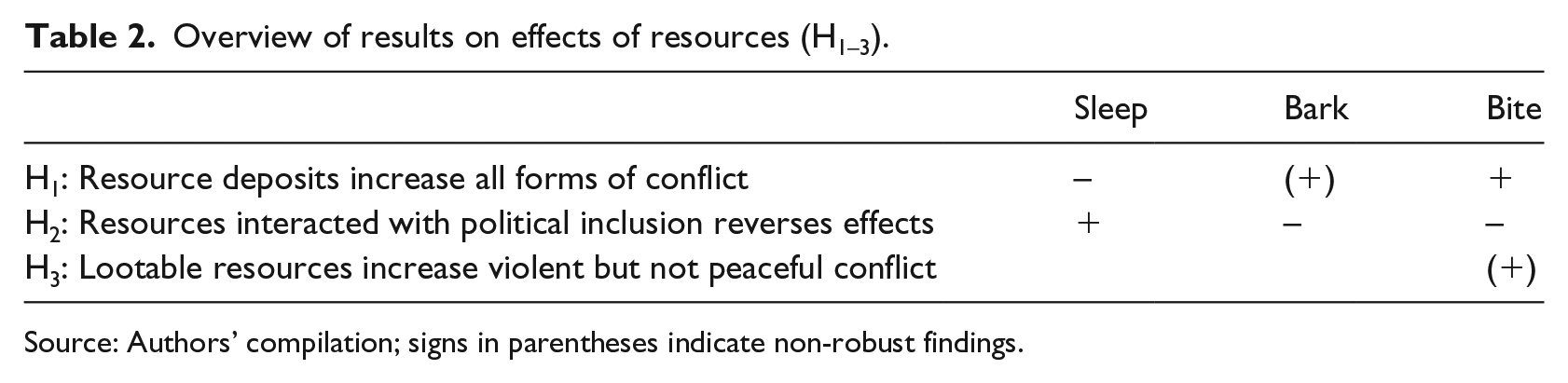
Source: Authors’ compilation; signs in parentheses indicate non-robust findings.
Overview of effects of context (H4).
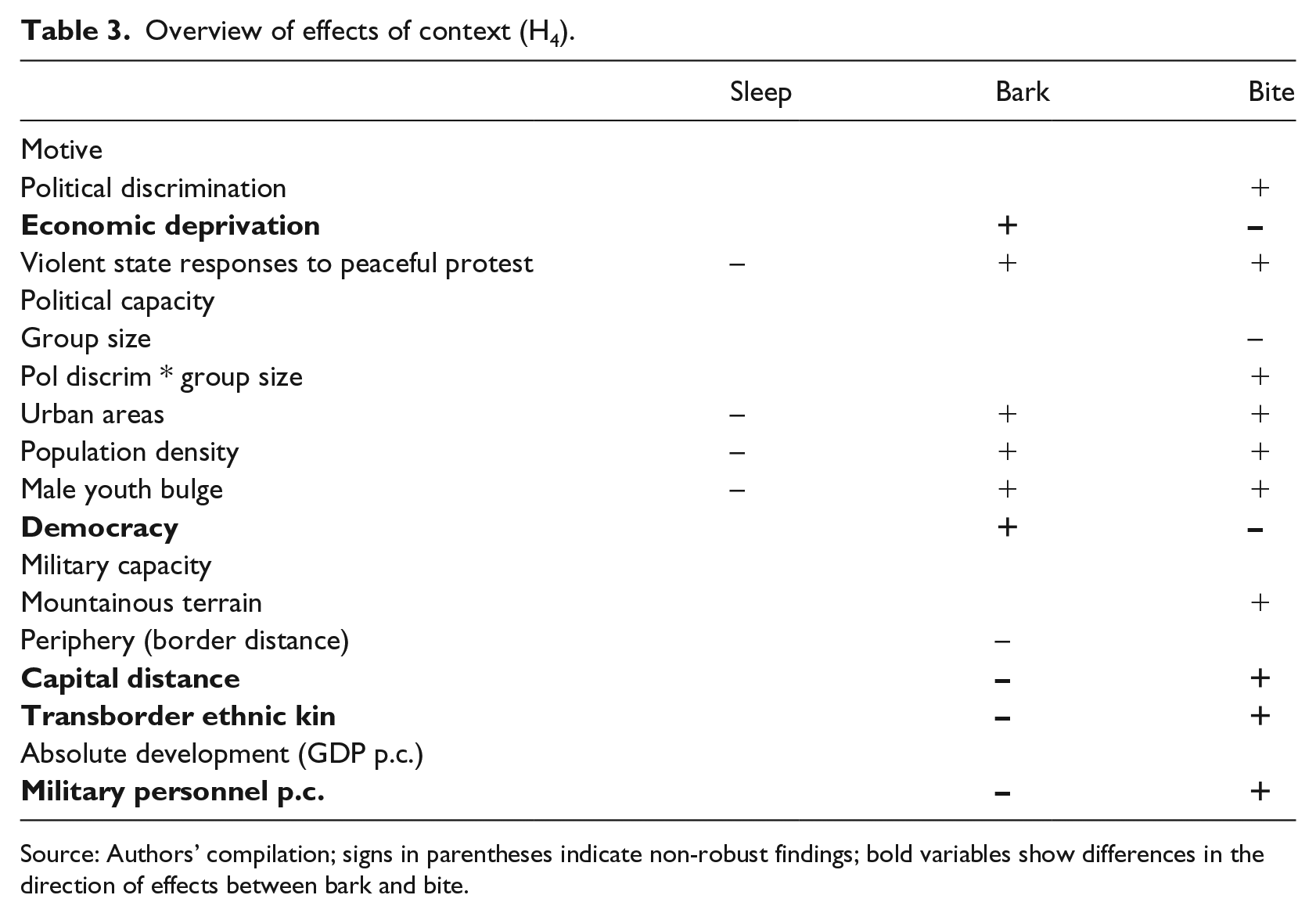
Source: Authors’ compilation; signs in parentheses indicate non-robust findings; bold variables show differences in the direction of effects between bark and bite.
Discussion
What can we conclude from our findings in relation to our theoretical expectations? By and large, our hypotheses were confirmed, as tables 2 and 3 illustrate. However, there are a number of noteworthy modifications, especially regarding the effect of context, which best explains the difference between bark and bite.
Confirming H1, areas with resource deposits were unlikely hosts of sleeping dogs, however, unexpectedly, were not equally likely to host barking dogs. Only in sub-Saharan Africa did the effect materialize as anticipated. Supporting H2, resource-endowed regions could buy peace with a combination of access to political power and to natural riches that coopt potentially violent actors. Lootable resources, lending support for H3, tended to increase the likelihood of biting- but not barking dogs. However, the effect of lootable resources, as proposed by H3, was less robust and did not make ethnic groups bite rather than bark across all specifications.
However, we found plenty of support for H4 that assumed that non-resource-related variables affected the form of dissidence in several ways, especially regarding the difference between peaceful and violent protest. A small number of variables stood out in that regard (see Table 3): Military capacity such as transborder ethnic kin, distance from the capital, mountainous terrain as well as more military personnel decreased peaceful and increased violent protest. Political (and less straightforward economic) exclusion made a difference regarding the use of violence. Democracy tended to increase peaceful protest while autocracy increased violent uprisings. Where institutions inhibited nonviolent change, violent uprisings became a more tenable option.
At least two variables showed somewhat unexpected results. Economic deprivation decreased the likelihood of violence but increased peaceful protest events; larger groups were also less likely to protest (unless they were discriminated against). Both findings pointed to the fact that capacity might be more demanding for violent mobilization. In sum, resources matter for conflict, depending mainly on the access to them; however, military capacity and political inclusion made a difference regarding violent or peaceful protest.
Conclusion
Theorizing in the resource–conflict link suggests a number of causal mechanisms affecting actors’ motives and capacity for conflict. The debate has remained quite silent however on what forms such conflicts will take, especially the difference between violent and peaceful conflict. A grid-cell analysis of Africa that centred on ethnic groups suggests that the logic of nonviolent and violent conflict differs substantially. Resources best explained the difference between biting and sleeping dogs: resource deposits increased the probability of violent protest. The effect was reversed for all forms of protest when groups in resource regions participated in the government. There was some evidence that the lootability of resources contributed to having biting rather than barking dogs. However, contextual factors best explained the distinction between bark and bite: democracy and economic differences made peaceful protest more likely but not violence; geographic factors such as capital distance and transborder ethnic kin increased the likelihood of military action.
This paper contributes to the literature in several ways. First, it is one of the first studies to systematically investigate the distinctive causal logic of several (non)forms of dissident collective action in the debate on the resource–conflict link, bringing together two research strands that have thus far operated largely independently from each other. We have demonstrated that the location of resources matters for the onset of dissident collective action in a number of ways.
Second, our paper has yielded results that are important far beyond the resource–conflict link. We have shown that a theoretical framework of motive and capacity might be well-suited to studying various forms of dissident collective action and to revealing some distinct determinants. Our empirical results support convincing evidence that both ‘grievances’ and ‘opportunity’ matter (Cederman et al., 2011; Collier and Hoeffler, 2004; Gurr, 1970, 2000; Regan and Norton, 2005). For instance, a range of demographic and geographic factors create political capacity for groups to mobilize and hence affect whether protest emerges in the first place. Violent state responses tend to perpetuate both forms of protest. Authoritarian state–society relations such as a lack of democracy and political exclusion of distinct groups as well as certain geographic and material capacity factors increase the likelihood of violence. Economic exclusion of groups reduces violent protest; an effect that is reversed when interacting with violent state repression.
Third and finally, we identified a number of variables that could serve as a starting point for designing promising strategies to forecast and successfully manage resource-related and other conflicts and prevent them from escalating into large scale violence. Lethal responses to peaceful protest, for instance, are not only ethically questionable but also unsuccessful in managing conflict; inclusion in resource-endowed governments is a way of avoiding protest. On the other hand, a more latent repressive approach relying on an overbearing security apparatus could successfully prevent peaceful protest from challenging the government; however, such latent repression is apparently less effective at preventing more devastating forms of protest.
The best form to avoid violent protest seems to implement policies characterized by political and, with less straightforward empirical support, economic inclusion. Political exclusion drives violence, as does repression of protests by economically marginalized groups. Resource extraction without providing groups with access to political decision-making similarly increases the risk of violent events. At the same time, democracy or at least a share of political influence, particularly in resource-endowed regions, might be a promising way to prevent bloodshed. It is perhaps no coincidence that African countries with relatively inclusive democratic systems and governments that at least partially share the riches with their populations, like Botswana, Namibia and – perhaps less clear-cut, as the Marikana case suggests – South Africa, experience little or no violence in relation to resource extraction.
Simultaneously, we have to consider a number of caveats. Our study is a first step rather than a final answer. Many open questions remain and there is huge opportunity for future research. Our results have to be replicated for other regions, with data on resources other than oil, gas and diamonds. We have identified significant statistical correlations, and several robustness checks confirmed our findings, but we cannot claim to have achieved full causal identification. Regarding the forms of dissident collective action, we may test more fine-grained concepts beyond our three basic options, including terrorism, organized or individual, as a special form of dissident action. We also cannot rule out the possibility that dissident action occurs in spatial units other than where motives emerged. Although we identified motive-related variables as being key drivers of (violent) protest, our findings may be biased in favour of capacity-related variables.
In methodological terms, many options could be useful in future studies. We could engage in a pronounced group-based format that allows a more precise attribution of motives and capacities to particular groups, use a formal model to capture the dynamic bargaining process between state and citizens better than in the static model proposed here, or employ configurational methods that could test interactions of higher order, that is, more complex interactive relationships between motives and capacities that likely drive the choice of collective action. Carefully selected and implemented case studies might be very useful in tracing the processes and exploring mechanisms. Future research needs novel data on group characteristics and grievances, resource-related and otherwise. All this will require substantial effort, but will be rewarding from both an academic and practical perspective. Understanding the conditions under which conflicts emerge at all and why some of these conflicts turn violent is essential for the prevention of violence.
Supplemental Material
Sleep_Bark_Bite_IASR_Appendix_1910 – Supplemental material for Sleep, bark, or bite: Do natural resources make the difference regarding peaceful or violent conflict?
Supplemental material, Sleep_Bark_Bite_IASR_Appendix_1910 for Sleep, bark, or bite: Do natural resources make the difference regarding peaceful or violent conflict? by Matthias Basedau and Vita Roy in International Area Studies Review
Footnotes
Declaration of conflicting interests
The author(s) declared no potential conflicts of interest with respect to the research, authorship, and/or publication of this article.
Funding
The authors disclosed receipt of the following financial support for the research, authorship, and/or publication of this article: The Research for this article was partially supported by the German Research Council (DFG); project number BA 3515/4.

Supplemental material
Supplemental material for this article is available online.
Notes
References
Supplementary Material
Please find the following supplemental material available below.
For Open Access articles published under a Creative Commons License, all supplemental material carries the same license as the article it is associated with.
For non-Open Access articles published, all supplemental material carries a non-exclusive license, and permission requests for re-use of supplemental material or any part of supplemental material shall be sent directly to the copyright owner as specified in the copyright notice associated with the article.
