



Abstract
Elimination of Enterococcus faecalis (E. faecalis) biofilms from the root canal system is a challenging issue in endodontics. The objective of this in vitro study was to evaluate the antibacterial efficacy of ultrasonic-activated herbal irrigants (black walnut [BW] and wormwood) and inorganic salts (alum and sodium chloride [NaCl]) against E. faecalis biofilms, compared with conventional irrigation. E. faecalis (MTCC 439) biofilms were grown on microtiter plates and treated with the test irrigants with and without ultrasonic activation for 5 and 10 minutes. Antibacterial efficacy was determined by Minimum Biofilm Eradication Concentration (MBEC) analysis using crystal violet staining and optical density measurement, and fluorescence microscopy using acridine orange and ethidium bromide staining to distinguish live and dead cells. All irrigants showed increased antibacterial activity when combined with ultrasonic activation (p < .05), with BW showing the highest biofilm reduction, followed by wormwood, alum, and NaCl. A 10-minute exposure time caused significantly greater biofilm disruption than 5 minutes. Ultrasonic activation dramatically enhances the antibacterial potential of herbal and inorganic irrigants, with BW, wormwood, and alum showing promise as adjuncts to conventional endodontic disinfection protocols.
Keywords
Introduction
Despite advances in endodontic treatment, persistent microbial biofilms within the root canal system continue to be the primary etiological factor in endodontic failure. 1 Of the various species of microbes involved in secondary and persistent infections, Enterococcus faecalis is considered one of the most virulent pathogens because of its tolerance to prolonged starvation, its ability to penetrate deeply into dentinal tubules, its resistance to high alkaline pH, and its resistance to common intracanal medicaments. 1 Its capability to create organized biofilms enhances resistance by obstructing the entry of antimicrobials and facilitating adaptive stress responses, which complicates total elimination during standard chemo mechanical preparation.
In light of the limitations such as cytotoxicity and tissue-irritation problems with conventional chemical irrigants, there has been a growing interest in herbal agents as possible biocompatible root canal disinfectants. Herbal irrigants have a variety of bioactive phytochemicals with antimicrobial, antioxidant, and anti-inflammatory effects, and they have been shown to reduce E. faecalis in vitro, 2 as well as endodontic pathogens in vitro.3,4
In addition to the type of irrigant, the effectiveness of antimicrobials can be greatly enhanced by activation techniques, as ultrasonic activation has been found to enhance irrigation dynamics by acoustic streaming and cavitation, allowing deeper penetration of irrigants into canal irregularities and disrupting biofilm architecture beyond what can be accomplished with passive irrigation alone. 5 Studies have demonstrated that passive ultrasonic irrigation combined with natural agents such as Morinda citrifolia, Aloe vera, and propolis for the removal of E. faecalis biofilm is superior to non-activated delivery. 6 Likewise, in clinical settings, Palwankar et al. showed that using ultrasonic activation to disinfect with herbal irrigants produced significantly better disinfection outcomes. 7
Although many herbal irrigants have been extensively studied, the endodontic potential of black walnut [BW] (Juglans nigra) and wormwood (Artemisia absinthium) has been poorly explored. BW contains juglone, tannins, and other phenolic compounds that have oxidative and membrane-disruptive antibacterial activity. Wormwood is rich in artemisinin and terpenoid derivatives that disrupt microbial metabolic pathways and cellular integrity. Concurrently, inorganic salts such as alum (potassium aluminum sulfate) and sodium chloride (NaCl) have antimicrobial effects that are mediated by protein coagulation, membrane destabilization, and osmotic stress.8,9 In vitro studies have also shown that potash alum has strong antibacterial properties against clinical isolates 10 and NaCl reduces bacterial viability by ionic imbalance and dehydration mechanisms. 11 Although several of these herbal and inorganic agents have been shown to have antimicrobial potential, comparative evaluation of ultrasonically- activated herbal irrigants and inorganic salts is limited.
The current study assessed the antibacterial efficacy of ultrasonically activated of inorganic salts (alum and NaCl) and herbal irrigants (BW and wormwood) against E. faecalis biofilms in vitro. Time-kill assays were conducted at intervals of 5 and 10 minutes, biofilm biomass was measured using Minimum Biofilm Eradication Concentration (MBEC) analysis, and bacterial viability was evaluated using fluorescence microscopy. This work attempts to offer clinically relevant insights into improving endodontic disinfection procedures and successfully treating persistent biofilm-mediated root canal infections by combining chemical and physical activation techniques within a standardized biofilm model.
Materials and Methodology
The research proposal was reviewed and approved by the Institutional Review Board, and ethical clearance was granted (Ref: EC/NEW/INST/2021/2435). Although this is an in vitro microbial study, Institutional Review Board approval was obtained as per institutional policy governing laboratory research involving microbial strains and biohazard handling compliance.
No human or animal samples were involved.
Based on the irrigation method used, the current study was divided into three main groups.
Group I included experimental irrigants that were used with traditional irrigation techniques (without activation). It was further subdivided into Group Ia, which received BW extract; Group Ib, which received a combination of wormwood and black walnut (WWBW) extract; Group Ic, which received alum; and Group Id, which received NaCl. Each of these subgroups was tested at two exposure times: 5 minutes and 10 minutes.
Group II involved experimental irrigants that were activated using an Ultrasonic Activator, referred to as ultrasonic-activated irrigation. This group was also subdivided into Group IIa, which received BW extract; Group IIb, which received the combination of WWBW extract; Group IIc, which received alum; and Group IId, which received NaCl. Similar to Group I, both subgroups under Group II were evaluated at two-time intervals: 5 and 10 minutes.
Group III served as the control group for both the experimental groups (I and II), as well as the time frame (5 and 10 min). It consisted of biofilms treated with 2.5% sodium hypochlorite (NaOCl), the standard chemical irrigant (Table 1).
Study Groups and Time Intervals for Irrigant Application.
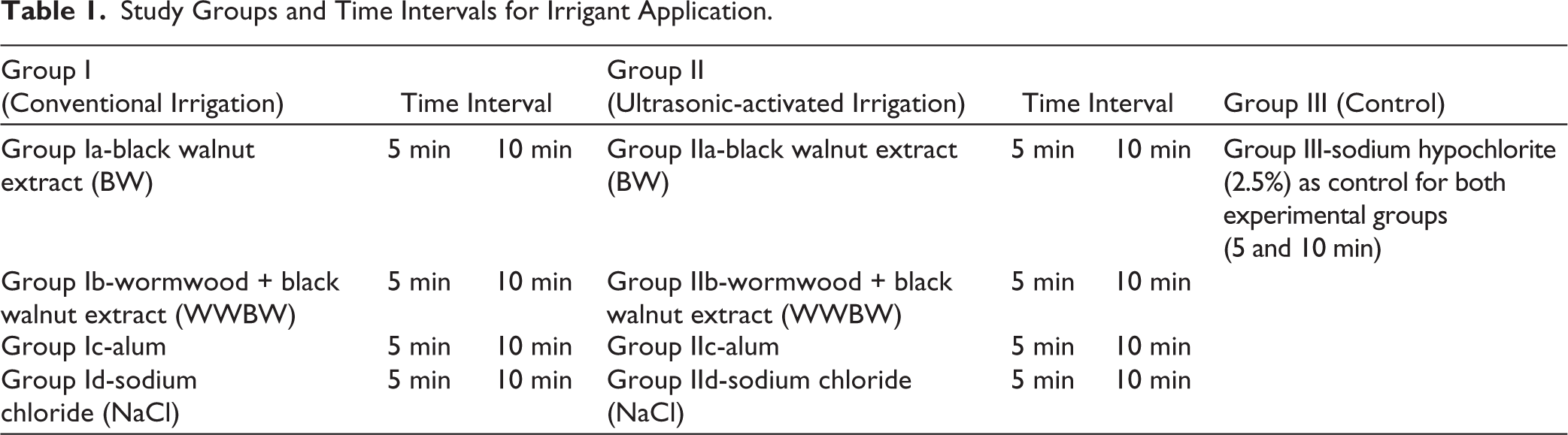
The study was performed in triplicate for each experimental group (n = 9) to ensure reproducibility and reliability of results.
Microbial Strain and Culture Conditions
The test organism, E. faecalis (MTCC 439), was revived from lyophilized form and cultured in Brain Heart Infusion (BHI) broth at 37°C for 24 hours.
Biofilm Formation
Bacterial cultures of E. faecalis (MTCC 439) were grown anaerobically overnight and adjusted to a 0.5 McFarland standard in BHI broth. For biofilm development, 200 µL of the standardized bacterial suspension was added to each well of a 96-well microtiter plate, and sterile distilled water was added to the peripheral wells to minimize evaporation. The plate was incubated anaerobically at 37°C for 5–7 days. Post-incubation, supernatant was carefully aspirated, and visual confirmation of biofilm formation was done at the bottom of the well. Non-adherent and planktonic bacteria were removed by rinsing with phosphate-buffered saline (PBS).
Preparation of Herbal Extracts and Inorganic Solution
Commercial BW extract (Tonga Herbs™) and commercial wormwood and black walnut extract (WWBW) (Vaastavik™) as well as commercially available salts of alum and NaCl (Sisco Research Laboratories Pvt. Ltd, India) were diluted to the desired concentration using BHI broth.
The concentrations were prepared according to the manufacturer’s instructions and a prior pilot study done for all the experimental solutions. To ascertain the test solutions effective antimicrobial concentrations, preliminary MIC and MBC were carried out.
Ultrasonic Activation
Ultrasonic activation was carried out using an Ultra X Ultrasonic Activator (Orikam, India) with a non-cutting micro-probe tip (≈0.4 mm diameter, 25–30 kHz). Each biofilm- containing well received 200 µL of the test irrigant, and the micro-probe was positioned 1–2 mm above the biofilm surface without contacting the well bottom. The irrigant was activated for 5 or 10 minutes at low–medium amplitude to generate acoustic streaming and cavitation.
MBEC Assay
Following confirmation of biofilm formation, varying concentrations of herbal and inorganic salt irrigants were added to the designated wells, while control wells were maintained with culture medium alone. The treated plates were then incubated again for 24 hours at 37°C under anaerobic conditions. The supernatant was discarded, and the wells were washed with PBS. After incubation, biofilms were fixed with methanol for 15 minutes and stained with 0.1% (w/v) crystal violet for 5 minutes. The wells were then rinsed with distilled water, and ethanol was added to solubilize the dye. The MBEC was measured by optical density (OD) at 570 nm using a microplate reader. Crystal violet staining measures total biofilm biomass, but not direct bacterial viability; it reflects a reduction in biofilm mass (adherent cells plus extracellular matrix) and does not necessarily indicate bactericidal activity. To overcome this limitation, fluorescence-based methods have been used to specifically measure biofilm viability.
Time-kill Assay with Fluorescence Microscopy
Bacterial culture preparation, biofilm formation, and confirmation were performed following the same protocol as described for the MBEC assay. The established biofilms were then exposed to the test irrigant solutions at their respective MBEC concentrations for durations of 5 and 10 minutes. After exposure of the biofilm to respective herbal irrigants for intervals, that is, 5 and 10 minutes, Ultrasonic activation of the irrigant was performed for both irrigant groups. In order to avoid any long-term residual effects on the biofilm, the irrigants’ antimicrobial activity was neutralized in both the ultrasonic activation and conventional groups by rinsing the biofilms with PBS two or three times after exposure.
Biofilm was fixed using methanol for 15 minutes, followed by washing and staining with a solution of acridine orange (AO) and ethidium bromide (ETBR) (5 µg mL−1 of each) for 30 minutes in the dark. Finally, the wells were washed with distilled water, and biofilms were observed under the fluorescent microscope (Nikon Eclipse Ts2) at 40 × magnification.
Results
MBEC Results
BW (50%) demonstrated significant antibacterial action.
Wormwood + Black walnut (WWBW) (25% each) showed a combined antibacterial effect with enhanced biofilm eradication.
Alum (10%) also showed significant antibacterial efficacy.
NaCl (20%) also showed antibacterial potential.
Fluorescence Microscopy
Fluorescence microscopy clearly demonstrated that the viability of E. faecalis biofilms varied depending on the type of herbal or inorganic irrigant used, as well as the mode of activation, whether conventional or ultrasonic. Higher fluorescence meant more live bacteria, and less fluorescence meant that the irrigant worked better at eradicating them (Figures 1 and 2).
Under conventional irrigation conditions (Herbal vs. Inorganic at 5 and 10 minutes; Figure 3c and 3d), all experimental groups demonstrated comparatively high fluorescence intensity, indicating limited reduction in bacterial viability. Among the tested irrigants, BW and alum exhibited relatively lower fluorescence values compared to wormwood and NaCl, suggesting comparatively better antibacterial efficacy, although the overall reduction remained modest. Furthermore, intragroup comparison between 5- and 10-minute exposure periods did not reveal any statistically significant difference (p > .05). These findings indicate that prolonging the contact time from 5 to 10 minutes did not significantly enhance the antibacterial effectiveness of the irrigants under conventional irrigation protocols.
Fluorescence Microscopy Images of Enterococcus faecalis Biofilm Showing Live (Green) and Dead (Red) Bacteria Treated with Herbal Irrigant—BW Extract for 5 Minutes (a) and 10 Minutes (b); Wormwood-Blackwalnut Extract for 5 Minutes (c) and 10 Minutes (d) Under Conventional and Ultrasonic-activated Irrigation.

Fluorescence Microscopy Images of Enterococcus faecalis Biofilm Showing Live (Green) and Dead (Red) Bacteria Treated with Inorganic Salt Irrigant—Alum for 5 Minutes (a) and 10 Minutes (b); NaCl for 5 Minutes (c) and 10 Minutes (d) Under Conventional and Ultrasonic-activated Irrigation.

In the 5-minute ultrasonic groups (Herbal vs Inorganic 5 min Ultrasonic) (Figure 3a), fluorescence intensity decreased significantly for all irrigants compared with the conventional groups (p < .05). Within the herbal category (Figure 4), BW demonstrated the lowest fluorescence, followed by wormwood, indicating stronger antibacterial activity. Among the inorganic salts (Figure 5), alum demonstrated lower fluorescence than NaCl, showing superior biofilm reduction. Intragroup analysis confirmed that ultrasonic agitation enhanced the antibacterial action of each irrigant compared with its conventional use.
(a) Fluorescence Intensity Comparison of Herbal Extracts (BW, WWBW) and Inorganic Salts (Alum, NaCl, NaOCl) at 5 Minutes Under Ultrasonic Activation. Shows Significantly Reduced Live Fluorescence with Ultrasonic Activation, with Herbal Extracts Demonstrating Enhanced Antibacterial Efficacy Compared to Inorganic Salts. (b) Fluorescence Intensity Comparison of Herbal Extracts and Inorganic Salts at 5 Minutes Under Conventional Irrigation. Demonstrates Higher Bacterial Viability Compared to Ultrasonic Activation, Indicating Limited Penetration and Antibacterial Action. (c) Fluorescence Intensity Comparison of Herbal Extracts and Inorganic Salts at 10 Minutes Under Ultrasonic Activation. Reveals Time-dependent Enhancement, with Marked Reduction in Bacterial Viability, Particularly in Herbal Irrigants. (d) Fluorescence Intensity Comparison of Herbal Extracts and Inorganic Salts at 10 Minutes Under Conventional Irrigation. Confirms Moderate Time-dependent Antibacterial Effect, Inferior to Ultrasonic Activation.

After 10 minutes of ultrasonic activation (Herbal vs Inorganic 10 Ultrasonic) (Figure 3b), all irrigants showed a further decline in fluorescence intensity (p < .01), indicating a clear time-dependent improvement in biofilm elimination. The BW group exhibited the lowest overall fluorescence intensity, followed by wormwood, alum, and NaCl. Intragroup comparison revealed a statistically significant reduction in fluorescence between 5- and 10-minute exposures for all irrigants, confirming that prolonged ultrasonic activation enhances antibacterial efficacy.
Ultrasonic activation really boosted antibacterial effectiveness across all the graphs, surpassing conventional irrigation by a clear margin (p < .05). Herbal irrigants performed better overall than inorganic salts. BW demonstrated better antibacterial efficacy followed by worm-wood, alum, and NaCl. Ultrasonic activation enhances the efficacy of the irrigant against E. faecalis biofilms.
(a) Intragroup Fluorescence Intensity Comparison of Herbal Extracts at 5-minute Exposure. Shows Reduced Bacterial Viability with Ultrasonic Activation Compared to Conventional Irrigation. (b) Intragroup Fluorescence Intensity Comparison of Herbal Extracts at 10-minute Exposure. Demonstrates Significant Time-dependent Reduction in Live Fluorescence, Enhanced with Activation. (c) Intragroup Comparison of Herbal Extracts Under Ultrasonic Activation (5 and 10 Minutes). Highlights Superior Antibacterial Efficacy at 10 Minutes, Confirming the Synergistic Action of Ultrasound and Herbal Irrigants. (d) Intragroup Comparison of Herbal Extracts Under Conventional Irrigation (5 and 10 Minutes). Shows Modest Time-dependent Improvement, Lower Than Ultrasonic-activated Groups.

(a) Intragroup Fluorescence Intensity Comparison of Inorganic Salts at 5-minute Exposure. Indicates Reduced Bacterial Viability with Ultrasonic Activation Compared to Conventional Irrigation. (b) Intragroup Fluorescence Intensity Comparison of Inorganic Salts at 10-minute Exposure. Demonstrates Enhanced Antibacterial Action with Increased Exposure Time. (c) Intragroup Comparison of Inorganic Salts Under Ultrasonic Activation (5 and 10 Minutes). Shows a Significant Time-dependent Reduction in Live Fluorescence, Confirming the Role of Ultrasonic Agitation. (d) Intragroup Comparison of Inorganic Salts Under Conventional Irrigation (5 and 10 Minutes). Reveals Comparatively Higher Bacterial Viability, Emphasizing the Limitations of Passive Irrigation.

Statistical Analysis
Each experiment was triplicated three times (n = 9 for each subgroup), and the results were presented as mean and standard deviation. Statistical analysis was carried out using GraphPad Prism software (version 5.1; GraphPad Software Inc., USA). One-way analysis of variance (ANOVA) was applied. Differences were considered statistically significant at p < .05 (*significant), p < .01 (**moderately significant), and p < .001 (**highly significant). Following one-way ANOVA, Tukey’s post hoc multiple comparison test was applied to control for type I error during intergroup and intragroup comparisons. Ultrasonic-activated experimental groups showed statistically significant reduction in live fluorescent intensity compared to non-ultrasonic groups.
Discussion
Root canal therapy relies on accurate instrumentation, proper disinfection, and complete obturation of the root canal system. Although long-term success depends on the elimination of pathogenic microorganisms, post-treatment failure is often attributed to inadequate microbial control. 12 However, irrigants aid in the removal of debris, organic tissue dissolution, and disruption of biofilms, thereby enhancing root canal disinfection. 13
Although NaOCl is the gold standard, it is cytotoxic, has allergic potential, and can cause periapical tissue injury when extruded past the apex, 14 so it has prompted researchers to investigate other irrigants with similar antibacterial efficacy and better biocompatibility.
Among the microbial species implicated in endodontic failure, E. faecalis is one of the most common microbial species involved in endodontic failure, as it is resistant to conventional disinfectants, survives in nutrient-depleted environments, invades dentinal tubules, forms robust biofilms, and is resistant to high pH and oxidative stress. 15 Hence, new irrigants and activation techniques are necessary to disrupt the biofilm matrix and increase antimicrobial penetration.
Recently, herbal irrigants have gained interest as potential replacements for chemical agents due to their natural antimicrobial, antioxidant, and anti-inflammatory properties. 4 Extracts of Azadirachta indica (neem), Morinda citrifolia, Aloe vera, Propolis, Triphala, and green tea have exhibited varying degrees of antibacterial activity against E. faecalis, while exhibiting lower cytotoxicity than NaOCl. 4
This current study evaluated two lesser-known herbal agents, BW (Juglans nigra) and wormwood (Artemisia absinthium), for which no molecular or biochemical mechanistic assays were specifically performed, rather they were chosen considering the literature proof, which states that antibacterial effects demonstrated well-known phytochemical and physicochemical mechanisms. BW contains juglone, tannins, and flavonoids, which are all highly oxidative and membrane- disruptive,16,17 while wormwood contributes terpenoids, which have antimicrobial and metabolic inhibitory effects. 18
Likewise, inorganic salts like alum (potassium aluminum sulfate) and NaCl have been studied as irrigants, as they have ionic, osmotic, and acidic stress effects on bacterial cells.8–11 Alum has astringent and protein-coagulating properties that disrupt bacterial cell walls and enzyme systems, and NaCl causes osmotic imbalance and ionic stress. Their cost- effectiveness, availability, and safety makes them attractive alternatives, particularly when used in combination with physical activation techniques that can enhance their penetration and reactivity within the canal system.
Ultrasonic activation greatly increased the antibacterial activity of both herbal and inorganic irrigants in this study, which can be attributed to acoustic streaming and cavitation that create microcurrents and pressure fluctuations, thereby dislodging biofilm clusters and enhancing irrigant diffusion into dentinal tubules. 9 Both time-kill and MBEC assays demonstrated that biofilm eradication was time-dependent, indicating a 10-minute activation produced greater bacterial reductions than 5-minute intervals, which is clinically justified because MBEC directly measured biofilm eradication, the actual therapeutic objective in endodontic infections.
Further, fluorescence microscopy confirmed that biofilm disruption and cell-viability changes correlated with irrigants with greater antibacterial activity, with increased red (dead cells) fluorescence and decreased green (live cells) fluorescence, indicative of greater penetration and more extensive bacterial death. Ultrasonic activation further enhanced these effects across all groups.
Under ultrasonic activation, BW demonstrated the greatest antibacterial efficacy, followed by wormwood, alum, and NaCl. Notably, the herbal irrigants—particularly BW—achieved antibacterial effects comparable to those of inorganic agents when ultrasonically activated, emphasizing the synergistic effect of acoustic streaming and cavitation in enhancing irrigant penetration and biofilm disruption.
These findings are supported by previous literature. Deepasakthi et al. 2 and Jain et al. 3 demonstrated significant antibacterial activity of herbal formulations such as neem and triphala against E. faecalis, highlighting the intrinsic antimicrobial potential of plant-based irrigants. Furthermore, Bhardwaj et al. 6 specifically reported enhanced biofilm removal when herbal irrigants were used with ultrasonic activation, attributing the improved efficacy to better irrigant agitation and deeper biofilm penetration. Similarly, Palwankar et al. 7 observed comparable antimicrobial outcomes in primary endodontic infections, reinforcing the clinical relevance of activated herbal protocols. With respect to inorganic agents, alum (potash alum) has been reported to possess broad-spectrum antibacterial and antifungal properties, 8 supporting its antimicrobial potential. Collectively, these studies2,3,6–8 substantiate that both herbal and inorganic salts exhibit significant antibacterial activity, which can be further potentiated through ultrasonic activation.
Five- and 10-minute activation intervals were chosen because they represent clinically relevant exposure times, and bacterial reduction at 5 minutes suggests clinical feasibility, whereas the enhanced effect at 10 minutes defines an optimal disinfection window. Ultrasonic activation of herbal and inorganic irrigants is a biocompatible adjunct or alternative to NaOCl that can be clinically effective in reducing cytotoxicity while disrupting biofilms.
The concentrations used in this study were determined based on pilot MBEC titration assays to establish the minimum effective concentration necessary to produce repeatable biofilm eradication, and they were chosen with translational relevance in mind, especially because of the anatomical complexities of the root canal system, fluid exchange, and mechanics of irrigation. Therefore, concentrations were selected that would be effective at clinically relevant concentrations with no loss of antimicrobial activity under simulated clinical conditions. The positive control was 2.5% NaOCl, as this is the concentration commonly used in modern endodontic practice for the delivery of effective antimicrobial activity with a lower cytotoxic risk than higher concentrations.
Limitation of Study
However, this in vitro study is not without limitations; the mono-species biofilm model does not adequately represent the polymicrobial nature of infected root canals, and differences in dentin permeability, irrigant diffusion, and intracanal fluid dynamics may influence clinical translation. Inferences about the proposed antibacterial mechanisms were made on the basis of the available literature, and molecular or biochemical assays were not performed to directly confirm the proposed mechanisms. Furthermore, cytotoxicity and biocompatibility studies were not performed to further substantiate both clinical applicability and biological safety.
Conclusion
A powerful substitute for traditional endodontic disinfectants is provided by ultrasonic-activated herbal irrigants, especially the blend of WWBW. The findings highlight the importance of combining natural and inorganic salt products with ultrasonic technology in order to overcome biofilm resilience and microbial resistance. This strategy may lead to safer and more efficient root canal cleaning procedures, which would improve endodontic therapy’s long-term efficacy.
Footnotes
Acknowledgements
The authors would like to acknowledge the support of Dr. Prabhakar Kore’s Basic Science Research Laboratory, KLE Academy of Higher Education and Research, Belagavi, Karnataka, for providing the necessary infrastructure and facilities for conducting this study.
Authors’ Contribution
All authors made substantial contributions to conception and design, acquisition of data, or analysis and interpretation of data; took part in drafting the article or revising it critically for important intellectual content; agreed to submit to the current journal; gave final approval of the version to be published; and agreed to be accountable for all aspects of the work. All the authors are eligible to be an author as per the International Committee of Medical Journal Editors (ICMJE) requirements/guidelines.
Consent to Participate
Not applicable.
Consent to Publication
Not applicable.
Data Availability
All data generated and results were included in this research article.
Declaration of Conflicting Interests
The authors declared no potential conflicts of interest with respect to the research, authorship, and/or publication of this article.
Ethics Approvals
Ethical approval details are given in the ‘Materials and Methods’ section.
Funding
The authors received no financial support for the research, authorship, and/or publication of this article.
Informed Consent
Not applicable.
Publisher’s Note:
All claims expressed in this article are solely those of the authors and do not necessarily represent those of the publisher, the editors, and the reviewers. This journal remains neutral with regard to jurisdictional claims in published institutional affiliation.
Use of Artificial Intelligence (AI)-assisted Technology:
The authors declare that they have not used artificial intelligence (AI)-tools for writing and editing of the manuscript, and no images were manipulated using AI.