




Abstract
The Santal Mission was established on 26th September 1867 by Mr E.C. Johnson a British missionary of Baptish Missionary Society, Lars Olsen Skrefsrud, a Norwegian and Hans Peter Boerresen, a Danish. So as to provide a better way of life to the Santal, Lars Olsen Skrefsrud and Hans Peter Boerresen played an important role to bring them to Goalpara district, which resulted in the creation of a Santal Colony in Assam. During the colonial period, the Santals were taken away by the British as tea coolies and forest labourers to different parts of India. Accordingly, the Santal Mission had brought a group of Santal community to Guma Duar in Goalpara district of Assam. Thereafter, several waves of Santal immigrants came to Goalpara district through the Santal Mission and made settlements in different places of Goalpara district. This article attempts to study the settlement of Santal and establishment of a Santal colony in Guma Duar of Goalpara district in Assam.
Introduction
The Santals were one of the largest ethnic groups living in Bengal, Bihar, and Orissa, which was known as Bengal province during colonial period. 1 A limited number of Santals began to settle in Assam province as tea labour. With the view to safeguard the socio-cultural identity and establish economic stability of Santali community, the government of India has created a new state Jharkhand in 2000 by curving out the Santal dominated southern portion of Bihar. Besides, a small number of Santals are seen in Bangladesh and Nepal. Historically, the Santals were original inhabitants of Chota Nagpur and Singbhum area of Bihar and the western frontiers of Bengal such as Bankura, Birbhum, and Purulia district, and Midnapur district of lower Bengal. 2 With the introduction of the Permanent Settlement in 1793 by Lord Cornwallis, the Santal of the Bengal province frequently experienced repression in the hands of the Zamindars. This revenue system empowered the Zamindar to exploit the peasants at their will, which created resentment in many parts of Bengal, Bihar, and Orissa. 3
In the late 1830s Lord William Bentick, the Governor General of India encouraged the Santals of Chota Nagpur to settle in the outskirts of Rajmahal hill (Damin-i-koh) area of Bihar that has been previously designated as Paharia’s land by Augustus Cleveland the collector of Bhagalpur. In order to protect Paharia from outside encroachments, their land was later given to the Santals on account of not serving its intended purpose of safeguarding socio-cultural life of Paharia. In 1833, the Government of Bengal formed the Damin-i-koh, a hill tract of northern part of Bhagalpur. The British enticed the Santals to live in the foothills of Rajmahal Hills with allocated land and recognised it as a Santal land, which is popularly known as Damin-i-koh. 4 The exploitative nature of certain vested interested groups of people aggravated the socio-economic life of Santals of Damin-i-koh. According to Olav Hodne, ‘Gradually the conditions of the Santals in Damin-i-koh worsened, chiefly because of the oppression of the moneylenders, the dishonesty of the shopkeepers, and the corruption of the police’. 5 Such nature of outsiders caused unbearable anger to the Santals who lost faith in British administration for not taking serious initiative for their grievances for which a rebellion broke out in 1855. The insurrection was more than just a spasmodic explosion of the Santal’s base impulses, in fact it was an expression of their rage against centuries of oppression and exploitation meted out by money lenders, landowners, and merchants. 6 The revolt of 1855 was sparked by four brothers Sidhu, Kanhu, Chandu and Bairal from Barheit Valley in the heart of the Damin-i-koh. 7 In this revolt, several moneylenders and traders were being killed by Santal and ten thousand Santals lost their lives in the hands of the British. Finally, the British ruled out the revolt and in the beginning of 1856 under ‘the Act 37 of 1855 a separate non-regulation district was formed in Santali dominated areas, to be known by the general designation of the Santal Parganas’. 8 The Santal Parganas became a separate district under the supervision of a deputy commissioner and four assistant commissioners within the Bhagalpur jurisdiction to appease the grievances of the Santals. 9 The area of 5,470 square miles is bounded on the north by the district of Bhagalpur and Purnea, on the east by Malda, Murshidabad and Birbhum, on the south by Bardwan and Manbhum and on the west by Hazaribagh, Mongyar and Bhagalpur. 10
The colonial authority encouraged all the Christian missionaries to work in order to uplift socio-economic conditions of the underprivileged Santali. 11 Thereafter, many Christian missionaries arrived in Santal Parganas as per the directions of colonial authority and they started the work of socio-economic upliftment of the Santals through religious service. Rev. A. Lesley was the first Baptist Missionary who came into contact with Santal in 1824 and worked for 17 years among the Santal ethnic group of Raj Mahal Hills in the northern part of Santal Parganas. Unfortunately, Lesley was compelled to leave India for health reasons in the year of 1841. 12 Thereafter, Rev. R.J. Ellis came to Santal Pargana and engaged in evangelical work among the Santal. Later on, Mr. E. C. Johnson was sent by the Baptist Missionary Society to Santal Parganas in place of Rev. R.J. Ellis was transferred from Santal Pargana to other places at the end of 1864. Mr. E. C. Johnson established a school for Santal children and began to preach the gospel. 13 He came into contact with two Lutheran Missionaries, Rev. L.O. Skrefsrud, a Norwegian, Rev. H. P. Boerresen, a Danish, who were working with Gossner Mission of Germany. After the end of Gossner Mission in 1865, both of them were invited by Johnson to work with him among the Santals under the Baptist Missionary Society. In 1867, an independent organisation was established popularly known as Indian Home Mission to Santals under tireless work of Mr. E.C. Johnson. The Indian Home Mission to Santal, known as the ‘Santal Mission’ started in September 1867 in Benagaria, with its headquarters at Dumka, the Santal Paraganas in Bihar. 14 The Indian Home Mission was totally under Baptist Missionary Society but later period a problem rose in between Baptist Missionary Society and Rev. H. P. Boerresen, Rev. L. O. Skrefsrud who were Lutheran. Thereafter, a meeting was held in London on 8 May 1877, where the Indian Home Mission finally broke into two Missions, one under the Baptist Missionary Society and another under Rev. L. O. Skrefsrud and Rev. H. P. Boerresen. 15 On 3rd June 1880, a Trust Deed was legally executed; therefore, the property of Indian Home mission to Santal came under the Christian Santal Church headed by Rev. L. O. Skrefsrud and Rev. H. P. Boerresen who were continuously working among the Santals under banner of the Santal Mission. In the Trust Deed, it was mentioned that the aim mission is to establish and independent self-governing of and self supporting the Christian Church. With the aim of improvement of socio-economic condition of the Christian Santals as well as to do evangelical works outside the Santal Parganas, the Santal Mission started to bring the Christian Santals immigrants to Guma Duars of Goalpara district of Assam which led to establish Santal Colony in 1881. Thereafter, several phases of Santal immigrants came to Santal Colony through the Santal Mission which cause expansion of Santal settlement in different areas of northern part of Goalpara district.
Discussion
The infertility of soil and overpopulation in Santal Parganas compelled the Santals to relocate to the northern parts of Bengal and Assam where they obtained work as coolies in the many tea gardens. 16 In the 1870s, the Santals of Dumka had petitioned Rev. L. O. Skrefsurd to find a place where they could migrate in large numbers for a better life. 17 In 1873, Rev. L. O. Skrefsrud met Goode in London, a Baptist philanthropist who pointed out the possibility of relocating Santals in the northern territory of South Australia as labourers. Following his meeting with Mr Francis Dutton, the South Australian Government’s Agent General in Britain, Skrefsrud summitted a letter to the Australian government requesting permission to settle Santals in the northern territory of South Australia. The South Australian Government responded to the letter of Rev. L. O. Skrefsrud and the matter was discussed in the parliament. After that, ‘he received an official invitation to come to Australia with the view of preparing for a Santal immigration’. 18 Initiative to migrate Santals to Australia was almost successful until the Indian government’s intervention. Consequently, Skrefsurd was forced to cancel the journey due to the great distance between India and Australia that made it impossible to relocate Santals to a new country. Rev. L. O. Skrefsrud. however, contacted Assam officials with a persistent endeavour to make Santal colonisation outside of the Santhal Parganas. In light of the tyranny that Santals experienced in zamindari territory, it is worth noting that the missionaries intended to relocate the Santal emigrants to a non-regulatory area of government-owned land.
In 1877, a superintendent of police who had been stationed in Assam advised emigration of the Santals to that region of the country. Dr. Graham took great interest in the Santal’s settlement in Assam. It was initially advised that matters of Santal settlement be made in upper Assam as a result of Rev. L.O. Skrefsrud’s conversation with Mr. Stevenson of Lakhimpur in Assam, who was engaged in the Santal Christian Mission in upper Assam, for the prospects of settlement and communication. On 10th August 1880, Rev. L. O. Skrefsurd wrote a letter to A.C. Campbell, the Deputy Commissioner of Goalpara District stationed in Dhubri, inquiring about the possibilities of establishing a Santal colony in the Eastern Duars of Goalpara district in Assam. In this letter, Rev. L. O. Skrefsurd mentioned that he had correspondence with Mr. Stevenson of Lakhimpur in Assam, who founded Santal colony in upper Assam, regarding the feasibility of settling the Santal immigrants in upper Assam through some friends of the Mission in Scotland. Besides, before receiving a reply letter from Mr. Stevenson, he had fortunately found the maps of Assam and learned that Lakhimpur was too far from Goalpara district for the beginning of their journey. Now, Goalpara district became more preferable due to its proximity to Darjeeling Railway. Therefore, he requested the Santals to carry their cattle with them to the Rampur Railway station. 19
Finally, Rev. L. O. Skrefsurd put some questions before the Deputy Commissioner of Goalpara and earnestly asked for the following responses:
(1) Are there any continuous tracts of jungle in your district, either towards the north of Goalpara or towards the south, where Santals could settle? (2) Are those jungles Zamindari lands or Khas? (3) What are the conditions under which the Assam Government would allow the Santals to settle if the land is Khas? To Zamindari land they would not go. Would the 20 years’ grant lease be given to the Santals, or are there other conditions?
20
In the last part of the letter, Rev. L. O. Skrefsurd wrote that Santal will settle in Assam by the thousands and he will be visiting both Dhubri and Lakhimpur.
On 13th August 1880, Letter No. 238, A.C. CAMPBELL, Esq., Deputy Commissioner of Goalpara wrote a reply letter to Rev. L. O. Skrefsrud that the wastelands of Guma, Ripu and Chirang Duars are absolutely government properties. These Duars comprised 1,570 square miles of land; of which 437 square miles have been reserved by the Forest Department and of the remainder about 20 square miles are being cultivated by ordinary Hindu and other ryots (cultivators). Additionally, there are 1,113 square miles of wasteland that is excellently suited for the cultivation of ahus and aman paddy. The fertile soil for regular farming was found in the Duars, which were located in close proximity to the Brahmaputra river. The Guma Duar contains 952,000 acres of excellent wasteland suitable for cultivation. Two Navigable rivers that flow into the Brahmaputra river, the Gadadhar and Sonkoh river, cross the tract approximately 26 miles from the station of Dhubri. It is also connected to the Sadar station and the Assam Trunk via a good road. 21
Deputy Commissioner of Goalpara District put the terms on which ryots (cultivators) land holdings in these tracts, are as follows: (1) The area which each person occupies, or desires to occupy, for the current year, is measured and assessed at the following rates, namely, low paddy and homestead at 8 annas per bigha, all other lands 4 annas per bigha. Three bighas are equivalent to an acre. (2) At any time before three months previous to the close of the official year, the ryot has the option of resigning any portion of holding, and he can, on application, take up any fresh land which may be unoccupied, and to which there are no other claimants.
22
Moreover, a Deputy Commissioner has mentioned in the letter that the terms provided are quite liberal and the rates are very reasonable according to their land under cultivation. He also wrote in the letter that no preparation had been made for a long lease of wasteland on special terms but they would get land-jobbing without a legitimate extension of ordinary cultivation. Considering that large numbers of settlers suffered fees in transit, he argued that no rent will be charged for the portion of the fiscal year in which land may be inhabited. Finally, he suggested to Rev. L. O. Skrefsurd to visit the location with a few settler’s headmen and informed them that Dhubri could be reached in roughly 30 hours from Rajmahal and other stations on the East Indian Railways line in the Santal Pargana. And the proposed journey to the wasteland from Dhubri is around a day. 23
On 17th August 1880, Rev. L. O. Skrefsrud wrote a letter to the Deputy Commissioner of Goalpara in response to letter No. 238 Dated 13 August mentioning that the information was very encouraging and the rates were reasonable for the ryots (cultivators) in general. However, Santals are unaware of the jobbing system, but they nevertheless wanted a large block for a village for a 30 years lease, and he said that they might come to terms over the land after the settlement. Additionally, he noted in the letter that he planned to travel to Goalpara district by the middle of September 1880 that offered more benefits than Lakhimpur district. 24
The Deputy Commissioner forwarded a letter No. 277, dated Dhubri, 1 September 1880 to the Commissioner of the Assam Valley districts with a copy of letter No. 239 from Rev. L. O. Skrefsrud’s letter of 10th August 1880. 25
The Deputy Commissioner of Goalpara has received a letter with the number 583, dated Shillong, the 6th September 1880, from S.O.B. RIDSDALE, Esq, c.s., Offg. Commissioner of the Assam Valley District. In the letter, it was clearly written that the proposed immigration of cultivators from the Santal Parganas to Assam had been taken seriously and promised to give permanent place to the immigrant cultivators in Guma Duar. Additionally, it is mentioned that the government will prepare more liberal terms to the settlers, after which no rent will be collected for the remaining of the year, half rent will be paid for the next year and full rents would only be collected for the succeeding year. The rates already agreed upon would not change until the rates across the Duars were increased, and leases of 10 years or if prepared, 20 years may be made renewable.
On 15 September 1880, Rev. L. O. Skrefsrud travelled to Duar Guma with six representatives of Santal headmen to see the proposed location for the settlement. The Deputy Commissioner of Goalpara district himself accompanied the party to the proposed place which was entirely covered with jungle grass 12 to 13 feet high.
26
On 27th September 1880, Rev. L. O. Skrefsrud, Missionary to the Santal, who was at Dhubri during his visits to Guma wrote a letter to the Deputy Commissioner of Goalpara put 29 points for concession for the Santals settlement which are as follows:
(1) ‘that the Santals get a tract of land exclusively assigned to themselves by the Assam Government, in the Duar Guma north of the cultivated land, and extending towards the Bhutan Mountains’. (2) ‘that they get leases in perpetuity for land never to be taken away from them, except on account of default in paying the fixed rent, not individually, but through their representative Manjhi or headmen in each separate village, and in such a way that the rates now fixed be not enhanced in any case within the first 20 years’. (3) ‘that the rates now fixed be not raised, even after 20 years, unless the rates of the whole Duar are similarly raised’. (4) ‘that the headman or Manjhi cannot oust the ryots (cultivators) or raise the rates now fixed, unless the rates are raised for the village’. (5) ‘that the lease be given to the headman as representative of the community for a unit of land constituting a village, with boundary marks’. (6) ‘that the cultivators have not to pay for any other land in the village than they actually cultivate’. (7) ‘that ryots (cultivators) when a village is first settled be allowed to cultivate the land for 2 years rent-free’. (8) ‘that after a village is first settled, they may not have to pay rent for the first year for any new land brought under cultivation’. (9) ‘that the Manjhi or headman of each village get 10-15 bighas of chalsram land not saleable, but the property of government and which will be taken away from the Manjhi of his misbehaving and given to the next Manjhi to be chosen by the village people from among themselves and confirmed by government, or that the headman get a commission’. (10) ‘that bonafide awal or first class land be assessed at the rate of 8 annas per bigha. Basti lands at the same rate and all other land 4 annas a bigha, with the exception of very high land, which should be given at 2 annas a bigha. No rent to be paid for land on which the house is built’. (11) ‘that the ryots (cultivators) be allowed to take leaves and firewood rent-free, and if other jungle fails to be allowed, to take leaves and low shrubs for firewood from the preserved forest without touching Sal or other wood valuable to government, nor will they harm the forest preserved land’. (12) ‘that the ryots (cultivators) be allowed to fish in the rivers and shoot in the jungles rent-free, also in preserved forest’. (13) ‘that the leaders, for the purpose of bringing settlers, get a free pass from Rampur Hat to Dhubri from 1 year to the other, so long as that work is necessary for filling Duars’. (14) ‘that all emigrants get a free pass from Rampur Hat to Dhubri when they first settle’. (15) ‘that the emigrants who have no cattle or food for the first year be helped by the government on their arrival in their new homes in your district, which loan they will pay back, with or without interest, as the government may wish’. (16) ‘that the Santals are in no way under the mandals or mauzadars’. (17) ‘that the ryots (cultivators) will be allowed to graze their cattle and take the fruit of the trees within their respective villages rent-free’. (18) ‘that the Santals may according to their custom, be allowed to settle all trifling matters among themselves by panchayats first, consisting of the Manjhis and villages people, and appealable to the pargana, with Manjhis the Deputy Commissioner or any person appointed for that purpose’. (19) ‘that the pargana’s, or over chief’s, power in the settling disputes be of the same kind as in the Santal Parganas, and that he either gets one rupee from each village or commission from the government for his work’. (20) ‘that the ryots (cultivators) may dig tanks without salami, only rent for land, or pay a small salami, and no annual rent for the land on which the tank is dug’. (21) ‘that the ryots (cultivators) may cut thatching-grass wherever they like rent-free, so long as that land is not in the occupancy of others, as well as to take “lotus” etc., from the mountains and other places not in the occupancy of others rent-free’. (22) ‘that no taxes for trade be levied from them’. (23) ‘that no abwab be taken from them’. (24) ‘that no forced labour be imposed upon them’. (25) ‘that on paying the rent, no part of their land will be taken from them, except for government roads and railways, etc., in which case they will be compensated’. (26) ‘that no taxes be levied on the industry of the ryots (cultivators)’. (27) ‘that they get rollas and khuntis for house-building rent-free’. (28) ‘that they get wood for carts and ploughs rent-free’. (29) ‘that they have to pay for their kits (one or two) when they have cut their dhan (rice)’.
Furthermore, in his letter dated 27 September 1880, he pointed serial number 14, requesting the government to draw a clear line from the tract where there are Bengali ryots (cultivators) either south and west of the territory assigned to the Santals in Guma Duar in order to procure approval for free passes for Santal emigrants from Rampur Hat to Dhubri by rail and steamer. 27
Lieutenant M. A. Grey, Offg. Deputy Commissioner of Goalpara, has submitted a letter No. 370 to the Commissioner of the Assam valley district regarding the arrival of Rev. H. P. Boerresen with Santals and the sanction of free passages from Rampur Hat to Dhubri. In this letter, it is stated that the district authority is carefully looking over the points raised by Rev. L. O. Skrefsrud regarding Santals’ settlement. 28
On 2 October 1881, Rev. L.O. Skrefsurd and followers reached Benagaria with some soil and water as testimony of the new country. According to Rev. L. O. Skrefsurd, who wrote letter to the Deputy Commissioner of Goalpara on 15 October 1880, from Benagaria of Dumka stating that the six Santals chiefs were satisfied after visiting Guma Duar. He also stated that many people have advised them to leave for Assam at the end of Magh (mid of February) to reside there. He also stated that our senior colleague, Rev. H. P. Boerresen would head off for Guma Duar on 20th and 30th October 1880, with 20–40 Santals to make first settlements and build houses.
On 18 October 1881, Rev. H. P. Boerresen proposed the site of Guma Duars with a party of 20 Christian Santals men to clear a site for a village and try to see more land. 29 They set up a few sheds to intend to afford the first emigrants some temporary shelter on arrival. This Santal party returned back to Benagaria on foot because they wanted to know the route by which they proposed to walk with their cattle to the new home. 30
Lieutenant M. A. Grey, Offg. Deputy Commissioner of Goalpara sent a reminder letter with No. 401, dated Dhubri, the 3rd November 1880 to the Commissioner of the Assam Valley districts regarding the arrival of Santals immigrants headed by Rev. H. P. Boerresen with the reference letter of 6 September 1880. Accordingly, immigrants were given land under the Act XXVI of 1871 for agricultural purposes. 31
On 12th November 1880, a letter No. 1106 was sent by S. O. B. RIDSDALE., C. S. Offg. Commissioner of the Assam Valley Districts to the Secretary to the Chief Commissioner of Assam for the introduction of Santal settlers into the Eastern Duar as well as arrangement of lands to new settlers under the land improvement Act, XXVI of 1871 with the reference letter of 20th October and 3rd November 1880. 32
C. J. Lyall, M. A., L. L. D., C. S., Offg. Secretary to the Commissioner of Assam wrote a letter No.3765, Dated Shillong, the 12nd November 1880, in response to the Offg. Commissioner of the Assam Valley Districts about the receipt letter of No.14T. of 20th October where it is clearly stated that Santal settlers were introduced in the Eastern Duars through the agency of the Norwegian Mission. The Chief Commissioner of Assam has stated in this letter that the Santal immigrants will receive the following concessions.
(1) ‘Each settler will be considered to have the same heritable and transferable right of use and occupancy to the land he holds as the ordinary ryot in Assam, subject only to the punctual payment of the government revenue, and to the condition attached to all such cultivation tenures in the province’. (2) ‘the present rates may be fixed for 10 years, and after that period they will be liable to change only when the general rates throughout the Duars are altered’. (3) ‘the headmen will be permitted neither to oust a cultivator nor has to change a potta (lease) without the Deputy Commissioner written order’. (4) ‘only land actually cultivated will be assessed with revenue’. (5) ‘the rates and terms of assessment are detailed in a subjoined paragraph’. (6) ‘there is no objection to leaves and firewood not being tax-paying timber being taken by the settlers from the reserved forests. Permission may be given to them to shoot and fish in them, but entrance into the reserved forest must be regulated by the rules of the forest department. Indiscriminate entrance will not be allowed’. (7) ‘payment of railway and steamer fare from Rampur Hat to Dhubri, may be made to all bonafide settlers’. (8) ‘advance may be given to new settlers without interest on special applications made by the Deputy Commissioner’. (9) ‘Santal will be no way under the control of the Mondols (land measurers) or Mauzadars (Government revenue collectors)’. (10) ‘the ryots (cultivators) will be permitted to graze their cattle and take the fruits of the trees within their respective villages rent-free’. (11) ‘no objection to the continuance of a punchait (village council) system for the settlement of the petty disputes’. (12) ‘the ryots (cultivators) will be at liberty to dig tanks on payment of rent for the land, and to cut grass from any lands not in the occupation of others’. (13) ‘the ryots (cultivators) will be free from all payment of cesses and forced labour’. (14) ‘that on paying the rent no part of their land to be taken from them except for government roads and railways etc. in which case they will compensate’. (15) ‘that they get rollas and post for house-building and wood for cart and plough rent free’. (16) ‘that they pay their rent in two instalments after the main paddy crop is harvested’.
33
C. J. Lyall, M. A., L. L. D., C. S., Offg. Secretary to the Chief Commissioner of Assam wrote a response letter with the No. 4004, dated Shillong, the 8th December, to the Offg. Commissioner of the Assam Valley Districts in response to the letter No. 1106 of 12 November 1880, in which the Chief Commissioner sanctioned an advance amount to the Santal immigrants for travelling to Eastern Duars. 34
On 31 January 1881, the first batch of settlers, 42 genuine families numbering 160 souls, set out from Benagaria, including Mrs. Boerresen’s family. 35 When they arrived at the southern border of the proposed colony, they assembled under a huge tree near the marketplace of Dingdinga and sang hymns of praise and ‘thanked God for his wonderful mercy and guiding care’. 36 After clearing the bush, they moved a short distance from the northern site of Dingdinga Bazar to the proposed site for the colony where they settled with the construction of tiny huts and a church and named it Thakurpur (village of God). 37 After a week, on 8th February 1881, another batch of 15 bona fide Santal families arrived. 38 Officially, there were 58 bona fide families but according to the book ‘The Seed of Borefruit’ written by Olav Hodne, mentioned that only 57 families arrived in the proposed colony. After some years, the immigrant Santals formed five villages such as Simaljuri, Bijaipur, Boerresenpur, Thakurpur and Dahorlangi.
The government paid ₹1,874-3-0 to all the 58 bonafide families that are given below:
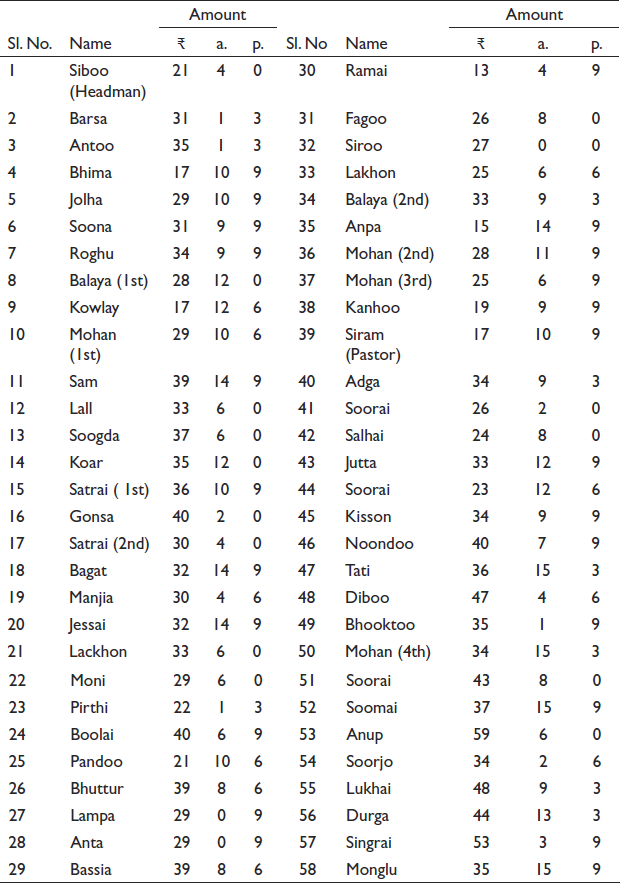
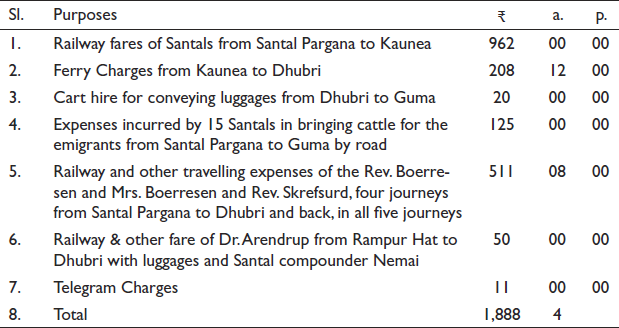
A. C. Campbell, Esq., c.s., Deputy Commissioner of Goalpara, wrote to the Commissioner of the Assam Valley Districts on 6 May 1881, with letter No.55 regarding the settlement of 58 head of Santal households numbering 237 individuals in Guma Duar. The government has agreed to pay a total ₹4,261-10-0 for the first group of genuine settlers’ transit fees from Rampur Hat to Dhubri by rail and steamer as requested by Rev. L. O. Skrefsrud. ‘₹1,888-4-0 has been incurred in railways and steamer fare and other charges in connection with the actual journey of bona fide settlers from Santal district to Dhubri’. 39 Dr. Wilken Anderup, a young Danish doctor and Mr. Nimai, a Santal compounder, also came to the Santal colony.
The incurred expenditure showing of ₹1,888-4-0 is given below:
T.J. Murray, Esq., c.s., Officiating Deputy Commissioner of Goalpara forwarded a memorandum in continuation of letter No. 55 dated the 6th May 1881, regarding his visits in company with A.C. Campbell, the Deputy Commissioner at Thakurpur to see the Santal settlement where they met and conversed with Manjhi Siboo, head of the village and Pastor Siram who were good command in Bengali. The letter clearly stated that the Santals were happy and all were engaged in their respective occupations including agriculture. They started a little Aus rice cultivation and Indian corn production, although plots are shown relatively small. 40
On 20th June 1881, W. E. WARD, Esq., M. A., I. C. S., and Commissioner of the Assam Valley District sent a letter bearing a no. 2248 to the Secretary to the Chief Commissioner of Assam with reference to letter No. 4004 of 8th December 1880 regarding the sanctioned expenditure incurred according to the Mr. Campbell’s letter stated as follow: 41
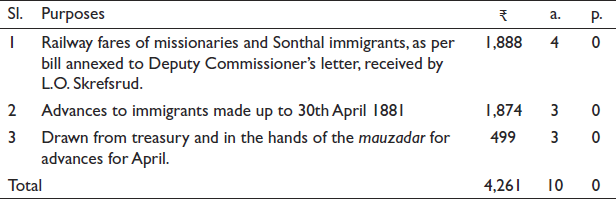
According to the Extract from Pioneer of 6th July 1881:
‘An interesting experiment is now going on in the Eastern Duars of Assam, where a Sonthal colony has been planted and still in a state of struggling infancy. The Sonthal converts have multiplied fast; and as land in Chota Nagpur is closely held by large proprietors and the Sonthal can only obtain it for cultivation as tenant-at-will, the missionaries determined to establish a new settlement in the waste land belonging to Government in the district of Dhubri. The first steps towards selecting the site and planting the colony were taken last autumn; and there are about sixty families established there, in five small hamlets. The soil is extremely rich, and as it is only covered with grass and not with forest, the labour of preparing it for cultivation is alright. So far, the immigrants have been fairly healthy, and nothing has occurred to make the prospects of understanding. They are under the guidance of their own headmen, and have about 500 head of cattle with them; and though the two chief missionaries, Messrs. Boerrsen and Skrefsrud, have had to return to Sonthalia, there is a young Norwegian Medical Missionary left in charge. The cloud on the horizon is that the colonists are already beginning to show signs of helplessness, and desire to rely too much on the aid of the Government, which has ruined so many of these enterprises. Government has paid for their journey to the place, about ₹ 1,820 and has advanced them a larger sum than this for their support till they should get in the harvest; but the latest reports seem to show that they find this system of living in advance too pleasant. They have mostly built themselves houses, but have to cultivate very little land, and it is obvious that unless they raise a harvest in the autumn sufficient for their own support, they will have subsisted for another year on loans, and will be crushed under a load of debt they can never repay. An officer who lately paid them a visit, reports that they are living an idle life, and are even buying rice from adjoining villages instead of paddy, though their women are sitting unoccupied at home, and might be employed in husking the paddy, which would be a considerable economy. It is much to be hoped that they may see the necessity, before it is too late, of leading a more strenuous and self-supporting life, and that this experiment may not be ruined, as so many others have been, by want of enterprise and stout-heatedness on the part settlers’.
42
The colonists were helped by grants given to each household in accordance with their needs. Thereafter, several batches of Santal immigrants arrived in Guma Duar. On 13th February 1882, Rev. Hans Peter Boerresen arrived with 26 Santal families totalling 120 people. They then travelled to the Santal colony with the emigrants. Mr. Murray paid ₹636 1-3 to MR. Boerresen for the emigrants’ travel costs to Dhubri. This amount comprises ₹65 in ferry tolls paid for 100 head of new colonists’ livestock transported by road by 10 of the new colonists. In addition to the foregoing, ₹18 is due for the rental of six carts for the transportation of children and belongings from Dhubri to Santal colony. According to the Chief Commissioner’s authorisation granted in paragraph 7 of his note on the colony, dated 4th December 1881, a monthly advance of ₹102-8 has been paid to the new colonists, and the instructions therein have been followed, with no family receiving more than ₹5. These advancements will be made only as long as they are required. 43 In 1883, a new wave of Santals began to settle, with 26 families totalling 98 persons travelling to Guma Duar and settled them among the original colonists. The travel expenses of these Santal immigrants were funded by the Deputy Commissioner, who had been approved by the Commissioner. Additionally, the second wave of Santal immigrants arrived in March 1883, with 31 persons. The following costs were incurred by the first group of emigrants from Rampur Hat to Dhubri in 1883, which included 26 families and 98 people: Rampurhat to Hooghly by rail for ₹105-12; crossing the Hooghly River to Naihati for ₹4-8; Naihati to Kaunia by rail for ₹250-14; Kaunia to Dhubri for ₹85-0; 11 carts for conveyance of luggage of the Santal from Dhubri to the colony at ₹3,33-0, payment of crossing of 110 heads of cattle from Santal Parganas to Guma Duar. A second group of Santal emigrants, consisting of 26 families and 98 souls, arrived at Goalpara and proceeded to Guma Duar of Eastern Duar to settle. The Deputy Commissioner of Dhubri had paid their travel expenses of ₹563-2. Expenses incurred by the second batch of Santals who arrived in March 1883; tickets from Rampur to Hooghly, at ₹1-7-6 each for 25 people at ₹36-11-6; crossing Hooghly River at ₹1-5-0, 25 tickets at ₹3-7-9 from Naihati to Kaunia at ₹87-1-9; 27 tickets from Kaunia to Dhubri at ₹27, and 2 carts for conveyance of luggage from Dhubri to Guma Duar at ₹6. 44 In 1884, a group of Santal immigrants arrived in Guma Duar, consisting of 38 persons. The Deputy Commissioner has approved travel expenses of ₹204-14-9 and a mensem advance of ₹32. After them, a group of 38 Santal emigrants arrived and made their way to Guma Duar to settle among the previous colonists. 45 In 1885, a total of 31 Santal immigrants arrived in Guma Duar to settle among the existing colonists. In contrast, 22 of the 31 Santals arrived in June, while the final 9 of them arrived in October 1885. Travel expenses totalling ₹121-8 for 22 Santals and ₹57-8 for 9 Santals have been approved. 46 A monthly advance of ₹15 was approved in detail in Letter No. 2003, dated 29 April 1886, for the settlers who arrived in October 1885. It also noted that ₹25 was paid in January and February in anticipation of the approval. A batch of 43 Santals who arrived in the colony between the months of March and May of 1886 also received a sanction of ₹232-8. 47 By 1888, after seven years of Santal colony establishment, there were about 600 people living there with an area of 1886 bighas of cultivated land. 48 In 1909, there were 38 village was formed in the Colony such as (a) Grahampur (b) Boerresenpur (c) Thakurpur (d) Karolinepur (e) Bankijor (f) Pausspur (g) Joepur (h) Benagaria (i) Rantazaupur (j) Lotamari (k) Samaguri (l) Saphadoha (m) Silghagri (n) Simoldohi (o) Kaerabani (p) Chondorpara (q) Matiajuri (r) Ranga (s) Meraldi (t) Reedtzthottpur (u) Nawadi (v) Saharghutu (w) Damra (x) Sirampur (y) Buru Amchua (z) Karikador (aa) Phaelaodi (ab) Manjadabri (ac) Kerappur (ad) Moltkepur (ae) Horpur (af) Tilabai (ag) Campbellpur (ah) Luisepur (ai) Andredruppur (aj) Jiyadanga (ak) Kawamohul (al) Dingdinga. 49 In the 36 villages, there were 682 families with 4,486 souls and 12,280 bighas of land brought under cultivation. 50 There was a significant influx of new emigrants to the Santal colony in between 1911 and 1921. In 1919, a total of 550 immigrants arrived from Santal Pargana and 200 from Dinajpur and Malda. 51 As per sources, there was 8,687 total population of the Santal Colony in 1911 but the population immediately increased up to 25, 512 total population during 1921. 52 The Santal immigrants were coming continuously through the Santal Mission in later period. On 24 August 1977, the Assam government converted the Santal Colony Tribal Block, into a full-fledged Santal colony with 57,930 bighas of land that comprised of 45 villages with its headquarter at Grahampur, and communities including Santals, Oraons, Mundas, Rabhas, Boro, Bengalis, etc., are present in the Santal Colony Tribal Block. 53
Soon after the establishment of Santal colony, the missionaries began their prosperous work among the newly settled Santals and other tribes inhabiting those areas. Followed by numerous churches were built in different Santali inhabited areas where they lived among them such as Haraputa, Grahampur, Skrefsrudfur, Sirampur, Dingdinga, and Simoldohi, for propagating religion. Additionally, schools were established for imparting western education to the Santals. 54 After that, various phases of Santal immigrants began to arrive both inside and outside the Santal colony. Over time, the Santal settlement expanded to other parts of the region including Kachugaon, Saraibil, Sapkata, Jaraguri, Gurefela, Padmabil, Hakma, Pakriguri and many places of Kokrajhar sub-division. 55 The Santal Mission worked to increase the welfare of the Santals through literary, medical, educational, and social advancement in addition to evangelism and conversion. However, language and literature have made the biggest contributions to society. Furthermore, the missionaries continued preaching the gospel outside the colony, resulting in increasing numbers of Christian converts from diverse groups, including the Boros, the Rajbongshis, Bengalis, and the Mohammedans. 56
Conclusion
The Santals, who have been depicted as a race wandering from one place to another in quest of a better livelihood, have ultimately got settlement in the Eastern Duar of Assam. The settlement, which was formed in 1880 on the Norwegian Mission’s initiative and initially sprawled over 25 square miles in the Guma Duar, benefited from many concessions from the colonial authorities. 57 The extremely fertile soil of the new territory had offered a better livelihood to the Santals. Despite the abundance productive the land, there lied several challenges and hardships 58 to overcome owing to the unhealthy conditions in the region caused by jungles and wild animals. In addition, it was an unhealthy track located in the malaria fever zone and the belt of black water fever. But with the clearing of the jungle, the health scenario significantly improved. The Santals settled in the western part of Assam, Goalpara district, north of Dhubri town near Dingdinga with a land of 30 sq mile which was named Thakurpur. Following that, different phases of Santal immigrants entered Goalpara through the Santal mission and settled in different places of Guma, Ripu, and Chirang Duar in Goaplara district of Assam. 59
Footnotes
Declaration of Conflicting Interests
The authors declared no potential conflicts of interest with respect to the research, authorship, and/or publication of this article.
Funding
The authors received no financial support for the research, authorship, and/or publication of this article.