




Abstract
Transgender identities and sexualities find a visibly accepted presence in the medieval history of India, especially in the Mughal era. Historical accounts and studies have indicated the prestige and power enjoyed by the third gender in the Mughal Empire to the extent that some of the writings have located them as an integral part of Mughal courts of law, holding some key positions of the royal palaces. In the extant literature on transgender, the analysis of their position as depicted through Hindustani Cinema in the Mughal period remains inadequate. The cinematic representation of the transgenders in the Mughal period can certainly offer a wide window to analyse their status in the given era, as this period has been documented as one of the most liberal periods for the transgender in Indian History. The present article aims to fill this gap through a mise-en-scene analysis of Hindustani Cinema based on the Mughal Empire during the twentieth and twenty-first centuries. The Hindustani Cinema has offered a marginalised space on-screen to transgender people for a long time by putting them only in humorous and comic roles. By providing an intense analysis of all the films based on the Mughal period in Hindustani Cinema, the present article argues that even period films are not devoid of the politics of representation of contemporary times.
Introduction
Cinema has been identified as a platform for the narration of a nation that constantly constructs and reconstructs the past on which the vision of the nation can be pursued in contemporary times or in the future. However, scholars have argued that historical films are particularly suited for the purpose of recovering the past in the light of the present needs of the nation. 1 Through historical films, the stories are relayed to reshape the past to express contemporary concerns. 2 On the other hand, while watching the re-enactment of historical films, where traditions are projected and valorised, the viewers would imagine that they are watching the realities of a particular period but such films have much incongruence with the period in which they are made. 3
At the outset, we would like to spell out the nomenclature chosen for the film industry functioning from Mumbai. It is neither Hindi Cinema nor Bollywood, or Indian cinema but Hindustani Cinema, owing to the amalgamation of languages used. 4 There has been a debate going on around the nomenclature of the film industry in Bombay for decades. If Khwaja Ahmad Abbas objected to the term ‘industry’ itself in the ‘Introduction’ to his book Sone Chaandi Ke Buth. 5 There has been a division in opinion between ‘Bollywood’ and ‘Hindi Cinema’. The term ‘Bollywood’ needs a complete rejection as it seems a rip off from the term ‘Hollywood’. The cinema that is created on Indian soil is far from the one created in the United States. Apparently, the term Bollywood was used in a film magazine in the 1970s and it stayed on. One cannot call it ‘Indian Cinema’ as that would entail the cinema from the different states too—Malayalam Cinema, Telugu Cinema, Manipuri Cinema and so on.
Our take on the same has been to call it ‘Hindustani Cinema’ and not ‘Hindi Cinema’, the simple reason being that the language used in the film is Hindustani. Stephen Alter in his book Fantasies of a Bollywood Love Thief (2007) 6 clearly points out that though Bollywood films are known as Hindi films, the root language is actually Hindustani.
Hindustani, a language which unfortunately does not exist now on the census is the most common blend of vernaculars spoken throughout North India, is essentially derived from Urdu. A language that was strongly advocated to be the national language at the time of the independence lives on through cinema.
In this backdrop, the present article argues that Hindustani cinema also creates national narratives through a continuous cultural reconstruction, which is political in nature. By focusing on the representation of transgender in the historical films based on the Mughal period of Indian history, the article highlights that the representation of the transgender in the films based on the Mughal period has remained highly inconsistent with the historical accounts of this period. The historical accounts and travelogues of the Mughal period include a variety of positions and roles for transgenders, who are largely mentioned as eunuchs in the history of this period.7,8 The article further argues that this inconsistency between the historical accounts and the cinematic representations of the transgender is very much aligned with the political contestations towards transgender identities in India.
There have been numerous writings on transgenders in Hindustani Cinema that posit them with marginalised identities and, so much so, out of the frame that they ended up becoming humorous stock in the film.9,10,11 However, transgender identities have not been analysed in cinema based on the Mughal period, an era that finds it space in Hindustani Cinema of twenty-first century as well. The present study argues that the cinematic history of transgenders would remain incomplete without locating them in Mughal period’s cinema for two reasons. First, the Mughal period was an era that marked a liberal and inclusive approach towards transgenders in India, and second, there are numerous films based on the Mughal period, providing a fertile ground to assess the position of transgenders during this influential historical period. This article highlights this gap in the politics of documenting the history of transgenders and focuses on their cinematic representation in cinema on the Mughals.
The Mughal Empire in India and Its Cinematic Representation
The Mughal Empire began in India in 1526 AD, and by 1700 AD, it had expanded to most of the Indian subcontinent. Although the dynasty continued to be in power till 1857, the decline had started after 1700. The Mughals enjoyed the longest period in the history of Medieval India with 21 emperors ruling for almost 330 years. The literature on various Mughal emperors and the socio-political economic condition during their times is vast, but dealing with that literature is beyond the scope of this article. This article focuses on the literature on transgender during the Mughal Empire, where scholars have argued the presence of castrated slaves and eunuchs in various Mughal emperors like Akbar, Jahangir and Aurangzeb.12,13
It has been argued that transgenders played an important role in the royal courts of the Mughal rule in Medieval India. They rose to well-known positions as political advisors, administrators, generals as well as guardians of the zenanas within the palaces. The transgenders were considered clever, trustworthy and fiercely loyal and had free access to all spaces and sections of the population, thereby playing a crucial role in the politics of empire-building in the Mughal era. 14 Even some of the recent media reports have claimed that the elevated stature of the third gender during the Mughal era has been documented for years by foreign travellers and historians, indicating the prestige and power enjoyed by them. 15 The Dutch merchant Francisco Pelsaert has mentioned in his writings during his visits to the Mughal court that transgenders used to get so many privileges such as fine horses to ride, fine clothes and servants to serve them. 16
Some scholars have informed about their exact designation in the Mughal nobility. Ikhtar Khan, a lawyer in the service of Jahangir, and the founder of Firozabad (Firoz Khan) in Akbar’s reign were claimed to be eunuchs. 17 However, largely, these writings put a long history of the Mughal period as a homogenised period, whereas the policies and temperament of Mughal emperors were quite different from each other. In this backdrop, it becomes imperative to locate the placement of transgenders during the reign of different Mughal emperors in India and the present article aims to fill this gap by analysing the same through the cinematic representations in Hindustani Cinema.
The cinematic representation of the Mughals depicts the romantic engagements of the emperors with a special focus on opulence of royal India under the Mughals. 18 These cinematic narratives also present its grandeur, its romance and relations and alliances with Rajput emperors. 19 Given the literature on the transgender in the Mughal period, the analysis of their position through their cinematic representation has remained absent. On the other hand, one of the prominent discourses of Hindustani Cinema has been about its contribution in nation-building, how cinema add to the nation-building process of the contemporary times. 20 The nation-building process through cinema in India started right after the independence by depicting its love for the newly independent India. 21 The nation-building discourse also touched the religious identities by placing Muslims in the imaginations of India as a nation.22,23 Women’s placement in society has also been an integral part of the nation-building process through cinema. This placement has been highlighted by focusing on women’s agency, sexuality and gender roles.24,25,26 Neo-liberalism provided a new lens to the cinema for constructing the nation for the Indian Diaspora.27,28 However, the placement and position of transgender in the nation-building through Hindustani Cinema has remained inadequate. By locating the presence and position of transgender in Hindustani Cinema during the Mughal period, the present article argues that the period films also add to the agenda of building the nation for contemporary times, instead of being limited to depicting the socio-political realities of that particular period, in which the film is based.
Methodological Approach to Locate Transgenders’ Placement Through Cinema
There are a total of 15 films based on the Mughals in Hindustani Cinema. For the purpose of this article, the analysis of these films has been done by the following mise-en-scene analysis. This form of film analysis examines specific scenes and shots to understand the meaning constructed through that scene. 29 The article analysed all those particular shots which had the presence or mention of the transgender in the film by focusing on the costume, language, expression and screen time to examine the meaning constructed from that shot, in the backdrop of that particular period. 30 The analysis explored answers to questions such as what effects are created in a scene for the transgender persons and with what purpose? How does the scene on transgender represent the period of that particular film? How does a scene express the broader perspective on the transgender in the film? These questions were kept in the backdrop to come up with concrete evidences for the presence and position of transgender in cinema on the Mughal period.
The sections of the article are based on different Mughal emperors and the films based on them to locate the representation of transgenders in the period of that particular reign, to locate whether this representation is incongruent with the historical writings of that period.
The Mughal Emperors in Hindustani Cinema: Locating Their Engagements with Transgenders
It is interesting to note that Franz Osten’s Shiraz (1928), a silent film, was also made on the commissioning of the Taj Mahal. However, the first sound film based on the Mughals was made during pre-independence India, Pukar (1939). The pre-independence period witnessed many other films, as well, on the Mughals like Taj Mahal (1941), Tansen (1943), Mumtaz Mahal (1944), Humayun (1945) and Shahjehan (1946). However, it was in 1960 that a film was made on the founder of the Mughal dynasty in India Babar, named after the name of the emperor himself.
Babar (1960) was based on the love between Babar and his son Humayun, and how the father gives up his life to save the son, the heir to the throne. The analysis of the film Babar indicates the presence of two transgenders as servants, not in the royal palace, but in the palace of Mirza sahab, also the house of Hamida Begum, the future wife of Humayun. In the scene, a friend of Prince Humayun pays a visit to the palace of Hameeda Begum, to meet his beloved, a cousin of the latter. To save himself from being seen, he hides in a rolled-up carpet. As luck would have it, two trans—Inmaad and Gulbadan—are beckoned and asked to carry the carpet from the zenana to the mardana. They are dressed in a kurta and a choodidaar with dupattas and are wearing some jewellery too. Hamida Begum, here lovingly called Bano Aapa, pulls them for not working diligently. Dejected, they pick the carpet to take to the diwan-e-khaas (Hall of Private Audiences), murmuring that lifting the heavy carpet could hurt their waist. However, once they carry, they are amused and pleased with themselves as they find the carpet very light. In fact, the rolled-up carpet was being carried vertically and the man hidden within was walking on his own. Inmaad and Gulbadan joke about their magical powers commenting that they make the carpet walk on its own but squeal with fear when they notice the feet of the man from under the carpet. While one faints with fear, the other runs, rather, prances out to get help and eventually returns with a sword. Their mannerisms are distinct.
However, unlike many other films on the Mughals, this film does have a mention of transgender persons, though in a humorous manner in which they were tricked to be mocked. Ironically, Baburnama, which is considered to be the most important historical source on the first Mughal emperor Babur, does not mention transgenders. This period has been depicted as having free interactions between men and women in the paintings of Baburnama. It has been argued that a strict binary and segregation between mardana and zenana was not practised at that time, due to which the transgenders as messengers were not required. Here, one can speculate the possibility that the makers of Babar did not know this historical fact that Babur’s court and palaces did not have transgenders but had only a generalised knowledge about the presence of transgenders in the Mughal period was implemented while making the film by projecting them as servants.
The film on the second Mughal emperor Humayun was made in pre-independence India and was named after the Emperor. The Ashok Kumar and Nargis starrer film, Humayun (1945), starts with a young Humayun and Babur, sowing seeds of friendship and brotherhood with the Rajputs. The Mughals and the Rajputs are shown visiting each other’s palaces throughout the film but at no point, one sees the presence of a transgender. Even when there is a message for Hamida Banu, who later becomes Humayun’s queen consort, the message comes through a noble. Though largely the historical accounts do mention the rarity of transgenders in this period, Bano (2008) does mention about a transgender Amber as a royal agent in the army of Humayun. The story of the film Humayun revolves around the political relations between Mughals and Rajputs but it misses out on any mention of Amber as an important part of the Mughal army.
The longest tenure in the Mughal period was that of
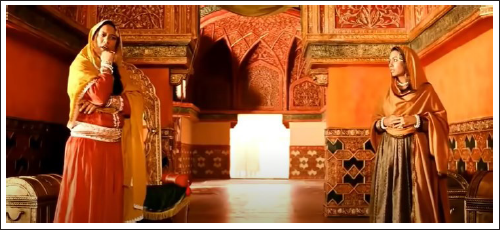
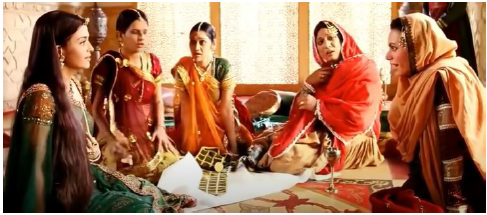
The film Jodha Akbar (2008) was based on the relationship of Akbar and his Rajput wife Jodha as an outcome of the political alliance between Mughals and Rajputs and how gradually love and romance sprung between them. Although there are historians who believe that Jodha Bai was married to the heir of Akbar, Prince Salim, later known as Jehangir (Bhargava, 1961) not only Jodha Akbar but in many more films, the queen of Akbar is addressed as Jodha Bai. The film under discussion was made in neoliberal India. This film has one transgender character, Niamat, who is introduced in the film when Akbar’s mother appears on screen to welcome Akbar’s new queen, Jodha in the palace. Thereafter, Niamat is shown as an integral part of the queen’s portion of the palace. She is an important part of the group of friends and servants who are companions to the queen to entertain her, to play with her, and to take care of all her needs. However, Niamat appears to be in a better position than other friends of the queen as she could speak about any issue in an uncontrolled manner without any fear of being punished. An apt example would be when she comments on the queen’s religion (Jodha being a Hindu) and on a temple being set up inside her room but the queen does not mind it (Figure 1). Later, she apprises the queen about the character of one of Akbar’s courtesans, which shows the intensity of inclusion and acceptance of a transgender in the royal palace, as she knows about the people in the palace closely. She is shown well dressed with fine jewellery and her language and body language being freer than her cisgender counterparts (Figure 2).
Historical accounts like Akbarnama (written by the court historian Abul Fazl) also mention Niamat around the resting area of the emperor in the zenana. In addition to this, the paintings in Akbarnama too have depictions of transgenders as guards at the entrance of the zenana. It has been argued that from Akbar’s reign, the references of transgenders are more common, as Ain-e-Akbari (again written by Abul Fazl) mentions about a eunuch officer as an in charge of the administration of the finances of the state. Eunuchs with no family ties were considered to be dependable and loyal. Abul Fazl in Akbarnama mentions that to counter the dishonesty among the other officers, the eunuchs were preferred to be part of the royal court to hold important roles and in Ain-e-Akbari, he mentions that they were promoted to be the officers in the royal court. These transgenders were given a lot of privileges during Akbar’s period by being offered wealth, palaces to live, along with expensive clothes and jewellery. It was believed that after their death, all the property and wealth will come back to the royal coffers. 31
Jodha Akbar appears to be the only film that shows some agency to the transgender character in the film, bringing it a little closer to the historical accounts, although, not completely. The presence of transgenders as royal officers was missing in Jodha Akbar too, which stands as an important indicator about the position of transgenders in Akbar’s reign.
There are two prominent films based on the fictional romance of Akbar’s son
The 1953 film, Anarkali, though made on the love story of Prince Salim (Jahangir) and Anarkali, was made seven years prior to Mughal-e-Azam. Although it was a blockbuster, largely because of the songs, it did not match the stature that Mughal-e-Azam had reached. In spite of the plot being the same, this film seemed more realistic in its temperament. What remains intriguing about this film is that there was not a single reference or depiction of the third gender throughout the film. Although there were messages being taken from the mardana to the zenana, they were carried by people who held important positions as shown in the earlier films. Many messages were brought by Raja Mansingh, one of the navaratnas of Akbar, who also happened to be the brother of the royal queen. The love messages/letters between Salim and Anarkali, were however, carried by the pigeons.
Mughal-e-Azam (1960) is a historical fiction, based on the life of the Mughal Emperor Akbar and his differences with the heir to the throne, Prince Salim, as the latter fall in love with a court dancer, Anarkali.
The film opens with Emperor Akbar walking barefoot in the deserts of Rajasthan, going to the dargah (shrine) of the Hazrat Moinudin Chishti, seeking blessings for the birth of a son, an heir to the throne. He is blessed with one, and the celebrations are shown with singing and dancing in the zenana, and a transgender is shown running across. At the moment, there is no other addition to the scene, but the fact that one of the opening scenes, which portrays festivity in the palace.
As the prince grows, his going wayward is shown, he being engrossed in singing, dancing and drinking. In all the scenes, when he is surrounded by nautch girls; a transgender too is present in that moment. However, the presence of this transgender is only at the beginning of the film, making an appearance a couple of times, to make an announcement to the queen, Jodhabai. As the story progresses, there is no reference whatsoever. Messages are still being delivered to the queen, but by the women working in the palace. In fact, as the tension between Emperor Akbar and Prince Salim rises, the messages go back and forth, but never through a transgender.
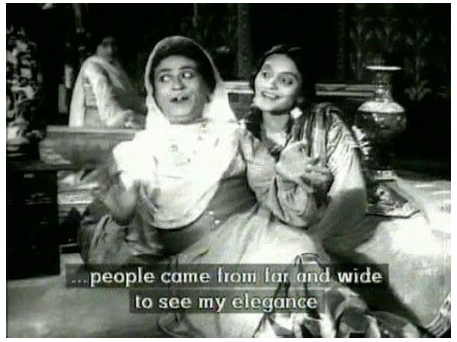
The film that was based on the reign of Jahangir without any presence of Akbar was Pukar (1939). It was set in the time and rule of Jehangir and Nur Jahan. Throughout the film, there are messengers going from the house of the Rajputs to the Mughal royal palace and vice versa. The Rajput household has both men and women domestic helpers, however, in a scene where many young girls in the royal palace are shown cracking jokes among themselves, Bijli, a trans, walks in. The girls pull its leg on how it walks. Bijli takes it in its stride and talks about how men would swoon over its when it was young (Figure 3). To this, the girl replied that it was sure that had it been a complete woman (aurat hee aurat), it would have surely become a queen of some kingdom. The conversation takes an interesting turn when Nur Jahan arrives and wishes to practice archery. On being asked, one of the girls says that the Queen should aim at something which has no purpose in life. When the Queen objects to it saying that everyone has some or the other purpose, the girl continues to add that Bijli is someone who is without any purpose. Bijli seems to get upset but responds jokingly. In the same scene, Nur Jahan sends Bijli to the Emperor with the message that she wished to see him. Her dress is the same as that of all the women in the palace. However, there is strange gaiety in her walk and she rather prances, which makes her stand out.
Historians have observed an important transition in the status of eunuchs from Akbar’s times to Jahangir’s times and that was their exclusion from the harem and bringing them to the outer part of the harems which were in between the kings resting area and the harem. 32 During Akbar’s period, the eunuchs were part of the royal court along with their access to the queen’s palace, as they served inside the harem. Although in the later period of Akbar’s reign, and during Jahangir’s reign too, the paintings showcase the presence of only women servants in the interior of the harems and eunuchs are found in the outer part of the harems in the zenana. Although it has been claimed that by the time of Jahangir, the castration practices were controlled, but eunuchs continued to be the viable option to keep the security and privacy of zenana by keeping them as guards of the women’s quarters. The absence of eunuchs from the interiors of harems was enforced more strictly during Jahangir’s period due to the need to control non-platonic interactions between the transgenders and the concubines of the emperor. 33
There is yet another popular film based on the love of Jehangir for his queen, Noor Jehan (1967). The story focuses on the life of Nur Jahan, born as Mehr-un-Nisa, and Prince Salim falling in love with her and then her subsequent marriage to Sher Afghan. As her husband, a soldier in the Mughal army, gets killed, she accuses the Prince of getting her husband killed. However, there is witness that it was Sher Afghan who had instigated the fight and was not killed on orders given out by Prince Salim. Later, after rejecting the Emperor’s repeated proposals, Mehr-un-Nisa, finally agrees to marry him and becomes Queen Nur Jahan. All announcements and messages, throughout the film, are carried by women and there is again, no representation of any transgender.
The comparatively better positioned Niamat of Akbar’s period and the humorous depiction of Bijli in Jahangir’s period in cinema go incongruent with their deteriorating position as depicted in the paintings of these Mughal emperors.
The next Mughal emperor who finds a cinematic representation is
After the death of Jehangir, when Shah Jahan revolts against Shaharyaar, it is a male messenger who comes running to break the news. Even, the news/information of this battle is communicated through either warriors or the nobles. The birth of the Princess of Shah Jahan is announced by a kaneez (slave girl), followed by the news of the critical stage/death of Mumtaz by another one. There is no presence of any transgender in the film, neither while carrying any messages nor in any scene presenting zenana.
There is another film made in 1946, titled Shahjehan which is situated in the court and palace of Shah Jahan and Mumtaz Mahal. Although there is a reference to the unending romance between the Mughal emperor and his queen, the plot and the main focus of the film revolves around the beauty of a common girl, Roohi who is wooed by a poet, Sohail and a sculptor, Shirazi (who is the same sculptor, who later designs the Taj Mahal). Roohi takes refuge in the royal palace and although one sees messengers going from the mardana to the zenana, there is no reference to any transgender at any point.
Jahan Ara (1964), revolved around the life and tragic love story of Jahan Ara, the daughter of Shah Jahan, who remained with him till his last breath. Here, the messages between the lovers are initially sent through pigeons and later through friends. Although the film is set in the palace, there is no reference to any transgender in the film.
The historical accounts continue to mention about eunuchs’ presence in the surrounding areas of harems as guard and spies during the times of Shah Jahan and Aurangzeb (Mukherjee, 2001). They have been identified as spies too, to inform the emperors about the activities of the zenana; however, there has been no cinematic representation of the same.
Unfortunately, the cinematic representations of the Mughal emperors thereafter have not been much pronounced. Emperor Aurangzeb does not find any prominent space in cinema till now. Although he is present in Taj Mahal: An Eternal Love Story (2005) but is portrayed in a negative light. As the title suggests, the film is on the eternal love between Emperor Shah Jahan and his Queen, Mumtaz, but the film starts after the death of the queen and the old emperor, grieving her loss. The film is in a flashback, where the old emperor remembers the love of his life. The film also starts with the battle of succession: the war that Aurangzeb had raged against his brother Dara Shikoh. It is observed that the one who seems to be a prominent soldier in the army of Aurangzeb, the one who takes the message of Aurangzeb to his father, Shah Jahan about Aurangzeb proclaiming himself to be the emperor, is a transgender. There is yet another representation of a transgender in the palace of Nur Jahan when the film goes in a flashback. A film titled Takht on the period of Aurangzeb has been announced but is yet to see the light of the day.
A film on the last Mughal Emperor, Bahadur Shah Zafar had been announced, titled, Aakhri Mughal but again the project never got started. However, Lal Qilla (1960), which is actually based on the first war of independence of the country (1857), has the presence of Bahadur Shah Zafar along with the other rulers. The plot of the film travels to different parts of the country where the war began. The film starts and ends at the Lal Qilla (the Red Fort) with the note that even if this war is lost, the war of independence against the British would continue. As there was barely any plot of the film within the palace, there was no representation of any transgender in the film.
Transgenders of Colonial India and Modern India in Mughal Cinema—Discussion
The prominent contribution of the article is that none of the research on transgenders has covered cinema on Mughals in India. The Mughal period has been documented as a period of remarkable inclusion of transgender in society, as well as polity of that time. Another prominent contribution of this article is that it has covered all the films based on the Mughals in Hindustani Cinema. Out of the 15 films, 13 were made in the twentieth century and two have been made in the twenty-first century. This article highlights a major gap between the historical accounts and cinematic representation of the transgenders in the Mughal period. The analysis of the cinematic representation of transgenders in the historical films on the Mughal emperors indicates that largely the filmography on the Mughals witnesses the absence of the representation of transgenders. There are only two films out of 15 films on Mughals in India, where an elaborate presence of transgenders can be located—Pukar’s Bijli (1939) and Jodha Akbar’s Niamat (2008). Apart from these two films, there has been some sporadic presence of transgenders which largely goes unnoticed by the viewers as they are given a brief screen time of some seconds and that too without any dialogues. Though the films, Jodha Akbar and Pukar, representing Akbar’s and Jahangir’s periods, respectively, do present transgenders in the zenana but their actual positions and agency of Mughal times are not accurately or fully represented in these films as well making their roles unmatched with the historical accounts on transgenders of these periods.
However, a deeper analysis of these two films indicates that Bijli’s presence to create humour in zenana, and she being not given any signs of agency or authority can be placed to the period in which this film was made. In 1939, when Pukar was released, India was still under the British rule which marked a great attack on the presence and position of transgenders in the Indian society. So, even the filmmaker tried to match the film with the historical accounts by adding a transgender character but he could only provide a humorous presence to Bijli, as she was a laughing stock among the other women in zenana. In other films of the pre-independence era, the transgender characters are absent.
Even in the post-independence period, when Hindustani Cinema saw almost half a dozen films on the Mughals, any presence of transgender character cannot be seen in those films. The article argues that despite the historical accounts on transgender in the in pre-British India, the cinema was ridden with colonial baggage in the post-independence cinema, as the filmmakers could not provide the presence and position to transgenders in those films as part of the Indian empire. Their muted presence in some of the films was only to show them as domestic helps at the lowest rank.
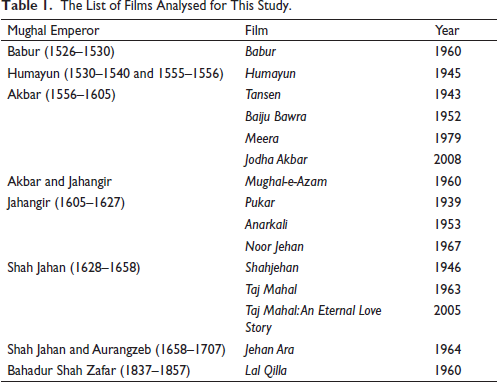
In the twenty-first century, the screen time, agency, body language and freedom of speech shown through the character of Niamat in Jodha Akbar are elaborated and enhanced as compared to Bijli. Jodha Akbar has been analysed by scholars in the nation-building framework by arguing that this film shows Hinduised Muslim as normative and unadulterated Muslims as evils. The film, it has been argued, is contributing to the nation’s imagination of a good Muslim emperor. 34 The present article argues that Jodha Akbar also added to the nation-building process by highlighting a transgender person with such prominence and agency (as shown in Niamat’s character) by giving maximum screen time to a transgender character for the first time among all the 15 films analysed in this study (Table 1). The study further analysed the film in the backdrop of the political scenario of the period when Jodha Akbar was released in 2008. The last decade of the twentieth century not only marked the neoliberal period for the Indian economy but also set the beginning of the movement to repeal Section 377 35 of the Indian Constitution by AIDS Bhedbhav Virodhi Andolan 36 in 1991. 37 This changing context to look at the sexualities beyond the heteronormative identities continued for a long time and after a decade Naz Foundation (India) Trust filed a Public Interest Litigation in Delhi High Court to legalise homosexuality among consenting couples, and eventually in 2009, the Delhi High Court gave judgement to call off the 150-year-old Section 377. Though this judgement was further challenged in 2013, eventually the Supreme Court declared article 377 unconstitutional in 2018.
The List of Films Analysed for This Study.
Since 1991, India was not only opening its economic boundaries, but also the boundaries for sexual identities. It is imperative to see the depiction of transgender character, in this backdrop, that Jodha Akbar got released in 2008, just a year before the judgement of the Delhi High Court against article 377. Niamat’s character’s strength in the film was not congruent to what Niamat was in Mughal times but more on what kind of recognition was desired and supported by many Niamats in the twenty-first century India.
As far as the representation of transgender is concerned, the study indicates that the Hindustani Cinema had been constructing a narrative against them for a long time and this narrative was not devoid of period cinema based on the Mughal Empire as well. The study also highlights how the absence of transgenders from the cinema based on the Mughals affected the audience position too as they could not give non-British meaning to identities and pleasure. Such absence of transgender from prominence in cinema in the Mughal period took away viewers’ privileges to perceive certain images, scenes and messages in understanding the Mughal Empire. In other words, these films could not mobilise Indian audiences to interrogate the political and cultural identities ascribed to them. The absence of one section of society and empire in the period film has the capacity to make the audience as Indian audience of period cinema with the western lens. In other words, it was stimulating their feelings for and identification with a nation carrying a colonial baggage. On the other hand, by the twenty-first century, the Indian political and social landscape had changed to challenge the British appropriation of India’s cultural space to construct a nation beyond the idea of patriotism and prudish colonial mindset.
What remains important is to see whether forthcoming cinema on Mughals would have some better representations of transgenders post article 377 India that promises to offer some form of equality to all forms of sexualities in India.
Conclusion
Cinema, like other arts, has a relation with society in a way that they both impact each other, influencing and casting impressions on each other. One can read the making of the nation and the society through the cinema it produces. However, at the same time, the politics of the nation also influence the cinema it produces, which indicates towards the creation and representation of a kind of society as desired by the contemporary politics of that nation.
The films on the Mughal Empire have been a part of Hindi Cinema from the beginning of cinema in India, till recent years, but the present article argued that the representation of transgenders varies in different periods of cinema. These different periods represent different socio-cultural and political scenarios in India, which subsequently, had an impact on the position of transgender in Indian society. The article argued that their depiction in the films on the Mughals got relatively stronger along with their changing positions in Indian society from marginality to a gradual recognition. The depiction of transgenders in Hindustani Cinema has always been under the shadow of politics of representation and audience reception. However, period cinema should ideally be taking the audience to that particular period but the films on the Mughals have located transgenders in such a way that more than historical representation, it caters to contemporary political concerns.
Footnotes
Declaration of Conflicting Interests
The authors declared no potential conflicts of interest with respect to the research, authorship and/or publication of this article.
Funding
The authors received no financial support for the research, authorship and/or publication of this article.
Filmography
Asif, K., Dirs. 1960. Mughal-e-Azam. Sterling Publishers Investment Corporation.
Bhatt, N., Dirs. 1960. Lal Qilla. H.L.K. Productions.
Bhatt, N., Dirs. 1952. Baiju Bawra. Prakash Pictures.
Desia, J., Dirs. 1943. Tansen. Ranjit Movietone.
Gowariker, A., Dirs. 2008. Jodha Akbar. AGPPL.
Gulzar, Dirs. 1979. Meera. Suchitra International.
Gupta, H., Dirs. 1960. Babar. Filmistan Pvt Ltd.
Jaswantlal, N., Dirs. 1953. Anarkali. Filmistan Pvt Ltd.
Kardar, A. R., Dirs. 1946. Shahjehan. Kardar Productions.
Khan, A., Dirs. 2005. Taj Mahal: An Eternal Love Story. Mashreq Communications Limited, Trilogy Entertainment Group.
Khan, A., Dirs. 1945. Humayun. Mehboob Khan Productions.
Kumar, V., Dirs. 1964. Jahan Ara. Om Prakash Bakshi.
Modi, S., Dirs. 1939. Pukar. Minerva Movietone.
Osten, F., Dirs. 1928. Shiraz. Pro Patria Films.
Sadiq, M., Dirs. 1963. Taj Mahal. A.K. Nadiadwala, Pushpa Pictures.
Sadiq, M., Dirs. 1967. Noor Jehan. Zenith Productions.
Sharma, K. N., Dirs. 1944. Mumtaz Mahal. Ranjit Movies.