




Abstract
Stone engraving or carving also known as petroglyph is an image created by removing part of a rock surface by incising, picking, carving or abrading, as a form of rock art. In the engraving, animals, men, ornaments, instruments, weapons and so on have been depicted which is the material culture of the Zo tribes. This article attempts to give a brief account of the living rock art tradition of the Zo people in the transborder area of Indo-Myanmar. The culture extended to Chin Hills and Mizoram who are the same group of southern Manipur. The periodisation of the studied rock art is beyond the understanding of a mere scholar without the help of experts. This article deals only with the petroglyph or rock art irrespective of megalith, monolith, dolmens or menhir. Efforts have been made to explore how these diverse tendencies can be beneficial within the study of rock art and history.
Keywords
Introduction
Stone engraving or carving also known as petroglyph is an image created by removing part of a rock surface by incising, picking, carving or abrading, as a form of rock art 1 is a tradition of the Zo people. It is found throughout the Zo-inhabited areas of India and Myanmar. Here, the term Zo is used to cover all the Chin, Kuki, Mizo and Halam groups. It is the tradition that offers the stone erection was a celebration with whole rhythm and movements. This is an exploratory study based on fieldworks done in southern Manipur and analysis of ethnographic or ethno-archaeological data. The study adopts both archaeological and ethnographic methods; the former was used for ethno-archaeological study, photography, mapping, measurement and recording of the petroglyph patterns including GPS location. The ethnography includes the collection of data on the various aspects of stone tradition such as folklore associated with the petroglyphs on megaliths and monoliths. Since the colonial period, many anthropologists have been interested in the archaeological remains of North-eastern India like H. H. Godwin Austen, who works among the Khasi and Jaintias, Ursula Bower on the Arunachalee tribes and J. H. Hutton on Nagas and published the ‘Megalithic work in Assam’, on Current Science 12(5), 167–169 in 1933. D. L. Haokip works on the petroglyphs of the Kuki–Chin people in the transborder area and published a paper entitled ‘The Petroglyphs of Indo-Myanmar Frontier’ in the Journal of Ancient Asia in 2021. Similarly, Malsawmliana published his article entitled ‘Engravings on Megaliths in Mizoram’ in the book edited by Milan Kumar Chauley and Manzil Hazarika in 2021. Many indigenous scholars are coming up with their scientific study of their stone culture in the recent period. The other aspect pragmatic is the development of the regions like construction of roads, highways, schools and buildings has destroyed or disturbed extensively the archaeological sites. Ignorant people who do not care to preserve them and the limited number of resource people have inadequate information available for a thorough understanding of the motifs and all.
Rock Art of Zo People
Rock art is all about capturing people, animals or events in a moment in time. This culture of stone erection common among the Zo tribes is known as ‘mualsuangdawh’, mualsuang means ‘stone on the mountain’ and dawh means ‘to erect’. Thus, it implies stone erected on the mountain. It was usually the powerful and the wealthy who had their monolith engraved. It served as a way of memorialising somebody or some events. People who had been dead for hundreds of years could still be living on the rock. They are ever popular because people are more curious about their ancestors. The social, economic, beliefs and so on were captured in such rock arts. They used some hard materials and scooped, pecked or engraved them under a hard rock surface to get the images. It is important to understand that this rock art is not the rock art of the prehistoric period found worldwide. From the field surveys as narrated by the locals, the oldest might be as old as 300–500 years only and continuing till today. Sing Khaw Khai, in his Suangpi Mualsuang referred that, in Burma, mualsuang erection practice started around 900 AD during the Pagan dynasty. 2 The studied rock art of Behiang village in Churachandpur district of Manipur is probably as early as the nineteenth century only (Figure 1). It is a source of history for people who do not have any written documents. They have recorded their daily activities on the rock. Rock art study also involves a component of art; it helps us understand the human mind and how complicatedly humans were thinking. How could they reproduce what they saw in their real-life on their two-dimensional surface? It is seen as an important development in the growth of human cognition, understanding and language on the use of symbols. They usually used sandstone for the mualsuang (memorial stone) for its durability. It is said that sandstone can withstand wildfire and weathering. 3 Rock art interpretation is highly challenging; different people give different meanings. Therefore, it is not very easy to find the true meaning of rock art remains, which I left to the experts.
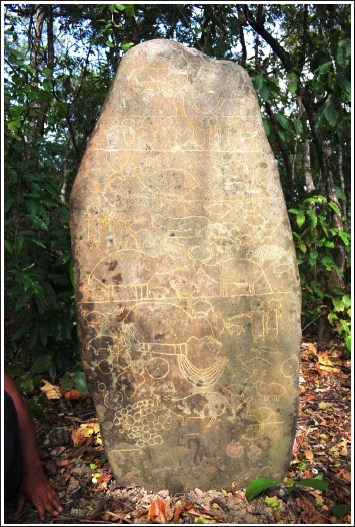
Memorial stone can be considered the living tradition of Zo, which is practised even today in different forms, themes and concepts. It is helping in the understanding of the art of their forefathers and also in interpretation. The art might be ceremonial in nature or related to ancestor worship or after life world. Perhaps this kind of belief only contributed to the development of rock art among Zo. Mualsuang could be erected only on two occasions. First, when one’s achieved thangsuah 4 (when he fulfils all the rite of passages) in his lifetime, and the second, in memory of the dead (like the son to his father). It was not a simple task to erect a memorial stone; there were certain rules one needed to accomplish and had to provide a grand feast for several days. The stone was erected with the offal of the sacrificial animal with an intonation by the priest, so it is taboo to disturb or destroy such stone. 5 Memorial stone cannot be erected on any mountain or out of the village boundary. It was erected by the roadway like the Ashokan edicts and pillars so that all passers-by could see it. The spot is usually the khuamual (resting place) on the way to the village or road junctions. Every Zo village has a khuamual which was made deliberately to be attractive for travellers or passers-by to rest on the stone slabs put for the purpose. It was believed that khuamual has fame or was blessed if people chose to rest there. 6 Traditionally, the memorial erection was done with a thick plank of hardwood 7 and later on, adopted the stone for its perpetuity. Not all mualsuang have been engraved; in fact, most of them have a blank surface which they are the older one. ‘History offers an even broader foundation from which to see the impact of social, political and economic events and change on dance and other arts’. 8
The practice of erecting stone monuments among the Zo was extensive and connected with their social, economic and ceremonial ties. In the pre-Christian period, the most challenging task of a man is to attain thangsuah and in order to achieve such social status one has to go through certain ceremonies or rituals with a long ‘feast of merits’ performance. There are some ‘Feasts of Merit’ performed by the great Zo individually when they achieved something extraordinary. These feasts also rocketed their status and position in their society. They performed these feasts in such a grand that it is not less than a festival or more than a festival. Many today still consider it as a festival. It is also an important attribute of identity. With no written records, it is the presence of such monuments that gives us an understanding of the past and present. 9 Among the archaeological remains, petroglyphs form an important asset for reconstructing the prehistory and cultural heritage of the Zo. In the olden times, high-status men had greater social influences and better access to food and shelter than their lower status counterparts. Therefore, the children of high-status men were more likely to survive the harsh environment their ancestors live in. During the barter system or beyond high-status children had unfair advantages, they received preferential treatment. Social status is like social order. It is how people position themselves accordingly to other people. Status is dictated by wealth, material possessions, achievement and people associated with them. Some people perceive the others are superior to them and some people are being inferior. This was an evolutionary process determining people who has the right to have more resources than the other people or how to get a better maid, or partner, and how to ensure that people with the lower status are not really messing around with the higher status because it destroys the social order and apparently makes the convention unequal because the people with the higher social status work hard for their status, wealth and spouse. Status is not static or permanent and usually people with the lower status would strive towards achieving the higher status and would strive towards a better quality of life. This social mobility actually enables to shuffle people with different statuses. When one jumps from lower to higher status, they disassociate themselves with their friends and environment they were at present in order to move into that new environment, which will bring force the idea of having higher status.
Mualsuang is to seek fame and pride in the world. The feast can be celebrated with any quadruple animal, but bison was the greatest of all. It was preferred a pair of bison as the revelling couple are one body. The wife has a big role to play in such feast of merits. Traditionally, the buh ai (crop feast) can be done only to the harvest that he himself cultivated. Even if he has slaves to work for him, it was not counted. 10 In feast of merit, the heads of the sacrificial animals were given to the bearer’s name. 11 The animals butchered for consumption on the festive day was called sagual. 12 Like the sacrificial animals, zu (beverages) also bears a name. Certain pots of zu were given a name like ton zu, gal zu and so on, and only selected individuals could consume it. The same drink was also made available for the public as in drinking party, namely, zupi (rice beer), vaizu (chaff beer) and zuha (millet beer). The essence of the feasts is the sacrifice of one or more animals (pigs and/or mithun) and the serving of large amounts of food to a number of guests. The number of guests invited, the amount of food served and the number of days over which the feast a man had held and the amount of his wealth that could be used for these auspicious days distinguished his status.
Conclusion
Petroglyph is a living tradition, with some modified forms, in this people’s culture. In the past, stones were raised or erected by an intending merit-seeker to attain a high position on their respective social ladders. The reveller needs to collect a huge amount of wealth to meet the cost of performing the whole series of Feasts of Merit. Each such feast is associated with many rites and rituals. Such stone culture was considered the highest form of competition and challenges they can achieve in their lifetime in society. There is a fast-changing and emerging trend towards the concept of raising megaliths/monoliths/menhirs. In the present day, most of the stones are usually raised at religious functions, at social or political functions. For instance, the Christians raise such monoliths to commemorate various functions like anniversary jubilees, villagers raise to commemorate their founding days and many communities raise menhirs to commemorate functions such as sporting events, conferences and the like. It is understood that the whole Zo community practices rock art in the past and in present. It is important to study the motifs in order to understand how far they can reconstruct their history. There is a need for extensive scientific research and analyses in order to come to a conclusive understanding that the traditions are antique and give new scope to the regional history.
Footnotes
Declaration of Conflicting Interests
The author declared no potential conflicts of interest with respect to the research, authorship and/or publication of this article.
Funding
The author received no financial support for the research, authorship and/or publication of this article.