




Abstract
Aim:
To assess the impact of colors on child’s anxiety and treatment preference for local anesthesia injections.
Material and Method:
The study group consisted of 100 randomly selected children aged 9 years. A specially prepared proforma was used to record personal information and history. Anxiety was assessed using faces version of the Modified Child Dental Anxiety Scale and children were categorized as anxious and non-anxious in the playroom. In the dental operatory, dental injectors (conventional plastic injector and six different colored plastic injectors) were displayed on a tray and were introduced to the children. The children were asked to consider which injectors they would prefer “if their tooth had to be put to sleep,” and their preferences were noted starting with their first choice. Sheets with stylized cartoon drawing of faces (modified Venham Picture Test) with six different emotions (happy, scared, crying, sad, angry, and running away) opposite line drawings of colored dental injectors were distributed. All the children were asked to match the cartoon faces with the injectors as per their preference. The data was collected and statistical analysis was done using SPSS 19.0.
Results:
A response analysis was performed in Microsoft excel, and frequencies were noted for color preferences in males and females. Significant differences between genders as well as different colors association was found.
Conclusion:
Reducing child’s anxiety through remodeling of physical appearance and color of dental instruments could be a potential modality of behavior management that needs further research.
Introduction
An understanding of the development of emotional knowledge and an awareness of age-appropriate effective milestones are essential for behavior management in pediatric dental practice. How children develop and achieve their emotional knowledge can help pediatric dental professionals understand how children perceive and interpret their environment, and how they respond, manage, and organize their own feelings in emotive situations. Language, verbal ability, and creativity are strongly associated with emotional understanding and have been used as measures of social and emotional adaptation in children. 1
One such creative measure is the cognition and use of colors, which is used as a means of expressing emotion and feeling. Within the everyday environment, children are exposed to a considerable amount of vibrant color through toys and possessions, all of which can carry certain messages and associations. 2 School-going age is a very influential time when children are flooded with several colors and where specific emotional associations are formed. Color appears to be context appropriate with different situations and reflecting different emotions, thoughts, and behaviors. 3
In the dental environment, color preference could be a measure that reflects and emphasizes particular emotional states, fear, and dental anxiety. Color preference and perception can be used to explore children’s perceptions of events in pedodontic clinical settings.
The local anesthesia injection is one of the most frequently quoted anxiety-provoking instrument, resulting in higher pain perception. If the physical appearance and color of these instruments could be modified to have a positive impact on the child’s behavior, it is possible that it may add to the comfort of a child, thus reducing dental anxiety. 4 Thus, the present study was undertaken to assess the impact of colors on child’s anxiety and treatment preference for local anesthesia injections.
Material and Method
Ethical committee approval was obtained prior to the commencement of the study. An informed written consent was obtained from the parents and participation was voluntary. The study group consisted of 100 randomly selected children aged 9 years attending the OPD of Department of Pediatric and Preventive Dentistry, VSPM Dental College and Research Center. The study was carried over a period of six months.
Inclusion criteria is given as follows:
All healthy communicative children. Those who are willing to participate in the study. First dental visit/no history of previous dental treatment.
Exclusion criteria: Patients with handicapping conditions, communicative disorders, and speech defects.
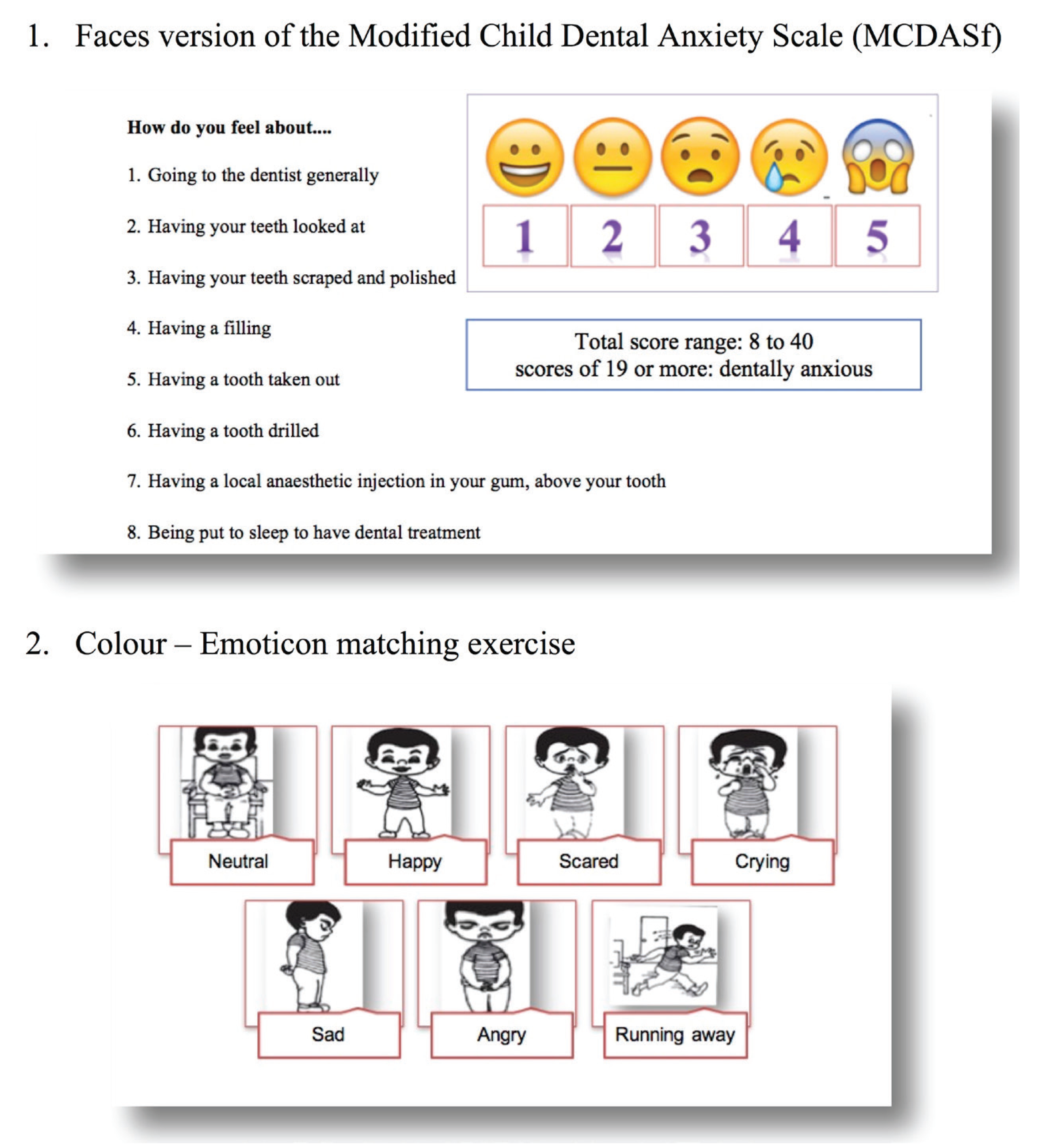
A specially prepared proforma was used to record personal information and history of children. Anxiety was assessed using faces version of the Modified Child Dental Anxiety Scale (MCDASf) 5 consisting of eight questions to evaluate dental anxiety about specific dental procedures. The scale incorporates a question about local anesthetic, and other dental procedures that will possibly distress children, such as extraction, dental general anesthesia, and relative analgesia. We modified the scoring row with five colored smileys ranging from very happy to very unhappy (Figure 1). The children were asked the questions and then told to point at the face, they felt most like at that moment. The scale was scored by giving a value of one to the most positive face and five to the most negative face. Total scores on the MCDAS ranged from 5 to 40. Children with MCDASf scores of 19 or more were considered dentally anxious. Children were thus categorized as anxious and non-anxious in the playroom and only non-anxious children were included in the study.
In the dental operatory, dental injectors (conventional plastic injector [PI] and six different colored [blue, green, white, yellow, red, and black] plastic injectors [CPI]) were displayed on a tray and were introduced to the children (Figure 1). The children were asked to consider which injectors they would prefer “if their tooth had to be put to sleep,” and their preferences were noted starting with their first choice. The injectors were used for demonstrative purposes only. The child was allowed to hold and inspect the types and finally choose the one injector that he/she preferred. Each child was given as much time as required to choose without any rushing. No opinions were allowed from the treating dentist or the parent, concerning which type to choose, so as not to lead the child to a specific choice.
Emoticon cards with stylized cartoon drawing of faces (modified from Venham Picture Test) 6 with seven different emotions/expressions (neutral, happy, scared, crying, angry, sad, and running away) and the seven colored injectors (blue, green, white, yellow, red, and black) were presented to children (Figure 1). The subjects were instructed to look very well at the different faces for 30 seconds after which they were given the exercise of matching each colored injector with emoticon cards with the different faces according to their preference. For clarity, some of them who could not understand the instructions in the English language were instructed in their local language.
Results
The data was collected and statistical analysis was done using SPSS 19.0. A response analysis was performed in Microsoft Excel, and frequencies were noted for color preferences in males and females. Blue was found to be the most preferred color by males, whereas red was most preferred by females. In contrast, red was the least preferred by males and black by females (Table 1). Chi-square test was used for analysis of color-emoticon matching exercise which showed significant differences between genders as well as different colors association (Table 2).
Color Preferences Between Gender

Color–Emoticon Matching Exercise Preferences

Discussion
Visiting the dentist can induce stances of strong anxiety in many people, especially children. The PI has a widespread use in dentistry and medicine in India. It is the most preferred due to its low price. We assume that children relate their choice to general experience of medical care and to assumption and expectations about the injector presumably based on its physical appearance. Therefore, it was thought to make the PI friendlier in its appearance and presenting it.
Color is a salient feature in a child’s life. A child’s environment including his/her clothes, toys, and home accessories convey many psychological messages through colors. 7 Goldstein claimed that specific color elicits specific emotional responses. 8 Judgments about colors are frequently noted. We often buy products in the colors that are most pleasing at the time of purchase, as colors appeal emotionally and aesthetically. The colorful pencil cases, the McDonald stores, or the cartoon stickers are common examples of how colors influence child preference and recall. Precisely how children come to associate different colors with positive or negative topics is an issue which needs to be addressed by further research. One possibility is that children acquire these associations from what they have seen and used in coloring books, television ads, smartphones, and interactive media.
Clinicians have asserted that children’s use of color in art, for example, is a manifestation of their underlying emotional status.7,9 In this study, it was decided to include six easily identifiable color groups: Blue, green, white, yellow, red, and black. The colors chosen correspond to the four principal colors (blue, green, yellow, and red) of the Munsell system. 10 To avoid specific hues and printer problem in reproducing the exact shade that could have a dramatic impact on the study, children were presented the actual modified syringe and given the exercise of matching the injectors with emoticon cards. Six emotions as defined by Ekman and Friesen include happiness, surprise, anger, sadness, aversion, and fear.11,12
Terwogt and Hoeksma found that the link between color and emotion preferences varied between age and gender. 13 Color preferences change based on individual experiences. In the present study, males preferred blue color the most and red color was the least preferred. Conversely, females preferred red color the most and the least preferred color was black.
It has been found that the associations of some mood tones with particular colors are more apparent and precise than others. The color yellow is associated with happiness, cheerfulness, and a positive emotional state; the color blue is associated with security, calmness, and comfort; green with quietness; red with anger, aggression, and excitation; and black with depression or anxiety. 7 Cimbalo et al. concluded that children viewing happy scenes used yellow, blue, green, and orange to color, whereas when viewing sad scenes, they tend to use red, black, and brown. 14 Lawler and Lawler found that preschoolers colored with a yellow crayon after hearing a happy story and with a black crayon after hearing a sad one. 15 In the present study, although both genders preferred bright to dark colors, the overall brightness preference was relatively stronger for girls than boys. Children, in many circumstances, show genderdifferentiated fashions of play and toy preferences. Hormonal processes are known to influence sex-dimorphic behavior. 16 Our findings also suggest this gender bias toward greater chromatic sensitivity in females.
Specific colors usually elicit particular emotions, but the particular emotions involved are in no way the same for each individual. The emotion triggered by a color depends on nationality, past experiences, and sometimes personal preferences.7,8
The child’s questionnaire included the MCDASf which is a reliable and valid measure of dental anxiety in children aged 8–12 years. 5 Using simple language, the scale covers eight items ranging from attendance at the dentist to extractions and general anesthetic. The Modified Venham Picture Test (VPT) was used as a self-report measure of situational anxiety, ranging from behaviors of neutral emotion and smiling to behaviors of attempted escape from treatment.
The study has been attempted to understand better the value of color in the dental environment and the appropriate colors for the pediatric dental population. The results showed that children do have preferential colors and can match these colors to emotions. The use of the “child friendly” instruments at the dental workplace could create a positive dental attitude in the child’s mind.
Thus, the importance of knowing color preference among children cannot be overemphasized. Color is highly informative for identifying objects and people rely more on color than on other perceptional features when locating an object. In other words, color plays a role in speeding visual processing. Color can have an important role within the mental health setting in enabling both therapeutic interpretations of emotional state and also as an intervention aid to facilitate exploration of emotion. The use of color interpretation and emotional association has the potential to become a useful tool in the pediatric dentist’s armory for intervention and treatment. Future research with larger sample size and different age, larger range of color samples, and varying emotions could establish a strong association between different colors and emotions of children. This research will have important implications for people who may be involved in using color in practical dental situations. These results can also help health care providers and professionals to understand appropriate colors better for children populations.
Conclusion
Reducing child’s anxiety through remodeling of physical appearance and color of dental instruments could be a potential modality of behavior management that needs further research. Customized child-friendly injector designs should be researched to have an affirmative impact on the child’s behavior and it is a favorable modality that may add to the comfort of a child during dental treatment. In the clinical context, color use can assist pedodontic interventions by activating and promoting positive emotions, which may provide enhanced therapeutic effects, reducing anxiety and enhancing motivation toward treatment.
Footnotes
Acknowledgements
None.
Declaration of conflicting interest
None.
Funding
None.