




Abstract
To mitigate the persistent lateral oscillation of a rowing boat, various asymmetric rig designs have been implemented, even in Olympic competitions. Previous theoretical studies have operated under the unrealistic assumption that all rowers possess identical strength. This paper advances previous findings by scrutinizing the scenario where rowers exhibit heterogeneous strengths. Our study unveils a novel rig design feature: among the four designs for an eight-rower boat proposed by Barrow (2010), the design “uddu duud” uniquely satisfies the equilibrium condition for angular moments. This design is different from the German rig, “udud dudu,” utilized by Team Canada to win the Men’s Eight at the 2008 Summer Olympics. Furthermore, we enhance the analysis by incorporating stochastic noises.
Introduction
The traditional rigging in rowing is symmetrically arranged. For instance, the symmetric design for a four-rower boat, illustrated in Figure 1, is denoted as “udud,” with “u” and “d” representing up and down, respectively.
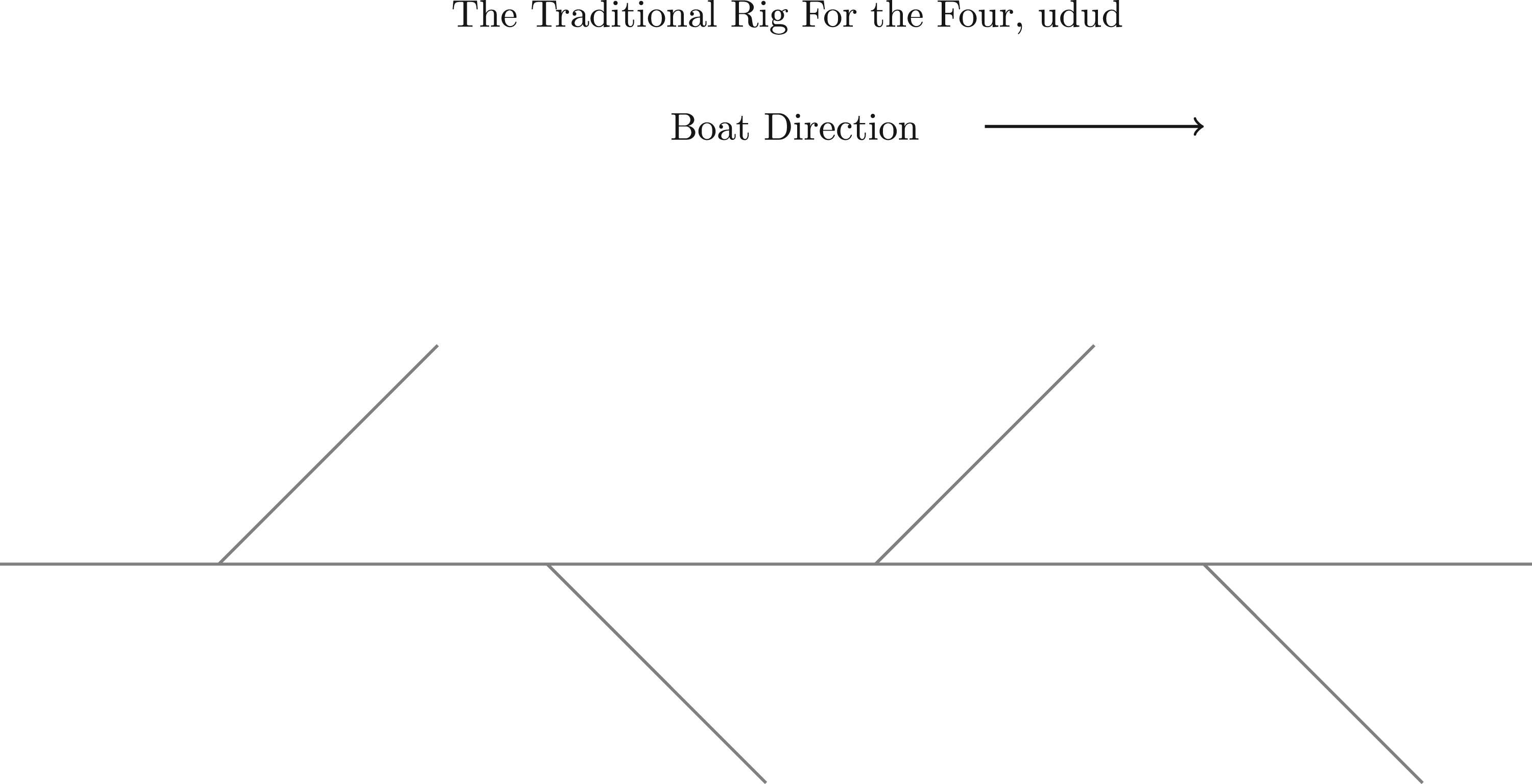
The traditional symmetric rig for the boat of four rowers, denoted by “udud.”
However, a significant issue with traditional rigs is that they tend to cause the boat to wobble from side to side. To address this concern, several asymmetric rigging designs have been implemented in practice, including the German rigging configuration “udud dudu” employed by Team Canada to win the Men’s Eight at the 2008 Summer Olympics, as depicted in Figure 2.
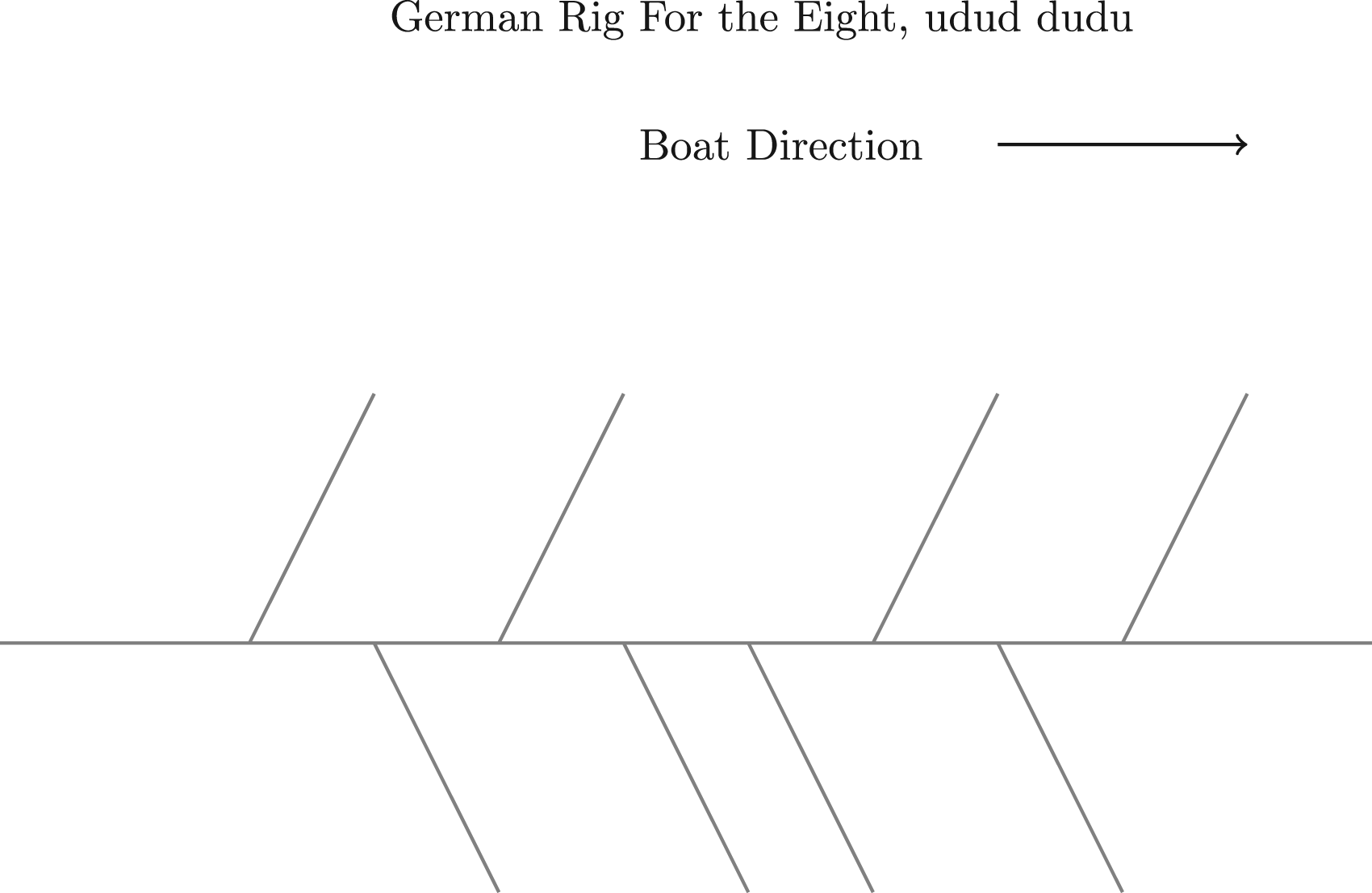
The German rigging configuration “udud dudu” employed by Team Canada to win the Men’s Eight at the 2008 Summer Olympics.
As noted by Barrow (2012), asymmetric rigging configurations are seldom adopted in international rowing competitions. The only instances cited there include the German rig employed by the aforementioned Team Canada—uniquely among the finalists in that event—and the “uddu” configuration utilized by Team Albania to triumph in the women’s coxed quad at the 1963 European Championship. Nevertheless, Barrow (2012) contended that Team Canada’s strategic use of an asymmetric rig to secure victory renders such configurations particularly compelling subjects for further investigation.
Townend (1982) conducted a theoretical analysis of rigging designs for the Four and Eight, focusing on the equilibrium of angular moments. Barrow (2010) provided a comprehensive solution to the problem for general boats, not limited to the Four or the Eight, identifying four solutions for the Eight, twenty-nine solutions for the Twelve, and so forth. However, the findings of Townend (1982) and Barrow (2010) only address scenarios where each rower exerts identical pressure, i.e., possessing equal strength. In practice, the strongest individual is typically positioned in the stroke seat (the front seat of the boat), while the lightest individual occupies the bow seat (the back seat of the boat). Consequently, the stroke seat exerts the greatest pressure, with the pressure diminishing progressively from the stroke seat to the bow seat.
This paper advances previous findings by examining the scenario of rowers with heterogeneous strengths. The mathematical framework employed in this study is the Prouhet-Tarry-Escott Problem (see, e.g., Allouche and Shallit, 1998; Dorwart and Brown, 1937). Specifically, with


In this paper, conditions (1) and (2) are not treated as assumptions but are jointly established as the necessary and sufficient equilibrium criteria to ensure that the net angular moment is nullified—an essential requirement for the boat to advance smoothly without lateral oscillation. Specifically, in the special case where all rowers exert equal force, Townend (1982) and Barrow (2010) demonstrate that condition (1) alone suffices to guarantee equilibrium. Our study generalizes their framework by accommodating heterogeneous force distributions, a more realistic scenario in which the strongest rower is strategically positioned in the stern (stroke) seat to set the pace and rhythm, while the weakest—typically the lightest—is placed in the bow seat to stabilize the boat. In particular, we prove that when rower strengths follow an arithmetic progression, the combined conditions (1) and (2) are both necessary and sufficient for equilibrium. We further extend the analysis to more general settings by incorporating stochastic noises and employing Taylor expansions.
Our study unveils a novel rig design feature: among the four designs for an eight-rower boat proposed by Barrow (2010), only the “uddu duud” configuration satisfies the equilibrium condition for angular moments. This design, illustrated in Figure 3, diverges from the German rig “udud dudu” utilized by Team Canada to win the Men’s Eight at the 2008 Summer Olympics.
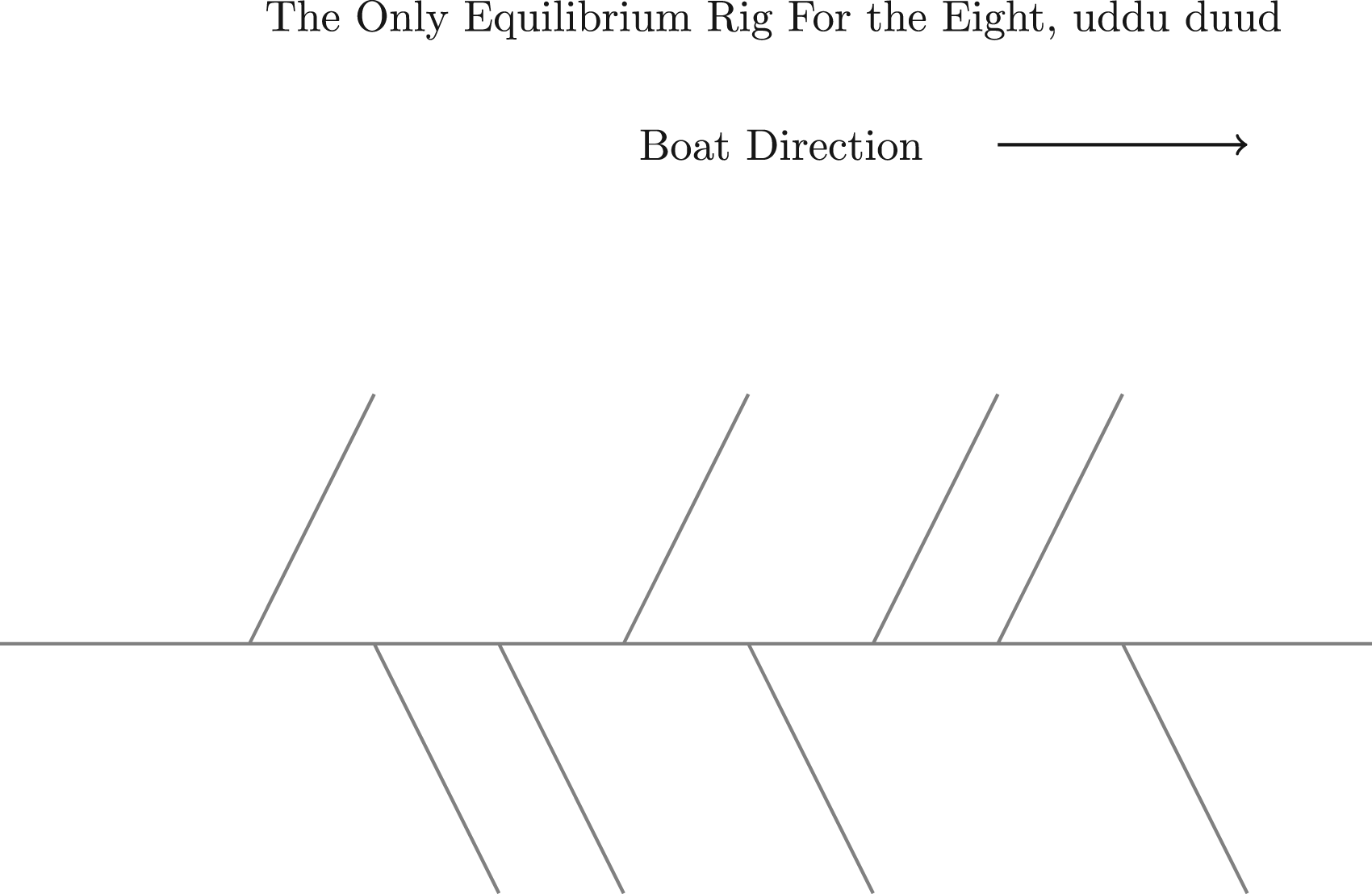
The only equilibrium rig for the Eight, “uddu duud,” proved in this paper. Note that the design diverges from the German rig “udud dudu.”
Our research also contributes to a burgeoning body of literature employing quantitative analysis to examine rowing. Kimmins and Tsai (2021) propose a gold medal standard to compare competition performance profiles and factor out environmental effects. Chu et al. (2023) identify associations between pacing profiles in 2K rowing races (over a distance of 2,000 meters) and various race factors. This paper complements this strand of literature by conducting a theoretical investigation into rigging design.
The paper is structured as follows. Section “Main Results” delineates the main results of the equilibrium condition, while Section “Examples” elucidates their numerical implications. Section “Extensions” extends the analysis by incorporating stochastic noises and more general sequences.
Main results
The notation and the assumption
To begin with, consider there are
Let
This assumption generalizes the framework proposed by Townend (1982) and Barrow (2010), who impose the restrictive condition
Let
With this notation, the vertical force exerted at the seat
Similarly, the vertical force at the seat
The equilibrium condition
To reach equilibrium, i.e., without wobbling, the total sum of the angular moments must be
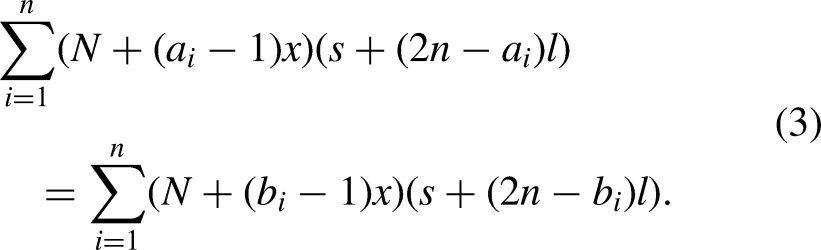
We have the following result: (3) holds for all
To prove this, we expand the left side of (3) to get
The special case of
Finding numbers that satisfy (1) and (2) is a special case of the classical Prouhet-Terry-Escott Problem and is also linked to the Thue-Morse sequences; see Dorwart and Brown (1937), and Allouche and Shallit (1998).
Examples
The Boat of Four. For the set {1, 2, 3, 4}, there is no configuration that satisfies (1) and (2). Consequently, there is no equilibrium arrangement with increasing forces from the bow to the stern. However, since
The Boat of Eight. For the set {1 - 8}, there exists only one equilibrium arrangement:
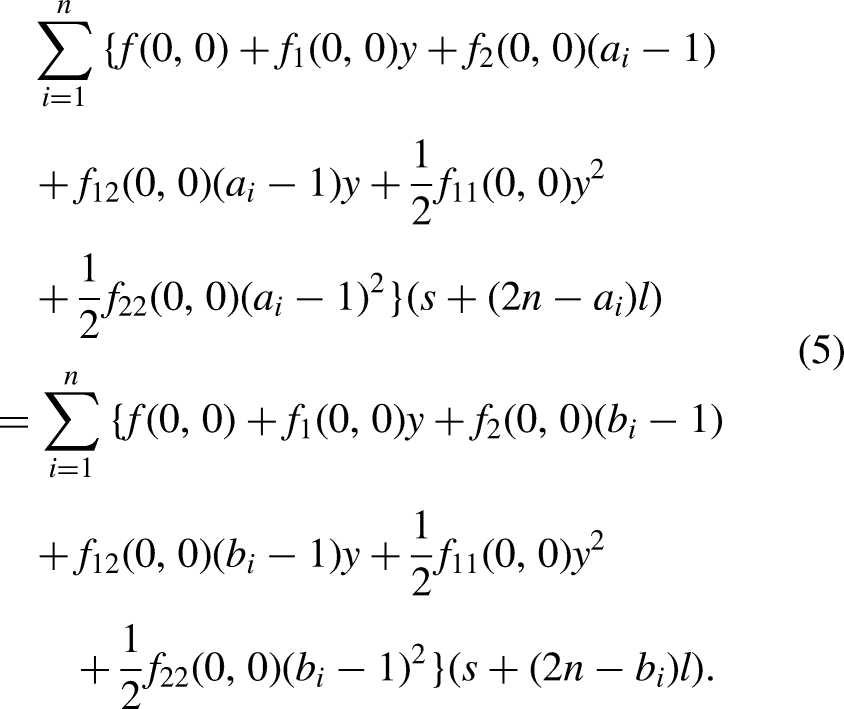

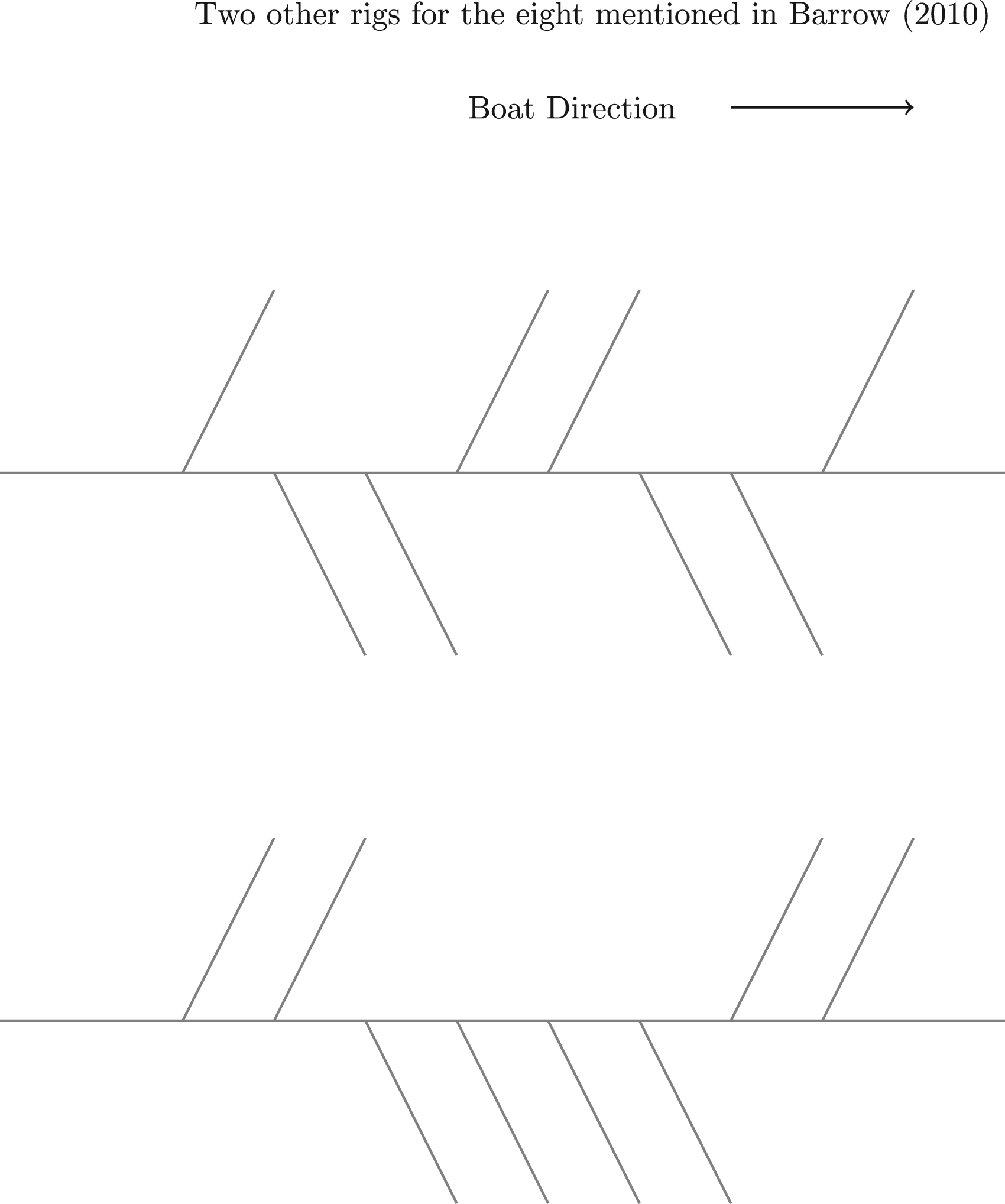
Two additional configurations mentioned in Barrow (2010)—the Italian rig “uddu uddu” (top panel) and an unnamed rig “uudd dduu” (bottom panel)—fail to satisfy one of the equilibrium conditions, specifically condition (2).
The Boat with 12 People. For the set {1 - 12}, there is only one arrangement,


The Boat with 16 people. For the set {1 - 16}, note that with equal force,


Extensions
Stochastic noises
We now relax the assumption of deterministic, arithmetically structured force sequences by introducing mean-zero stochastic noises.
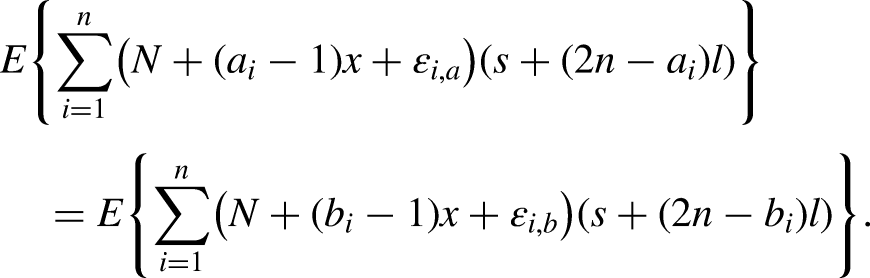
Specifically, with the inclusion of noise terms
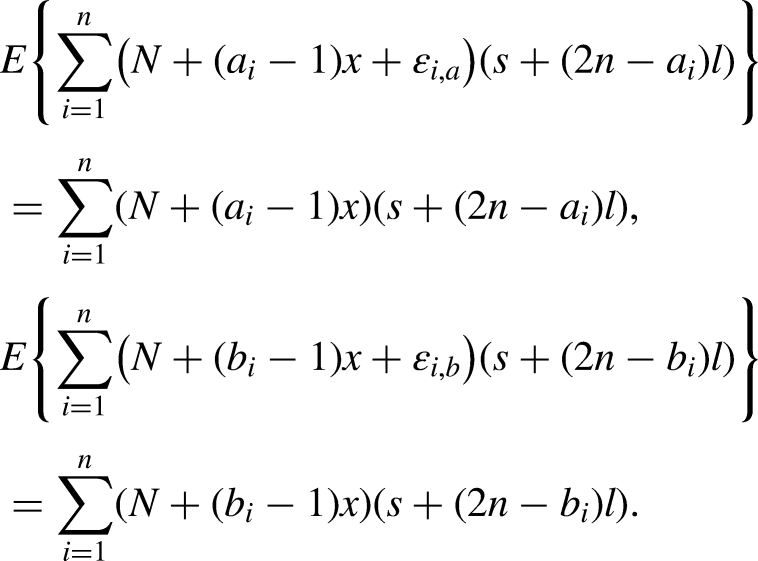
To mitigate average lateral instability, we now impose an equilibrium condition requiring that the expected value of the total angular moment be zero. This ensures that, on average, the boat remains dynamically balanced and free from side-to-side oscillation. Formally, the equilibrium condition is expressed as:
General deterministic sequences
We shall extend the results by relaxing the arithmetic assumption through Taylor expansion. Instead of the arithmetic assumption, consider the forces as
Given that the disparity in force output between the strongest and weakest rowers is relatively minor, the parameter
The vertical force exerted at the seat
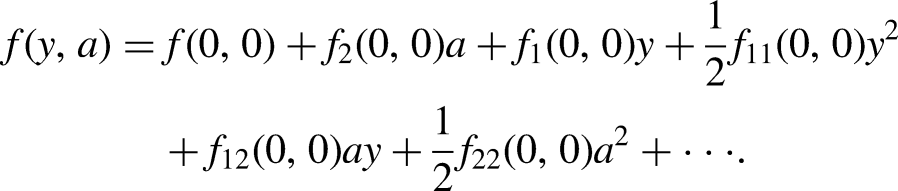


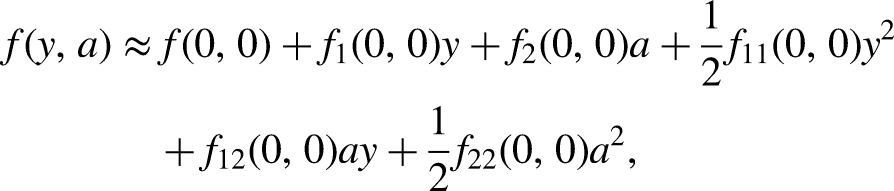
If we use the first-order approximation, the vertical force exerted at seat
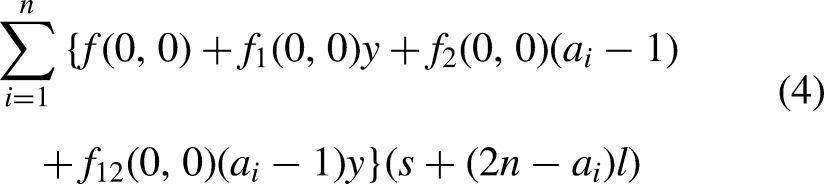
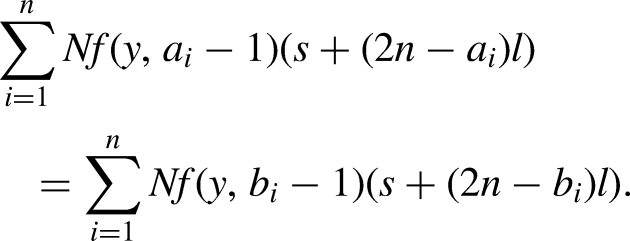
The first-order approximate equilibrium condition based on the first-order Taylor approximation (using up to the
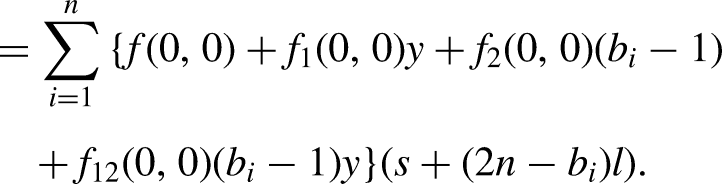
The necessary and sufficient condition for the first-order approximate equilibrium remains unchanged. More precisely, if (1) and (2) are satisfied, then (4) holds. Consequently, all the previous examples remain valid without any modification, provided we accept the first-order approximation to the equilibrium condition.
If we use the second-order approximation, the vertical force exerted at seat
The second-order approximate equilibrium condition based on the second-order Taylor approximation is given by
The same algebra as previously employed yields the following result, the proof of which is omitted:
The second-order approximate equilibrium condition (5) holds for all
Regarding the second-order approximate equilibrium, the numerical examples require some modification. For boats of eight and twelve rowers, no rigging configuration satisfies (1), (2), and (6). Specifically, for the eight-rower boat:



General deterministic sequences with stochastic noises
We now synthesize the results from the preceding subsections to accommodate general force sequences perturbed by stochastic noises, using the Taylor series expansion.
If we use the first-order approximation with stochastic noises, the vertical force exerted at seat
Extending to the second-order approximation with stochastic noises, the vertical force exerted at seat
In summary, as we relax the homogeneity assumption imposed by Townend (1982) and Barrow (2010), the necessary and sufficient conditions for equilibrium become increasingly intricate. In the case of uniform force distribution, the equilibrium condition reduces to equation (1). When forces follow an arithmetic progression or are approximated using a first-order Taylor expansion, the equilibrium requires both conditions (1) and (2). For the more nuanced second-order Taylor approximation, the full set of conditions—(1), (2), and (6)—must be satisfied to ensure equilibrium. Fortunately, evidence from elite rowing competitions suggests that intra-crew force disparities are relatively minor. As such, the first- or second-order Taylor approximations are likely to provide useful representations for practical applications.
Effective on-water rowing technique demands not only consistent boat speed (even during the recovery phase) but also precise crew coordination; additionally, performance is significantly influenced by external factors such as weather and wave conditions (Secher, 1992). None of these factors is captured by our simplified model. Moreover, rowers may require an adjustment period to acclimate to any novel rigging configuration. Nevertheless, considering that Team Canada secured victory in the Men’s Eight at the 2008 Summer Olympics using an asymmetric rig, our proposed asymmetric design may offer valuable insights and practical potential.
Footnotes
Acknowledgements
The author would like to thank the editor, the associate editor, two anonymous reviewers, and Mr. Daniel Ford for their insightful comments.

Funding
The author(s) received no financial support for the research, authorship, and/or publication of this article.
Declaration of conflicting interests
The authors declared no potential conflicts of interest with respect to the research, authorship, and publication of this article.