




Abstract
Background
The digital transformation of health care is moving fast and development of ways of working take place in clinical practice.
Objective
The aim of this qualitative study was to explore how physiotherapists in primary health care describe their approaches to working in video-based digital physiotherapy.
Methods
The study was based on semi-structured in-depth interviews with ten physiotherapists with varying levels of experience in primary health care. The interviews were analysed using qualitative content analysis.
Results
The results show that adapting physiotherapy to a new digital arena is a demanding process. Five categories were identified: Reorientation of clinical reasoning for a digital setting, a substantial transformation of the healthcare system, the impact of professional identity on adaptability, managing unknown expectations, and working in a new arena brings new demands and opportunities. The physiotherapists described a shift that required the development of conversational skills, new methods for gathering assessment data, and the adaptation of interventions to fit digital environments. The study also highlights the need for targeted education, support, and research to guide the development and implementation of digital care.
Conclusions
The evolution of the professional role in digital physiotherapy should be recognised as a challenging process. To support individual physiotherapists, there is a need for a strong structural foundation in terms of education and technology.
Keywords
Introduction
The World Health Organization 1 has introduced a Global Strategy on Digital Health, aimed at improving health outcomes globally by promoting the rapid development and adoption of appropriate, accessible, affordable, scalable, and sustainable digital health solutions, with an emphasis on person-centred care. The utilisation of digital health services, including digital physiotherapy, has grown significantly in recent years,2–4 particularly within Primary Health Care settings. 5
Despite advancements in digitally delivered physiotherapy, it remains unclear which methods are most suitable for this format, 6 and there is a lack of evidence-based education within the field. While video-based physiotherapy may be comparable to face-to-face treatment, the evidence supporting video-based assessments is insufficient. 7
Physiotherapy is practiced across diverse settings and patient populations within healthcare, employing various interventions guided by clinical reasoning. 8 Clinical reasoning in physiotherapy is a complex, dynamic process where therapists utilise their knowledge and skills to assess, diagnose, plan, implement, and evaluate patient care. This involves integrating different forms of reasoning – such as diagnostic, narrative, and collaborative approaches – to address the patient’s unique clinical situation. The process requires adaptive thinking and continuous interaction with the patient to make informed, context-specific decisions that guide effective treatment and patient management. 8
Although physiotherapists have expressed positive attitudes towards digital healthcare, 9 it remains unclear what is performed in video-based physiotherapy and how physiotherapists experience working with this mode of care.
This study aimed to explore how physiotherapists in primary health care describe their practice in video-based digital physiotherapy.
Materials and method
A qualitative interview study was conducted in a primary health care setting during the winter of 2021–2022. The study received ethical approval from the Swedish Ethical Review Authority (2022-04489-02) and adhered to the principles outlined in the Declaration of Helsinki. The study was reported in accordance with the Consolidated Criteria for Reporting Qualitative Research. 10
Recruitment
A strategic sample of physiotherapists with experience in digital physiotherapy within primary health care was selected. Participants were recruited through managers from various rehabilitation clinics across Region Västra Götaland, Sweden, encompassing diverse geographic and sociodemographic areas. A strategical sample was made to achieve variation in participants’ age, gender, and years of experience as registered physiotherapists. All participants provided written informed consent.
Data collection
Semi-structured, in-depth interviews were conducted on a single occasion, either face-to-face or digitally within the participants’ clinical settings, lasting approximately 50–70 min. The interviewer, a researcher with experience in qualitative research (EL), had no prior relationship with the participants and was introduced as a physiotherapist with an interest in video-based physiotherapy. The interview followed a guide with open-ended questions, exploring experiences with video-based patient encounters. The interview guide was pilot tested and refined before data collection commenced. Interviews were audio-recorded and transcribed verbatim.
Analysis
The unit of analysis was the complete interviews, and qualitative content analysis was performed following Graneheim and Lundman. 11 Both authors collaborated on the analysis. Initially, the interviews were read multiple times to gain an overall understanding. Each interview was divided into meaning units based on the research question. These meaning units were coded and organised into categories and subcategories through a process that repeatedly moved between the parts and the whole, ensuring that the results were firmly grounded in the data, preserving context and meaning. The authors aimed for reflexivity, discussing their preconceptions before and throughout the process. Both authors were female registered physiotherapists with experience in primary health care and digital physiotherapy. EL held a PhD and was trained in qualitative research with experience in several studies using the current method, while MF was an MSc with prior experience in qualitative research.
Result
A total of 10 participants were recruited for the study, with no dropouts. The participants included five males and five females, with a median age of 37.5 years (range: 28–58). They had varying levels of experience as physiotherapists, between 2 and 28 years (median: 10.5 years). The participants reported having conducted between 5 and 75 video-based physiotherapy consultations (median: 41).
Overview of the categories and subcategories supporting the theme a demanding process to fit physiotherapy to a new arena.
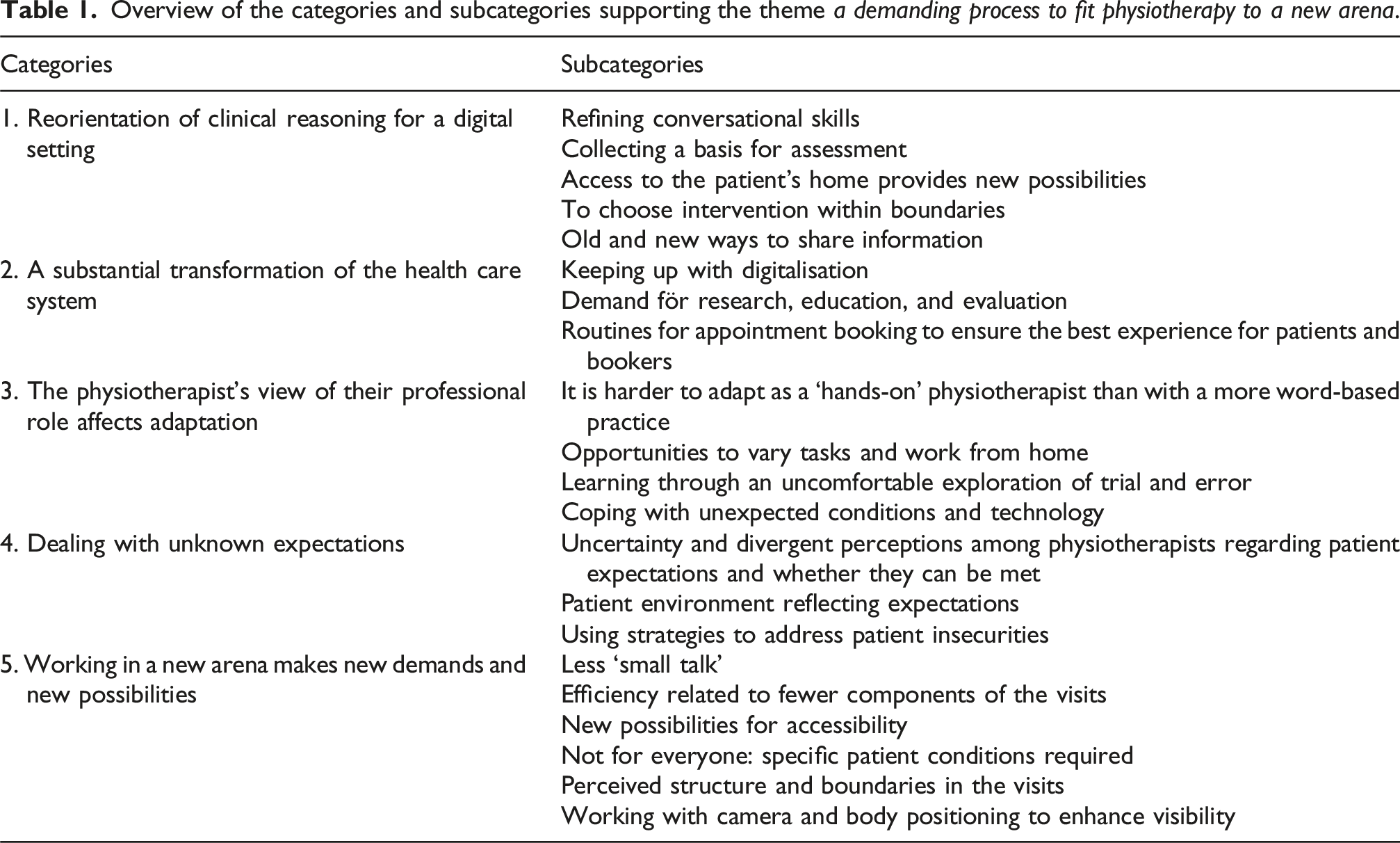
Reorientation of clinical reasoning for a digital setting
Refining conversational skills
Physiotherapists described substituting body language with verbal communication, employing techniques such as reflections, summaries, and open questions. Visual cues like nodding replaced verbal confirmations to maintain session flow. Humour and casual conversation were used to create a comfortable atmosphere, and participants aimed to maintain usual behaviour despite the digital setting. I usually try to use a bit of humor. And I also tend to start with an open question, like ‘You can tell me what I can do for you’, or something like that. It usually works better than when you’re stressed and just jump in with ‘So, you have pain in your hip’. That tends to make things more awkward, and you get much shorter answers from the patient. – Male, 47 years, physiotherapist för 10 years
Collecting a basis for assessment
The basis for physiotherapeutic assessment differed from in-person visits. Anamnestic information became more crucial for diagnostics. Methods to assess body and movement varied; while some found self-examinations ineffective, others used them as a substitute for physical tests. Not being able to feel structures or guide movements was seen as a limitation. Exercise prescription and monitoring treatment responses over time were used to supplement the diagnosis. Participants noted that physical examinations were sometimes necessary, and having the option to book an in-person visit provided reassurance.
Access to the patient’s home provides new possibilities
Meeting patients in their home environment was seen as advantageous, as it provided a sense of security, fostering more personal conversations. It also allowed physiotherapists to offer environment-specific advice. Digital visits were considered a viable alternative to home visits in several cases.
Choosing interventions within boundaries
The digital setting was particularly suitable for interventions aimed at enhancing motivation, including goal setting and structured self-care planning. Advice was frequently given, though some participants felt it was insufficient to ‘only’ offer advice. Digital consultations were also effective for quick follow-ups and for instructing, adjusting, and progressing exercises.
Old and new ways to share information
The digital setting facilitated new methods for information sharing, such as screen sharing, video clips, and other digital resources. Some participants also used analogue tools, like whiteboards, and sent written information and exercise programs via email or post. The use of one’s body to demonstrate exercises was viewed differently; some found it useful, while others did not. So, I use a [program to create] exercise plans, put together the exercises, and send them to him. Then he gets them right away, and he can also watch videos showing how to do the exercises, where I can also add comments like if something doesn’t match exactly with the video or ‘keep this in mind when you’re working out’, for example. ... And yeah, it usually works really smoothly because they get it instantly. Plus, they can see everything... So I never have to lie down on the floor and try to demonstrate the exercises. I never do that because it just doesn’t work. – Male, 58 years, physiotherapist för 13 years
A substantial transformation of the healthcare system
Keeping up with digitalisation
Participants acknowledged that society’s digitalisation is rapidly evolving, making it essential to offer digital appointments as an option. Some noted that keeping up with digital developments is necessary to remain competitive. Digital work was seen as a complement to physical care, offering new possibilities. I think everyone should be able to offer digital appointments. I see it as a given in the society we live in, considering how quickly digitalization is progressing. I also see it as a way to make your clinic more attractive by being able to offer digital visits, because to me, that’s just a given. – Female, 38 years, physiotherapist for 14 years
Demand for research, education, and evaluation
Many participants expressed a desire for more knowledge about digitally performed physiotherapy. The lack of evidence was concerning, and some questioned whether digital physiotherapy was effective. Participants called for the development of new ways of working, specific tests, and assessments for digital consultations, and for identifying suitable patient groups. They also highlighted the need for education in digital physiotherapy for both professionals and students. It’s a new way of thinking in some cases… It’s not something you can just pick up right away. It could be included in the [physiotherapy] education if it turns out to be something that will be used more often. Someone needs to figure out, ‘What are the appropriate assessments we can still do? How can we guide the patient? What are our limitations? Should we develop new assessments to help us diagnose? Or do we need to focus on the anamnesis and then meet them in person for a more thorough evaluation? Should we do follow-ups digitally? Is that what we should aim for?’ – Male, 35 years, physiotherapist for 11 years
Routines for appointment booking to ensure the best experience for patients and bookers
Some participants emphasised the importance of providing patients with information prior to their appointment, especially if they were unfamiliar with digital healthcare. Information about technical requirements, positioning, and lighting was crucial to optimise conditions. Participants noted that booking a digital appointment should be seamlessly integrated into the regular booking system. They also discussed the potential benefits of triaging patients to determine their suitability for digital consultations, though more knowledge is needed to implement this effectively. Maybe we should put something on the website about who this is suitable for. Or some form of triage is needed, actually. You’d talk to someone, like a nurse or someone, and ask, ‘Hey, this has happened’. Then that person might say, ‘You need to see someone in person’, or ‘This would probably work well with a digital visit’. I think that would make things more efficient. And efficiency is the whole point of this, after all. – Man, 58 years, physiotherapist för 13 years
The physiotherapist’s view of their professional role affects adaptation
It is harder to adapt as a ‘hands-on’ physiotherapist than with a more word-based practice
Physiotherapists’ views of their professional roles significantly influenced their ability to adapt to digital practice. Those trained to follow a structured examination approach found it challenging to adjust when such methods were less effective. Many emphasised the importance of thorough patient questioning and anamnesis as critical diagnostic tools. Viewing physiotherapy as a craft, some participants expressed concern about losing the hands-on aspects of the profession. The absence of physical examinations led to a sense of loss for some, highlighting the challenge of adapting to a non-physical practice. The lack of physical contact does... it definitely affects how the session goes and how you plan it. It does. But as I've said before, you have to be thorough with your questions. And I already do that quite a lot during in-person visits, asking a lot of questions anyway, so the difference might be less noticeable for me compared to others who immediately jump in and start feeling the area, like when you’re newly graduated and just want to start examining the knee right away. – Male, 46 years, physiotherapist for 13 years
Opportunities to vary tasks and work from home
Several participants had the opportunity to work digitally from home, describing this environment as providing calm and optimal conditions for listening to patients without disturbances. This setting not only facilitated focused interactions but also highlighted the benefits of remote work, such as varying tasks and maintaining a high level of patient care from home. But I also think it’s a nice... what should I say, break from the in-person visits. I like having variety in my work as a physiotherapist. Having appointments, new consultations, follow-ups, training patients, home visits. And then you have the digital visits as well, which I think are just another part of it, mixing in some digital sessions here and there. It’s a different kind of care meeting. And it’s like... Yeah, you work a bit differently than you do with just in-person visits. So I think it’s a fun and interesting change of pace in the job, or variety in the work. – Female, 28 years, physiotherapist since 3 years
Learning through an uncomfortable exploration of trial and error
The transition to digital physiotherapy required learning through trial and error. Practitioners needed to experiment and adapt as they navigated this new mode of practice. Reflecting on patient visits played a crucial role in supporting this development, allowing for continuous improvement and adaptation. Not all practitioners had fully explored the potential of digital interactions, which may hinder their ability to maximise the benefits of this evolving practice. I’m still figuring this out, what’s suitable and what’s maybe not so suitable to handle digitally. I’m constantly learning, like ‘What kinds of assessments can we do here? How can I guide this so it’s appropriately limited, without... well, steering too far away from what the patient expects to discuss?’ and so on. – Male, 35 years, physiotherapist for 11 years
Coping with unexpected conditions and technology
Participants described increased demands to manage unknown situations and environments during digital visits. They highlighted the need to handle stress and feelings of insecurity, possibly perceiving a negative impact on their work environment. Uncertainty surrounding technology was a significant source of stress, exacerbated by technical issues, leading to discomfort and anxiety.
Dealing with unknown expectations
Uncertainty and divergent perceptions among physiotherapists regarding patient expectations and whether they can be met
Participants described uncertainty around patient expectations and whether these could be met in digital settings. They worried that patients might prefer physical visits and highlighted the need to explore patient expectations more thoroughly. Many observed that patients generally understood that not all aspects of physiotherapy could be effectively managed digitally. Participants’ own expectations were also problematised, as the desire for a clear diagnosis is often challenging in a digital format. However, they also noted that despite initial scepticism, many patients ultimately express satisfaction with the advice and treatment provided. They might have a bit more expectations and maybe know a bit more about what an in-person visit involves. Like, they know they’re going to see a physiotherapist who will probably touch them, feel where it hurts. But with a digital visit, I think the expectations aren’t as clear. What are we going to do in this kind of visit other than just talk? – Female, 28 years, physiotherapist for 3 years
Patient environment reflecting expectations
Participants provided examples of patients attending visits in varied settings, with differing levels of disturbance. These settings limited physiotherapeutic possibilities and were also considered to reflect patients’ expectations regarding private conversations or large movements. A lot of people are on their phones, so they set up the phone, prop it up, step back, and show what’s going on. Some are at work, which is a bit more difficult. But many are at home, which is easier. Of course, if you’re in an open office or... I’ve had some nurses call in, and yeah, if you’re in that kind of environment, it might not be so easy. So it really depends on the environment the patient is in. But I think that also reflects even more on what their expectations are. If they’re in an environment where they’re not limited, they might have a different view of the session as well. – Female, 28 years, physiotherapist for 5 years
Using strategies to address patient insecurities
Participants described several strategies to manage patient insecurities and set realistic expectations. They emphasised the importance of informing patients beforehand, encouraging them to try new methods, and providing supportive feedback during the visits. Building trust that things typically improve with practice was seen as crucial. Additionally, having open discussions about reasonable expectations helped align patient understanding and reduce anxiety. I think it’s good to ask at the beginning of the session, ‘What are your expectations for this visit?’ Or, What do you want help with today?’ That way, you can address it if someone says, ‘I want you to tell me what’s wrong with my knee’. Then you can say upfront, ‘This is a digital visit, so I might not be able to be super specific, but I can discuss with you what I think it might be’. That way, both of you go into the session with the same expectations, so the patient doesn’t end up feeling disappointed at the end. – Female, 28 years, physiotherapist for 4 years
Working in a new arena with new demands and possibilities
Less ‘small talk’
Participants noted that conversations during digital physiotherapy sessions tended to be more focused and direct, which saved time. However, this efficiency comes with the risk of missing the social function of small talk, which can be a valuable tool for building trust and rapport with patients. The physiotherapist could also miss out on details that could be important for the assessment. The absence of casual conversation may hinder the development of a strong therapeutic relationship, highlighting the need to balance efficiency with personal connection. I don’t know if physical contact somehow unconsciously extends the conversation. It’s just speculation or a theory from my side, that having an in-person visit somehow lengthens the dialogue. I was going to say it benefits the dialogue, but maybe I wouldn’t go that far, because sometimes, like I said, you actually need more focus to get everything done, especially when you’re working in a time-limited environment where things need to move quickly. – Female, 28 years, physiotherapist for 3 years
Efficiency related to fewer components of the visits
Participants described how digital visits eliminate the need for travel and changing clothes, which saved time. Appointments could be scheduled in shorter time slots, setting expectations for quick visits for both patients and physiotherapists. The reduced distractions in a digital setting helped maintain focus. However, some participants noted that ensuring the technology works and managing additional pre- and post-visit tasks could consume more time. Additionally, the effectiveness of digital assessments and treatments may not match in-person visits, leading to inefficiencies if follow-up physical visits are required. It’s a more defined format, and both the patient and the therapist are a bit more focused on the idea that it’s supposed to go a bit quicker in this setting compared to when you’re at the clinic. And then there are the practical aspects, like getting dressed, and greeting the patient... so even though you lose out on certain things, I still think you save quite a bit of time with it. – Female, 37 years, Physiotherapist for 2 years
New possibilities for accessibility
Participants noted several opportunities for improving accessibility through digital physiotherapy. Patients no longer needed to travel to the clinic, making it easier to schedule appointments during their workday. This also simplified fitting these appointments into the physiotherapists’ schedules. Being able to see someone quickly was seen as potentially reducing patient frustration and anxiety. Additionally, patients could receive treatment even when fatigue or pain (such as post-COVID-19 conditions or acute back pain) made it difficult to visit the clinic in person. This increased accessibility enhanced the convenience and responsiveness of care. Some of the frustration disappears for the patient too... It’s frustrating to be in pain and not be able to get an appointment, and it's frustrating not being able to explain what’s wrong. And here at our clinic, it’s often really hard to get an appointment with the GP. They often tell patients to come here for a physiotherapy assessment, which is probably great most of the time. The problem is that we have almost a three-week wait for a new appointment. So we’ve started offering initial consultations online fairly often, which lets patients get a first visit there. And getting a follow-up appointment is much quicker, so they end up coming here faster than they would have otherwise. – Female, 28 years, physiotherapist for 5 years
Not for everyone: Specific patient conditions required
Participants pointed out that certain conditions need to be met for digital physiotherapy to be effective. Patients needed to be able to articulate their issues clearly, which could be challenging without preparation and even more difficult when working with an interpreter. A background in exercise and good body awareness were found to be beneficial. Comfort levels with digital meetings varied greatly depending on personality and familiarity with technology, making it easier for younger patients who were more digitally savvy. Some participants described that treating children could be particularly challenging, as they might move out of the camera frame, and using toys for distraction was not possible, often leading parents to take over the session. These factors highlight the need for tailored approaches based on individual patient capabilities and circumstances. She responded... Well, it was basically a phone call. And it usually works better when you’re sitting and talking face-to-face because... Yeah, it just feels a bit more relaxed somehow. But this... It was a bit awkward, kind of short and to the point... The answers weren’t very detailed, and it felt a bit stiff… Maybe it just lacked some nuance. It’s probably a personality thing. – Male 54 years, physiotherapist for 28 years
Perceived structure and boundaries in the visits
Participants noted that digital physiotherapy sessions provide clearer structure and boundaries compared to in-person visits. They mentioned that it is easier to keep track of time on the screen, making time management more efficient. Ending a session is straightforward, much like pressing a button. This results in visits being more confined and focused, ensuring that both the patient and the physiotherapist stay on track and address the essential aspects of the consultation without unnecessary deviations.
Working with camera and body positioning to enhance visibility
Participants discussed the importance of camera and body positioning to enhance visibility during digital physiotherapy sessions. They noted the need for patients to receive clear instructions on how to position themselves to ensure effective observation and interaction. Similarly, physiotherapists must be mindful of their positioning to maintain visibility and communication. Proper positioning on both ends is crucial for the success of digital consultations, allowing for accurate assessments and effective guidance throughout the session.
Discussion
This study demonstrates that the transition to digital healthcare represents a significant paradigm shift for professions traditionally reliant on hands-on work. This shift introduces new demands and necessitates the development of innovative approaches. Physiotherapists face challenges in adapting to the digital era, requiring them to explore new ways of working and to adjust to evolving patient expectations.
The findings of this study suggest that video-based digital physiotherapy necessitates an adaptation of the professional role and practice of physiotherapy, which may be somewhat uncomfortable. However, it also presents new opportunities to engage with patients within their home environments and daily lives. Traditionally, initial information gathering in physiotherapy relies on a combination of medical history and physical examination. 8 In a video-based setting, physiotherapists must adapt their methods for data collection, as direct physical examinations are limited. They must rely more on verbal communication and patient self-reporting, necessitating enhanced skills in questioning and interpreting responses. The challenges posed by video consultations, in our findings, are consistent with those reported in other studies.12–15 Our study indicates that clinical reasoning undergoes significant changes during digital consultations, presenting both challenges and new opportunities. Video-based digital physiotherapy requires new approaches to information gathering to support clinical assessment, refined conversational skills, adaptation of interventions to digital conditions, and new methods of sharing information with patients. The transformation of patient conversations, as highlighted in our findings, is also supported by others. Huhn et al. 16 emphasise the importance of adaptive and iterative clinical reasoning that is contextually informed. Video-based digital physiotherapy alters the context in which reasoning occurs, requiring physiotherapists to adjust both methods and mindset. Clinical reasoning in physiotherapy is both cognitive and affective, relying on interaction with the patient’s physical body. Our findings describe how, during digital consultations, physiotherapists must rely more on verbal communication and patient statements rather than direct physical examinations, altering the way information is collected and interpreted. In this context, physiotherapists must develop new strategies to build trust and understand patients’ needs through the screen, which may require adjustments in the therapeutic alliance. 17
Our analysis also reveals that physiotherapists seek support, education, and research to guide the development and implementation of digital care. Many had little or no experience with digital tools before the pandemic, highlighting the need for targeted training programs in digital rehabilitation. 18 Physiotherapists may feel uncertain about conducting physical assessments and building therapeutic relationships through a screen, yet many appreciate the ability to offer digital care. 18 The results underscore the need for structured guidelines and recommendations to optimise the use of video-based digital physiotherapy. This is also emphasised by the American Physical Therapy Association (APTA), 19 which stresses the importance of implementing evidence-based methods in digital care. The APTA points out potential barriers and risks associated with video-based digital physiotherapy, such as technical issues, lack of personal support, and challenges in conducting certain physical assessments. Our study identifies similar challenges, with physiotherapists expressing uncertainty about how to conduct effective assessments through a screen.
Physiotherapists who primarily rely on ‘hands-on’ treatments find it particularly challenging to adapt to the digital care environment, 15 but a different approach may ease the transition. The transformation of professional practice through digital consultations is a natural consequence of societal development, and the professional role must evolve accordingly. However, forced organisational changes could negatively impact the psychosocial work environment. 20
Future research
Future research should focus on maintaining evidence-based physiotherapy as the opportunities for physical assessment and guidance evolve with video-based digital practice. Additionally, guidance for decision-makers regarding when video-based digital physiotherapy is appropriate or less advantageous needs to be developed.
Limitations
The scope of this study is limited, as it includes a relatively small group of physiotherapists from a specific region in Sweden. This limitation suggests that some results may be influenced by local routines, resources, and the unique context of this region. Consequently, the generalisation of our findings to a broader population of physiotherapists and other geographical areas may be limited, and further research is needed to confirm these findings in different contexts and with larger participant groups. Although the sample size was small, it represented a variation in experiences, and the data were sufficiently rich to perform a thorough analysis. 21
Conclusion
The development of the professional role in digital physiotherapy is a demanding process that requires recognition and support. To assist individual physiotherapists, a structured foundation in terms of education and technology is essential.
Footnotes
Acknowledgements
We would like to acknowledge all participants who generously shared their thoughts.

Funding
The author(s) disclosed receipt of the following financial support for the research, authorship, and/or publication of this article: This work was supported by the Renee Eander foundation.
Declaration of conflicting interests
The author(s) declared no potential conflicts of interest with respect to the research, authorship, and/or publication of this article.